



Abstract
Based on the concepts of interval type-2 fuzzy sets and intuitionistic fuzzy sets, this paper introduces the concept of interval type-2 intuitionistic fuzzy set that provides an extra dimension to intuitionistic fuzzy sets for the first time. Different arithmetic operations on interval type-2 intuitionistic fuzzy set are defined and a defuzzification method of interval type-2 intuitionistic fuzzy sets is developed for ranking purpose. Also, existing analytic hierarchy processes are further generalized with the introduction of interval type-2 intuitionistic fuzzy analytic hierarchy process to assess the relative importance among the alternatives in a convenient way under multi criteria decision-making environment. This process is efficient enough to evaluate the differences among the alternatives more prominently than the existing method that plays an important role in multi criteria decision-making contexts. Finally, a case example on supplier selection problem is considered and is solved to illustrate the applicability and validity of the proposed methodology.
Keywords
Introduction
Analytic hierarchy process (AHP) [30] is one of the most efficient methodology for solving different multicriteria decision making (MCDM) [16] problems due to its simple structure which can create a chance of searching and evaluating different cause and effect relationships between goals, factors, sub-factors and alternatives using hierarchical structure of the problems [44]. Most of the times, AHP [15] experiences difficulties in capturing uncertain parameters and imprecise judgment of experts. In this context, ordinary i.e., type-1 fuzzy set (T1 FS) [43] based fuzzy AHP (FAHP) [33, 38] is developed to handle these difficulties.
In 1975, Zadeh generalised the concept of T1 FS [4, 9] by introducing type-2 fuzzy set (T2 FS) [25]. But due to the computational complexities, the generalized T2 FSs are simplified using interval T2 FSs (IT2 FSs) [12, 26]. Further, FAHP method is extended by Abdullah and Najib [1] with the introduction of IT2 FAHP to solve complex decision making problems having various conflicting criteria. Kahraman et al. [21] developed IT2 FAHP method by defining a new defuzzification process to solve various MCDM problems.
Grattan-Guinness [19] pointed out that the presentation of a linguistic expression in the form of fuzzy set is not enough as it is difficult for decision makers (DMs) to determine a unique number as the membership degree of each element of the set. In fact, when a membership degree is determined for each element of a FS [7], it is assumed that there is no hesitancy for the DM in his or her preferences. However, this hesitancy is natural. Considering these phenomena, Atanassov [2, 3] introduced the notion of intuitionistic fuzzy (IF) set (IFS) [36] as a generalization of T1 FSs [43]. In addition to membership degree of each element in T1FSs [6], IFS [35] assigns a degree of non-membership to each element. The hesitancy of decision maker is considered in IFS as the difference between membership degree and non-membership degree of each element. Szmidt and Kacprzyk [37] proposed a method to aggregate the individual IF preference relations into a social fuzzy preference relation on the basis of a fuzzy linguistic quantifier. Silavi et al. [34] demonstrated the possibility of extending AHP using IFS. In recent years, the applications of IF AHP [22, 31, 40, 41] and interval valued IFS [20, 29] in the context of decision making are increased rapidly.
Again, the defuzzification of IFS [42] plays an important role in ranking of IFSs [28]. In 2011, Saneifard and Saneifard [32] introduced a method for defuzzification of fuzzy sets using Mellin’s transformation [17]. Nowadays, various defuzzification methods [18, 45] are available in the literature; but most of them failed to provide effective output in a justified way. In such circumstances, Biswas and De [5] introduced a method using Mellin’s transform. In the present study, IFS is defuzzified using the concept of probability density function.
In MCDM environments, DMs frequently suffer to describe exact situation using suitable IF linguistic variables [23]. Although, previous theories [1, 26] already established that IT2 FSs can be used as an effective tool to deal such types of inconsistencies. The main purpose of this paper is to propose a decision support system which can handle possible vagueness and uncertainties in a justified way in order to prioritize the best alternative in MCDM contexts. In this perspective, the present study makes a fusion among IT2 FS and IFS to define a new fuzzy set viz., interval type-2 IFS (IT2 IFS). Based on the newly defined arithmetic operations on triangular type IT2 IFSs, this article proposes, for the first time in the literature, FAHP method viz., interval type-2 IF (IT2 IF) AHP (IT2 IF-AHP) which is characterised by IT2 IFS to solve different MCDM [8] problems. The developed IT2 IFS with its inherent flexibility for capturing possibilistic uncertainties provides extra freedom while determining equivalent linguistic variable corresponding to criteria of MCDM problems under vague situation. Finally, the proposed IT2 IF-AHP method is applied to solve a real life decision making problem and the achieved results are compared with the FAHP and IT2 FAHP methods to investigate the validation of the proposed methodology.
Preliminaries
To introduce the concepts of IT2 IFS and arithmetic operations on triangular IT2 FSs some basic concepts on the variants of FSs are presented in this section.
T1 FS
In fuzzy set theory, a T1 FS [11, 14, 24]
where
T2 FS
T2 FS [25] is a fuzzy set whose membership functions are itself T1 FSs. A T2 FS,
where
A T2 FS,
where
IT2 FS
Let
where
Thus in an IT2 FS
IFS [2,10,27]
An IFS is represented as
where the functions
are defined, respectively, the degree of membership and non-membership of the element
Furthermore, the degree of indeterminacy of
Methodological development of IT2 IFS
In this section, the concepts of IT2 IFS with arithmetic operations on triangular IT2 IFSs are introduced.
An IFS is said to be an IT2 IFS if the degree of membership and non-membership are determined by IT2 FSs instead of T1 FSs. An IT2 IFS
where
As like other variants of FSs, triangular FSs are of special interests, the concept of triangular IT2 IFSs is introduced in the next sub section.
Triangular IT2 IFS.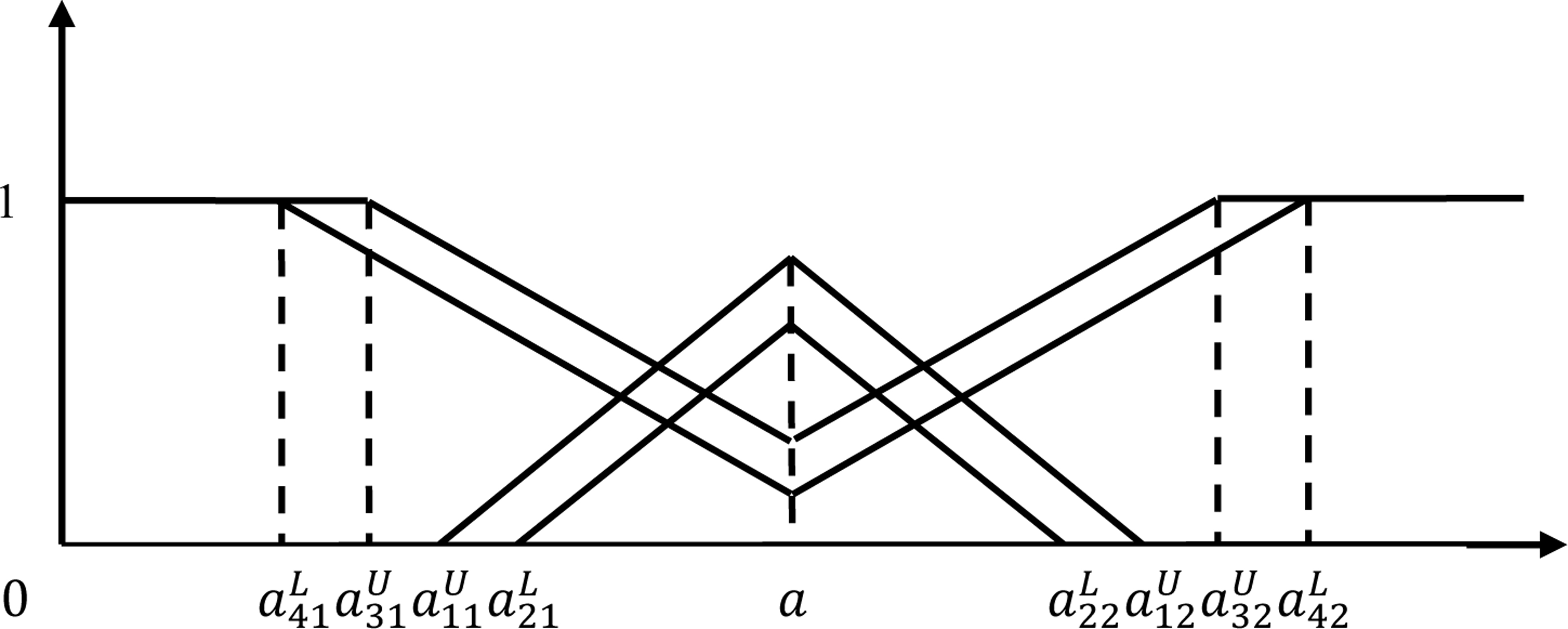
A triangular IT2 IFS is represented as follows:
where
Arithmetic operations on triangular IT2 IFSs
and
be two triangular IT2 IFSs.
The arithmetic operations on triangular IT2 IFSs are described as follows.
3.1.1.1 Additon
The addition of two triangular IT2 IFSs is denoted by,
3.1.1.2 Subtraction
The subtraction of the IT2 IFS,
3.1.1.3 Multiplication
The multiplication of two triangular IT2 IFSs is denoted by
3.1.1.4 Multiplication by a crisp value
The multiplication of a triangular IT2 IFS
3.1.1.5 Division
Let
provided
3.1.1.6 Integral power of a triangular IT2 IFS
Let
where
Any two IT2 IFSs can be compared on a basis of their quantitative values which are extracted by the process of defuzzification. In this section, a defuzzification method for triangular IT2 IFSs has been introduced:
Let
be an IT2 IFS, and the upper and lower membership and non-membership functions of
Now, considering the upper and lower membership functions and the standard complement of the upper and lower non-membership functions, an alternative representation of IT2 IFSs can be found which is represented in the following figure.
IT2 IFS with complement of non-membership function.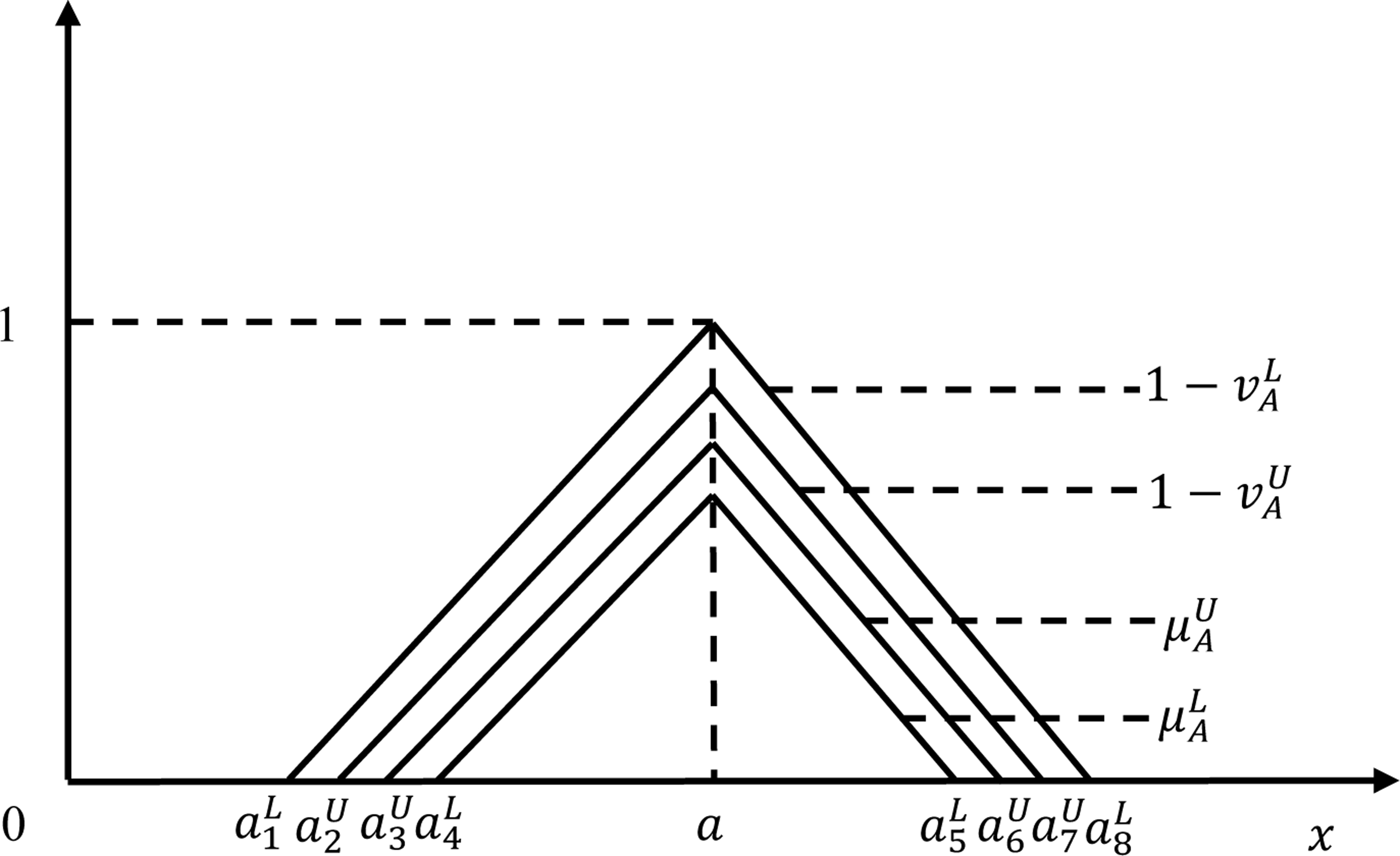
The mathematical form of the upper and lower non-membership functions of
It is to be noted here that membership function of any T1 FS can be represented in terms of some random variable [13] with a probability density function. Let
Thus using the membership and complement of non-membership functions, the probability density functions are expressed as
and
where the values of
Executing the above integral, the value of
Thus the probability density functions of all the random variables corresponding to the membership and non-membership functions are described as follows:
Now, since the IT2 IFS
Let
Thus
where
For computational simplicity, the values of
It is to be noted here that other values of
Scale of relative importance for pair-wise comparison
Now, the expected defuzzified value of
Thus, the defuzzified value of an IT2 IFS can be derived.
In this section the concept of IT2 IFS is introduced in the context of AHP to achieve a systematic process which can capture the inconsistencies present in different MCDM problems in more precise way.
As like AHP, a hierarchical structure that consists of goals, criteria and sub-criteria (if any) is constructed. In this formulation, the pair wise comparisons of the alternatives and criteria are made using a comparison scale described in terms of using triangular IT2 IFSs. The comparison scale is formulated in Table 1.
Using the scale as presented in Table 1, an IT2 IF pair wise comparison matrix is constructed as follows:
where each
Also,
After formulating the comparison matrices, the consistency of each matrices are checked. In this perspective, the IT2 IFSs are to be converted first into its equivalent defuzzified values using the defuzzification process as described in the previous section.
Based on the defuzzified values, the comparison matrix
It is worthy to mention here that a fuzzy comparison matrix
Once the optimal comparison matrix is determined, the geometric mean
where for an IT2 IFS
The IT2 IF local weight of the
After calculating the local weights, the IT2 IF global weight of the
where
Finally, the overall weights of each alternative are calculated as follows:
IT2 IF overall weights (
Crisp weights are normalized to rank all the alternatives using the following equation as
where
Thus the weight of the alternatives can be obtained by capturing uncertainties through IT2 IF-AHP in a justified manner.
The whole procedure of IT2 IF-AHP is summarized in the following algorithm.
Determine criteria and alternatives to construct of hierarchical structure. Based on the expert’s judgment establish initial IT2 IF comparison matrix. Calculate CR values of each initial comparison matrices and modify those matrices where CR values are greater than 0.1. Compute the geometric mean of each row of the comparison matrix using Eq. (9). Evaluate the IF local weight of each criteriaof the comparison matrix using Eq. (10). Determine the IF global weights of each alternative corresponding to each criterion using Eq. (11). Evaluate the IF overall weights of each alternative as given in Eq. (12). Calculate the equivalent crisp weights of the alternatives using the defuzzification process presented in Eq. (8). Normalize the crisp weights in order to prioritize the alternatives.
The process may also be presented in the following flow chart (Fig. 3).
In this section, the developed method of IT2 IF-AHP is applied to resolve a supplier selection process. Suppose,
Pairwise comparison of preferences among the criteria
Pairwise comparison of preferences among the criteria
Flowchart of the proposed method.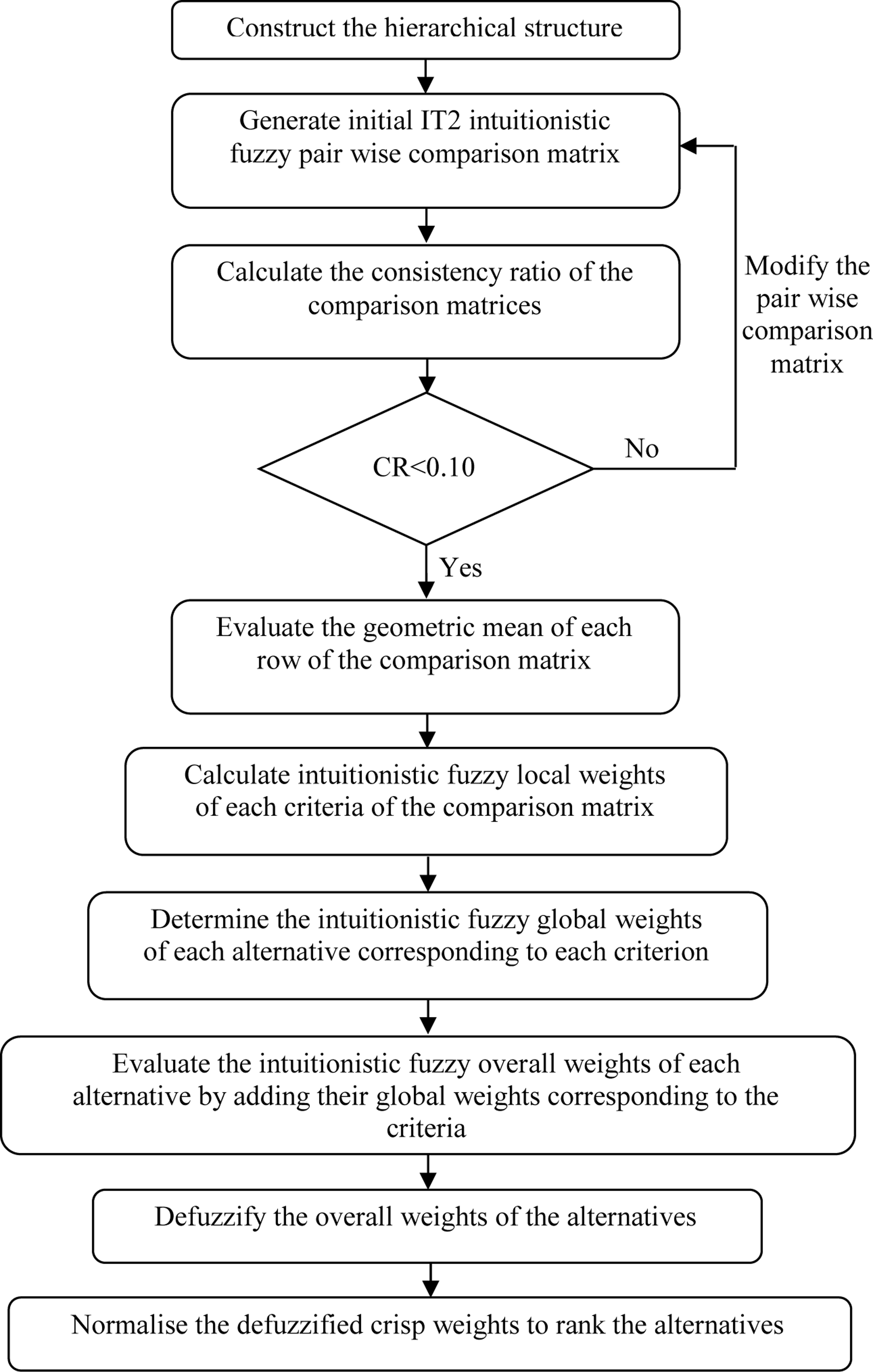
Hierarchical structure a supplier selection problem.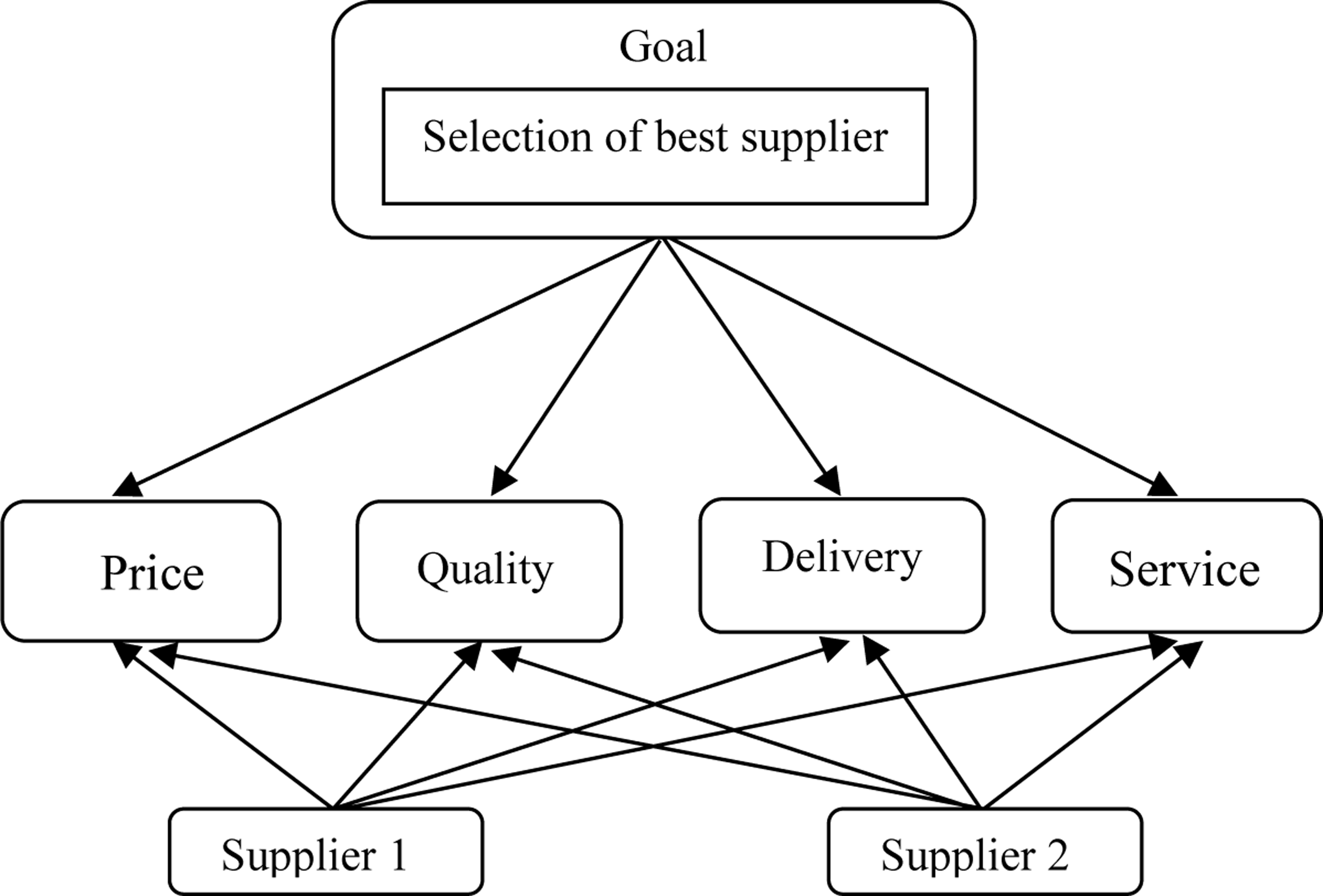
The IT2 IF pairwise comparisons between the suppliers with respect to each criterion are presented in the following table:
Pairwise comparison of suppliers
Geometric mean of the criteria
Geometric mean of the suppliers with respect to the criteria
IT2 IF local weight of the criteria and Suppliers with respect to each criterion
IT2 IF global weights of the Suppliers with respect to each criterion
Now, the problem is to select the suitable supplier for the company using the proposed IT2 IF-AHP method. The step by step evaluation is presented below.
Overall, defuzzified and normalized weights of the suppliers
Overall, defuzzified and normalized weights of the suppliers
The hierarchical structure of the problem is given in Fig. 4. Comparison matrices corresponding to the criteria, Defuzzified pairwise comparison matrices of each criteria and alternatives are evaluated from the corresponding IT2 IF comparison matrices in Tables 2 and 3 using Eq. (8). The consistency ratio (CR) of each matrix is checked. The consistency ratio of all matrices is found less than 0.10. The geometric mean The IT2 IF local weight ( The global weight ( After calculating the global weights of each supplier, the IT2 IF overall weights (
Graphical comparison of the final weights of the suppliers obtained using T1 FAHP, IT2 FAHP and IT2 IF-AHP method. The IT2 IF overall weights ( Finally, the defuzzified weights
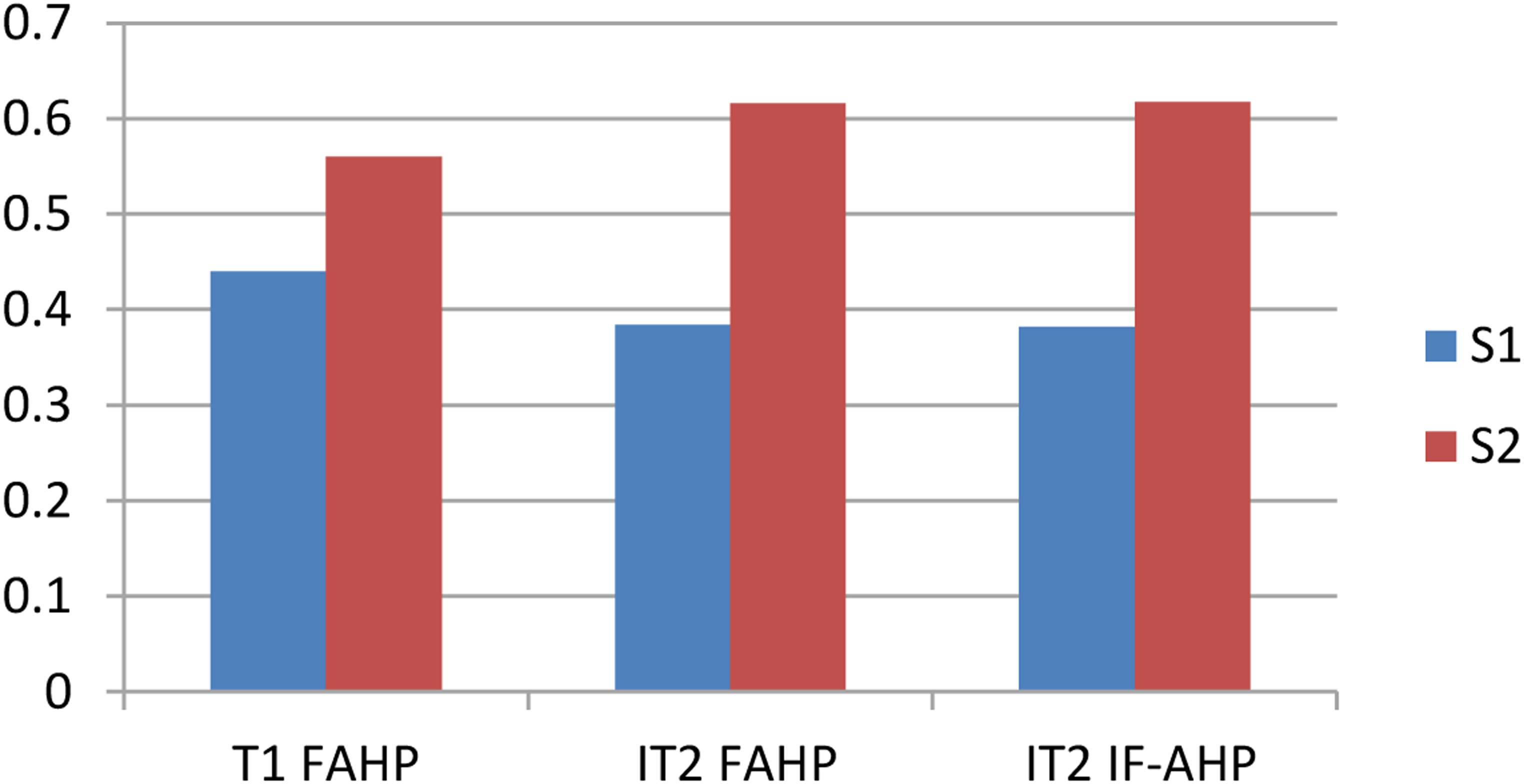
Considering all the four criteria (
Graphical comparison of the individual weights of the suppliers with respect to each criteria obtained using TI FAHP, IT2 FAHP and IT2 IF-AHP method.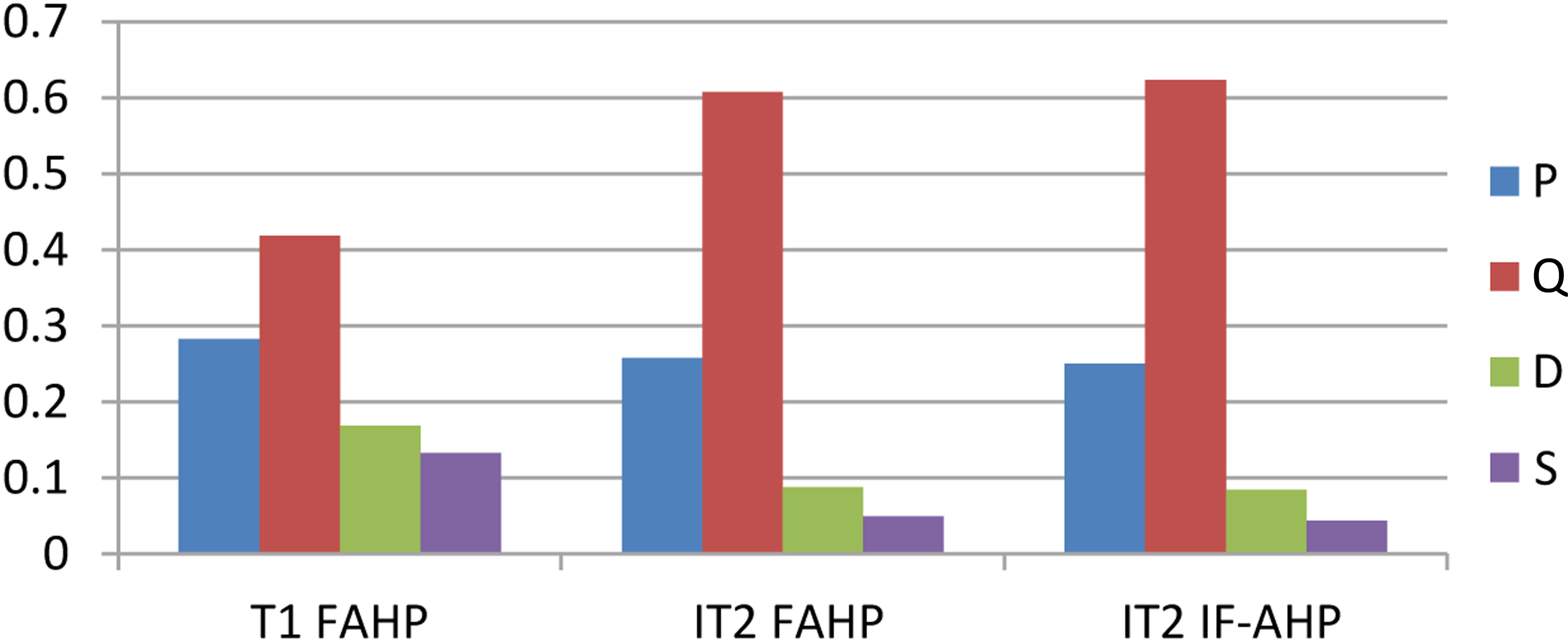
From Table 9, it is observed that all the three techniques declare the second supplier (
Most of the time it is difficult to define membership and non-membership functions using IFSs since it is not possible to model uncertainty and imprecision sufficiently. The IT2 FS capture this problem by incorporating footprint of uncertainty into IFSs. In the present study, an IFS based on IT2 FS concept is developed to introduce IT2 IFS for the first time in the literature. Also, the present article proposed a defuzzify technique for ranking the IT2 IFSs.
Based on the proposed IT2 IFS, the widely used AHP method is further generalised using a new IT2 IF preference scale and the IT2 IF-AHP method is thus introduced to solve decision making problems which are surrounded by higher degrees of possibilistic uncertainties. In decision making process, DMs very often face difficulties to assign a definite IFNs corresponding to linguistic terms which are used for comparison of criteria. These kinds of difficulties can be effectively resolved by the concepts of the developed IT2 IFS which with its inherent flexibility provides extra freedom while determining the equivalent linguistic variable corresponding to a vague situation. Also, IT2 IFSs provide an extra dimension in the form of IT2 upper and lower membership and non-membership functions which make it more flexible than normal IFSs. Again, the developed method can be appeared as an effective tool when it becomes difficult for the DMs to assign exact membership and non-membership values of the parameters. Due to the flexibility, the developed IT2 IF-AHP method out performs the traditional FAHP method [33] in handling any uncertainties inherent in decision making situation more precisely. The main benefits of this approach are that it converts a complex MCDM problem into simpler hierarchy as well as reduces the inconsistency of the DMs judgements.
In this modern era, selecting an appropriate supplier plays a vital role in order to achieve goals and success of overall performances of any industry. In such situation, the present model can be used for ranking the suppliers by prioritize each criterion according to their importance. Further, due to the computational simplicity of the developed model, this approach will also help the administrators in dividing the complex decision making problem into simpler hierarchy so that they can select the best alternative.
Further the concepts of IT2 IFS can be used in the context of T1 fuzzy inference system to provide an extra degree of freedom in a justified manner. Although, the IT2 IF-AHP can be improved using T2 FSs as linguistic variables. However, it is desired that proposed methodology may open up a new vistas in the environment of multi criteria decision making.
Footnotes
Acknowledgements
The authors remain grateful to the reviewers for their comments and suggestions for improving the quality of the manuscript.