



Abstract
Epileptic seizures happen because of neuronal disorder that produces an unusual pattern of brain signals. Automatic seizure detection has proved to be a challenging task, for both long terms monitoring as well as epilepsy diagnosis. In this work, the proposed discrete wavelet transform (DWT) based singular value decomposition fuzzy k-nearest neighbor classifier (SVD-FkNN) technique, is one of the most effective methods in supervised learning, which provides good accuracy with fast learning speed in comparison to several other conventional techniques. In this work, both feature extraction and classification of EEG signals have been done for epilepsy detection of the human brain using the Bonn University dataset. The proposed method is based on the multi-scale eigenspace analysis of the matrices, generated from the sub-band signals of all EEG channels using DWT by SVD at a substantial scale and are classified using extracted singular value features and FkNN classifier with different ‘k’ values to obtain better accuracy. The proposed DWT based SVD-FkNN technique has been applied for the first time on the EEG signal for epilepsy detection (using five-class classifications). The experimental results of the proposed method give an overall accuracy of 100% for two and three class classification and 93.33% (
Introduction
Electroencephalogram (EEG) is the record of bioelectric potential generated by the actions of neurons of the brain which demonstrate different neurological disorders inside the brain [1]. Due to the non-linear and non-stationary nature of complex EEG signals, it is very difficult to analyze it in the time domain. EEG signals are of two different types, depending upon the position of electrodes in the head: Scalp or Intracranial. The recording of the EEG signal is done with a 10–20 electrode placement system as shown in Fig. 1. It is done by placing different surface electrodes on the scalp which is non-invasive and is very much sensitive to noise and artefacts [2, 3]. Special electrodes are embedded in the brain through surgery for acquiring intracranial EEG. To study the brain abnormalities, one must be familiar with temporal patterns and their characteristics. Detection of epilepsy and its treatment are done by using EEG signals [4].
EEG signal comprises of different frequency bands such as
10–20 electrode placement system.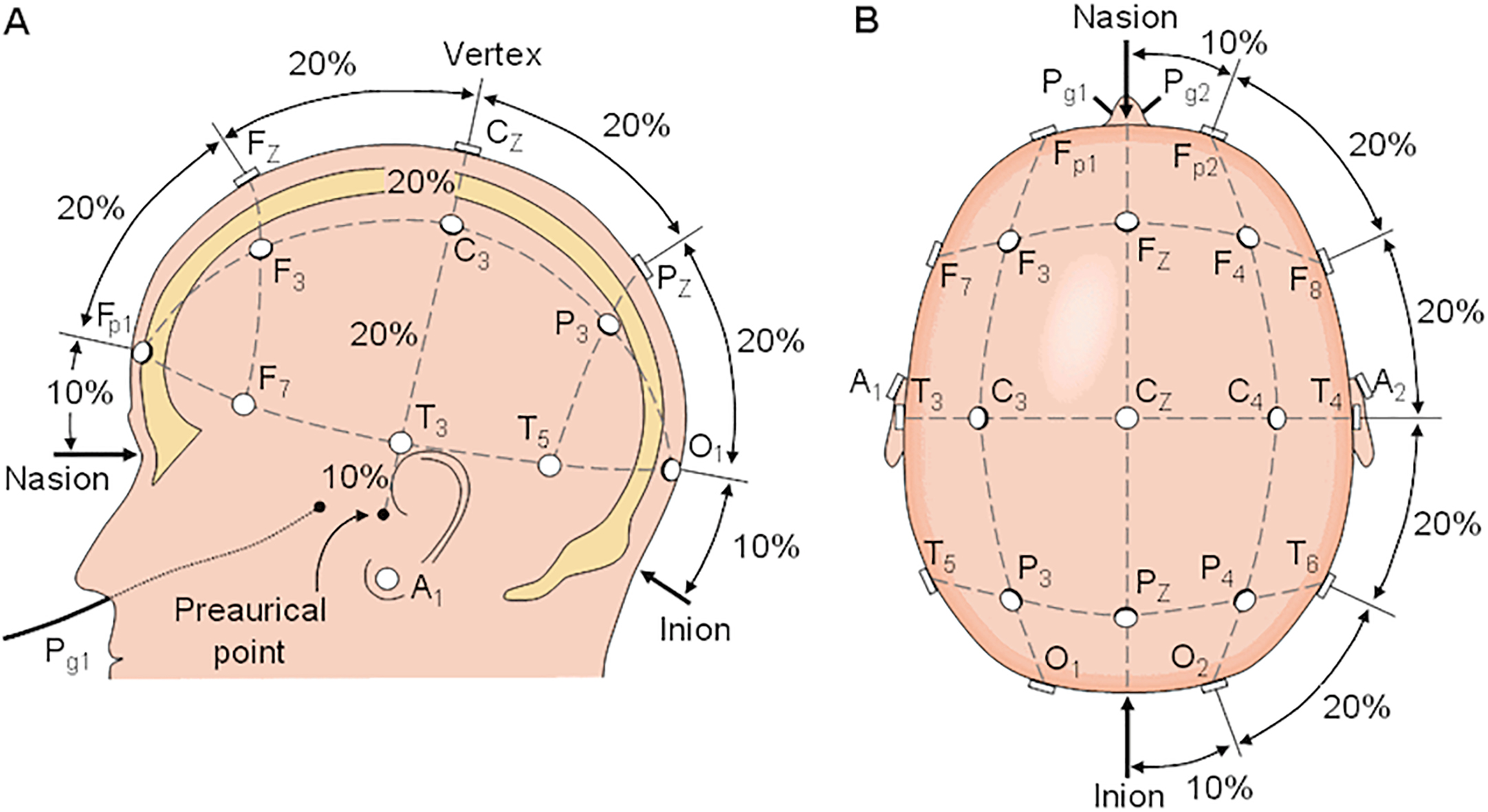
Epilepsy which is a chronic disorder is mainly associated with the existence of seizures. A Seizure is a rapid flow of electrical signals disturbing the brain function which affects approximately 70 million people (i.e., 1%) around the world [8, 9]. Clinical diagnosis of epilepsy can be done by examinations, such as computer-aided tomography (CT), positron emission tomography (PET), magnetic resonance imaging (MRI), magneto-encephalogram (MEG), or electroencephalogram (EEG). EEG is preferred in comparison with other stated methods due to its various advantages. It is reasonably priced and temporal resolution is also high. Electrical activity in the brain is measured directly with EEG. However, for accurate diagnosis of epilepsy, the EEG of a patient is monitored manually over several days which is very tedious. Therefore, for the treatment of epilepsy, a reliable seizure detection system is used to support long-term monitoring procedures [10]. EEG is broadly intended for the detection of various diseases such as Alzheimer [11], and sleep apnoea [12]. It is also used for controlling and determining the depth of anesthesia in surgical procedures, sleep disorders, the study of sleep psychology, migraine analysis and different types of emotions [13].
The fuzzy-kNN (FkNN) classifier [14] is an enhancement upon the standard kNN classifier. The kNN classifier is based on a traditional set theory which gives equal importance to each neighbor by assuming that the boundaries are perfectly defined between classes, which are not true always. The main disadvantage of kNN is that the samples may be classified differently if it belongs to more than one class depending upon the measurement of distance. This problem is overcome using fuzzy sets named as fuzzy-kNN classifier where a membership value is assigned for each sample which represents the closeness of each given class [15]. It is preferably used in the medical field for various applications [15, 16]. FkNN classifier has two major advantages over traditional kNN those are mentioned below [17]:
When the test sample class is considered, the FkNN classifier considers the ambiguous nature of neighbors. Each sample is assigned to a membership value in each of the ‘k’ classes rather than the binary decision.
In this paper, epileptic seizure detection is done using EEG signal and discrete wavelet transform (DWT) is used to decompose the EEG signal into different sub-bands such as,
This paper presents the detection of epilepsy from EEG signals using SVD features and FkNN classifiers. The contributions of this paper are as follows:
EEG signals are divided with identical frame size and then DWT is applied for extraction of sub-bands, known as delta, theta, alpha and, beta brain rhythms and SVD is applied on each of the sub-bands for Eigen analysis and extraction of singular value features. DWT based SVD-FkNN classifier is used for two, three and five class classification of EEG signals recorded during different conditions with appreciable accuracy. Results obtained from the proposed DWT based SVD-FkNN classifier are compared with several other classification techniques, which shows the proposed technique gives better accuracy with faster classification speed over several other techniques.
The rest of this paper is structured into different sections as follows. Section 2 describes related work of research. The Proposed method is described in Section 3. Results and the discussion are presented in Section 4. In Section 5, the conclusion is drawn and the future scope is suggested.
In literature, different EEG signal analysis methodologies have been studied to analyze epilepsy. Several feature extraction and classification methods have been proposed for automatic epilepsy detection. In this section, some of the applied methods are analyzed for comparison and validation of this proposed method.
Here we have compared the performance of different methods using different standard EEG datasets. Liu et al. [19] proposed support vector machine and DWT used in long term monitoring of multichannel intracranial EEG (iEEG) with an accuracy of 95.33%. Zandi et al. [20] proposed a wavelet packet transform for real-time seizure detection from scalp EEG, which revealed a sensitivity of 90.5%. Niknazar et al. [21] applied recurrence quantification analysis (RQA) and error-Correction Output Codes (ECOC) with an overall accuracy of 98.67%. Alam et al. [22] use empirical mode decomposition (EMD) for calculating statistical moments and artificial neural network (ANN) classifier which produces 100% accuracy. Samiee et al. [23] propose rational discrete short-time Fourier transform (DSTFT) with a maximum accuracy of 99.3%. Uthayakumar et al. [24] have used Generalized Fractal Dimensions (GFD) and DWT for wavelet decomposition to indicate the sick state of epileptic patients. Sharmila et al. [25] have used Naïve Bayes (NB) and kNN classifier. Using DWT, the NB classifier shows 100% accuracy for normal eyes open and epileptic EEG data.
Here we have also compared the performance of other methods which was applied to the Bonn University EEG dataset. Gazic et al. [26] describe an automated method for the detection of epilepsy using wavelet transform and statistical pattern recognition with 99% accuracy. Satapathy et al. [27] used PSO trained RBFNN for epilepsy detection with 99% classification accuracy. Guo et al. [28] used genetic programming (GP) and k-NN classifier and GP-based features produce 93% classification accuracy. Orhan et al. [29] proposed an MLPNN-based model to classify EEG signals with K-means clustering with an accuracy of 96.67%. Tiwari et al. [30] used SVM for computing local binary patterns (LBPs) with an accuracy of 98.80%. Jiang et al. [31] used transductive transfer learning, semi-supervised learning and TSK fuzzy system with higher than 95% accuracy for seizure classification. Here, we have done both two-class and five-class classification using FkNN classifier. Two class classifications produce an overall accuracy of 100% and in five classes, overall accuracy is more than 90%.
Also, we have compared the performance of our work with earlier works for the classification of epilepsy for two classes. Fu et al. [32] have used Hilbert-Huang transform (HHT) and SVM to analyze time-frequency image (TFI) of EEG signals with 99.125% classification accuracy and achieved it for theta rhythm. Tzallas et al. [33] use time-frequency analysis with an artificial neural network classifier having a classification accuracy of 100%. Peker et al. [34] have used dual-tree complex wavelet transformation (DTCWT) with complex-valued neural networks that gave 100% accuracy. Kaya et al. [35] use 1D-local binary pattern-based feature extraction method with 99.50% accuracy. Pachori et al. [36] propose a representation of phase space using least-squares SVM for different kernels demonstrating 100% overall accuracy. Subasi et al. [37] have done signal decomposition using DWT, dimension reduction using PCA, ICA, and LDA and classification with (SVM) with an accuracy of 99.50%. Chen et al. [38] produces 100% accuracy with dual-tree complex wavelet (DTCWT) Fourier features and the NN classifier. Guo et al. [39] used line length features based on wavelet transform multi-resolution decomposition with ANN produces 99.60% accuracy. Wang et al. [40] have got 100% accuracy with the best basis-based wavelet packet entropy feature extraction method. Joshi et al. [41] propose fractional linear prediction (FLP) approach using SVM with RBF kernel and the accuracy was found to be 95.33%. In Table 1, the related work is presented in a nutshell.
Related work in a nutshell
Related work in a nutshell
The illustrative block diagram of our proposed SVD-FkNN method for epilepsy detection using the classification of the EEG signal is presented in Fig. 2. This method comprises of different stages or steps. The first step uses Bonn University EEG database, the second step is based on multi-scale study of EEG signal, the third step is formulation of sub-band matrix, in the fourth step SVD is applied which is then used for Eigen analysis of the sub-band matrices, and the fifth step is Eigen value feature selection and in the sixth and final step is classification of EEG signal which is done using FkNN. Each step has been explained in the subsequent subsections.
EEG database
An open-source epileptic data set which was recorded at Bonn University, Germany has been used in this paper [42]. The data set consists of five sets of EEG data such as Set-A, Set-B, Set-C, Set-D and, Set-E. All the datasets have been recorded using a 128-channel amplifier and datasets are digitized with a 173.61 Hz sampling rate, obtained from 12-bit A/D converter, resulting in 86.8 Hz bandwidth. Detail description of each set is given in Table 2. Figure 3 illustrates samples of those five sets.
Detailed description of Bonn University EEG datasets
Detailed description of Bonn University EEG datasets
Block diagram used to investigate the epileptic effect.
Sample EEG signals from sets A, B, C, D, and E.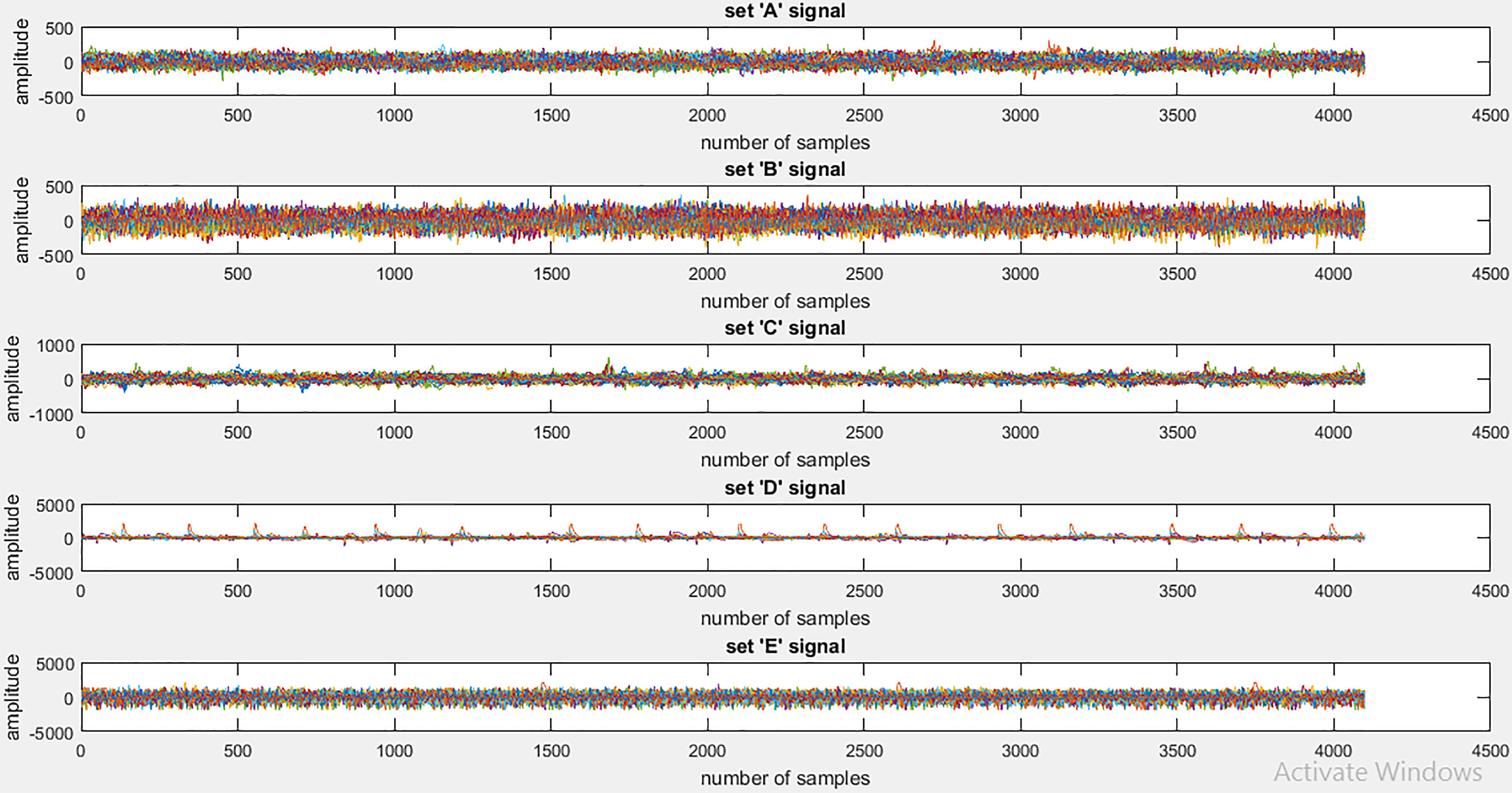
DWT decomposition method.
In pre-processing noises are filtered from EEG signal and also, data is segmented into frames. Here band-pass filter of 0.53–40 Hz is used to filter noises and other high-frequency artefacts from all channels [42] during EEG recording. Then segmentation of each EEG channel is done by dividing into several identical frames where each frame consists of 170 samples. As every channel is having 4097 samples and 100 channels, a total of 24 numbers of frames is formed with leaving out the final data. Here each frame size is 170
Multi-scale Eigen analysis and feature extraction using DWT and SVD
DWT is an important tool for feature extraction of non-stationary signals like EEG. It has also better resolution and high performance over transform methods for epilepsy analysis. DWT could analyze the signal at different frequency bands with different resolutions. Therefore DWT is selected for feature extraction of the EEG signal. It decomposes the signal into approximation coefficients (A) and detailed coefficients (D). These coefficients are calculated as:
where
It is also important to select a wavelet whose shape and frequency characteristics would match with the seizure. Here Daubechies-4 (db4) is used for seizure detection [45] due to its smoothing feature which makes it more appropriate to detect any changes in the EEG signal [46, 47].
EEG signal is decomposed using DWT into several levels as shown in Fig. 4 where the signal is passed through both HPF and LPF at each level. The mother wavelet is HPF and its mirror form is LPF [25, 48]. Each level output signal is a downscaled signal by 2 factors. LPF produces an approximation (A) coefficient and HPF produces details (D) coefficients. Again A1 is decomposed for the next level and the complete procedure is repeated until the required decomposition level is achieved. Let the original signal is
Various sub-bands are used to capture the EEG signal information with multi-scale analysis using DWT [18, 50]. For each channel, wavelet coefficients of approximation (A) and detail (D) sub-bands are assessed by the internal product of EEG data. These internal assessments are done with scaling and wavelet functions [51]. Computation of these functions is based upon both dilation and translation of the mother wavelet.
Now for
where,
Filter bank realization is used to assess the wavelet coefficients. Here LPF is labeled as the scaling function and HPF is termed as the wavelet functions [52].
Both approximation and detail sub-bands for
And the corresponding sub-band matrices framed by
In this work, for every EEG channel total, five number of decomposition level has been selected and six number of sub-band matrices were found. The detail and approximation sub-band matrices are
Information related to EEG signals is captured by the
where,
is the singular value matrices for approximation sub-band matrix
is the singular value matrices for
Here classification of epilepsy is done by considering the singular values of
In this work, from different sub-band matrices of the EEG signal, we have considered the first eight singular values as the information of wave is present in the first eight singular values. The First eight singular values of
Fuzzy-kNN (FkNN) classifier
Fuzzy-kNN (FkNN) classifier works on the nearest neighbor principle. It gives equal importance to each sample for classification [14, 54]. In the kNN technique, Euclidean distances between unknown samples and training samples are used to find a correlation between them. The advantage of kNN over neural network-based classifiers is that it does not generate the pre-defined model during training. The limitation of this classifier is the increased computation time if the number of training samples is higher, as each time it calculates the distance. Therefore it is better to use kNN when training samples are less. To overcome this limitation and to achieve better classification accuracy, Fuzzy logic is used with the kNN algorithm known as the FkNN classifier. In the FkNN algorithm, membership value is assigned to a sample vector. This membership value is useful for classification. This algorithm assigns the membership by considering the distance of the vector from its k-nearest neighbors and those neighbors’ memberships in the possible classes [14, 15].
The kNN algorithm is to search ‘k’ documents known as neighbors having maximal similarity in training sets. According to the association of neighbors class, test document’s candidate classes are defined. The resemblance between both the test document and the neighbor document is taken as the class weight of neighbor documents. The decision function can be defined as follows:
where
Then the decision rule is:
If
The kNN algorithm gives poor classification accuracy with an unbalanced class. Therefore, the fuzzy theory is used to improve the accuracy of the kNN algorithm [14]. In the FkNN, rather than individual classes as in kNN, the fuzzy memberships of samples are assigned to different categories according to the following formulation:
where
There are two ways to define
The value
Let us consider
First singular value features of 
Second singular value features of 
Compute the Euclidean distance between the testing signal feature and each feature in the training set of the signals and form a distance matrix. Find the summation value of the distance matrix Sort the distances in increasing numerical order and pick the first ‘k’ elements. A fuzzy weight matrix is created for the Weight Where m is the scaling parameter for the classifier Then the weight matrix is multiplied with the label values of the nearest neighbor values to obtain the output matrix of the classifier. The output class label is computed by considering the maximum weight value position in the output matrix.
The newly formed feature matrix is
Overall accuracy (%) of FkNN classifier for five-class classification with
Overall accuracy (%) of FkNN classifier for three-class classification with
The sensitivity of
where
In this paper, a 5-fold cross-validation methodology is used for the selection of training and testing EEG features of the FkNN classifier. Here different
Overall accuracy (%) of FkNN classifier for two-class classification with
Comparison of results with other classification techniques
To validate our method, we have used Intel core with the 7th generation i5 processor as a hardware requirement for our experimental work. We have used MATLAB R2015a (64bit) for our software requirement to simulate our proposed method.
Analysis of variance (ANOVA) test is performed for analyzing the statistical importance of the EEG signal. It is observed that the
Then the performances of FkNN have been compared with SVD features of different sub-band matrices of EEG. The motivation behind choosing FkNN [56, 57] algorithm over simple kNN is that FkNN assigns class membership to a sample vector rather than assigning the vector to a class. Therefore, no arbitrary assignment is made by the algorithm. The membership functions in FkNN classifier provide strength and confidence because of which the test sample fits to a specific class [58, 59].
Here both sensitivity and accuracy for FkNN classifiers are analyzed. For FkNN, we have used three different ‘k’ values for the selection of five different features. Different ‘k’ values were taken for comparison purposes only and it has been observed that lower ‘k’ values provide better accuracy than a higher value. Five different features namely
Similarly, three-class and two-class classifications are also analyzed by taking different combinations of normal data (A, B, C, and D) and epileptic data (class E). Considering the singular value and the statistical features, the sensitivity and overall accuracy of FkNN are shown in Tables 4 and 5, respectively. Here both the two-class and three class classifications give 100% classification accuracies. In two, three and five class classification the elapsed times are 0.1860 sec, 0.2161 sec and 0.3168 sec, respectively.
Here proposed SVD-FkNN technique is compared with other classification and different feature extraction methods. The result indicates the proposed technique provides better accuracy with very fast learning speed than as compared to others. The comparison of our result with other classification techniques is shown in Table 6.
Conclusions
Automatic seizure detection plays a significant role in the diagnosis and long-term monitoring of epilepsy and rehabilitation for epileptic patients. In this paper, very fast epileptic seizure detection in the EEG signal has been carried out with better accuracy by using the proposed DWT based SVD-FkNN classification technique. The proposed technique is applied to classify five different classes of EEG signals based upon the multi-scale eigenspace analysis using the extracted SVD features. Here two-class, three class and five-class classification with three different ‘k’ values have been taken up which gives 100% accuracy for both two-class and three-class and more than 93% accuracy for five-class classification. DWT based SVD-FkNN provides good accuracy with very fast learning speed in comparison with several other existing algorithms. In two, three and five class classification the elapsed times are 0.1860 sec, 0.2161 sec and 0.3168 sec, respectively. The result obtained is compared with other referred classification techniques, which validates its superior performance in terms of accuracy and classification speed over other techniques. In the future this technique may be applied to other standard large EEG databases and various statistical parameters like different types of entropy, power spectral density can be taken to study its performance. Also, feature extraction methods like variational mode decomposition (VMD) and different classification methods can be considered to analyze its efficiency.
Footnotes
Acknowledgments
The first author would like to thank the technical support of the Department of Information and Communication Technology, Fakir Mohan University, Vyasa Vihar, Balasore.