



Abstract
This study aims to determine the effect of augmented reality-based mobile software on students’ academic achievement in the technical drawing lesson. Quantitative method was used in the study. In order to determine the effect of augmented reality-based mobile software developed on the students’ academic achievement, a static group pre-test-posttest experimental design was used. The study group consists of 84 engineering students. Thirty-seven of the students participating in the study are female and 47 are male. Academic achievement test was used in the study.
Introduction
In recent years, the world has experienced a period in which technological change is fast and the convenience provided by it affects life. In this period the important is not to reach the technology, but to use technology effectively and to transfer it to other fields. The augmented reality (AR) is a product of the development of technology in the recent years and has been used in different fields. Today, AR technology is widely used in military, medical, engineering, entertainment, sports, advertising, tourism [4, 21, 36].
Augmented reality is a technology in which real-world and virtual images come together, and simultaneous interaction between real and virtual objects is ensured [4]. A different definition is referred to as a technology that reflects virtual objects such as images, videos, sounds, animations or three-dimensional models to real-world environments [39, 33, 10, 11, 13].
AR technology is divided into location-based and picture-based [11]. Location based AR is based on the location of the user. By using technologies such as GPS and WLAN, the location of the user is determined. Then, the detected location image is enriched by the addition of virtual data. Image-based AG systems are based on the addition of virtual graphics on the real-world image. If the location of the graphics to be added is made by the pointers previously identified, it is called the pointer-based and if there is any point placement on the screen without the need for pointer scanning, AG is called the non-pointer AR [28].
In recent years, education is one of the areas where AG technology is widely used [18, 35]. Studies investigating the effects of the use of network technologies in education reveal positive results [13, 5, 8, 27, 31, 26, 34, 29, 22]. These results are listed below:
Improve motivation against the lessons Facilitate learning by embodying abstract concepts Increasing participation in class Making the learning process effective Contribute to the development of spatial competences Support student-centered education
Descriptive research pattern
Together with the globalization, competition between countries has increased and technology and industry have become important weapons in this competition. Advanced and progressive countries are taking steps to train individuals who have the knowledge, skills and competence they want. Vocational and technical education has become increasingly important in the training of these individuals who will contribute to the technology and industry [37] (Ministry of National Education, 2018).
Vocational and technical education has an important responsibility in meeting the individual, social and economic needs of the society. For this reason, in order to realize the vocational and technical education process according to the desired priorities, the lessons given in this process should be conducted in a healthy way and potential problems should be determined and solutions should be produced. For this reason, in Turkey it is aimed to establish a vocational and technical education system which takes into consideration the needs of economic and social sectors and provides learning opportunities suitable for individuals’ interests, abilities and temperaments (Ministry of National Education, 2018). However, some studies on the vocational educational show that have been problems about education process in some lessons. One of these lessons is the technical drawing lesson [6].
For technical and technical education and many engineering fields, the technical drawing lesson is of critical importance. The technical drawing is a common drawing method whereby the technical elements can convey their ideas to each other by using special lines, symbols and signs within certain drawing rules [23, 3]. In this lesson, students gain the skills of standardized special lines, symbols and signs, projection, cross-section, perspective views of objects, visualization and drawing in the mind [6].
The ability to understand and work on technical drawings is an important skill. However, when students learn the technical drawings through traditional learning methods, they usually have difficulty in understanding the concepts related to perspective and projection, and transferring the three-dimensional shape of the object from two-dimensional drawings to drawing. The same problem applies when the object needs to draw two-dimensional front, side and top views by looking at the three-dimensional model [15, 2]. The technical drawing lesson is a course that requires the ability to spatially visualize, such as imaginatively folding, opening and rotating objects in a three-dimensional space. Therefore, students experience problems in understanding the subject and associating the subjects with each other [14]. This context, it is thought that AG technologies can contribute to the elimination of these problems in technical drawing lesson. It supports this idea in the studies conducted in this field. It is stated that the use of technology in vocational and technical education makes the education process more student-centered, effective and meaningful and also increases motivation [20, 38]. For this reason, in this study mobile augmented reality software was developed and it was aimed to provide an effective, efficient and entertaining interactive process to the students. The aim of this study is to determine the effect of augmented reality based mobile software on students’ academic achievement.
The experimental model was used in the study. The experimental model is the type of research in which the data that is intended to be compared is produced in order to discover the cause-effect relationships between the variables [7]. In order to determine the effect of augmented reality-based mobile software developed on the students’ academic achievement, a static group pre-test-posttest experimental design was used. The symbolic view of the model is given in Table 1.
The study group
The study group consists of 84 engineering students. Thirty-seven of the students participating in the study are female and 47 are male. Pre-test was applied for two groups for equivalence and the results are given in Table 2.
Independent samples
-test results of achievement and pre-test mean scores of experimental and control groups
Independent samples
Normality test results of the pretest and posttest of the experimental and control groups
Sample activity images.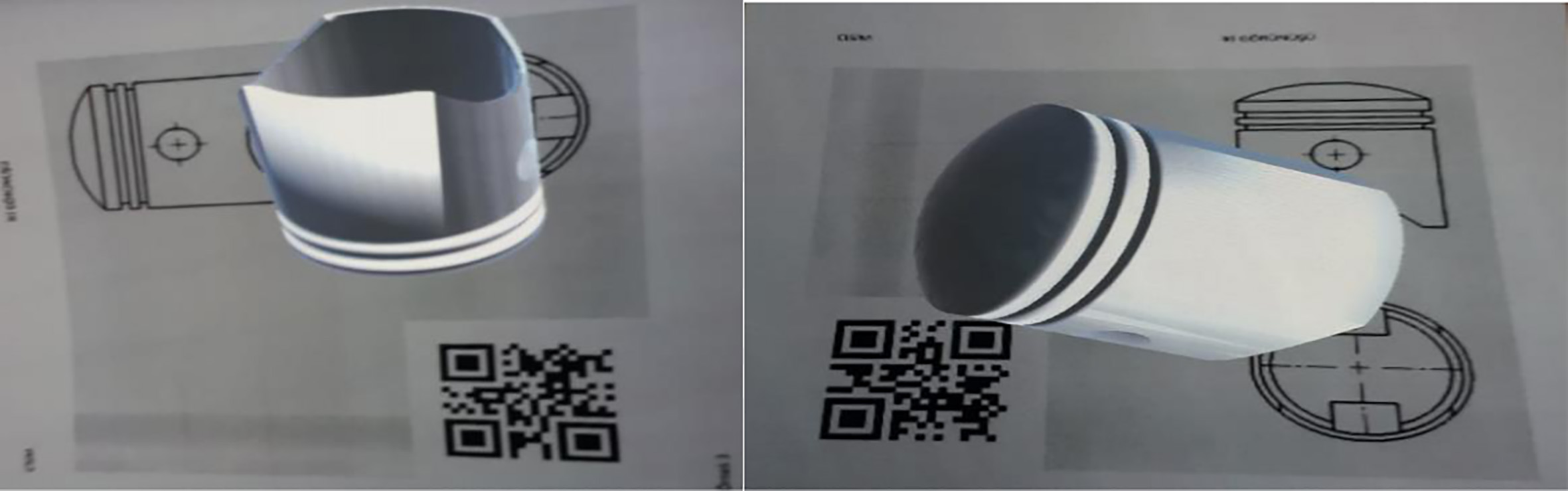
Looking at Table 2; there was no statistically significant difference between the academic achievement scores of the experimental and control group students (
Academic achievement test was used in the study. In the process of developing the academic achievement test, first of all, a pool of questions was formed by taking expert opinions. Then, pilot studies and statistical operations were performed. Data collection tools were finalized according to the data.
Data analysis
The aim of this study was to determine the effect of augmented reality-based mobile software on students’ academic achievement. Before the analysis of the data, it was examined whether the data had a normal distribution. Since the number of samples was less than 50, Shapiro-Wilk test was used and the results were given in Table 3.
The level of significance according to the Shapiro-Wilk test was found to be greater than 0.5. Both groups had a normal distribution for pretest and posttest scores. In addition, the mean, mode and median values are close to each other and skewness and kurtosis values are within
Software development and application process
In this research, a diagnostic-based augmented reality mobile software was developed using the Vuforia SDK (Software Development Kit, Software Development Kit) via the Unity 3D application.
The working principle of the diagnostic-based augmented reality mobile application is the display of the marker defined in the program to the camera. The distance between the camera is defined and clarified. The marker is then identified and the result is a 2D or 3D object. The resulting 2D or 3D object is rotating at the same time as the marker is rotated [19].
The teaching activities supported by AG technology were applied to the groups for 6 weeks after the pre-test and post-application posttests were performed.
Results
The dependent samples
The dependent samples
-test results of the pre-test and post-test scores of the experimental group
The dependent samples
A statistically significant difference was found between the pre-test and post-test scores of the students in the experimental group (
The dependent samples
A statistically significant difference was found between the pre-test and post-test scores of the students in the control group (
The independent samples
The independent samples
There was a statistically significant difference between the groups according to the
In this study, the effect of using AR technology in technical drawing lesson on students’ academic achievement was investigated. As a result of the analysis, there was a significant difference between the pre-test and post-test scores of the experimental and control groups. This result shows that the education given in both groups increases academic achievement. When the analyzes about the difference between the two groups were examined, it was determined that there was a significant difference between the post-test scores of the experimental and control groups in favor of the experimental group (
In this research, the effect of the teaching activities supported by AR technology on the academic achievement was tested. The literature information shows that the teaching activities supported by AR technology have positive effects on students in many areas such as motivation, interest and attendance. A study by [1] showed that augmented reality environments can provide benefits in visualizing and concretizing the magnetic field in order to teach the subject of magnetism in physics lessons. In another study, it has been concluded that augmented reality practices are highly effective in meaningful learning and facilitating the transfer of knowledge to real world problems [9, 35].
In other studies, it has been concluded that augmented reality applications have improved the ability to retention, understanding, use and rearrange visual shapes in the mind [11, 17, 22]. [20, 38] concluded that the use of such technological applications in education increases motivation by providing a fun and interactive environment for students.
In the results of study it was concluded that the use of augmented reality technology in technical drawing lessons increased students’ academic achievement. In addition, studies conducted in this area suggest that teaching activities supported by technology increase the quality of education in different variables such as motivation, student-centered education, attendance [12, 2, 6, 25, 30]. In this respect, while planning the training process, account the teaching activities supported by AG technology and to expand its use is neccessary. In addition, it is suggested that new studies should be planned because the new studies in this area may reveal different effects of the teaching activities supported by AG technology.