



Abstract
The Sustainable Development Goals (SDGs) initiative by corporations requires that their business activities be linked to the 17 SDGs. Moreover, the digital transformation (DX) of enterprises requires the use of digital technology to realize a digital company with competitive advantage. It is inefficient to implement the SDGs and DX initiatives separately in an enterprise. In this paper, we propose a solution to the question, “How do we combine knowledge for the SDGs and DX?”
Keywords
Introduction
In this paper, we consider the knowledge required to integrate different specialized knowledge such as SDGs and DX from the viewpoint of knowledge integration. Although digital technologies help organizations realize SDGs, the effective knowledge to integrate SDGs and DX has not been provided. In this paper, we propose the DSDG (Digital SDGs) framework to integrate knowledge on SDGs and DX. Moreover, an example study will be conducted in a medical domain to show the effectiveness of the proposal.
This paper is organized as follows. First, Section 2 describes related work of SDGs, DX, and knowledge integration. Next, Section 3 organizes issues to relate SDGs and DX within the corporate context using integrated knowledge. Then DSDG framework to combine SDGs and DX is proposed in Section 4. Section 5 explains a study to apply DSDG framework. The effectiveness and limitations of the proposed approach are then discussed in Section 5. Section 6 summarizes this paper and mentions issues of the proposed method.
Related work
In the following, SDGs, DX, and integrated knowledge will be explained.
SDGs
In order for a company to work on the SDGs, it is necessary to translate the goals of the SDGs into the business environment of the company and align them with the management strategy. For this reason, UNGC (United Nations Global Compact), WBCSD (World Business Council for Sustainable Development), and GRI (Global Reporting Initiative) provide SDG Compass [1].
SDG Compass embodies guidelines for companies to formulate management strategies that are consistent with the SDGs and to measure and manage corporate activities that contribute to the SDGs. For example, the SDG Compass provides a five-step procedure: 1) understanding, 2) determining priorities, 3) setting goals, 4) integrating into management, and 5) reporting. In particular, in determining priorities, companies can use the SDGs Compass to develop their business towards a sustainable world.
The Ministry of the Environment recommends that SDGs efforts by companies be linked to SDGs by taking an inventory of the activities of the company and organizing the environment of business activities and the relationship with the local community [2]. In the process of linking corporate activities with SDGs, it is necessary to integrate the knowledge of corporate business activities with the knowledge of SDGs motives and approaches.
The SDG Behavior List for Enterprises presents examples of SDG behavior in the supply chain process based on SDG [3].
However, these processes did not clarify actions for guiding to a specific company. For example, as the SDG behavior exemplifies the production, procurement, provision, and sale of food that takes safety into consideration for “hunger,” it cannot be said that the SDG is selected in line with the behavior of general companies.
Liu et al. [4] described the SDGs as field type (G2: food safety, G3: health and welfare, G4: education, G6: water resources, G7: energy), cross-cutting type (G8: labor, G9: industrial promotion, G11: Living environment, G12: Production and consumption), Global commons type (G13: Climate environment, G14: Marine resources, G15: Ground environment), Comprehensive type (G1: Poverty eradication, G5: Gender equality, G10: Correction of inequality, G16: Judiciary, G17: Global Partnership). DX can be considered for each SDGs classification. With field-type SDGs, business activities can be digitized based on field knowledge. Cross-cutting SDGs can digitize national and local government services. Global commons-type SDGs enable digital cooperation between global policies and national policies. Comprehensive SDGs can support discussions with various stakeholders with digital technology.
El Massah and Mohieldin [5] are investigating the situation of SDGs and e-government in seven countries around the world. As a result, it is clarified that DX is necessary for the governments of each country to effectively formulate sustainable development strategies.
DX
The Ministry of Economy, Trade and Industry will continue to publish the “DX Promotion Index” [7] in 2019 and the “DX Report 2” [9] in 2020, following the “DX Report” [6] in 2018. During this period, while the term DX was widely recognized in Japan, people who had nothing to do with DX until then referred to DX, and different interpretations of DX became widespread in various situations. Regarding the definition of DX, despite the fact that the “DX promotion index” is clearly defined, the number of people who arbitrarily decide that DX is a buzzword and assert their own views is increasing, and confusion is expanding. On the other hand, it can be said that it is commendable that DX was recognized by the general public as an important word.
According to the definition of DX by the Ministry of Economy, Trade and Industry, the subject of digital transformation is a company.
In response to drastic changes in the business environment, to establish a competitive advantage, based on the needs of customers and society, the company will utilize data and digital technology to transform the following and realize the digital enterprise; products, services, and business models, the business itself, organizations, processes, and corporate culture and culture.
From this definition of the Ministry of Economy, Trade and Industry, knowledge about digital technology is integrated with knowledge about product and service usage by customers, business model knowledge, business knowledge, knowledge about organizations, knowledge of processes, knowledge about corporate culture and culture, etc. It turns out that it is necessary to do. In this way, in order for a company to promote digital transformation, it is necessary to integrate a lot of knowledge with digital knowledge, so the method of integrating knowledge is important. In addition, the standard of knowledge quality seems to enable a company to establish a competitive advantage by integrated knowledge.
DX includes management transformation, business transformation, and IT transformation. In management reform, it is necessary not only to change the business model, but also to change the organization, culture and climate. In business transformation, it is necessary to work on digitization of business capacity as well as business process transformation. In IT transformation, it is necessary to realize an IT architecture that can respond quickly to business transformation by utilizing data and digital technology as well as IT system renewal.
DX is the realization of a digital enterprise through these three types of transformation. Here, the digital enterprise is loosely coupled with “block-type digital management” that can respond quickly to changes in the business environment, customers, and social needs, “digital business” based on the digital business ecosystem, and microservices that support business capabilities. It consists of an “adaptive IT system”.
Knowledge integration
The creation of knowledge in modern society requires transdisciplinary knowledge production in order to integrate knowledge (discipline) from different disciplines [9]. Stock and Burton [10] distinguish between multidisciplinary, interdisciplinary, and transdisciplinary.
In multidisciplinary knowledge production, knowledge of academic knowledge in different fields is linked, but new knowledge is not created across the boundaries of academic fields. Interdisciplinary knowledge production aims to solve different problems in a common framework by unifying technical terms and methodologies beyond the knowledge domain of different disciplines and beyond the scope of individual disciplines to create a new collaboration of knowledge.
In transdisciplinary knowledge production, new knowledge is created by recombining knowledge through the interaction of knowledge in different disciplines for the purpose of solving concrete problems in the real world. Interdisciplinary knowledge production unifies terms and methodologies of different disciplines, but does not create new disciplines. In transdisciplinary knowledge production, knowledge from different fields is combined to dynamically create knowledge in order to solve specific problems. The purpose of transdisciplinary knowledge production is to solve concrete problems, and the universality of the created knowledge is not important.
On the other hand, “to establish the compatibility of knowledge between different fields by extracting common concepts, methods, and structures among different research fields, and to create a more universal system of knowledge through it,” is the integration of knowledge. The purpose of the integration of knowledge is to clarify and solve specific problems by discovering new knowledge that transcends existing disciplines. The academic system that enables anyone to integrate knowledge is “integration of knowledge”.
There are knowledge types, i.e., individual type, coordinated type, controlled type, and unified type according to the dimensions of knowledge integrated expression and knowledge integrated process in the form of integrating knowledge of different fields. In individualized knowledge integration, interdisciplinary knowledge with individual structures is integrated by individual processes. In coordinated knowledge integration, interdisciplinary knowledge with a common structure is integrated by individual processes. In controlled knowledge integration, different fields of knowledge with individual structures are integrated by a common process. In unified knowledge integration, different fields of knowledge with a common structure are integrated by a common process.
Most of the integrated forms of knowledge in different fields so far are individual types. Controlled and unified knowledge integration has not yet emerged. The reason for this is that no organization has emerged that promotes multiple knowledge integrations in parallel. In the future, there is a possibility that controlled and unified knowledge integration processes will be adopted by organizations that plan multiple standards.
In the integration of knowledge, the context of integrating knowledge and the context of utilizing integrated knowledge are important. In the usage context, specialized knowledge is embodied and utilized as on-site knowledge. In the integrated context, field knowledge is analyzed and generalized, and different specialized knowledge is integrated.
In the process of creating integrated knowledge, we first define the integrated context of knowledge to clarify the environment in which integrated knowledge is utilized. Next, we define the value of integrated knowledge utilized in this context. Then, design the horizontal trunk knowledge to create this value. By consensus building with stakeholders in the context about the designed integrated knowledge, the value of integrated knowledge is shared, and it is developed and utilized in the context.
Issues
In the following, we will summarize the issues for associating SDGs and DX within the context of a company using integrated knowledge. First, the constituent conditions of the task, which consist of the elements that make up the task and their relationships, are shown. Next, the overall structure of the task will be clarified so as to satisfy this condition.
The conditions that make up the task are as follows.
[Condition 1] The current company will realize a digital company by DX. In other words, DX is a means of converting the situation of current companies that do not utilize digital technology into digital companies that utilize digital technology.
[Condition 2] The current company will realize SDGs as goals for the digital company.
[Condition 3] Integrated knowledge can develop DX as a transformation process based on the capabilities of the current company and the SDGs that the digital company is trying to realize.
The problems solved by integrated knowledge can be summarized as follows by summarizing the above conditions.
Problem
The DX transforms a current company E into the digital company DE that will achieve G, a set of SDGs planned to achieve by E. DX can realize SDGs of E in the course of transforming to the digital Enterprise. This means the digital knowledge and SDGs knowledge are integrated in the process of the digital transformation.
The relationships between the above five elements, SDGs, current companies, digital companies, integrated knowledge, and DX are summarized below. First, by integrated knowledge, we will clarify the DX that solves the extracted SDGs goals with digital technology in the light of the capabilities of the current company. This DX transforms the current company into a digital company. Digital companies can realize the extracted SDGs.
In this way, by using integrated knowledge, it is possible to integrate the efforts of SDGs and DX in enterprises.
DSDG framework
Classification of SDGs in enterprises
The SDGs classification by Liu et al. [4] has been described above, but in the following, SDGs are classified into growth type, business type, infrastructure type, environment type, and control type so that companies can easily promote SDGs efforts.
Growth-type goals are G4: Education and G9: Industry Promotion. The business-type goals are G8: Employment/Rewarding, G12: Production and Consumption, and G17: Global Partnership. The infrastructure-type goals are G2: food safety, G3: health and welfare, G6: water resources, G7: energy, and G11: living environment. The environmental goals are G13: climatic environment, G14: marine resources, and G15: ground environment. Controlled goals are G1: Poverty Eradication, G5: Gender Equality, G10: Correction of Inequality, and G16: Justice.
By classifying the SDGs in this way, it is possible to examine the possibility of deploying the same type of digital solution for the goals of the same classification. For example, for growth goals, distance learning and teleconferencing can be realized with online conferencing solutions.
DSDG strategy map
DSDGM
DSDGM
DSDG strategy map.
A digital balanced scorecard (DBSC) has been proposed to formulate a company’s digital strategy [11]. In BSC (Balanced ScoreCard [12]), which is the basis of DBSC, the strategic map has a financial perspective, a customer perspective, a business process perspective, and a learning and growth perspective. Clarify the goals from the financial perspective and the goals from the customer perspective, and then define that those goals are achieved by business processes. In addition, we will formulate IT systems and employee education plans that support business processes from the perspective of learning and growth. On the other hand, DBSC can embody the digital transformation target as DX requirements from the viewpoint of learning and growth of BSC, and clarify the business process digitized by DX requirements.
In the following, in order to promote the achievement of SDGs in enterprises using DX, a strategic map for DSDG (Digital Sustainable Development Goals) is constructed as a DX method to realize SDGs by integrated knowledge.
First, the SDGs can be added to the goals of the DBSC strategic map by applying the knowledge integration process described above.
[Step 1] To identify the knowledge to be integrated, DBSC and SDGs are extracted.
[Step 2] In the structural analysis of integrated knowledge, the goals of the SDGs and the goals of the DBSC strategy map are compared. In addition, in the SDGs, the impact on the goals of the SDGs is analyzed based on the “value chain” of the company, so it is confirmed that the “business process” of the DBSC and the “value chain” of the SDGs are the corresponding terms.
[Step 3] In the integration of the analyzed integrated knowledge elements, the components of the SDGs are integrated into the components of the DBSC. Therefore, “goals” are added as a superordinate concept of the goals of the SDGs and the goals of the DBSC’s financial perspective and customer perspective. In addition, in order to integrate the DBSC customer-oriented goals into the SDGs goals, the name will be more comprehensive “stakeholder value”. Furthermore, since KPIs are set in the SDGs, “data” for measuring KPIs was extracted as an element. Data is collected and used by business processes.
[Step 4] In the integration of the knowledge element relationships of the analyzed integration target knowledge, the elemental relationships are adjusted based on the results of Step 3.
[Step 5] Consistency between SDGs and management strategy in the integration of knowledge quality standards of analyzed integration target knowledge.
[Step 6] Confirm the consistency of SDGs management strategy and the consistency between management strategy and DX according to the integrated knowledge quality standards.
Figure 1 shows the metamodel for the DSDG strategy map constructed by the above procedure.
In the DSDG strategy map, DX requirements can be clarified for the identified SDGs. On the other hand, when comprehensively considering the SDGs strategy of a company, there is a problem that it is difficult to grasp the whole picture of the response to SDGs in the DSDG strategy map. Therefore, by constructing a matrix with the SDGs classification described in 4.1 as a column and the viewpoint of the DSDG strategy map as a row, it is possible to confirm the efforts of SDGs in a company from a bird’s-eye view. The columns are growth-type, business-type, infrastructure-type, environment-type, and control-type. This matrix is called as the DSDGM (Digital SDGs Matrix) as shown in Table 1. DSDGM is a matrix representation of DSDG strategy map.
SDGsVCM
SDGsVCM (SDGs Value Chain Matrix) is a table with SDGs classification as rows and value chains as columns. In the matrix element of SDGsVCM, the lower goal for SDGs and the action to realize it are described. With SDGsVCM, it is possible to plan what kind of transformation can be made using digital technology for the activities that make up the value chain. Table 2 shows the configuration of SDGs VCM.
By applying the SDGs VCM to the value chain of the current company, it is possible to analyze the positive and negative effects on the SDGs. Based on this result, future SDGs VCM can clarify the value chain goals and changed behaviors of digital companies to be realized. The goal of DX is to close the gap between the current SDGs VCM and the future SDGs VCM.
SDGs value chain map
SDGs value chain map
DSDGs matrix of medical institutions
DSDG strategy map for medical institutions.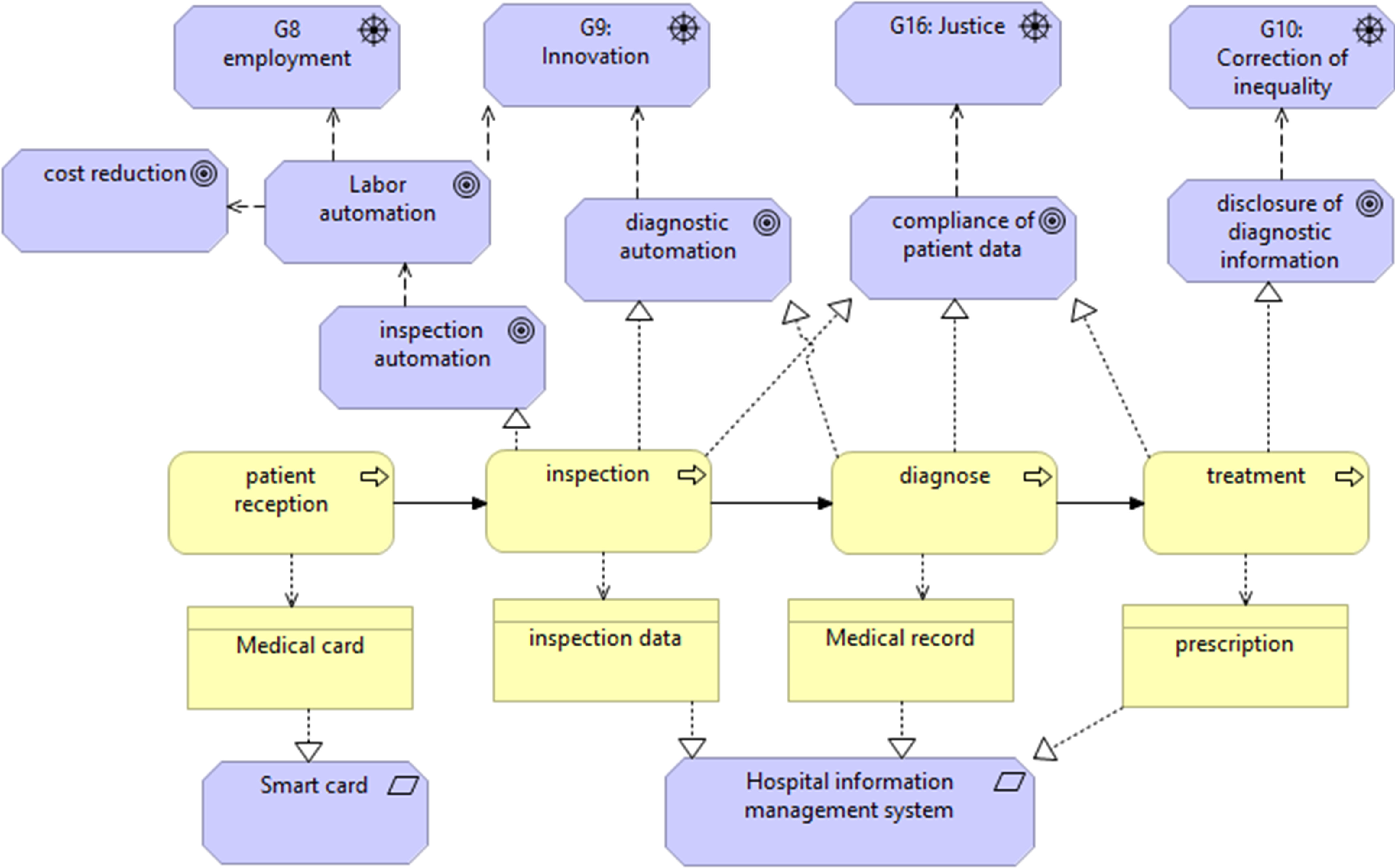
In the following, we will introduce a virtual case where the above-mentioned method knowledge is applied to clarify the SDGs in medical institutions [13] and automotive manufacturing companies.
Medical institutions
Figure 2 shows an example of a DSDG strategy map for outpatients in hospitals. Figure 2 is created by ArchiMate [13]. ArchiMate is an open group standardized visual modeling language for describing enterprise architectures.
The business processes that make up the value chain are outpatient reception, examination, diagnosis, and treatment. Here, the fee payment is omitted for the sake of simplicity. The stakeholder related to this medical institution are patients, hospital staff, laboratory technicians, nurses, and doctors. Examples of medical data are medical examination cards, test results, medical records, and prescriptions. DX request is an IC card that stores medical examination cards, and a hospital information management system that digitizes test results, medical records, prescriptions, and their operations.
The management goal is cost reduction. Automation of examinations and labor saving by automatic diagnosis are the values provided to examination engineers, nurses, and doctors as stakeholder in hospitals.
SDGs VCM for medical institutions
SDGs VCM for medical institutions
As SDGs, G8, G9, G10, G16 are extracted. Labor saving in medical work contributes to G8, automation contributes to G9, compliance of patient data contributes to G16, and disclosure of diagnostic information to patients corrects information inequality, which contributes to G10.
In the DSDG framework, we will consider what to do with digital technology for SDGs regarding growth, operations, infrastructure, environment, and control in response to DSDG strategic map perspectives, management goals, stakeholder values, stakeholder data, value chains, and digitization requirements. For example, the activities to be digitized can be identified according to the classification of SDGs as shown in Table 3 of DSDG matrix.
In terms of management goals, candidates for SDGs classification include development of digital medical services, digital medical care through corporate collaboration, reduction of medical equipment costs, reduction of environmental load on medical facilities, and governance of medical management and actions. Candidates for stakeholder value include automatic diagnosis, job satisfaction of staff, automation of medical work, health and welfare, hospital living environment, in-hospital food safety, reduction of living/occupational environmental burden, and equality of information held by patients and medical institutions.
Candidates for stakeholder data include medical cloud, medical data, medical resource monitoring data, environmental data, and medical practice trail data. Candidates for the value chain include comprehensive medical cooperation, digital medical cooperation, medical equipment environment (water resources, energy) cost reduction, environmental load reduction, and equal access to medical information. Candidates for digitization requirements include automation of diagnostic treatment, medical education, automation of medical practice, smart health and welfare, smart living environment, food safety tracking guarantee, reduction of environmental load, and DX control.
At the specific stage of the influence area of SDGs Compass [1], it is recommended to analyze the positive and negative effects of value chain activities on SDGs and identify corporate activities. By using the SDGs value chain map, it is possible to identify the activities that are expected to have the effect of digitization in the entire value chain activities. The value chain case of this medical institution is simplified with reference to the value chain of medical care provided by Porter and Teisberg [14].
In SDGsVCM, rows are classified into SDGs and columns are value chains. Matrix elements describe lower goals for SDGs and actions to achieve them.
This value chain consists of monitoring/prevention, diagnosis, therapeutic treatment, recovery, and management. To providing prevention videos is candidates for goals 4 and 9. The monitoring and prevention service collaboration is the candidate for business goals 8, 12, 17. The efficient health monitoring and medical history management are candidates for infrastructural goals 2, 3, 6, 7, 11. The reduction of monitoring load is a candidate for environmental goals 13, 14 and 15. The monitoring data compliance is the candidate for control goals 1, 5, 10 and 16. In this way, digitization action candidates can systematically be discovered to realize SDGs by decomposing value chain processes.
DSDGs matrix of automotive manufacturing companies
DSDG Strategy map for Automotive companies.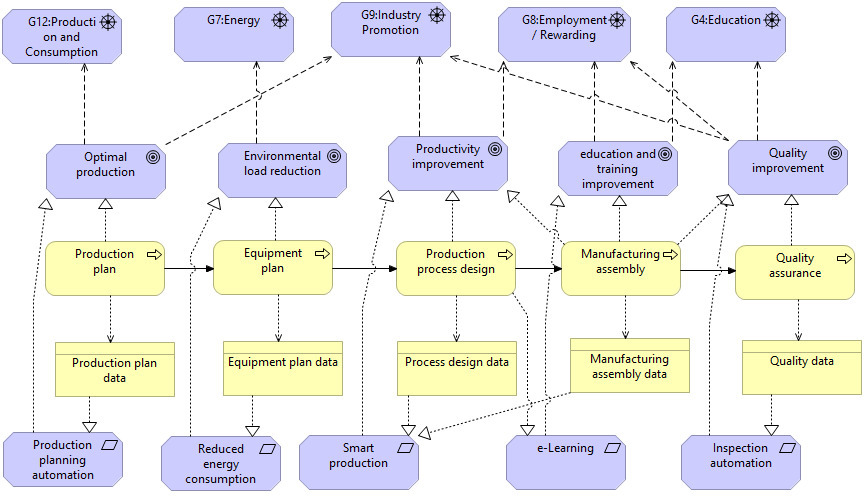
With SDGsVCM, digitization candidates can be comprehensively extracted for each value chain of medical institutions. For example, digitization candidates can be extracted according to the value chain. In reality, not all digitization candidates extracted by SDGs VCM can be realized. It is necessary to determine the priority by evaluating the digitization candidates of SDGsVCM from the viewpoint of value and feasibility. In addition, not all digitization candidates extracted by SDGsVCM will be successful. At first glance, it may be thought that we are extracting useless candidates. However, because we do not know which digitization candidates will succeed, we can improve efficiency by strategically carrying out the hypothesis testing process by systematically extracting as many candidates as possible.
SDGs Value Chain Map for Automotive engineering chain
SDGs Value Chain Map for Automotive engineering chain
Figure 3 shows an example of a DSDG strategy map for production processes in automotive companies. Figure 3 is created by ArchiMate. In the middle of Fig. 3, automotive production processes are described.
These manufacturing processes access the manufacturing data consists of production plan, equipment plan, process design, manufacturing assembly and quality data, respectively. At the bottom, there are digitization requirements to realize goals of automotive production processes. These goals are optimal production, environmental load reduction, productivity improvement, education and training improvement, and quality improvement. At the top of Fig. 3, there are 5 SDGs, i.e., G12, G7, G9, G8 and G4 from the left. The Optimal production contributes to G12 and G9. The Environmental load reduction contributes to G7. The Productivity improvement contributes to G9 and G8. The Education and training improvement contributes to G4 and G8. The Quality improvement contributes to G4, G8 and G9.
Table 5 shows DSDG matrix of automotive manufacturing companies. For automotive manufacturing companies, activities to be digitized can be identified according to the classification of SDGs as shown in the above DSDG matrix.
In terms of management goals, candidates for SDGs classification include development of mobility service creation, digital supply chain, cost reduction of production equipment, reduction of environmental load on production facilities, and governance of manufacturing activities. Candidates for stakeholder value include self-driving car, automation of production process, production process safety, load reduction of production environment and consumer/producer equality.
Candidates for stakeholder data include mobility cloud, supply/production data, production resource monitoring data, environmental load data, and production activity data. Candidates for the value chain include comprehensive production/supply collaboration, digital production collaboration, production equipment environment (water resources, energy) cost reduction, environmental load reduction, and equal access to production data. Candidates for digitization requirements include automation of driving and manufacturing, e-learning for smart production, smart production, smart energy monitoring, and Digital governance.
Table 6 shows a SDGs VCM for automotive manufacturing companies. This value chain consists of production plan, production process design, production, and quality assurance. Typical digitization candidates can be considered for each SDGs classification are shown in columns according to the value chain processes.
To providing 3D BOM (Bill of Materials) is a candidate for goals 4 and 9 in the production plan phase. The data driven production is the candidate for business goals 8, 12, 17. The production monitoring is the candidate for infrastructural goals 2, 3, 6, 7, 11. The production load reduction is a candidate for environmental goals 13, 14 and 15. The planning data compliance is the candidate for control goals 1, 5, 10 and 16. In this way, digitization action candidates can also systematically be discovered to realize SDGs by decomposing value chain processes for automotive production value chain.
The novelty, applicability, knowledge integration, SDG cube, and limitations are explained bellow.
Novelty
We have proposed the DSDG strategy map, DSDG framework, and SDGs VCM as integrated knowledge for companies to promote DX and SDGs. The integrated knowledge is considered to be a translation medium for developing SDGs and DX into corporate strategies. In addition, the knowledge of SDGs and DX in the context of a company is based on the two directions as follows:
Direction 1. The current company will realize the SDGs as a result of the transformation into a digital company by DX.
Direction 2. The integrated knowledge can guide DX through current company’s capabilities and necessary SDGs.
So far, the SDGs have provided general guidelines for developing goals into actions, but the method for selecting goals and embodying actions in an organization has not been clarified.
The DSDG strategy map, DSDG framework, and SDGs VCM proposed in this paper will help accelerate the integration of SDGs and DX in the enterprise. This will reduce the inefficiency of individual separated approach.
Applicability
The proposed DSDG framework consists of Strategy map, DSDG Framework matrix, and SDGs VC matrix had successfully been applied to medical and automotive manufacturing domains. The result shows that the proposed DSDG framework can be applied to different business domains.
Knowledge integration
In the course of constructing the DSDG framework, the following different kinds of knowledge had been combined.
Digital transformation (DX) Digital Balanced scorecard (DBSC) SDGs
The reason of the successful knowledge integration is that the constituents of the above knowledge include concepts of goals and business processes as common elements. Although DX is a means to realize digital enterprise, it includes the digital enterprise as the goal of DX. DBSC has four perspectives of management goals, stakeholder values, value chain as a series of business processes, and DX requirements. SDGs are sustainable development goals and realization of SDGs are facilitated by decomposing according to business processes.
As the target knowledge include common concepts, the natural integration of knowledge has been accomplished.
The SDGs cube can be constructed by using the SDGs classification, Digital strategy perspectives, and value chain process as three axes. Digital strategy perspectives consist of management goals, stakeholder value, stakeholder data, value chain, and digital requirements. For example, a set of tuples (G, D, P) constructs a three-dimensional space, where let G, D, and P be elements of SDGs goals, digital solutions, and value chain processes, respectively. The 3D space is called as a SDGs cube.
The elements of the SDGs cube correspond to certain SDGs classification goals, certain DSDG perspectives, and certain processes that make up the value chain.
This element becomes the target of DX, and the maturity of digitization corresponds to it. METI published DX promotion index [7] to evaluate digital maturity levels of companies. Therefore, the SDGs cube becomes four-dimensional when the digitization maturity is taken into consideration.
In this way, in DX for SDGs, it is necessary to manage the multifaceted DX projects that make up the SDGs cube. In addition, since it is considered that there are dependencies and conflicts between the elements of the SDGs cube, careful consideration must be taken when executing the project. Therefore, it is necessary to increase the independence of SDGs cube elements and loosely couple the interrelationships.
Limitations
Although medical and automotive manufacturing cases have been examined to evaluate the applicability of the proposed method in this paper, it is necessary to evaluate the applicability of the approach for real industrial cases. For this reason, an SDQ (SDGs DX and QC) research group has established in the Central Japan Quality Control Association [15]. The SDQ research group started to study DSDG framework for real business cases in detail.
Moreover, it is necessary to clarify the quantitative effort to develop DSDG framework for the given special business domains. For example, it is necessary to show the DSDG framework development cost and complexity by examining for practitioners.
In the course of describing case studies, some commonalities between DSDG frameworks of medical and automotive manufacturing cases are found. For example, monitoring load, load reduction, and data compliance. These commonalities imply that DSDG patterns are able to design for efficient development of DSDG framework. However, the DSDG framework pattern is not clarified yet now.
Summary
In this paper, it has clarified that the DSDG strategy map, DSDG framework, and SDGs VCM can be constructed as integrated knowledge for coordinating promotion of SDGs and DX by using the knowledge integration procedure. Based on the DSDG framework, it is possible to identify the SDGs that companies should work on from a bird’s-eye view using digital technology.
The DSDG strategy map can relate SDGs, DX requirements, and company’s management goals based on stakeholder value, data, and business processes. DSDG matrix also provides the comprehensive view of the DSDG strategy map. With the SDGs VCM, SDGs that should be realized by digital technology can be comprehensively extracted based on the value chain of a company.
In this way, multifaceted efforts are required to solve the problems of the SDGs. Different integrated knowledge is required depending on where the company deals with SDGs and DX.
Moreover, the proposed DSDG framework had been successfully applied to medical and automotive manufacturing cases.
In the future, new development of integrated knowledge shall be required according to new situations. Moreover, the proposed DSDG framework shall necessary be applied and evaluated to real industrial cases.