



Abstract
Generally, Wireless Body Area Networks (WBANs) are regarded as the collection of small sensor devices that are effectively implanted or embedded into the human body. Moreover, the nodes included in the WBAN have large resource constraints. Hence, reliable and energy-efficient data transmission plays a significant role in the implementation and in constructing of most of the merging applications. Regarded to complicated channel environment, limited power supply, as well as varying link connectivity has made the construction of WBANs routing protocol become difficult. In order to provide the routing protocol in a high energy-efficient manner, a new approach is suggested using hybrid meta-heuristic development. Initially, all the sensor nodes in WBAN are considered for experimentation. In general, the WBAN is comprised of mobile nodes as well as fixed sensor nodes. Since the existing models are ineffective to achieve high energy efficiency, the new routing protocol is developed by proposing the Hybrid Tunicate-Whale Swarm Optimization (HT-WSO) algorithm. Subsequently, the proposed work considers the multiple constraints for deriving the objective function. The network efficiency is analyzed using the objective function that is formulated by distance, hop count, energy, path loss, and load and packet loss ratio. To attain the optimum value, the HT-WSO derived from Tunicate Swarm Algorithm (TSA) and Whale Optimization Algorithm (WOA) is employed. In the end, the ability of the working model is estimated by diverse parameters and compared with existing traditional approaches. The simulation outcome of the designed method achieves 13.3%, 23.5%, 25.7%, and 27.7% improved performance than DHOA, Jaya, TSA, and WOA. Thus, the results illustrate that the recommended protocol attains better energy efficiency over WBANs.
Keywords
Introduction
Some of the technological advancements, such as a new direction of tremendous growth, fog computing, ambient-assisted living as well as blockchain technology, are commonly seen in healthcare departments [6]. Many researchers have attributed a lot to the growth and emergence WBANs. Here, the WBAN has been defined as the network that has compiled miniature-sized nodes that are located on or inside the human body [17]. These sensor has been utilized to calculate the different physiological parameters in the body, namely, electromyography (EMG), glucose level, electrocardiogram (ECG), blood pressure, temperature, and heartbeat rate [12]. But, the WBAN is not accepted as a substitute for the hospital by medical professionals. The major aspect of these techniques is regarded as the nodes, which are located inside the human body as well as it does not the easiest process to replace the batteries in the nodes once they are discharged from the human body [10]. Considering this, the nodes with longer battery life spans have been preferred to the human body. The most significant utilization of these WBANs is in medical-related applications [3].
The reliability of transmission has been considered the major problem in WBANs, which is revealed through the guaranteed delivery of data, particularly for the emergency of data [28]. Moreover, in life-critical scenarios, reliable and fast routes are regarded as essential for transmission. Here, the efficiency of data transmission has played a vital role in saving human lives [22]. Then, efficient routing has been regarded as the backbone for the procedure of attaining reliability [30]. Due to the constrained manner in the resources of the wireless communication channels as well as the WBAN, there are various problems and limitations while implementing and designing the related to reliability and energy efficiency are also considered the most significant as well as difficult ones [5, 7]. Because both reliability and energy efficiency have greater influence over the lifetime and the reliability period of the network and applications are needed. In recent times, the conventional routing algorithms for WBANs have been categorized as cross-layer routing, temperature-based, and cluster-based algorithms [15]. Similarly, the thermal-dependent technique has been utilized for the implanted WBAN [26]. Moreover, the recognition of these hotspot nodes has consumed higher energy than wearable WBAN [11].
In the conventional literature, clustering-dependent routing techniques have been utilized to maximize reliability as well as energy efficiency in order to attain robust network operation for the WBAN application [32]. Moreover, the WBANs still face an issue that requires considerable attention. Various scholars have implemented a routing protocol that is combined and known as the Link Aware and Energy Efficient scheme for Body Area Network (LAEEBA). In this protocol, the path along with a reduced amount of hops, has been chosen for transmission [19]. Many works have aimed at cluster-dependent routing. Then, the routing protocol, along with the clustering techniques has been recommended for selecting the best cost function [1]. Cluster-dependent three-tier models for preserving the life-serving details and optimal energy consumption are also used [31]. There is a requirement for utilizing various optimization algorithms for energy-efficient and reliable routing solutions; it tends to increase the reliability period and the overall network lifetime. So, the motive of introducing the WBAN application has emerged.
Some of the major attributes in the WBANs model regarding energy efficient routing are given below.
To recommend the WBANs model for energy efficient routing with the help of HT-WSO algorithm for further enhancing the energy efficiency of the model. Thus, the WBANs are more helpful in various monitoring applications like healthcare, military, environment, agriculture as well as warfare, etc. To develop the HT-WSO by combining the TSA and WOA for attaining the optimum value in getting suitable paths for data transmission by resolving the multi-objective function in reaching the energy-efficient routing in the WBANs model. To determine the objective function through distance, hop count, energy, path loss, and load and packet loss ratio to further enhance the reliability of the recommended WBANs model with optimal path selection scheme among devices. To improve the performance of the WBANs model concerning various parameters for improving the energy efficiency when assimilating with various existing methods.
The forthcoming sections of the WBANs model are as follows. The existing work related to the WBANs routing protocol model is in Section 2. A system model for WBANs for energy-efficient routing is in Section 3. The proposed energy-efficient routing model for WBANs using HT-WSO is explained in Section 4. Multi-objective fitness function derived from the energy-efficient routing model for WBANs is in Section 5. The result analysis of the WBANs model is discussed in Section 6. The WBANs model is concluded in Section 7.
Related work
Kaur et al. [13] have suggested a new routing protocol-dependent deep learning network optimizer, which has been utilized to enhance the working ability of both the heterogeneous and homogeneous configurations. The recommended routing protocol techniques have supported the working performance of the WBAN by attaining an enhancement over several parameters. The recommended routing protocol has sustained a lesser packet drop rate, minimum energy consumption and normal traffic, and enhanced average lifetime. The working ability of the recommended model was also assimilated over various routing protocol techniques for both the heterogeneous as well as the homogeneous cases, such as M-ATTEMPT, iM-SIMPLE as well as SIMPLE. Then, it was estimated that the recommended model had shown better values in all over cases and proved its accuracy.
Mu et al. [20] have recommended minimal energy consumption techniques dependent on a directional diffusion routing protocol for performing the WBANs. Here, the concept of the gradient has been designed to demonstrate the rate, the direction of the data transmission as well as the minimum hop count on the diffusion, which has been utilized for evaluating the gradients. Each node has been acquired to manage the details about the gradient and its neighbouring nodes along with the shortest path. Consequently, the residual energy has been regarded to enhance the working ability. The outcomes have shown that the proposed routing protocol has been reduced the packet loss power as well as the rate of consumption in both the mobile and statics scenarios. The data transmission has been enhanced as well as the network’s life has been extended essentially.
Samarji and Salamah [25] have recommended the model by a joint scheme have enhanced an energy-effective routing scheme as well as a traffic management scheme. The recommended techniques have been implemented dependent network clustering that has shown positive influences on the entire network delay. Here, the clustering has been optimized, and then the genetic algorithm was used to detect the cluster heads regarding the nodes dependent matters such as path loss, signal-to-noise ratio, residual energy, and distance to the Software-Defined Networking (SDN) controller during consecutive intervals. Besides the clustering techniques, an emerging technology on traffic management has also been implemented, which essentially tackled the packets by assuring the free delay for ED transmission. It has been made by assigning the needed-related power, and high data rate as well as a high priority for routing. The working ability has provided that the designed model has outperformed various priority-dependent conventional models.
Saleem et al. [24] have proposed novel heuristic techniques in order to choose the optimal clusters over the WBANs for monitoring the behaviour as well as the health of livestock. The proposed techniques have been applied to an optimizer algorithm for choosing the optimal cluster from various pasturage sizes by utilizing the sensor of various transmission ranges regarding the user preference for the density cluster. The proposed method, along with the optimizer algorithm, has been assimilated along with recent methods like Moth Flame Optimization, Ant Colony Optimization as well as Grasshopper Optimization. The assimilated outcomes have shown the proposed models’ efficiency for remote monitoring applications.
Yang et al. [33] have constructed a novel protocol for scheduling as well as routing over the WBANs regarding the node energy, traffic type, path loss, as well as other adequate factors. Initially, the channel competition procedure was constructed to minimize network flooding make use of the relevant details by the nodes deployed. Further, the energy-abundant routes have been chosen in accordance with the energy consumption as well as node type over the routing setup stage. In the end, an adaptive slot technique has been proposed to reach the needs of data priority as well as its rate in the slot assignment stage. The investigational outcomes have shown that constructed protocol has saved the energy of the channel.
Ullah et al. [30] have designed a new technique for improving the reliability of resources-constrained WBAN as well as the stability period. This technique has been compressed into two novel solutions like, Forwarder Node Rotation and Forwarder Node Selection methods. The designed techniques have taken the enhancement of the clustering routing methods as well as attained improved longer network stability period, lifetime, and ultimately increased reliability. Then, the delay in the recommended model has enhanced the reliability and efficiency of the routing solution for WBANs.
Khan et al. [16] have designed a novel routing protocol model that has utilized the sensors in the WBANs to determine the parameters effectively. The forwarder node has accepted the data through sensor nodes that were far from the sink. The concept of multi-hopping has used the forwarder node. After attaining the data, the forwarder node that has forwarded this data to the sink node. This model has assimilated with the conventional model along with that has assimilated in terms of parameters path loss, residual energy, throughput as well as network stability, as well as lifetime.
Zadoo et al. [34] have suggested a novel methodology for WBAN. The techniques were defined as a clustering-dependent protocol, which has been incorporated to reduce the radiation effects on the human body. Therefore, the nodes have acquired lower signal power for data transmission. CH compressed the attained packets and passed them into the hub nodes. Low signal power was useful for minimizing the effect of radiation. Moreover, the body tissues near CH have enhanced radiations as it has received as well as transmitted a huge amount of data for the entire transmission round. To minimize the effect of radiation in the CH, the suggested model has managed the reliability of the node’s body location to radiation for CH selection. This technique has been used for CH selection. The selected CH node that acquires lower transmitted power, as well as its body location, has the least sensitivity to the RF radiations to lower the radiation effects. The suggested model has assimilated over other relevant models, which provides energy-efficient.
Qaffas et al. [21] have formulated the Controller Placement Problem (CPP) in the multi-objective optimization problem. Moreover, the new Adaptive Population-Based Cuckoo Optimization (APB-CO) algorithm was developed. However, the designed APB-CO algorithm has been validated to analyze the variations of 100 nodes in the network. Throughout the analysis, the designed method has been validated with various performance metrics. Thus, the result analysis has shown the proposed model has shown effective performance when combined with the different existing approaches.
Aryai et al. [2] have recommended the Swarm Intelligence Multi-Objective Fuzzy (SIMOF) protocol in WBAN. Here, the SIMOF has been comprised of two stages, like Whale Optimization Algorithm (WOA) along with automatic rule tuning and Fuzzy Inference System (FIS). Hence, the FIS was performed based on bandwidth, temperature, distance, reliability, and energy. Thus, the performance of the designed method was enhanced with the help of the mamdani rule of FIS using the WOA algorithm. Thus, the developed model has attained superior performance while validating with diverse methods.
Javaheri et al. [3] have implemented the hybrid Aquila optimizer and Arithmetic Optimization Algorithm (HAOA). However, the designed HAOA algorithm was used to optimize the parameters and reasoning rules in Fuzzy Logic Controller (FLC). Here, the designed method has been utilized to solve the problems in local optima. Moreover, the research work implemented a new approach for fuzzy logic-based and thermal-aware clustering and routing scheme in WBAN. The evaluation of the result validation has proved that the offered technique has attained enriched performance when compared with other conventional approaches in terms of packet delivery ratio and distance.
Maintaining the integrity of the specifications
Benefits and limitations of traditional routing mechanism in WBANs
Benefits and limitations of traditional routing mechanism in WBANs
Studies are explained about the existing routing protocols in WBANs. Some of the features and limitations in the existing WBANs model are given in Table 1. Adam optimizer [13] increases the network lifetime and residual energy. It applies to heterogeneous and homogeneous configurations. In order to less consume energy, hybrid optimization is employed. Directed diffusion [20] successfully reduces the control overhead and packet loss. However, it is not applicable in real-world applications as it contains more delay. SDN [25] achieves the desired results regarding various measures. Yet, it mitigates the computational complexity. It does not support cross-layer interactions to retrieve medical information. ALO [24] attains the optimal CH for performing in an effective routing. Due to this process, it contains less lifetime. Scheduling [33] effectively performs the more energy-based routing and can extend the network lifespan. Without being aware of relay nodes in the network, the routing efficiency gets affected. Routing [30] yields less delay value for all the implemented protocols. On the other hand, it fails to achieve the stability and lifespan of the network and does not consider security measures. RK [16] reduces path loss and energy consumption and maximizes the network throughput and stability. However, usage of multiple paths, overlapping occurs. It also leads to creating time complexity. FEELS [34] selects the optimum CH that aids to reduce the radiation effect of the sensor. But, the more fuzzy rules, the more imprecise results are obtained. Owing to these challenges stimulate to development of the model for energy-efficient routing in WBANs.
System model of WBAN
On considering the network over smart wearable patches along with
Various sensing nodes, as well as the major node, usually include the WBAN. Here, the central nodes are regarded as the network sink as well as also serve as a public network gateway by utilizing the mobile network or the WLAN. Here, mobile phones are given as an interface to check health indications. Nodes included in the sensors are gathered whereas it, helps to transmit the data to the sink for adequate treatments to anthropometric, practitioners determination such as blood sugar, ECG, temperature, CGG as well as pulse, and other details such as GPS Wearable Patches as well as the movement over the body that are combined with the WBAN model.
In order to conserve the energy as well as elongate the period of the nodes, here, the nodes have been converted from active to sleep states depending on the commands and measurements. Moreover, the nodes in the active state can perform reception and transmission. Further, the switching over of this node energy state to be used for the lifetime prolonging, as well as conservation, has been defined as the duty cycle. In this case, the node awakens over the periodic interval in order to listen to the broadcasts, the mode in it is defined as Low-Power Listening (LPL). The nodes acquired in the wireless modules that have a user interface, as well as the controller, are considered to have fewer mobility values. The system model of WBANs for energy efficient routing model is depicted in Fig. 1.
System model in WBANs for energy efficient routing model.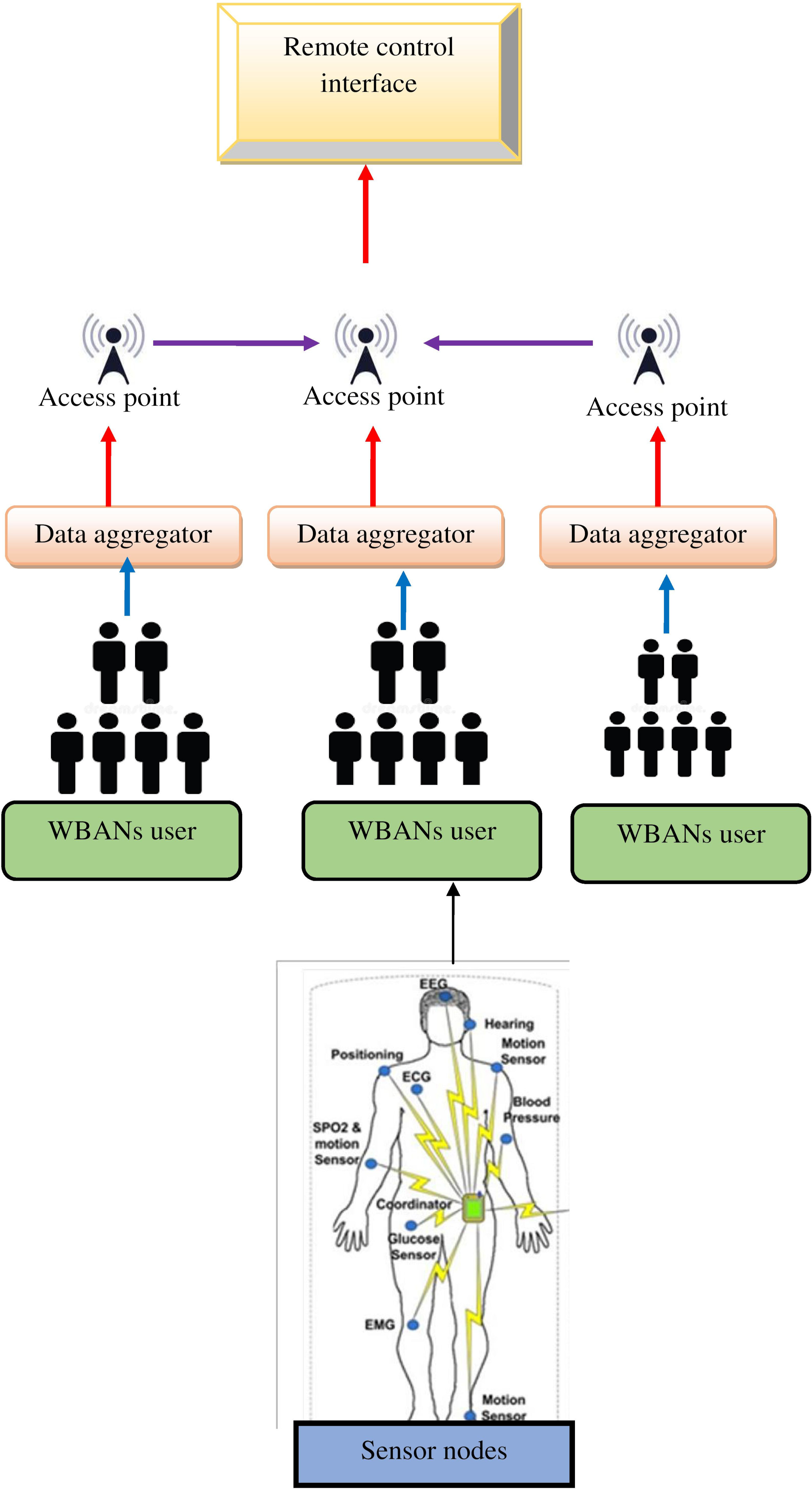
Every node in the WBANs has acquired the same amount of energy during the deployment. Then, the nodes have drained their energy while receiving, transmitting as well as broadcasting the data. Moreover, the energy consumption may differ when the hops count differs from the source to the sink. The aggregator nodes, as well as the Common nodes, acquire different ranges over the energy consumption rates. The aggregator node includes the single outward edge and the multiple inward edges into the sinks. Then, the data is transmitted into the sink sequentially. The energy used by the node is termed as
Then, the transmitting energy
Here, the transmission time is given as
When the energy spent for receiving is termed as
The half drain
At the initial stage, the energy node is indicated as
Hence, the WBANs system model has been designed in such a way to attain better energy efficiency in data transmission.
Developed WBAN energy efficient routing
The WBANs have been defined as the interconnection among multiple nodes, which are positioned in or around the surface of the body that is capable of wireless communication. Here, the body area network includes actuators and sensors for monitoring and recording the bio-signals [35]. Hence, these functions are useful to determine the health of the patients. These WBANs [8, 27] have contained various monitoring applications like healthcare, military, environment, agriculture as well as warfare. Further, the sensor nodes are a low-cost, light weighted and low-power-consuming intelligence model that has the capability to compute even in wireless mode. It also has a sensor or micro technology that measures the process and then transmits the signal from human body physiology into the control unit to be useful for real-time diagnosis by medical personnel. This technology is usually powered by batteries. The necessity of battery lifetime is used in WBANs, particularly in the cases like pacemakers that acquire at least five years of life. Moreover, energy consumption has been reliant on the nature of the applications. But, the reliability of the WBANs is based on the duration of the network. Moreover, the packets require being transmitted multiple times then, it consumes transmission energy of multiple nodes over assimilated low power level. Similarly, various health hazards such as enzymatic disorder, tissue damage as well as minimized blood flow have taken place. Some of the BAN technologies are dependent on the human phantom property. They have resolved the issues of propagation around ellipsoid and cylinder geometry for characterizing the approximation of the body form. This system is evaluated by utilizing the full-wave electromagnetic measurement and simulation campaigns. Some of the traditional models have failed, and issues in performing the model hence, the energy-efficient routing in WBANs are implemented. The architecture of the energy efficient routing in WBAN is depicted in Fig. 2.
Architectural depiction of the energy efficient routing in WBANs model.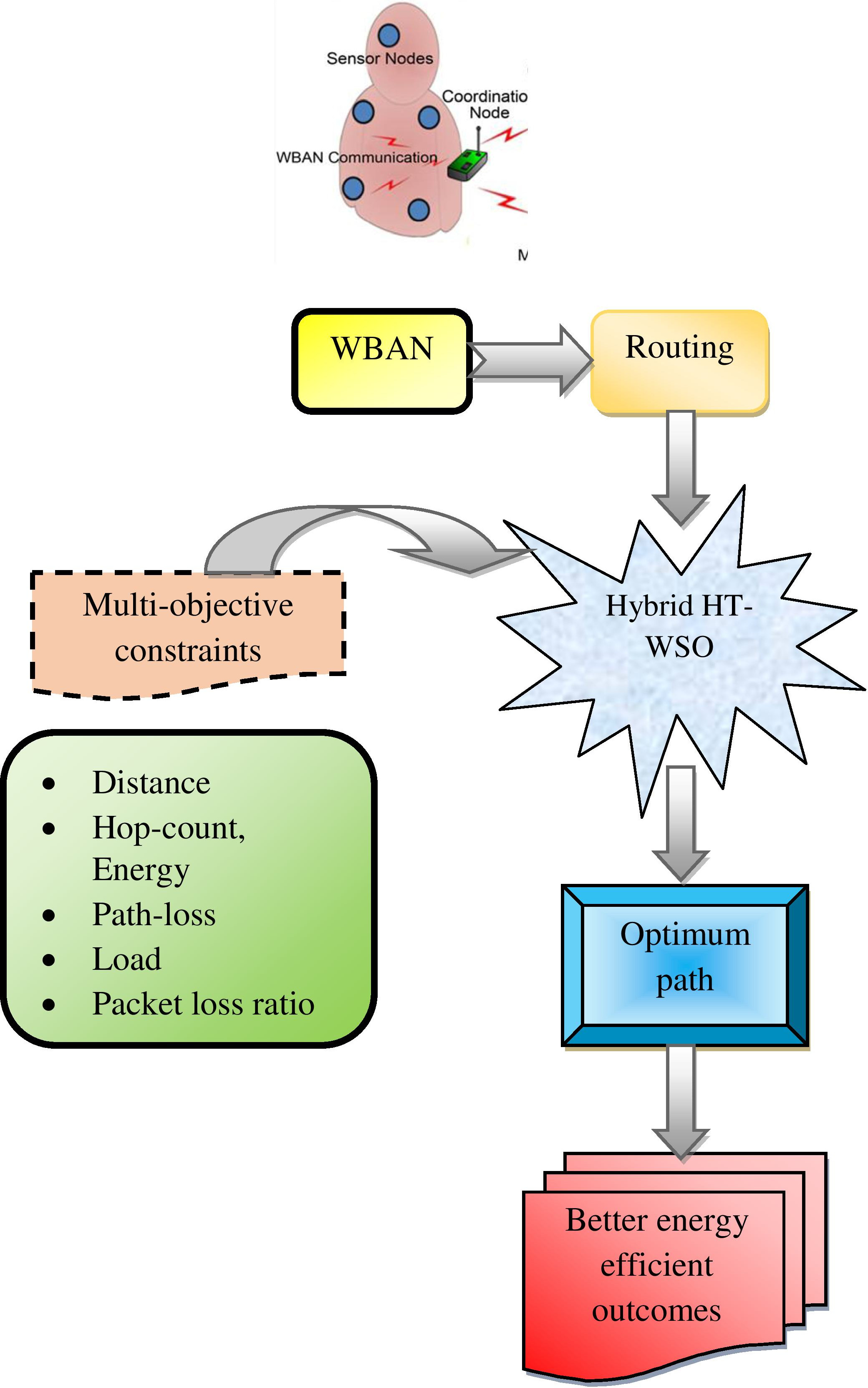
Here, the recommended energy efficient routing in the WBANs model with optimal path selection has been designed. In the energy-efficient model, all the sensor nodes in the WBANs have been gathered initially. Commonly, the WBANs have been comprised of fixed sensor nodes and mobile nodes. Hence, the conventional techniques are ineffective to attain high energy efficiency, a novel routing protocol technique has been designed using the recommended hybrid optimization algorithm. Consequently, the designed techniques have regarded the multiple constraints for determining the objective function. For further evaluating the efficiency of the network, the objective function has been derived by distance, hop count, energy, path loss, and load and packet loss ratio. In order to obtain the optimal path selection, the HT-WSO is applied. Moreover, the designed HT-WSO algorithm is utilized to speed up the training process in the network. However, the designed model is performed to control the parameters in the complex network structures to improve the effectiveness of the designed model. In the end, the ability of the model is evaluated by utilizing the parameters as well as assimilating over traditional models. Thus, the outcomes provide better energy efficiency over WBANs.
The newly suggested WBANs model has enhanced the energy efficiency of the offered method by using the hybrid algorithm such as TSA and WOA is known as the HT-WSO algorithm. In TSA [14], the effect of both the sensitivity and the scalability has higher efficiency to perform the process. It has provided a less susceptible value when assimilated over the other models. The effectiveness, as well as efficiency of the model has adequate values. But, the multi-objective optimization problems are not explored in TSA. On the other hand, the WOA [18] has the ability to resolve real-time issues along with the unknown space in an effective manner. But, the multi-objective and the binary version in the WOA model are not detailed, which degrades the performance. Here, the development of the HT-WSO model has been deployed to overcome the drawbacks of the conventional model. It is performed with the aid of an objective function, and that is given in Eq. (6).
Here,
Tunicates have been regarded as bio-luminescent, which is closed at one end and open at the other end. The significant fact about the tunicate is their jet propulsion and the swarm behaviour. Here, the tunicate has the potential to detect the position of the food sources in the sea. Moreover, the swarm behaviour has updated the location of the other searching agents is based on the best optimal solution. The overall operation is mathematically expressed as follows.
a) Avoid conflicts between search agents: To tackle the conflicts among the search agents, the term
Here, the water flow advection in the deep ocean is expressed as
Here, the initial as well as the subordinates speed in order to make the social integration, is given as
b) Movement toward the direction of the best neighbour: After overcoming the conflict among the neighbours, the search agents have been moved toward the orientation of the best neighbour, as expressed in Eq. (11).
Here, the distance between the food source and the search agent is denoted as
c) Converge towards the best search agent: The search agent has the ability to manage its location towards the best search agents that, as shown in Eq. (12).
Here, the updated location of the tunicate along, in accordance with the food source position,
d) Swarm behaviour: The swarm behaviour of the tunicate is upgraded regarding; the first two optimal best solutions with respect for locating the best search agents. The swarm behaviour of the tunicate has been expressed as in Eq. (13).
The position updating is indicated as
Spiral updating position: This technique has been defined to calculate the distance between the whale positioned at
Flowchart of designed HT-WSO for WBANs energy efficient routing model.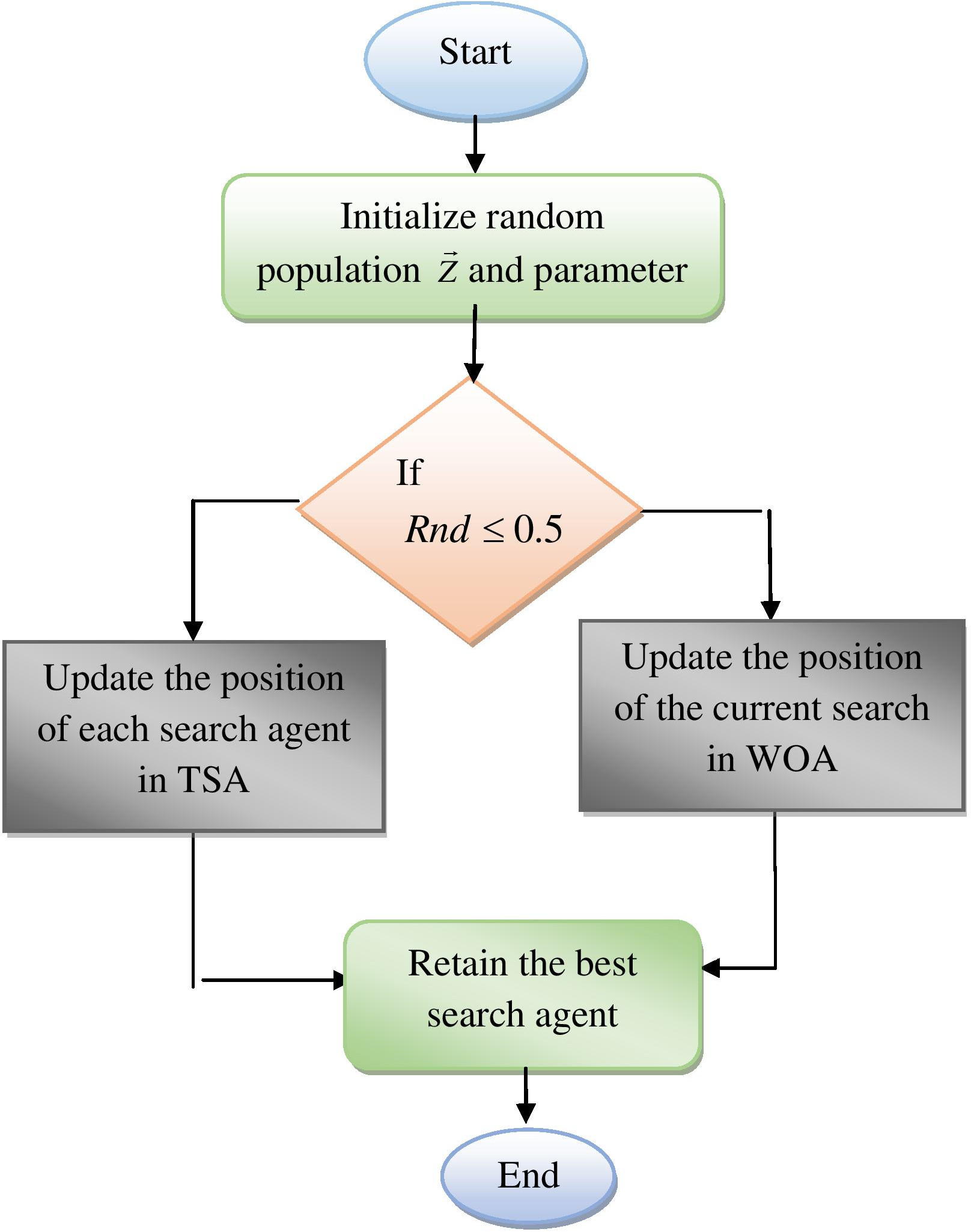
The term
The flowchart for the recommended HT-WSO for routing protocol is depicted in Fig. 3.
In this phase, the constraints for deriving the multi-objective fitness value function is evaluated to enhance the energy efficiency of the WBANs model for optimally selecting the suitable paths for data transmission between the nodes. It has been carried out by deriving the constraints for the following measures.
a) Energy Ene: It is defined as “the total residual energy is the sum of harvested energy (generated from the external environment by sensor node) and residual/remaining energy of the sensor node”.
Here, the total harvested energy from the energy harvester embedded inside the sensor node is given as
b) Distance DS: It has been evaluated between the two nodes by formulating the length between the two nodes, and it is expressed by using Eq. (16).
Here, the terms
c) Hop count
d) Path loss PL: It is related to the position where the receiver as well as the transmitter is located. Commonly, the propagation path loss has enhanced the frequency and also the distance, and it is given in Eq. (17).
Here, the free space wavelength is indicated as
e) Load LD: It is defined as the integration of both the communication and computational load, and it is given in Eq. (18).
Here, the computational processing cost is indicated as
f) Packet loss ratio pktls: It has been performed by retrieving all the real-time packet sizes from both the received as well as transmitted form, and it is given in Eq. (19).
Here, the total number of transmitted and received packets is depicted
Finally, the recommended WBANs model using the HT-WSO algorithm has performed superior to provide better energy efficient values.
In this stage, the multi-objective derived fitness function is necessary to perform the WBANs model to provide better energy efficiency outcomes as detailed below. This model has the capability to improve the quality of the user’s life as well as it has improved the capacity of the entire network. It does not require complex connectivity, and consumes low cost for infrastructure setup. But, this model has failed to operate at a low data level as well as it is not suitable to perform the WBANs application in large-scale data. To overcome the problems in the WBANs, the recommended model has been implemented, and its objective function is given in Eq. (20).
Here, the multi-objective derived fitness function is indicated ojf, and the selected path
Here, the term ICWA refers the energy criteria function. Thus, it shows the two boundary points like most anomalous and disregarding the real anomalies. Here, the values of
Multi-objective fitness derived for optimal path selection in the recommended routing protocol model in WBANs.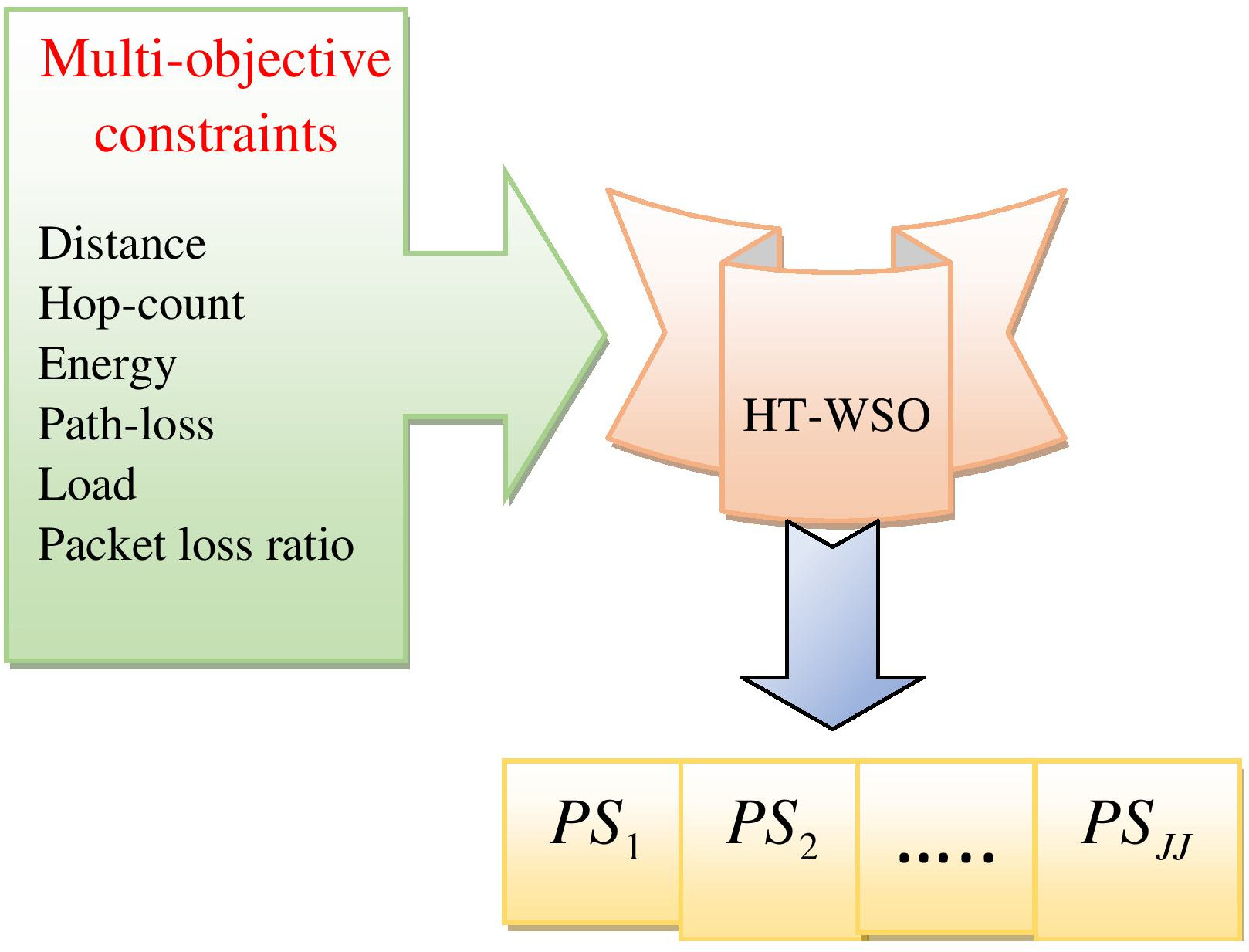
Simulation setting for WBANs model
Statistical validation on the WBANs model with optimal path selection over other conventional models by varying the number of nodes a) node at 50, b) node at 100 and c) node at 150. 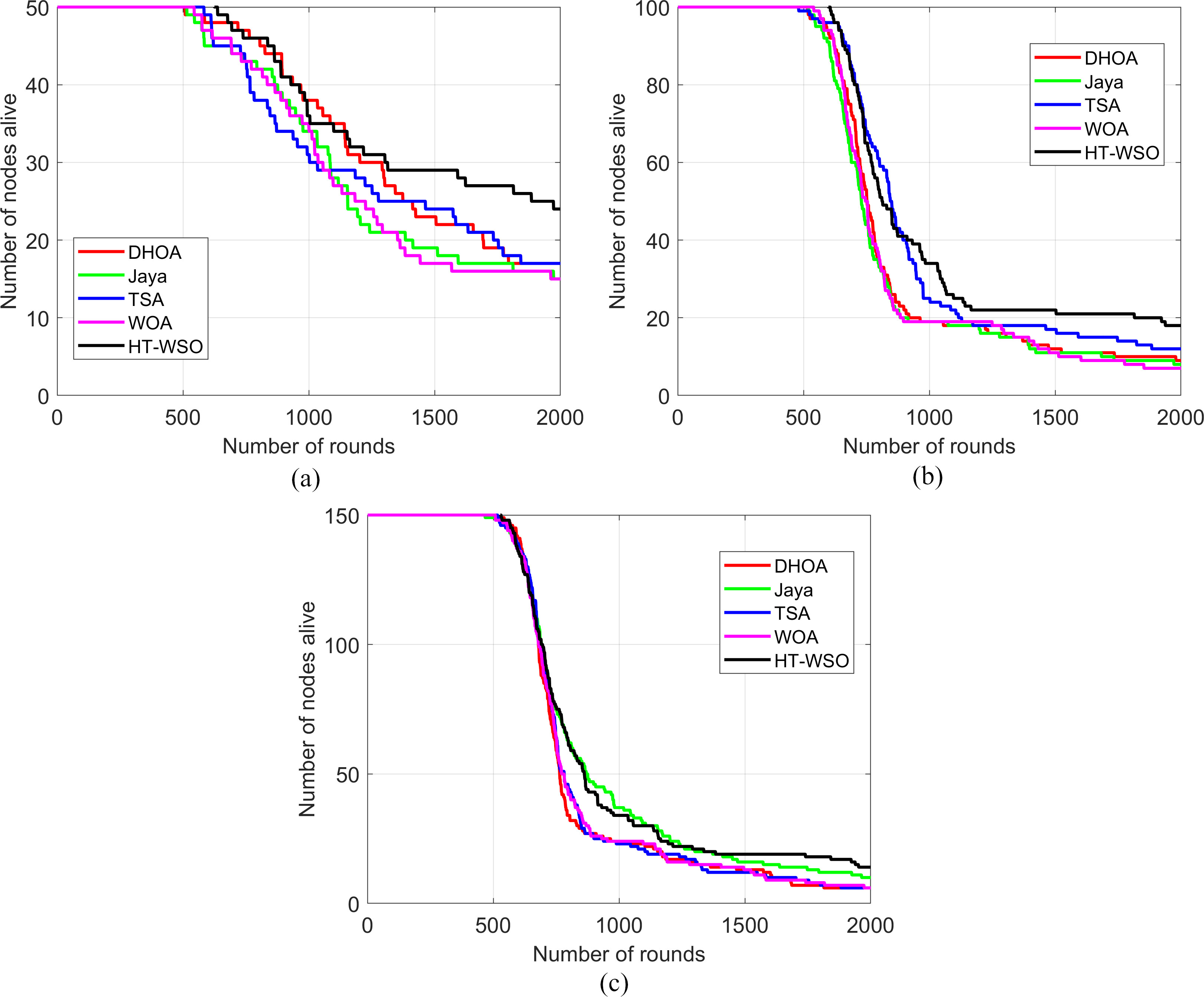
The developed routing protocol in WBAN was evaluated in MATLAB 2020a, and the performance analysis has been validated. Here, the various metrics, such as distance, hop count, energy, path loss, load, and packet loss ratio, were considered to evaluate the efficiency of the network and compared with other approaches. Here, the algorithms like Jaya [23] and Deer Hunting Optimization algorithm (DHOA) [4] have been used. The population number was 10, the Maximum Iteration was 100, and the Chromosome length was equal to the number of nodes. Some of the parameters used in this model have been tabulated below.
Statistical validation over several traditional algorithms by differing the number of rounds at the number of node 50 regarding a) Distance, b) Energy, c) Hob-count, d) load, e) packet loss ratio and f) path loss.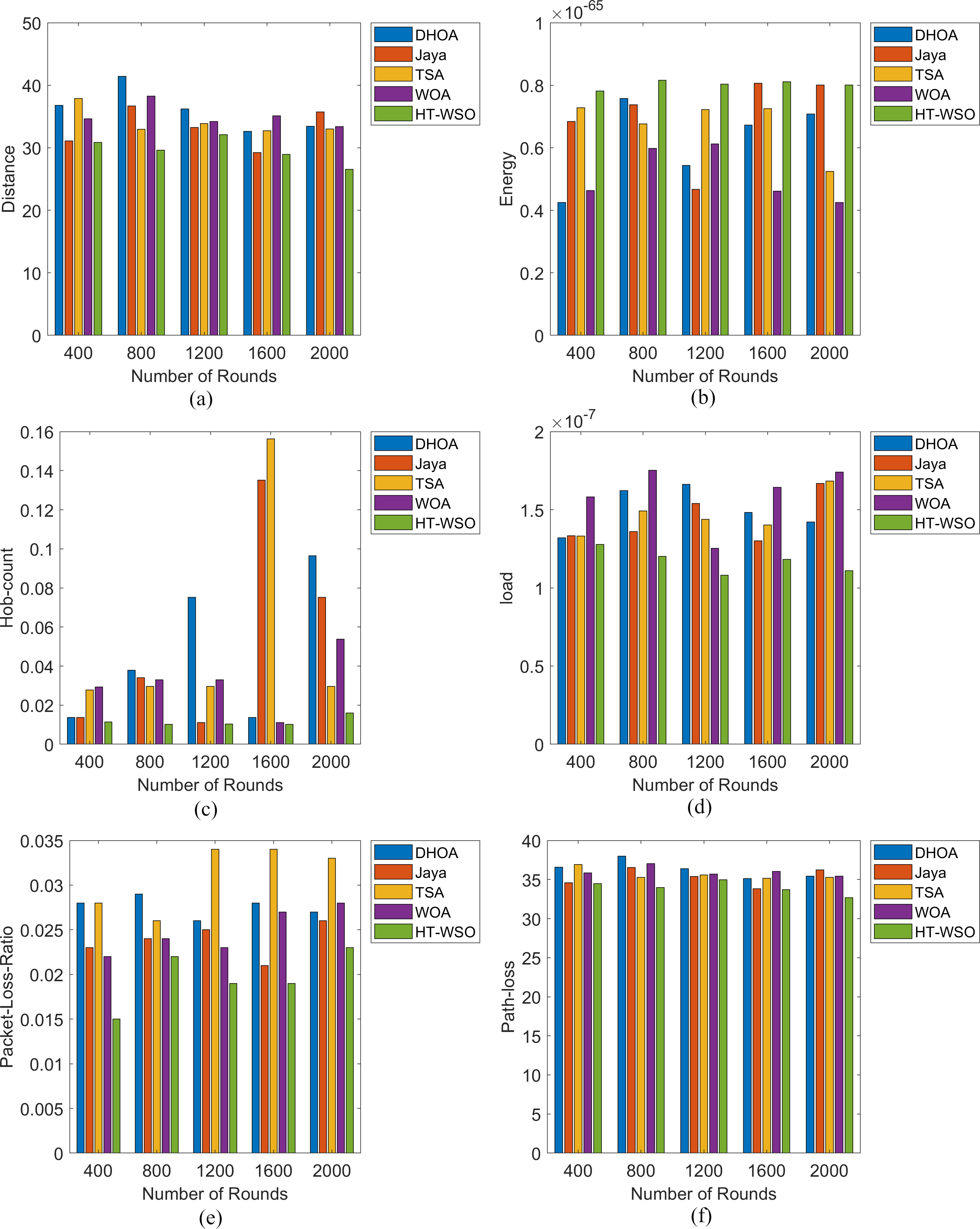
Statistical validation over several traditional algorithms by differing the number of rounds at the number of node 100 regarding a) Distance, b) Energy, c) Hob-count, d) load, e) packet loss ratio and f) path loss.
Statistical validation over several traditional algorithms by differing the number of rounds at the number of node 150 regarding a) Distance, b) Energy, c) Hob-count, d) load, e) packet loss ratio and f) path loss.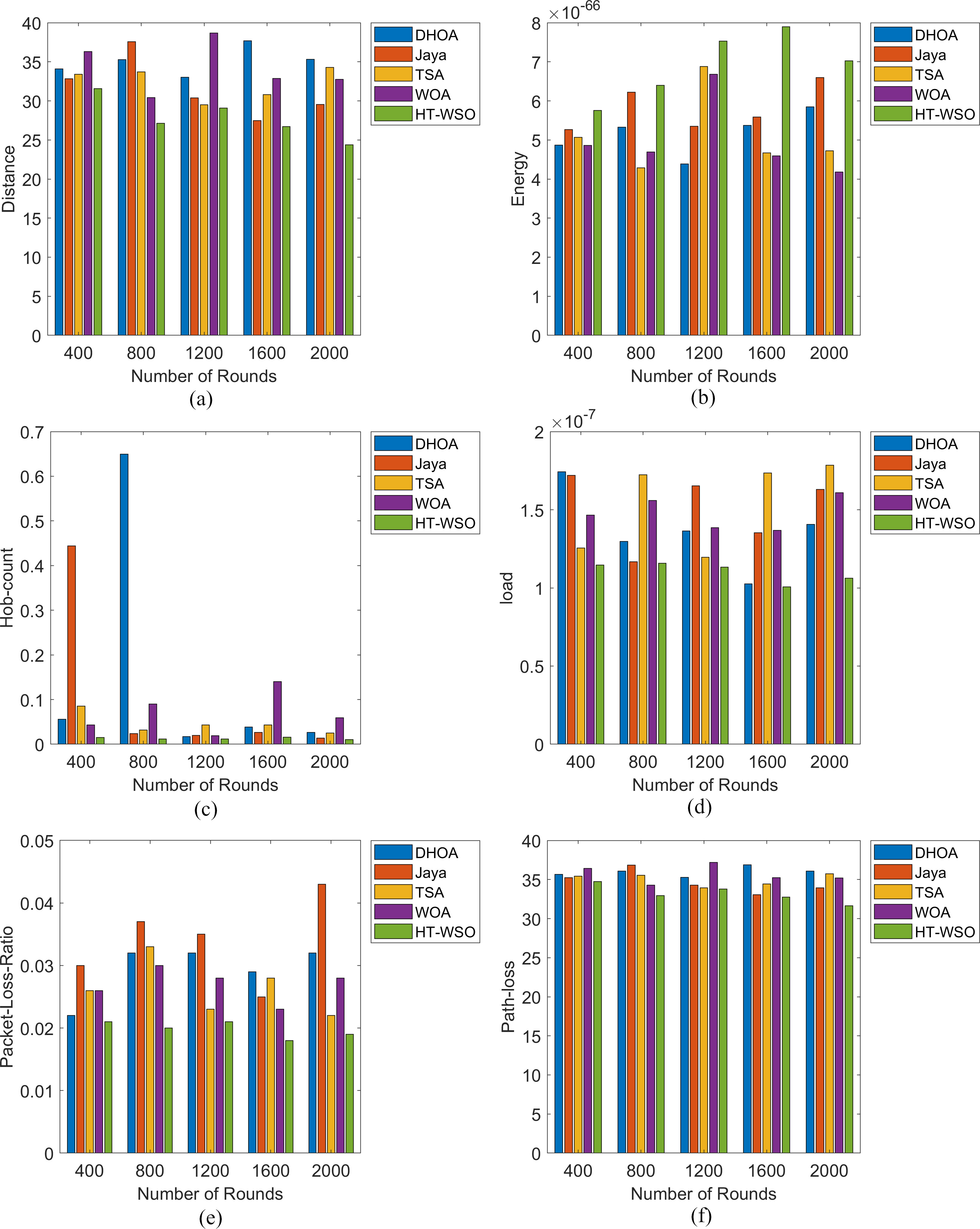
Overall statistical estimation on the recommended WBANs model routing protocol by varying the number of nodes
Overall Statistical evaluation over various classical models with the recommended WBAN model routing protocol by varying the number of nodes at 50
Overall Statistical evaluation over various classical models with the recommended WBAN model routing protocol by varying the number of nodes at 100
Overall Statistical evaluation over various classical models with the recommended WBAN model routing protocol by varying the number of nodes at 150
Comparative analysis of the developed model for offered WBAN model routing protocol
The statistical analysis over other conventional algorithms by differing the number of the round is illustrated in Fig. 5. Here, the successive alive nodes for each transmission can be performed at every round. The transmission is validated with various existing heuristic algorithms, which helps to prove the effectiveness of the offered model. Moreover, the improvement of the number of alive nodes is utilized to enlarge the network lifetime. Here, the recommended HT-WSO model has 26%, 52%, 20%, and 60% higher values than DHOA, Jaya, TSA, and WOA models. Hence, it shows that the recommended method attains enhanced performance while evaluating the successive alive nodes with various traditional algorithms.
Statistical analysis over the number of nodes 50
The statistical analysis over various traditional algorithms by varying the number of nodes at 50 is shown in Fig. 6. In graph analysis, it is clear that the recommended HT-WSO model has acquired less value in all the cases, except the energy in Fig. 6b has a higher value when assimilated over other models. The distance value of the HT-WSO is 18%, 23%, 16%, and 18% lower than that of the DHOA, Jaya, TSA, and WOA models at 1600. In the given graph analysis, the existing TSA model achieves a second better performance regarding distance. Moreover, the DHOA model attains lower performance because it takes longer distances to achieve the goal, affecting the system’s reliability. At 800 rounds, the designed model attains higher energy consumption. It is similar for all other values; the recommended HT-WSO consumes lesser load, path loss, packet path loss value, and hop count accordingly. Moreover, it shows the efficiency of the WBANs model.
Statistical analysis over the number of nodes 100
Here, Fig. 7 depicts the statistical analysis over various traditional algorithms by varying the number of nodes at 100. The value of path loss in Fig. 7e for the recommended HT-WSO model has 14%, 9%, 6%, and 6% lower than the DHOA, Jaya, TSA, and WOA models by varying the number of the round at 400. The graph analysis shows the effective performance regarding distance, energy, hob-count, load, packet-loss-ratio, and path-loss. The performance of the recommended method achieves 6.0%, 11.4%, 13.8%, and 16.2% higher than DHOA, Jaya, TSA, and WOA in terms of distance. Moreover, the existing Jaya algorithm achieves a second better performance in terms of load. Moreover, the existing DHOA algorithm shows second better performance. Throughout the result analysis, the simulation outcome of the designed method shows superior performance while validating with conventional methods.
Statistical analysis over the number of nodes 150
Here, Fig. 8 has illustrated the statistical analysis over various traditional algorithms by varying the number of nodes at 150. The value of energy in the recommended HT-WSO model is 60%, 45%, 77%, and 81% higher over DHOA, Jaya, TSA, and WOA models at 1600 by varying the number of rounds. Here, the graph analysis of the designed method shows superior performance. While estimating the result analysis, the DHOA algorithms hold higher path loss. Thus, the recommended WBANs model has shown better energy efficiency over others. Thus, the simulation outcome of the designed method shows better performance while validating with other-state-of-art methods.
Overall analysis by varying the number of nodes
Here, Table 2 illustrates the assimilative analysis of the recommended WBANs routing protocol model that has been made over various classical algorithms. Statistical estimation has been utilized to show the performance of the offered method in an effective manner. Hence, the designed model has provided better energy-efficient outcomes.
An overall analysis of the WBANs routing model
The assimilative analysis of the recommended WBANs routing protocol model has been carried out over various classical algorithms by varying the number of nodes from 50 to 100, is represented in Tables 3, 4, and 5. Regarding the distance value, the recommended HT-WSO model has 30%, 29%, 10% and 18% over DHOA, Jaya, TSA and WOA models by means of best in node 50. Thus, the recommended model has provided better energy-efficient outcomes.
Comparative analysis using recent existing methods for designed WBAN models routing protocol
The comparative analysis of the designed model using recent existing methods regarding energy is tabulated in Table 6. The performance of the developed model attained 2.2%, 15.1%, and 6.7% progressed than APB-CO, SIMOF, and HAOA. Thus, the result validation of the designed model attains better performance while validating with other-state-of-art methods.
Conclusion
In recent years, the WBAN has been widely used in the healthcare applications for remote patients. Moreover, the existing techniques stated the several challenges like energy constraints, path loss, and transmission delay. However, these challenges tremendously decrease the network lifetime. In this context, we have planned to develop a novel method for to enhance the energy efficiency in the WBAN model. This paper has implemented the multi-objective constraints for energy-efficient routing in the WBANs model. All the sensor nodes in the WBANs were gathered initially. Commonly, the WBANs model was comprised of fixed sensor nodes and mobile nodes. Hence, the conventional techniques were ineffective in order to obtain high energy efficiency, a novel routing protocol technique was constructed by using the recommended hybrid optimization algorithm. For further estimating the efficiency of the network, the objective function was derived by distance, hop count, energy, path loss, and load and packet loss ratio. In order to obtain the optimum path selection, the HT-WSO was applied. In the end, the ability of the model was evaluated by utilizing the parameters as well as assimilating over traditional models. Throughout the analysis, the recommended HT-WSO aided WBANs model has shown 11%, 9%, 13%, and 7% enhanced performance than DHOA, Jaya, TSA and WOA in terms of best-at path loss for the number of node 150. Thus, the outcomes of the designed HT-WSO model provide better energy efficiency over WBANs while validating with existing methods. The practical implications of the designed method for WBAN routing protocol help to enhance the scalability and efficiency of healthcare applications. Generally, it can be widely used for tracking the device, monitoring, and tracking appliances. Hence, it provides significant implications for delay, energy and packet loss ratio. Thus, the implications of our research findings show the superior performance that is utilized to improve the network lifetime in the WBAN routing protocol.
Importance of the study
Moreover, the WBAN can be utilized in medical healthcare applications to monitor patients using sensor nodes. Thus, the designed method is utilized to minimize the computational overhead, and thus it helps to attain the minimal optimal path in the WBAN network. In a wide geographical area, the optimal routing path is needed in case of emergencies. However, the designed hybrid optimization model is performed, which helps to improve the network life. Thus, it provides reliable performance when the communication links are connected in the WBAN system.
Limitations and future work of the developed model
In the WBAN routing protocol, the quality of the service metrics is very limited. Here, the synchronization of data from the multiple nodes becomes complicated while gathering the data from various sensors. Additionally, the cross-layer interactions in different networks become challenging tasks in multi-hop communication networks. In future work, the Cascading Information retrieval by Controlling Access with Distributed slot Assignment (CICADA) will be adopted to further enhance the reliability of the designed model. Moreover, the Quality of Service (QoS) will be improved for the WBAN in the routing protocol. Consequently, different deep learning approaches will be adopted, which will help to improve the performance in the WBAN model.