



Abstract
Several sensor nodes are used in Wireless Sensor Networks (WSNs). A multi-level clustering-based multi-trust model is introduced in WSN. The model’s main intent is to compute trust value for performing secure transmission. Initially, to verify vulnerability, the watchdog counter provides the required trust output. Further, this is intended to build a multi-level trust clustering process. Here, multi-trust is carried out by energy trust, communication trust, and data trust. Hence, multi-trust is compared with a threshold value. Once the trust value is generated, it is given for processing the cluster groups. Due to more multi-trusting, it creates multi-level clustering for security level enhancement. After the cluster group is formed, the major aspect of CH is optimally obtained with a Modified Exploration-based Pelican Optimization Algorithm (ME-POA). Finally, performance is carried out in multi-objective functions, where parameters are defined as distance, delay, energy, and multi-trust. Thus, with the determination of optimal results, the proposed multi-level clustering proves that it offers secure data transmission over WSN.
Keywords
Introduction
The Internet of Things (IoT) development and the incorporation of sensors into various intelligent devices are used in WSN technology to connect the physical world of humans with the virtual world of electronics [1]. WSN is a particular kind of ad-hoc network made up of sensors placed around a region to track various factors like sound or motions, temperature, and vibration [2]. Due to the benefits of this kind of network, including its speed of deployment, ease of use, and lower cost, WSNs have been extensively employed in many applications, that includes battlefield monitoring, healthcare, and the environment. WSNs, provide many research hurdles, such as hardware limitations, coverage gaps, fault tolerance, energy consumption, and localization [3]. Security is the most currently unresolved challenging issue and is not fully addressed [4]. The sensor nodes are correctly prearranged in the clustering method, which can reduce the nodes’ power consumption because sensor nodes have limited battery life [5]. Clustering could offer benefits like decreased routing latency, load balancing, enhanced connectivity, data fusion, scalability, fault tolerance, and stabilized topology [6].
WSNs contain many clustering techniques that depend on the algorithm, which can be categorized as deterministic or probabilistic systems [7]. The existing methods are crucial for enhancing WSN security since they often assume that a clustering architecture has already been established before choosing a reliable CH [8]. Therefore, before using any security model, the most reliable nodes must be selected as the CH. The sensor nodes are transmitted to the sink node directly or across many hops after clustering in WSN [9]. Energy consumption increases when CHs are connected directly to the sink, but this problem does not require a routing mechanism since it is not affected by its overheads [10]. Moreover, less energy will be used when CHs collaborate in different-hop routing, which can enhance the lifespan of the WSN [11]. The two main significant factors when selecting a reliable CH are security and energy. Few clustering strategies take security into account by including the factors such as reputation and trust in the election process, while effective cluster strategies focus only the energy [12].
Further, the CH frequently changes when network time is minimized, and the CH is selected when transmission of the control packet gets enhanced. WSN is essential for various applications specified for multiple optimization problems in organizations [13]. The routing, lifetime, quality of service, throughput, power consumption, connectivity, coverage, calibration, and optimized clustering are the purpose of WSN [14]. The WSNs for quality of service and energy efficiency are focused on multi-objective optimization, which is utilized for network lifetime, energy efficiency, and coverage. These issues are observed to be solved in various heuristic algorithms such as Evolutionary algorithms, Whale optimization algorithms (WOA), Harmony search algorithms, and Particle Swarm Optimization (PSO) [15]. The extended scope and multiple dimensions are presented, that is, WSN routing utilized swarm intelligence-based methods [16] for performing data transmission with clustering. Various protocols have selected the optimal path, but there are a few challenges, such as less delay and high throughput. Hence, the WSN lifespan is enhanced by conflicted parameters such as cluster head selection, optimal clustering, and energy-efficient routing [17]. Therefore, a new secure trust-based- transmission with multi-clustering is developed to secure the data transmission efficiency.
The major contributions of this paper are mentioned as follows.
To build a competent multi-level clustering in WSN to securely transmit the data over the network with high energy efficiency and obtain a better transmission rate. To perform the multi-trust computation with trusted nodes to secure data transmission by determining three trust values such as data trust, communication trust, and energy trust. To design an efficient multi-level clustering architecture with the support of developed ME-POA for selecting optimal trusted CH over the network initiated with K-means clustering for determining the clusters. To establish a hybrid optimization algorithm named ME-POA for performing multi-level clustering in WSN using trusted nodes to provide efficient data security and energy efficiency. To analyze developed secure trust-based transmission with multi-level clustering in WSN with conventional algorithms and techniques to prove the effectiveness of the developed model.
The organizations of this paper are described as follows. Section 2 explains the literature survey and challenges in existing methods. Section 3 discusses the proposed methodology of multi-level clustering in WSN. Section 4 describes the implementation of multi-level clustering with secure trust-based transmission in WSN. Section 5 discusses the developed ME-POA to perform multi-level clustering in WSN. Section 6 represents the result and discussions. Finally, Section 7 elaborates on the conclusion.
Related works
In 2020, Saidi et al. [18] analyzed the significant nodes and eliminated the unwanted nodes in the network. The local clustering algorithm introduced the malicious CH without affecting the network’s performance because it focused on a trust evaluation model with cluster members. After the election process, the simulation observed that the developed method protected the network from compromising the CH and prevented malicious nodes from acquiring CHs. The suggested approaches have achieved a higher detection rate and lower number of false negative and false positive values in malicious nodes for misbehavior detection.
In 2015, Butun et al. [19] introduced a multilevel clustering framework of Intrusion Detection System (IDS) which was utilized for hierarchical WSN. There were two intrusion detection frameworks: Upward-IDS (U-IDS) and Downward-IDS (D-IDS). The U-IDS was utilized for detecting the irregular behavior of the cluster, and the D-IDS was used for detecting the member nodes’ irregular behavior. Hence, the optimum parameters, such as U-IDS and D-IDS framework, have been analyzed and performed with various calculations.
In 2022, Le-Ngoc et al. [20] designed a framework for a multi-level clustering method with the utilized Sugeno-based Fuzzy Logic Controller (FLC), which has organized WSN into multiple clustering levels. The CH was gathering the members of data and forwarding it to the sink nodes. On the other side, it collaborated the data packets into the sink destination in multi-hop routing. For optimizing the FLC clustering, enhanced SSA algorithms were employed. The effectiveness of the clustering process was enhanced, and the rule base was reduced by optimizing the FLC. The extended simulations were performed in OMNET++ for analyzing the suggested method concerning different performance measures that consisted of the average energy of the WSN’s nodes, Last Node Dead (LND), retransmission ratio, Half Nodes Dead (HND), data packet loss and First Node Dead (FND). Therefore, the suggested method outperformed various multi-hop routing and well-known clustering techniques.
In 2020, Mehta and Saxena [21] suggested a clustering method to sustain energy efficiency in WSNs named Sailfish Optimizer (SFO) and Multi-Objective Based Clustering. The effective fitness function from multiple objectives was utilized for selecting the CH. It was supported for minimizing the total dead sensor nodes and energy consumption. After selecting the CH, the data transmission and SFO were utilized for selecting the optimal path. The resulting outcome for the recommended method was compared and analyzed with various algorithms, which include PSO, Ant Lion optimization (ALO), Genetic algorithm (GA), and Grey wolf optimization (GWO). The suggested methods have shown the simulation outcomes as they have superior performance in energy consumption and the number of sensor nodes than the GWO algorithm. Therefore, it compared and analyzed with existing approaches, and it provided superior performance than the other optimization methods.
In 2020, Bhushan and Sahoo [22] suggested a fuzzy-based clustering technique that was utilized for balancing the cluster formation and network communication that supported for identifying the joined nodes. To identify the optimal path and destination, the Ant Colony Optimization (ACO) algorithm was utilized. The performance analysis and the results showed that the ISFC-BLS has higher security and efficiency than the other existing clustering techniques or heterogeneous ring clustering techniques.
In 2021, Verma et al. [23] recommended an Intelligent Clustering ITS (ICITS) method for selecting the CH with hybrid optimization techniques named GABAT. It was upgraded by enhancing the BAT and GA algorithm techniques. The main objective of the ICITS framework was utilized in military road transport areas such as reliability and security. The data was gathered directly from the sensor node location. The suggested ICITS have shown the simulation outcomes as it have better performance than the Cluster-based Intelligent Routing Protocol (CIRP) with various performance measures such as the number of packets sent, network survival period, and stability period.
In 2020, Arikumar et al. [24] designed it by utilizing intelligent techniques such as Fuzzy Inference System (FIS)and PSO techniques named Energy Efficient Lifetime Maximization (EELTM) method. Then, it introduced an optimal selection algorithm named CH – Cluster Router (CR) method utilized by calculating the fitness values with the supported PSO technique. It was utilized to identify two optimal nodes; every node contained the CH–CR method. The CH was employed for collecting the data from the members of clusters, CR was utilized to collect data from the CH, and finally, the data was transferred to the BS. Therefore, the CH overhead was minimized. In intelligent approaches, the FIS partitioned the network into unequal clusters, and each CH radius was figured out. The suggested EELTM method was observed and analyzed the performance with various clustering techniques.
In 2022, Priyanka et al. [25] recommended a circular WSN which contained various levels of nodes that were randomly distributed when the node density was higher in the sink node. It was enclosed with several numbers of sectors. Each sub-sector in dynamic cluster head selection was developed by utilizing WOA. The residual energy and network lifespan were analyzed for the recommended method performance. The recommended circular WSN method was analyzed and proved to be performing in energy depletion. Then, the suggested method performance was compared with the LEACH and PSO protocol methods. The results have shown that the suggested methods have minimized the residual energy ratio and 50 joules of initial energy compared with the LEACH and PSO protocol techniques. Hence, it enhanced the network lifetime and percentage minimization in residual energy ratio when initial energy was increasing.
In 2022, Skondras et al. [30] developed a selection and clustering-based algorithm for the cluster head with an effective Group Handover (GHO) strategy. The cluster head has been selected with respect to Point of Access (PoA) groups. As a result, the author has created novel downlink and uplink transmission channels to replace data packets. At last, extensive experimentations were executed for a next-generation drone network architecture that supports multimedia services and the Internet of Things (IoT).
In 2020, Siountri et al. [31] focused on applying new technologies in the construction industry like Blockchain, IoT, and BIM. It investigates their interoperability and interconnection on an offered architecture. Additionally, effective security, monitoring, and management were considered essential factors for the operation of the organization that hosts.
Problem statement
Features and challenges of existing clustering models in WSN
Features and challenges of existing clustering models in WSN
With the admittance of wireless technology, WSNs occupy a milestone place in the technology industry. Being with myriads sensor nodes, communication occurs among all the nodes. Due to this inter-communication, several attacks can cause intruders in the transmission process. Thus, security maintenance is the main challenging issue in WSN. Enormous studies are given in Table 1. regarding the advantages and challenges of clustering and CH selection in WSN. Trust management scheme [18] increases the trust value and improves the performance by a high true and less false rate. But, it impacts the memory and communication overhead of the network. U-IDS and D-IDS [19] decrease the trade-off gradually and attain less false alarm probability. However, it falls into the execution time complexity. FLC-SSA [20] reduces the retransmission ratio and data packet loss and evades the congestion problem. Yet, it does not achieve high reliability and more security path for transmission using sensor nodes. MCH-EOR [21] identifies the optimal and secured path and maximizes the multi-objective function. On the contrary, it cannot apply to using evolutionary algorithms. Fuzzy clustering [22]enhances the robustness of the network topology and obtains less delay and more energy. But, it does not stabilize the network lifetime and QoS parameters. IC-GA and BAT [23] increase the stability, survival time, and packet delivery rate. However, it produces a slow convergence rate by generating random parameters. EELTM [24] increases the lifetime of the network, and the energy consumption is reduced. But, the quality of connection establishment does not evaluate. CH-WOA [25] deduces the ratio of residual energy used for transmission. Yet, the data imbalance leads to the yield of imprecise results. To tackle all the disadvantages mentioned above, a new clustering approach is introduced for the WSN environment.
Proposed multi-level clustering model
WSN is frequently used in intelligent environments, including environmental monitoring, traffic monitoring, transportation, smart homes, and smart cities. The sensor nodes are now accessible in low-power, low-cost, and compact nodes equipped with sensing, processing, and wireless communication capability due to recent technological advancements. These cheap sensor nodes are frequently installed in a large number of WSNs. The data processing module, transmission module, and data collecting module are included in each sensor node. If the network is operational, the sensor node collects data and sends it to a base station. The main limitation of WSN is the limited energy of sensor nodes. The node will expire more quickly due to inefficient energy usage, which shortens the network’s lifetime. Data transmission in WSN uses more energy than data processing and sensing. The volume of data traffic can be decreased to enhance the network’s total energy consumption. Moreover, the battery’s cost is significantly less than the sensor’s. A single neighbor is the one in which a node’s data is transmitted in a single-hop communication, which prevents it from duplicate data transmission throughout the network of WSN. Reliability is lower in a single-hop network, but energy usage is higher. When there is a multi-hop communication, the node sends data to all of its nearby nodes, increasing energy cost reliability. It may be energy-efficient to group sensors into clusters because prior research has shown that it transmits a bit of data and uses more energy than computing. It is a challenging task to manage several data sets in clustering, and it is time-consuming and unable to recover from data corruption. Multi-level clustering is, therefore, necessary to tackle these constraints. Therefore, a new multi-level clustering with a secure trust-based transmission model in WSN is developed, which is shown in Fig. 1.
Secure trust based-multi-level clustering for data transmission in WSN.
A new multi-level clustering in WSN with secure trust-based transmission is developed to protect the data transmission and enhance energy efficiency. At first, the watchdog counter is utilized to check the vulnerability of the nodes. Then, the multi-level trust is computed with three different trust values: data trust, communication trust, and energy trust to ensure the trusted nodes in the network. These trust values are compared with threshold values, where the nodes will be avoided if the trust values are higher than the threshold. On the other side, if the lower value is obtained in the trust values of the nodes, then those nodes are taken to further processing. Then, multi-level clustering is initiated with K-means clustering to get clustered nodes from trusted nodes. Further, the multi-level clustering is performed with developed ME-POA to enhance the security level and energy efficiency of data transmission in WSN. Multi-level clustering saves a lot of time and extends the network lifetime; clusters are easy to assign in advance and easy to use in large datasets. Therefore, the new multi-level clustering secure trust-based transmission is performed in this proposed model. The objective of the developed model is to minimize energy consumption, distance, and delay and simultaneously maximize trust in the WSN network while performing data transmission.
The energy model is used to determine how much energy is required to transfer data across the network from the source node to the target node, which is described in Eq. (1).
Through Eq. (2), the energy is computed for receiving
Here, the reduced energy caused by the multipath fading process over the WSN is denoted by
In WSN, the trust-based transmission with multi-level clustering with is performed with several parameters that are given in Table 2. The parameter includes the number of nodes, number of rounds, initial energy, optimal election probability of node, field dimension, ETX, ERX, Efs, Emp, percentage of nodes, alpha, and data aggregation energy.
Initialization of parameters for multi-level clustering with the secure trustbased transmission in WSN
Initialization of parameters for multi-level clustering with the secure trustbased transmission in WSN
Vulnerability checking by watchdog concept
For each subordinate, CHs maintain watchdog counters with abnormal counters. This technique is called Secure Trust-Based Transmission. The Level 1 CH of the remaining nodes, in this case, is Node A. As a result, each subordinate node has a watchdog counter, including Node 1, Node 2, …, and Node 6. This watchdog counter counts the particular irregularities. Any watchdog counter crossing a particular threshold is detected and added to the isolation table along with its associated node. Next, all communication with this node is shut down in the mitigation step. However, assume that the Node 4 threshold value watchdog counters, as well as the Node 4 watchdog counter, are 10. So, Node 4’s watchdog counter has reached the threshold value, and Node 4 is identified in the isolation table as an irregular node. Finally, Level 1 CH disables all communication with Node 4. The vulnerability checking using the watchdog concept is shown in Fig. 2.
Vulnerability checking using watchdog concept.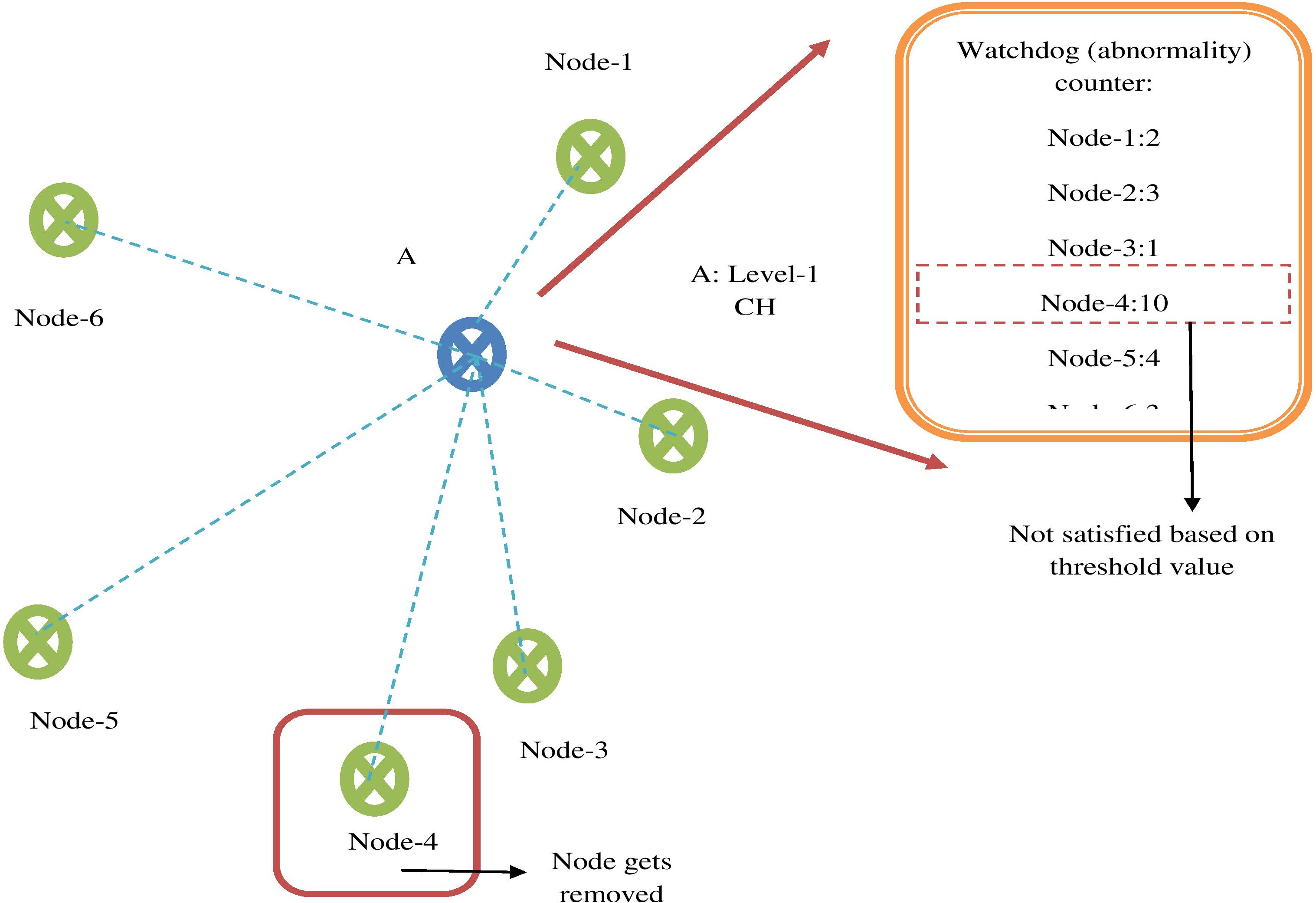
Here, in this proposed methodology, the watchdog concept is employed for checking vulnerability in the nodes present in the WSN to verify whether those nodes are trusted or not for the data transmission in WSN. Only the trusted nodes proceed to the next level of processing.
Trust is a crucial measure since it supports choosing a reliable node with low energy over an unreliable node with high energy. Each node gives all of its neighbors the same initial trust value during the election, which makes the election of the CH dependent on other election metrics like communication trust, data trust, and energy trust. The action of nodes changes over time during the further rounds of the election. In addition, when determining the weight of nodes, a significant weight is given to the trust value. As a result, nodes with high trust values have a better probability of becoming CHs than nodes with low trust values. Different measures are used to choose trustworthy nodes. The calculation of trust values is made with three factors, such as data trust, communication trust, and energy trust, which are described as follows.
Data Trust: The number of successful and unsuccessful readings is used to determine the data trust value expressed in Eq. (3).
Here, the number of packets from the cluster member with successful readings is indicated by Rp, and the number of packets from the cluster member with unsuccessful readings is denoted by Sp. The range of data trust falls between [0, 1].
Communication Trust: WSNs transmit data using a wireless link in communication trust. There is ineffective communication between the nodes when there is a link attack, a selfish attack, or a selective forwarding attack. This unsuccessful communication has some connection to the wireless channel and link quality as well as the attacks. The trust evaluation over communication trust is depicted in Eq. (4).
Here, the link quality factor is represented by
Energy Trust: The ratio of the energy consumed at time
Here, the energy consumed by CM at time
The multi-level clustering is initiated with the K-means algorithm for generating clustered nodes, which is used for further clustering. In k-means clustering, the input is obtained as nodes in WSN clustered to obtain 10 clustered nodes as the output. The clustered nodes are further processed into multi-level clustering using the developed ME-POA at different levels to get trusted optimal CH for reducing the computational overhead in the data transmission process. The optimal trusted CHs are chosen with the help of the developed ME-POA and denoted by
Developed multi-level clustering in WSN based on developed ME-POA.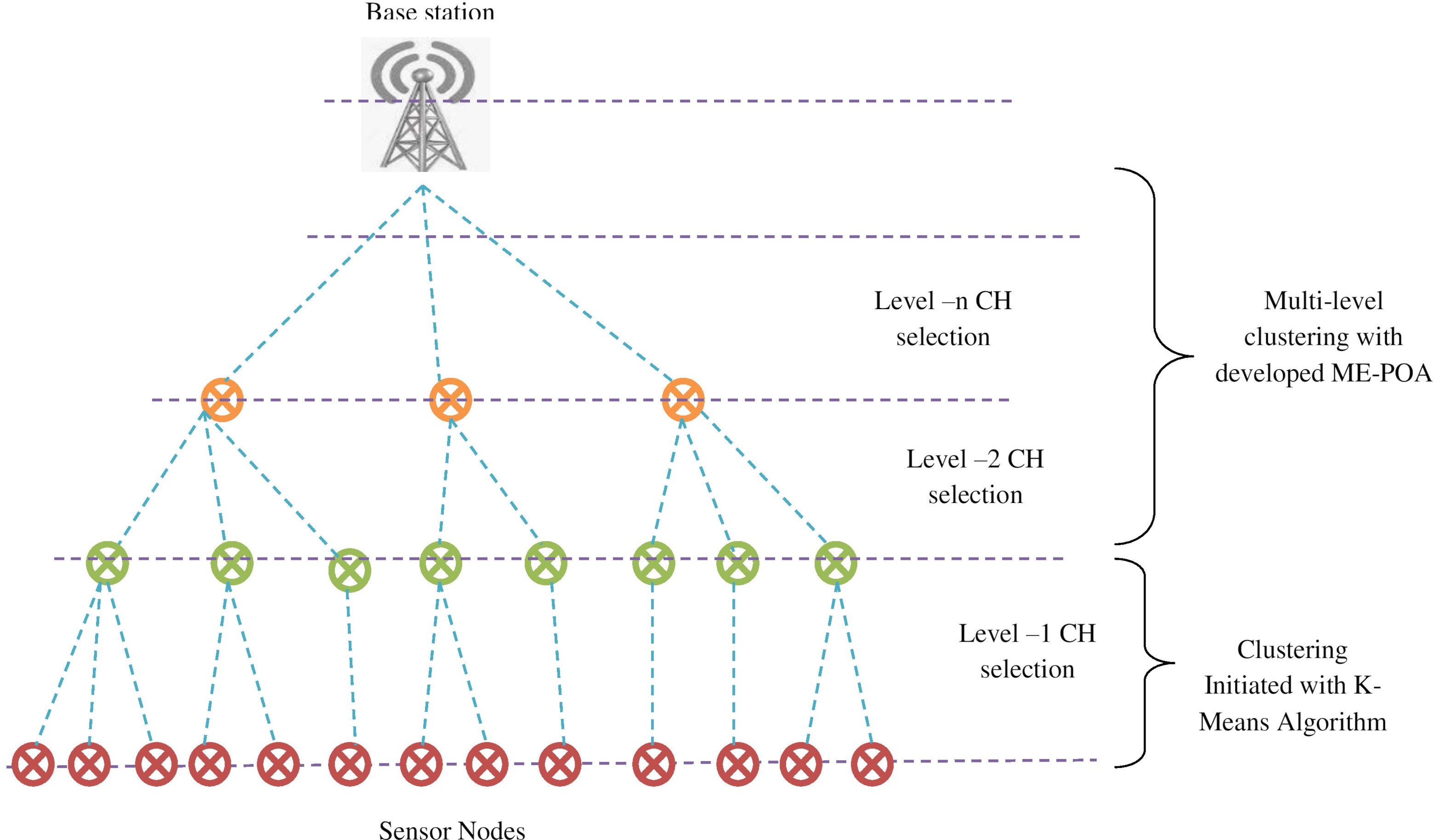
Proposed ME-POA
The suggested multi-level clustering-based secure transmission in WSN develops ME-POA for securing the data and enhancing efficient energy to extend the network lifetime. POA [26] is used in this proposed model since it has better performance and a high accuracy rate. It solves various optimization problems. However, it has time complexity and difficulty solving real-time application issues. Therefore, an enhanced version of POA is developed and named ME-POA. In this suggested ME-POA, the term
Here, the term
POA: Pelican is a bird with a long beak and a wide bag in its neck for catching and swallowing prey. When a pelican is hungry, it will even consume seafood. Frogs, turtles, and crustaceans are only sometimes eaten by pelicans. Pelicans frequently cooperate during hunting. Pelicans have become hunters due to their clever hunting behavior and tactics. It randomly initializes population members based on the lower and upper bound problems derived in Eq. (7).
Here, the term
The population matrix is used to identify the pelican population members in the suggested POA. The columns of this matrix indicate the suggested values for the problem variables, and each row represents a candidate solution that is expressed in Eq. (8).
Here, the term
The objective function vector of the candidate solution is determined in Eq. (9).
Here, the term
Exploration Phase 1 (Approaching prey):
During the first phase, pelicans determine the location of the prey and then fly toward it. This enhances the POA’s ability to explore the problem-solving space precisely. In the exploration phase, moving toward the location of the prey is given respectively. Here, the random parameter
Here, the position of the prey in
Suppose it increases the value of the objective function. In that case, the algorithm is stopped from moving to non-optimal locations during this sort of updating, also known as effective updating, which is derived in Eq. (11).
At this time, the objective function of phase 1 is indicated by
Exploitation Phase 2: Water-surface winging
The pelican in the second phase reached the water’s surface. This enhances POA’s capability for local search and exploitation. The recommended behavior of pelicans is utilized in Eq. (12).
Here, the constant term is denoted by
Here, the objective function value based on phase 2 is indicated by
In WSN, the trusted CH selection is performed using developed ME-POA, which helps to transfer the data into the base station efficiently and is helpful in data aggregation. The trusted CH selection employs a multi-objective function to minimize delay, distance, and energy consumption and simultaneously maximize data trust, communication trust, and energy trust of the WSN. The total trust of the node is calculated which is shown in Eq. (14).
Here, the total trust is denoted by To_tru. Communication trust is denoted by Co_Tr. The data trust is indicated by Da_Tr and the energy trust is denoted by En_Tr. The multi-objective function is given in Eq. (15).
Here, the energy consumption is denoted by ene, the constant variable is denoted by
Experimental setup
Various experiments have been evaluated, and the performance of the developed multi-level clustering model has been conducted in MATLAB 2020a. The analyses were performed between the suggested model and traditional models. The total number of population, as well as the number of iterations, was considered as 10. The performance analyses were included as normalized energy, convergence analysis, and a number of alive nodes. The performance analysis of the developed ME-POA was compared with conventional algorithms such as JAYA [27], Sail Fish Optimizer (SFO) [28], Particle Swarm Optimization (PSO) [29], and POA [26].
Evaluation of convergence analysis based on cost functions
Evaluation of convergence performance of developed trustbased data transmission with multi-level clustering in WSN using various algorithms by varying the node count to be (a) 50, (b) 100, and (c) 150.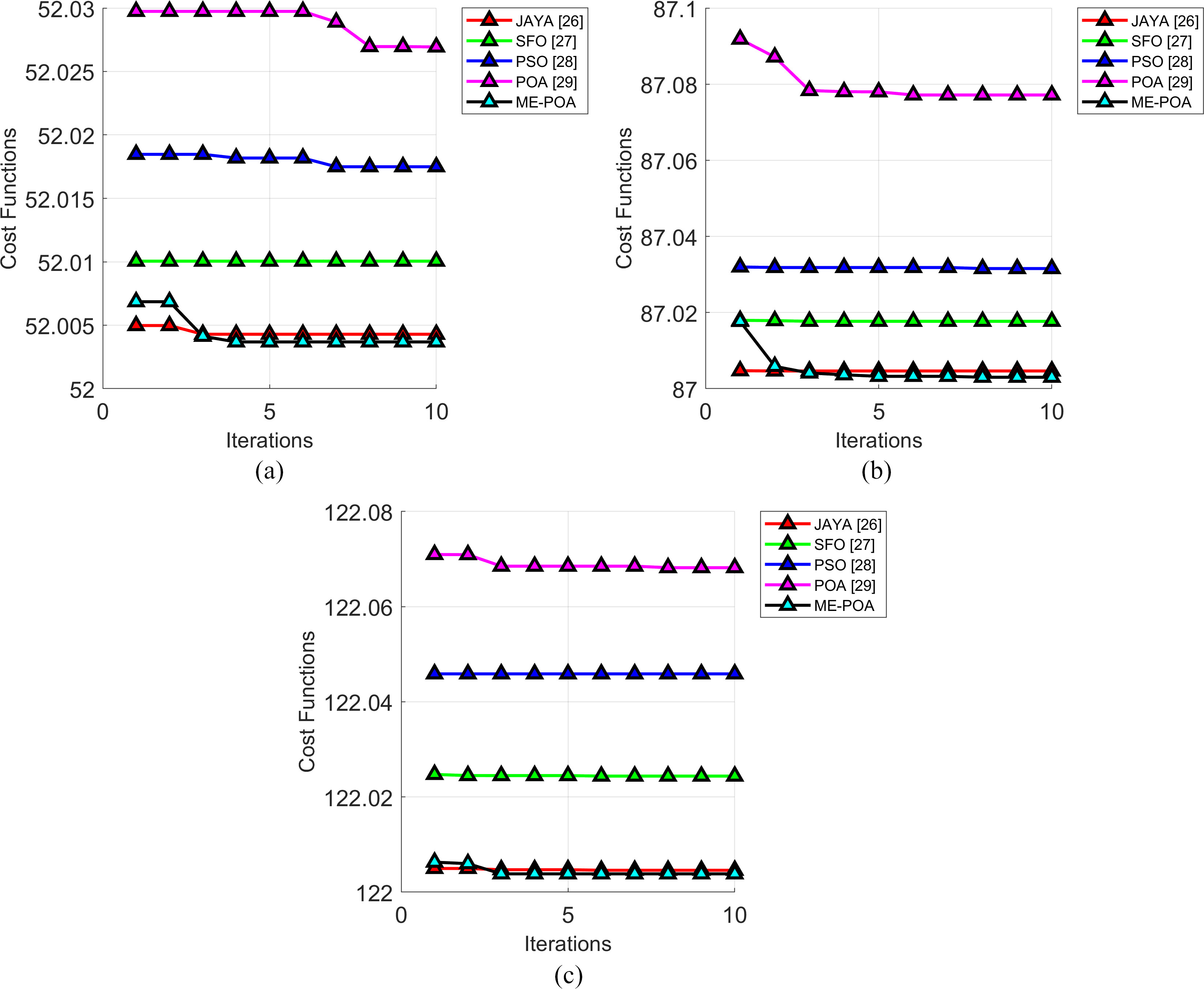
Evaluation of Alive nodes with developed multi-level clustering model over various algorithms by varying the node count to be (a) 50, (b) 100, and (c) 150.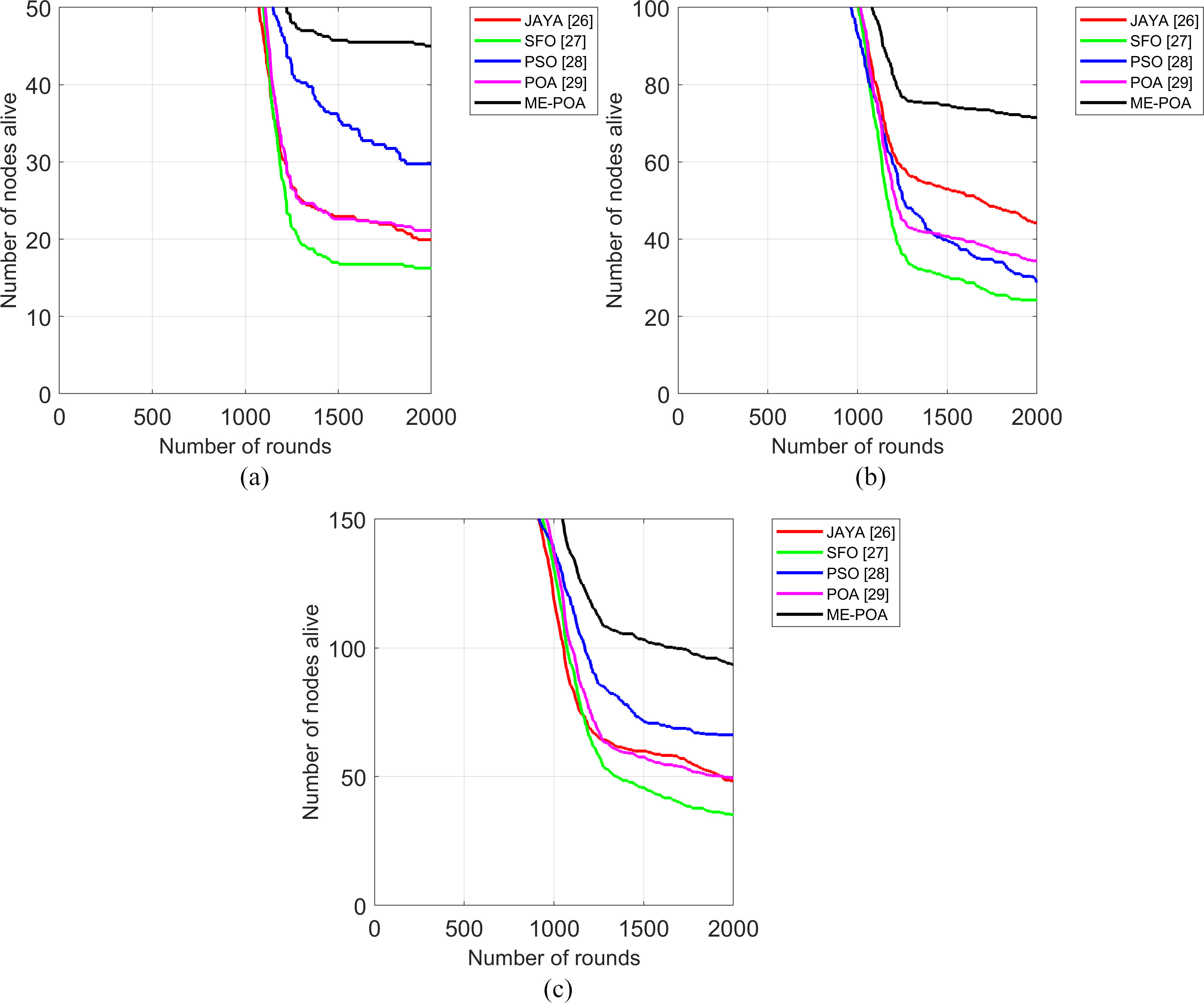
Evaluation of Normalized energy with developed multi-level clustering model over various algorithms by varying the node count to be (a) 150 (b) 100, and (c) 50.
The performance of the developed ME-POA-based multi-level clustering model is observed with various algorithms to analyze the convergence performance that is shown in Fig. 4. The suggested ME-POA is 4.2%, 4.8%, 7.7%, and 5.8%, superior to the conventional algorithms such as POA, SFO, POA, and JAYA algorithms. Hence, the developed ME-POA is minimized delay in the data transmission of WSN.
The suggested ME-POA-based multi-level clustering model is evaluated with various algorithms to analyze the number of alive nodes that are shown in Fig. 5. The suggested ME-POA is 5.3%, 4.2%, 2.2%, and 2.6%, superior to the conventional algorithms such as POA, SFO, POA, and JAYA algorithms. Hence, the developed ME-POA is better than other existing varying nodes in WSN.
Evaluation of Normalized Energy over the developed model
The suggested ME-POA-based multi-level clustering model is analyzed with various algorithms to analyze the normalized energy that is shown in Fig. 6. The developed ME-POA is 3.1%, 2.5%, 0.6%, and 1.5% better than the conventional algorithms such as POA, SFO, POA, and JAYA algorithms. Hence, the developed ME-POA achieves better performance than other existing normalized nodes. Finally, the developed model achieves secure trust data transmission in WSN.
Evaluation based on cluster head selection of the developed model
Evaluation of cluster head selection with developed multi-level clustering over various algorithms in terms of variation nodes such as (a) 150 (b) 100 and (c) 50.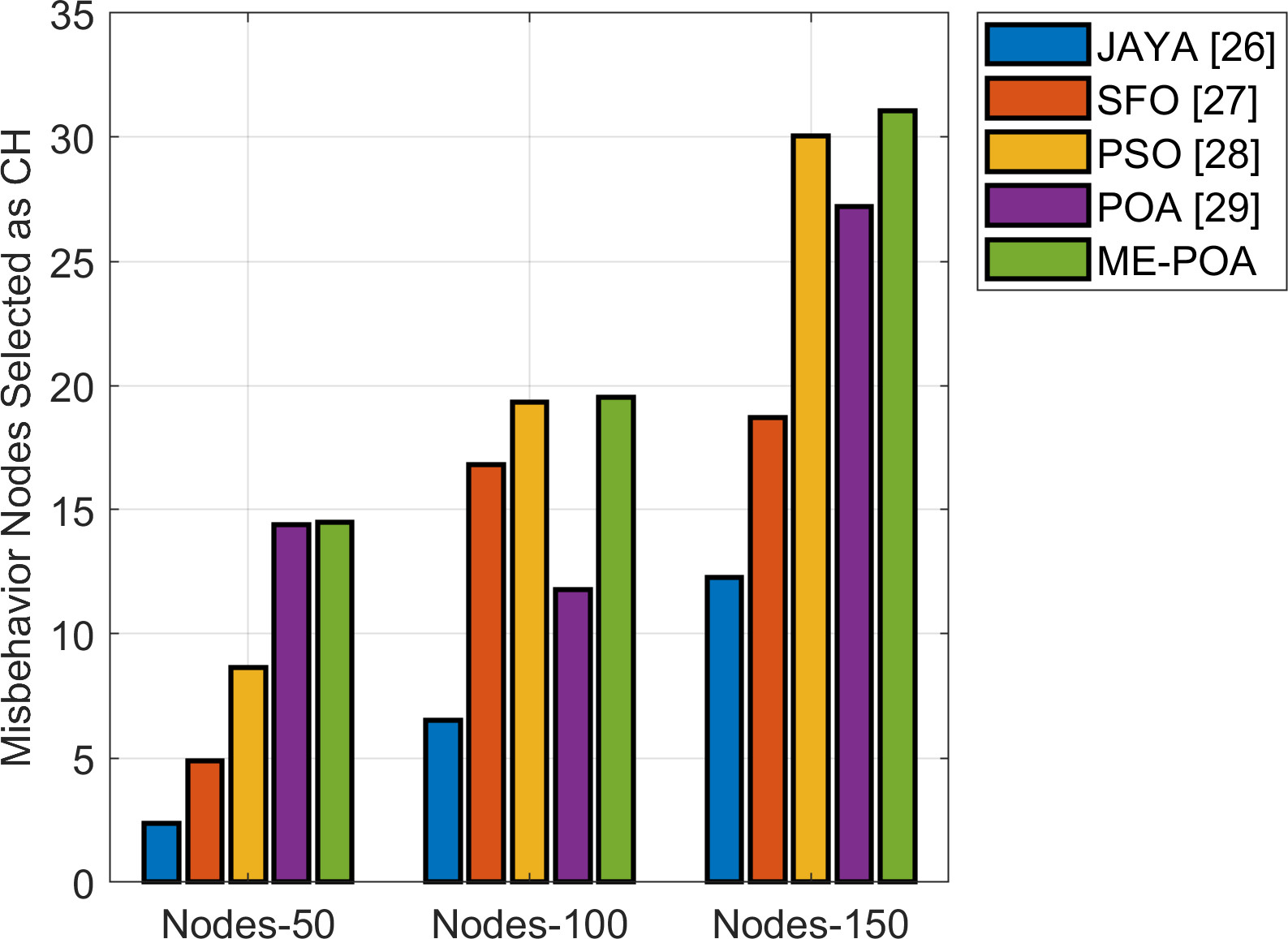
The suggested ME-POA-based multi-level clustering model is analyzed with various algorithms to evaluate the cluster head selection that is shown in Fig. 7. In cluster head selection, it includes three node values that are considered 50,100, and 150. The suggested ME-POA for node 150 is 2.1%, 2.3%, 3.5%, and 5.4%, superior to the conventional algorithms such as POA, SFO, POA, and JAYA algorithms. The developed ME-POA is better than other existing nodes. Finally, the developed model achieves efficient data transmission performance with minimum delay and energy consumption.
A secure trust-based multi-level clustering in the WSN network was proposed to address the communication problems in data transmission. The model’s primary goal was computing the trust value of the node for carrying out the secure transmission. At first, the watchdog counters have been impacted to confirm the vulnerability of the nodes in the WSN. Then, the multi-trust computation was performed with three trust values data trust, communication trust, and energy trust. Thus, if the trust value was larger than the threshold, the corresponding node would have been ignored or destroyed otherwise, it would be utilized for transmission. The multi-level clustering was then performed for enhancing the security level due to multi-trust values. After the cluster group was produced with K-means, developed ME-POA was used for multi-level clustering to reduce computation overhead. The performance of the suggested ME-POA was 4.2% enhanced than JAYA, 4.8% improved than SFO, 7.7% improved than PSO, and 5.8% enhanced than POA at the node variation of 100 under the convergence analysis. Therefore, the suggested multi-level clustering model has demonstrated that it provided secure data transmission over the WSN with the determination of optimal results. Thus, the performance enhancement is applicable for other research like target tracking, Smart Home Appliances, Forest fire detection, and Water quality capability. It is utilized to resolve privacy and security issues and also it is mainly useful for IoT healthcare applications. In the future, we will try to apply our designed method for any one of the above-mentioned real-time applications. Additionally, we will plan to explore more energy-efficient approaches to tackle the source location privacy (SLP) issue according to mobile sink nodes or multiple source nodes.