



Abstract
With the rapid development of the economy, the demand for electric power is increasing, and the operation quality of the power system directly affects the quality of people’s production and life. The electric energy provided by the electric power system is the foundation of social operation. Through continuous optimization of the functions of the electric power system, the efficiency of social operation can be improved, and economic benefits can be continuously created, thereby promoting social progress and people’s quality of life. In the power system, the responsibility of the power distribution network (PDN) is to transmit electricity to all parts of the country, and its transmission efficiency would directly affect the operational efficiency of the power system. PDN scheduling plays an important role in improving power supply reliability, optimizing resource allocation, reducing energy waste, and reducing environmental pollution. It is of great significance for promoting social and economic development and environmental protection. However, in the PDN scheduling, due to the inflexibility of the power system scheduling, it leads to the loss and waste of electric energy. Therefore, it is necessary to upgrade the operation of the PDN automatically and use automation technology to improve the operational efficiency and energy utilization rate of the power system. This article optimized the energy-saving management of PDN dispatching through electrical automation technology. The algorithm proposed in this paper was a distribution scheduling algorithm based on electrical automation technology. Through this algorithm, real-time monitoring, analysis, and scheduling of PDNs can be achieved, thereby improving the efficiency and reliability of distribution systems and reducing energy consumption. The experimental results showed that before using the distribution scheduling algorithm based on electrical automation technology, the high loss distribution to transformation ratios of power distribution stations in the first to fourth quarters were 21.93%, 22.95%, 23.61%, and 22.47%, respectively. After using the distribution scheduling algorithm, the high loss distribution to transformation ratios for the four quarters were 15.75%, 13.81%, 14.77%, and 13.12%, respectively. This showed that the algorithm can reduce the high loss distribution to transformation ratio of power distribution stations and reduce their distribution losses, which saved electric energy. The research results of this article indicated that electrical automation technology can play an excellent role in the field of PDN scheduling, which optimized the energy-saving management technology of PDN scheduling, indicating an advanced development direction for intelligent management of PDN scheduling.
Keywords
Introduction
PDN scheduling refers to the process of real-time control and scheduling of the power grid in the power system. Its main purpose is to ensure the stable operation of the power grid, and to avoid overload, faults, and other issues in the power system. At the same time, it is also necessary to maximize the efficiency and safety of the power grid. PDN scheduling plays a very important role in the safe and stable operation, economy, and reliability of power systems. Electrical automation can apply high performance computing and data analysis techniques to improve its efficiency, accuracy and reliability. High-performance computing can be used to optimize the automatic control program to ensure the best performance of electrical equipment in different scenarios. Data analysis can be used to monitor the working state and health status of electrical equipment, so as to timely warning and maintenance before the failure, so as to avoid production losses and safety risks caused by the failure of electrical equipment. By integrating high-performance computing and data analysis into electrical automation, the intelligent management of electrical equipment can be better realized, and the production efficiency and competitiveness of enterprises can be improved. Electrical automation technology mainly includes the following aspects: hardware equipment, software systems, communication technology, network technology, etc. Electrical automation technology is an indispensable and important technology in modern industrial production, which can help enterprises improve production efficiency and product quality, and has broad development prospects. However, although electrical automation technology has been widely used at this stage, the research on optimization of this technology for distribution scheduling is still in its infancy.
Based on consulting relevant information, this article listed the following scholars’ research on PDN scheduling. Wang Lingling studied the data driven distributed robust economic dispatch of multiple micro grids. He proposed a data driven distributed robust economic scheduling model for PDNs and microgrids, and used norms to construct confidence sets based on the uncertainty probability distribution of data. His research results optimized the economic dispatch of multi micro power grids [1]. Liu Jun pointed out that the uncertainty of renewable energy not only has a significant impact on active power dispatching, but also poses a huge challenge to reactive power dispatching. He proposed an optimal reactive power dispatch model based on distributed robust chance constraints, which combined a second-order cone programming based model and a linear power flow model under nominal operating mode [2]. Li Xiangjun studied the optimal scheduling of battery storage stations in PDNs. He proposed an optimal scheduling model for distributed battery energy storage stations considering peak load transfer, thereby improving the voltage distribution in the PDN. He considered constraints such as node power balance, peak load transfer, voltage deviation, and transformed the model into a mixed integer linear programming problem, improving the accuracy of the model [3]. Lu Jinling believed that achieving large-scale utilization of renewable energy and two-way interactive power consumption is the main goal of active PDNs. He established an optimal scheduling model for multi-stakeholder games, and found the optimal correlation equilibrium strategy by using multi-stakeholder equilibrium games with improved correlation equilibrium learning, thereby improving the load curve and renewable energy consumption [4]. The above research topic has deeply studied PDN scheduling from multiple aspects, and these research results have good reference value for the research of this topic. However, these research directions did not combine PDN scheduling with automation technology, which limited the depth and practicality of further research on this topic.
After consulting the materials, the following research literatures on PDN scheduling and automation technology were found. Wang Kai pointed out that automation technology occupies an important position in many fields and is increasingly widely used in power systems. He analyzed the application of electrical automation technology in power systems, and introduced electrical automation technology into the power system, which greatly improved work efficiency and reduced the human and material resources consumption of power enterprises [5]. Xuan Chen believed that the application of electrical automation technology in power systems is of great significance for power supply stability and work efficiency. On the basis of research on PDN automation and PDN planning models, he analyzed the significance of urban PDN automation, and proposed data sharing and feeder automation, thereby improving the distribution automation system and PDN planning [6]. These scholars have provided good references in the research direction of this topic, but their research is mainly limited to the theoretical level, lacking practical application value and authenticity. Therefore, this article conducted more practical research in order to optimize their research issues.
The energy-saving management of PDN dispatching refers to the adoption of energy-saving measures in PDN dispatching to reduce energy consumption and improve energy utilization efficiency, thus achieving the goal of energy conservation and emission reduction. It is of great significance for achieving energy conservation and emission reduction, improving the economic benefits of the PDN, and ensuring the reliability of power supply. In order to optimize the energy-saving management of PDN scheduling, this paper used electrical automation technology and distribution scheduling algorithms based on electrical automation technology to optimize the operation steps of distribution scheduling. Through experiments, it has been proved that before using the distribution scheduling algorithm based on electrical automation technology, the power supply reliability rates of power distribution stations in the first to fourth quarters were 96.22%, 96.37%, 97.74%, and 97.96%, respectively. After using the distribution scheduling algorithm, the power supply reliability rates for the four quarters were 98.76%, 99.51%, 98.84%, and 99.61%, respectively. This indicated that after using the distribution scheduling algorithm proposed in this article, the security and stability of the power grid have been improved, which can better meet the power consumption needs of users and ensure power safety. The innovation of this article lied in the use of electrical automation technology to optimize the management process of PDN scheduling, which improved the stability of electric power and reduced energy consumption of electric power.
Exploration on PDN dispatching and electrical automation technology
Definition and Importance of PDN scheduling
PDN dispatching refers to the coordinated management and dispatching of transformers, distribution cabinets and lines in the distribution system, thereby ensuring the safe and reliable supply of electrical energy [7, 8]. The main task of PDN dispatching is to formulate reasonable distribution schemes and dispatching plans according to the needs of users and the actual situation of the distribution system, and to carry out real-time monitoring and adjustment, so as to achieve effective management and control of the distribution system [9]. PDN dispatching is one of the important tasks in the power system, and its importance is mainly reflected in the following aspects:
Guarantee of power quality
PDN scheduling can formulate reasonable distribution schemes and scheduling plans based on the needs of users and the actual situation of the distribution system, with the purpose of ensuring the stability, safety, and reliability of various electrical parameters during the power transmission process. The following are several aspects of ensuring power quality:
Voltage stability: Voltage stability is affected by factors such as load changes, power fluctuations, and transmission line impedance [10]. Therefore, PDN scheduling needs to take measures to maintain voltage stability, such as reasonably scheduling the output of generators, controlling load changes, and strengthening the maintenance of transmission lines. Frequency stability: The stability of the grid frequency is affected by factors such as power supply fluctuations, load changes, and generator output. PDN dispatching needs to adjust the output of generators according to load changes to maintain the stability of grid frequency. Waveform distortion of power quality: Waveform distortion of power quality refers to the existence and variation of various harmonic components in the power waveform. The presence of harmonic components can affect the quality of electrical energy, such as causing damage to electrical equipment, interfering with communication, and so on. Therefore, PDN scheduling needs to take measures to control the presence of harmonic components, such as using filters, optimizing the design of power electronic equipment, and so on.
Improvement of power supply reliability
PDN scheduling can ensure the power demand of users, and can avoid problems such as power supply interruption or unstable quality, thereby minimizing the time and scope of power outages and improving power supply reliability. The following are several aspects of improving power supply reliability:
Equipment maintenance: Regular maintenance and repair of power grid equipment can ensure that the equipment is in good operating condition [11]. Maintenance can include cleaning, overhauling, and replacing damaged parts of the equipment, thereby extending the service life of the equipment and ensuring its operational reliability. Standby power and standby equipment: PDN dispatch requires standby power and standby equipment when necessary, so that it can cope with grid failures and unpredictable situations. The standby power supply can include diesel generator sets, storage batteries, etc., and the standby equipment can include switches, transformers, etc. The configuration of standby power supplies and equipment needs to take into account factors such as reliability, economy, and operability. Safety management and risk control: Strengthening safety management and risk control can ensure the safe operation of the power grid. Safety management can include measures such as strengthening monitoring and early warning of the power grid, establishing safety assurance mechanisms, and emergency plans. Risk control can include analysis and evaluation of power grid risks, formulation of countermeasures and risk management strategies, etc.
Optimization of resource allocation
Optimizing resource allocation refers to the rational allocation of PDN resources on the premise of ensuring the quality and reliability of power supply, so as to maximize the operational efficiency and economy of the power grid. This involves a comprehensive understanding and in-depth analysis of power grid resources to facilitate correct decision-making and rational allocation of resources. The following are several aspects of optimizing resource allocation for PDN scheduling:
Load forecasting and optimal scheduling: By analyzing the accuracy of load forecasting, optimal scheduling is performed. Based on the accuracy of load forecasting, reasonable operation of distribution transformers, optimal configuration of distribution cabinets, and optimal scheduling of distribution lines can be achieved through optimal scheduling [12]. Optimizing the layout of distribution lines: By reasonably arranging distribution lines, the operational efficiency and economy of the power grid can be improved. Optimizing the layout of distribution lines requires consideration of factors such as load changes, the service life of power equipment, and the utilization of power resources. Establishing intelligent PDNs: Intelligent PDNs can intelligently manage the power grid through sensors, controllers, and other devices, thereby achieving monitoring, control, and scheduling of the power grid, improving the response speed and fault handling capabilities of the power grid, and saving energy and resources.
Reduction of environmental pollution
Reducing environmental pollution is an important aspect to be considered in PDN scheduling. By taking various measures to minimize environmental pollution and impact, and protect the ecological environment, the sustainable development of the power industry can be effectively promoted. The following are several aspects of PDN scheduling to reduce environmental pollution:
Promotion of clean energy: Clean energy sources include wind power, solar power, hydropower, and geothermal energy. Compared to traditional energy, clean energy is more environmentally friendly and does not generate a large amount of greenhouse gases and other harmful pollutants. PDN scheduling can reduce environmental pollution and impact by adjusting the supply and use of clean energy. Strengthen pollutant control: By establishing pollutant emission standards, introducing advanced pollution control equipment, and strengthening the supervision and management of pollutant emissions, PDN scheduling can effectively control the emission of pollutants generated in the process of power production and supply, and reduce environmental pollution. Promote energy storage technology: Energy storage technology can effectively solve problems such as power fluctuations and instability, and can improve the reliability and stability of power systems, thereby reducing environmental pollution. PDN dispatching can promote energy storage technology by introducing energy storage technology and using electric energy storage equipment.
The importance of PDN scheduling.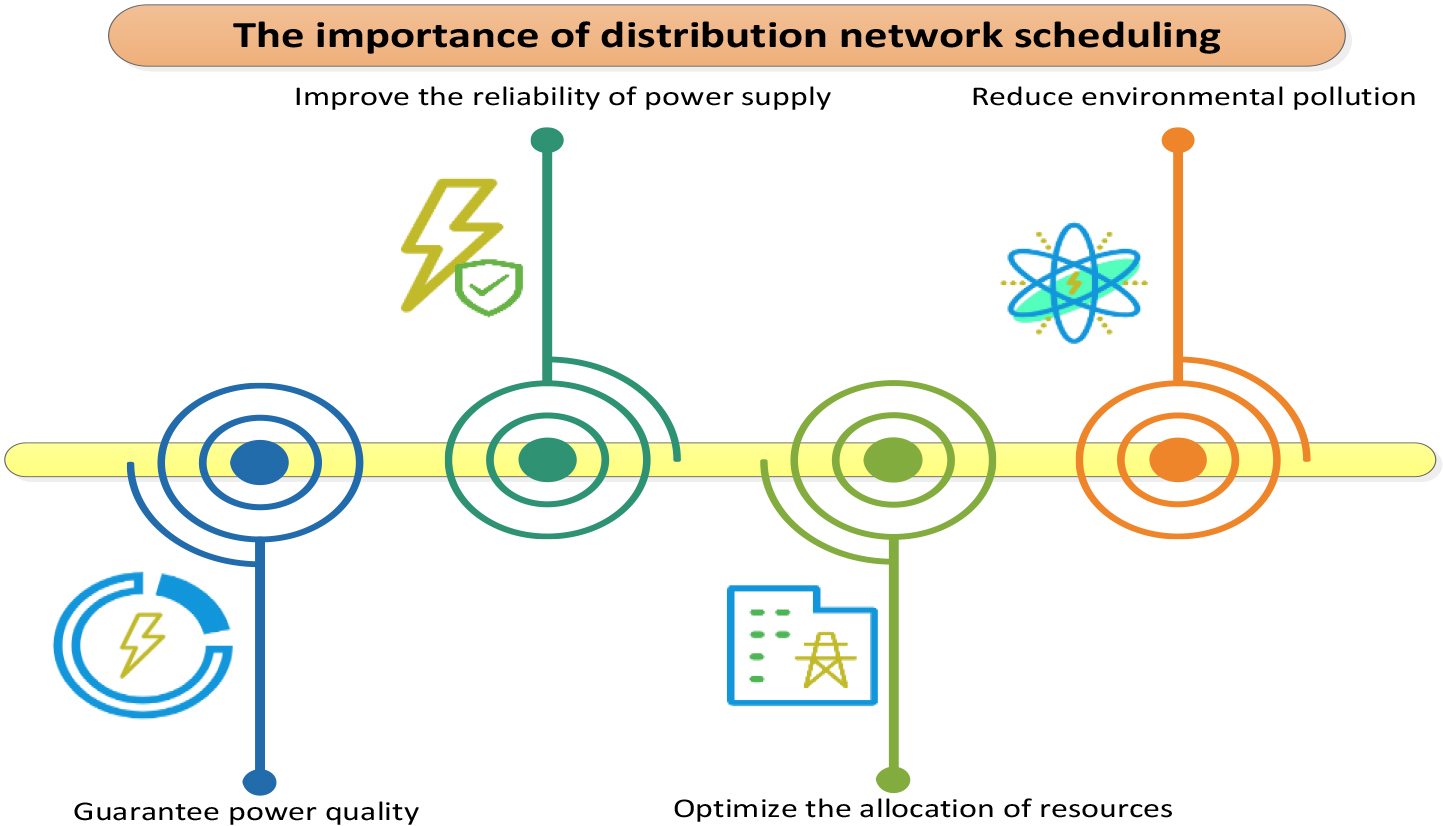
The importance of PDN scheduling is shown in Fig. 1.
PDN dispatching is an important work in the power system. Through reasonable distribution schemes and scheduling plans, it can effectively improve the quality and reliability of electric energy, and provide users with more high-quality services, thereby ensuring the safety, stability, and efficiency of grid operation [13, 14]. The workflow generally includes the following steps:
Data collection and analysis
PDN scheduling requires the collection and analysis of power data from various nodes, including current, voltage, load, etc., in order to carry out accurate planning and scheduling. The following are the steps for PDN scheduling to collect and analyze data:
Data collection: PDN dispatching needs to collect various data, including the operation status of power grid equipment, power quality, power load, meteorological conditions, etc. This data can be collected through various sensors, monitoring equipment, and data collection systems. Data cleaning: The collected data may contain some noise, abnormal values, etc., which requires data cleaning to ensure data quality. Various algorithms can be used for data cleaning, such as filtering, interpolation, and anomaly detection. Data analysis: PDN scheduling needs to analyze the collected data to discover problems and anomalies in the power grid. Data analysis can use various algorithms and tools, such as statistical analysis, machine learning, artificial intelligence, and so on.
Planning the PDN structure
On the basis of collecting and analyzing data, PDN scheduling needs to plan the optimal PDN structure based on existing power equipment and user needs. The purpose is to determine the appropriate configuration and layout of power distribution equipment, thereby meeting the load requirements of the power grid and the requirements for safe and stable operation. The following aspects need to be considered in planning the PDN structure:
Load demand: Firstly, it is necessary to determine the total load required by the PDN and the load demand of each power supply area. This information can be obtained from the load forecasting model of power supply enterprises. After determining the load demand, it is necessary to consider how to evenly distribute the load to each power supply area, and determine the maximum load capacity of each area. Power distribution equipment: According to load requirements, appropriate power distribution equipment configurations have been determined, including substations, switchyards, distribution transformers, etc. When configuring power distribution equipment, it is necessary to consider factors such as the size of the power supply area, load density, reliability, and security. Layout of power distribution equipment: After determining the configuration of power distribution equipment, it is necessary to consider how to arrange these equipment. Reasonable equipment layout can make the power supply effect of the PDN better, and can reduce interference and faults between distribution equipment.
Implementation of scheduling control
The implementation of scheduling control refers to the scheduling and control of the PDN in practice, including the adjustment of the operating status of power equipment and optimisation of load distribution, in order to meet the load requirements of the network and the requirements for safe and stable operation. The following describes in detail the implementation and control process of PDN scheduling:
Preparation of dispatching plan: In PDN dispatching, it is necessary to prepare a dispatching plan in advance, including power supply plan, load plan, distribution equipment switching plan, etc. When formulating a plan, factors such as power supply demand, distribution equipment status, and reliability should be comprehensively considered. Implementation of scheduling plan: After receiving the scheduling plan, the control center needs to confirm the plan and perform specific execution control. This includes turning on or off power distribution equipment, adjusting the output voltage of the substation, controlling load distribution, and so on.
Monitoring and optimization
PDN dispatching needs to continuously monitor the operation of the power system, so as to timely identify and handle problems, and provide feedback on the operation status and data of the power grid to higher authorities and relevant departments. The monitoring and optimization process of PDN scheduling is described in detail below:
Monitoring the operation status of the PDN: Monitoring and optimization of PDN scheduling requires real-time monitoring and analysis of the operation status of the PDN. By monitoring parameters such as power supply load, voltage, current, frequency, and power factor, as well as switching status and fault information of distribution equipment, it is possible to comprehensively and accurately evaluate the operation status of the PDN, and timely identify problems and take corresponding measures. Optimized scheduling plan: Based on monitoring the operation status of the PDN, it is necessary to optimize and adjust the scheduling plan to achieve better scheduling results. For example, according to different load demands and distribution equipment status, the power supply plan and load distribution scheme have been adjusted, and the switching plan of distribution equipment has been optimized, thereby improving the operational efficiency and reliability of the PDN. Optimizing maintenance management: Through regular maintenance and repair of power distribution equipment, as well as adopting advanced technologies such as reliability center maintenance and fault diagnosis, the reliability and service life of power distribution equipment can be improved, and the failure rate can be reduced, thereby further improving the operational efficiency and reliability of the PDN
Workflow diagram of PDN scheduling.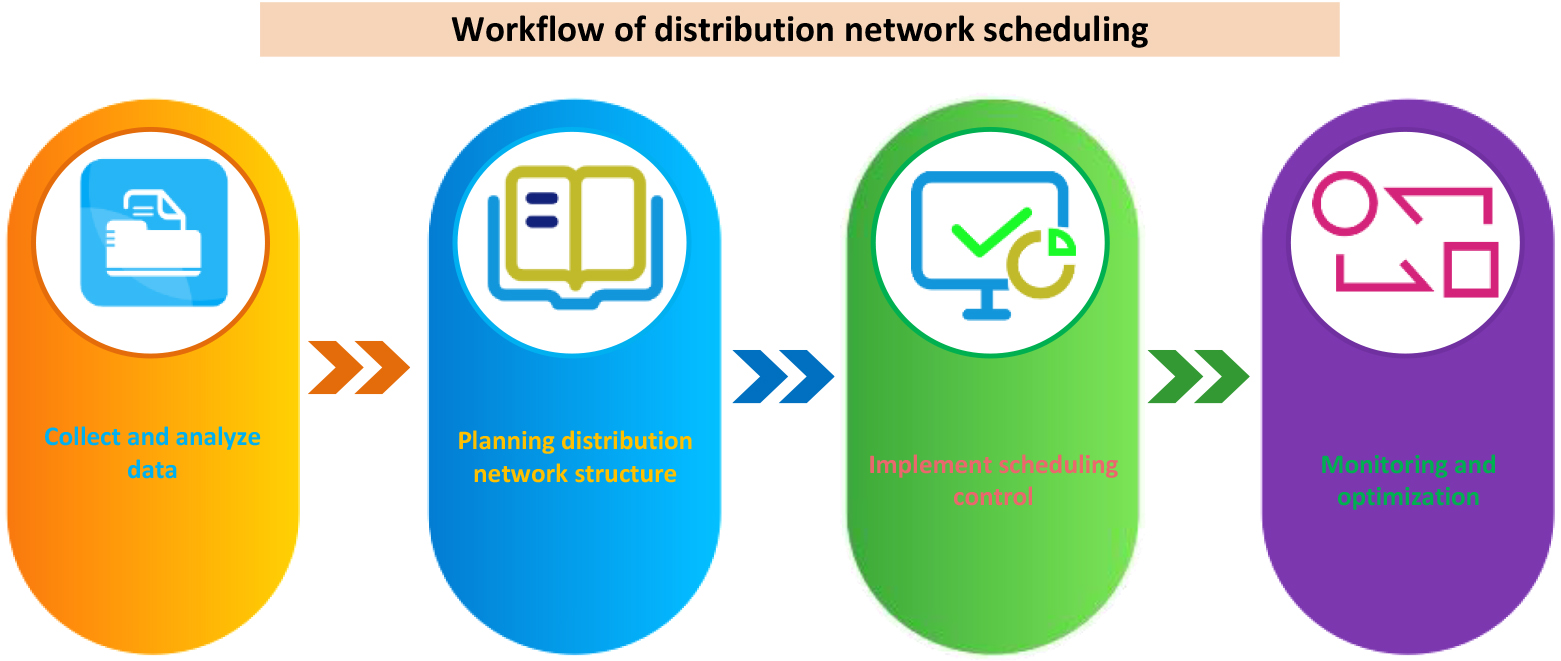
The workflow of PDN scheduling is shown in Fig. 2.
Electrical automation technology is a technology that utilizes electronic components and electrical equipment to achieve automatic control [15, 16]. In modern industrial production, electrical automation technology is widely used in automated production lines, industrial robots, intelligent manufacturing, and other fields, which can improve production efficiency and reduce costs and the impact of human factors. It can greatly improve production efficiency and product quality, and reduce labor costs and operational risks. The following is the basic operation process of electrical automation:
Programming
At this stage, it is necessary to design according to specific needs and requirements, including selecting appropriate equipment and instruments, drawing electrical drawings, writing automation control procedures, etc. [17, 18]. The programming process for electrical automation can be divided into the following steps:
Requirements analysis: At this stage, it is necessary to clarify the specific requirements of the automation system, including control objects, control methods, control accuracy, data collection methods, communication protocols, etc. Requirements can be determined through research, user interviews, on-site visits, and other methods. Programming: Based on requirements analysis, programming is required. This process includes determining control strategies, writing control algorithms, designing data acquisition systems, and determining controllers and actuators. During the design process, it is necessary to select appropriate controllers, sensors, actuators, and other equipment according to specific requirements. Program optimization: If a program has performance bottlenecks or other issues, it needs to be optimized. Optimization includes code optimization, algorithm optimization, data collection optimization, etc. Optimization can improve the control accuracy and response speed of the system.
Installation and commissioning
The installation and commissioning of electrical automation is a complex and important task, which requires a solid professional knowledge of electrical and automation. Only by strictly observing safety regulations and operational requirements, and paying attention to details and quality can the normal operation and stability of equipment and systems be ensured [19]. The following are the detailed steps for the installation and commissioning of electrical automation:
Installation of equipment: The installation and wiring of the equipment have been carried out according to the design scheme. This includes the fixed installation of various electrical equipment, wiring of wires, equipment adjustment, etc. At the same time, it is also necessary to conduct grounding and insulation treatment according to safety requirements to ensure the safe operation of the system. Commissioning stage: The entire system has been tested and debugged. This includes testing the functionality of each device, checking whether each wiring point is correctly connected, checking whether electrical signals are transmitted correctly, and ensuring that the device can work properly. System acceptance: After completing the commissioning, it is necessary to conduct acceptance on the entire system to check whether the system meets the design requirements, including functions, performance, reliability, safety, and other aspects. Documentation and system training are also required to ensure that users can correctly use and maintain the system.
System operation
System operation of electrical automation refers to putting the entire system into use and achieving predetermined functions after completion of the installation and commissioning stages. During system operation, it is necessary to monitor and maintain the system, so as to ensure stable operation and troubleshooting of the system. The following are the detailed steps for the operation of the electrical automation system:
Starting the system: It is necessary to check the system to ensure that all equipment is connected, parameters are set correctly, and all safety measures have been implemented. After that, the entire system is started through the controller, and checked whether the various devices are operating as expected. Monitoring system operation: During system operation, it is necessary to understand the operation of the entire system by monitoring the operating status of each device, feedback signals from sensors, and output signals from controllers. System update: With the continuous development of technology, electrical automation systems also need to be continuously updated and upgraded. When carrying out updates and upgrades, the system needs to be backed up and restored, and then the system software and hardware updated according to the actual requirements, thus ensuring that the system can be adapted to the new process requirements and technological trends.
Operation and maintenance
During the operation of these electrical automation systems, various faults and problems may occur, affecting the normal operation of the system. Therefore, a systematic approach and process is needed for the operation and maintenance of electrical automation systems to ensure that they are always in proper working order. The following are some detailed instructions for the operation and maintenance of the electrical automation system:
Regular maintenance and inspection: Regular maintenance and inspection is the key to ensuring the long-term stable operation of the electrical automation system. The contents of maintenance and inspection include cleaning, calibration, commissioning, and replacement of necessary components of the equipment. Establishing records: Establishing records is an important step in the operation and maintenance of electrical automation systems. These records should include equipment maintenance and inspection records, equipment usage records, and repair records. These records would help track equipment usage, failures, and repairs, and provide useful information to guide future maintenance and repair. Fault diagnosis and repair: Even on the basis of maintenance and inspection work, faults and problems may still occur. In this case, fault diagnosis and maintenance work are required to ensure the normal operation of the system.
Operation flow chart of electrical automation.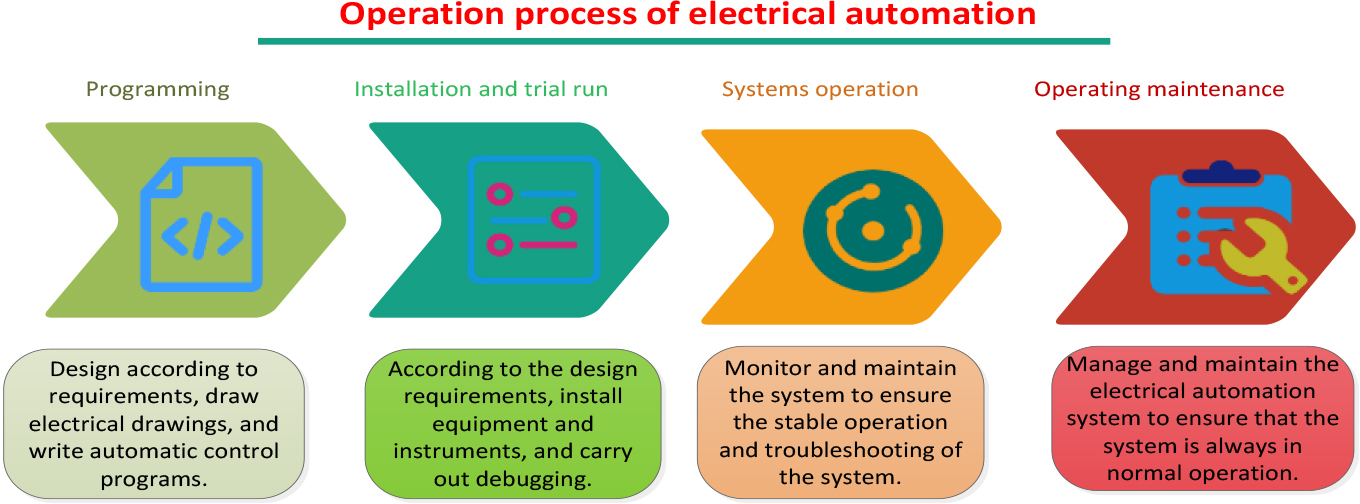
The operation process of electrical automation is shown in Fig. 3.
High-performance computing and data analysis can play an important role in power distribution scheduling algorithms. By using high performance computing, it can calculate and optimize power distribution equipment capacity more quickly and accurately, and the method of data analysis can analyze and model historical data to predict future load demand and node capacity distribution, so as to better guide the implementation of power distribution dispatching algorithm. Therefore, using the high performance computing and data analysis technology in the distribution system can optimize the distribution dispatching algorithm and improve the efficiency and reliability of the distribution system.
The operating cost of a PDN mainly includes the cost of purchasing electricity from a superior power grid, the operating cost of controllable distributed power sources, and the cost of energy storage and load regulation. The formula is:
Among them,
Among them,
Among them,
Among them,
Among them,
The algorithm first calculates the real-time load demand based on the load forecast value, and then rationally allocates the distribution equipment based on the real-time load demand and the capacity of the distribution equipment. It also optimizes the structure and layout of the PDN, which can improve the operational efficiency and economy of the distribution system. In addition, optimizing distribution scheduling decisions can also reduce unnecessary energy consumption and carbon emissions, thereby achieving the goal of energy conservation and emission reduction.
After proposing the distribution dispatching algorithm based on electrical automation technology, high performance calculation and data analysis are needed to test the performance of the algorithm. Through these tests, the distribution network scheduling ability, energy saving and management ability of the algorithm can be studied more in depth. Specifically, the high-performance computing method will be used to quickly process and analyze massive data, and the data analysis tools will be used to evaluate and optimize the performance indicators of the algorithm. These comprehensive means will greatly improve our research level and scientificity of power distribution dispatching algorithm based on electrical automation technology. The result data is shown in Table 1.
Power supply reliability refers to the percentage of continuous and uninterrupted power supply provided by the power supply system to users within a certain period of time. It is one of the important indicators to measure the reliability of power supply systems. The higher the reliability rate of power supply, the more reliable the power supply system provides to users, and the better the user’s power consumption experience.
Power supply reliability before and after using the distribution scheduling algorithm
Power supply reliability before and after using the distribution scheduling algorithm
Voltage qualification rate before and after using the distribution scheduling algorithm.
Power grid variable capacitance ratio before and after using distribution scheduling algorithm.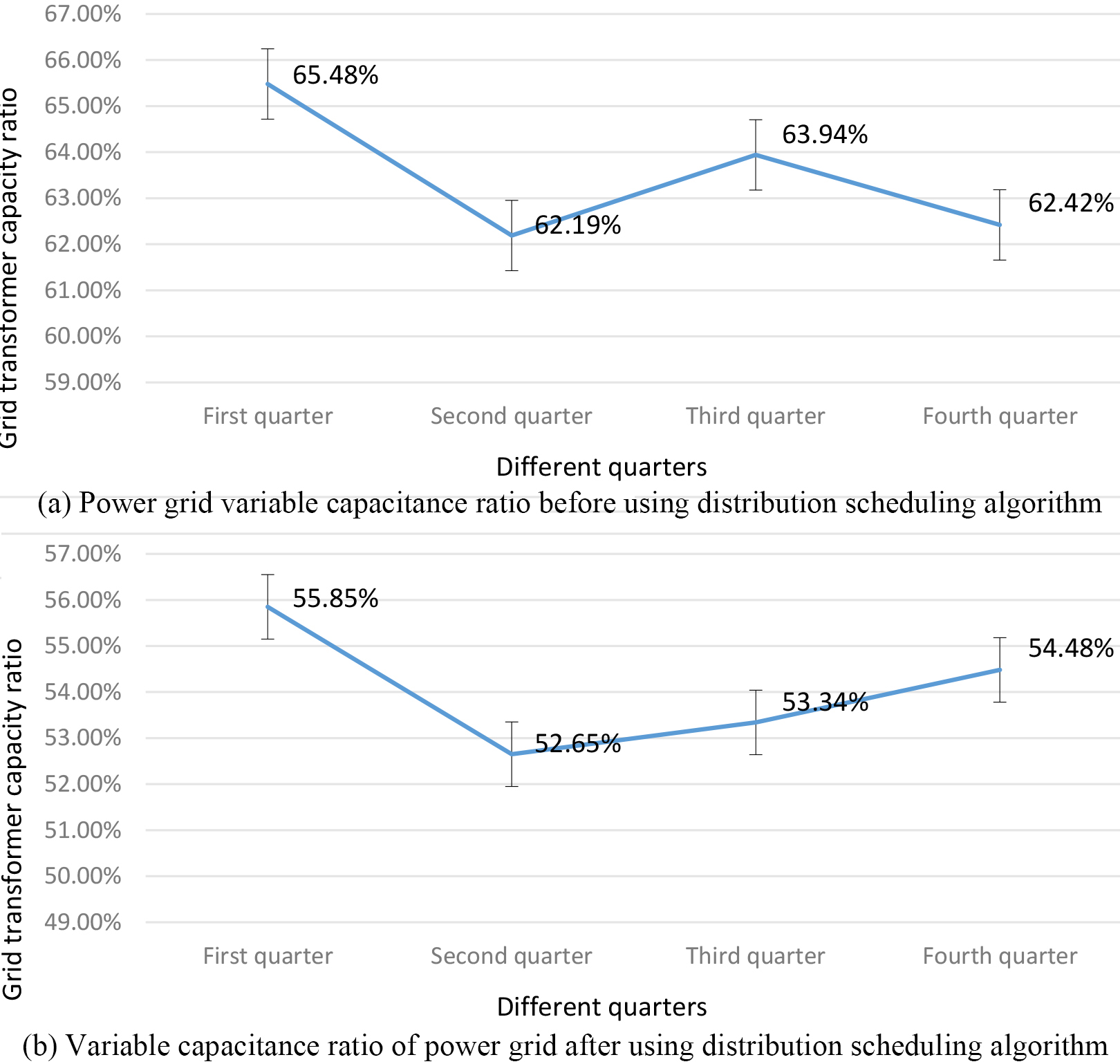
High loss distribution transformer ratio before and after using distribution scheduling algorithm.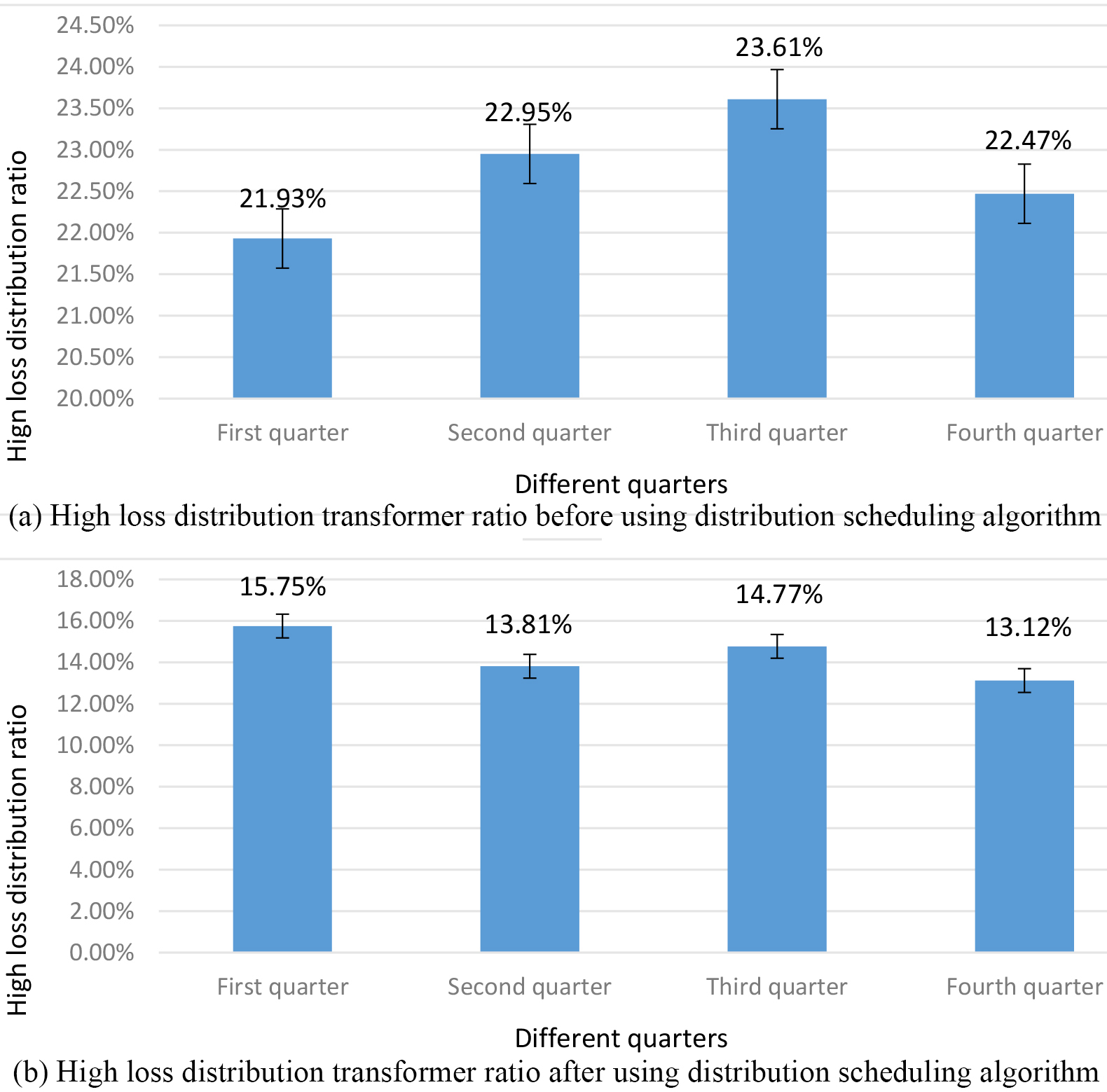
After analyzing the data in Table 1, it is understood that before using the distribution scheduling algorithm based on electrical automation technology, the power supply reliability rates of the power supply and distribution station in the first to fourth quarters were 96.22%, 96.37%, 97.74%, and 97.96%, respectively. After using the distribution scheduling algorithm based on electrical automation technology, the power supply reliability rates for the four quarters were 98.76%, 99.51%, 98.84%, and 99.61%, respectively. Obviously, using the distribution scheduling algorithm proposed in this article can improve the power supply reliability of power supply distribution stations, thereby bringing a better power consumption experience to users.
In the process of PDN scheduling in power supply and distribution stations, the voltage qualification rate of the power supply system is a relatively important performance index. It refers to the percentage of voltage quality of the power supply system that meets national or industry standards within a certain period of time. If the voltage qualification rate is relatively low, it may affect the normal use of electrical equipment, and even lead to equipment failure. The change of voltage qualification rate of power supply and distribution stations before and after using distribution scheduling algorithms based on electrical automation technology was studied. The experimental data is shown in Fig. 4.
From the data in Fig. 4(a) and (b), before using the distribution scheduling algorithm based on electrical automation technology, the voltage qualification rates of the power supply and distribution station in the first to fourth quarters were 96.54%, 95.61%, 96.14%, and 95.82%, respectively. After using the distribution scheduling algorithm based on electrical automation technology, the voltage qualification rates for the four quarters were 99.11%, 98.95%, 98.98%, and 99.08%, respectively. It can be seen that after using the distribution scheduling algorithm, the voltage qualification rate of the power supply distribution station has been improved, ensuring the normal use of electrical equipment.
After that, the variation of the variable capacitance ratio of the power grid of the power distribution station before and after using the distribution scheduling algorithm based on electrical automation technology was tested. The experimental data is shown in Fig. 5.
The variable capacitance ratio of the power grid refers to the ratio between the power load and the power supply in the transmission and distribution grid. Generally, the higher the ratio, the tighter the supply and demand relationship in the power system, which means that the power supply in the transmission and distribution grid may not be sufficient to meet the demand of the power load.
According to the data in Fig. 5(a) and (b), before using the distribution scheduling algorithm based on electrical automation technology, the power grid variable capacitance ratios of the power supply and distribution station in the first to fourth quarters were 65.48%, 62.19%, 63.94%, and 62.42%, respectively. After using the distribution scheduling algorithm based on electrical automation technology, the power grid variable capacitance ratios for the four quarters were 55.85%, 52.65%, 53.34%, and 54.48%, respectively. Through analysis, it can be seen that after using the distribution scheduling algorithm, the power grid variable capacitance ratio of power supply and distribution stations has decreased, easing the supply and demand relationship of power supply and distribution.
Finally, the changes in the high loss distribution to transformation ratio of power distribution stations before and after the use of distribution scheduling algorithms based on electrical automation technology were tested. The experimental data is shown in Fig. 6.
High loss distribution transformer ratio refers to the situation where the capacity of distribution transformers in transmission and PDNs is too large, resulting in excessive losses during operation, which affects the overall efficiency of the power grid. When the high loss distribution to transformation ratio is relatively large, it indicates that large losses would be generated during the distribution process, leading to a decrease in the energy saving efficiency of the power grid.
According to the data in Fig. 6(a) and (b), before using the distribution scheduling algorithm based on electrical automation technology, the high loss distribution to transformation ratios of the power supply and distribution station in the first to fourth quarters were 21.93%, 22.95%, 23.61%, and 22.47%, respectively. After using the distribution scheduling algorithm based on electrical automation technology, the high loss distribution to transformation ratios for the four quarters were 15.75%, 13.81%, 14.77%, and 13.12%, respectively. After using distribution scheduling algorithms, the high loss distribution to transformation ratio of power distribution stations has been reduced, which reduced distribution losses and improved the energy efficiency of the grid.
Energy-saving management of PDN dispatching based on electrical automation refers to the use of electrical automation technology, optimisation of PDN dispatching strategies, adoption of energy-saving equipment and strengthening of monitoring and management of PDNs to reduce energy consumption and improve energy utilisation efficiency of PDNs. It can use electrical automation technology to monitor the operation status of the PDN in real time, and can predict and analyze the power load, thereby optimizing the PDN scheduling strategy. It can avoid excess and insufficient power in the grid, thereby reducing energy consumption in the PDN. In summary, the energy-saving management of PDN scheduling based on electrical automation is of great significance for reducing energy consumption and improving energy utilization efficiency of the PDN, and is also an effective means to achieve energy conservation, emission reduction, and pollution reduction. This paper proposed a distribution scheduling algorithm based on electrical automation technology. Through experiments, it has been proved that the distribution scheduling algorithm has multiple optimization functions in power grid systems, which can improve the reliability of power supply and voltage qualification rate. In addition, it can reduce the capacitance ratio and high loss distribution to transformation ratio of the power grid. With the continuous development of electrical automation technology, its application in the field of power supply management would become increasingly widespread. In the future, electrical automation technology would be widely applied in the following aspects: Construction of smart grids: Electrical automation technology can help smart grids achieve real-time monitoring, automated control, and optimal scheduling, thereby improving the efficiency and reliability of the grid. Maintenance of transmission and PDNs: Electrical automation technology can detect and solve grid faults in a timely manner through real-time monitoring and automated control of transmission and PDNs, which can improve the safety and stability of the grid. In short, with the continuous development of electrical automation technology, its application prospect in the field of power supply management is very broad, and it would make greater contributions to the sustainable development of human society.