



Abstract
In the fiercely competitive landscape of modern business, the establishment and maintenance of strong brand relationships have become pivotal for organizations seeking sustainable success. This research explores the intricate dynamics of brand relationships by examining the influences of three core constructs: brand commitment, brand reliability, and brand attitude. Drawing upon an extensive review of the literature on branding and consumer behaviour, this study develops a comprehensive theoretical framework that elucidates the interplay among these pivotal factors. We hypothesize that brand commitment, brand reliability, and brand attitude, are independent factors and brand relationship is a dependent factor. To empirically test our hypotheses, we employ a rigorous research design, incorporating quantitative data collection methods. Data was gathered directly from survey participants through the administration of questionnaires, and the gathered data was subjected to analysis using SPSS and AMOS software. This analysis encompassed various statistical techniques, including SEM, CFA, descriptive analysis, regression analysis, ANOVA, reliability test, correlation analysis, the Kaiser-Meyer-Olkin (KMO) and Bartlett’s test. The sample for the study consisted of 600 respondents drawn from a wide range of organizations. All the analyses reveal that Brand Commitment, Brand Reliability, and Brand Attitude all have statistically significant impacts on Brand Relationship. Consumers who possess a profound dedication to a brand are inclined to develop robust and lasting connections with it. Future investigations could explore the factors that potentially moderate or mediate the relationships under research. Furthermore, exploring these dynamics within diverse industries and cultural settings can provide a more all-encompassing grasp of brand relationships.
Keywords
Introduction
In an increasingly competitive marketplace, where consumers are bombarded with choices from anexcess of brands, establishing and maintaining a strong brand-customer relationship has become a paramount objective for businesses. Brand relationships are intricate and multifaceted, shaped by a variety of factors that emanate from both the brand itself and the consumers who interact with it. Understanding these dynamics is crucial for businesses seeking to thrive in an environment characterized by shifting consumer preferences, evolving communication channels, and the relentless pursuit of brand loyalty [1]. The perception of branding has evolved significantly over the years. Traditionally, brands were viewed primarily as symbols of product quality, aiding consumers in making informed choices in a marketplace inundated with options. However, in today’s context, brands have transcended their utilitarian role. They have transformed into entities that resonate with consumers on emotional, psychological, and even societal levels. Brands are no longer just about what a product does; they are about what they stand for, the values they embody, and the relationships they foster. The trust a customer places in a company’s brand signifies the potential benefits the brand offers to the consumer. Consequently, when individuals make purchases, the reputation of the company’s brand plays a pivotal role. Moreover, customers tend to opt for dependable businesses [2, 3, 4]. As the marketing landscape has evolved, so too have the tools and concepts used to analyze it. Understanding consumer-brand relationships requires a more holistic perspective that goes beyond traditional marketing metrics. It demands an exploration of the emotional bonds consumers form with brands, their perceptions of brand reliability, and the attitudes they hold toward these brands.
Brand commitment, often referred to as brand loyalty, is a cornerstone of successful brand relationships. It signifies the extent to which consumers are dedicated to a brand, consistently choosing it over competitors and advocating for it among peers. The concept that loyalty can enhance profitability has been substantiated by a multitude of research papers and articles. Currently, by fostering loyalty, an organization can ensure its sustainability over an extended period while reaping the benefits of cost-efficiency [5, 6, 7]. Brand commitment is not merely a transactional outcome; it embodies a deep emotional bond between the consumer and the brand. This connection engenders trust, a sense of belonging, and a willingness to invest in the brand not just as a product but as a part of one’s identity.The importance of brand commitment cannot be overstated. A committed customer is not just a source of immediate revenue; they are a long-term asset that provides stability and profitability to a brand. Research has shown that brand commitment leads to higher customer retention rates, increased willingness to pay premium prices, and enhanced resistance to competitive marketing efforts. The extended commitment of customers to a brand contributes significantly to the long-term success of the company, as greater customer loyalty leads to increased profits for the company [8, 9]. Hence, understanding the factors that drive brand commitment is pivotal for businesses seeking to build enduring relationships with their customer base.
Brand reliability, often interlinked with the concept of brand trust, pertains to the scope to which consumers believe a brand consistently delivers on its promises. Brand reliability represents the collective assessment of an individual’s form in their minds regarding a brand. In a world replete with choices, consumers seek refuge in brands that they can rely on a brand that consistently meet or exceed their expectations [10, 11]. When consumers perceive a brand as reliable, it fosters a sense of security and decreases the perceived risk connected with purchasing its products or services.The role of brand reliability is multifaceted. It not only influences the initial purchase decision but also plays a pivotal role in sustaining brand commitment over time. A brand that consistently delivers on its promises not only attracts new customers but also solidifies its bond with existing ones. Conversely, a breach of trust due to inconsistent performance can lead to disillusionment, eroding brand commitment, and damaging the brand-consumer relationship.
Brand attitude encompasses consumers’ overall evaluations and feelings toward a brand [12]. It represents the emotional and cognitive responses that consumers associate with a brand, including their likes, dislikes, and general sentiments. A positive brand attitude is associated with favourable perceptions, while a negative attitude can deter consumers from engaging with a brand.Brand attitude is a complex construct that can be influenced by various factors, including prior experiences, marketing communications, and peer influence. Brand affinity refers to consumers’ actions when purchasing a particular brand, serving as a reference point for the development of perceptions regarding the product’s comfort, leading to the evaluation of the chosen brand as top-notch and premier, which in turn fosters reluctance to switch to alternative brands [13, 14]. Understanding the dynamics of brand attitude is crucial, as it not only shapes consumers’ initial interactions with a brand but also influences their brand commitment and subsequent behaviours. A positive attitude can lead to stronger brand commitment, while a negative attitude can act as a barrier to building lasting brand relationships. Implementing a completely stochastic strategy revealed that consumer loyalty to a brand serves as a driving force behind their inclination to engage in repeat purchases [15, 16].
The research on the Impacts of Brand Commitment, Brand Reliability, and Brand Attitude on Brand Relationships makes several valuable contributions to the field of branding:
This study contributes to a deeper understanding of how consumers form and maintain relationships with brands. By examining the roles of brand commitment, brand reliability, and brand attitude, it elucidates the multifaceted nature of brand relationship. Examining the factors that influence brand relationships, contributes to a broader understanding of consumer decision-making processes and the dynamics of consumer-brand interactions. The findings of this research offer practical insights for businesses and marketers. Understanding how brand commitment, reliability, and attitude influence brand relationships can inform brand management strategies, helping organizations foster stronger and more enduring connections with their customers. Examine how consumers’ attitudes towards a brand, including their emotional responses and perceptions, impact their brand relationships.
Maja Šerić et al. [1] undertook a study aimed at gauging how the perception of uniformity in marketing communications shapes the relationships between customers and brands. The upholding of a uniform message and brand image across a variety of marketing communication platforms constitutes a foundational principle of the integrated marketing communications (IMC) strategy. This investigation specifically concentrated on the hospitality sector, involving 452 participants tasked with assessing fast-food brands. The results reveal a noteworthy and direct influence of communication uniformity on both brand trust and brand loyalty. While it was observed that communication consistency positively affects affective brand commitment, this effect did not reach statistical significance. Additionally, the study confirmed the interconnectedness of these three brand relationship outcomes. To enhance the accuracy of measuring communication consistency, it is recommended that future research employ a more rigorous assessment approach involving more than just two items.
H.A. Dimuthu Maduranga Arachchi [4] conducted a comprehensive examination of the direct connection between individuals’ perception of a company’s commitment to corporate citizenship (CC) and their inclination to make purchases (PI). This research investigation also explored the examination of brand trust, consumer-brand identification, and the potential influence of personal norms on these connections. It drew upon insights from various theories. To collect quantitative data, a survey was administered to a sample of 411 individuals who were employed by retail brands. The individual served as the primary unit of analysis. The study’s results revealed a significant positive impact of perceived corporate citizenship on purchase intention, illustrating a direct relationship. Additionally, the study indicated that factors collectively played a mediating role in this connection to some extent. Notably, personal norms emerged as a substantial influencer in the relationships between apparent corporate citizenship and purchase intent, as well as between brand trust and purchase intention, alongside consumer-brand identification and purchase intent.
Dariyoush Jamshidi and Alireza Rousta [7] conducted an extensive examination of the hypothetical and experiential evidence concerning the intricate network of cause-and-effect relationships among various elements. These elements serve both direct and indirect roles in influencing brand loyalty. The research findings emphasized the crucial significance of brand personality, brand image, and brand experience in driving customer satisfaction. These discoveries carry substantial implications for marketing professionals and brand managers, providing valuable insights for crafting effective promotional and marketing strategies to bolster brand trustworthiness and customer contentment. The research underscores the significance of brand image as a cornerstone in the tender of brand directors, serving as both a direct precursor to loyalty and a critical driver of brand satisfaction.
Annisa Marliawati and Dwi Cahyaningdyah [9] conducted an extensive research study aimed at examining the ramifications of brand knowledge and brand image on brand loyalty, with brand trust acting as a mediating factor. The research cohort consisted of 116 individuals, meticulously selected through a non-probabilistic sampling technique. The results unveiled that brand experience wielded a substantial and statistically significant positive sway on brand loyalty. Conversely, brand image exerted a favorable impact on brand loyalty, albeit without reaching statistical significance. Furthermore, brand experience demonstrated a positive and statistically significant influence on brand loyalty by way of the mediating factor, brand trust. Likewise, a brand image displayed a positive and statistically important effect on brand loyalty, also mediated by brand trust. In addition, it was discerned that brand trust had a constructive and statistically significant bearing on brand loyalty. The authors suggest that future researchers consider adding new variables or indicators to enhance the model and address any unresolved issues from this study. Furthermore, researchers should expand the scope of their investigations to include not only customers of the Ijjah Collection via Shoppe in Indonesia but also customers from international markets.
Kardina Yudha Parwati et al. [11] conducted a comprehensive analysis aimed at understanding the impact of cognitive and emotional factors on consumer loyalty. Their study focused on local fashion product consumers of Cotton Ink. To explore and clarify the intricate interconnections among self-congruence, celebrity endorsements, brand perceptions, and brand allegiance. This investigation gave specific attention to the role of brand perceptions in mediating the link between self-congruence and celebrity endorsements, and their impact on brand loyalty. The research contributes valuable new insights to the field, shedding light on the dynamics within the Cognition-Affect-Behaviour Paradigm. The findings showed that consumer attitudes directly influence loyalty towards Cotton Ink. Furthermore, brand perceptions played a pivotal role as a mediator, bridging the gap between self-congruence, celebrity endorsements, and brand loyalty.
Cheng-Hun Fong and Yen-Nee Goh [12] conducted a comprehensive examination of the factors leading to brand equity and its associated consequences within the realm of private healthcare organizations. Their research was based on Aaker’s Brand Equity Model. To gather data for their study, they employed a self-administered survey and employed a convenience sampling method. They successfully collected a total of 271 fully completed surveys, which were then subjected to data analysis using SPSS and Smart PLS. The study introduced six key factors contributing to brand equity. Furthermore, it established that brand equity has a positive impact on consumer’s intention to purchase health services from private healthcare organizations in Penang. This research was dedicated to exploring the healthcare services provided by private healthcare organizations in Penang from a brand equity perspective. It highlighted the limited attention previously given to investigating the factors leading to and implications of brand equity in the context of healthcare. Ultimately, this study aimed to offer valuable insights into the marketing of healthcare, particularly when viewed through the lens of brand equity.
Heni Rakhmawati and Meylani Tuti [14] have explored the connections between brand experience and various aspects of brand perception. These aspects encompass brand attitudes, brand attachment, brand satisfaction, and brand loyalty. Their research employed a purposeful sampling method, specifically selecting individuals who exclusively use Make Over products as their sample group. The study rigorously assessed the reliability and validity of the data using a hybrid analytical approach that combined quantitative and descriptive techniques. This study delves into the ramifications of brand dedication, brand dependability, and brand sentiment on brand associations. Our investigation sought to enhance comprehension regarding how these elements shape consumers’ perceptions and engagements with brands. The primary insight derived from this research indicates that the brand encounter linked to Make Over cosmetic items has a substantial impact on how individuals shape their brand sentiments, build brand connections, encounter brand contentment, and ultimately nurture brand allegiance, utilizing both direct and indirect avenues. The study’s results underscore the pivotal role of a consumer’s engagement with a brand in molding their brand sentiments and nurturing heightened brand allegiance. Furthermore, it highlights that brand loyalty can be strengthened by nurturing brand attachment, leading to increased overall satisfaction.
Sunil Atulkar’s [16] research investigation explored the intricate facets of emotional attachment’s role in nurturing brand trust and brand loyalty. The findings of the research underscored that brand allegiance is shaped not only by antecedents related to emotional connections, like perceived excellence, perceived value, customer contentment, and perceived distinctiveness but also by the direct influence of brand confidence. Remarkably, further examination unveiled that distinctions within income groups moderate these discoveries, with high-income consumers displaying a heightened brand consciousness and unwavering loyalty to particular brands. The research findings furnish valuable insights for retailers aiming to expand their customer base by implementing promotional initiatives and strategies that accentuate emotional elements, thereby fostering stronger brand connections. Additionally, the study highlights factors like purchasing behaviour, financial capacity, and lifestyle as potential focal points for future researchers.
Problem statement
The establishment and maintenance of strong brand relationships have become pivotal for companies seeking to secure a loyal customer base and sustain long-term success. While the significance of brand loyalty and positive brand perceptions is broadlyrecognized, there remains a significant gap in our understanding of the intricate interplay between key factors that contribute to the formation and nurturing of brand relationships. The existing literature has explored brand commitment, brand reliability, and brand attitude as distinct constructs that influence consumer behaviour and brand-related outcomes. However, a comprehensive examination of how these constructs intersect and jointly impact brand relationships is conspicuously absent. Therefore, there is a pressing need to consider the integrated effects of brand commitment, brand reliability, and brand attitude on the development and sustainability of brand relationships.
Research objectives
To examine the extent to which brand commitment influences the strength and quality of brand relationships among consumers. To evaluate the role of brand reliability in shaping consumer perceptions of trust and loyalty within brand relationships. To investigate how brand attitude, including emotional and cognitive components, contributes to the overall brand relationship experience. To analyze the interplay and potential synergies between brand commitment, brand reliability, and brand attitude in influencing brand relationship outcomes. To identify the key drivers and moderators that may enhance or diminish the impacts of brand commitment, brand reliability, and brand attitude on brand relationships.
The significance of a study provides a clear understanding of why the research is important and what contributions it makes to the field of study, industry, or society as a whole. Brands are valuable assets for businesses. Understanding the factors that influence brand relationships can help companies make informed decisions regarding branding strategies, customer engagement, and loyalty-building initiatives. Customer retention is a key objective for businesses. This research can offer insights into the factors that enhance customer commitment and loyalty to a brand, ultimately helping companies retain their customer base. A strong brand relationship can confer a competitive advantage. This study’s findings can assist businesses in building stronger brand-customer relationships, potentially leading to increased market share and profitability. By understanding the interplay between brand commitment, reliability, attitude, and relationships, this research can benefit consumers by encouraging businesses to offer better products, services, and experiences.By fostering stronger brand relationships, businesses can increase customer loyalty and trust, which can contribute to long-term sustainability in an ever-competitive market.
Significance of the study for the academic world
This research contributes to the academic community by adding to the existing body of knowledge on brand management and consumer behaviour. It explores the relationships between brand commitment, brand reliability, brand attitude, and brand relationships, offering new insights and potentially challenging or refining existing theories. The study’s findings can help refine and develop theoretical frameworks related to brand-consumer relationships, making it a valuable resource for researchers in marketing, consumer psychology, and related fields. This can lead to more comprehensive and accurate models for understanding consumer-brand interactions. By detailing the research methodology and data analysis techniques employed, this study can serve as a reference for researchers interested in studying similar phenomena. It provides insights into how to measure and analyze constructs like brand commitment and reliability. The study can be used as an educational resource in academic settings, helping students understand the practical implications of theoretical concepts. It can be incorporated into marketing and business courses to illustrate real-world applications.
Businesses can use the study’s findings to refine their brand management strategies. Understanding the impact of brand commitment, reliability, and attitude on brand relationships can inform how companies build and maintain strong connections with their customers. The research can help companies better understand how to engage and retain their customers. By identifying the factors that contribute to brand relationships, businesses can tailor their marketing and customer service efforts to enhance customer loyalty. Marketers can use the study’s findings to create more effective marketing campaigns. By understanding how brand commitment and attitude influence consumer behaviour, companies can tailor their messaging and promotions to resonate with their target audience. The study can encourage companies to gather feedback from customers regarding their brand experiences, allowing for continuous improvement and adjustment of strategies based on customer insights.
H1-There is a positive relationship between Brand Commitment (BC) and Brand Relationship (BRE)
Brand commitment is a complex construct encompassing various dimensions. At its core, it signifies the strength of the psychological bond between a consumer and a brand. This bond is not solely transactional; rather, it is rooted in emotions, trust, and shared values. Brand commitment can manifest in several ways, such as repeat purchase behaviour, advocacy, and a willingness to pay premium prices for a particular brand. Brand relationships encompass the entirety of interactions, perceptions, and experiences that consumers associate with a brand. These relationships are not limited to the purchase decision alone; they extend to the post-purchase phase and the ongoing engagement between consumers and brands. Successful brand relationships are marked by trust, satisfaction, and a sense of belonging. Brand commitment fosters trust and loyalty. When consumers are emotionally connected to a brand, they are more likely to trust its promises and remain loyal over time. This trust forms the foundation of a strong brand relationship. Committed consumers often become brand advocates. They enthusiastically recommend the brand to others, which can lead to a ripple effect, expanding the brand’s reach and strengthening its relationships with new customers. Strong brand commitment acts as a buffer during challenging times. When confronted with a crisis or heightened competition, loyal customers tend to steadfastly support the brand, contributing to its stability and fortitude within the customer-brand dynamic. Brand loyalty finds its foundation in the realm of emotions, as individuals who harbour a profound emotional connection to a brand exhibit greater tolerance for sporadic imperfections and demonstrate a willingness to dedicate their time and energy to cultivating the bond with the brand. Devoted consumers often exhibit a reduced sensitivity to price fluctuations, showing readiness to pay a premium for a brand they have faith in and with which they share a deep sense of connection. This willingness to pay more further strengthens the brand’s financial performance and viability. A brand relationship built on commitment tends to be enduring. It withstands the test of time, ensuring that consumers continue to engage with the brand throughout their lives.
H2-There is a positive relationship between Brand Reliability (BR) and Brand Relationship (BRE)
Brand reliability is a fundamental component of a brand’s identity and a crucial factor in building and maintaining trust with consumers. It encompasses the consistent and dependable performance of a brand in delivering on its promises and meeting customer expectations. In essence, it’s about a brand being seen as trustworthy, credible, and dependable by its target audience. This reliability extends across various aspects of the brand, from product quality and customer service to communication and brand values. Brand reliability and brand relationship are intricately connected, with the former serving as a foundation for the latter. Trust is the cornerstone of any strong brand relationship. A reliable brand consistently delivers on its promises, which builds trust with consumers. When customers trust a brand, they are more likely to engage with it on a deeper level, purchase its products or services repeatedly, and become brand advocates. A reliable brand often enjoys higher customer loyalty. When consumers have confidence in a brand’s consistency and quality, they are more likely to choose that brand over competitors for their future purchases. This loyalty translates into repeat business, which is invaluable for brands. Reliability can also contribute to an emotional connection with a brand. When a brand constantly meets or surpasses customer prospects, it can evoke positive emotions like satisfaction and happiness, further strengthening the brand relationship. Brands that have established a reputation for reliability are often better equipped to weather challenges and crises. Consumers are more likely to forgive and continue supporting a brand they perceive as reliable, even in difficult times. Brand reliability is a critical element in the broader concept of brand relationship. It involves consistently delivering on promises, maintaining product quality, and fostering trust with consumers. This trust is the foundation of a strong and enduring brand relationship. When consumers perceive a brand as reliable, they are more likely to engage with it on multiple levels, from repeat purchases to brand advocacy. Therefore, businesses should prioritize and invest in building and maintaining brand reliability as it is key to long-term success in today’s competitive marketplaces.
H3-There is a positive relationship between Brand Attitude (BA) and Brand Relationship (BRE)
Brand attitude encompasses the comprehensive assessment or perception held by consumers concerning a particular brand. It serves as a fundamental element in understanding consumer behaviour and exerts a pivotal influence on moulding consumer inclinations and purchasing choices. In the field of marketing and branding, brand attitude mirrors the emotional and cognitive reactions exhibited by individuals toward a specific brand. This research explores the concept of brand attitude and its constructive correlation with brand rapport, illuminating the profound influence it wields over brand triumph and customer allegiance. A favourable brand attitude cultivates trust and certainty among consumers. When individuals harbour a positive disposition towards a brand, they are more inclined to place faith in its commitments, calibre, and dependability. This confidence forms the foundation of a robust brand connection, as consumers feel secure and assured during their interactions with the brand. Brand attitude stands as a principal motivator of brand loyalty and dedication. Consumers who possess a favourable brand attitude are more prone to remain devoted to the brand, repeatedly making purchases, and resisting competing alternatives. They foster an emotional attachment to the brand, which translates into a long-standing commitment to the brand’s products or services. Constructive brand attitudes are intimately intertwined with customer contentment. When customers find gratification in their brand encounters, it serves to reinforce their positive attitudes. Contented customers are not solely inclined to sustain their patronage but also evolve into brand advocates, disseminating favourable word-of-mouth and drawing in fresh clientele. Positive brand attitude contributes considerably to brand equity, which signifies the comprehensive value and potency of a brand within the marketplace. Brands with high brand equity command premium prices, enjoy greater market share and are more resilient to competitive pressures. Marketers must invest in strategies that cultivate and nurture positive brand attitudes to not only attract customers but also retain them in an increasingly competitive marketplace. Understanding the importance of brand attitude is essential for building and sustaining successful brands in today’s consumer-driven world.
Research framework
The research framework serves as the foundation for understanding and analyzing the relationships between the key variables. The independent variables are Brand Commitment (BC), Brand Reliability (BR), and Brand Attitude (BA), Brand Commitment represents the degree of loyalty and attachment that consumers have towards a particular brand. It can be measured using various factors such as repeat purchase behaviour, enthusiasm to pay a premium for the brand, and advocacy for the brand. Brand Reliability reflects the scope to which consumers perceive a brand as dependable and trustworthy. It can be measured through factors like product quality, consistency in delivering promises, and customer service reliability. Brand attitude encompasses consumers’ overall evaluations and feelings toward a brand. It includes aspects like brand associations, perceived brand image, and emotional connections with the brand. The dependent variable is Brand Relationship (BRE), Brand Relationship signifies the character and potency of the connection between consumers and the brand. Figure 1 shows the conceptual framework of the research.
Conceptual framework.
To test the hypotheses, the research employs a quantitative research design, using surveys as the data collection method. The study collects data on BC, BR, BA, and BRE strength from a representative sample of consumers.
Data collection and study techniques
To conduct a statistical data analysis comprehensively, it is essential to have access to both primary and secondary data.
Primary Data: Primary data was acquired through the use of open and closed-ended structured questionnaires.
Secondary Data: Secondary data was gathered from a diverse range of sources, including books, newspapers, magazines, theses,articles, and research papers authored by various individuals. These sources are now readily accessible online, for instance, through platforms like Google Scholar.
Data Analysis Method: SPSS AMOS Software was employed for the analysis of the collected data. The analysis methods employed encompassed SEM, CFA, descriptive, regression, ANOVA, reliability, correlation, as well as KMO and Bartlett’s test.
Sample Size: The questionnaire used in this study was constructed based on established tools developed by various researchers. Data collection was targeted at staff members and executives from different organizations who possessed knowledge about various brands. The questionnaire was distributed among them, and data were collected from a sample of approximately 600 individuals.
Results and discussion
The section outlines the diverse analytical approaches employed within this research. By applying the SPSS analysis, the hypotheses have undergone thorough systematic validation, all of which have been substantiated as accurate.
Demographics
The demographic information indicates a diverse sample in terms of gender, age, and education, which is generally a positive aspect of the study. Analyzing how brand commitment, reliability, and attitude influence brand relationships across these demographic categories can offer a more inclusiveacceptance of the research. In the sample of 600 individuals, 51% were male (303 individuals), and 49% were female (297 individuals). The respondents were distributed across various age groups. Among the participants, 28% (167 individuals) were between the ages of 18–30, 22% (131 individuals) fell in the 31–43 age group, and 25% (151 individuals) belonged to each of the 44–56 and
Demographic information
Demographic information
The reliability test results are essential for assessing the consistency and internal reliability of the questionnaire or scale used to measure the constructs of brand commitment, brand reliability, brand attitude, and brand relationship. Cronbach’s Alpha serves as a frequently employed metric for assessing the internal cohesion of a collection of items or queries within a survey, with a scale spanning from 0 to 1. Elevated values on this scale correspond to enhanced internal consistency. In this research, the overall Cronbach’s Alpha is calculated to be 0.817. This value is generally considered good. It suggests that the items related to brand commitment, brand reliability, brand attitude, and brand relationship in the questionnaire are internally consistent, meaning that they measure the same underlying constructs reliably. The measure of internal consistency, but it’s based on standardized (z-score transformed) values of your items. It helps ensure that the reliability assessment isn’t influenced by differences in item scales or variances.In this research, Cronbach’s Alpha based on standardized items is 0.801. This value is also good and very close to the overall Cronbach’s Alpha. It further confirms that the internal consistency of the measurement items is reliable, even after standardization. This means that the questionnaire or scale employed is likely to measure these constructs consistently and accurately, increasing the confidence in the validity of the research findings related to these constructs. Table 2 shows the reliability test for this research.
Reliability test
Reliability test
The descriptive statistics table provides key information about the variables related to the impacts of Brand Commitment (BC), Brand Reliability (BR), and Brand Attitude (BA) on Brand Relationship (BRE). The data for Brand Relationship (BRE) consists of 600 observations. The range of values for BRE is from 1.00 to 5.00, indicating that the respondents’ ratings on Brand Relationships vary between these values. The total sum of all the Brand Relationship scores is 1383.80. The mean score for Brand Relationship (BRE) is approximately 2.3063, which represents the average rating given by the respondents. The standard deviation for BRE is approximately 0.03902, suggesting that the ratings tend to cluster closely around the mean, indicating relatively low variability in Brand Relationship scores. The variance, a measure of how spread out the data is, is approximately 0.95569.For Brand Reliability (BR), the data consists of 600 observations, with values ranging from 1.00 to 5.00. The total sum of the scores is 1747.60, and the mean score is approximately 2.9127. The standard deviation is about 0.05435, indicating a moderate amount of variability in the data. Brand Commitment (BC) also has 600 observations with values ranging from 1.00 to 5.00. The total sum is 1736.60, and the mean score is approximately 2.8943. The standard deviation is about 0.05467, suggesting a similar moderate level of variability. Brand Attitude (BA) comprises 600 observations with values ranging from 1.00 to 5.00. The total sum is 1468.40, and the mean score is approximately 2.4473. The standard deviation is approximately 0.05093, showing a relatively low level of variability. These descriptive statistics are provided in Table 3.
Descriptive statistics
Descriptive statistics
The objective of the regression analysis was to gain insights into how three specific factors, Brand Attitude (BA), Brand Reliability (BR), and Brand Commitment (BC), collectively influence the dependent variable, Brand Relationship (BRE). The findings reveal that the model exhibits some degree of predictive capability, as evidenced by an R Square value of 0.123. This R Square value suggests that roughly 12.3% of the fluctuations observed in Brand Relationship can be accounted for by the combined impact of these three predictors. The Adjusted R Square, which stands at 0.119, considers the model’s complexity and slightly lowers the R Square value. The standard error of the estimate, measured at 0.89720, reflects the average error when predicting Brand Relationship using this model. Moreover, the Change Statistics demonstrate that these predictors jointly contribute significantly to the model’s performance, as indicated by an F statistic of 27.882 with 3 and 596 degrees of freedom. The associated p-value for this F statistic is less than 0.001, signifying that the model is statistically valid in elucidating variations in Brand Relationship. The Durbin-Watson statistic, registering at 1.780, suggests the absence of noteworthy autocorrelation in the residuals. In summary, this regression analysis underscores the statistically significant impact of Brand Attitude, Brand Reliability, and Brand Commitment on Brand Relationship, explaining approximately 12.3% of its variability while accounting for model complexity. Table 4 illustrates the regression analysis.
Regression analysis
Regression analysis
a. Predictors: BA, BR, BC. b. Dependent Variable: BRE.
The analysis of correlations among the study’s variables, specifically Brand Commitment (BC), Brand Reliability (BR), Brand Attitude (BA), and their impact on Brand Relationship (BRE), has unveiled several noteworthy findings. We have observed a strong and positive correlation between Brand Commitment (BC) and Brand Relationship (BRE) (correlation coefficient (
Regression analysis
Regression analysis
**. Correlation is significant at the 0.01 level (2-tailed).
The results of the one-way ANOVA tests for the impacts of Brand Commitment (BC), Brand Reliability (BR), and Brand Attitude (BA) on Brand Relationship indicate statistically significant differences among the groups. For Brand Commitment (BC), Between Groups the Sum of Squares (SS) is 137.058, indicating variability in Brand Relationship scores between different levels of Brand Commitment. Within Groups SS is 937.163, representing variability within the same levels of Brand Commitment. The F-statistic is 4.721 with 18 and 581 degrees of freedom between and within groups, respectively. The significance value is less than 0.001, indicating that the differences in Brand Relationship scores among the levels of Brand Commitment are statistically significant.
For Brand Reliability (BR), Between Groups SS is 104.069, suggesting variability in Brand Relationship scores between different levels of Brand Reliability. Within Groups SS is 957.755, representing variability within the same levels of Brand Reliability. The F-statistic is 3.507 with 18 and 581 degrees of freedom between and within groups, respectively. The significance value is less than 0.001, indicating that the differences in Brand Relationship scores among the levels of Brand Reliability are statistically significant.
For Brand Attitude (BA), Between Groups SS is 120.747, indicating variability in Brand Relationship scores between different levels of Brand Attitude. Within Groups SS is 811.349, representing variability within the same levels of Brand Attitude. The F-statistic is 4.804 with 18 and 581 degrees of freedom between and within groups, respectively. The significance value is less than 0.001, indicating that the differences in Brand Relationship scores among the levels of Brand Attitude are statistically significant.
The one-way ANOVA tests reveal that Brand Commitment, Brand Reliability, and Brand Attitude all have statistically significant impacts on Brand Relationship. The p-values being less than 0.001 suggest that these factors significantly influence the variation in Brand Relationship scores among different groups. Table 6 Shows the One-Way ANOVA analysis of this research.
One-way ANOVA
One-way ANOVA
The Kaiser-Meyer-Olkin (KMO) measure of sampling capability for our factor analysis is 0.665. This value suggests that the data used in the analysis is moderately suitable for factor analysis, indicating that the relationships between the variables (Brand Commitment, Brand Reliability, and Brand Attitude) are somewhat interrelated. Furthermore, Bartlett’s Test of Sphericity yielded an approximate Chi-Square value of 1753.365 with 6 degrees of freedom and a significance level (Sig.) of 0.000. This indicates that the correlations between the variables are statistically significant. In other words, the variables in our analysis are not independent and do exhibit some level of interrelationship, which justifies the use of factor analysis to explore underlying factors or dimensions within these variables. Table 7 Shows the KMO and Bartlett’s Test of this research.
KMO and Bartlett’s test
KMO and Bartlett’s test
a. Based on correlations.
Confirmatory factor analysis
The CFA results of this research are presented in Table 8. The Chi-Square statistic assesses the goodness of fit of the model, yielding a value of 150.45 in this case. The model has 75 degrees of freedom. The ratio of Chi-Square to degrees of freedom, which indicates how well the model fits the data, is 2.005, with lower values being preferable.The Comparative Fit Index (CFI) measures the model’s fit relative to a baseline model. A CFI value closer to 1 indicates a better fit, and in this case, it’s 0.925, which is quite favorable. The Tucker-Lewis Index (TLI) also assesses the model’s fit relative to a baseline model, and a value of 1 or close to 1 is desirable. Here, it’s 0.910. The Root Mean Square Error of Approximation (RMSEA) gauges the model’s fit while considering approximation errors in the population. A lower RMSEA indicates a better fit, and it’s 0.065 in this case. The Standardized Root Mean Square Residual (SRMR), measuring the average absolute difference between observed and predicted correlations, yields a value of 0.050, signifying good fit.Factor Loadings display how variables relate to the latent construct known as Brand Relationship. Higher factor loadings, closer to 1, suggest a stronger relationship between variables and the latent construct.Measurement Model Fit Indices evaluate how well observed variables represent the latent construct. Construct Reliability & Validity includes Cronbach’s Alpha, which measures internal consistency reliability for the Brand Relationship construct (0.816), and Composite Reliability (0.849) for the same construct.Average Variance Extracted (AVE), a measure of convergent validity, stands at 0.722, above the recommended threshold of 0.5. The square root of AVE for the Brand Relationship construct is used to assess discriminant validity, which should be greater than the correlations between the construct and other constructs.The correlations between the Brand Relationship construct and other constructs (Brand Commitment, Brand Reliability, Brand Attitude) should be lower than the square root of AVE to establish discriminant validity.Overall, Table 8 provides a comprehensive assessment of the measurement model’s fit. The fit indices generally suggest that the model fits the data reasonably well, and the reliability and validity measures are satisfactory.
Structural equation modelling
The results of a Structural Equation Model (SEM) analysis involve understanding the relationships between the latent constructs (factors) and the observed variables, as well as evaluating the goodness-of-fit statistics for the model. The following Fig. 2 indicates a good fit, suggesting that the model’s predicted relationships match the observed data well. A positive coefficient indicates a positive relationship between two variables. In this case, the predictor variable is associated with a greater than 0.5 which is a positively significant increase in the outcome variable.
SEM analysis.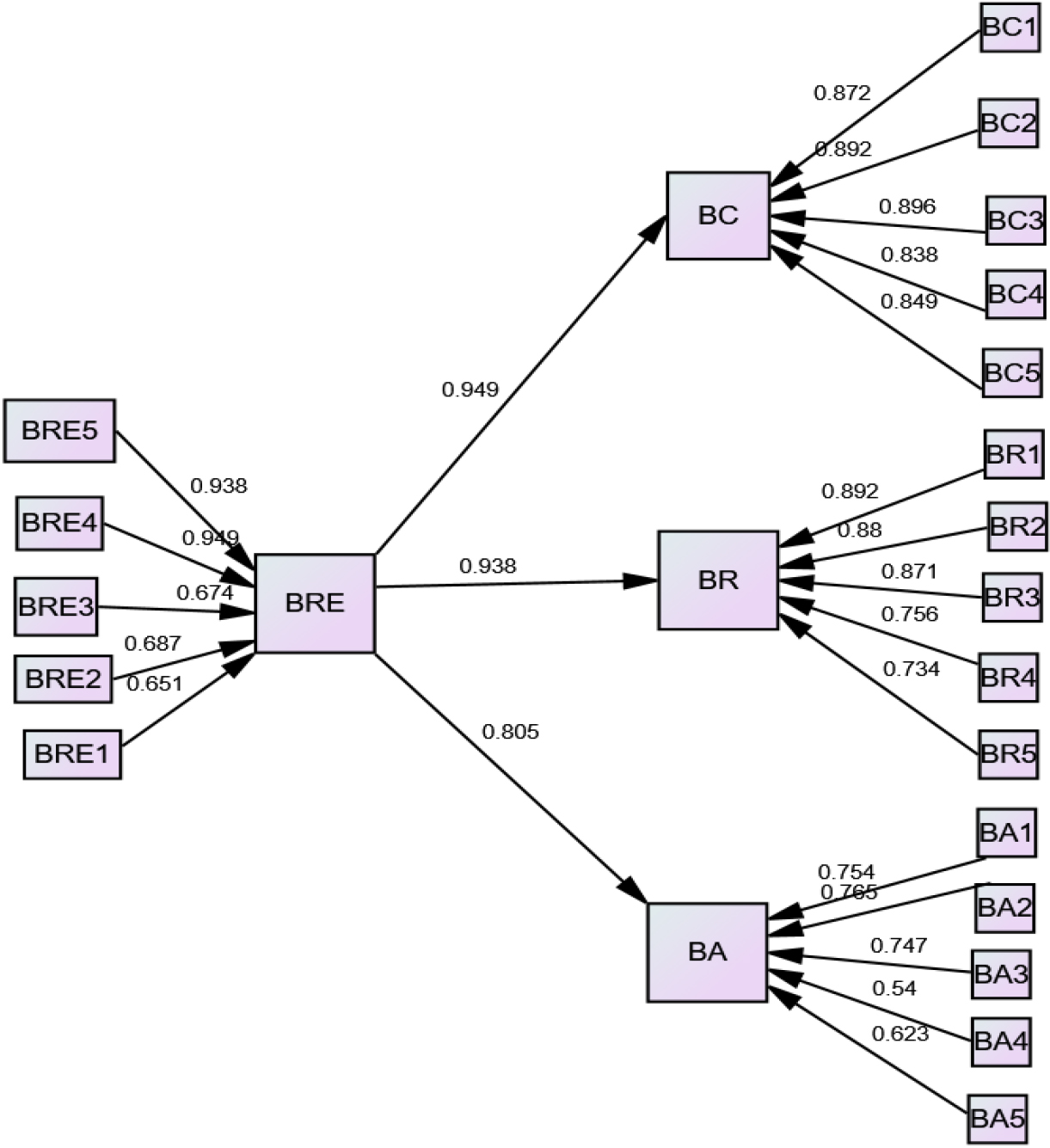
This research investigates the impacts of brand commitment, brand reliability, and brand attitude on brand relationships. Our research aimed to contribute to the understanding of how these factors influence consumer perceptions and interactions with brands. The results affirm the notable favorable influence of brand commitment on brand relationship. Individuals who intense commitment to a brand exhibit a greater propensity to foster robust and lasting affiliations with it. This underscores the importance of fostering brand commitment as a strategic goal for businesses. Brand reliability plays a pivotal role in shaping brand relationships. Consumers view reliable brands as trustworthy partners, which in turn enhances their brand relationships. Businesses should prioritize consistency and reliability in delivering products and services to establish trust. The brand attitude was found to be closely linked to brand relationships. Consumers with positive attitudes towards a brand are more inclined to engage with it and maintain a favorable relationship. Businesses should invest in cultivating positive brand attitudes through effective marketing strategies and customer experiences. This research suggests that brand commitment, brand reliability, and brand attitude are interrelated. A strong brand commitment may lead to more positive brand attitudes, while consistent brand reliability reinforces commitment. Recognizing these intricate relationships can guide businesses in designing holistic brand strategies. These findings have substantial implications for marketing practitioners. Crafting marketing campaigns and initiatives that foster brand commitment, enhance reliability, and promote positive brand attitudes can lead to stronger and more enduring brand relationships. This, in turn, can contribute to increased customer loyalty and brand advocacy. While this study has provided valuable insights, it is essential to acknowledge its limitations. Future research can explore the moderating and mediating factors that might influence the relationships studied here. Additionally, investigating these dynamics across different industries and cultural contexts can offer anadditionalbroad understanding of brand relationships. This study underscores the significance of brand commitment, brand reliability, and brand attitude in shaping brand relationships. These factors are intricately connected and have profound implications for businesses seeking to build and nurture lasting connections with their customers. Recognizing and strategically managing these elements can empower brands to thrive in today’s competitive marketplace. As brands continue to evolve, understanding the dynamics of brand relationships will remain critical for businesses aiming to build lasting customer loyalty and maintain a competitive edge.