



Abstract
BACKGROUND AND OBJECTIVE:
Numerous studies have addressed the relationship between paretic knee extension strength and comfortable walking speed after stroke. However, the correlations reported are highly variable. This review sought to summarize the correlational data using meta-analysis.
METHODS:
Relevant literature was identified via a search of 3 bibliographic databases. Articles were screened and perused for inclusion. Included articles were examined for information on the sample studied, procedures for measuring strength and gait speed, and correlations reported between the 2 variables. Meta-analysis was used to calculate a summary correlation.
RESULTS:
Of 299 unique articles, 18 met inclusion criteria. Articles were diverse in regard to samples studied, procedures described, and correlations reported. Meta-analysis using data from all included studies revealed a summary correlation of 0.51. For studies using hand-held or isokinetic dynamometry, the summary correlation was 0.46 and 0.59 respectively.
CONCLUSIONS:
This study provides a better indication of the correlation between paretic knee extension strength and comfortable gait speed than individual studies. The correlation is high enough to provide support for the routine measurement of paretic knee extension force for individuals who have experienced a stroke.
Introduction
Reduced muscle strength is the preeminent impairment in most patients who have experienced a stroke [1]. The impairment is most obvious in, but not limited to, the limb muscles of the paretic side [2]. Research addressing muscle strength after stroke often addresses knee extension. This focus is logical given the relative simplicity of measuring knee extension strength and its relationship with performance of activities such as standing from sitting [3] maintaining standing [4] transferring from bed/mat-to-chair [5], and walking [6]. Research examining the relationship between knee extension strength and comfortable walking speed is particularly plentiful [7, 8, 9, 10, 11, 12, 13, 14, 15, 16, 17, 18, 19, 20, 21, 22, 23, 24]. As research on this relationship is diverse in regard to procedures and outcomes, this systematic review was conducted to consolidate findings relative to the relationship. Hopefully my findings will provide guidance to clinicians working with patients with lower limb paresis and gait limitations after stroke.
Methods
This review involved electronic searches of the PubMed, Scopus, and CINAHL databases by the author and is valid for February 28, 2021. The searches employed the search string “stroke AND strength AND knee AND (gait OR walk).” A manual search of reference lists and files followed. To be eligible for inclusion in the review an article had to specifically address the correlation between objective measures of paretic knee extension strength (force or moment) and comfortable gait speed in patients with stroke. Articles dealing with other aspects of muscle performance (e.g., power) and gait speed (e.g., maximum) instead did not qualify an article for inclusion. Reviews, case studies, dissertations, and articles in languages other than English were excluded.
Articles qualifying for inclusion were perused for information on the sample tested, specifics of how strength and gait speed were measured, and correlations reported between knee extension strength and gait speed. In cases in which more than one correlation was reported, the first was used in subsequent meta-analysis.
A meta-analysis of correlations was conducted using MedCalc statistical software [25]. Specifically, a summary correlation coefficient was calculated using a random effects model that incorporated the sample sizes and correlation coefficients from individual studies.
Results
Of 299 nonduplicative articles considered, 18 were eventually found to meet all criteria for inclusion and none of the criteria for exclusion (Fig. 1). These studies were conducted primarily in the United States, but they originated in Brazil and 5 other countries as well. Tested individuals resided in a variety of settings-from acute rehabilitation to community-dwelling. The total number of participants was 624 with individual studies contributing correlations from 12 to 90 participants (Table 1).
Cross-sectional correlations between knee extension strength and gait speed of patients with stroke
Cross-sectional correlations between knee extension strength and gait speed of patients with stroke
Study flow chart.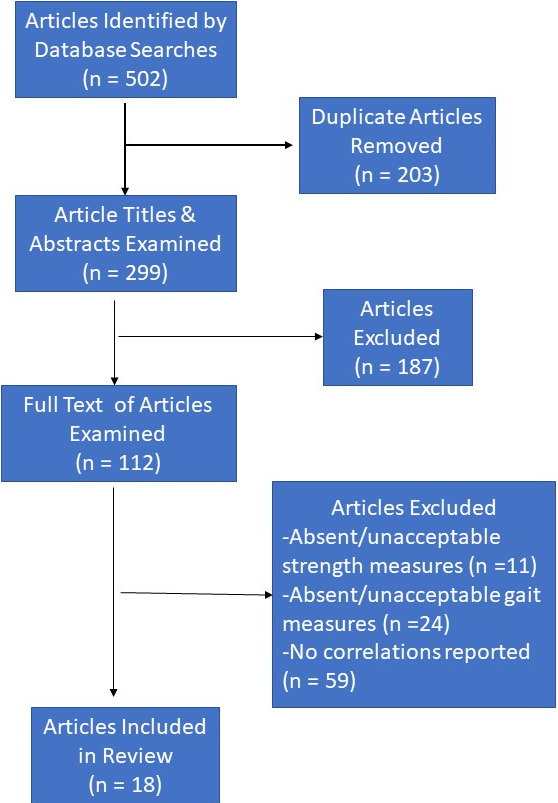
With the exception of one study, knee extension strength was measured using hand-held dynamometry or isokinetic dynamometry. Measurements were reported in units of force or torque with some adjusted for gravity or participant weight. Gait speed was typically measured after patients were instructed to walk at a “comfortable” speed, though synonymous terms (e.g. “habitual”) were sometimes used. Most gait speed tests involved a dynamic start. The timed distances ranged from 3.8 m to 12 m. (Table 1).
The correlations between paretic knee extension strength and gait speed ranged from 0.21 to 0.81 (Table 1). The meta-analysis determined a summary correlation of 0.51 (95% confidence intervals
Forrest plot of studies included in review.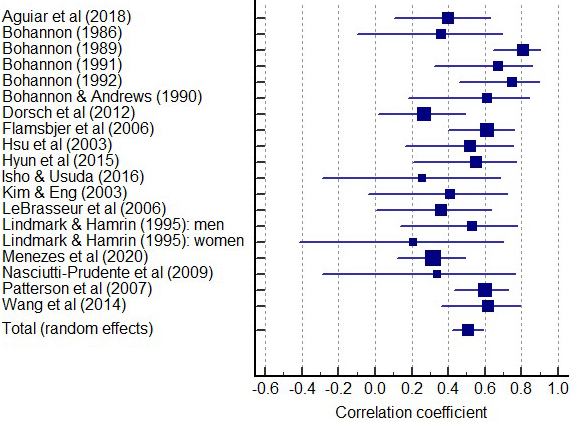
Funnel plot of studies included in review.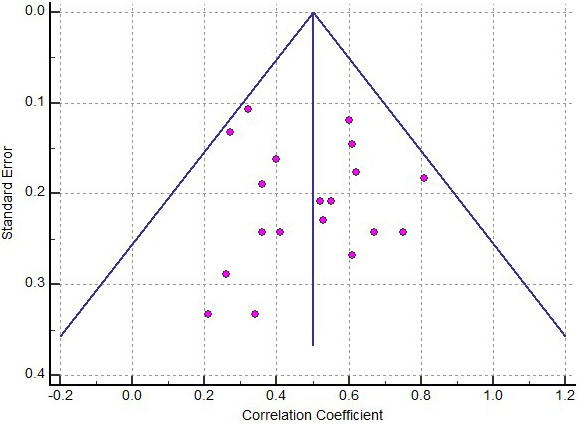
The objective of this review was to consolidate data from multiple studies to establish the relationship between paretic knee extension strength and comfortable gait speed in patients with stroke. The summary correlation calculated by meta-analysis (0.51) should provide a better indication of the relationship between the variables than the individual studies included. The moderate correlation calculated using meta-analysis is of sufficient magnitude to support recommendation of the objective measurement of paretic knee extension after stroke. This support is present regardless of whether strength measurements were obtained by hand-held and isokinetic dynamometry. That noted, measures of knee extension strength obtained by isokinetic dynamometry may provide a better explanation of gait speed than those obtained using hand-held dynamometry. This could be because of inadequate tester strength [26].
The value of the findings of this meta-analysis notwithstanding, they are narrow in scope. The strength of lower limb muscle actions other than paretic knee extension (including those from the nonparetic side) [9, 24]; and combinations of muscle action strengths [27] have also been found to correlate with comfortable gait speed. Moreover, other measures of muscle performance such as power have been shown to correlate with comfortable gait speed [11]. Finally, muscle strength is known to relate with maximum gait speed also [6].
This meta-analysis had several procedural limitations. Among these were use of a single individual to search for and vett articles for inclusion. No quality rating was performed other than making certain that inclusion and exclusion criteria were addressed.
Conclusions
Numerous studies have examined the relationship between paretic knee extension strength and comfortable walking speed. This meta-analysis of the studies shows that the correlation between the variables is moderate. Given the numerous factors contributing to successful ambulation, the correlation is of sufficient magnitude to warrant the routine objective measurement and treatment of paretic knee extension strength after stroke.
Ethical considerations
As a review, this study is exempt from IRB approval.
Funding
None.
Footnotes
Acknowledgments
None.
Conflict of interest
None. Given his role as an Editorial Board Member, Richard W. Bohannon had no involvement nor access to information regarding the peer review of this article.