



Abstract
BACKGROUND:
Limited data exist regarding segmental contributions of lower extremity muscles to the swim start performance during different start techniques in young swimmers.
OBJECTIVE:
To determine the differences in the kinematic parameters between the grab start (GS) and track start (TS) techniques and assess the interactions between the lower limb muscle strength and swim start performance.
METHODS:
A total of 40 swimmers, 20 girls (age: 13.70
RESULTS:
The angle of entry (EA) at water and knee joint angle (KA) were significantly greater during GS both for boy
CONCLUSIONS:
Incorporating lower body strength training into the swimming training schedule may improve swim start performance variables during grab start and track start techniques.
Introduction
Start, strokes, and turns comprise the most important technical domains of swimming. Despite the general recognition of the importance given to stroke techniques during swimming, an effective start is essential for success in swimming [1, 2]. The time observed between the start signal and the moment when the swimmer’s head reaches 10 m or 15 m is defined as start performance and it takes up an increasing proportion of the total duration of the competition during short-distancing races [3, 4, 5].
The grab start (GS) and track start (TS) are common techniques in swimming races and most swimmers tend to use one of the two start techniques [6]. In terms of biomechanical aspects, these two start techniques differ distinctively from each other while neither of the two has been strongly linked to total swimming performance [7]. When analyzing the GS technique, both feet of the swimmers are positioned at the front of the block, and hands grab the front edge of the block, inside or outside of both feet. On the other hand, in TS, swimmers place one foot at the front edge of the block while the other foot is placed on the back of the block, with similar hand placement [8].
Considering the determinants that impact swimming performance, the muscular performance of the lower body is one of the most important components of start performance while improved muscle strength comprises an essential role for enhanced sports performance [9, 10]. During both starts, the hips, knees, and ankles extend forcefully in an attempt to maximize horizontal velocity during takeoff. Limited data to date indicate that the hip muscles are the most important contributor to the work done during GS and TS. However, in addition to the hip muscles, the knee and ankle moments have also been shown to generate almost simultaneously for a superior start performance. Both start techniques have also been shown to be dependent on variations in the starting posture, jump or dive directions, different limb-segment interactions, and muscle-recruitment patterns [11]. Considering the differences in starting mechanisms between GS and TS, the contribution of the lower extremity muscles to the start performance might be different due to the positioning of the body during both start techniques. In addition to the contribution of neuromuscular components to the GS and TS performance, a superior start also requires a fast reaction time, significant jumping power, a high take-off velocity, and a decrease in drag force during entry [5]. Since enhanced lower body strength has a significant role in fast starts, the performance of lower extremity muscles i.e., hip, knee, and ankle, may be important in reducing the starting time and, consequently, the overall race time. In this regard, the interaction between lower extremity muscles and start performance may directly affect the ability to exert force on the block during the push-off phase, affecting the take-off velocity and flight distance [12, 13].
Due to the limited number of studies on lower limb muscle strength in relation to a swimming start performance, the aims of this study were (1) to determine the differences in the kinematic parameters between the GS and TS and the possible differences in the two start techniques between the genders, and (2) to assess the interactions between lower limb muscle strength and the performance of the two start techniques.
Methods
Study participants
A total of forty swimmers (13.80
The inclusion criteria applied in the research were healthy, physically active (e.g. at least three times a week) boy and girl swimmers aged between 13 and 16 y, who were not suffering from any kind of acute or chronic disease that would limit their ability to participate in the study. Refusal to consent, acute joint pain, treatment for major knee problems within the previous six months such as ligament reconstruction or meniscus tearing, failure to adhere to testing requirements, and/or, evidence of altered training/fitness resulted in exclusion from the study. The swimmers, who met the inclusion criteria were given more information about the purpose of the study and were asked to participate. The participants underwent body composition measures, isokinetic testing measures of the knee, ankle, and hip muscles, and biomechanical evaluation of GS and TS on a separate day with 24 hours of rest between tests to avoid neuromuscular fatigue.
Bodily measurements
The body composition parameters of participants were expressed as Mean
Evaluation of lower extremity muscle strength
A Cybex NORM (Humac, CA, USA) isokinetic dynamometer was used for the assessment of isokinetic knee extension and flexion peak moment, the participants were seated in the upright position with the hips flexed at an angle of 90
In the following test session, isokinetic testing of the ankle plantar flexor (PF) and dorsiflexor (DF) was performed at 60
On the third visit to the laboratory, hip extensor and flexor muscle strength was evaluated in a supine position at 60
Video analysis
The swimmers were recorded in groups of two persons. Upon completion of each start technique, each swimmer relaxed during a 50 m swim. The second swimmer was recorded for the first type of start, and when the first swimmer was resting. The same procedure was followed for the remaining swimmers. However, if a swimmer’s arms, legs, or trunk were not fully extended at water entry subsequent to each start, the starts were excluded from further analysis. An automatically generated start signal with a random duration between ‘take your marks’ and the start signal in order to mimic race conditions was applied. Each swimmer performed a standardized 15-minute warm-up consisting of a general easy swim before the testing. Two measurements were executed on the sample of 40 swimmers. Each swimmer made two starts for each type of start, for a total of four starts, and the best times for each start technique were analyzed. A Basler 602f brand video camera with a speed of 100 Hz (capable of taking 100 frames per second) was used to record each start technique for further analysis. One lateral video camera was placed five meters from the edge of the pool and was used to videotape the block and flight phases. The camera was placed 90
Anthropometric characteristics of the swimmers
Anthropometric characteristics of the swimmers
Note: (mean
Differences between the grab and track start for male and female swimmers (mean
Note:
Differences between male and female swimmers for both start techniques (mean
Note:
The measures of video analysis consisted of flight distance (FD), flight time (FT), flight velocity (FV), the entry angle (EA) and knee angle (KA), and reaction time (RT): For assessment of FD parameters of the participants, the distance covered by the swimmer from the block until his/her hand enters the water was measured and expressed in meters. Block time was determined as the sum of the swimmers’ reaction time and the time to push the exit platform, from the exit signal to the moment the feet leave the exit block. The time between leaving the block and the first contact of the swimmer’s hand with the water was determined as FT, and output data was expressed in seconds. FV was calculated using an indirect measurement calculated from the distance phase and flight phase with the equation FV
The normality of the data distribution was tested with Shapiro-Wilk test. The results were presented as the Mean
Differences between the neuromuscular performance of male and female swimmers
Differences between the neuromuscular performance of male and female swimmers
Note: (mean
The associations between neuromuscular strength and grab start performance
Note: FT: flight time, FD: flight distance, FV: flight velocity, KE: knee extension, KF: knee flexion, HE: hip extension, HF: hip flexion, DF: dorsiflexion, PF: plantar flexion.
The associations between neuromuscular strength and track start performance
Note: FT: flight time, FD: flight distance, FV: flight velocity, KE: knee extension, KF: knee flexion, HE: hip extension, HF: hip flexion, DF: dorsiflexion, PF: plantar flexion.
Table 1 shows the means and standard deviations of swimmers’ age, height, body weight, lean body mass, and percent fat mass.
Significant differences were revealed in the GS entrance angle both for boys (44.18
The FT, FD, and FV, KA at water entry were significantly higher for boy swimmers both during GS and TS while EA was significantly lower for boy swimmers during GS compared to girl swimmers (Table 3).
The comparison of neuromuscular components revealed that knee flexion parameters were greater in the dominant limb for boy swimmers while dorsiflexion parameters were higher in the dominant limb for girl swimmers (Table 4).
The results of the Pearson moment correlation coefficient analysis revealed positive significant correlations between the neuromuscular components and FT, FD, and FV both during GS (Table 5) and TS (Table 6) performance.
The correlations between the entry angle during grab start and (a) hip and (b) knee extension and flexion parameters.
The correlations between the entry angle during track start and (a) hip and (b) knee extension and flexion parameters.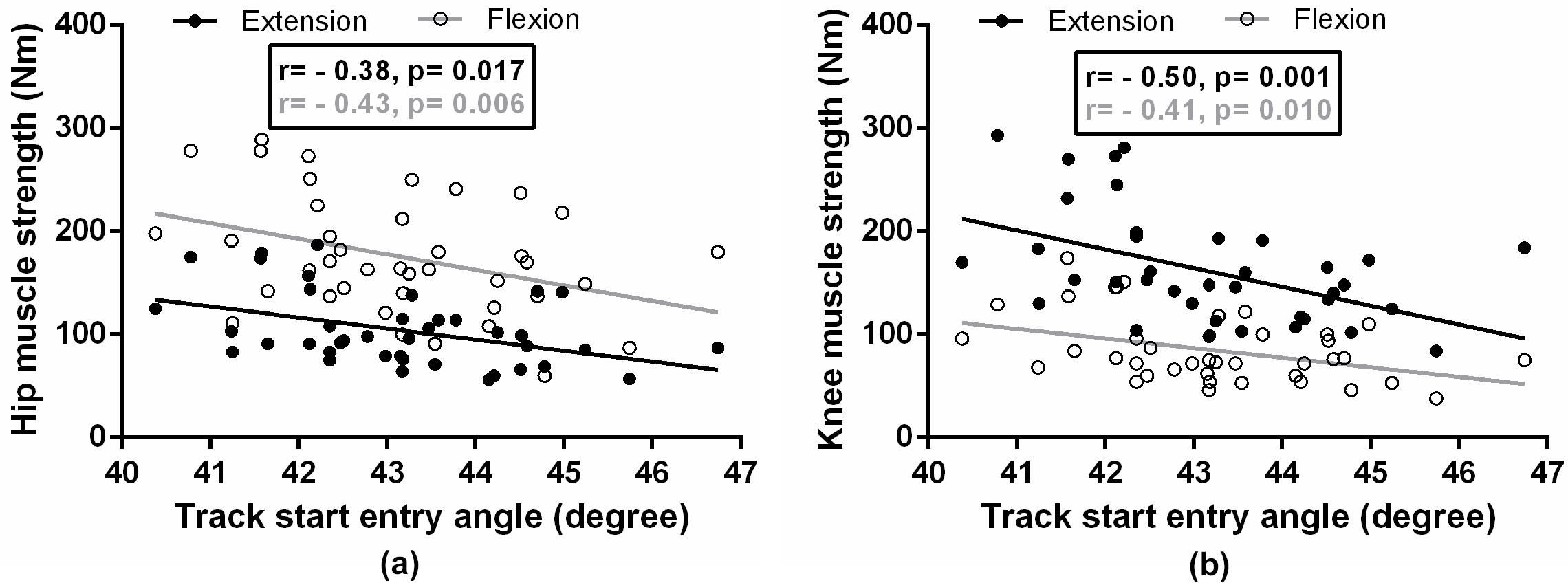
Pearson moment correlation coefficient analysis also showed negative significant correlations between EA during GS and hip (Fig. 1a) and knee (Fig. 1b) extension and flexion parameters and significant negative correlations between EA during TS and hip (Fig. 2a) and knee (Fig. 2b) extension and flexion parameters.
Linear regression analysis was performed to determine the percentage of variation in GS and TS variables explained by hip, knee, and ankle muscle strength parameters. The combination of lower extremity muscle strength (i.e., knee, hip, ankle) explained about 63% of the variation in FV, 59% in FD, 48% in FT, and 35% in RT during GS performance. Similarly, 57% of the total variance in FV, 57% in FD, 46% in FT, and 29% in RT during the TS performance were explained by the combination of strength of these muscle groups.
The muscular strengths and proper alignments of ankle, knee, and hip muscles in the GS and TS can help swimmers boost their acceleration and momentum off the block and allow them to perform an efficient take-off start. Nevertheless, limited information exists concerning the interactions between lower extremity muscle strength and GS and TS in young competitive swimmers. The current study revealed that the variables of kinematic analysis were not statistically significant for either gender, except for EA during GS (Table 2). The speed, distance, and duration associated with take-off were significantly higher for boys with either start technique. Boy swimmers had significantly lower EA during GS compared to girls. These results indicate that the boy swimmers achieved better start performance for each start technique than the girl swimmers. Significant shorter FT was verified for girl swimmers in previous research while they reported similar FD, FT, and FV despite greater values for boy swimmers [14]. Another study noted that swimmers had greater means (mean) for FT in GS compared with TS. Whereas the difference was not statistically significant both prior to and following the experimental program. The difference in the FT was 0.02 s prior to and 0.01 s following the experimental treatment [8]. Also, the difference in the FT was 0.10 s between these two starting techniques whereas the results were not statistically significant [15]. The difference in the FT was 0.01 s higher during GS for either gender in the current study compared with TS (Table 4). Similar results concerning FT, FD, and FV were also verified in previous studies [1, 16, 17, 18, 19].
Based on kinematic analysis of swim start performance, EA was significantly higher during GS for either gender, whereas it was significantly lower for boys during GS compared to girls. Data from previous studies support these findings where it was proposed that swimmers could practice and perform the appropriate start into the water under the appropriate angle for both start techniques [16, 20, 21]. However, negative significant correlations between EA and hip and knee muscle strength during GS (Fig. 1a and 1b) and TS (Fig. 2a and 2b) show that strength discrepancies of these muscles may be responsible for the decreased EA during either technique due to the loss of horizontal velocity and increase in propulsive efficiency during the transition stage.
In addition to the variations in EA, the angle of the knee joint at water entry was also significantly greater during GS compared to TS for each gender (Table 2). Higher values of knee joint angle during water entry have been shown to produce a greater vertical force during push-off with a rear angle of 100
However, the comparison of neuromuscular components revealed that knee flexion parameters were greater in the dominant limb for boys while DF parameters were found higher in the dominant limb for girls (Table 4). Additionally, due to the positive significant correlations that occurred between the neuromuscular components and FT, FD, and FV both during GS (Table 5) and TS performance (Table 6), the participants needed to increase their knee and ankle muscle strength performance to optimize the start during training and competitions. Similar interactions have also been reported between swim performance to 5 m and leg-extensor power (
These findings suggest that swimmers can regulate the leg amplitude through a strong synergy between these muscles. Enhancing the strength of these muscles may help swimmers minimize the velocity lost at water entry and lead to performance gains both during GS and TS. The increases in strength performance can be attributed to performance gains during swim start, which in turn, enable the swimmers to generate greater force and power during both start techniques due to the link between strength and starting performance. However, there are some limitations of the current study. Our study consisted of participants between the ages of 13–16 years of age and the application of isokinetic testing was limited to concentric muscle contractions and one specific angular velocity. Future research need to be warranted including athletes with high-performance levels, and varying muscle contractions at different angular velocities to explain these confounding relationships.
Conclusions
Variables that account for overall GS and TS performance showed no significant difference between the two different start techniques, except for EA. Increasing strength performance of the lower extremity muscles may help swimmers to exert a greater force on the block during the push-off phase during GS and TS and may provide them with an efficient take-off velocity and flight distance during each start technique. In summary, incorporating lower body strength training into swimmers’ training schedules is important in order to improve GS and TS, which may also increase overall performance in sprint swimming.
Author contributions
All authors listed have made substantial, direct, and intellectual contributions to the work and approved it for publication. All authors read and approved the final version of the manuscript.
CONCEPTION: Buse Argun, Nevzat Demirci and Gökhan Umutlu.
PERFORMANCE OF WORK: Buse Argun, Nevzat Demirci and Gökhan Umutlu.
INTERPRETATION OR ANALYSIS OF DATA: Nevzat Demirci and Gökhan Umutlu.
PREPARATION OF THE MANUSCRIPT: Gökhan Umutlu.
REVISION FOR IMPORTANT INTELLECTUAL CONTENT: Nevzat Demirci and Gökhan Umutlu.
SUPERVISION: Nevzat Demirci and Gökhan Umutlu.
Ethical considerations
All participants were informed about the equipment and familiarized with the experimental procedures before they underwent testing sessions. Written informed consent was provided by all participants prior to participating in the study approved by the Mersin University Institutional Review Board (Protocol number 281, date of approval: 27.09.2017) in compliance with the ethical standards of the Helsinki Declaration.
Funding
The study was funded by the Mersin University Scientific Research Projects Commission (BAP) (2017-2-TP2-2576), (2018-1-TP2-2734).
Footnotes
Acknowledgments
The results of the current study do not constitute an endorsement of the product by the authors or the journal. The authors would also like to thank the participants involved in the study.
Conflict of interest
The authors declare that the research was conducted in the absence of any commercial or financial relationships that could be construed as a potential conflict of interest. Given his role as an Editorial Board Member, Gökhan Umutlu had no involvement nor access to information regarding the peer review of this article.