



Abstract
BACKGROUND:
Muscle strength in the upper and lower limbs is a major contributing factor to punch force and is one of the keys to success in boxing.
OBJECTIVE:
This study aimed to investigate the relationship between knee and shoulder strength and punching force in boxers.
METHODS:
Twenty-one boxers completed knee flexion, knee extension, shoulder external rotation and internal rotation isokinetic concentric contractions at slow (60
RESULTS:
Pearson’s correlation coefficients revealed that knee extension (
CONCLUSIONS:
The main findings indicated the importance of the capacity to generate maximum knee extension and rapid shoulder internal rotation strength, contributing to punch force production.
Introduction
Boxing was first included in the Olympic program in 1904. To win a match, boxers must deliver powerful punches to knockout opponents. Alternatively, one can use the repeated execution of punches with high force to increase the possibility of a win based on points. Punch force is a key factor influencing competition results and an important indicator of boxing performance [1]. Smith et al. found that the maximal punching force (PFmax) was greater in elite boxers than in mediocre and novice boxers [2]. These results suggest that boxers benefit from the ability to punch with high force. A successful boxer must have the ability to generate well-developed muscle strength in order to improve PFmax. The lead (LA) and rear arm (RA) straight punches, the most frequent boxing punches, are influenced by both upper-and lower-body muscular strength [3]. Most studies have examined the correlation between strength performance-related testing and punching force Loturco et al. revealed positive relationships between countermovement jump (CMJ) height and PFmax [4]. Furthermore, propulsion power in bench press and bench throw was found to be significantly related to PFmax [4]. Dunn et al. indicated no correlation between countermovement bench throw force and punching force [5]. However, boxing is a non-symmetrical sport. Muscle strength imbalances are both joint-specific and punch movement-specific [6]. One of the critical limitations of previous bilateral testing is that symmetrical patterns may lack specificity for asymmetrical sports such as boxing. In other words, both limbs simultaneously apply force to determine jump or bench press performance, while there are distinct differences in muscle activation patterns when performing LA and RA punches [7].
Limited research has directly and accurately measured muscle strength in relation to punch force. It has been reported that isometric midthigh pull force is associated with the PFmax [5]. Maximum isometric force in squat exercises also has a positive relationship with LA and RA PFmax [4]. These studies have contributed to the understanding of a possible factor of punch forces and to optimizing strength training. However, the patterns of motor unit recruitment during isometric contractions differ from those seen during dynamic contractions [8]. More importantly, in whole-body strength testing, it is difficult to distinguish the specific contributions of the knee and shoulder. Dynamic evaluations are likely preferable to isometric tests in the physical evaluation of boxers who participate in high-velocity sports. In this sense, several studies have used isokinetic dynamometry to determine the link between sports performance and the peak torques (PT) of the knee and shoulder. In water polo athletes, the shoulder internal rotation PT at 60
High-level punching performance necessitates excellent muscle strength in both upper and lower limbs [12]. To accelerate toward a target, the punching arm rapidly extends with angular velocity generated by shoulder rotation strength [13]. Also, increasing ground reaction forces generated by knee extension thus improve the punch force [14]. Understanding the links between muscle strength characteristics and punch performance could lead to more effective strength training programs aimed at improving force. However, the relationship between PT of the knee and shoulder and PFmax has not been investigated. Therefore, the aim of the present study was to analyze correlations between PFmax and PT of the knee and shoulder at different velocities. The hypothesis of this study was that positive relationships exist between PT of the knee and shoulder and PFmax. Additionally, the ability to produce strength through high-velocity movements should be an important factor affecting punch force [4]. We also hypothesized, that at 180
Materials and methods
Participants
Twenty-one national-level male boxers (Height: 173.1
Testing procedure
Isokinetic testing: Knee
Isokinetic peak torques of extension (KE) and flexion (KF) in the dominant and non-dominant limbs were measured using an isokinetic dynamometer (IsoMed2000; D&R Ferstl GmbH, Hemau, Germany) (Fig. 1). Participants performed a 15–20 min warm-up, including jogging and stretching. According to the instruction manual for the IsoMed 2000 System, participants were seated in appropriate and stable position using fixed straps to avoid compensatory trunk movement. The rotation axis of the machine and the knee joint were aligned, and gravity compensation was performed [15]. The range of motion (ROM) for testing was set from 10
Isokinetic strength testing.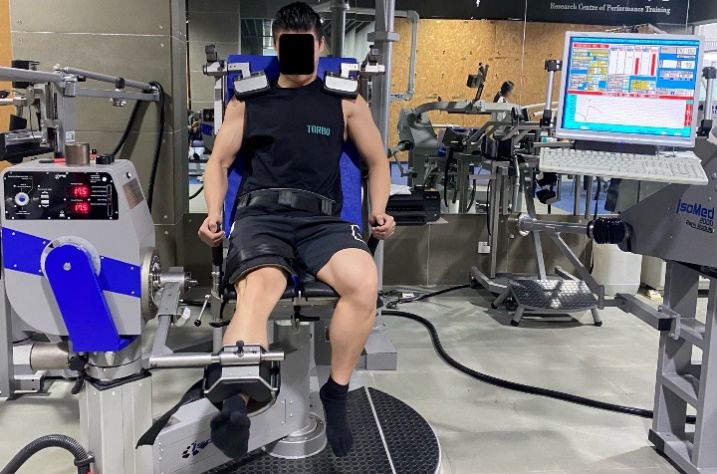
Punching force test using Kistler Instruments.
Isokinetic concentric torque of external rotation (SER) and internal rotation (SIR) in the dominant and non-dominant shoulders was measured by using an isokinetic dynamometer (IsoMed2000). Participants were seated with 45
Maximum punching force testing
Participants underwent a 20-min warm-up consisting of jogging, dynamic stretches, and shadow boxing. All boxers were advised to punch the bag with maximum effort while retaining the proper technique for the particular punch type being executed. The equipment employed to assess punching force was a force plate (Kistler Instruments, Winterthur, Switzerland) fixed on a tripod, with a built-in signal amplifier, and the sampling frequency was set at 1000 Hz. The platform was completely surrounded by a body barrier to prevent injury to the subjects, who also wore their own competitive gloves throughout the punch tests. Each boxer independently found the greatest position for optimal performance [4]. Athletes had to punch the target area with full force, then return to the starting position while remaining stable and static. Each punch was performed three times in succession, with a 60-s recovery period between trials. The relative maximal punching force during both PFmax LA and RA were calculated. A previous study showed that three punches was sufficient to obtain maximal punch force [4]. Due to different arm lengths, every participant was allowed to choose their own punching distance for their best performance. Verbal motivation was provided to each boxer to inspire the maximal punching force (Fig. 2).
Statistical analysis
Descriptive statistics (means and standard deviations) were performed to summarize all data. The Shapiro-Wilk test for data normality was applied. Pearson correlation analysis were used to assess the relationship between punch force (lead and rear straight) and the peak torque of shoulder and knee. Correlation coefficients: very weak (0.11
Peak torque of knee and shoulder in dominant and non-dominant limbs
Peak torque of knee and shoulder in dominant and non-dominant limbs
Pearson’s significant correlation results between the relative PFmax LA and relative PT of the knee and shoulder
Pearson’s significant correlation results between the relative PFmax RA and relative PT of the knee and shoulder
The ICCs for testing
The PT of knee and shoulder, and PFmax LA and RA, are shown in Table 1. The ICCs for flexion and extension test at velocities of 60
Correlation between the relative PFmax LA and the relative PT of the knee and shoulder in the dominant and non-dominant limb. D 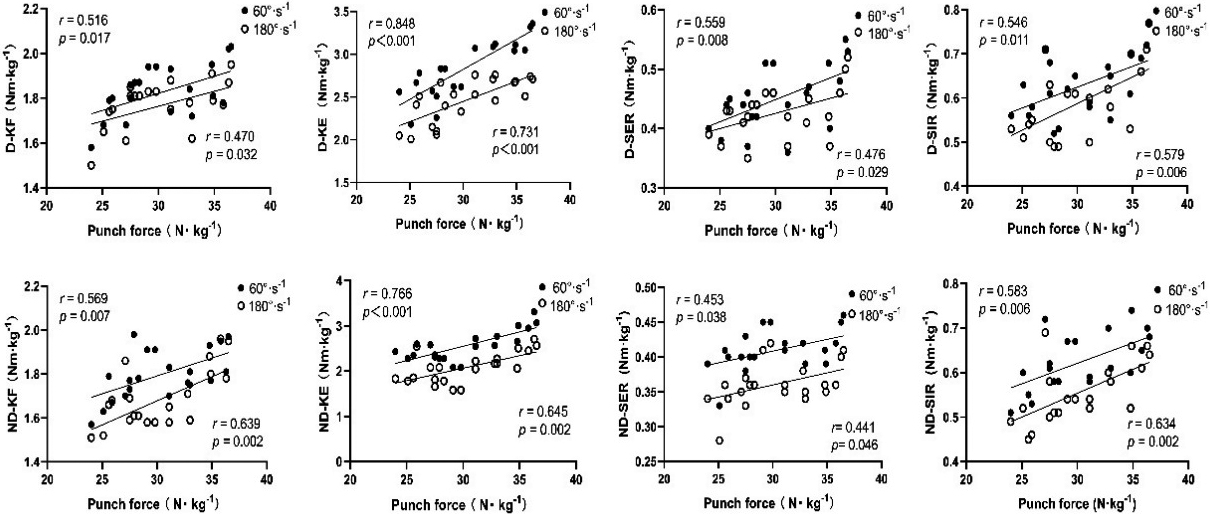
Correlation between the relative PFmax RA and the relative PT of the knee and shoulder in the dominant and non-dominant limb. D 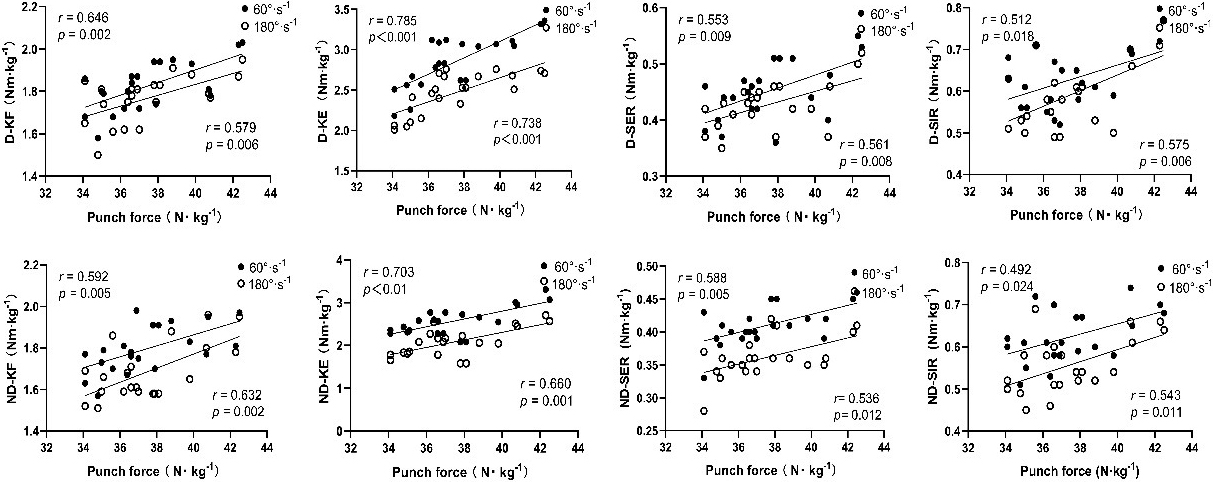
For correlations between the knee PT and the PFmax LA test, a moderate to very strong correlation was found between PFmax LA and D-KF at 60
For correlations between the knee PT and the PFmax RA test, a moderate to strong correlation was found between PFmax RA and D-KF at 60
Discussion
This is the first study that has analyzed relationships between shoulder and knee peak torque and maximal punching force. The first hypothesis that positive correlations exist between PFmax and PT of the knee and shoulder was found to be true. Our results partially supported the second hypothesis. SIR PT at fast velocity (180
We observed that D-KE provided the highest correlation with PFmax LA and RA. ND-KE also shown strong correlations with PFmax LA and RA. Electromyographic research has suggested that, during the initiation and execution stages of punches, the right leg is seen to move the body toward the target and generate a peak vertical force [21]. According to Dyson et al., activation of the rectus femoris extension (KE) and biceps femoris flexion (KF) is critical for maximal force punching, particularly the influence of rectus femoris activity on a powerful rear straight punch. Similarly, the dominant leg provided 71% of the total ground reaction force (GRF) for the straight LA punch [22]. Loturco et al. also found significant correlation in boxers between maximum isometric force in squats and PFmax LA (
In the present study, we found moderate to strong associations between KF strength and LA and RA PFmax. A possible reason for this is that biceps femoris strength relates to hip extension action during the punch phase. In track and field, the biceps femoris achieved hip extension during the ground contact phase, and athletes with a large Y-axis direction (anterior-posterior) of GRF had higher biceps femoris electromyogram activation [24]. Similarly, boxers require acceleration to approach a target along the Y-axis. Dowson et al. also revealed that KF strength had a large correlation to sprint performance (
The moderate to strong correlations for both LA and RA PFmax were also observed in ND-SIR and D-SIR. When performing straight punches, the arms of boxers must accelerate toward their target by enhancing concentric shoulder muscle contractions [26]. Furthermore, the correlation was smaller for PFmax with SER strength than SIR strength, likely related to the kinematic characteristics of punching. Arm movement during punching can be divided into: the extending phase and the returning phase. SER contributes more to increasing returning phase velocities viewed from the direction of applied forces. There are noticeable differences in velocities between the two phases [22]; however, we did not measure the returning phase performance. This highlights the importance of SIR strength for improving PFmax. The currently available evidence on the relationship between upper-limb strength and punching force is conflicting. A previous study reported a strong correlation between mean propulsive power in bench press and LA (
Another important result from the relationship between variables was the SIR. It had stronger associations with PFmax at higher velocities (180
Interestingly, a stronger association between the PFmax and KE was found to be at 60
Conclusions
In summary, the present study highlighted the close relationship of knee PT, shoulder PT and punch performance. Boxers should focus on improving their knee and shoulder joint strength. Furthermore, these findings revealed that boxers with greater KE torques at slow angular velocities and SIR torques at high angular velocities, could produce higher punching forces. For further research, the change in punching performance in boxers after strength training of knee and shoulder muscles using different velocities should be investigated.
Author contributions
CONCEPTION: Dexin Wang.
PERFORMANCE OF WORK: Zixiang Zhou.
INTERPRETATION OR ANALYSIS OF DATA: Wenjuan Yi, Weijia Cui and Rui Wu.
FOR IMPORTANT INTELLECTUAL CONTENT: Chao Chen and Xin Chen.
SUPERVISION: Dexin Wang.
Ethical considerations
Participants received a detailed explanation of the purpose and methods of the study prior to signing a written informed consent form. This study was conducted in accordance with the Declaration of Helsinki on Work Involving Human Subjects. The study was approved by ethics committee of Shanghai University of Sport (102772021RT102).
Funding
This study was supported by the Shanghai Key Lab of Human Performance (Shanghai University of Sport) (No. 11DZ2261100), and Science and Technology Commission of Shanghai Municipality (No. 22010503800).
Footnotes
Acknowledgments
We gratefully acknowledge all the study subjects for their helpful cooperation.
Conflict of interest
The authors have no conflicts of interest to report.