



Abstract
BACKGROUND:
Long-time judo training can lead athletes to develop upper limb asymmetry and shoulder asymmetry during force production, mainly in the action of pulling, pushing, and throwing; that requires higher strength and velocity of the internal and external rotators of the shoulders, which may also result in shoulder injury, or a decrease in judo performance.
OBJECTIVE:
To investigate asymmetries in concentric force of the internal and external shoulder rotators of the dominant and non-dominant upper limbs in high-level judokas at angular velocities of 60, 180, and 300∘/s.
METHODS:
14 highly trained male judokas (age 24.4
RESULTS:
There was no difference in dominant vs. non-dominant for discrete analysis (
CONCLUSIONS:
Based on results, judokas do not present significant asymmetries in concentric force of external or internal shoulder rotators when compared to the dominant vs. the non-dominant upper limb according to discrete and one-dimensional (SPM) analysis.
Keywords
Introduction
Due to the high competitiveness at an international level, judokas train approximately 4 hours a day in activities that demand physical and technical capacity [1]. Training continuity can lead athletes to develop strength and anthropometric asymmetry due to the repetitive application of preferred techniques (tokui-waza) [2]. These asymmetries must be monitored and judokas need to perform compensatory training if necessary because a higher inter-limb difference increases the risk of injury [3, 4]. According to Clark [5], assessing strength asymmetry is a fundamental point for a sports career, as it will prevent the athlete from developing muscular disorders. It is suggested that athletes who present inter-limb asymmetry
Since the development of asymmetries is inherent in judo training [2, 8], studies have been conducted to measure strength asymmetry in upper [9, 10] and lower limbs [3, 8]. In this line, a study showed that a fatigue protocol resulted in inter-limb asymmetry [8], however, four simulated combats did not produce asymmetry in national level judokas [10]. Therefore, it becomes relevant that new protocols investigate the asymmetries produced by training and its effects on performance and risk of injury.
Specifically in judo, there is a high prevalence of shoulder injuries [11], which are associated with the actions of pulling, pushing and throws [10], especially by the application of arm levee throws [12]. Arm throws (te-waza), such as ippon-seoi-nage and morote-seoi-nage, are often used by competitors [13]. These throws require higher strength and velocity capacity of the internal and external rotators of the shoulders. In order to apply this technique, the tori (athlete executing the throw) must externally rotate and abduct their arm to around a 90-degree angle relative to their thorax. This movement helps to create the necessary space for the opponent to be lifted onto the back. Following this, the tori rapidly internally rotate their arm, which helps to drive the opponent over their shoulder and onto their back [14]. In this context, the importance of assessing the strength of the external and internal shoulder rotators is justified.
In fact, there are already published papers on this subject. Marcondes et al. [15] observed that, regardless of sex, the dominant side tends to present higher glenohumeral rotator muscle strength. Madaleno et al. [16] observed that women tend to have higher shoulder joint laxity than males. In a recent study, Delorme et al. [4] observed that younger athletes have less shoulder stability and higher glenohumeral strength (internal and external) when compared to older judokas. Therefore, it is clear that there are many gaps that have not yet been scientifically explored, and new studies which characterize shoulder action can help in developing specific programs that help to prevent injuries.
Specifically regarding the assessment of internal and external shoulder rotators, studies have used different angular velocities between 0 and 300 degrees/second (∘/s) to measure the athlete’s ability to generate muscle strength [17]. An isokinetic test at 300∘/s was applied to handball athletes [18] and baseball pitchers [19] to assess the maximum angular force capacity, 180∘/s for moderate levels and 60∘/s for the lowest angular velocity. The isokinetic evaluation is also important for judokas, since the actions developed in combat require the use of dynamic strength, particularly during high velocity and power actions, which can define the winner in the combat [1]. An isokinetic analysis of the rotators can also help to estimate the risk of shoulder injuries and propose prevention strategies [20]. According to data presented by Błach et al. [11], 25% of judokas who injure their shoulder require hospital care and may have their career seriously affected. Furthermore, according to the study carried out by Akoto et al. [21], serious shoulder injuries can take the fighter away from the mats for up to 6 months, and when they return their technical and physical capacity are below ideal.
Most studies using isokinetic force evaluation in shoulder rotators use discrete variables such as peak torque or peak moment to find assessment asymmetric or ratio in judo athletes [22, 23, 24]. However, Roy et al. [25] showed that peak moment could provide a limited view of the changes in shoulder strength due to fatigue, considering that it is specific to judo in its training and competition [26]. However, some studies used statistical parametric mapping (SPM) for biomechanical analysis, and asymmetries [27, 28], because this method enables continuous and complete analysis of the movement, preventing discrete variable selection bias caused by the evaluator [29]. With this analysis strategy, the data obtained from the curve are smoothened, and it is possible to notice space-time changes [22].
In view of the above, the present study aimed to investigate asymmetries in concentric force of the internal and external shoulder rotators of the dominant and non-dominant upper limbs in high-level judokas (without injury or history of shoulder injury), at angular velocities of 60∘/s, 180∘/s and 300∘/s. We hypothesize that the asymmetry presented will be lower than 15%, regardless of velocity.
Methods
Experimental approach
This experimental protocol aimed to measure possible asymmetries of internal and external shoulder rotators in high-performance judokas. The main investigator initially contacted the National Federation to request access to coaches and athletes. An informative speech with the athletes who met the inclusion criteria was given at each club visited, and those who agreed to participate signed the informed consent form in accordance with the Declaration of Helsinki for ethics in scientific studies. Data collection was performed in a single visit to the Neuromechanics laboratory. The participants initially completed an anamnesis in which data on age, dominance side, injury history, and tokui-waza were collected. This protocol was authorized by the institutional ethics committee of the University of Santiago of Chile on July 21, 2013, where the data were collected (Ethics Committee Protocol No. 352/22).
Participants
The following inclusion criteria were adopted: a) male athletes; b)
Individual Tokui waza (favorite technique) applied to dominant and non-dominant side by the participants
Individual Tokui waza (favorite technique) applied to dominant and non-dominant side by the participants
Notes: gris cells represent the tokui-waza applied by non-dominant side. Te-waza – throw techniques in which the main lever is applied with the upper limbs, koshi-waza – throw techniques in which the main lever is applied with the trunk, ashi-waza – throw techniques in which the main lever is applied with the lower limbs, sutemi-waza – sacrifice techniques (need a wrapping by the tori).
Before each participant entered the laboratory, their temperature was measured, and all the necessary precautions were taken to attend to the COVID protocol of the University. All the participants received the protocol instructions, that there were two tests and the necessary positioning on the machine. Height, body mass, corrected biceps circumference, corrected thigh circumference and APE index were measured before starting the non-isokinetic test. Next, a 15-minute warm-up was performed, which was composed of aerobic exercises on the treadmill, joint mobility and dynamic stretching of the upper limb and trunk, strength of the upper limbs and uchikomi with an elastic band (Morote-seoi-nage).
We evaluated the absolute peak moment normalized by body mass, measured in the internal and external shoulder rotation. The movement was performed in a sitting position with the abductor arm at 45∘ oriented in the scapular plane, at 3 angular velocities (60∘/s, 180∘/s and 300∘/s), at a sampling frequency of 100 Hz, in concentric/concentric mode, based on the velocity found in throw techniques according to Imamura et al. [30]. Peak moment (Nm) and range of motion (in degrees) were recorded. All evaluations started with the dominant upper limb. All movements were performed within the amplitude limit (70∘ of internal and external rotation). For each test, the participant was positioned aligning the joint with the mechanical axis of the isokinetic device (Cybex® Humac Norm Dynamometer CSMI, model 502140, Stoughton, MA, USA). All participants performed 3 submaximal repetitions for familiarization. Then, 5 maximum repetitions were performed together with a standardized verbal stimulus, with a 2-minute rest interval between the dominant and non-dominant arms, while for the different velocities, the participants rested 6-min between them [31], the order of tests was external rotation and external rotation how one-cycle completed five cycles. The subjects were sat with their shoulders abducted 30∘ and their elbow flexed to 90∘. The isokinetic device was calibrated before each test according to the operating manual [32], and all measures were performed by the same evaluator. In this study gravity correction was used for all test [33]. The results were calculated as the mean of the five maximum repetitions to moment for each velocity (60∘/s, 180∘/s, and 300∘/s). We used the asymmetry index equation to estimate the risk of injury associated with upper limb asymmetry, as follows:
Data processing
The signal was extracted from the isokinetic device to a spreadsheet. The first point
Descriptive values and inferential discrete analyses for internal and external rotation when comparing dominant vs. non-dominant upper limb
Descriptive values and inferential discrete analyses for internal and external rotation when comparing dominant vs. non-dominant upper limb
M
A discrete and one-dimensional analyses were performed in the evaluation of asymmetries between the dominant and not-dominant limbs. The discrete analysis was performed between peak moment between limbs through an independent sample Student’s
Results
Table 2 shows the raw and normalized data for the internal (60∘/s, 180∘/s and 300∘/s) and external (60∘/s, 180∘/s and 300∘/s) rotators for dominant and non-dominant upper limb and AI.
Discrete analysis
There was no difference in dominant vs. non-dominant for discrete analysis (
Statistical parametric mapping (SPM) for difference (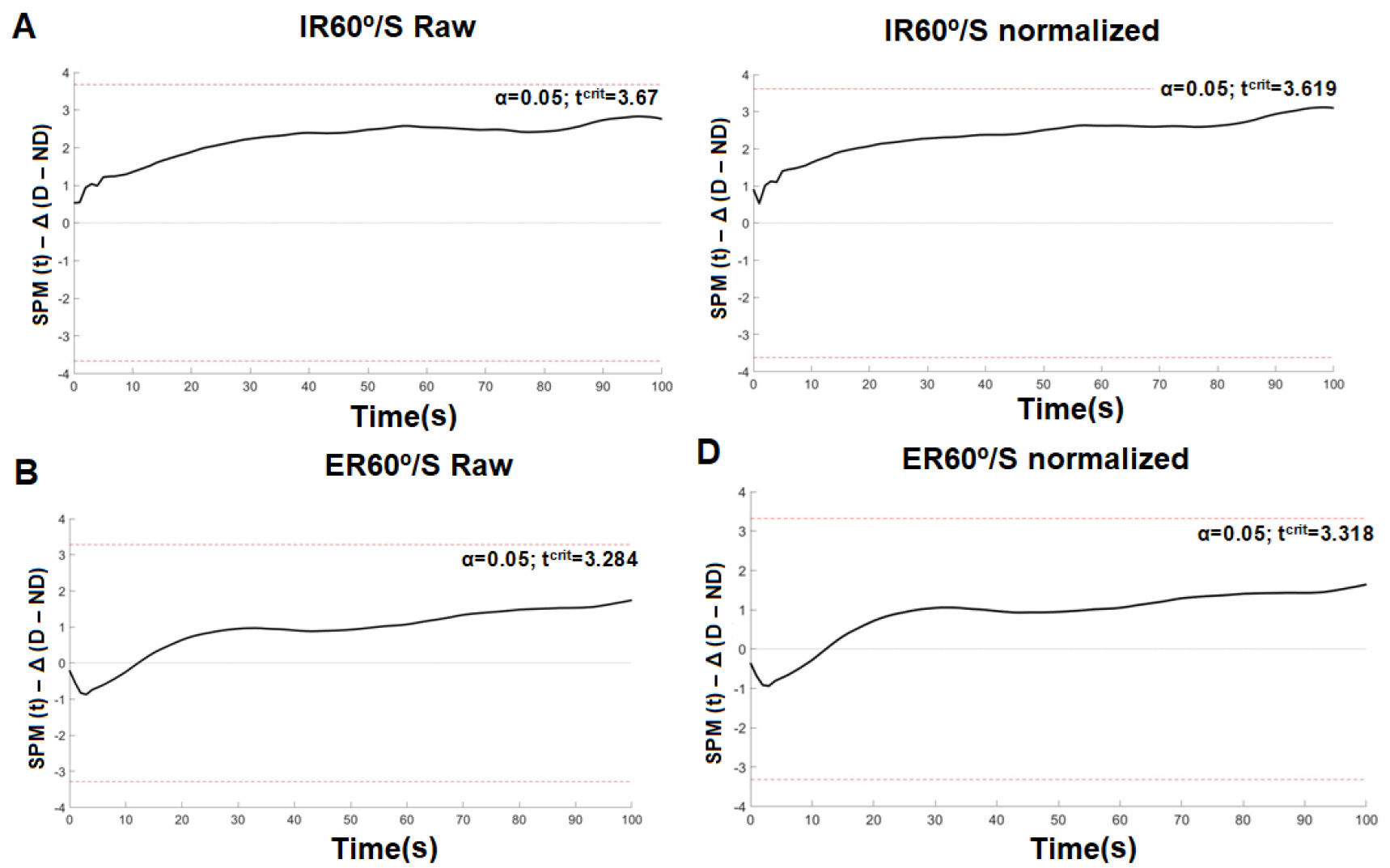
Statistical parametric mapping (SPM) for difference (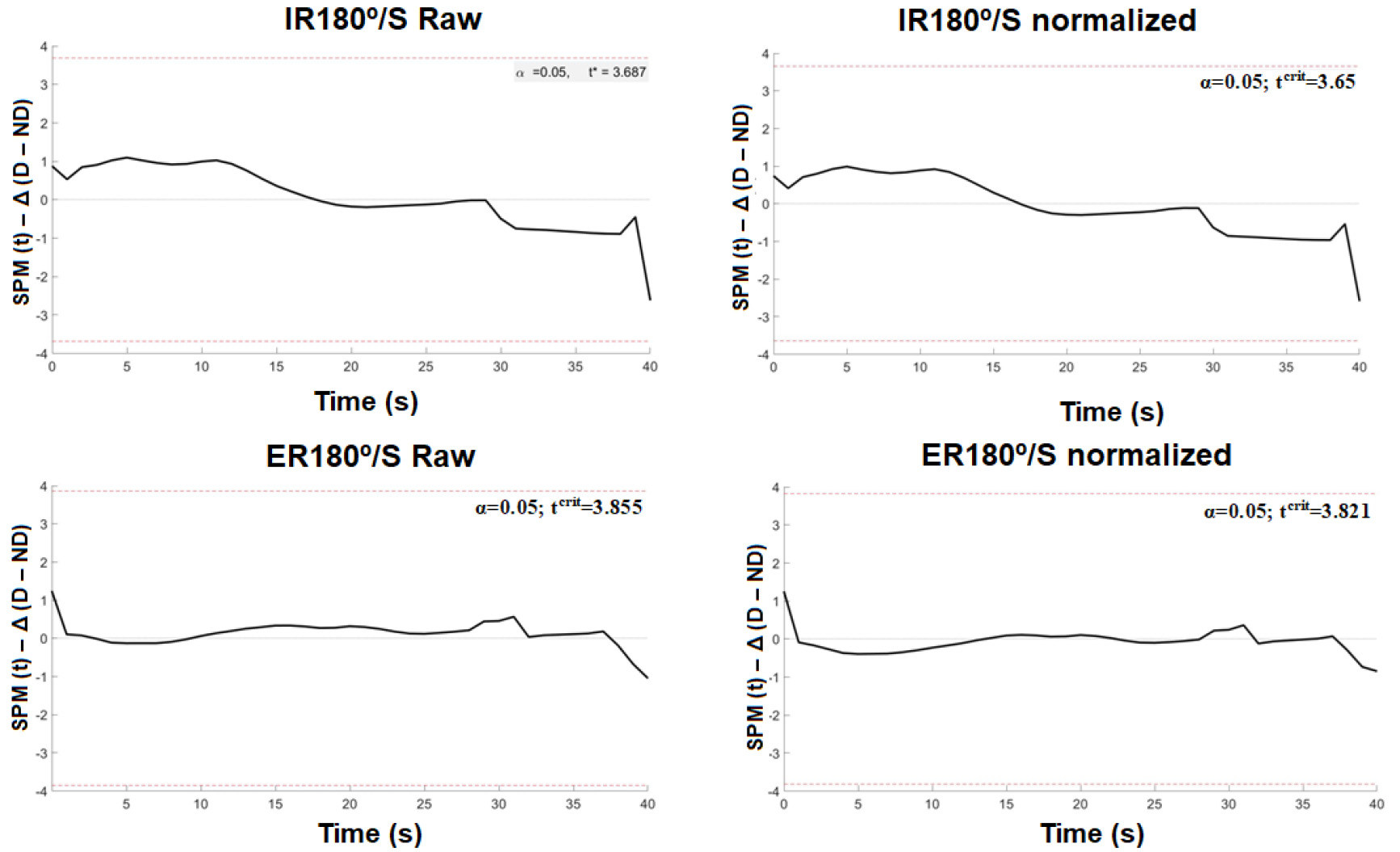
Statistical parametric mapping (SPM) for difference (
Figures 1, 2 and 3 show the comparative data through the
Discussion
Evaluating shoulder internal and external rotator force can be a good predictor of injury risk in athletes [20]. In this sense, this study investigated asymmetries in concentric force of the internal and external shoulder rotators of the dominant and non-dominant upper limbs in high level judokas, at angular velocities of 60, 180 and 300∘/s. Our main results confirmed our hypothesis, as we did not observe significant asymmetry between dominant vs non-dominant upper limbs despite the angular velocity. Regardless of the statistical result, the AI between the dominant and non-dominant sides did not exceed 5% difference; according to Parkinson et al. [34], the threshold between 10–15% is commonly used as an indicator for the increased risk of injuries, however this value does not yet have scientific support.
Some explanations could be found in the muscles that make up the two groups of shoulder rotators, where the IR muscles are the subscapularis, pectoralis major, and latissimus dorsi, while the ER muscles are composed of the infraspinatus, teres minor, and teres major [37]. The IR muscles are large muscles with multiple movements and more strength than the ER muscles [38]. Although our results did not show statistically significant differences, it is observed that as the speed of execution of the test increases, the differences were smaller, whereas some studies showed that if the speed is not specific to the sport, the peak moment asymmetries will be smaller [39]. On the other hand, the subjects in our study performed physical training for 2 hours a day with emphasis on unilateral and bilateral strength training, where some studies demonstrated that these training present similar improvements in muscle [40], circumference [41] and cross-section area [42],where unilateral strength training enhances specific unilateral strength gains [41] and unilateral strength patterns [43] as a unilateral test.
To the best of our knowledge, the present study was the first to compare the force asymmetry of the internal and external shoulder rotators in high-performance judokas at 3 different angular velocities, and it was also the first study to use the SPM method for analysis. The results of the present study are in line with those obtained by Kons et al. [10], who did not observe an increase in asymmetry in the upper limbs after 4 simulated judo matches (4 min
We found more studies in our literature search which investigated the lower limb asymmetry in judokas [3, 8, 10]. However, the asymmetry of the upper limbs can increase the risk of injuries in the sport [4]. In addition, early detection of asymmetries are important for the development of prevention strategies [44]. One of the factors that can lead to asymmetry in judokas is the successive training of unilaterally applied techniques [16, 45]. It is important to emphasize that relevant asymmetries in the upper limbs have been observed in judokas still in training [2, 45]. In athletes aged 8–18 years, Fukuda et al. [2] observed that training time is directly related to peak (
To the best of our knowledge, this was the first study to measure the force of the internal and external shoulder rotators in judokas by the SPM curve; one of the advantages of this method is to increase the number of observations, allowing a complete analysis of the performed movement [47], as seen in Figs 1–3. SPM is a statistical technique that is widely used in functional neuroimaging to detect spatiotemporal changes in the brain in relation to different experimental conditions [29]. However, recent studies have used this method to analyze performance in sports biomechanics [47, 48, 49]. Using an SPM Curve, James et al. [49] observed that high-level mixed martial arts athletes (
Based on our results, SPM curves are not sensitive to detect asymmetries in upper limbs of high-performance judokas. Thus, our results raise two hypotheses, namely that either the analyzed group does not have significant asymmetries, or the method is not sensitive for such a diagnosis. When analyzing the tokui-waza (Table 1), approximately 10% of the throws were te-waza to the detriment of 43% of ashi-waza; therefore, the group of analyzed judokas does not preferentially use upper limb levers during training and competitions, which may be a contributing factor for not observing asymmetries. Future studies may perform an individual analysis to obtain such answers [50]. The data obtained in the present study must be interpreted regarding its limitations, since we measured high-performance male athletes without any history of shoulder injuries.
Conclusions
Based on the established aims, applied methods, and obtained results, it can be concluded that healthy judokas do not present significant asymmetries in concentric force of external or internal shoulder rotators when compared the dominant vs. the non-dominant upper limb according discrete and one-dimensional (SPM) analysis. Researchers and practitioners should analyze asymmetries individually, because analysis in a group could be influenced between subjects and not be sensible for asymmetries detection.
The asymmetry data observed here may be different for those who trained with higher emphasis on the dominant side. In this sense, we recommend an individualized analysis as practical applications and athletes who present asymmetry above 15% of the internal and external rotators of the shoulder should undergo preventive treatments before injuries occur. Finally, it is important to highlight that this has no history of injury, athletes who were injured may present different results compared to those analyzed here.
Author contributions
CONCEPTION: EAM, DAT, MGV, CJB, BM, ON, PMM and CJB.
PERFORMANCE OF WORK: EAM, DAT, MGV and CJB.
ANALYSIS OF DATA: EAM, DAT, MGV, CJB, PMM, ON and BM.
PREPARATION OF THE MANUSCRIPT: EAM, DAT, MGV, CJB, PMM, ON and BM.
Ethical considerations
The study was authorized by the institutional ethics committee of the University of Santiago of Chile on July 21, 2013, where the data were collected (Ethics Committee Protocol No. 352/22). Participants signed an informed consent form in accordance with the Declaration of Helsinki for ethics in scientific studies.
Funding
This study was partly financed by The Directorate of Scientific and Technologic Research (DICYT) of the University of Santiago of Chile (USACH) under Grant number [022287AM].
Footnotes
Acknowledgments
The authors would like to thank the Chilean judo federation, coaches and athletes.
Conflict of interest
The authors declare no conflict of interest.