



Abstract
BACKGROUND:
Heart Rate Variability (HRV) is a non-invasive method of assessing the autonomic nervous system response during exercise and fatigue.
OBJECTIVE:
The aim of the study was to analyze the validity and feasibility of the stress score index (SS) calculated from SDNN values during exercise.
METHODS:
18 Men performed 2 running tests: 1) incremental exercise test; 2) 10-minute constant load test. Subjects underwent HRV analysis during the constant load test, before both tests, and afterward in a seated position at 3 intervals (0’–5’, 5’–10’, 10’–15’). The relationship between SDNN and SD2 was analyzed before, during, and after the test. SS was calculated as 1/SD2*1000. The Bland-Altman test analyzed the reliability of ESS. The bias, limits of agreement (LoA), standard deviation of difference, intraclass correlation (ICC), and person coefficient were calculated.
RESULTS:
The bias was 0.15
CONCLUSIONS:
The SS index calculation from SDNN is a reliable alternative during exercise.
Introduction
Heart Rate Variability (HRV) is a non-invasive method of assessing the autonomic nervous system and cardiac function [1, 2]. It consists of analysing the fluctuations in the time intervals between adjacent heartbeats [2]. Its utility and feasibility have been widely studied, with its application in health and sports being particularly important [3, 4, 5, 6, 7, 8, 9]. As HRV analysis only requires the heartbeat signal to obtain the results, its use has been extended to wearable devices (heart belts, watches, smartphones) [5, 10, 11, 12]. The algorithms that these devices typically incorporate are based on the HRV guidelines [1, 2]. The calculations of HRV are mostly based on linear parameters, such as the root-mean-square of the consecutive differences between normal heartbeats (RMSSD) and the standard deviation of normal sinus beats (SDNN) [10, 11, 13]. These parameters have been studied as markers of parasympathetic activity [2], but there are more variables that can be used as physiological stress indicators. Specifically, the Poincaré Plot is a geometric and non-linear method that plots each R-R interval as a function of the preceding R-R interval, with the values of each pair of consecutive R-R intervals defining a point on the graph. Two different indices can be derived from this diagram, SD1, which indicates parasympathetic activity, and SD2, which is the inverse of sympathetic activity [1, 14]. However, while SD1 is a direct indicator of parasympathetic activity, understanding SD2 as an indicator of sympathetic activation could lead to confusion, as it is inversely related. Therefore, there are some studies that highlight another indicator of sympathetic activity, the Stress Score (SS), which is obtained from the Poincaré Plot SD2 index [8, 9, 15, 16, 17, 18, 19, 20, 21]. SS has been shown to be a valid index to control and monitoring training load in many sports [18, 19, 20]. For example, SS has been useful tool for tracking individual assimilation of weekly workload, including the match, in professional football players [8]. Similarly, SS appears to be the best HRV predictor of internal load during recovery in hot and humid conditions [15]. SS shows a good relationship with an internal physiological variable as it is the creatine kinase (CK) before and after a handball competition [22]. Although SS can be a reliable tool, it requires the SD2 index for its calculation, which current devices (smartwatch, mobile phone etc.) hardly provide. These devices provide HRV data based on SDNN or RMSSD calculation [5, 23, 24]. SDNN and SD2 described a close linear relationship under resting conditions [9]. In this line, if these two variables had the same behavior during exercise, we could infer SD2 from SDNN measurement, and in consequence, the SS index. However, to our knowledge, the relationship between SD2 and SDNN during exercise has never been studied. Moreover, there is no wearable device or smartphone app that could provide the SS index SS. We hypothesized that it would be possible to estimate SS from SDNN data during exercise. Therefore, the aim of the present study was to establish a valid equation for estimating SS from SDNN measurements. Secondly, the study analyzed the validity and feasibility of the SS index calculated from SDNN values during exercise.
Material and methods
Participants
Eighteen male athletes participated in the study (25.17
Design
All participants completed two different exercise tests 7 days apart. The first was an incremental exercise test to exhaustion with was gas analysis. Respiratory gas exchange was recorded during the incremental test. The first ventilatory threshold, second ventilatory threshold and maximal aerobic speed (MAS) were calculated [25]. The second test was a 10-min constant exercise test at 70% of MAS obtained from the previous incremental exercise test one week earlier.
All subjects underwent a seated HRV analysis in pre-test (5 minutes) and post-test (3 different conditions): from 0’ to 5’, from 5’ to 10’ and from 10’ to15’ of the recovery. The study also measured HRV during the 10-minute constant load test. The total number of HRV registers was 162. 19 registers had to be eliminated due to technical complications during the tests. The total number of HRV data analysed was 143.
Measurements
The R-R interval monitor Firstbeat Bodyguard 2 (Firstbeat Technologies Ltd, Jyväskylä, Finland) collected the data for the HRV analysis, performed with the algorithms of Kubios HRV v2.0 (Biosignal Analysis and Medical Imaging Group, Department of Physics, University of Kuopio, Kuopio, Finland). The philters provided by the Kubios software were applied when necessary (no more than 10% error) after a double visual inspection to detect artefacts. The parameters obtained from Kubios were SDNN and SD2.
Stress score and estimated stress score
Descriptive data from SD2 and SD2 estimated (ESD2) in all conditions
Descriptive data from SD2 and SD2 estimated (ESD2) in all conditions
Abbreviations: Poincaré plot SD2 index (SD2); estimated SD2 (ESD2); intra-class correlation (ICC); graded exercise test (GXT); maximum aerobic speed (MAS).
Relationship between SD2 and SDNN with all the data measured (
In the study, the stress score was calculated using the following calculation (1/SD2*1000) [9]. To obtain the estimated stress score (ESS), this work applied the equation obtained from the relationship between SD2 and SDNN measured in all conditions (
The study analysed the statistics using the software IBM SPSS statistics 27 (International Business Machines Corporation, New York, USA) and presented all data as mean
Results
Descriptive data from SS and SS estimated (ESS) in all conditions (
143)
Descriptive data from SS and SS estimated (ESS) in all conditions (
Abbreviations: Stress score (SS); estimated stress score (ESS); intra-class correlation (ICC); maximum aerobic speed (MAS).
Relationship between SD2 and estimated SD2 (ESD2) with data from all conditions (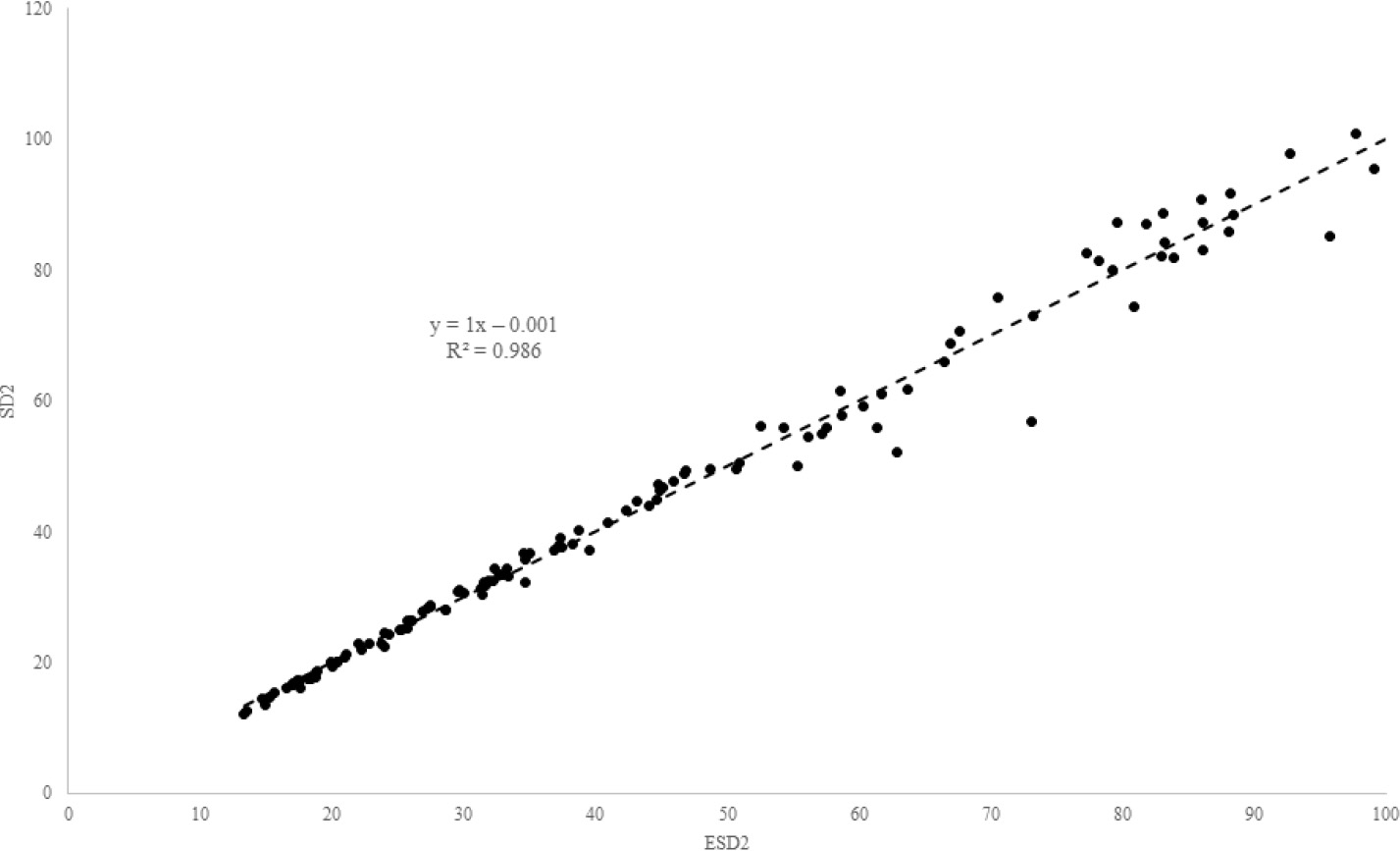
Table 1 describes the measured SD2 and ESD2 (mean
Relationship between Stress Score (SS) and estimated Stress Score (SSE) with data from all conditions (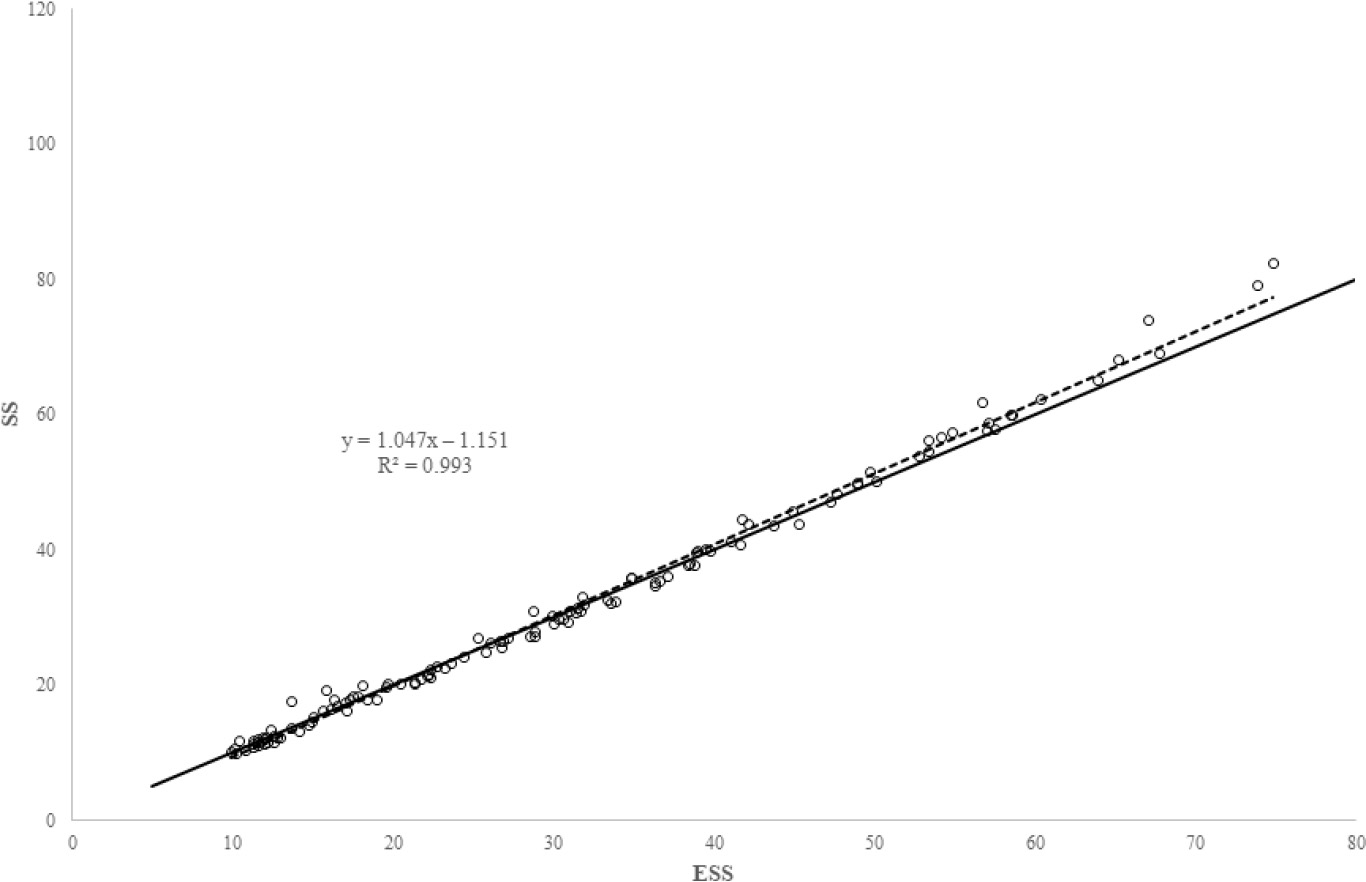
Bland-Altman plot (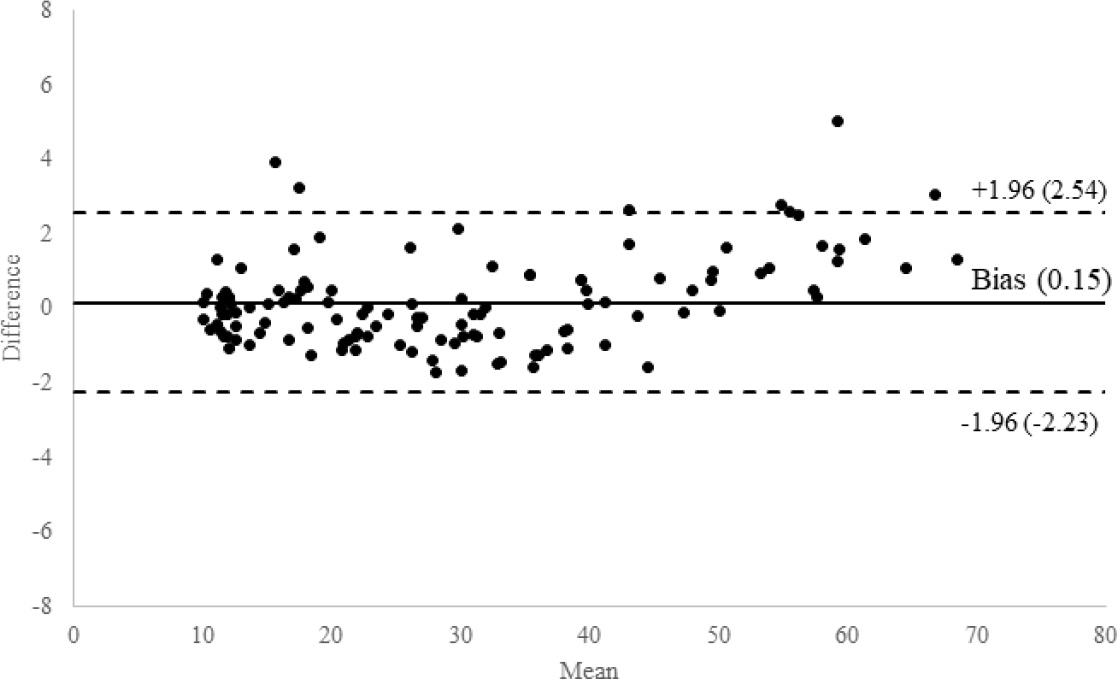
The main finding of this study is that SS can be derived from SDNN values during exercise. The data show that there is a linear relationship between SD2 and SDNN. Thus, these results are on the same line as the work published by [9] under resting conditions. This relationship suggests that SDNN is not only an indicator of parasympathetic activity, but also represents the reversal of sympathetic activity.
This finding provides an opportunity to estimate SD2 from SDNN. That is, SS, which requires the SD2 index for its calculation, can be estimated from the estimate of SD2 by SDNN. This assumption is confirmed by comparing SS and ESS because the agreement between the two variables is high, with a mean difference of 0.15
SS has been demonstrated a good physiological internal load marker. The SS value is a reliable indicator of exercise load regulation [8, 9, 15, 16, 18, 19, 20, 21]. However, nowadays it is difficult to measure it in a practical way from the most usual apps. Our results enable the measurement of SS using SDNN. This new approach offers athletes and coaches the opportunity to incorporate SS into their daily routine. These results could have an important practical application, as most devices and apps do not include a non-linear HRV index to monitor exercise load. In contrast, linear parameters such as SDNN or RMSSD are usually available [5, 23, 24]. Moreover, this study proved that estimation of SS is possible under three different conditions: rest, exercise, and post-exercise recovery. The correlations were statistically significant under all conditions, so the estimation of SS by SDNN measurement is valid regardless of training intensity and time of determination.
In conclusion, the present study shows that the relationship between SDNN and SD2 is constant not only at rest, but also during and after exercise. This finding provides a new approach for the use of SS by athletes and coaches during their training program. Thanks to this new approach, the SS index could be easily measured using actual smart watch and apps.
Author contributions
CONCEPTION: Salazar-Martínez E., Naranjo Orellana J., Sarabia-Cachadiña E.
PERFORMANCE OF WORK: Salazar-Martínez E., Naranjo Orellana J., Sarabia-Cachadiña E.
INTERPRETATION OR ANALYSIS OF DATA: Salazar-Martínez E.
PREPARATION OF THE MANUSCRIPT: Salazar-Martínez E., Sarabia-Cachadiña E.
REVISION FOR IMPORTANT INTELLECTUAL CONTENT: Naranjo Orellana J.
SUPERVISION: Salazar-Martínez E., Naranjo Orellana J., Sarabia-Cachadiña E.
Ethical approval
The Ethics Committee of the University Study Centre-Cardenal Spínola CEU approved the present study in 4-5-2021. Procedures were carried out in concordance with the Declaration of Helsinki. All subjects were informed before the study and signed a written informed consent form in accordance with the Declaration of Helsinki.
Footnotes
Acknowledgments
The investigators would like to thank the sport students whose cooperation made this study possible and Carlos Muriel for his assistance.
Conflict of interest
The authors have no conflicts of interest to report.