



Abstract
BACKGROUND:
In short track speed skating, there is asymmetric fatigue of the gluteus maximus (GM) muscle resulting from the technique of skating. Scientific reports confirm the relationship between muscle fatigue and its change in the slope frequency of bioelectrical activity.
OBJECTIVE:
To investigate whether athletic experience in elite short track speed skating can distinguish the asymmetry change in slope frequency of the raw electromyographic signal (EMG) of the GM muscle, influenced by the disparity in experience between junior and senior athletes.
METHODS:
In the research, an elite group of short track speed skating national team athletes Junior and Senior, participated. Isometric tension GM muscle was tested using the Biering-Sorensen test.
RESULTS:
The study confirmed differences in the asymmetry of slope frequences EMG signal in GM muscle between juniors and seniors in short track speed skating (
CONCLUSIONS:
Statistically significant differences in the level of slope frequences of the right gluteus maximus muscle juniors vs. seniors were demonstrated, suggesting asymmetry due to experience and skating technique.
Introduction
Short track speed skating (Short Track) is an Olympic sport characterized by the specific position of the athletes and the counter-clockwise direction of movement in high-speed races on the track. High speeds and loads during cornering require athletes to spend years mastering the technique of shifting the center of gravity to the right leg. It has been hypothesized that training experience influences the optimization of load transfer and cornering techniques, resulting in a distinct asymmetry of gluteal fatigue, which is crucial for this sport.
Currently, few scientific studies address the issue of isokinetic endurance or strength of the hip extensors in short track athletes and relate to the impact of training on changes in the neuromuscular profile, strength, and power parameters of the lower limb muscles [1], or concentric maximum voluntary contraction strength of the leg muscles and the times as well as speeds over different distances [2].
The asymmetric pattern of observed changes in the lower limbs has been demonstrated in both muscle desaturation and alterations in the neuromuscular profile [3, 4]. In the studies by the authors above, an asymmetry is presented, which characterizes the overloading of the right lower limb in experienced athletes. The research also aimed to illustrate asymmetric differences in specific parameters of the lower limbs during straight-line skating and cornering on the ice rink track.
The results of the studies indicate that the right leg is more active during cornering. Among other things, it was observed that there is a difference in joint angles between the left and right limb during cornering [5], which seems quite natural considering the movement characteristics. However, Felser et al. [3] showed that asymmetric neuromuscular changes occur during cornering to the disadvantage of the right leg. On the other hand, Hesford et al. [6] found a significant asymmetry in oxygen supply and blood volume to the disadvantage of the right leg during successive laps. Another problem that has been diagnosed in this discipline is the overloading of the gluteus maximus muscle, which as the strongest hip extensor plays a crucial role in maintaining the characteristic position in the short track. The asymmetry of this phenomenon has been confirmed in Polish Olympic team athletes [7, 8, 9]. This is particularly important at the elite athlete level as it can be directly linked to overloads leading to various injuries, such as anterior cruciate ligament injuries or hamstring strains [10].
In scientific research on Short Track, there is a deficiency in studies describing muscle fatigue asymmetry while considering the age and experience of the athletes. Park et al. [11] have shown that there are asymmetrical differences in lower limb biomechanics based on athletes’ experience; however, this does not allow conclusions to be drawn about the effects of this asymmetry on muscular changes and its impact on overloads injuries.
Our study is the first to demonstrate the asymmetry of gluteal fatigue between junior and senior short track athletes. Our hypothesis regarding differences in muscle fatigue asymmetry in relation to athletes’ experience stems from variations in the riding technique exhibited by juniors vs seniors. Observations by coaches indicate that juniors overload the left lower limb more, whereas seniors overload the right lower limb. This is an important issue because it concerns therapies in regenerative sports medicine and highlights potential overloads associated with the athlete’s experience.
Methods
Participants
The study conducted included two groups of participants. The experimental group (Senior) comprised fifteen elite Short Track athletes from the national team (mean age 21.7
Study protocol
Body position in the Biering-Sorensen test.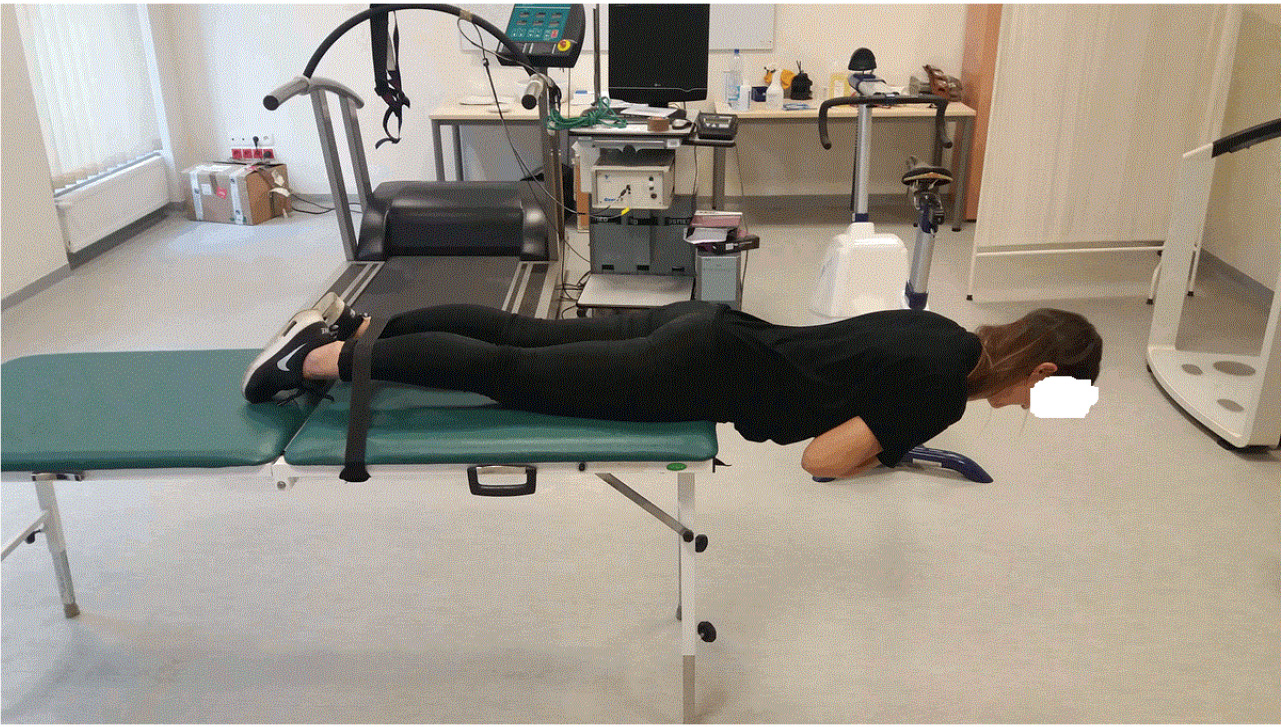
Muscle fatigue was determined based on the analysis of the change in slope frequency of the raw electromyographic signal (sEMG) from the GM muscle, examined during an isometric contraction using the validated Biering-Sorensen test position [12]. Scientific reports confirm the relationship between muscle fatigue and its change in the slope frequency of bioelectrical activity. The effectiveness of the myolectrical manifestations of fatigue test during a 60-s contraction was confirmed by Mutchler et al. [13]. In this protocol (Biering-Sorensen test), participants maintained a specific body position to ensure isometric and symmetric muscle tension in the tested body segment throughout the 180-second duration of the test. Participants lay on a horizontal table on their abdomen, aligning their iliac crests with the table’s edge. Straps secured the lower limbs around the ankle joints. They were instructed to sustain a horizontal position with the body (including the head, shoulders, and torso) unsupported for as long as possible, while crossing their arms at the chest (Fig. 1).
This test has been demonstrated to be reliable [12, 14] and has been frequently employed in studies on gluteus maximus (GM) muscle fatigue [9]. It is designed to ensure simultaneous and symmetrical isolation of both gluteal muscles (GM) during the test [7, 15].
During the test, a 16-channel EMG system (manufactured by NORAXON DTS) was utilized, which recorded signals with a precision of 16 bits at a sampling rate of 1500 Hz. The sampling rate is limited by the capabilities that NORAXON DTS offers. The bio-electrical assessment of activity in the gluteus maximus muscles was conducted following the SENIAM methodology [16, 17].
The TeleMyo DTS system (Noraxon) exhibited the following technical specifications: device baseline noise below 1
Statistics and data analyses
The slope of muscle fatigue, described as a regression coefficient from a linear regression line between mean frequency and time, was calculated for each participant. The mean values of these slopes were analyzed using mixed ANOVA with within-between interactions, considering the side factor (left/right muscle) and the studied group (senior, junior). The power spectrum of sEMG frequencies shifting toward lower frequencies during muscle contractions indicates an increase in fatigue levels. Average frequency analysis can be utilized to estimate the extent of this shift and the degree of fatigue.
Asymmetric slope frequency of the gluteus maximus muscle characterizing juniors and seniors short track athletes
Asymmetric slope frequency of the gluteus maximus muscle characterizing juniors and seniors short track athletes
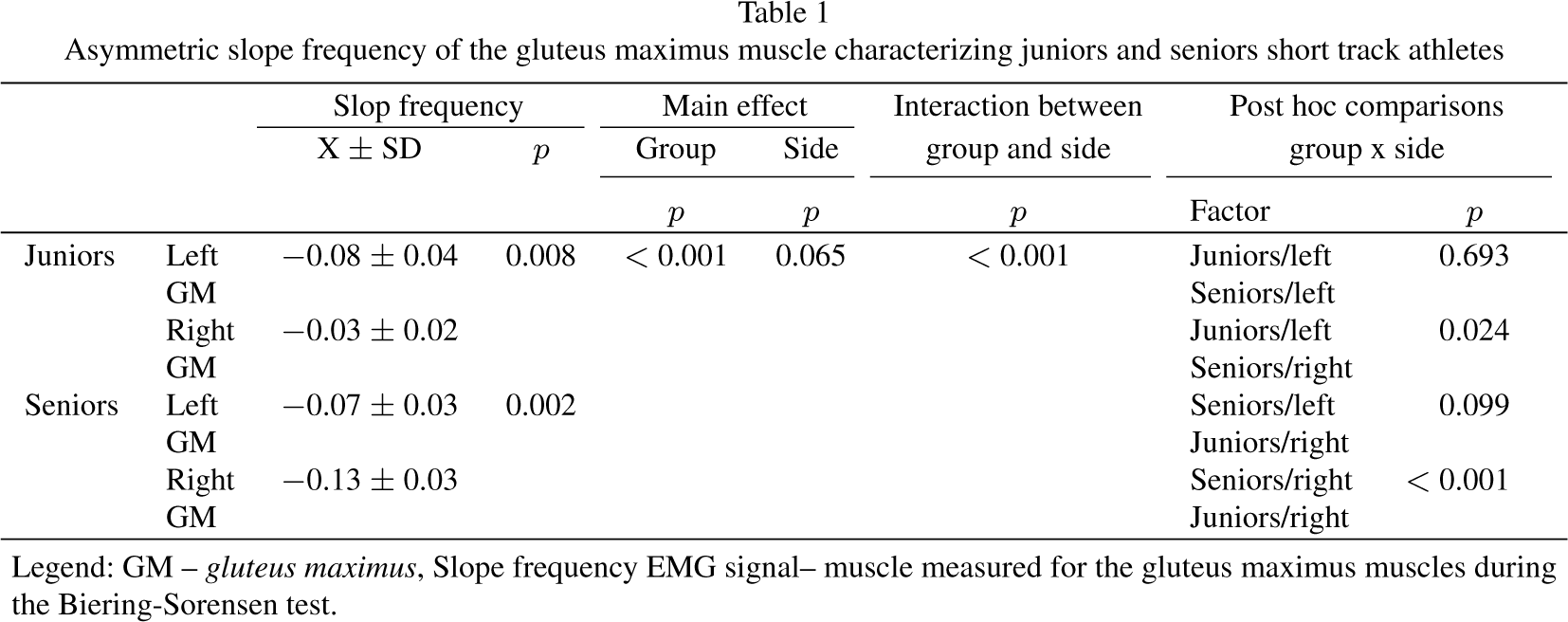
Legend: GM - gluteus maximus, Slope frequency EMG signal- muscle measured for the gluteus maximus muscles during the Biering-Sorensen test.
The sample size of 15 (in each group) participants in 2 groups is sensitive enough to detect Effect size 2 p= 0.22 power 80% and a 5% significance level.
In the Seniors group, statistically significant differences (
In the Juniors group, a statistically significant difference (
A 2
Post Hoc Comparisons analysis GROUP x SIDE indicated a statistically significant difference between the Juniors/left and Seniors/right groups (
Post Hoc Comparisons analysis GROUP x SIDE indicated a statistically significant difference between the Seniors/right and Juniors/right (
Discussion
To our knowledge, this is the first study to show that differences in slope frequency of the EMG signal between the right and left GM muscles in Short Track athletes are due to differences in experience athletes, largely related to skating technique during turns on the track.
As mentioned earlier, scientific reports confirm the relationship between muscle fatigue and its change in the slope frequency of bioelectrical activity [13], which can be directly related to fatigue changes in the GM muscles of the examined athletes.
Senior athletes showed greater slope frequency in the right GM muscle, which is consistent with studies concerning the overload on the right side of the body in elite athletes [1, 3, 6, 7]. Junior athletes showed greater slope frequency in the left GM compared to the right muscle. Intergroup analysis between the groups revealed statistically significant differences in the level of the right GM muscle (juniors vs. seniors), indicating a significant asymmetry resulting from experience. Confirmation of this hypothesis is also evident in the lack of intergroup significance (seniors vs. juniors) when comparing the fatigue of the left GM muscle, indicating significant differences that are likely due to technique.
There is currently no literature on research regarding the asymmetry of fatigue between juniors and seniors. However, studies have been conducted that show differences in skating technique taking into account the experience and age of the participants [5]. Previous studies of our own have demonstrated differences in the asymmetry of muscular disorders were demonstrated, disadvantageous to the left lower limb in young athletes [8], which directly indicates differences resulting from experience. The results of these studies suggest that younger athletes exhibit left GM muscle fatigue and tend to shift their center of pressure onto the right leg while quiet standing. This asymmetry in weight distribution (right vs. left leg) is likely caused by a higher number of trigger points in the left limb, indicating dysfunction on that side in young athletes. This view, which is related to the asymmetry of body balance, is also confirmed by coaches working with the junior group in our study.
It is currently difficult to accurately determine the age at which a short track athlete achieves a high technical level. However, studies on senior athletes point to the aspect of asymmetric loading in cornering, which is considered the most technically demanding element. Felser et al. [3] demonstrated that the bioelectrical activity of the muscles in both legs differs between straight-line skating and cornering, with a greater discrepancy observed in the disturbances in the muscles of the right leg. This result demonstrates the importance of technique in driving of curves, which increases leg muscle asymmetry the most. Hesford et al. [18] also observed an asymmetry in muscle oxygen desaturation resulting from short track technique, which may influence the level of muscle fatigue.
Finally, our results confirm that the characteristic counterclockwise movement in short track ice skating causes senior athletes to overload the right side. This may lead to an increased risk of injury to the lower limb and/or the development of functional pain due to asymmetry in fatigue. We are aware that the limitation of our study is that only two muscles were examined; however, the decision in this matter was based on the results of our previous research and the suggestions of the coaches and physiotherapists of the Polish national speed skating team.
Limitations
Presenting our research results, we are aware that using sEMG to analyze isometric instead of the gluteus maximus muscles does not reveal the dynamic nature of these muscle activities. However, we identified significant differences in the “slope” changes of bioelectrical activity frequency related to fatigue processes, which are important for athletes and coaches. We do not aim to demonstrate clinical significance for the phenomenon we describe; rather, we attempt to illustrate the importance of the processes occurring in short-track athletes, which is highly significant for coaches.
Conclusion
Statistically significant differences in the level of slope frequences of the right gluteus maximus muscle juniors vs. seniors were demonstrated, suggesting asymmetry due to experience and skating technique. Significant differences in the level of the right GM muscle (juniors vs seniors) were demonstrated, indicating asymmetry arising from experience and skating technique.
Funding
The authors report no funding.
Author contributions
CONCEPTION: MK, ES.
PERFORMANCE OF WORK: MK, PP, PD.
INTERPRETATION OR ANALYSIS OF DATA: MK, PP.
PREPARATION OF THE MANUSCRIPT: MK, ES.
REVISION FOR IMPORTANT INTELLECTUAL CONTENT: MK, PD, ES.
SUPERVISION: MK, ES.
Ethical considerations
The study was conducted in accordance with the Declaration of Helsinki and approved by the Ethics Committee of the Medical University of Poznan. (Resolution No 110/22; of 10 March 2022). Trial registration: 20/07/2022, Trial Id: ACTRN12622001016729.
Footnotes
Acknowledgments
The authors have no acknowledgments.
Conflict of interest
The authors have no conflicts of interest to report.