



Abstract
BACKGROUND:
Maca extract may regulate oxidative stress and muscle damage after exhaustive endurance exercise (EEE); however, its impact on these physiological activities remains obscure.
OBJECTIVE:
To examine the effects of Maca extract supplementation on oxidative stress, muscle damage and aerobic capacity after EEE.
METHODS:
Twenty healthy men were assigned to Maca or placebo groups and received two doses per day for 12 weeks. Pre- and post-EEE tests assessed levels of oxidative stress and muscle damage. The EEE test also recorded metrics such as time to exhaustion, peak oxygen consumption, and maximal and average heart rates.
RESULTS:
Post-exercise, there was no significant difference in oxidative stress markers between the Maca and placebo groups. However, the Maca group exhibited lower stress levels at both Post-4 and Post-24 in comparison to Post-0, while the placebo group only displayed a decrease at Post-4. Notably, Maca extract supplementation immediately increased catalase activity at Post-0. Though muscle damage markers did not significantly differ, the slope of CK elevation in the Maca group appeared lower than the Placebo group, suggesting Maca’s potential in preventing muscle damage. However, no differences were noted on aerobic capacity markers.
CONCLUSIONS:
Maca extract may have some beneficial effects on reducing oxidative stress and possibly muscle damage after EEE.
Introduction
Regular exercise is one of the cornerstones of preventing the onset and development of pernicious chronic diseases, including diabetes mellitus, coronary heart disease, heart failure, depression, hypertension, and obesity [1, 2]. Recent years have witnessed a significant upsurge in worldwide participation in long-distance endurance events, high-intensity interval training, and endurance training [3]. However, an increasing body of evidence implies that despite various beneficial attributes, certain types of exercises may impose significant physiological and neurological stresses [4, 5].
Numerous evidence has revealed that regular physical activity of a moderate intensity, lasting at least 30 min each day, is beneficial for maintaining good health and reducing potential disease risks [6]. However, our laboratory data revealed that 30-min [7] and 60-min [8] exhaustive endurance exercise significantly increased oxidant stress. This elevated oxygen utilization, combined with various metabolic processes, leads to the generation of reactive oxygen species (ROS), which includes free radicals and other molecules capable of causing cellular damage. The body’s natural defence mechanisms, including antioxidant enzymes, are activated to counteract this oxidative stress, but the cumulative effect of prolonged and intense exercise can overwhelm these protective mechanisms. Oxidative stress can have both beneficial and detrimental impacts on athletes. In moderation, it can stimulate adaptations and improvements in athletic performance. However, when the balance tips toward an excessive production of ROS, it can lead to cellular damage, inflammation, and a range of health issues, including muscle fatigue, impaired recovery, and increased susceptibility to illness [9, 10].
In addition, the exercise-induced muscle damage resulting from the mechanical disruption of the myofibrils structure triggers immune cells that release reactive oxygen and nitrogen species (RONS) and pro-inflammatory cytokines [11, 12]. Therefore, previous studies indicated that RONS exacerbates muscle damage through increased oxidative reaction and inflammation [13], during exhaustive endurance exercise (EEE) [6]. Previously, various herbal medications such as curcumin [14, 15], tart juice concentrate [16] have been explored for their impact on immune and anti-oxidative response; however, owing to inadequate therapeutic efficacies in terms of recommended doses and their impacts, an attempt to ascertain a suitable candidate is still in progress.
Lepidium meyenii, commonly known as Maca, is an herbaceous biennial plant of the Brassicaceae family that originates from the Andes region at 3500 to 4450-m above sea level [17]. The root of Maca is being used as a food supplement in fertility medicine due to its biological activities, such as increasing fertility, anti-fatigue activity, improving memory impairment and sexual function, and inhibition of prostatic hyperplasia [18, 19]. Many reports and clinical trials have claimed the positive effects of Maca on mild erectile dysfunction and increasing sexual desire in healthy menopausal women [19, 20]. This may be attributed to increased levels of superoxide dismutase (SOD) and lower levels of catalase (CAT), lipid peroxidation, and lactate dehydrogenase (LDH) [21]. Reportedly, Maca contains triterpenoid saponins and abundant nutrients and amino acids, which are also related to promoting muscle hypertrophy, decreasing diet-induced obesity, and improving muscle [22].
This above-mentioned scientific literature indicates that Maca may regulate oxidation, inflammation, and muscle damage. Therefore, we determined oxidative stress, muscle damage and aerobic capacity after EEE by determining antioxidant levels (Catalase and superoxide dismutase). The inflammatory response was assessed through TNF-
Methods
Participants
An a priori power analysis was performed using G*Power software (v.3.1.9.2). For a 2
Experimental design and protocol
The trial utilized a placebo-controlled, double-blind, matched paired design. The participants were instructed to refrain from engaging in strenuous workouts, staying up late, smoking, consuming nutritional supplements, and drinking alcohol throughout the experiment. All participants performed the first graded exercise test (GXT) until exhaustion on a treadmill for determination of
Maximal oxygen consumption assessment and exercise intensity
As per a previous study [8], we evaluated participants’
Oxidative stress evaluation
Participant characteristics
Participant characteristics
Data presented as means
After the blood samples were collected into tubes with and without anticoagulant, they were centrifuged at 3000 rpm for 10-min to isolate serum and plasma using a centrifuge (Centrifuge 5702 R from Eppendorf, Hamburg, Germany). The effects of Maca on exercise-induced redox homeostasis were examined by assessing indices of oxidation (thiobarbituric acid reactive substances [TBARS]) and antioxidant (glutathione peroxidase [GPx], SOD, and CAT). Oxidative stress biomarker TBARS was measured by colorimetric methods [24]. 200
The serum from various time course was also analyzed for CK and LDH levels using a chemistry auto analyzer (Cobas c702 from Roche Diagnostics, Mannheim, Germany).
Statistical analyses
All data are expressed as mean
Results
Effects of maca extract supplementation on oxidative stress biomarkers and antioxidants
All participants completed the intervention of supplementation and performance tests. Table 1 presents the characteristics of participants in the two groups. No significant difference in age, body height, body weight, and
Changes in (A) TBARS, (B) SOD, (C) CAT, and (D) GPx levels following exhaustive endurance exercise at Pre, Post-0, Post-4, and Post-24 hours with Maca supplementation and placebo are depicted. $ indicates a significant (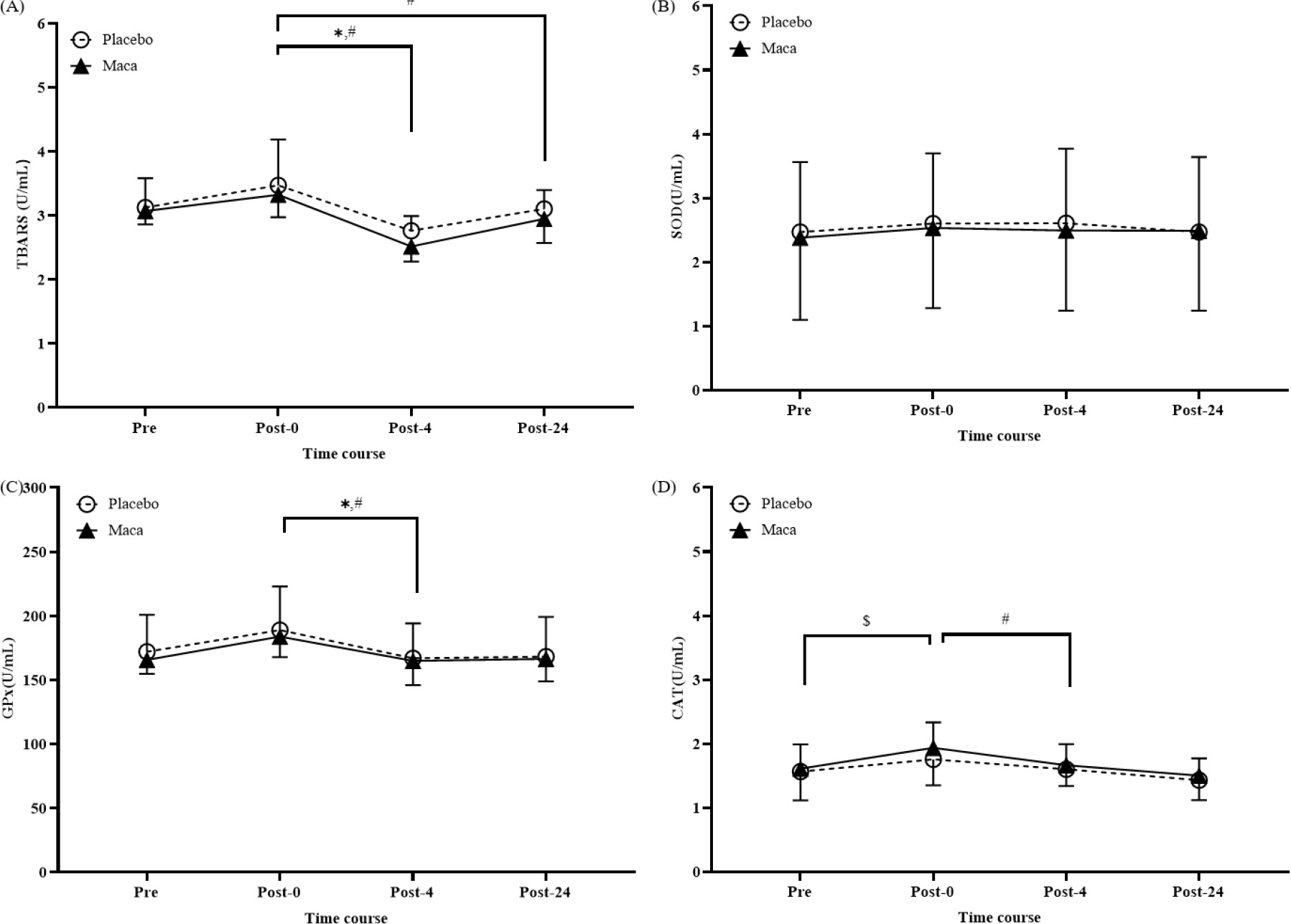
First, we used TBARS assay to detect the impact of Maca extract supplementation on oxidative stress after EEE. There was no statistical difference between the Placebo and Maca groups at Post-0, Post-4, and Post-24 time courses, as shown in Fig. 1A. When comparing different time courses within the same group, we observed that in the Maca group, both Post-4 and Post-24 exhibited significantly lower levels compared to Post-0 (
Furthermore, we utilized the activity of three distinct antioxidant enzymes in blood serum (SOD, CAT, and GPx) to evaluate the antioxidant effects of Maca extract supplementation post-EEE. As shown in Fig. 1B, there was not a significant difference in SOD levels, whether comparing between the two groups or within each group. However, the two groups had no difference in CAT levels (Fig. 1C). An evident increase was noted in the Maca group at Post-0 compared to Pre, whereas no such change was observed in the Placebo group. This suggested that Maca might respond to EEE-induced ROS production by promptly stimulating CAT. Subsequently, a significant decrease was observed at Post-4 and Post-24 in the Maca group compared to Post-0 (
Conversely, within the Placebo group, a notable decrease was only observed at Post-24 compared to Post-0 (
Changes in (A) CK and (B) LDH levels following exhaustive endurance exercise at Pre, Post-0, Post-4, and Post-24 hours with Maca supplementation and placebo are shown. *indicates a significant (
Changes in aerobic capacity values during the exhaustive endurance exercise
The data are presented as mean
Elevated CK and LDH levels signal muscle damage or injury, often due to intense physical activity, strains, or other injuries [25]. As shown in Fig. 2, no significant differences in CK and LDH levels between the two groups were observed. However, there was a notable increase between Post-24 and Post-0 within each group. Interestingly, the slope of CK elevation in the Maca group appeared lower than the Placebo group, suggesting Maca may potentially prevent muscle damage after EEE.
During the EEE test, indicators of aerobic capacity, such as average heart rate, maximal heart rate, running time until exhaustion, and peak oxygen uptake, were recorded and shown in Table 2. The results showed no significant differences between the two groups in terms of time to exhaustion, peak oxygen consumption, HRmax, or AHR (
Discussion
This study examined the effects of 12 weeks of Maca extract supplementation on oxidative stress, muscle damage and aerobic capacity after EEE. The findings revealed that twice per day supplementation of 2.25 g of Maca extract for 12 weeks may have some beneficial effects on reducing oxidative stress and possibly muscle damage after EEE. However, Maca extract had no effects on aerobic capacity. The TBARS assay revealed no initial disparity in oxidative stress between the groups. In addition, while both groups exhibited increased oxidative stress levels at Post-4 and Post-24 compared to Post-0, the Maca group displayed a significant reduction at these time points, unlike the placebo group, which only showed this decrease at Post-4. This implies that Maca extract supplementation might effectively suppress oxidative stress after EEE. In coherence to our study, Maca exhibited anti-oxidative effect in Cyclophosphamide-Induced Hepatotoxicity Mice through Keap1-Nrf2 Pathway [21]. Regarding muscle damage biomarkers, CK and LDH levels did not differ significantly between the groups. Similar to ours, a previous study showed no statistically significant difference in improved sperm concentration and hormone levels [26]. Nevertheless, there was a general increase in both groups from Post-0 to Post-24. Notably, the rise in CK levels appeared to be less pronounced in the Maca group, suggesting a potential role of Maca extract in mitigating muscle damage. Taken together, Maca extract supplementation could ameliorate muscle damage by curtailing oxidative stress post-EEE, aligning with findings from a prior animal study [27]. Additionally, strenuous physical activity often creates an imbalance where the production of ROS (increased free radicals) surpasses the body’s capacity to eliminate them, leading to reduced muscle strength and subsequent fatigue [28]. These free radicals are implicated in chronic diseases, aging, mutagenesis, carcinogenesis, and cardiovascular pathologies. Maca has been reported to shield cells from hydrogen peroxide by preserving intracellular ATP synthesis, reducing free radicals, and mitigating peroxynitrite-induced cell death [29]. Recent pharmacological investigations have indicated that dried Maca extract, specifically macamides, exhibit diverse biological effects such as neuroprotection, antioxidant defence, anti-osteoporosis properties, inhibition of fatty acid hydrolase, stimulation of testosterone secretion, and Leydig cell proliferation [30, 31]. Furthermore, macamides have been suggested to neutralize free radicals, protect cells from oxidative stress, and reduce fatigue [32].
In a prior study, Maca supplementation was demonstrated to enhance antioxidant activity by elevating muscle GPx levels during weight-loaded forced swimming exercises in a rat model. However, CAT levels were not assessed in that study. Our research indicates (Fig. 1C) that Maca supplementation might primarily elevate antioxidant activity through CAT following EEE. This aligns with the demonstrated effect of catalase overexpression in reducing disuse atrophy in rats and enhancing muscle function in mice by decreasing free radical generation [33, 34]. Moreover, the enzymes activated by different types of exercises may vary, necessitating further experiments to explore this phenomenon.
While an earlier animal study exhibited Maca’s capability to enhance swimming endurance and significantly prolonged time to exhaustion [35]. However, despite an extensive evaluation, our human-based investigation did not yield a statistically significant variance in time to exhaustion between the groups during EEE. The intricate transition of insights from animal models to human scenarios has encountered notable complexities; nonetheless, it remains a promising avenue necessitating further exploration and understanding. In addition, our comprehensive analysis encompassing parameters such as peak oxygen consumption, HRmax, and average heart rate, meticulously detailed in Table 2, did not reveal substantial variances between the groups. These outcomes collectively suggest a plausible inference that the 12-week Maca supplementation regimen might not exert a discernible impact on aerobic capacity, as evidenced by the absence of statistically significant alterations in these pivotal performance indicators.
Apart from various strengths, our study also includes some limitations. First, the comprehensive understanding of Maca’s overall impact on EEE is limited due to the small sample size of this investigation. Hence, a large sample size is needed to verify our findings. Nevertheless, we still observed that Maca may assist in both reducing oxidative stress and muscle damage after EEE. Second, since we only tested within 24 hours post-exercise, we remain uncertain about Maca’s long-term protection against post-exercise muscle damage. However, based on the results of CK, Maca appears to offer prolonged protection against post-exercise muscle damage. Third, as we administered Maca before EEE but did not continue its intake afterward; therefore, future adjustments to the protocol may involve providing Maca continuously even after EEE to assess its long-term effects. Fourth, our study also lacks background of dietary intake and diet, smoking, and physical activity, which restrict the generalizability of findings.
Conclusions
In conclusion, the study suggests the potential benefits of Maca extract in reducing oxidative stress markers and potentially mitigating muscle damage. However, further investigation may be needed to confirm these findings. In our opinion, Maca extract supplementation may still protect against oxidative stress and muscle damage after EEE.
Author contributions
Conceptualization, Ming-Che Liu, Pei-Wei Weng and Ming-Ta Yang; Data curation, Ming-Che Liu, Pei-Wei Weng, and Ming-Ta Yang; Formal analysis, Ming-Che Liu, Pei-Wei Weng, Yu-Hsiu Chien, Wei-Bin Hsu, and Ming-Ta Yang; Funding acquisition, Ming-Che Liu, Pei-Wei Weng and Ming-Ta Yang; Investigation, Ming-Che Liu, Pei-Wei Weng, Meng-Huang Wu, Wei-Bin Hsu, Sheng-Wei Chen, and Ming-Ta Yang; Methodology, Ming-Che Liu, Pei-Wei Weng, and Ming-Ta Yang; Project administration, Ming-Ta Yang; Writing – review & editing, Ming-Che Liu, Pei-Wei Weng, Yu-Hsiu Chien, Wei-Bin Hsu, and Ming-Ta Yang.
Funding
This research was funded and supported by the Ministry of Science and Technology (MOST) of the Executive Yuan, Taiwan (Grant no. MOST 110-2410-H-038-013).
Footnotes
Acknowledgments
The authors are grateful to all participants who volunteered in the current study. The authors also appreciate Prof. Sy-Jye Leu for providing laboratory areas and supplies for this research.
Conflict of interest
No potential conflict of interest was reported by the authors.
Appendix
Supplementary data
Experimental design. GXT: Graded exercise testing; EEE: Exhaustive endurance exercise.