



Abstract
BACKGROUND:
Isometric maximal voluntary force (IMVF) is essential for individuals’ health and physical performance. Therefore, there is a need for valid and reliable devices to assess IMVF.
OBJECTIVE:
To determine the validity and reliability of the Valkyria Trainer Balance® portable force platform in its isometric mode.
METHODS:
Fifty-eight physically healthy individuals (30 men and 28 women) participated in the study. A repeated measures design was used to compare the inter-day test-retest reliability of peak force. The validity of the Valkyria Trainer Balance® force platform was determined by comparing the peak force with the ArtOficio® force platform. The analysis consisted of the intraclass correlation coefficient (ICC), standard error of measurement (SEM), and coefficient of variation (CV). A CV
RESULTS:
CV the peak force showed high test-retest inter-day reliability (CV
CONCLUSIONS:
The results of this study demonstrate that the Valkyria Trainer Balance® force platform is valid and reliable for assessing IMVF in physically healthy individuals.
Introduction
From the perspective of functionality, specifically in everyday activities, there is evidence that higher levels of muscle strength are associated with greater physical performance in both men and women [1]. Parallel to this, scientific evidence has shown that different manifestations of muscle strength and the various development methods are determinants of athletic performance [2]. Precisely, isometric maximal voluntary force (IMVF) corresponds to a determinant variable in the quality of life of older adults, improving the physical function of this age group [3]. Likewise, it has been observed that high levels of IMVF are determinant in elite sports performance [4]. Consequently, the importance of a high level of muscle strength, specifically IMVF, for health promotion [5] and sports performance [6] is widely accepted and evidenced.
On the other hand, the specificity of force training methods has been accompanied by the technification of assessment instruments [7, 8]. In this sense, devices to assess force have advanced from highly sophisticated desktop equipment that allows evaluation in different positions and movement speeds [9] to equipment that enables the reproduction of natural movements, whether they are movements like those performed in activities of daily living [7] or specific sporting gestures [10]. Valid and reliable devices are now available to assess different manifestations of muscle force [11, 12, 13]; in most cases, these devices have been developed to transfer assessments from the laboratory to the field [8, 14, 15, 16]. In this regard, devices such as the KForce Plates® system (Kinvent, Montpellier, France), in all its versions, have proven to be valid and reliable for assessing both lower extremity mechanical capacities [8] and unipodal balance in healthy athletes [14]. Likewise, the Natus® portable force platform (Seattle – Washington, USA) has been shown to be valid and reliable for assessing postural sway in healthy students [15]. Likewise, other devices have validated their sensors in static force evaluation mode. However, they lack validation and reliability studies in specific sports gestures. Based on the information found, it has been observed that there is a wide variety of devices to assess IMVF in the field. However, to our knowledge, despite the devices’ portability, no research has determined the validity and reliability of these devices for assessing IMVF.
The Valkyria Trainer Balance® (VTB®) force platform, developed by IVOLUTION® (Sunchales, Argentina), is a portable force platform composed of two independent operating plates. In the genesis of its creation, one plate is designed to evaluate the right limb and the other to evaluate the left limb. Of its components, to measure the resultant force unidirectionally in the vertical axis, the VTB® force platform has a beam-type load cell. This information is processed by an analog-to-digital converter and, from there, to an electronic processor. The VTB® force platform works with the Valkyria Trainer® V1.1.9 software (Sunchales, Argentina). This connection can be run from Android or iOS mobile devices (Bluetooth connection) or through a desktop version for Windows® or Mac® (USB connection). Considering the two plates of this force platform, muscle strength can be evaluated jointly and per limb, incorporating within the evaluations the imbalances or asymmetries between limbs [17]. However, despite the versatility, portability, and low cost of the VTB® force platform, there are no indicators of the validity and reliability of this device in its isometric modality. Our research hypothesis is that the VTB® force platform, in its isometric mode, is valid and reliable for assessing IMVF. Consequently, the present study aimed to determine the validity and reliability of the VTB® force platform in its isometric mode in physically healthy individuals.
Age and anthropometric characteristics
Age and anthropometric characteristics
CI, confidence interval; kg, kilograms; kg/m2, kilograms per square meter; max, maximum; min, minimum; SD, standard deviation.
Participants
Fifty-eight physically healthy persons (30 men and 28 women) volunteered to develop the study (Table 1). The inclusion criteria were male or female, between 18 and 32 years of age. The exclusion criteria were musculoskeletal, joint, or tendon injury in the last three months or the inability to perform IMVF with the lower extremities. Recruitment of participants and evaluations were carried out between September 2023 and March 2024. Informed consent was provided on paper and signed before the start of the evaluations. Likewise, all participants were informed of the study objectives before signing the informed consent and assessments. The study’s protocol was approved by the Scientific-Ethical Committee of the Universidad de Las Américas, Chile (registration number: CEC_FP_2023011). All study procedures were conducted in line with ethical standards under the Declaration of Helsinki (updated in 2013) and the ethical standards for exercise and sports [19].
Statistical software (G*Power, v3.1.9.7, Heinrich-Heine-Universität, Germany) was used to calculate the sample [18]. The combination of tests used in the statistical software to calculate the sample size was as follows: a)
Research design.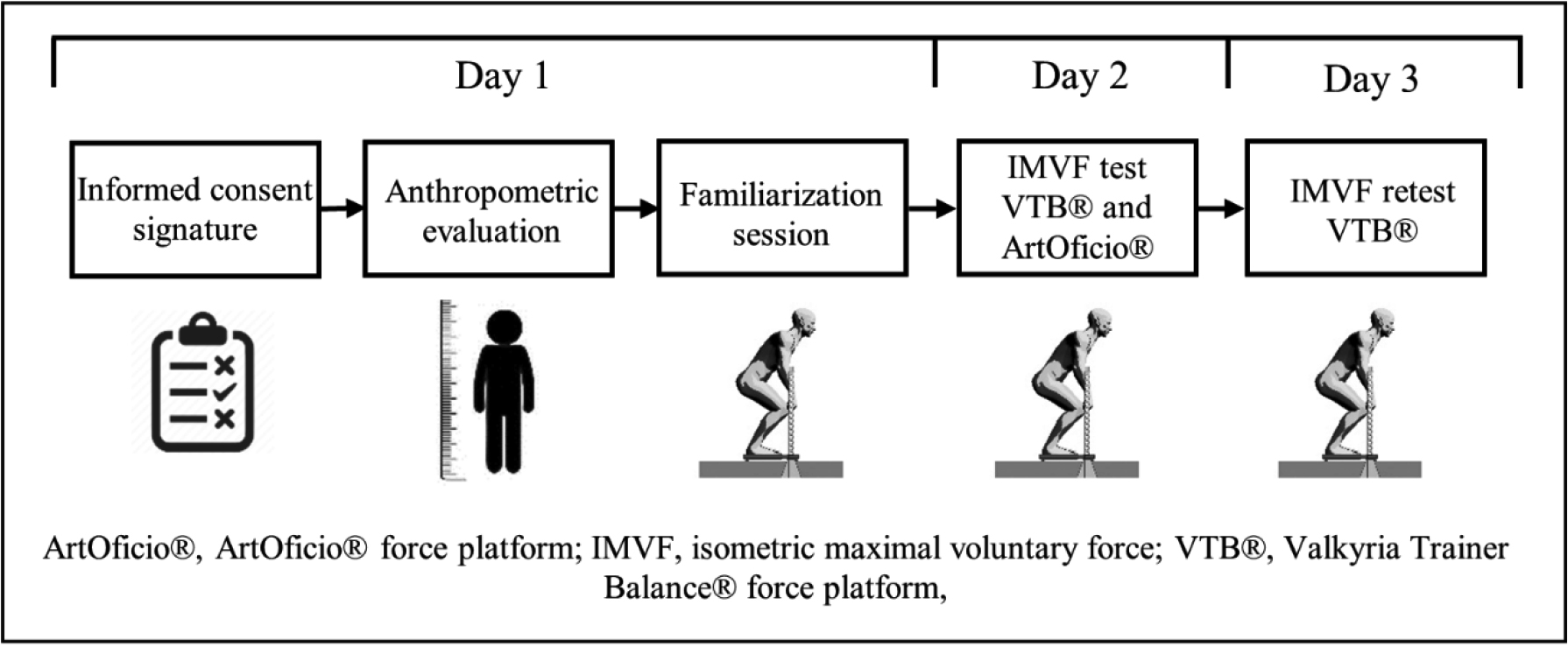
A repeated measures design was used to determine test-retest inter-day reliability, specifically for peak force (PF). All study participants attended the laboratory for three days at 72-h intervals, avoiding physical exercise between assessment days. During the first visit, informed consent was signed, basic anthropometric assessments were performed, and a familiarization session with an isometric deadlift with 90∘ knee flexion was developed. In the second visit, the IMVF was evaluated during the isometric deadlift exercise with 90∘ knee flexion on the VTB® and the ArtOficio® force platform model AMS-1 (Santiago, Chile). Previous studies have already used the ArtOficio® force platforms [18, 19]. For this reason, the latter device was employed as the gold standard for validating the VTB® force platform in its isometric mode. The IMVF was re-evaluated in the same exercise in the third session but only on the VTB® force platform. The latter information was used to determine the inter-day test-retest reliability (Fig. 1).
Warm-up protocol for the IMVF assessment
Participants performed a standardized 20-minute warm-up. The warm-up included the following exercises: 1
Isometric deadlift with 90∘ knee flexion and Valkyria Trainer Balance® force platform.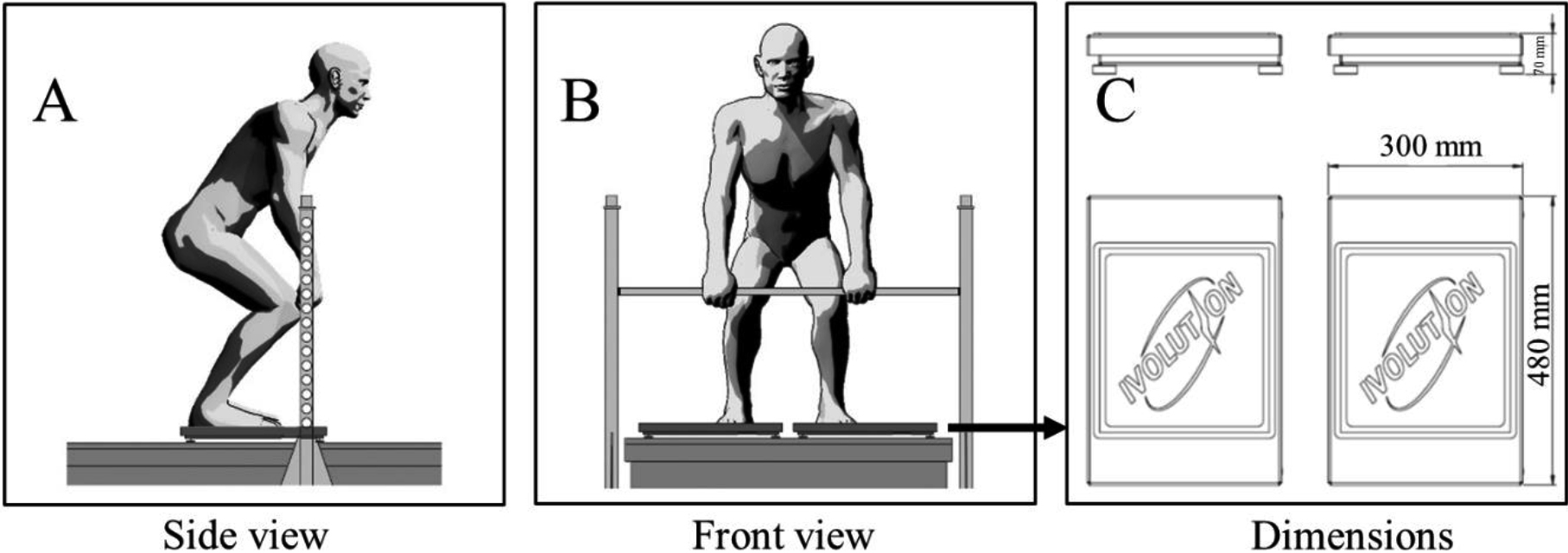
The tests were performed on two force platforms. Independently, a metal structure with holes held a horizontal bar. Thus, once the participants reached the starting position for the isometric deadlift with 90∘ knee flexion, they grasped the bar and performed the IMVF for this exercise (Fig. 2). Knee angles were checked with a goniometer in the familiarization and evaluation sessions. In addition, to avoid musculoskeletal injuries, incorrect postures were corrected during the familiarization session. These corrections also prevented participants from performing improper compensations, e.g., shoulder lifts or trunk offsets, during the performance of the assessments. Each participant performed three repetitions of 5-s with a 2-min pause per session of the isometric deadlift exercise with 90∘ knee flexion. At each repetition, IMVF was requested; of these, the repetition with the highest IMVF value was processed in the statistical analysis. During the tests, participants were instructed to pull the horizontal bar toward themselves with the greatest possible force for 5-s. At the end of the run time, the investigators verbally reported the completion of the exercise. The IMVFs began after a verbal “ready, go” signal. In real-time, the researchers observed the IMVF kinetics of the isometric deadlift. In this way, they determined whether the participants had reached a force plateau. If the kinetics described a stable force plateau, the participant was considered to have achieved the PF.
During the second PF evaluation session, participants performed the IMVFs on the VTB® force platform. This device has a sampling rate of 1k Hz, and its internal electronic board has a 64M Hz ARM Cortex® M4F processor, 1MB flash, and 256KB SRAM. The internal electronics board receives the signal from each platform according to the following scheme: Load cell
During the same session, participants performed the isometric deadlift exercise with 90∘ knee flexion on the ArtOficio® force platform model AMS-1. Like the VTB® force platform, this device has two force plates with a vertical capacity of 4000 Newton (N), longitudinal
Regression analysis for an isometric maximal voluntary force test evaluated through the Valkyria Trainer Balance® force platform in test-retest (men, 
A Matlab R2013a script (MathWorks Inc®) was employed to extract the PF from the raw data obtained from both force platforms automatically during the test repetitions. Furthermore, mean peak values were computed using varying window lengths. The PF served as the middle value within the window. Consequently, six mean peak values were derived: PF50, PF100, PF200, PF300, PF400, PF500. The numerical designation associated with PF indicates the window length; for instance, PF50 represents the peak value related to the mean of 100 data points (50 before and 50 after) surrounding the PF value. The unit of measurement for PF was Newton (N).
Data from the two devices for assessing the PF of IMVF and anthropometric parameters were sorted in a spreadsheet designed for the study. Descriptive data are presented as means and standard deviations (SD). Considering there were 58 participants (30 men and 28 women), the normal distribution of the data was confirmed by the Shapiro-Wilk test (
Results
At the time of the study, the 30 men were 22.6
Regression analysis for an isometric maximal voluntary force test evaluated through the Valkyria Trainer Balance® force platform in test-retest (women, 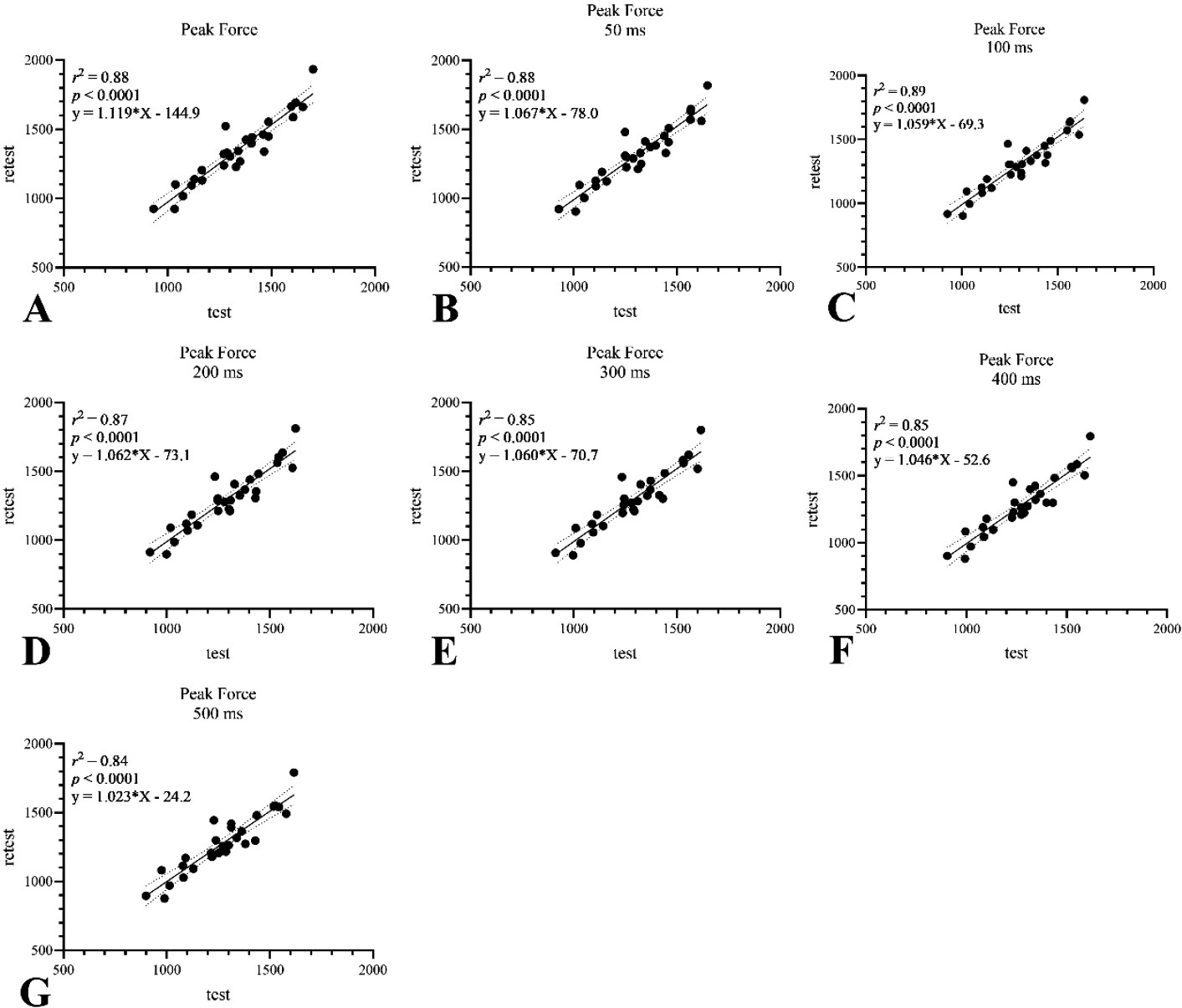
| Men ( |
VTB (mean |
Art (mean |
p |
|
SEM [(95% CI] | CV [95% CI] | ICC [95% CI] |
|---|---|---|---|---|---|---|---|
| peak force (N) | 1,915.6 350.6 | 1,906.1 353.1 | 0.466 | 9.5 [ 36.1 to 16.9] | 50.3 [40.0 67.6] | 2.6% [2.0 3.5] | 0.98 [0.96 0.99] |
| PF50 (N) moving window 100 ms | 1,850.1 357.1 | 1,899.2 353.5 | 0.006 | 49.0 [14.8 to 83.3] | 64.8 [51.6 87.1] | 3.4% [2.7 4.6] | 0.96 [0.93 0.98] |
| PF100 (N) moving window 200 ms | 1,841.8 361.4 | 1,894.5 354.2 | 0.002 | 52.6 [19.4 to 85.9] | 62.9 [50.1 84.6] | 3.3% [2.6 4.5] | 0.97 [0.94 0.98] |
| PF200 (N) moving window 400 ms | 1,826.2 363.1 | 1,881.1 356.5 | 0.001 | 54.8 [25.9 to 83.8] | 54.7 [43.6 73.6] | 2.9% [2.3 3.9] | 0.97 [0.95 0.98] |
| PF300 (N) moving window 600 ms | 1,809.4 364.5 | 1,866.0 358.7 | 0.001 | 56.6 [28.3 to 84.8] | 53.4 [42.5 71.9] | 2.9% [2.3 3.9] | 0.97 [0.95 0.99] |
| PF400 (N) moving window 800 ms | 1,793.4 366.9 | 1,852.1 360.8 | 0.001 | 58.6 [27.3 to 90.0] | 59.4 [47.3 79.8] | 3.2% [2.5 4.3] | 0.97 [0.94 0.98] |
| PF500 (N) moving window 1000 ms | 1,779.8 369.3 | 1,841 362.7 | 0.001 | 61.1 [25.6 to 96.6] | 67.2 [53.5 90.3] | 3.7% [2.9 4.9] | 0.96 [0.93 0.98] |
| Women ( |
VTB (mean SD) | Art (mean SD) | P | [95% CI] | SEM [(95% CI] | CV [95% CI] | ICC [95% CI] |
| peak force (N) | 1,333.6 203.4 | 1,344.7 212.1 | 0.465 | 11 [ 19.6 to 41.8] | 56.0 [44.3 76.2] | 4.1% [3.3 5.6] | 0.93 [0.85 0.96] |
| PF50 (N) moving window 100 ms | 1,309.6 195.6 | 1,338.9 212.7 | 0.060 | 29.3 [ 1.3 to 60.0] | 55.9 [44.2 76.1] | 4.2% [3.3 5.7] | 0.93 [0.85 0.96] |
| PF100 (N) moving window 200 ms | 1,304.1 194.1 | 1,337.4 211.9 | 0.032 | 33.2 [2.9 to 63.6] | 55.3 [43.7 75.3] | 4.1% [3.3 5.7] | 0.93 [0.85 0.96] |
| PF200 (N) moving window 400 ms | 1,295.4 191.6 | 1,333.6 210.0 | 0.016 | 38.2 [7.6 to 68.8] | 55.8 [44.1 75.9] | 4.2% [3.3 5.7] | 0.92 [0.85 0.96] |
| PF300 (N) moving window 600 ms | 1,288.2 190.8 | 1,329.2 208.2 | 0.009 | 40.9 [10.7 to 71.1] | 55.0 [43.4 74.8] | 4.2% [3.3 5.7] | 0.92 [0.85 0.96] |
| PF400 (N) moving window 800 ms | 1,279.9 191.4 | 1,324.8 206.6 | 0.005 | 44.8 [14.5 to 75.2] | 55.3 [43.7 75.4] | 4.2% [3.3 5.7] | 0.92 [0.85 0.96] |
| PF500 (N) moving window 1000 ms | 1,272.6 192.7 | 1,321.0 205.4 | 0.003 | 48.3 [17.6 to 79.1] | 56.0 [44.3 76.3] | 4.3% [3.4 5.8] | 0.92 [0.84 0.96] |
Reliability valkyria trainer balance® force platform in isometric mode
Bland-Altman analysis. The solid line represents the average of the differences between variables evaluated through the Valkyria Trainer Balance® force platform in test-retest (men, 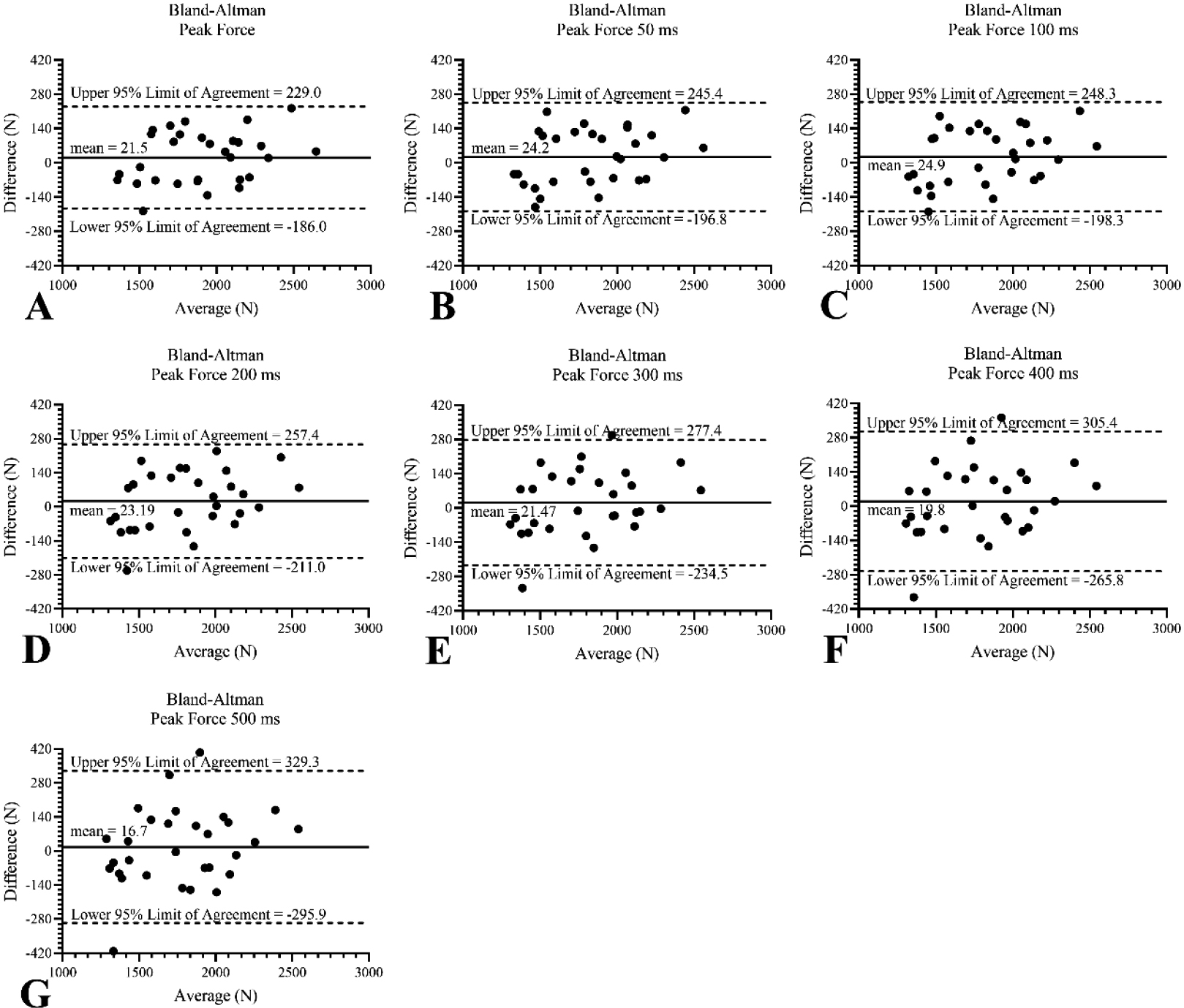
Bland-Altman analysis. The solid line represents the average of the differences between variables evaluated through the Valkyria Trainer Balance® force platform in test-retest (women, 
In the men, the validation analysis showed that the PF (N) measurements between the two devices had a high CV threshold (2.6%, 95% CI: 2.0–3.5). The same analysis showed that all sliding windows created for device validation (PF50, PF100, PF200, PF300, PF400, PF500) had a high CV threshold (2.0–4.9%). Concerning the ICC, the PF values and all the sliding windows created for validation showed a high threshold (range: 0.93–0.99). In the women, the validation analysis showed that the PF (N) measurements between the two devices had a high CV threshold (4.1%, 95% CI: 3.3–5.6). The same analysis showed that all sliding windows created for device validation (PF50, PF100, PF200, PF300, PF400, PF500) had a high CV threshold (3.3–5.8%). Concerning the ICC, the PF values and all the sliding windows created for validation showed a high threshold (range: 0.84–0.96). These values allow inferring that the VTB® force platform presents a low systematic error for PF assessment. The mean values, SD and 95% confidence intervals are illustrated in Table 3.
When evaluating the concordance of the VTB® force platform between the inter-day IMVF assessments (test-retest) in the men, the PF showed no significant differences (test: 1,915.6
In the men, the regression analysis showed that the IMVF evaluated through the VTB® force platform in the test-retest presented a very high
When comparing the mean values and differences of PF at test-retest, the Bland-Altman analysis showed a common bias of 21.5
The present study aimed to determine the validity and reliability of the VTB® force platform in its isometric mode in physically healthy individuals. The results showed that the VTB® force platform is valid, with high inter-day agreement and reproducibility. Specifically, the VTB® force platform is valid and reliable for assessing IMVF (N), both in a single data through PF and in mean data calculated through moving windows, accepting the research hypothesis.
Scientific evidence has shown that IMVF has a predominant role in neuromuscular function [27], physical function [3] and in promoting human health [5]. Therefore, there is a need to develop valid, reliable, and low-cost devices that allow assessment of IMVF both in the clinic and the field [14]. In this context, both men and women the VTB® force platform demonstrated high concordance compared to another desktop device (men: CV
In parallel, using software to process raw data downloaded from devices used in sports science is becoming increasingly common [14, 28, 29, 30, 31]. During the determination of the validity and reliability of the VTB® portable force platform, the Matlab R2013a script (MathWorks Inc®) was used. This software was used to generate window lengths that, in turn, allowed inter-device comparison and inter-day analysis of the VTB® portable force platform. In similar experiences, during the validation of the PLATES v3 device (Kinvent, Montpellier, France), Meras Serrano et al. [14] used Matlab R2022b software for data processing. Specifically, the researchers developed a script to collate the raw data downloaded from the devices used during the study [14]. Likewise, processing raw data through software such as Matlab makes it possible to describe the physical demands of athletes [29], project performance in specific sports gestures [31], and even establish statistical metrics associated with sports health in contact sports [28], among other variables.
Despite the availability of software that allows raw data processing, most devices for assessing muscle force lack sliding windows that will enable users to interact with the results of assessments developed in the field [8, 14, 15, 16]. The latter analysis is not foreign to the VTB® portable force platform. However, using sliding windows for portable force devices requires further exploration.
Study limitations
From the practical point of view of the research, to perform the calculation of the mean data, a script was created that analyzed the raw data from both devices. The latter is because the VTB® force platform software lacks user-interactive commands that allow adjustment to a sliding window. Finally, given the scope of the present investigation, the results only allow us to ensure the validity and reliability of the VTB® portable force platform in its isometric mode. Consequently, it is necessary to explore the other modes of the device further.
Conclusions
Based on the inter-device concordance results, it is concluded that the VTB® force platform is valid for assessing IMVF in physically healthy individuals. Also, based on the high inter-device agreement and reproducibility, it is concluded that the VTB® force platform is reliable for assessing IMVF in physically healthy individuals. These results allows the acceptance of the research hypothesis.
Practical applications
Due to its weight, connection to devices (Bluetooth or USB) and portability, the VTB® force platform allows a valid and reliable measurement in the field. Finally, by having two independent plates, the platform allows the evaluation of both limbs, differentiating the force exerted by each limb and analyzing imbalances and asymmetries.
Author contributions
CONCEPTION: Á.H.O. and R-B-I.
PERFORMANCE OF WORK: Á.H.O., R.B-I. and M.T-B.
INTERPRETATION OR ANALYSIS OF DATA: Á.H.O.
PREPARATION OF THE MANUSCRIPT: Á.H.O., R.B-I. M.T-B. and M-M.Y-C.
REVISION FOR IMPORTANT INTELLECTUAL CONTENT: Á.H.O., R.B-I. M.T-B. and M-M.Y-C.
SUPERVISION: Á.H.O.
Ethical approval
The study was conducted under the Declaration of Helsinki and approved by the Scientific-Ethical Committee of the Universidad de Las Américas, Chile (registration number: CEC_FP_2023011). Informed consent was obtained from all subjects involved in the study.
Funding
The authors report no funding.
Supplementary data
Not applicable.
Footnotes
Acknowledgments
To Federico Crippa for his support and technical assistance during the development of the study. To Manuel Díaz for his support in the graphics of the manuscript. To the students Cristóbal García, Yerson Sáez, Krishna Escalona, Franco Salgado, Gerardo Riquelme, Polonia Zamora and Catalina Basualto for their collaboration in data collection. To all the participants who voluntarily took part in the study.
Conflict of interest
The authors have no conflicts of interest to report.