In this paper, based on a complete residuated lattice, we introduce the concept of fuzzy cut-stable maps and discuss the relationship between fuzzy cut-stable maps and some special maps. We also obtain the extension property of fuzzy cut-stable maps. Furthermore, it is proved that the category of fuzzy complete (continuous) lattices with fuzzy complete homomorphisms is a full reflective subcategory of the category of fuzzy (precontinuous) posets with fuzzy cut-stable maps.
The completion of a partially ordered set (a poset) [8, 16, 8, 16] originated from Dedekind’s pinoeer construction of the real line by cuts of rational numbers [9]. Later, MacNeille [22] generalized Dedekind’s construction and introduced the famous completion by cuts for arbitrary posets, which was known as the Dedekind-MacNeille completion (also called the normal completion or the completion by cuts). After that, many researchers have been devoted to studying it[1, 11].
Quantitative domain theory (QDT for short) [12–15, 28], which refines ordinary domain theory [16] by replacing the qualitative notion of approximation by a quantitative one of degree of approximation, has undergone active research in the past three decades, and forms a new branch of domain theory. The appearance of Quantitative domain theory promotes the development of the completion theory, and many researchers have been committed to studying it. Wagner [28] introduced the enriched Dedekind-MacNeille completion for an enriched category. Blohlvek [5] described the Dedekind-MacNeille completion for an L-ordered set as an application of the theory of concept lattices in fuzzy setting. Xie, Zhang and Fan [29] built and characterized the Dedekind-MacNeille completions for fuzzy posets. Wang and Zhao obtained a categorical characterization of the Dedekind-MacNeille completions for an L-ordered set [27]. Motivated by the studying of the previous works, we show that the category of fuzzy complete (continuous) lattices will be a full reflective subcategory of the category of fuzzy (precontinuous) posets when suitable morphisms aredefined.
The outline of this article is the following: In Section 2, we recall some basic definitions and results used in the rest of this paper. In Section 3, we introduce the notions of fuzzy lower (upper) cut-continuous maps, fuzzy lower (upper) cut-stable maps, fuzzy residuated (residual) maps and fuzzy cut-preserving maps. The relationships among these maps are also discussed. In Section 4, we obtain the extension property of fuzzy cut-stable maps on fuzzy posets, and prove that the category of fuzzy complete (continuous) lattices with fuzzy complete homomorphisms is a full reflective subcategory of the category of fuzzy (precontinuous) posets with fuzzy cut-stable maps.
Preliminaries
We refer to [2] for general category theory, to [17, 19, 20, 17, 19, 20] for fuzzy set theory, and to [8, 16] for lattice theory.
Definition 2.1. (See [4, 25]) A residuated lattice is an algebraic structure (L ; ∧ , ∨ , * , → , 0, 1) of type (2, 2, 2, 2, 0, 0) such that
(L ; ∧ , ∨ , 0, 1) is a bounded lattice with the least element 0 and the greatest element 1;
(L ; * , 1) is a commutative monoid with the identity 1;
satisfies the adjointness property, i . e . , ∀ x, y, z ∈ L, x * y ≤ ziffx ≤ y → z .
A residuated lattice is called complete if the underlying lattice is complete.
Theorem 2.2. (See [6, 18]) LetLbe a residuated lattice. Then
a* b ≤ a ∧ b ;
a = 1→ a ;
a≤ b ⇔ a → b = 1 ;
a→ (b → c) = (a * b) → c ;
a→ b ≥ b ;
When L is complete,
a* (⋁ ibi) = ⋁ i (a * bi) ;
a→ (⋀ ibi) = ⋀ i (a → bi) ;
(⋁ ibi) → a = ⋀ i (bi → a) .
In this paper, if there is no further statement, L always denotes a complete residuated lattice.
Definition 2.3. (See [4, 12]) A fuzzy poset is a pair (X, e) such that X is a set and e : X × X ⟶ L is a map (called a fuzzy partial order over X), which satisfies for every x, y, z ∈ X,
e (x, x) =1 (reflexivity);
e (x, y) * e (y, z) ≤ e (x, z) (transitivity);
e (x, y) = e (y, z) =1 implies x = y (antisymmetry).
For a set X, LX denotes the set of all fuzzy subsets of X, that is, the set of all maps from X to L. For λ ∈ L, the constant map with the value λ is denoted by λX.
Example 2.4. (1) (The canonical fuzzy partial order on L) Define eL : L × L → L by eL (x, y) = x → y for all x, y ∈ L . Then (L, eL) is a fuzzy poset.
(2) Let X be a set. For A, B ∈ LX, the subsethood degree [17] sub (A, B) of A in B is defined by sub (A, B) = ⋀ x∈X1.2 (A (x) → B (x) 1.2) . Then (LX, sub) is a fuzzy poset.
(3) Let (X, e) be a fuzzy poset. Then ≤e = {(x, y) ∈ X × X ∣ e (x, y) =1} is a classical (partial) order on X.
Definition 2.5. (See [32–34]) Let (X, e) be a fuzzy poset and A ∈ LX. An element x0 ∈ X is called a join (meet) of A, in symbols x0 = ⊔ A (x0 = ⊓ A), if for all x ∈ X,
A (x)≤ e (x, x0) (A (x) ≤ e (x0, x)) ;
⋀y∈X (A (y) → e (y, x)) ≤ e (x0, x) (⋀ y∈X (A (y)→e (y, x)) ≤ e (x, x0)) .
Theorem 2.6. (See [32–34]) Let (X, e) be a fuzzy poset andA ∈ LX. Thenx0 = ⊔ A (x0 = ⊓ A) iffforallx ∈ X, e (x0, x) = ⋀ y∈Y (A (y) → e (y, x))(e (x, x0) = ⋀ y∈Y (A (y) → e (x, y))).
Definition 2.7. (See [32–34]) A fuzzy poset (X, e) is called a fuzzy complete lattice if for all A ∈ LX, ⊔ A and ⊓A exist.
Proposition 2.8. (See [32–34]) Let (X, e) be a fuzzy poset. Then the following statements are equivalent:
(X, e) is a fuzzy complete lattice;
for any A ∈ LX, ⊔ A exists;
for any A ∈ LX, ⊓ A exists.
Definition 2.9. (See [30]) Let (P, e) be a fuzzy complete lattice. ∀ x ∈ P, define ⇓x ∈ LP as follows
If ∀ x ∈ P, x = ⊔ ⇓ x, then (P, e) will be called a continuous lattice.
For all x ∈ X, if ⇓x (x) =1, then we call x a compact element in P. The set of all compact elements in P is denoted by K (P).
Definition 2.10. (See [30]) Let (P, e) be a fuzzy complete lattice. Define kx : P → L by ∀ y ∈ P,
If ⨆kx = x, then we call X an algebraic lattice. Suppose f is a map between fuzzy posets (P, eP) and (Q, eQ). Then f is said to be a fuzzy order-preserving (order-embedding) map if eP (x, y)≤eQ (f (x) , f (y)) (eP (x, y) ≤ eQ (f (x) , f (y))) for all x, y ∈ P .
Definition 2.11. (See [23]) Let f : X → Y be a map. The Zadeh forward powerset operator and the Zadeh backward powerset operator are, respectively, defined by for all A ∈ LX, y ∈ Y and for all B ∈ LY.
Definition 2.12. (See [21, 30]) A pair of fuzzy order-preserving maps f : P → Q and g : Q → P is called a fuzzy adjunction, in symbols, f ⊢ g if eQ (f (x) , y) = eP (x, g (y)) for all x ∈ P, y ∈ Q. In this case, f is called a left adjoint of g and g is called a right adjoint of f.
The pair is a fuzzy adjunction between LP and LQ. That is, , i.e., for all φ ∈ LP and ψ ∈ LQ.
Definition 2.13. Let (P, eP) , (Q, eQ) be fuzzy posets. A map f : P → Q is called fuzzy join-preserving if for all φ ∈ LP, and is called fuzzy meet-preserving if for all φ ∈ LP.
Proposition 2.14. (See [21, 30]) Letf : P → Qandg : Q → Pbe maps between fuzzy posetsPandQ. The following are equivalent:
(f, g) is a fuzzy adjunction;
eQ (f (x) , y) = eP (x, g (y)) for all x ∈ P andy ∈ Q;
both f and g are fuzzy order-preserving and (f, g) is a classical adjunction between (P, ≤ eP) and (Q, ≤ eQ);
f ∘ g ≤ 1Q and g ∘ f ≥ 1P.
Proposition 2.15. (See [31]) Letf : P → Qandg : Q → Pbe maps between fuzzy posetsPandQ. Then
ifPis a fuzzy complete lattice, thenfis fuzzy order-preserving and has a right adjoint ifffis join-preserving;
ifQis a fuzzy complete lattice, thengis fuzzy order-preserving and has a left adjoint iffgis meet-preserving.
The category whose objects are fuzzy complete lattices and whose morphisms are fuzzy complete homomorphisms (both fuzzy join-preserving and fuzzy meet-preserving) will be denoted by FCLC.
Definition 2.16. (See [29]) Let (P, e) be a fuzzy poset and φ ∈ LP. We define φl, φu as follows:
Proposition 2.17. (See [4, 5]) (the Dedekind-MacNeille completion) Given a fuzzy poset (P, e), ∀A, B ∈ LP, a fuzzy cut is a pair (A, B) such thatA = Bl, B = Au. The collection of all fuzzy cuts, ordered bye ((A, B) , (C, D)) = sub (A, C) = sub (D, B), is a fuzzy complete lattice, called the Dedekind-MacNeille completion ofP. We sometimes useDML (P) ={(A, B) ∣ ∀ A, B ∈ LP, A = Bl, B = Au} orto denote the Dedekind-MacNeille completion ofP, that is to say,DML (P) oris a fuzzy complete lattice.
Clearly, {(A, B) ∣ ∀ A, B ∈ LP, A = Bl, B = Au} is isomorphic to {A ∣ ∀ A ∈ LP, A = Aul}, thus {A ∣ ∀ A ∈ LP, A = Aul} can also denote the Dedekind-MacNeille completion of P. ∀ A, B ∈ LP, Au and Bl are usually called fuzzy upper cut and fuzzy lower cut, respectively.
Let (X, e) be a fuzzy poset and x ∈ X. Define two maps ιx, μx : X → L by ιx (y) = e (y, x) , μx (y) = e (x, y) for all y ∈ X. Clearly, we have ⊔ ιx = ⊓ μx = x and the pair (ιx, μx) is a fuzzy cut of X. Define by η (x) = (ιx, μx) for all x ∈ P, then η is an order-embedding.
Lemma 2.18. (See [4, 29]) Let (P, e) be a fuzzy poset andφ, ψ ∈ LP. Then
φ ≤ φul and φ ≤ φlu;
sub (φ, ψ) ≤ sub (ψu, φu) and sub (φ, ψ) ≤ sub (ψl, φl);
sub (φ, ψ) ≤ sub (φul, ψul) and sub (φ, ψ) ≤ sub (φlu, ψlu);
φu = φulu and φl = φlul.
Fuzzy cut-stable maps
In this section, we introduce the notions of fuzzy lower (upper) cut-continuous maps, fuzzy lower (upper) cut-stable maps, fuzzy residuated (residual) maps and fuzzy cut-preserving maps. The relationships among these maps are also discussed.
Definition 3.1. Let (P, eP) , (Q, eQ) be fuzzy posets, f : P → Q a map. Then we call f a fuzzy lower (upper) cut-continuous map provided that ∀ B ∈ LQ, if B is a fuzzy lower (upper) cut of Q, then is a fuzzy lower (upper) cut of P. We say f is fuzzy cut-continuous if f is both fuzzy lower and upper cut-continuous.
Example 3.2. Suppose (P, eP) is a fuzzy poset, then is also a fuzzy poset. Define , subop) , x ↦ μx and id : P → P, x ↦ x, then f is a fuzzy lower cut-continuous map, g is a fuzzy upper cut-continuous map and id is a fuzzy cut-continuous map.
Definition 3.3. Let (P, eP) , (Q, eQ) be fuzzy posets, f : P → Q a map. Then we call f fuzzy lower (upper) cut-stable if ∀ A ∈ LP, . We say that f is fuzzy cut-stable if f is both fuzzy lower and upper cut-stable.
Example 3.4. Let (P, eP) , (Q, eQ) be fuzzy posets, f : P → Q a map. Define g : LP → LQ, h : LQ → LP by ∀ A ∈ LP, B ∈ LQ, x ∈ P, y ∈ Q, g (A) (y) = ⋁ a∈P (A (a) * e (a, y)) , h (B) (x) = ⋀ b∈Q (e (x, b) → B (b)), respectively. Then g is fuzzy lower cut-stable, h is fuzzy upper cut-stable and is fuzzy cut-stable.
In the following we will use to denote for brevity.
Definition 3.5. Let (P, eP) , (Q, eQ) be fuzzy posets, f : P → Q a map. Then we call f fuzzy cut-preserving if for every fuzzy cut (A, B) of P, the pair is a fuzzy cut of Q.
Example 3.6. By example 2.4(1), we have (L, eL) is a fuzzy poset. In fact, (L, eL) is also a fuzzy complete lattice. Define f : LL → L as follows ∀ A ∈ LL, f (A) = ⊔ A, then f is fuzzy cut-preserving.
Proposition 3.7.Supposef : P → Qis a map. Then
f is fuzzy lower (upper) cut-continuous iff for all A ∈ LP;
f is fuzzy order-preserving iff for all A ∈ LP;
f is fuzzy cut-preserving iff iff for all A ∈ LP.
Proof. (1) (Necessity) Suppose f is fuzzy lower cut-continuous. ∀ A ∈ LP, is thefuzzy lower cut generated by A)
(Sufficiency)(Bl)) ul ≤ Blul = Bl. So , that is, . Hence, f is fuzzy lower cut-continuous.
Similarly, we have that f is fuzzy upper cut-continuous iff for all A ∈ LP.
(2) (Necessity) Suppose f is fuzzy order-preserving. We can easily prove , thus .
(Sufficiency) ∀ x ∈ P, put A = ιx, then (ιx) u. Therefore, . ∀ x, y ∈ P,
(3) (Necessity) Suppose f is fuzzy cut-preserving. Since ∀ A ∈ LP, (Aul, Au) is a fuzzy cut of P, it follows that is a fuzzy cut of Q. Hence, .
(Sufficiency) Suppose (A, B) is a fuzzy cut of P. It suffices to show that is a fuzzy cut of Q, i.e., . It is easy to check that , (B) l. Similarly, f is fuzzy cut-preserving iff for all A ∈ LP.
Corollary 3.8.Every fuzzy cut-preserving map is fuzzy order-preserving. For maps between fuzzy complete lattices the converse implication is also true.
Proposition 3.9.f : P → Qis fuzzy (lower,upper) cut-stable iff it is fuzzy (lower, upper) cut-continuous and fuzzy cut-preserving.
A map f between fuzzy posets P, Q is said to be fuzzy residuated (residual) if ∀ q ∈ Q, ∃ p ∈ P such that (∀ p ∈ P, ∃ q ∈ Q such that ).
Proposition 3.10.A mapf : P → Qis fuzzy residuated (residual) iff it has a right (left) adjointg : Q → P.
Corollary 3.11.LetP, Qbe fuzzy complete lattices,f : P → Qa map. Then the following four properties are equivalent: fuzzy residuated, fuzzy lower cut-stable, fuzzy lower cut-continuous, fuzzy join-preserving.
Putting all the pieces together, we have the following diagram.
Proposition 3.12.Let (P, e) be fuzzy poset, (Q, e) a fuzzy complete lattice,f : P → Qa map. Thenfis fuzzy cut-preserving ifffor allA ∈ LP, where asfis fuzzy lower (upper) cut-stable ifffor allA ∈ LPfor allA ∈ LP).
Extension theorem and its applications
In this section, we show that the category of fuzzy complete (continuous) lattices with fuzzy complete homomorphisms is a full reflective subcategory of the category of fuzzy (precontinuous) posets with fuzzy cut-stable maps.
Firstly, let’s give the extension property of fuzzy cut-stable maps on fuzzy posets.
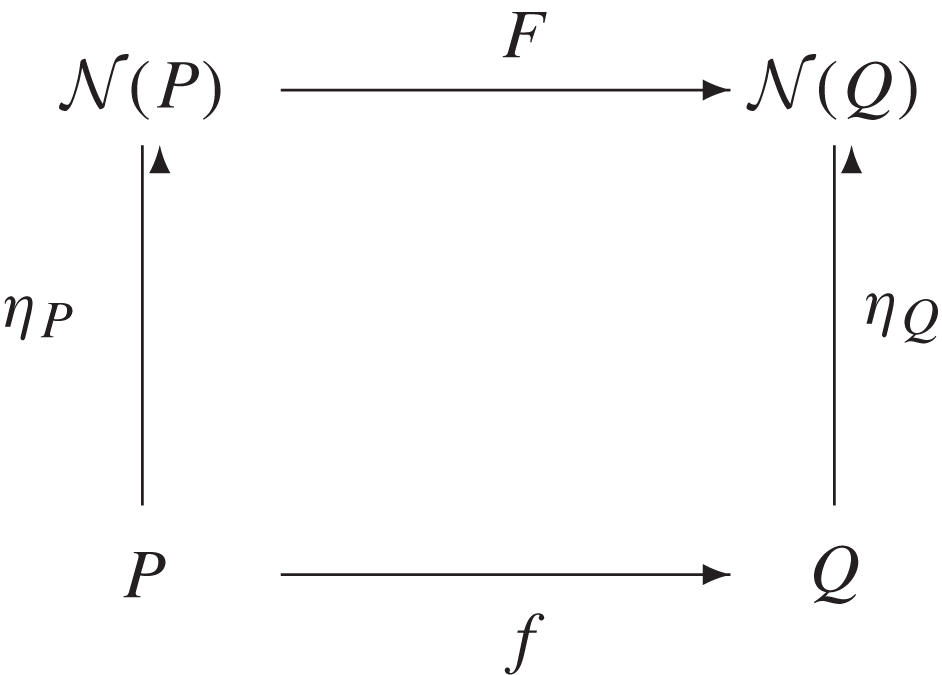
Theorem 4.1.SupposeP, Qare fuzzy posets. Thenf : P → Qis fuzzy cut-stable iff there exists a (unique) fuzzy complete homomorphismFbetween the Dedekind-MacNeille completionandextendingf, i.e., making the following diagram commutative:
Proof.(Necessity) Assume that f : P → Q is fuzzy cut-stable. Define by .
Clearly, it is well-defined. In fact, F has a right adjoint and a left adjoint . Since , we have that H, G are well-defined. Let (A, B) be a fuzzy cut of P, (C, D) a fuzzy cut of Q. Since sub ((A, B) , G (C, D)) = subB) , (C, D)), it follows that (F, G) is a fuzzy adjunction. Similarly, (H, F) is also a fuzzy adjunction. Hence, F is a fuzzy complete homomorphism. As (e (x, x′) → e (y, f (x′))) = ιf(x) (y) , then F ∘ ηP= ηQ ∘ f (x).
For the uniqueness, suppose there exists such that .
(Sufficiency) Suppose there exists a fuzzy complete homomorphism F : P → Q such that F ∘ ηP =ηQ ∘ f. ∀ A ∈ LP,
Therefore, . Similarly, f is also fuzzy upper cut-stable.
By the above theorem, we observe that the composite of two fuzzy cut-stable maps is again fuzzy cut-stable.
Corollary 4.2.Suppose (P, e) is a fuzzy poset, (Q, e) is a fuzzy complete lattice,f : P → Qis a map. Thenfis fuzzy cut-stable iff there exists a (unique) fuzzy complete homomorphismsuch thatf = g ∘ ηP. In particular,ηPis fuzzy cut-stable.
The category of fuzzy posets with fuzzy cut-stable maps is denoted by FPOS.
Easily, we can obtain:
FPOS⟶FCLC
is a functor.
Corollary 4.3.The categoryFCLCis a full reflective subcategory of the categoryFPOS.
Next, we will answer the question under what circumstances will be surjective or injective, respectively. First of all, let’s recall the notions of join-denseness and meet-denseness. Suppose (X, e) is a fuzzy poset and Y ⊆ X. Y is said to be join-dense (meet-dense) in X if for all x ∈ X there is a fuzzy subset φ of Y such that . Here i : Y → X is the inclusion map. As usual, a map f : P → Q is said to be join-dense (meet-dense) iff so is its image in Q.
Proposition 4.4.Letfbe a fuzzy cut-stable map between fuzzy posets (P, e) and (Q, e). Then
is surjective iff f is join-dense iff f is meet-dense.
is injective iff is an embedding iff f is an embedding.
is a bijective iff f is a join-dense (meet-dense) embedding.
Proof. (1) Suppose is surjective. For any , there is such that . Thus . Because , we have .
Conversely, if f is join-dense, we need to prove , that is, for all . Since , thus it suffices to check that = C. Firstly, since , we have .
Secondly, ∀ y ∈ Q,
Similarly, is surjective iff f is meet-dense.
(2) If is an embedding, then is injective. Conversely, if is injective, we shall show that f is an embedding. It suffices to prove that ∀ x, y ∈ P, e (y, x) = e (f (y) , f (x)). Since is a fuzzy adjunction and is one-to-one, it holds that , ∀ x ∈ P, =(ιx, μx). Hence, .
If f is an embedding, we need to show that ,i.e., . sub (A, C) for all .
(3) This is an immediate consequence of (1) and (2).
For convenience, in the following we will use to denote the Dedekind-MacNeille completion of P. We say that a fuzzy subset λ : P → L is finite if the support set {x ∈ P : λ (x) ≠0} of λ is a finite set.
Definition 4.5. Let (P, e) be a fuzzy poset. A fuzzy subset I of P is called a (Frink) fuzzy ideal if for each finite fuzzy subset Z of P, we have sub (Z, I) ≤ sub (Zul, I).
Clearly, ∀ x ∈ P, ιx is a (Frink) fuzzy ideal.
Remark 4.6. (1) If , then φ is a (Frink) fuzzy ideal.
(2) If I is a (Frink) fuzzy ideal, then I is a fuzzy lower set.
Lemma 4.7.LetFl (P) denote the set of all (Frink) fuzzy ideals. Then (Fl (P) , sub) is a fuzzy complete lattice.
Definition 4.8. Let P be a fuzzy poset. ∀ y ∈ P, rotatebox []270twoheadrightarrow y is defined by ∀ y ∈ P, rotatebox []270twoheadrightarrow y(x) = ⋀ I∈Fl(P)1.1 (Iul (y) → I (x) 1.1).
Remark 4.9. ∀ y ∈ P, rotatebox []270twoheadrightarrow y is a (Frink) fuzzy ideal.
Proposition 4.10. (1) ∀ x, y ∈ P, rotatebox []270twoheadrightarrow y(x) ≤ ↓ y (x).
(2) ∀ x, u, v, y∈ P, e (u, x) *rotatebox []270twoheadrightarrow y(x)* e (y, v) ≤rotatebox []270twoheadrightarrow v(u).
Definition 4.11. We call a fuzzy poset P precontinuous if for each x ∈ P, x = ⊔ rotatebox []270twoheadrightarrow x.
Proposition 4.12.A fuzzy posetPis precontinuous iff for eachx ∈ P, (rotatebox []270twoheadrightarrow x) ul (x) =1.
Define Γ, rotatebox []270twoheadrightarrow : LP → LP as follows: ∀ A ∈ LP, x ∈ P, Γ (A) (x) = ⋁ I∈Fl(P) (Iul (x) * sub (I, ↓ A)), rotatebox []270twoheadrightarrow A (x) = ⋁ y∈P(rotatebox []270twoheadrightarrow y (x) * A (y)), respectively.
Proposition 4.13. (1) Γ (A) , rotatebox []270twoheadrightarrow Aare fuzzy lower subsets of P.
(2) rotatebox []270twoheadrightarrow A = rotatebox []270twoheadrightarrow (↓ A) ≤ rotatebox []270twoheadrightarrow Γ (A) ≤ ↓ A ≤ ↓ ΓA = ΓA.
If FLow (P) denotes all the fuzzy lower subsets of P, then restrictions ▵ = Γ ∣ FLow(P), ∇ = rotatebox []270twoheadrightarrow ∣FLow(P) are self-maps of FLow (P) .
Lemma 4.14.Suppose (P, e) is a fuzzy poset. IfPis precontinuous, then the pair (∇ , ▵) is a fuzzy adjunction of the fuzzy complete latticeFLow (P) .
Proof. ∀A ∈ FLow (P) , rotatebox []270twoheadrightarrow Γ (A) ≤ ↓ A = A. Conversely, ∀x ∈ P, A (x) = (rotatebox []270twoheadrightarrow x) ul (x) * A (x) ≤ ⋁ y∈P((rotatebox []270twoheadrightarrow y) ul (x) * A (y)) ≤ ⋁ y∈P ((rotatebox []270twoheadrightarrow y) ul * sub (rotatebox []270twoheadrightarrow y, rotatebox []270twoheadrightarrow A)) ≤ ⋁ I∈Fl(P) (Iul * sub (I, rotatebox []270twoheadrightarrow A) (x)) = rotatebox []270twoheadrightarrow Γ (A) (x). Hence, ▵ ∘ ∇ ≥ idFLow(P) and ∇ ∘ ▵ ≤ idFLow(P).
By the above lemma, we have that the operator Γ ∣ FLow(P) is a fuzzy meet-preserving map. Define by . We can easily show that is a fuzzy closure operator and . Since for all I ∈ Fl (P), it follows that is a fuzzy meet-preserving map of fuzzy (Frink) ideals and induces a fuzzy join-preserving map from Fl (P) onto its image .
Theorem 4.15.Suppose (P, e) is a fuzzy poset. IfPis precontinuous, then the normal completionis a fuzzy continuous lattice.
Proof. For each I ∈ Fl (P), define kI : Fl (P) → L as follows: ∀ A ∈ Fl (P) ,
It is easy to show that if I = ⨆ kI, then Fl (P) is algebraic. Therefore, the normal completion is a fuzzy continuous lattice.
Let FCONT denote the category of fuzzy continuous lattices with fuzzy complete homomorphisms and PFPOS denote the category of fuzzy precontinuous posets with fuzzy cut-stable maps. Similarly to Corollary 4.3, we have the following Theorem.
Theorem 4.16.The categoryFCONTis a full reflective subcategory of the categoryPFPOS.
Conclusions and future works
In this paper, we introduce the concept of fuzzy cut-stable maps and discuss the relationship between fuzzy cut-stable maps and some special maps. We show an important property of fuzzy cut-stable maps, that is, extension property. Furthermore, the property is applied to obtain that the category of fuzzy complete (continuous) lattices with fuzzy complete homomorphisms is a full reflective subcategory of the category of fuzzy (precontinuous) posets with fuzzy cut-stable maps.
Future work would focus on two parts. The first is to continue studying fuzzy cut-stable maps, we hope to show the relationship between the category of fuzzy compactly generated posets with fuzzy cut-stable maps and the category of fuzzy algebraic lattices with fuzzy complete homomorphisms. The second is to investigate the extension property of fuzzy weakly cut-stable maps, discuss the relationship between fuzzy weakly cut-stable maps and some special maps, and how to characterize fuzzy weakly cut-stable maps.
References
1.
AbianA., On definitions of cuts and completion of partially ordered sets, Mathematical Logic Quarterly14 (1968), 299–302.
2.
AdámekJ., HerrlichH. and StreckerG.E., Abstract and Concrete Categories, Wiley, New York, 1990.
3.
BanaschewskiB. and BrunsG., Categorical characterization of the MacNeille completion, Archiv Der Mathematik18 (1967), 369–377.
4.
BělohlávekR., Fuzzy Relational Systems, Foundations and principles, Kluwer Academic Publishers, Plenum Publishers, New York, 2002.
5.
BělohlávekR., Concept lattices and order in fuzzy logic, Annals of Pure and Applied Logic128 (2004), 277–298.
6.
BělohlávekR., Some properties of residuated lattices, Czechoslovak Mathematical Journal54 (2004), 161–171.
7.
BishopA., A universal mapping characterization of the completion by cuts, Algebra Universalis8 (1978), 349–353.
8.
DaveyB.A. and PriestleyH.A., Introduction to Lattices and Order (second edition), Cambridge University, Cambridge, 2002.
ErnéM., The Dedekind-MacNeille completion as a reector, Order8 (1991), 159–173.
11.
ErnéM., Ideal completions and compactifications, Applied Categorical Structures9 (2001), 217–243.
12.
FanL., A new approach to quantitative domain theory, Electronic Notes in Theoretical Computer Science45 (2001), 77–87.
13.
FlaggB., SüderhaufP. and WagnerK., A logical approach to quantitative domain theory, Preprint, Elsevier, 1996, submitted.
14.
FlaggR.C., Quantales and continuity spaces, Algebra Universalis37 (1997), 257–276.
15.
FlaggR.C. and KoppermanR., Continuity spaces: Reconciling domains and metric spaces, Theoretical Computer Science177 (1997), 111–138.
16.
GierzG., et al., Continuous Lattices and Domains, Combridge University Press, Cambridge, 2003.
17.
GoguenJ.A., L-fuzzy sets, Journal of Mathematical Analysis and Applications18 (1967), 145–174.
18.
HájekP., Metamathematics of Fuzzy Logic, Kluwer Academic Publishers, Dordrecht, 1998.
19.
HöhleU., On the fundamentals of fuzzy set theory, J Math, Anal Appl201 (1996), 786–826.
20.
HöhleU. and RodabaughS.E., (Eds.). Mathematical of Fuzzy Sets: Logic, Topology, and Measure Theory. Kluwer Academic Publishers, Boston/Dordrecht/London, 1999.
21.
LaiH. and ZhangD.X., Complete and directed complete -categories, Theoretical Computer Science388 (2007), 1–25.
22.
MacNeilleH.M., Partially ordered sets, Trans Amer Math Soc42 (1973), 416–460.
23.
RodabaughS.E., Powerset operator foundations for poslat fuzzy set theories and topologies, in:
HöhleU., RodabaughS.E. (Eds.), Mathematics of Fuzzy Sets: Logic, Topology, and Measure Theory, The Handbooks of Fuzzy Sets Series, vol.4, Kluwer Acdemic Publishers, Boston, Dordrecht, London, 1999, pp. 91–116(Chapter 2).
24.
RuttenJ.J.M.M., Elements of generalized ultrametric domain theory, Theoretical Computer Science170 (1996), 349–381.
25.
WardM. and DilworthR.P., Residuated Lattices, Transactions of the American Mathematical Society45 (1949), 445–454.
26.
WangK.Y., Some researches on fuzzy domains and fuzzy quantales, PhD Thesis, College of Mathematics and Information Science, Shaanxi Normal University, Xi’an, 2012.
27.
WangK.Y. and ZhaoB., Join-completions of L-ordered sets, Fuzzy Sets and Systems199 (2012), 92–107.
28.
WagnerK.R., Solving recursive domain equations with enriched categories, Ph.D. Thesis, School of Computer Science, Carnegie-Mellon University, Pittsburgh, 1994.
29.
XieW.X., ZhangQ.Y. and FanL., The Dedekind-MacNeille completions for fuzzy posets, Fuzzy Sets and Systems160 (2009), 2292–2316.
30.
YaoW., Quantitative domains via fuzzy sets, Part I: continuity of fuzzy directed complete posets, Fuzzy Sets and Systems161 (2010), 973–987.
31.
YaoW. and LuL.X., Fuzzy Galois connections on fuzzy posets, Math Logic Q55 (2009), 84–91.
32.
ZhangQ.Y. and FanL., Continuity in quantitative domains, Fuzzy Sets and Systems154 (2005), 118–141.
33.
ZhangQ.Y. and FanL., A kind of L-fuzzy complete lattices and adjoint functor theorem for LF-Posets, Report on the Fourth International Symposium on Domain Theory, Hunan University, Changsha, China, 2006.
34.
ZhangQ.Y., XieW.X. and FanL., Fuzzy complete lattices, Fuzzy Sets and Systems160 (2009), 2275–2291.