




Abstract
This article focuses on the relationship between network leadership and innovation in the public sector. Data from three case studies on digital-based municipal networks in Norway are presented, covering the period from 2006 to 2017. Although the networks share key characteristics, their capacity to accomplish technical and organizational integration varies considerably. Each network is thus analyzed according to four traditional leadership roles. A key finding is that there is a connection between innovation and network leadership. Networks facilitate entrepreneurship, but without an integrator and well functioning administrative superstructure, their ability to innovate could be compromised: the mix of leadership roles therefore matters. Second, given the lack of formal authority in networks, power arises when professional ICT experts with access to knowledge collaborate with Chief Executives Officers with access to decision-making structures. ‘Dyadic leadership’ and ‘Network conductors’ are terms introduced as contributions to this emerging insight. Third, informal networks and “ICT-clubs” struggle to innovate as integration advances beyond relatively loose digital collaborations. A key explanatory factor is the extent to which network leaders manage to mobilize political and administrative support towards formalizing the networks and thus driving innovation.
Keywords
The integration of technical and organisational networks
New digital technology puts pressure on long-established governmental forms (hierarchies) while also opening up opportunities for cooperation that span traditional institutional boundaries (networks). The purpose of this article is to understand network dynamics, and to investigate the relationship between leadership in networks and the capacity to implement digital innovations.
Increasingly, Norwegian municipalities are developing a variety of joint ICT-supported services across municipal and institutional boundaries (Jacobsen, 2014). Municipal cooperation is not a new organizational form; however, the scale has gained momentum in recent years, not least because of technology. Local municipalities join forces to master complicated projects such as building ICT infrastructure, to gain access to expertise, reduce costs, enhance e-services and ultimately share case processing and joint service production (Baldersheim et al., 2008, Haug, 2009, Haug, 2014). The main advantage is that a fusion of technical and organizational networks provides local politicians and public service managers with a new way of thinking about the relationship between the functioning of local administration and the structure of municipalities (Haug, 2009).
In a network perspective, innovation is an open process, inspired by focusing on the use of a wide range of internal and external resources for innovative opportunities (see e.g. Chesbrough et al., 2006). Participation in innovation processes through co-creation and networks enables municipalities to become “open institutions”. Recent estimates suggest that each of Norway’s current 426 municipalities, half of which has less than 5,000 inhabitants, is a member of more than 14 different public sector networks. At present a fast growing number of cross-institutional digital collaborative arrangements are emerging at the local and sub-regional level in Norway as well as in the other Nordic states (NOU, 2005:6, ECON, 2006; Høykom, 2004a, 2004b & 2006; Baldersheim et al., 2008; Jacobsen, 2014).
Exploring the large literature on innovation, a distinction is sometimes made between invention and innovation (Haug, 2014). Rogers (1983), who has been especially concerned with the diffusion of innovations, focuses on the individual and organizational levels: “An innovation is an idea, practice, or object perceived as new by an individual or other unit of adoption” (Rogers, 2003: 36). The latter encapsulates a localist view of innovation applied by several studies of innovation and implementation of ICTs (Andriessen & Koopman, 1996; O’Looney, 2002; Snellen, 2005; Fagerberg et al., 2005; Bessant & Tidd, 2011) and this localist perspective will be employed here. Moreover, networks are considered to be implementation structures for ICT and new ways to produce public services.
Although inter-organizational collaboration among public agencies is now commonplace, so too are expressions of frustration by those involved (Rhodes, 1999; Heeks, 1999; Kickert et al., 1999). Sullivan and Skelcher hold that ‘there can be considerable political, operational and financial obstacles to making collaboration work’ (2000:7). Others have scrutinized the problem of the ‘democratic anchorage’ of network organizations and a possible loss of legitimacy compared to conventional government (Stoker, 2004; Sørensen & Torfing, 2005; Olsen, 2006; Jacobsen, 2014; McGuire & Agranoff, 2011).
Innovation in three municipal networks in Norway
Three networks were first examined between 2005 and 2008 (Haug, 2009). The main data collection methods were interviews with municipal mayors, CEOs and ICT managers, document studies of local contracts, network plans, reports, budgets, financing, etc., as well as analyses of the websites of the various networks.
Each network aimed at facilitating and implementing inter-agency ICT initiatives at the local and sub-regional level in Norway. All are public sector networks (McGuire & Agranoff, 2011; Jacobsen, 2014) of members with democratically elected leaders and all are subject to identical legal regulations, with similar tasks and responsibilities. Although participation from universities or private businesses occurs, each network was essentially initiated and developed by a group of neighbouring municipalities.
Despite their many similarities, the networks produced significantly different outcomes. The difference can be presented along two related dimensions: technical and organisational integration. Technical integration concerns the extent and types of shared ICT solutions between the network members, ranging from basic infrastructure, through shared ICT-applications, servers and professional systems to the provision of e-services across the boundaries between municipalities. The second dimension relates to organizational integration. This include structural variation and can vary from an informal ‘club’ of IT managers established to exchange ideas through a contractual relationship to a ‘consortium’ with a board of representatives, based on a formal and comprehensive agreement between the municipalities.
Three Norwegian municipal networks according to level of technical and organizational integration.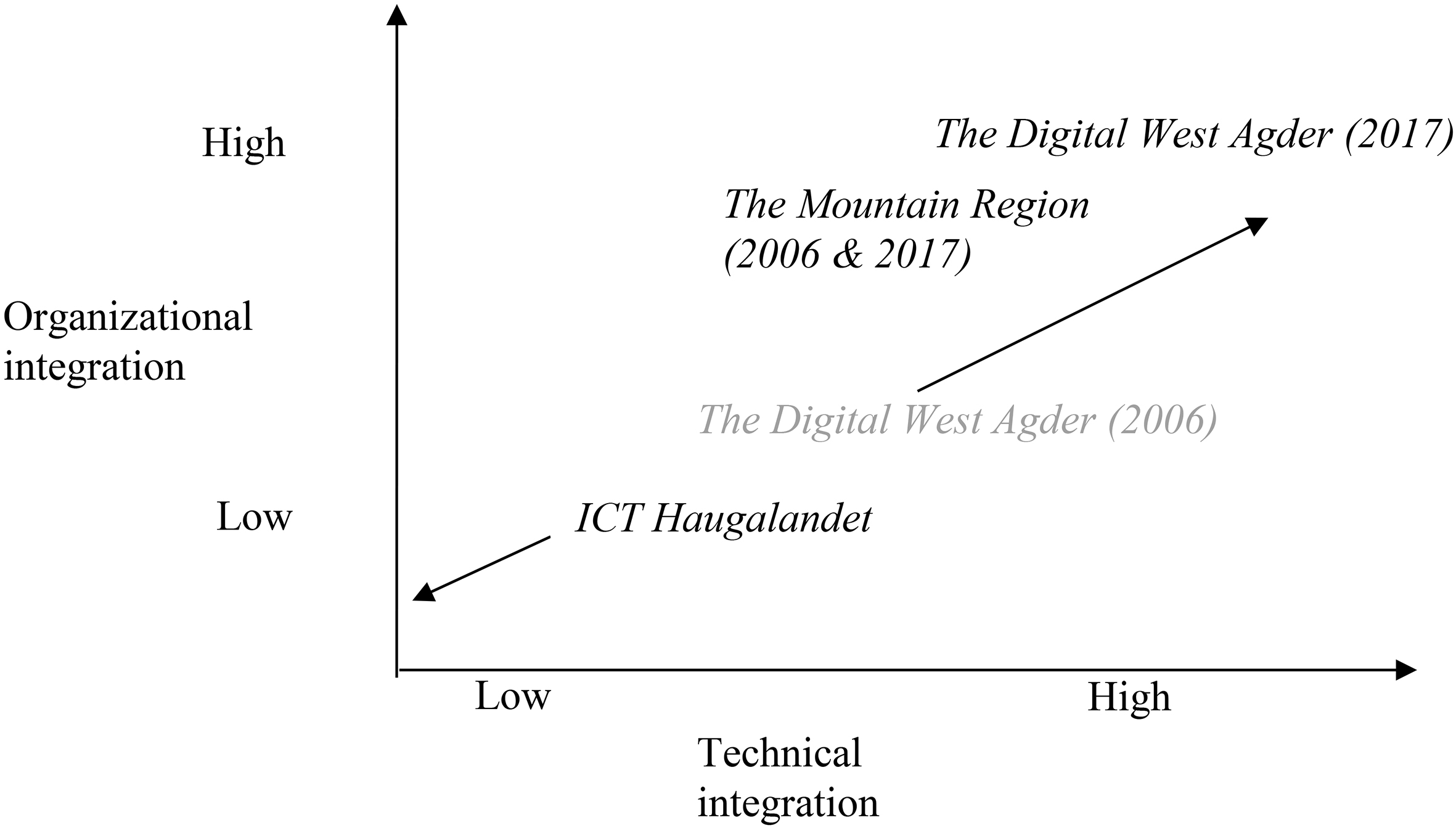
In Fig. 1 below, each of the three networks is positioned along these two dimensions (arrows illustrate the development from 2006 to 2016). In 2006, the Mountain Region was characterized by a high level of technical and organizational integration. The Digital West Agder (DDV) was a moderately technically integrated network, although binding organizational integration was almost totally absent. The third case, ICT Haugalandet, was situated close to the lower left corner. It has a similar low level of organizational integration as the Digital West Agder, but is much less technically integrated. The latter case is particularly interesting because this network had earlier been viewed as a success story in a Nordic context (Baldersheim & Øgård 2003).
Placing each network as in Fig. 1 is, of course, a sweeping statement. A network might well be considered successful despite moderate integration. Nevertheless, an important question arises: why are the three networks – despite a number of similarities – positioned so differently along these dimensions? Moreover, how do these networks develop through time? To answer this and related questions, we shall now undertake a more detailed description of each network paying particular attention network leadership.
Northouse defines leadership as ‘a process whereby an individual influences a group of individuals to achieve a common goal‘ (2012:3). Four elements in this definition should be emphasized. First, leadership is a process. Leaders continuously influence – or are influenced by – the person(s) they lead. As a result, leadership is not a linear or one-way process, but an interactive practice. Second, leadership emphasizes influence. Influence is about how leaders obtain power over those directed. Third, leadership normally occurs in groups, which differ in size and shape A fourth key element is that leadership is about pursuing goals. Leadership takes place through instructions and other means and has its effect in a context where individuals and processes are moved towards a target. Based on these broad and general elements, a large number of more specific leadership categories are crystallized.
It is perhaps paradoxical to talk about network leadership or ‘the network manager’ (O’Toole et al., 1999). After all, networks are defined by a lack of authority, as in Powell’s (1991) classic study ‘Neither Market nor Hierarchy’. Yet, as O’Toole has pointed out, actors or sub-sets of actors sometimes gather individuals to support or move the network towards specific solutions or a particular policy (1999:137). At the same time, such actors cannot automatically expect full support. O’Toole’s suggests that in the absence of authority or suitable rules, a network leader must use a wider range of strategies than those commonly recognised in the public sector. Agranoff and McGuire have argued that network management can be described through four management functions or “Collaborative Management Skills": Activation, Framing, Mobilizing and Synthesizing (Agranoff & McGuire 2001a: 298–300; Cf. Agranoff, 2007).
However, what does ‘a wider range of strategies’ mean, and how are such functions held in practice? A useful typology of leadership roles is developed by Adizes (1980), who devised what has become known as the PAIE scheme (Producer, Administrator, Integrator and Entrepreneur). These four roles are frequently referred to in textbooks on leadership (e.g. Strand, 2007; Northouse, 2012).
The Producer focuses on the importance of pursuing a goal. He or she is good at ‘getting things done’, familiar with technology and other aspects of the field. A producer thinks logically, rationally and is capable of strategic thinking. He or she typically serves as project manager or technical engineer.
The Administrator focuses on control, monitoring and legal regulations. He or she considers structure and regulations as important, and is keen to keep things in order. Strict discipline, surveillance, documentation of working hours, specification of procedures, contracts, audit and total quality management are techniques in the Administrator’s toolbox.
The Integrator, on the other hand, is more concerned with identity, interdependency and harmony. He or she cultivates holistic thinking, compassion, inclusive training and social integration, and tries to mediate when conflicts emerge. The integrator is a negotiator and a master of compromises.
Finally, the Entrepreneur is characterized by an ability to create a vision and to follow this up by means of creative solutions. He or she values starting something new, e.g. exploiting a new technology or initiating organizational changes. The Entrepreneur is also good at mobilizing support for ideas, building alliances, etc. Personal capacities include a willingness to take risks, energy, endurance and charisma. However, the Entrepreneur is sometimes criticized because he or she does unusual things that might override social norms or has an unrealistic interpretation of business opportunities, etc. Thompson et al. (1991) employ the term ‘cowboy’ to describe the ‘dark sides’ of the entrepreneur. Adizes (1988) uses the term ‘arsonist’ to describe leaders not capable of pursuing their ideas from vision to implementation and operation.
Given the vast leadership literature, it is, of course, possible to overlook other theories of leadership that might be relevant. For instance, McKenney et al. (1997) operate with an interesting typology in specific forms of ‘technological leadership’ (1997), and van Wart’s (2014) presents several leadership styles in ‘The Leadership Action Cycle’. However, the choice of leadership perspective here is based on a network leadership literature review (Haug, 2009). Adizes’s strength is that all the roles are simple to define, transparent and subject to a number of previous empirical analyses of municipal leadership in Norway and the Nordic municipalities (Strand, 2007). A further strength of the PAIE scheme is its emphasis on various leadership roles being complementary. All roles must be covered, but the mix matters. The PAIE scheme is generic, i.e. also suitable for explaining variation in results from network-based organizations.
Below the PAIE scheme is applied to three municipal ICT based networks in Norway. The overall idea is not to ‘test’ the PAIE approach per se, but to investigate the networks’ motivations and the relationship between leadership in networks and the capacity to implement digital innovations.
Case 1: Network leadership in the Mountain Region
The Mountain Region (‘Fjellregionen’) in Southeast Norway covers an estimated 24,000 inhabitants, but the area is comparable to Schleswig-Holstein or Thüringen in Germany. In the south of the region, a digital partnership between five municipalities has been formed. The primary driver and host is the town of Tynset in the largest municipality.
Here several initiatives and ICT projects are of interest. First, a common helpdesk and resource ‘pool’ for ICT-employees has been established. ICT staff from the five municipalities are in fact working an estimated 40 percent of the time for their home municipality and 60 percent for the network on a rotating basis. According to the CEO in Tynset, the solution is considered a major success due to both better utilization of the ICT resources and because staff no longer have to work in isolation:
The resource ‘pool’ made it possible to allocate ICT experts from day to day operations to new initiatives. The pool of ICT-related ‘know-how’ plays a major role in generating and operating new ICT-based projects
From the centre of Tynset the network is coordinated by means of a ‘work central’ connecting or disconnecting users and applications according to what is agreed upon. The bulk of the functions are furthermore organized as technical yet professional ‘sub-networks’, e.g. a health network, a social services network, rehabilitation and care network, etc. For instance, an employee dealing with child welfare in one municipality can easily access necessary data (personal data, records, local regulations, etc.) from a municipality situated on the other side of the region. In short, services can be carried out in neighbouring municipalities thus facilitating organizational flexibility. Mutual ICT infrastructure has also stimulated cooperation among local politicians and CEOs on issues such as writing statements on national consultations or reports on regional issues.
In 2005 each Municipal Council decided to formalize the network into an Inter-Municipal Corporation (based on a special Norwegian statute). The five municipalities are the formal owners of the company, which has three steering structures: a Board of Representatives (mayors), a Steering Group (mainly CEOs), and a General Manager (currently the ICT manager in Tynset municipality). Each municipality is the formal owner of common resources. Yet, if a municipality decides to leave the group, the technology stays behind. Another result of the agreement is that they act as one legal partner when dealing with private ICT providers, thus gaining market power and further reductions in ICT costs. As a result, each municipality is more formally as well as financially committed, although withdrawal is always an option.
If we take a closer look at network leadership in the Mountain region in 2006, the most prominent role was the Producer. According to our informants, the network did not develop due to a top-down approach or a visionary leader. On the contrary, the network emerged and developed gradually from below, i.e. out of pragmatic and careful planning by the five municipal ICT-managers. As time passed, the ICT personnel came to know each other – even forming friendships – while exchanging ideas about technology and how to better utilize scarce resources. The process was problem-driven; based on the experience of severe pressure of work, professional isolation, stagnation and vulnerability. Even though all ICT-managers participated, the ICT-manager in Tynset municipality in alliance with his Assistant Chief Administrative Officer (CEO) were identified by the informants as particularly important. They were the first to put a draft agreement on paper, they designed common work processes and organizational models, arranged meetings, prepared common ICT purchases as well as conducting several negotiations about the location of services and designing the common work pool.
The network also had a clear Administrator; or rather consensus was established as to the necessity of formalizing this role. Local politicians, CEOs and ICT managers all wanted ‘to keep things in order’. Yet none appeared as directly ‘bureaucratic’ in the negative connotation of the word. According to the CEOs, the Administrative role has contributed to stabilizing the network, has enhanced transparency and political influence, as well made it possible to fulfil legal obligations. The CEOs were also motivated by binding agreements on issues such cost sharing, governability, accountability and liability. Among the technicians, a formal model also made it easier to handle issues of information security. Data protection was considered particularly important early on as each municipality handles a significant amount of sensitive personal data. Yet, the most important driving force behind the formalization was probably political power. When the Mayors entered the network, they soon demanded a formal model in order to ensure political influence and control. This has even increased, as one of the Mayors explained (2006):
In the beginning, the agreement was far too euphoric. Having the Board of Representatives to meet once a year was not enough – too optimistic. The politicians wanted more influence.
The third kind of leadership also evident in the Mountain region was the Integrator. Keywords used to describe this role were ‘facilitator’ or ‘good at reducing barriers’. The integrator did not work on an operative level, but was frequently in contact with ICT consultants and others involved. This was of course partly the job of the Manager (a position established after they decided to set up the inter-municipal company). However, according to our informants the most important architect and the key Integrator in the Mountain region was the Assistant Chief Executive Officer in Tynset municipality. As mentioned above, this person was also particularly active as an Administrator and assistant CEO for the largest municipality. By initiating reports, carefully listening to politicians, designing work models, utilizing local knowledge, and reconciling differences among the ICT managers, he has contributed significantly to the network. He also appeared as a positive and unifying person. Moreover, because he held an important position in the largest municipality, he easily gained access to political leaders in all municipalities.
For example, he initiated the Plan of Actions, in which the local politicians consider on an annual basis which ICT projects will be given priority. The plan has, according to the informants, contributed significantly to increasing political governability while at the same time reducing unrealistic expectations as to what the network is going to deliver. It prevents potential conflicts and is recognized and institutionalized as a key steering document. A second example concerns flexibility. Each municipality is accepted as sovereign and does not have to commit itself to a particular ICT project. This was an important principle, emphasized by the assistant CEO as functioning almost as a ‘valve’ for the network. A third integrating step, initiated by the ICT manager in Tynset, was to include ‘the users’ in ICT projects. Permanent user groups (such as healthcare workers, teachers and administrative staff) were established in relation to digital expert systems operated by the network and they continuously provide feedback. This inclusive strategy also created a ‘sense of belonging’ and prevented negative attitudes towards ICT activities. The ICT manager as well as the Assistant CEO emphasized that the comprehensive strategy resulted in far better ICT systems, eased implementation, and also legitimized technical network decisions on the operative level.
In short, three of Adizes’ four roles were apparent in the Mountain Region in 2006. However, we did not find a typical Entrepreneur. Based on the conversations with the informants, there was no typical enthusiast or visionary leader. The network was built as they expressed it, ‘stone by stone’ by Producers, Administrators and Integrators.
Ten years later, the Mountain Region’s network is still vital and functioning well. Their ICT and innovation processes remain organized as an Inter-municipal Company with no major changes. The network manager is also the same person, still employed in Tynset municipality, but seconded full-time to the company. The other employees are also seconded to the company for 60% of their time. The company has, on behalf of the owners, duties and responsibilities similar to those in the municipalities’ mainstream ICT units/departments. New ICT developments and rapid technological changes are analyzed and selectively implemented. Enhanced system capacity through collaboration between the municipalities in the Mountain Region promotes ongoing innovation. According to the ICT manager (2017) there are still not, however, typical entrepreneurs in the forefront of the technological development. The CEO in Tynset municipality confirmed this, emphasizing there are few conflicts, yet the need for cooperation has increased as a result of increasingly comprehensive technical solutions.
Case 2: Network leadership in the Digital District of West Agder
The second case is the Digital District of West Agder in Southern Norway (DDV), encompassing 11 municipalities (2006–2012) and an estimated 57,000 inhabitants in an area of 6,250 sq km.
DDV consisted of three seemingly independent networks under an overarching structure. One, initiated by the municipality of Kvinesdal, was responsible for e-mail systems and web solutions. A second network was IDIVA, an initiative emerging from a common accounting system for six municipalities. Thirdly, common software for district nurses, home care, social welfare offices and childcare was established. Examples from the large portfolio included the development of a common ICT-strategy, joint purchasing routines, shared servers and security systems, a joint helpdesk, IP-based telephones and videoconferencing. A common ‘hub’ was in place in the municipality of Mandal (the largest of the 11 municipalities). Nevertheless, no ‘pool’ of ICT personnel was evident in DDV in 2006. In contrast to the Mountain region, the ICT manager in Mandal emphasized the importance of keeping all ICT resources at the local municipal level:
Local access to ICT competence is vital to any organization. We do not want to change that. We do not want to centralize personnel. What we are thinking about is to centralize certain functions, still keeping a decentralized operative level. I think ICT personnel should work where people actually work.
DDV was at that time managed by a highly informal council consisting of municipal CEOs under the daily supervision of the CEO in Marnadal municipality. Although there was no legally binding agreement, ‘authority’ seems to have been exercised through the professional influence of the ICT heads, most notably by the ICT team leader from Mandal. In the interviews, he appeared clearly production-oriented: an ICT engineer more focused on the technical capabilities and limitations than on administration and formalization of cooperation. This person also had a close relationship with the CEO in Marnadal municipality and worked almost as a secretary to the CEOs.
In DDV trust was founded on a loosely constructed and highly flexible collaboration in which pragmatism, voluntarism and equality were outstanding features. This was also reflected in the fact that none of the municipalities were committed to participating in projects (except basic infrastructure and security). Every municipality had an equal say regardless of municipal size, effort and investment in DDV. Terms used to describe the network were ‘mutual trust’ and ‘gentlemen’s agreement’.
Despite the network’s achievements, it was striking that there was extreme caution about initiating new ICT schemes that might impact on the municipalities’ internal organizational structures. The ICT team seemed to work somewhat in isolation although in an understanding with the CEOs. Collaboration was apparently influenced by a ‘twin logic’: on the one hand an economic/technological logic facilitating comprehensive collaboration and cost reductions due to standardization, specialization or centralization; on the other hand, a political logic on the part of the CEOs, which shaped developments in proportion to what was ‘politically possible’. Questions such as ‘do we need 11 accounting offices when we can do with one’ were systematically avoided. Due to the consciousness of this twin logic, the ICT team as well as the CEOs ‘feared’ initiating ICT projects that might cause political disputes over the location of services and institutions or staff reductions.
As of 2006, only two decisions were made by the politicians: the first concerned participation in a regional broadband initiative; the second when they had to pay €76,000 to cover the municipal part of the expenses incurred by building broadband. Thus, DDV was in 2006 by and large a technically and producer-driven process. Although there was occasionally talk about including ‘the political leadership’, politicians were reduced to ‘walk-on’ parts in a ‘theatre’ governed exclusively by ICT managers and CEOs. Compared to the Mountain region, DDV was in 2006 less technically and organizationally integrated. To remain undisturbed in their new ‘playground’, the CEOs and ICT managers chose not to involve the political level.
Can this be explained by difference in network leadership? As with the Mountain region, DDV encompassed a strong Producer role. According to our informants, this role was played largely by ICT managers through technical projects. The ICT personnel were united mainly through an informal ICT forum, which they considered to be ‘highly efficient’ and ‘a success story’. Coordinated by the ICT manager in Marnadal municipality, the forum discussed current challenges, introduced solutions to practical problems, and initiated new projects. There was little evidence of written agreements or a long-term strategy. No record of meetings, decisions taken or budgets were kept. Still, DDV always seemed able to access external financing, such as that provided by the state for broadband initiatives. This made the network independent of ‘being controlled in detail by politicians’ – according to the ICT manager in Mandal, who was straightforward on this issue:
If you got money, you don’t need politics!
The role of Administrator was, in other words, almost entirely absent in DDV in 2006. As mentioned above, however, this was a conscious strategy to avoid ‘political interference’. As the leader of the informal steering committee put it: ‘we have not been much preoccupied with formalization’. The CEO in Marnadal described it in 2006 as ‘a rational marriage’.
The absence of an administrator role might also be explained by the fact that this network had a particularly well-developed Integrator. The key person mentioned spontaneously by the informants was the CEO in Marnadal municipality (usually addressed only as ‘Big Per’ due to his physical size as well as regional influence). Although integration in DDV was limited to administrative and technical staff, the CEOs ‘connected’ to local politicians from time to time and ‘informed’ politicians when it was considered necessary. As ‘Big Per’ expressed it himself:
In this collaboration it has been very little politics. The steering committee is the CEOs. We inform politicians if necessary. This is a genuine network. It only happened this way.
The CEO in Marnadal had been elected as chair of the board in IDIVA (see above) as well as head of the informal CEO forum in DDV. A combination of positions and personal capacities made this person function almost as an ‘intersection’ between the other CEOs, ICT managers and key political decision makers. He also gained trust because, as his own municipality did not have an ICT unit of its own, he could not be accused of ‘feathering his own nest’. The ICT manager in Mandal had, by serving his CEO, developed a close relationship with ‘Big Per’ and functioned in 2006 almost as a professional secretary to the CEOs in DDV. As in the Mountain region, each member of the network had flexibility about participating in projects. A ‘two-or-more-rule’ was implemented, meaning that if more than two members wanted to collaborate on a particular ICT project, the project was defined as a ‘DDV-project’. Nevertheless, the ICT manager from Mandal seemed to act as a fulcrum for most of the day-to-day coordination: he recorded and carried forward project initiatives to the CEOs, often informally through ‘Big Per’. Similarly, if the CEOs had a question, much of the contact went through these two leaders. Big Per’s comment
I’ll just have a chat with Roy [the ICT manager in Mandal]
illustrates the close relationship between the head of the informal CEO steering committee and the leader of the ICT forum. ‘Roy’ also describes this structure as informal and flexible, but still highly effective. The following quote captures this efficiency argument, but also illustrates the importance of having top level CEOs on board:
We do not have to go home to get permission
However, the Entrepreneur was only to some extent evident in DDV. It was difficult for the informants to pinpoint one particular person as particularly creative or visionary. Elements of entrepreneurship were evident in the ICT manager in Mandal, as well as the CEOs e.g. when contributing to providing financial support to DDV.
Today, ten years later, the DDV network is indeed vital and developing. Several interesting changes have occurred. A key modification is that the network had to abandon its ‘independence’ and develop into a much more formalized Inter-Municipal Company in 2015. Local ICT resources were centralized and about 40 employees are today located in new premises, serving nine municipalities. Both key initiators (the CEO and the ICT-manager) have left the network, as have two of the original 11 municipalities. According to the current manager, this was due to arguments about the location of services, with the breakaway group wanting to keep technology in the municipalities to protect local jobs. An overall management board is also in place, consisting of all nine municipal CEOs. The board is responsible for the management of DDV, for setting out the e-strategy for cooperation and for budget decisions. The current manager of the company cited three reasons for these changes: (a) the need for politicians and administrative leaders to be in control of the costs and development; (b) the flexibility facilitated by remote control technology, and (c) a need to better standardize technology by means of authority. The ‘voluntary procurement’ and ‘encouragement’ strategy of 2006 gradually became inadequate: the original model resulted in ‘too much talk and difficulties to agree’ and as he chose to formulate it: ‘to get an omelette, you have to break some eggs’.
The new DDV is currently developing several new and innovative ICT-related projects, monitoring and implementing rapid technological changes, safeguarding data security, facilitating teaching, organizing conferences, etc. Overall, the new DDV reflects significantly enhanced system capacity through more formalized collaboration between the municipalities. In short, from a theoretical point of view, the role of Administrator and the network’s bureaucracy has been significantly strengthened. This clearly promotes entrepreneurship and innovation.
Case 3: Network leadership in ICT Haugalandet
The third and final case is ICT Haugalandet. The network consisted of twelve municipalities in the Southwest of Norway, encompassing around 130,000 inhabitants and crossed the boundary between two Counties (Rogaland & Hordaland) as well as two political sub-regional counties (‘regionråd’). The network initiative can be traced back to the establishment of a common library system, originally established by the ICT manager in Tysvær municipality in the late 1990s. Initially, much like in DDV, the ICT managers were working ‘in isolation’ from administrative leaders and politicians.
Later, however, the network went through several processes of fragmentation. Competing networks emerged, and it is perhaps more precise to describe ICT Haugalandet (2006) as a system of parallel networks. Yet, two structures provided some degree of integration: an informal ICT club called ‘ISI’ where ICT managers met frequently to discuss current ICT-related issues and developments, and a coordinating body consisting of all the CEOs. This group initiated several ambitious collaborative processes in which all the twelve municipalities were invited to participate. However, it was not possible to identify more than a very basic level of collaboration within the network. Despite a handful of ICT projects, ICT Haugalandet was far less technologically and organizationally integrated than the other two projects. After visiting the network twice (2003/2006) we formed an impression of severe problems of leadership and control.
However, ICT Haugalandet did have Producers. The ICT managers initiated and implemented interesting ICT projects such as the municipal ‘HUB’, established in Tysvaer to connect all the municipalities in the network. Despite their high level of technical skills, the Producers did not manage to mobilize sufficient support in terms of external funding or cost-sharing mechanisms to sustain a common and enduring portfolio of ICT systems. Technical integration was limited to maintaining basic infrastructure, informal project coordination and ICT purchases.
Constraints experienced by the Producers might well be explained by the fact that the role of Administrator was by and large absent. While the ICT consultants deliberately wanted to avoid ‘bureaucratization’ and ‘political interference’ this network was heavily dependent upon internal financial support, which required political decisions at municipal level. In addition, the absence of a comprehensive agreement and functioning superstructures eventually caused promising projects to fail.
To understand why why the administrative role did not function properly in ICT Haugalandet, we need to review the development of the network. As promising results emerged from the ICT collaboration effort, combined with an increased demand in some of the municipalities for more efficient municipal services, several CEOs wanted to control the regional ICT efforts. In other words, a basically bottom-up approach changed from 2003 onwards into a top-down driven process. In 2005 the CEOs initiated a large report, in which for the first time questions of cost reduction became a priority for the network and on this basis a comprehensive agreement was designed to formalize the network structure.
However, in 2006, only two out of the twelve municipalities supported the initiative. Opposition came from the ICT specialists who argued that further integration required more not less investment in personnel and equipment. The differences in financial position of the network members made agreement difficult and there was a general fear of job losses in the light of previous experience of attempted municipal amalgamation.
Despite the failure of the agreement, the ICT managers continued to meet informally. The network was characterized as a truly useful ‘arena for learning’, a ‘think tank’ and ‘innovative forum’. They even tried to formalize it by establishing a more formal agreement and a steering committee. However, the initiative was quickly rejected by the CEOs. One of the ICT managers described the event as follows:
We collaborated well. And we wanted to be more formal, but this was rejected by the CEOs. They were afraid of us becoming a ‘state within the state’. We have selected a leader and that is it.
The response of another ICT manager points to the key issue of power and control:
We were looked upon as a power structure. For ICT managers to ‘talk together’ are ok. ‘The group think’ is not.
What is evident in this case, is an almost complete lack of the Integrator role. Divergent actors (professional forces, levels, and institutions) prevented the network from pursuing additional technical and organizational integration.
Projects accomplished at Haugalandet in 2006 occurred mainly due to the role of two archetypal Entrepreneurs. The (former) ICT manager in Tysvær municipality, flanked by his colleague and friend from Karmøy municipality, for years contributed significantly to regional ICT development. Their colleagues and others described the two as ‘indefatigable’, ‘generous’, ‘enthusiastic’ and ‘passionate about shared ICT solutions’. Some informants also emphasized their unique capacity to ‘sell ideas’ and ‘go-ahead spirit’. Entrepreneurship was perhaps most evident with the ICT manager in Tysvær. He demonstrated enormous tenacity in the face of official opposition in implementing such ICT innovations as fingerprint log-in for laptops in the network and in driving a large Internet telephone project that encompassed 26 municipalities in a joint tender.
However, observing the network today, 10 years later, there is not much cooperation left: all the key players have resigned or left ‘the club’. Three of the municipalities have, however, continued based on a ‘letter of intent’ with some community services. Beyond this, both organizational and technical cooperation have largely vanished. One of the former ICT managers ascribed the development to ‘demanding political conditions in the region’. She referred to different power structures, the varying sizes of the municipalities, fear of job losses, and an ongoing ‘positioning’ in connection with possible municipal amalgamations in the region. She also highlighted the loss of “entrepreneurship” or the motivation of the development. Theoretically, ICT Haugaland lost both the Producer and the Entrepreneur roles.
Network leadership across three networks – a comparison
In Table 1 below, the most important findings from the three networks are summarised (2006 findings in parenthesis if changed). The table is structured according to the four PAIE leadership roles presented initially (Producer, Administrator, Integrator and Entrepreneur).
Leadership in three ICT based municipal networks summarized according to the PAIE scheme 2006–2017
Leadership in three ICT based municipal networks summarized according to the PAIE scheme 2006–2017
The table is of course simplified, and each role should not be viewed in isolation. Indeed, this study confirms one Adizes’ (1980) key arguments , namely that the four leadership roles are complementary. The point is that each role is important for an organization to function well. This also seems the case with networks. If one or more of these leadership profiles are missing or functioning poorly, technical and organizational integration suffers. Furthermore, as networks lack formal authority, the balance between the four PAIE-roles is different compared to traditional hierarchical public sector organizations.
Looking at Table 1, a first impression is that all three networks did have a more or less functioning Producer role. However, only one network at that time had recognized an Administrator role: the Mountain Region alone made an explicit point of ‘keeping things in order’. This was also the most technically and organizationally integrated network and has maintained a strong position in the region. A well functioning network administration was considered vital by key stakeholders. By deciding to formalize the network, political participation was accomplished and recognized. In theoretical terms, the Administrator role was flanked by a vigorous Integrator role (mobilization of political expertise). This in turn facilitated a new and much needed arena for the Producers to innovate (the ICT ‘pool’). In the Digital District of Agder as well as ICT Haugalandet, the Administrative role was deliberately toned down in 2006, if not totally absent. In the former, however, innovations were limited to ‘safe’ projects to avoid potential conflicts about the location of personnel and institutions. In the latter, the role of Integrator was missing. Lacking both Integrator and Administrator, ICT Haugalandet was struggling despite access to the Producers and enthusiastic Entrepreneurs. Here, however, these two networks chose different paths between 2006 and 2017. DDV further developed the Administrator role, ICT Haugaland did not (or would not) do so. As we will see below, this is important for understanding the further network dynamics and development.
In addition, networks to a much larger extent than hierarchies require an Integrator capable of bridging institutions. This calls for compromising skills, attentiveness, negotiating experience and holistic judgments. In single municipalities, integration is an important task of the local political council. Municipal networks that do not manage to incorporate the political level, might well in the end fail not only because an important stakeholder is ignored, but because local politicians are usually well trained in negotiation and compromising.
Finally, networks do not depend on a particular Entrepreneur. As pointed out in the introduction, previous studies of leadership have revealed that public sector leaders on average emphasize the roles of Administrator (A) and Integrator (I) more than leaders in the private sector do (Strand, 2007; Agranoff, 2007). Public organizations are typically designed to minimize private judgements, initiatives and unpredictability among public servants. The room for leadership is made tight, and the Entrepreneur has an uncertain existence in the public sector (Strand, 2007:331). Networks seem to foster the Producer role (P) and the Entrepreneur (E). Without exception, a more or less informal ICT ‘club’ is established facilitating free dialogue and inspiration. These informal institutional settings facilitate alternative interpretations and critical judgements – and thus innovation. Although this varies, there is reason to believe that networks complement traditional public sector leadership by enabling innovation.
However, innovation does not depend on access to a particular ‘Entrepreneur’. In the Mountain Region, which mainly lacked this figure, significant innovation still emerged, although ‘stone by stone’. Unlike the two other networks, the Mountain Region also managed to create a well functioning superstructure supporting the Producers. The same later happened in DDV. Well-functioning Entrepreneurs might indeed initiate interesting technical projects. This is the case particularly at ICT Haugaland, but without some sort of superstructure, indefatigable efforts and initiatives are not sustainable long-term.
Overall, the PAIE leadership typology has proved to be a helpful tool with which to analzse network management. While there is a certain lack of clarity about the roles and the boundaries are sometimes blurred, both the functions and roles were easily recognised by the informants in this study. There are however two categories that may supplement the PAIE-framework. The first is what we might label network conductors, i.e. a leader that manages to link several networks in such a way that seemingly independent networks start functioning as a whole. He or she is not necessarily particularly visible, rather operates behind the scenes, pulling strings, giving advice, making connections and building alliances. To achieve this, he or she eagerly takes on assignments such as being on boards in different networks at different levels. A ‘network conductor’ also constantly visits different networks and single stakeholders, thereby gathering and sharing information about what is going on elsewhere and identifying potential constellations, mutual projects, etc. The most important ability is to ‘conduct’, that is fostering holistic thinking, synthesising and synchronizing (almost like conducting musical instruments in a symphony). The CEO in Marnadal municipality (‘Big Per’) is an illustrative example of a ‘network conductor’. The initial structure, consisting of three independent networks, caused challenges relating to coordination, technical incongruence and security problems. DDV managed to unite these network structures technically as well as organizationally into parallel yet complementary ‘networks within networks’, which later developed into a more formal structure. ICT Haugaland failed to do this, and lost out due to competing sectional interests.
The second category is dyadic leadership, which occurs when two leaders collaborate in such a way and to such an extent that they dominate the development of a network. Even though single leaders may hold key roles in networks, in each network in our study certain pairs of leaders became apparent. That is, people who work especially well together and form a good team. In the Mountain Region, the administrative leader and assistant CEO in Tynset municipality and the ICT manager constitute such a dyad. The ICT manager has little experience of influencing political and administrative processes. The assistant CEO does not understand the technology in detail. However, when they join forces they appear as particularly effective leaders, capable of dominating the local network agenda. Similarly in DDV the ICT manager in Mandal municipality and the administrative CEO in Marnadal joined in a highly capable leadership dyad. This twosome is typically referred to simultaneously as ‘negotiators’ ‘mediators’ and ‘facilitators’. By a unique ‘chemistry’ and shared view on important network policies, as well as complementary skills, exceptionally good cooperation emerges. A third example of dyadic leadership is the professional alliance between the two municipal ICT managers in Tysvær and Karmøy in Haugalandet. However, in this case the leadership dyad did not combine complementary and consolidating skills but reinforced an already heavily technically oriented entrepreneurship.
Conclusion: Innovation and network leadership: The bureaucracy strikes back?
The focus of this study has been to understand the relationship between innovation and network leadership. Three ICT-based municipal networks were studied in Norway in the periods 2005/6 and 2017, using Adizes’ PAIE model (1980) to examine leadership roles in each.
Innovation certainly occurred in all three networks. However, the degree of innovation and the ability to sustain it depended to a large extent on the leadership structures in each case. In each network innovation began with Producers (P) coming together informally to exchange ideas. In the most successful network (the Mountain Region) Producers joined with Administrators (A) and Integrators (I) from the beginning. It took some time for the Producers (P) and the Integrators (I) in the DDV network to overcome their initial suspicion of bureaucrats (A) and pursue integration but when they did, they enjoyed considerable success in innovation. While the Haugalandet network Producers initially showed some Entrepreneurship (E) they were unable to move beyond the informal collaboration stage and the network could not sustain itself.
Our study confirms Adizes’ findings that the different leadership roles are complementary. In our case, the configuration of the roles turned out to be crucial: not all of the networks combined the roles in the same way. Indeed, somewhat surprisingly, the most successful network did not seem to have an Entrepreneur (E) and the least successful network did.
We have proposed 2 additional categories to supplement the PAIE typology: the network conductor and the leadership dyad.
The networks studied here, in Norwegian municipalities, are mainly focused on ICT. We clearly need more and broader studies to confirm or reject the findings presented. Several studies of network development are necessary – not least to further develop a theoretical framework that can explain the network’s life cycle and network dynamics.
For the moment it is worth noting that a common factor in the successful networks was the incorporation of the Administrator role in the promotion of innovation: the bureaucracy strikes back!