



Abstract
This study analyzes the policy changes that take place even when though internal institutions and external environments are stable. It tracks the answer to a couple of questions: Does the content of economic policy direction change every year in a more stable macroeconomic environment? If it changes, how can this be explained by theory? To investigate these changes, Korean annual economic policy direction reports released from the Ministry of the Interior were collected. Through text mining analysis, the words in the reports from over 24 years (from 1993 to 2016) were examined. The analytical results show that policy elites constantly compete to influence the policy by keeping themselves in the past to acquire and maintain legitimate authority while responding to the government’s needs for creative innovation and change.
Introduction
The government continues to announce new and changed policies. Disasters and social problems often trigger new policies, and these issues are included in policy reports as issues to be resolved annually. These policies change depending on the political and economic, environment and policy change while the government is in the process of correcting their errors. But is this real change? For example, in the case of an entirely self-contained vehicle, the performance design of the car may be changed, but some functions may be only included temporarily or disappear in later model. Could policy change be similar? However, studies that have analyzed policy changes have been approaching the premise that they viewed narrative as case studies or as intermittent events and change. This study investigates whether there is actually policy change.
Annually, the Korean government announces “economic policy directions”, which cover the macroeconomic conditions (including economic growth, prices, employment, domestic demand, imports, and exports) and policy issues to be pursued during the year. These economic policy directions should be the result of the rational efforts of policy elites who intend to review the domestic and foreign policy environments comprehensively and improve the efficiency and raise public interest in the entire national economy. However, in reality, the policy elites are faced with innovation pressure to make the economic policy direction report look new and different from previous report, and if unsuccessful, they must endure criticism from the press for ‘rehashing’. Despite the absence of rapid changes in the economic policy environment, it is necessary to reproduce an economic policy direction that sufficiently differs from the policy packages that were built up in previous years. In other words, policy elites are not competing with other economic entities, but with their own ideas from the past.
This study starts from the question of how economic policy direction changes regularly and intentionally every year in a stable macroeconomic environment, and then asks how these changes can be explained. According to classical institutionalism, without a strong external economic shock, policy elites will not be tempted to change policy packages by going beyond institutional channels. Other than internal policy ambiguity and gaps in the institutional components, there is a limit to justifying the annual changes to the policy package (Campbell, 1998; Greif & Laitin, 2004; Orren & Skowronek, 1994; Streeck & Thelen, 2005). In addition, there is difficulty in considering the direction of economic policy because of private interests between the policy elite and interest groups as actors, and it is not easy to explain why policy elites prefer regular changes to the policy package.
This study aims to approach these questions from the ideation perspective that theoretical importance has recently been emphasized. It involves the process of identifying the role of the idea that triggers mechanism that policy change always occurs even when there is no demand from interest groups and environmental change, and the process of competition between different policy alternatives at the agenda setting stage through ideas. To do this, this research determines whether the direction of the economic policy announced annually is changed or fixed in terms of concepts or ideas by analyzing unstructured data. While institutional research has preferred a narrative analysis based on qualitative data, this research focuses on analyzing the phenomenon more objectively by using the method of extracting and analyzing meaningful data through computer operation. Computer-based research (Orren & Skowronek, 1994) can complement traditional social science methodologies, such as helping to identify patterns or rules in unstructured data, and it can also contribute to complementing the ‘absence of a microscopic framework for macroscopic phenomena’.
This study analyzes economic policy direction reports by using a text mining method that is one of the unstructured data analysis techniques. In short, using the analysis of economic policy directions, this research explores whether the ideas of policy elites continuously change and examines what these changes mean from an institutional perspective.
Theories of institutionalism
The theory of institutionalism emphasizes the importance of both formal and informal institutions and contexts as an alternative to morphological, pluralistic, and rational choice theories that understand phenomena based on a microscopic analysis of human behavior (Orren & Skowronek, 1996; Streeck & Thelen, 2005). As institutions attempt to verify organizations, and the individuals who populate them, are suspended in a connection of values, norms, rules, beliefs, and assumptions are regarded as natural, that are at least partially of these individuals’ own making (Barley & Tolbert, 1997). Institutional research in organizations particularly emerged as some variables of institutional theory, like institutional emergence, conformity, conflict, change, isomorphism, processes that establish schemas, rules, norms, and routines that treat organizations and managers as rational actors. However, early institutionalism focused on historical context has contributed to explaining that the political and economic structure constrains policy and institutional contexts influence the specific shape of the policy, however it is limited to theorizing what policies are selected and changed in uncertain situations. In relation to institutional change, early institutionalism has been described as punctuated equilibrium (March & Olsen, 1996; Mehta, 2010), in which institutions are changed by external shocks, such as war and economic crisis. This is helpful in explaining the sustainability and stability of the system, but it does not provide an adequate answer for gradual changes. To overcome these limitations, institutionalism has focused on the endogenous changes that can be triggered by the interdependence of institutional components and internal contradictions (Campbell, 1998; Greif & Laitin, 2004; Orren & Skowronek, 1994; Streeck & Thelen, 2005). It is possible to explain an endogenous change as it begins to regard the system as an orderly and unintentionally designed single unit, but as the various components begin to regard it as a complementary united complex at a time interval. In other words, the institution is composed of various components formed at different times and the contexts are in a conflictual or complementary relationship, so that gradual change can occur without any external impact.
On endogenous changes, Campbell (Campbell, 1998; 2004; 2005; 2007) explains them in terms of bricolage and translation. Changes by bricolage, which involve adding and reassembling new components, appear in the form of path dependence where the old system continues to exist, and these new components are merged with existing systems through interpretation. Orren and Skowronek (Orren & Skowronek, 1994; Orren & Skowronek, 1996) argue that institutions as composites have a no simultaneity of institutional formation in which heterogeneous institutional elements overlap according to the needs at that time, triggering institutional change. (Greif & Laitin, 2004), who maintains a similar stance, argues that institutional change occurs at an institutional refinement level that reinforces the existing system, not by the introduction of a completely new system, because the legacy of the former system constitutes the initial state of institutional change.
If an institution (as a complex system) changes as it is rearranged and reunited among the interdependence and conflicts of the internal components, it is necessary to discuss how the actors who perform it bind the components together. The ‘idea’ has provided a starting point for such discussion in recent years. In the study of institutionalism ideational processes are regarded as impactful to policy change. The processes help to construct the problems and issues that enter the policy agenda. The ideational processes also could shape the assumptions that affect the content of reform proposals related to policy. In short, ideational processes impact the ways policy elites perceive their policy interests and the political environment in which they mobilize (Béland, 2009). The processes are not only catalyst but also variable of policy change.
The idea is to provide a conceptual framework that can bridge the gap between actor-centered explanations and institutional constraints. Under the uncertainty of complex reality, the idea plays the role of a filter for what to recognize as a policy problem and a direction for how to respond to perceived problems (Bradford, 1999). By introducing the concept of ideas, it became possible to correct the “bias of macro-structure”, which was held by institutionalism, and to provide a mechanism for link the relationship between actors and institutions.
Despite the theoretical usefulness and role of ideas, discussions about the definition and types of ideas are emerging in various and multi-layered ways. For example, Campbell (Campbell, 1998) considers the normative aspects of historical institutionalism and the cognitive aspects of organizational institutionalism and suggests ideas as programs, ideas as paradigms, ideas as frames, and ideas as public sentiments. Mehta (Mehta, 2010) presents three types of ideas: policy solution, problem definition, and zeitgeist reflecting public philosophy. In sum, the ideas are divided into three categories: program, paradigm, and public sentiment.
The program idea is a concrete solution for solving the current policy problem and it has the technical and professional characteristics of problem solving. The paradigm idea is a theoretical assumption or a view of the world that suggests the macro direction of policy, and it serves as a criterion for limiting how the policy elite perceive the problem and the range of acceptable solutions. The public sentiment idea means the standard of judgment or recognition of the general public about the problem solution. Program, paradigm, and public sentiment ideas are more likely to be accepted as policy because they are more consistent. On the other hand, if the policy elite’s solution to the problem is judged or if it goes against the general public’s perception, the possibility of adopting it as a policy becomes low. If only the constraints of the institution in relation to the relationship between ideas and institution are emphasized, then the possibility that different outcomes may occur under the same institutional context will be neglected. There has also been a lack of explanation about why the actors adopt a policy. An explanation that links ideas, institutions, and actors is necessary. Genieys and Smyrl, 2016 argue that programmatic elites who share specific policy ideas compete for ideas to gain more support, and that the idea of a particular member of the elite being accepted through such a competition drives institutional change. According to Genieys and Smyrl, 2016, the state consists of a plurality of policy elites who share specific policy ideas, and they compete for ideas to acquire and maintain legitimate authority. Policy rivalry continues to seek change because of the competition for ideas to dominate the cognitive and normative framework, therefore policy changes occur even when there is no demand from the outside and the institution is stable.
As mentioned above, the significance of ideas in institutional research was examined. The idea is useful because it links the institution as a mechanism and the actor as a policy selector, and it allows us to understand why specific choices are made under specific circumstances. An idea has two-sided effects as dependent and independent variables that trigger institutional change, and it contributes to developing a medium-sized interface of micro- and macro-action choices. As mentioned earlier, there are various types and classifications of ideas, such as monetarism (Hall, 2001), neoliberalism (Bradford, 1999), capitalism diversity (Campbell, 1998; Hall, 2001), supply-oriented economic trends, and public sentiment ideas. As a result, the boundary between the institution and idea is mixed, and the explanatory power of the idea is degraded. To emphasize the conceptual difference between institution and idea, it is necessary to reduce the unit of analysis.
When the technical tools in science field were eased to social science research, technical analysis tool such as text mining analysis enables to study the socio-economic implications and the influence of institutions empirically. Furthermore, sociological thought on the link between institution and action to outline a theory of organizational structures by altering institutionalized roles and patterns of interaction.
What is required is a systematic exploration of the relative importance of behavioural and interpretive phenomena in the institutionalization process and, on the basis of such exploration, the fashioning of a set of methods that are sensitive to and systematic about documenting both cultural and structural dynamics (Barley, 1986; Barley & Tolbert, 1997) .
So, in relation to ideas and institutional changes, Genieys and Smyrl (Smyrl & Genieys, 2016) argue that various government departments or agencies compete for ideas to gain legitimacy, which may change policy in a stable administrative environment. This assumes that a plurality of elite groups is competing, and it is necessary to expand the discussion as to why a single institution or single elite group continues to generate ideas. In actuality the organizations, and the individuals who populate them, are suspended in a web of values, norms, rules, beliefs, and taken-for-granted assumptions that are at least partially of their own making (Barley & Tolbert, 1997).
Each sector of the government is generating policy ideas independently under their own functions and powers. In a single organization, efforts to differentiate ideas are continuously being carried out, and empirical research is needed to analyze them.
Method
Data
The data used for this study was obtained from Ministry of Strategy and Finance in South Korea. Since 1993, the Ministry has published annual economic policy direction reports. We analyzed the ‘Economic Revival Policy’ from 1959, which is the first economic policy direction. The report on the economic policy direction in 1993 was published on December 29, 1992, the last year for the government of the Thirteenth President, Roh Tae-woo, and it has served as a starting point for analyzing the changes in the government of the Fourteenth President, Kim Young-sam. To demonstrate the changes in policy ideas, the government has refined and analyzed the economic policy direction report released at the end of the preceding year or at the beginning of the year through text mining. The report is available online in PDF format. The report describes the previous year’s economic growth and economic policy reporting and reflection, economic and political situation outside of Korea, strategies and measures for future economic growth and economic policies, and domestic and international expectations. It should be noted that the economic and political trends of the previous year will be reflected in the policies of the following year. Therefore, the contents of the economic policy direction report of 1994 reflect the political and economic situation of 1993. During the analysis, the time lag was noted.
The preprocessing involved decomposing the words of the PDF file using the R package. We used the KoNLP program for word extraction and the and Sejong dictionary package among R programs. We extracted only nouns by processing figures, symbols, and duplicate words, and the frequency of each word was calculated using Excel. The original text is in Korean and using R program, which can handle Korean, did not impair the meaning of the original text. Only the result report was translated into English.
To analyze the changes in economic policy direction reports, this study used text mining methods. Text mining refers to computerized techniques to classify, cluster, and analyze textual data in order to find useful patterns within large volumes of text data. The major purpose of text mining is to derive high quality information by applying supervised and unsupervised natural language processing, as well as diverse statistical learning methods (Hagen, 2016).
Descriptive statistics
A total of 327,891 words were extracted in the 24 economic policy direction reports from 1993 to 2016. At first, we retrieved 95,551 words by preprocessing excluding the numbers, symbols, and postpositions. Then, 10,061 unique words are used in the analysis after removing duplicate words. The 94 words of 10,061 unique words were used in all 24 economic policy direction reports. The 94 words represent about 4.9% of unique words used in the relevant year.
In order to examine how the extracted words changed with time, we analyzed the ratio of new words newly appeared in that year in comparison with the previous year. As a result of analyzing the economic policy direction based on 1993, 39.39% of the words used in the economic policy direction report in that year were new words that were not used in the previous year. That is, about 39% of the economic policy direction compared to the previous year was described as a new word, and the remaining 61% used the formerly used word. It shows about one-third of the economic policy direction report as new words compared with the previous year, and the remaining two-thirds used words that had been used before.
We further investigated the frequency of major terms to find that the direction of Korea’s economic policy has focused on the words “expand, strengthen, and improve” policy programs related to “enterprises, small business, institutions, and markets”. The yearly flow of the top 20 words with high frequency among the reference words are such as “expansion”, “support”, and “promotion”. They have a frequency of 1,000 times or more and are regarded as the main words of the economic policy report. Four words related to the government’s policy intentions, “expansion”, “support”, “promotion”, and “reinforcement”, along with, “improvement”, “arrangement”, “enterprise”, and “investment” are used every year. The words, “enterprise”, “small business”, “market”, and “institution”, reveal the target of the policy program. Similar to the words, “enlargement”, “strengthen”, “improvement”, “enhancement”, and “expand”, they implicitly presuppose some changes. On the other hand, “preparation”, “development”, and “introduction” are related to new ideas, but their frequency is relatively low.
We identified policy directions and changes by examining the words in the economic reports. In particular, the sentence was created by changing the combination of words, or by using words that have similar meanings. The analysis of 24 year period of reports has shown that the economic policy has remained fairly stable with average changes in roughly 50% of the words. Thus, we examine that economic policy changes by the internal situation such as through the interests of policy elites rather than the economic external environment.
Premise
This study shows that policy elites are constantly changing the policy packages that they have created acquire and maintain legitimate authority, and that policy changes can be made even in a stable environment. Including the competition between multiple policy elites (Smyrl & Genieys, 2016), it also shows that policy changes can occur internally even when policy elites monopolize policy formation. In addition, this research investigates whether changes in the ideas that constitute the policy package can be a dependent variable, or if it is an independent variable constrained by upper ideas or institutions. Based on previous research, the following content is considered to be the subject of study and premise.
First, this study analyzed 24 economic policy direction reports, which were published annually from 1993 to 2016, centered on the Ministry of Strategy and Finance in Korea. This implies that most of the studies based on historical institutionalism are related to economic policy. The economic policy direction report is a comprehensive policy package that outlines what policy measures were put in place in the political and economic situations of the preceding year. The report basically consists of the evaluation of economic operations in the preceding year, the economic conditions, the basic direction of economic policy, and major policy tasks to be pursued in the upcoming year. This study only investigated the “basic directions and major issues of economic policy” corresponding to the policy package of the year.
Second, this study considered that the economic policy direction report is not a single and complete unit, but a mixture of various policy ideas (Campbell, 2005, 2010; Fairclough, 2003; Hall, 2001; Tan, 1999). The economic policy direction report contains various policies to be pursued by the government during the upcoming year, such as jobs, household debt, the housing market, and external integrity, and various policy measures are combined to form the whole. The components are not created collectively at a specific time but are reunited and rearranged at different times, and they coincide with heterogeneous ideas formed at different times (Orren & Skowronek, 1994; 1996).
Third, although there are various types and levels of ideas, in this study, the idea of the economic policy direction report is considered to be a concrete solution to the policy problem (ideas as program) (Fairclough, 2003; Smyrl & Genieys, 2016). A program idea is an idea that provides a means of solving a pending issue and achieving its goal. It is distinguished from a paradigm idea related to problem definition and a public sentiment idea as a hypothesis of problem solving. Program ideas are influential when they are highly compatible with paradigm ideas and public sentiment ideas.
Fourth, this study assumed that program ideas can be broken down into texts, or words, which are the basis of verbal expression. The subject of research in social sciences tends to have an unstructured character rather than a structured attribute. As a spreadsheet, it does not appear as a fixed field, but rather the research accumulates in forms such as reports, newspaper articles, and booklets. In particular, about 80% of the information in the economic policy direction report is stored in text format (Fairclough, 2003). The text expresses social representation and identity (Thelen, 2004). The economic policy direction report shows that the perception of policy elites on policy issues at the time is expressed by single words and a combination of several words. In other words, the main analysis and variables of this study are the words of the economic policy direction report.
Fifth, this study grasped the importance of the word and the survival of the idea based on the frequency of the words in the report. This study assumed that the emergence, persistence, and disappearance of words can be interpreted as fluctuations of ideas, and that core words often appear in economic policy direction reports. Based on these assumptions, this study applied descriptive statistics to the words, such as their frequency and percentage.
Sixth, this study considered that institutional context affects ideas as well as the preferences and interests of actors (Hall, 2001). The institutional context not only affects how policy elites express their ideas and reconstruct them, but it also affects administrative and political feasibility. It is not easy to manifest it (Hall, 2001), because it implies everything that affects the implementation of actors both formally and informally, such as democratic and capitalist fundamental structures, electoral systems, bureaucratic organizational forms, and practices and regulations. This study considered the president’s tenure as a political context and the economic growth rate as an economic context in order to understand the economic situation at that time. On the other hand, the organizational changes of the Ministry of Strategy and Finance, which produces the economic policy direction, are controlled. In the meantime, the Ministry of Strategy and Finance has changed its organizational function, such as operating under the deputy prime minister or a ministerial-level organization, or functioning as a budget organizing function and an economic adjustment function. The changes in the functions and phases of this organization are not considered as a parameter in this study to avoid unnecessary complexity. Further research can be done on the relationship between organizational and idea change in the future.
As stated above, to analyze the economic policy direction reports based on the above premise, this study used the text mining method, which is one of the unstructured data analysis methods. Text mining is a process of text refinement that extracts words from various types of texts and performs the technical processing of elements such as stop words and punctuation. Then, frequency analysis and clustering were used to extract meaningful knowledge. The words of the economic policy direction reports were extracted by using the R program, and the word frequency by year was calculated.
Results
Analysis by year
The percentage of new words in one year compared with the previous year were analyzed to examine how long the words as policy ideas were retained and replaced with new components as time changes. Our results show that 39.39% of the words in the economic policy direction report of one year were new compared with the previous year on average. The policy elite described about one-third of the economic policy direction report as new words compared with the previous year, and the remaining two-thirds used words that had been contained before.
Change in new word rate compared to previous year and real growth rate.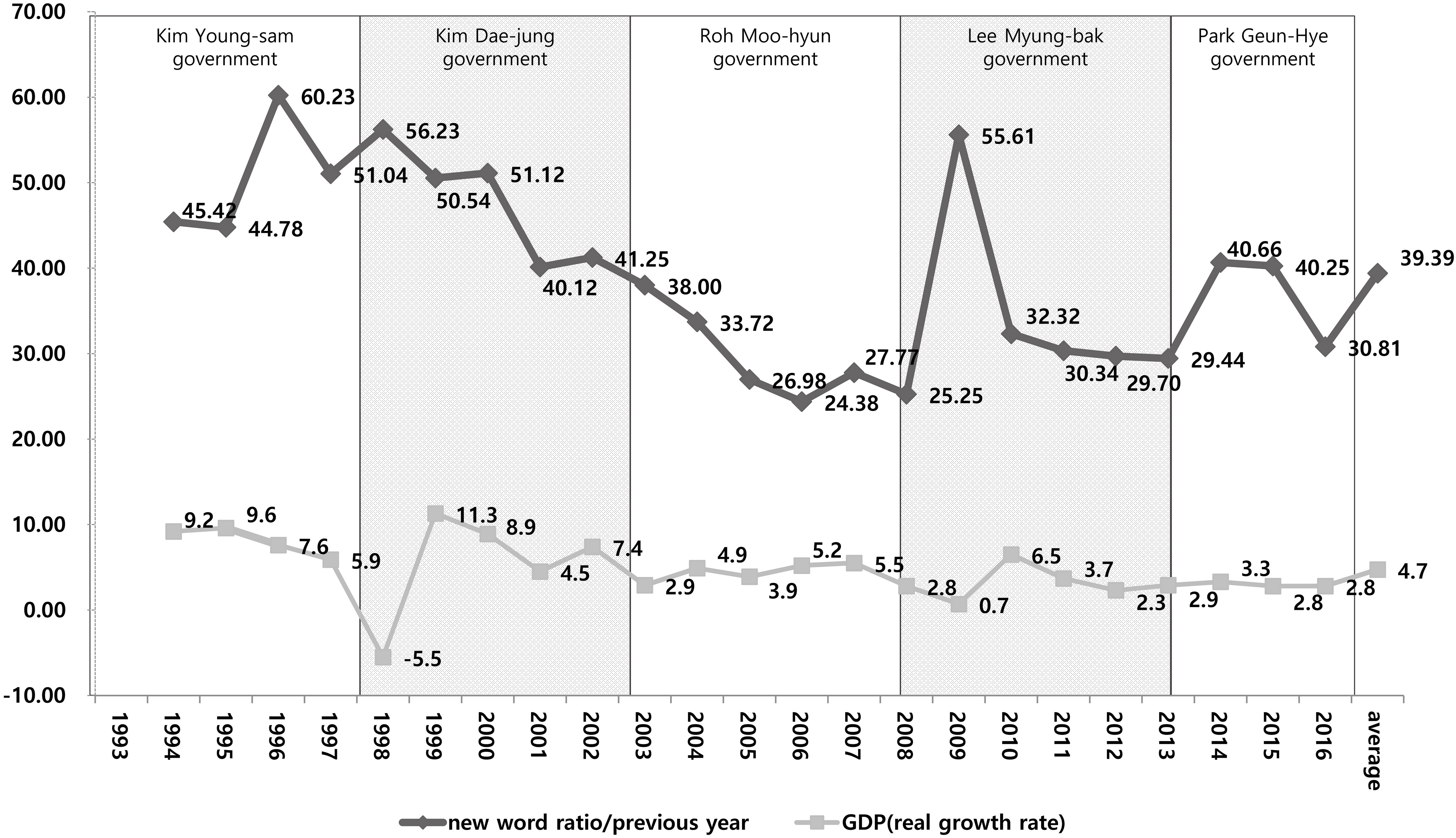
These changes were influenced by the context of the political and economic situation at the time. As can be seen in Fig. 1, the ratio of new words compared to the previous year changed when the presidential term changed. The economic policy direction of 2004, which was announced on December 30, 2003 at the beginning of the Roh Moo-hyun administration, included 33.72% of new words compared with 2003.
The 2009 economic policy direction (December 16, 2008), which was announced during the global financial crisis triggered by the bankruptcy of Lehman Brothers, a US financial investment company, had a dramatic change of 55.61% of new words. This was the first time the Lee Myung-bak administration launched its economic policy direction and its policy program to cope with the economic crisis. The crisis also had a baseline effect on the economic policy direction in 2008. On the other hand, from 2010 to 2013, the direction of the economic policy announced by the Lee Myung-bak administration shows about 30% of new words emerged from the year before. In 2014, the new word rate rose to 40.66% in the economic policy direction report for the first time since the launch of the Park Geun-hye administration . However, after the December report of 2015, the economic policy direction report’s new word rate decreased to 30.81%.
This shows that the change in economic growth affected the government’s economic policy and thus the change in the new word rate, however, it is not easy to find a characteristic relationship between the new word rate and the economic growth rate for the year. In 2002, when the economic growth rate was the highest at 7.4%, the new word rate was 42.4% compared to the reference year, 2001. However, in 2010, when the economic growth rate was quite high at 6.5%, the new word rate was 32.8%, which is below the average rate. In 2009, when the economic growth rate was only 0.7%, the rate of new words was high. However, as mentioned above, there was a global financial crisis as well as the first year of a new ruling government. The new word rate was 29.5% in 2012, which had the lowest economic growth rate (2.3%) except for 2009, and the new word rate was 40.4% in 2015 when the economic growth rate was 2.6%. It seems difficult to assert that the percentage of new words compared to the previous year is directly related to the economic growth rate.
To examine the long-term changes in policy ideas, the percentage of new words based on the 2001 economic policy direction report was analyzed. As shown in the result, 43.99% of new words emerged in comparison with 2001, and these changes were relatively stable. However, in 2013, the new word rate was as high as 48.7%. This reflects the characteristics of the last year of the Lee Myung-bak administration, which was different from the previous one. In the report for 2016 (announced on December 16, 2015), 47.1% of the words were new, and there was an increase in new words compared to 2001 when the contents of the Three-Year Economic Innovation Plan of Park Geun-hye was emphasized.
The new word change in the economic policy direction is also related to the change of the regime. As shown in Fig. 1, in the first half of the presidential term, new words appear relatively high, but the proportion of new words decreases as the latter half of the presidential term approaches to expiration. For example, 33.72% of new words appeared in the direction of the economic policy in 2004 (released on December 30, 2003) , during the early period of the Roh Moo-hyun administration, they gradually decreased in the latter half of the year and only 25.25% in the 2008 economic policy direction report. In the Lee Myung – bak administration, the rate of emergence of new words became stable as the latter half of the year.
New words ratio by base year change.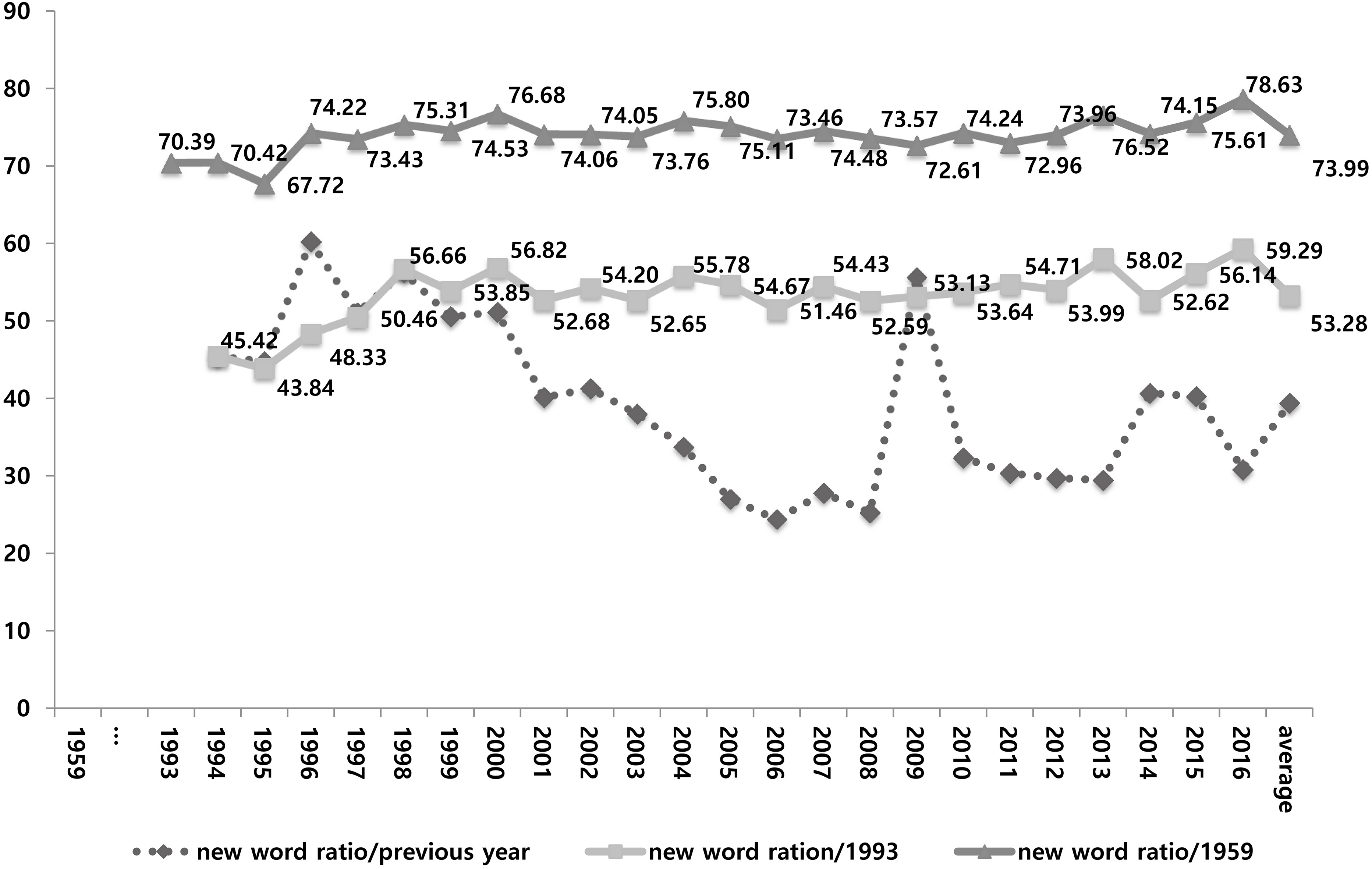
On the other hand, policy changes and the variation depending on where the reference point or analysis point for comparison is located. Figure 2 depicts a yearly change from a specific point in time in 1959, 1993 or a previous year. As we have seen, the new word emergence rate was 39.39% on the basis of the immediately preceding year, and the change range was at least 24.38% from the maximum of 60.23%. However, when the economic policy direction of 1993 was compared as the baseline comparison, as shown in Fig. 2, 53.28% of new words on average emerged and that level remained stable. Compared to the 1959 report when the first economic policy direction was presented, new words have emerged and remained stable at an average of 73.99%. As the base time expands, the shape of the change becomes stable.
New words ratio by year.
The extent and breadth of the change can vary depending on where we place the point. To overcome these limitations, we compared new word emergence rate based on the cumulative comparison time periods of the previous year, the last two years, the last three years, and etc. up to last 20 years. As can be seen in Fig. 3, the number of new words increased by 39.39% compared to the previous one year, 41.74% compared to the previous two years, and 43.34% compared to the previous three years, and an 62.22% increase in new words appeared when compared to the last twenty years. It shows that the change is more steady and gradual and less disconnected.
However, when compared with the previous year, average 39.39% of the new words appeared, and 40% or more of the new words thereafter can be viewed as a very large discontinuous change. An explanation of why this phenomenon is raised should be added.
After deconstructing the economic policy direction reports into words, it is clear that the policy elites changed their policy ideas intentionally and regularly to differentiate them from the policy packages they built in the past. The results verify practical and theoretical contribution in institutionalism. Unlike the claims of Geniyes and Smyrl, 2016 that multiple policy elite groups compete for superiority of the cognitive and normative framework, policy elites continue to change their ideas. Differentiation from past ideas is reflected in the combination of continuously of detailed ideas with the dominant policy ideas, and this combination has always occurred, even when the external environment is stable.
This research also extends methodological perspectives in institutionalism analysis. It applies empirical text analysis to verify the relations between policy idea and policy change. Based on the results of this study, the indications of the research are as follows. First, the economic policy direction report forms the basic framework of the idea by centering on a few key words that appear repeatedly, such as “enterprise”, “market”, “investment”, “expansion”, and “support”. For example, the 94 words common to all 24 of the analyzed reports were used 27.95% on average, and the 7,005 words appear in only one report which accounted for 10.8%. In other words, while retaining the key elements of the idea, the new idea elements temporarily are introduced, emerge, be rearranged, or disappear according to the circumstances. This shows that the words as ideas are constantly re-emerging or mixing in competition with each other.
Second, the policy elite changed the policy direction by replacing about one-third of the economic policy direction report with the new words by introducing new policy words, and the remaining two-thirds contained previous words. The percentage of new words compared to the previous year varied from 60.23% at the maximum to 24.38% at the minimum. The policy elite emphasized the difference between past and present by reordering, collapsing, removing, and reproducing ideas, and the new policy package was trimmed to fit the economic situation. This is regarded as an intention to preserve the legitimate authority of the policy elite on a regular basis every year by differentiating themselves from the policy elite that produced the policy package in the past rather than engage in a competition of ideas with other policy elites or economic actors.
Third, if one-third of the previous economic policy direction report is replaced by new words without restrictions, it is completely new. However, the policy elite constrained the change to a certain extent so that the economic policy direction would not radically deviate from the overall path due to the accumulation of differences from the previous report. Based on the 1993 economic policy direction report, the economic policy direction reports during 1993–2016 maintained a policy package change of 53.28% on average compared to 1993. The limitation of this idea is that words are selected and rearranged within the scope of paradigm ideas and public sentiment ideas (Bradford, 1999), and words are interpreted as being selected within the institutional framework of the liberal market economy. Institutions limit their ideas, and paradigm and public sentiment ideas are considered as constraining program ideas.
Fourth, the differentiation of the idea was related to the presidential term. In the early part of each presidential term, the policy elite modified the words of the economic policy direction in accordance with the presidential agenda and the commitment of the president and decreased the extent of the change toward the latter half of the term. For example, in 2004, the first term of the Roh Moo-hyun administration, the new word rate was 33.8% compared to the previous year, but dropped to 25.2% in 2008, the last year of the administration. The direction of economic policy has been coordinated and adjusted according to the presidential term rather than influenced by exogenous economic conditions. The policy elites produce a report on the economic policy direction at the time of the presidential election in order to recognize and maintain their legitimate authority separately from the president or the authority party. However, this study could not confirm how the reorganization of government related to the Ministry of Strategy and Finance, which took place during the inauguration of President Lee Myung-bak, was related to the idea change.
Fifth, although the economic policy direction report is related to the economic policy of the year, it is difficult to find meaningful relevance between economic growth rate and new word rate. As economic growth slows, policy elites are expected to create a new policy package, however the actual new word rate is below average and the new word rate is rather high at the time of economic growth. The policy package reflects the economic situation, but shows that a new idea does not necessarily depend on economic conditions.
Through the micro approach to institutional analysis, this study explored the formation, change, and persistence of program ideas as manifestations of the intentional and strategic efforts of policy elites. The results provide empirical support for recent scholarly efforts that are focusing on the perceptions and ideas of actors as well as the interactions and conflicts of internal components in explaining institutional change.
However, the following limitations should be studied in future research.
First, the direction of economic policy is composed of program ideas, and it should be further discussed whether it is reasonable to assume that program ideas can be broken down into words. For the simplicity of research and the ease of text mining analysis, the economic policy direction was considered as a program idea, but the economic policy direction should be regarded as containing policy ideas and public sentiment about macroeconomics. These comprehensive parts need to be reinforced by descriptive and qualitative research.
Second, whether the economic policy direction report is suitable for analyzing the differentiation of ideas can be argued. Although the economic policy direction report contains the economic policy of that time, it is necessary to make a logical complement to the existing research that analyzes macroeconomic characteristics, such as monetary policy, neoliberalism, capitalist diversity, and supply-oriented economic trends (Campbell, 1998; Hall, 2001). In other words, it is necessary to agree on whether it is appropriate to microscopically analyze macroscopic phenomena.
Third, there is ambiguity as to whether a program idea is restricted by the institution or if it can function as an independent variable to trigger institutional change such as politicians’ power to justify how the activities of politicians shift to stay their interests. In addition, president’s agenda is also important variable because it affects idea and causes policy change. So, it is necessary to establish the relationship between the institution and the idea, and future research on understanding the pure influence on the idea system should be carried out. In addition, in-depth empirical studies are needed on the effect of change by the government organization as an institution or by the actor as an institution as they relate to idea change. For example, complementary descriptive and content analysis could be helpful to explain the results of the quantitative phase, such as quotes of the most representative parts of the reports.
Despite these limitations and needed reinforcements, this study is meaningful in that it discovered the importance of ideas in institutional change and suggested the possibility of linking the changes of actors, ideas, and institutions. The future studies need to further strengthen the current findings by expanding the scope of the documents to consider macro-level concepts as well as relationships and the impact of actors and other policy agenda.
Footnotes
Acknowledgments
This work was supported by the National Research Foundation of Korea Grant funded by the Korean Government (NRF-2017S1A3A2066084). This paper is an extended version of a conference paper presented at the 18th International Conference on the Digital Government Research, dg.o 2017, June 7–9, 2017, City University of New York, New York, United States.