



Abstract
This paper contributes to the e-government literature discussing the role of information and communication technologies (ICTs) as an enabler of different modes of production of public services. E-government developments are often associated with organizational transformations aimed to increase the efficiency and the effectiveness of the internal production of public services or to facilitate the exchange of information and the coordination among different public organizations. However, ICTs can also enable the co-production of public services allowing citizens or non-public organizations, such as NGOs, social enterprises or private companies to co-produce public services with public sector organizations. ICTs can generate new relationships and dynamics that involve actors and resources outside public organizations, modifying the ways by which the value embedded in the services is produced. This paper critically describes and compares four different ICT mediated modes of production in the light of the two different logics of value creation. For each mode of public service production we identify the associated benefits, risks and possible solutions that can be deployed to mitigate the risks.
Introduction
The e-government literature has widely discussed how the introduction of information and communication technologies (ICTs) has improved the efficiency and effectiveness of public service production (Alford & Yates, 2016; Boulos et al., 2011; Cordella, 2007; Cordella & Willcocks, 2010; Gascó-Hernández et al., 2017; Margetts & Dunleavy, 2013; Mergel & Desouza, 2013; Pestoff et al., 2011). However, new ICTs such as Blockchain, Artificial Intelligence (AI), API platforms, Virtual Reality (VR), and Augmented Reality (AR), to mention a few, are changing how public services are produced and the process by which these services increase citizens’ wellbeing and hence the value they deliver (Grönroos, 2008; Vargo & Lusch, 2004).
For example, AI is used in cities like Los Angeles to reply to citizens’ queries without the need to contact the call center of the local government using chatbots like CHIP. The HM (Her Majesty) Land Registry in the UK has adopted Blockchain to make property transactions instantaneous and with no need for human intervention. API platforms such as the London Datastore have made Open Data publicly accessible to enable third parties to exploit their 700 datasets to develop additional services for citizens. The Department of HomeLand Security in the USA has developed a multiplayer, scalable, online training platform based on AR and VR, called Enhanced Dynamic Geo-Social Environment (EDGE), to train first responders from different US agencies that deal with complex scenarios such as terrorist attacks.
While public administrations increasingly rely on new and advanced technologies to innovate their services, it is not clear yet how these technologies will change the future production of public services. However, lessons can be learnt from the impact that other disruptive technologies have had on the production and delivery of public services. There is, in fact, a rich literature in e-government that discusses the disruptive effects that technologies enabled by the internet have had on the transformation of public sector organizations (Cordella, 2007; Cordella & Tempini, 2011; Fishenden & Thompson, 2013; Kallinikos, 2011; Margetts & Dunleavy, 2013; Mergel & Desouza, 2013). The Internet has transformed how public services can be produced because it has challenged the Weberian bureaucratic configuration of production, typical of many public organizations, making it possible to move the production of services beyond the boundaries of public organizations (Cordella & Paletti, 2017; Cordella & Tempini, 2011; Margetts & Dunleavy, 2013). Similarly, the gradual rise of citizens’ expectations for more personalize services (Cutler et al., 2007; Zuboff & Maxmin, 2002) accompanied by the increased diffusion of internet and social networks in society has challenged the siloed service production logics that were reinforced by New Public Management (NPM) reforms which aimed at improving the rationality and cost-effectiveness in the production of services through the adoption of more decentralized and segmented service production strategies (Dunleavy, 2005). In response to these challenges faced by siloed service production, new management approaches and production configurations have been proposed to exploit the power of the internet to connect public organizations and overcome the siloed service production limitations. Joined-Up-Governance (JUG) and New Public Governance (NPG) are good examples of these alternative management approaches. JUG exploits the potential of the network technologies to facilitate coordination and integration among public sector organizations to efficiently produce public services avoiding the duplication of activities and resources (Dunleavy, 2010). NPG suggests a configuration of the production that exploits the network technologies to connect public organizations with non-public actors such as citizens, companies, NGOs, and facilitates the co-production of public services (Lindsay et al., 2014). An example of this transformation of the production of public services is represented by DEFRA (Department for Environment, Food and Rural Affairs) and other public and local authorities in the UK that have adopted the smartphone app LoveCleanStreet that has enabled 3,800 citizens to report 11,900 incidents of litter and has facilitate the planning of more targeted cleaning operations over the last two years.
ICTs are indeed simplifying the adoption of co-production allowing public organizations to experiment alternative models of production which directly involve external actors to deliver more and better services to citizens. The e-government literature discusses with optimism the potential benefits of co-production enabled by different digital technologies (Alford & Yates, 2016; Boulos et al., 2011; Cordella, 2007; Cordella & Willcocks, 2010; Gascó-Hernández et al., 2017; Margetts & Dunleavy, 2013; Mergel & Desouza, 2013; Pestoff et al., 2011) but does not offer any comprehensive discussion and comparisons of the impacts of co-production and of the more traditional modes of public service production on the service production process and of the associated risks and benefits. In this paper, we fill this gap and we critically compare and contrast four different ICT mediated modes of production of public services on the basis of the openness of the production process and on the level of control that the different modes of production allow over the production of public services. We also highlight the risks and benefits associated with the adoption of each mode of production.
The paper is structured as follows: Section 2 explains the relationship between ICTs, value creation logics and modes of productions; Section 3 analyses the closed value creation process typical of bureaucratic organizations and the operational capabilities of the bureaucratic modes of production; Section 4 analyses the open value creation process and operational capabilities of two modes of production that use ICTs to enable the co-production of public services: opensourcing and crowdsourcing; Section 5 compares and contrasts the different modes of ICT mediated service production to discuss their impacts on the production of public service. To summarize the contribution, the case of Transport for London (TfL) is introduced and discussed; Section 6 brings the paper to a conclusion and explains how the findings of this paper can provide valuable inputs for future research in the domains of ICT mediated production of public services.
ICTs, value creation logics and modes of production
The configuration of public service production is indeed a fundamental element that shapes the value that public services deliver (Cordella, 2007; Moore, 1995) and depends on the logic of value creation that is adopted by the public organization.
The bureaucratic organization reflects a service production configuration that embeds a value creation logic based on standardization as a driver of value creation. Standardization of the production process helps reduce inefficiencies, leads to more efficient organizational performance and hence increases the value that public services deliver per unit of input. Standardization in the production and delivery of public services is also of paramount importance to guarantee the values of impartiality, fairness, and equality that are preconditions for effective democratic governance (Diefenbach, 2009; Hoggett, 1996). In the context of bureaucracy, ICTs increase the value produced by enhancing the value creation mechanisms rooted in standardization (Cordella & Tempini, 2011). This is the case when ICTs are used to improve the efficiency of an internal process by strengthening standardization and supporting automation of standardized practices and procedures. The production in this context is configured according to the manufacturing logic of value creation (Osborne, 2010). Following a similar logic as for the production of industrial goods, the organization focuses on the output and redesign of internal processes to optimize the processes needed to produce the given value (Vargo & Lusch, 2004). The production process is centralized and the contribution of each actor is carefully planned according to a specific set of predefined interdependences designed to produce a predefined output. Subsequently, the value creation process is closed, because public organizations know what citizens need and therefore design the optimal standards and procedures to deliver the value that has been planned. Moreover, services are produced exploiting the resources which are mainly internally available. Following this logic, services can be either produced in-house or in partnership (joined-up) with other departments of the same public organization or with other branches of the public administration. The in-house production relies on the internal resources available to one branch of the organization to produce a predefined service or product (Osborne, 2010; Vargo & Lusch, 2004). The joined-up configuration is an extension of this mode of production that is not bounded by the limited resources available in the organization that produces siloed services. The joined-up service production creates synergies among different units of the same organization or among different public organizations to acquire the resources needed to produce a public service (Bagozzi, 1975; Cohen & Kamarck, 2007; Grönlund & Horan, 2005). The in-house and the joined-up modes of production are based on a closed model of value creation that does not include external actors. ICTs are deployed to support the internal value creation processes making internal production more efficient, enhancing standardization and automation and, in the case of the joined-up approach, facilitating the coordination among different units and the exchange of resources across public organizations.
Breaking the boundaries of the manufacturing logic of value creation in the context of public sector organizations, Margetts and Dunleavy (2013) suggest that ICTs can help public organizations to establish relationships with external actors that are potentially resourceful to enhance value creation capabilities of public sector organizations. In fact, ICTs enable online social interactions that help citizens to communicate, organize themselves easily, share social expectations and support the provision and delivery of public services (Kallinikos, 2011). In addition, ICTs enable the diffusion of information on large scale and facilitate the access to knowledge and to other information related to the production of public services. ICTs also enhance the modular and granular nature of information and make the production process of public services easy to divide into subtasks that can be outsourced to external actors (Benkler, 2007; Kallinikos, 2011). These effects favor a shift in the logic underpinning the production of public services. Breaking the organizational boundaries and opening the access to external resources and inputs for the production of public services, ICTs favor the adoption of the service logic of value creation (Vargo & Lusch, 2004) where citizens or external actors such as companies or NGOs are directly involved in the co-production of public services. Co-production means that public organizations produce public services with the support of external resources made available to the public administration by external actors. This new value creation process is open since the resources, capabilities, and processes needed to increase the value produced by public services are not limited to those strictly internally owned by public organizations. In this case the production process is decentralized, and the contribution of external actors is spontaneous and not pre-determined. Co-production is different from creating partnerships because the collaboration is not pre-defined and planned. In addition, public organizations do not know who will contribute and how the contribution will shape the service (Baldwin & Woodard, 2008). Hence, the outcome of this production processes is sometimes difficult to predict.
The two main modes of production that follow the service logic of the value creation process of public services are crowdsourcing and opensourcing which have similar but not identical production configurations. Crowdsourcing delegates to external actors – such as citizens – specific steps of the production or the solution of already framed problems (Brabham et al., 2014; Lee et al., 2012; Ye & Kankanhalli, 2015). The delegation of these activities allows public organizations to access to external resources and produce more valuable services (Mergel, 2015); Opensourcing instead relies on external actors to fully create, modify or complement a public service without the initiative or the direct involvement of public sector organizations (Cochrane, 2000; Cordella, 2007; Lee et al., 2012; Mergel, 2015; Shklovski et al., 2010; Silva & Prustalis, 2010).
The two value creation logics
The two value creation logics
The value that each configuration of the production is able to produce and deliver is the outcome of the specific operational capability (Benington & Moore, 2010) which is unique for each mode of production. The operational capability results from the combination of the four resources of finance, staff, skills, and technology that enable and shape the value creation process (Benington & Moore, 2010).
The configuration of the operational capabilities of each mode of production follows the related value creation logic. In the manufacturing logic all the elements that constituted the operational capability are owned by public organizations, therefore, the entire value creation process happens within the boundaries of the organization. Meanwhile, in the service logic some or all the elements of the operational capability are offered by external actors, and the value creation process happens partially or totally outside the organization.
Bureaucracies have historically been conceived as strategic solutions aimed at increasing the efficiency of the organizational practices and procedures needed to produce standardized and homogeneous services. According to Weber’s (1922) theorization, bureaucracy is the result of applying technical knowledge and calculation in order to meet efficiency needs perfectly in line with the rationale underpinning the manufacturing logic of value creation (Vargo & Lusch, 2004; Weber, 1922). Weber in fact identifies bureaucracies as the ideal response that rationalization – in this context meaning the “use of calculation to master phenomena and things through the domination of rules and instrumental systems” (Clegg, 2007, p. 1) – can offer to help an organization to optimize the production process while guaranteeing the values of fairness and equality (Cordella & Bonina, 2012) on top of efficiency and effectiveness in the production process (Maier, 1970).
The organizational transformations proposed by NPM as well as by JUG reinforce the value creation process depicted by the manufacturing logic (Cochrane, 2000) since the reforms driven by these management approaches also identify the value creation process as occurring within the organizational boundaries. Both NPM as well as JUG suggest that to produce more value public sector organizations should improve resource management, efficiency, and reduce the overlapping of controls (Cordella, 2007).
These management approaches assume that citizens’ needs are known and that public organizations have all the resources required to produce the value internally. Accordingly, the challenge is to identify the optimal configuration to produce and serve the given services. As per the manufacturing logic of value creation (Osborne, 2010), the production process is closed, and the organization has complete control of the value generated. The challenge is to identify the best configuration of internal processes to optimize the use of the resources needed to produce the service and to achieve the highest level of standardization in their delivery. The rationalization of each step of the production process, typical of the bureaucratic organization is indeed very efficient in helping public organizations to predict the value that will be delivered and to guarantee its delivery (Hood & Lodge, 2006; Margetts & Dunleavy, 2013; Osborne & Gaebler, 1992; Osborne & Plastrik, 1998). According to this production paradigm, public organizations are the only producers of the value embedded in the public services.
The next section will better analyze how the operational capability of the different bureaucratic configurations impact upon their value generating process and discuss how ICTs can support these different value creation processes.
Bureaucratic modes of productions
In-house production
The in-house production is the standard bureaucratic mode of production where services are produced combining resources that the organization owns within its boundaries accordingly to pre-defined and standardized procedures.
Bureaucratic organizations pursue the in-house mode of production to guarantee a high level of control over organizational resources and procedures and to maximize internal efficiency. While efficient under many conditions, bureaucracies might also generate inefficiencies (Hoggett, 1991). This is the reason why the NPM doctrine has been successful in driving profound reforms within the organization of public sector organizations. NPM suggests adopting private sector managerial model to make the in-house production of public organizations more efficient (Benington & Moore, 2010; Cordella, 2007; O’Flynn, 2007) without profoundly transforming value generation process of bureaucracies. The main contribution of NPM is to increase the focus on results and performances in order to make public sector organizations more effective in the production of public services (Diefenbach, 2009). Market competition is also suggested as a valuable resource to increase the efficiency of the production process. Once again, the needed outputs are known and the challenge is to find the optimal configuration to produce these outputs.
Building on Moore’s operational capability framework (Benington & Moore, 2010) the in-house mode of production is based upon the following configuration:
Finance: All the financial resources needed are defined and limited by law and derive from the internal budget of the organization; Staff: The people involved in the production process belong to public and/or private organizations; Skills: The competencies needed to produce the service are available and can be exchanged and coordinated using the market mechanism; Technology: ICTs are used as a support to make the production process more efficient, and to increase the control over the production.
In the in-house mode of production, all the different elements of the operational capability are configured to support a planned production process that ensures efficient delivery of a pre-defined value to citizens. However, the in-house mode of production is not suitable to produce all public services. If adopted to produce services that need intra-organizational collaboration can lead to macro level inefficiencies. For example, in the UK there are 110 local library services, with 110 different management structures and different ICTs infrastructure which have made each library more efficient but also unable to coordinate with the other libraries. As a result of their lack of collaboration and silo structures typical of the in-house mode of production, 80% of the books in these libraries in the UK are identical (Dunleavy, 2010). Hence the in-house mode of production and the adoption of ICTs that improve the internal efficiency can benefit the services produced by the single public organization but can also make the overall system more inefficient, especially if ICTs infrastructures do not allow the exchange of data among public organizations (Cordella & Willcocks, 2012). A more synergistic approach to book acquisitions and management would have reduced duplications and increased the variety of books available to citizens and hence would have better served citizen’s needs and expectations in the entire country. The need for an alternative mode of production based on intra-organizational collaboration has led some public organizations to adopt the joined-up configuration to produce more valuable public services.
The joined-up configuration of production is the result of the JUP management approach that exploits ICTs to facilitate horizontal and vertical coordination in order to increase the efficiency and further reduce the costs of production of public services (Dunleavy, 2010). The production process is still highly rationalized and collaborations among offices, departments and organizations are still predefined through a precise plan and the final outcome is known. The process is still internalized by the public sector organization but the production process exploits synergies between different units (Cordella & Bonina, 2012).
From the operational perspective, the joined-up mode of production is characterized by the following configuration:
Finance: All the financial resources needed are defined and limited by law/protocols but each organization contributes its own budget to finance its own tasks; Staff: The people involved in the production process come from the organizations involved and have fixed roles and competences; Skills: The competences needed to produce the service are already available and standardized; Technology: ICTs are used to support and facilitate the collaboration and coordination among different organizations.
An example of a joined-up production is the Summary Care Record (SCR) of the British National Health Service (NHS). This new e-health system aims at eliminating different formats of healthcare records to reduce duplications and contradictions of files. The SCR allows hospitals and doctors to always have updated healthcare records of their patients even when patients have been previously treated in other hospitals in England (Pagliari et al., 2007; Sheikh et al., 2011). As a result, hospitals can collaborate in the care of patients minimizing waiting list, duplications, waste of resources to reduce the overall costs of treatments within the NHS. The SCR case shows how the adoption of the joined-up mode of production increases the overall efficiency of an organization at the macro and micro level.
While ICTs can be deployed to increase the intra-organizational efficiency among different public organizations, as in the case of the SCR, they can also be deployed to enable public sector organizations to foster their ability to collaborate with non-public organizations to co-produce services.
In the next section, we explore the configuration of alternative modes of production that use ICTs to enable co-production of public services.
The focus on the importance of co-production in the context of public services provision as “the process through which inputs used to produce a good or service are contributed by individuals who are not in the same organization” (Ostrom, 1972, p. 1073) is a response to the increased challenges faced by public sector organizations in effectively servicing certain public services. The public management literature has recently restored the co-production concept due to the fact that many public services need the active involvement of citizens to be effective and efficient (Alford, 2009; Durose et al., 2013; Osborne et al., 2016; Vamstad, 2012). Co-production in the public management literature accounts to the direct involvement of citizens and of other actors external to the public administration in the design, production and provision of public services. One example of these forms of co-production was the direct involvement of citizens in the police investigation of the Boston marathon bombing (McNutt, 2014) where citizens’ inputs made the difference in the success of the investigation. Co-production helps public organizations to deliver better and more efficient public services (Kannan & Chang, 2013; Nambisan & Nambisan, 2013) overcoming the limits and constraints of a centralized service provision system. Alternative public management approaches such as NPG, consider the co-production of public services as the solution to the inability of public organizations to provide effective services (Eriksson, 2012; Osborne, 2006; Pestoff et al., 2011; Wiesel & Modell, 2014).
Co-production in the public management literature is related to the adoption of the value creation paradigm embedded in the service logic which can unfold in two types of co-production (Gronroos, 2011). The first type of co-production concerns the provider’s sphere and relates the collaboration of a public organization with external actors for the production of a public service. In this case, external actors collaborate to increase the value proposition of the public organization that is not the only producer of the service anymore. The second type of co-production concerns the citizens’ sphere where value is produced when citizens use the services where the value proposition is embedded. For example, a medical check represents the value proposition of a public hospital. However, value is generated only if citizens book an appointment and attend the check. The public transportation service also represents a value proposition that produces value if citizens take action and use it. The service logic suggests that public organizations do not necessarily know what value citizens want or do not have sufficient resources to produce what citizens want and then collaborate with external actors to increase the offer of public services and the possibility to meet citizens’ needs or expectations. For the purpose of this paper, we will mainly focus on the co-production that happens in the provider’s sphere.
The reason why co-production is becoming more widespread is because ICTs have drastically reduced the coordination costs making easier for citizens and external actors to co-produce public services (Benkler, 2007; Kallinikos, 2011).
Opensourcing and crowdsourcing are two modes of production that well account for how ICTs can mediate co-production and favor the emergence of the service logic of value creation in the public sector. Crowdsourcing and opensourcing are two ICTs mediated modes of production which, by following the service logic, open the value creation to external contributions and change the role of public organizations, citizens, and other external actors in the value creation process. Both opensourcing and crowdsourcing are based on a partially or totally decentralized production and on spontaneous contributions of external actors. Public organizations that adopt these modes of production do not know in advance who is contributing and how the contribution is shaped, therefore it is difficult to pre-define the final outcome. In addition, although both modes of production deploy ICTs as enablers of co-production, their organizational capabilities are slightly different.
The next section will better explain the similarities and differences between crowdsourcing and opensourcing, in the context of public services value creation.
Modes of productions related to co-production logic
Crowdsourced production
The definition of crowdsourcing refers to situations where organizations outsource tasks normally performed by employees to a large community to exploit the skills that are available within the community and not inside the organization’s boundaries (Brabham et al., 2014; Howe, 2006; Lee et al., 2012; Ye & Kankanhalli, 2015). In the context of the public sector, crowdsourcing offers a valuable support to exploit resources which are not available in public sector organizations but that are needed to produce services which generate the value that citizens expect and want. The crowdsourcing mode of production is characterized by the following configuration (Benington & Moore, 2010):
Finance: Undefined sources complement the internal budget; Staff: The employees and all those who respond to the open call; Skills: The existing competences of employees are combined with the competences of the crowd; Technology: ICTs are used to enable the crowd to be involved in the production of services.
Crowdsourcing has been already applied to the production of several public services. The U.S. patent and trademark office (USPTO) decided to open its patent application process to external actors.
The project denominated Peer-to-Patent consisted in crowdsourcing the initial stage of the process to a crowd of 2,500 contributors, that on average spent 6 hours helping public officers to review patents and reduce their workload, making the service more efficient and effective (Center for Patent and Innovation, 2008). Similarly, the U.S. Agency of International Development (USAID) that manages cooperation and development projects worldwide, has organized a special program called “Grand Challenges” that uses crowdsourcing to find solutions for its most difficult challenges in the field of economic and humanitarian assistance (Geiger et al., 2011).
Crowdsourcing is very useful if the organization knows what service has to be produced but lacks the resources necessary to produce such a service. Usually, crowdsourcing is effective when a specific task such as mapping illegal dumping in a city demands a high number of resources to be coordinated or when the knowledge needed to undertake the production process requires capabilities from different domains that cannot be found within the public organization (Boudreau & Lakhani, 2009). Therefore crowdsourcing is not suitable for all public services and requires specialized experts that can help public organizations to understand better which tasks can be simply executed by a crowd and which strategies can help to mitigate negative or useless contributions (Geiger et al., 2011).
Opensourcing is a mode of production that follows the service logic and that was first implemented to support software development by sharing resources across developers (Raymond, 2005). Opensourcing, in fact, allows developers to create or improve software design solutions which are not known or foreseeable by the owners of the providers of the shared resources (Hertel et al., 2003; Wielsch, 2010).
Beyond software development, the opensourcing can be extended to all product platforms or infrastructures that enable third parties to co-produce services or products (Baldwin & Clark, 2006). People that contribute to opensource projects developing different services or products do so because they need these products or services and they are happy to make them available to the community (Von Hippel, 2005). The entire production process is open and managed by a network of loosed coupled actors that build the service on top of a shared public infrastructure or resource.
The opensourcing mode of production is characterized by the following configuration:
Finance: Budget is heterogeneous and there is no precise financial source; Staff: A network of loosed coupled actors that contribute to the service production process; Skills: The competences depend exclusively on the external actors involved; Technology: ICTs are used to enable a loosed coupled network of actors to create or improve services.
Opensourcing is also becoming an innovative mode of production to develop public services without the direct initiative and control of the public organization (Currion et al., 2007). Peoplefinder is a Google Maps based smartphone app that was developed during the Katrina disaster to help people to find their friends and relatives. The service was developed by external volunteers that used the API of a public database where 640,000 names of Katrina survivors were stored (Gao et al., 2011; Shklovski et al., 2010).
Opensourcing is useful if there are no clear ideas and resources to create public services, but there are inputs that can be exploited, such as in the case of Open Data in the public sector (Lin, 2015; Zuiderwijk & Janssen, 2014). Opensourcing gives the possibility to solve problems or create public services that public organizations have never thought about. Opensourcing is particularly useful for problems that require cumulative knowledge or that need collaboration and integration of different perspective and resources. The goal of opensourcing is to provide services that solve common problems or create public goods (Pollitt, 2003). The adoption of opensourcing requires the acquisition of specific expertise able to effectively manage the external contributions without any possibility to plan, control and predefine the final outcome. Open API platforms managed by public organizations facilitate the access of citizens and companies to public datasets for the production of public service. The entire production process is open to external contributions, there is no possibility to plan, control and predefine the final outcome. The characteristics of the platform or infrastructure can limit and influence the development of the service but sometimes it is difficult to predict the impact of opensourced contributions. This lack of control does not make this configuration suitable to address problems which need specific and pre-defined solutions.
Value creation logics and modes of productions
The comparison of the different modes of productions shows that the configuration of the operational capabilities of each mode of production profoundly affects its underlying value creation logic.
The discussion of the two different value creation logics and the comparison and contrast of these different production configurations that embed the two value creation logics is resourceful to highlight how and when each production mode helps increasing the value that public services deliver. As shown in Fig. 1, the four modes of production we have discussed in this paper shape the openness of the production process and the control that the public administration has on the final configuration of the public service. A more open production typical of the service logic implies a lower control over the final outcome. The choice of the production mode shall consider the specific characteristics of the public service that is produced. Certain public services can be produced more effectively through a closed value creation process and maintaining high control over the final output and hence rely on the in-house or on the joined-up modes of production, while other public services, benefit from a more open value creation process and less control over the final outcome and rely on opensourcing or crowdsourcing modes of production.
Comparison of openness and control over the final outcome of the modes of production.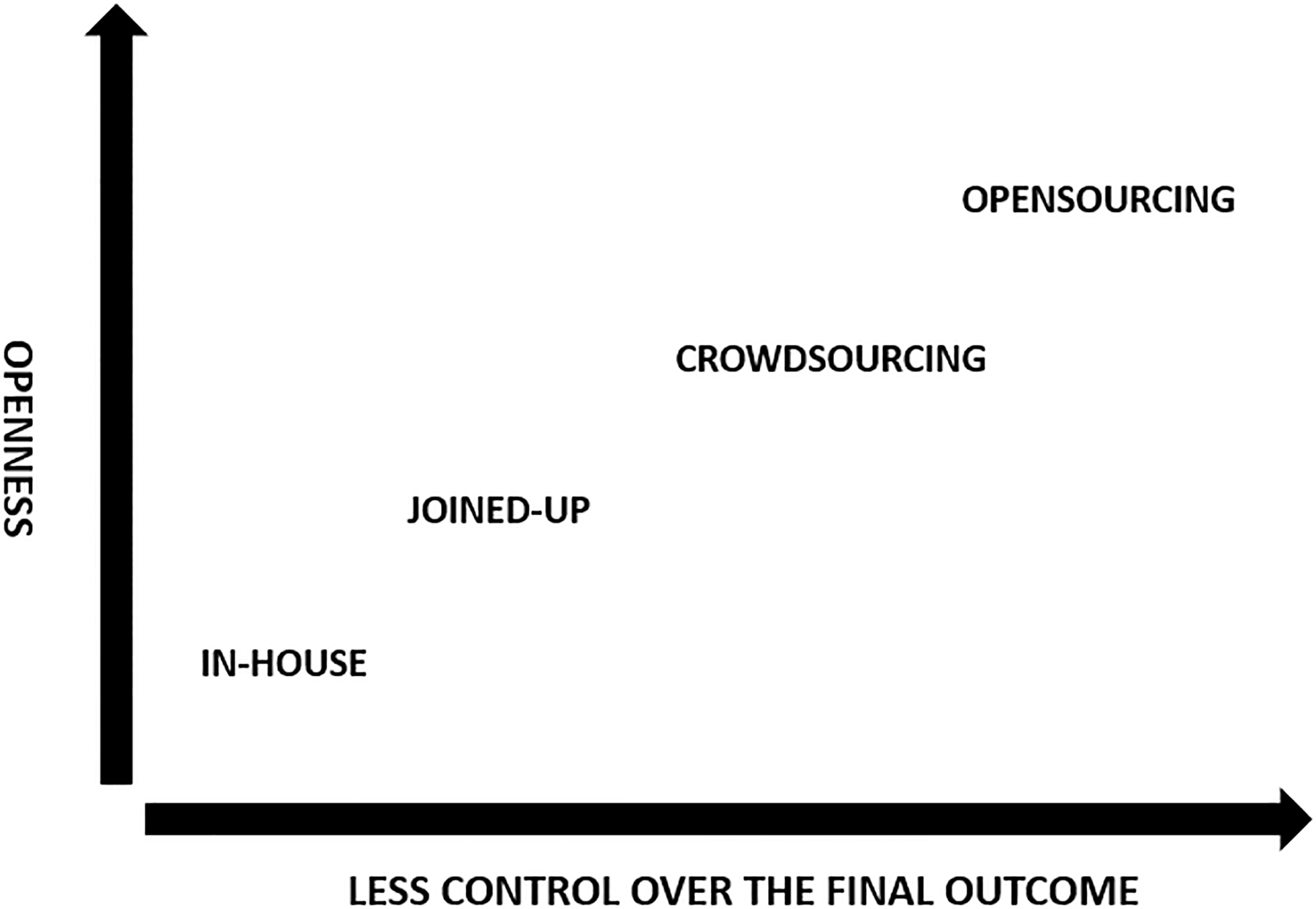
For example, it would be dangerous to delegate the policing service to citizens. The policing service requires a high level of control over the final outcome because it has to ensure fairness and equality to all citizens (Cordella & Willcocks, 2012). Therefore the police have to produce the policing service in-house or, as in antiterrorism operations in partnership with military forces (Devroe et al., 2017). Conversely, environmental protection services do not require a high level of control but require the cooperation and the involvement of external actors because public organizations do not have enough resources or capabilities to effectively protect and clean the environment to the level that citizens expect. Hence as shown by the DEFRA example, public organizations can crowdsource some stages of the production of this service to offer a more effective cleaning service.
The selection of a mode of production should also consider the risks and the benefits related to the adoption of the new configuration of the production (Table 3). The in-house production mode ensures a high level of control over the value delivered by the public services but is unable to customize the services to fulfill individual needs or expectations (Cutler et al., 2007). These deficiencies make this mode of production suitable for public services that need a high level of control and standardizations to guarantee equality and fairness such as policing or judicial services where citizens must receive equal and fair treatment. The joined-up mode of production helps public organizations to optimize the service production, sharing operational capabilities and reducing duplications. The problem with this mode of production is the potential conflicts of interests that might drive the different public organizations that cooperate to produce the same public service (Wilkins et al., 2017). A solution that might mitigate this risk is the adoption of shared policies and protocols that improve the intra-organizational consistency and trust (Mayer & Kenter, 2015). The adoption of ICTs like Blockchain technologies can also increase trust and facilitate coordination because the data that is shared is immutable and modification from any actor can be easily traced. For example, Blockchain can be applied to SCR in order to ensure that the medical data that is shared among hospitals is trustworthy and that all the actors involved in the production of the healthcare service agree with its reliability.
A more open value creation process enables a public organization to access to external resources and capabilities necessary to deliver services that fulfill individual values and expectations. An example is the San Ramon Valley Fire Protection District (SRVFPD) in the USA which developed the application PulsePoint in 2009 to crowdsource the emergency service to improve cardiac arrest outcomes. PulsePoint enables citizens trained in cardiopulmonary resuscitation (CPR) to provide life-saving assistance to victims of sudden cardiac arrest while awaiting the arrival of the ambulance. However, crowdsourcing makes it difficult to control how external actors contribute their resources to the goal of a public organization like SRVFPD (Bertot et al., 2016). Therefore, it is necessary to limit the use of crowdsourcing to simple tasks like CPR that do not risk producing negative value for citizens but that are indispensable to produce the service effectively.
The selection of opensourcing instead allows public organizations to produce more service options and then to provide a bigger value proposition to citizens. An example is Famiio, a platform that uses the Open Data of different public organizations in the UK to help public organizations to better advertise more than 500,000 childcare and family services, making it easier for citizens to find the services they need (Open Data Institute, 2018). However, a recurrent problem with opensourcing that is evident in the case of Open Data is related to the inability to maintain control on how external actors use the data. External actors, such as Famiio, might associate public data with the private data of their clients, and use algorithms or AI to produce services that, for example, threat the privacy of citizens, create price discrimination and other types of negative outcomes that generate negative value for citizens. To mitigate these risks, public organizations that adopt opensourcing have to keep a constant control on how external actors develop services enabled by public infrastructures and better govern the value creation process through policies and regulations.
Risks and benefits of each modes of productions
The case of Transport for London (TfL) and its approach to the production of information services on public transportation can better clarify how different modes of production can be combined by the same organization to deliver public services using different value creation logics.
TfL is the public organization in charge of delivering and managing public transportation for 8.7 million people in the metropolitan area of London in the UK. The information service about public transportation is one of the ancillary public services that TfL provides to facilitate the journey experience of citizens across London. Historically, the service has been produced in-house by TfL, which offers maps, screens in tube stations, emails, SMS and a website that has a “Journey Planner” functionality that can be utilized by citizens to plan their trips. This mode of production follows the manufacturing logic of value creation because TfL uses exclusively internal financial resources and human resources and skills to produce these options for information services. The ICT infrastructure that supports the internal production of the information service is an API platform that is designed to increase internal efficiency. From 2010, TfL has transformed this infrastructure into an Open Data platform opening some of its APIs to third-party developers to produce apps that serve citizen’s needs. These new apps have been produced by companies like Google, City Mapper and by many individual developers. Now we have more than 500 apps available on the market that build on the TfL’s open APIs. These apps provide alternative information services about public transportation to citizens. This means that since 2010 TfL has redesigned its ICT infrastructure to be able to support two different modes of service production: in-house and opensourcing. The design of the open APIs and hence to development of an Open Data platform enables the involvement of a large community of developers and the adoption of opensourcing leading TfL to change the driving logic of production into the service logic.
TfL, via the open APIs, provides the needed resources to the developers to produce apps that can help citizens to use better the transportation services offered by TfL. In line with the opensourcing mode of production, TfL can control the data provided by the open APIs to the developers, but it cannot control the use that the developers make of these data into their apps. Hence, TfL cannot predict what services external actors will develop with its data. Nevertheless, thanks to the combination of the in-house and of the opensourcing modes of production, TfL is able to provide more information service options and then a bigger value proposition to citizens. For example, citizens can now choose between the in-house TfL Journey Planner and many other similar apps developed by external actors such as Google Maps. Each app has specific functionalities that serve different citizens’ needs. All the apps co-produced by external developers allow citizens to find the most suitable information service and then to personalize the public service according to their preferences. An increased diversity in the offered functionalities helps more citizens to extract the maximum value from the transportation services offered by TfL.
The TfL case shows that a public organization can produce the same service utilizing different modes of production and also adopting different value creation logics simultaneously. In addition, the deployment of the API platforms as a tool to increase internal efficiency or as an enabler of co-production shows that the same ICTs can have a different role according to the value creation logic that is adopted by the organization. Moreover, the case of TfL shows that co-production can be used not only to substitute old modes of production but also to complement the existing value proposition, increasing the ability of the organization to offer the service that citizens needs and that makes them satisfied. The TfL case also shows that a public organization can be the unique producer of value as well as an enabler of value creation adopting different configurations of the production and then different relationships with citizens and external actors.
The e-government literature has discussed how ICTs enable different modes of public service production (Alford & Yates, 2016; Boulos et al., 2011; Cordella, 2007; Cordella & Willcocks, 2010; Gascó-Hernández et al., 2017; Margetts & Dunleavy, 2013; Mergel & Desouza, 2013; Pestoff et al., 2011) but has not critically compared these different modes of production in the light of the underpinning logic of value creation. This paper fills this gap in the literature and compares four different modes of production according to their operational capabilities and their related logics of value creation. For each mode of public service production, we identify the associated benefits, risks and possible solutions that can be deployed to mitigate the risks.
The contribution of the paper is relevant not only to discuss and benchmark the four modes of production of public services that we have presented in this paper. Innovative technologies such as Blockchain or AI might offer the resources needed to support new modes of production of public services either based on the manufacturing or the service logic. The importance to question how these new modes of production will impact upon the characteristics of the services provided -open or closed, under strict or loosed control of the public administration- remains relevant and important for those producing the public services and those consuming them. The paper offers a valuable framework to analyze current and future modes of public services production in the light of their levels of openness and control.