




Abstract
This research explored the effect of institutional factors on e-governance development and performance, with particular attention to Russian Federation conditions. The authors conducted a multi-method case study that explores how institutional factors appear to influence the performance of e-governance. Using the case of the Russian Federation, the analysis focused on underlying regulative, normative, and cultural factors revealed through international and domestic studies, government structures, legal foundations, and choices made about what to monitor and measure. We found strong hierarchical structures with fragmented responsibilities, and laws and regulations that focus mainly on the role of authorities, formal power and technologies. In terms of performance, most attention is paid to monitoring e-services and technical infrastructure with almost no attention to citizen engagement, empowerment, or participation. These dominant trends contribute to institutional traps (including internal fragmentation, inflexible patterns of interaction, expectations of corruption, over reliance on international rankings) that significantly limit the development of e-governance and its promises of administrative reform, better public services, and new concepts of citizenship. The research concludes with an argument that a multi-faceted approach to assessment provides greater understanding of a given country’s e-governance pattern and its prospects for future development.
Keywords
Introduction
E-governance has become a popular concept for promoting innovative public administration and enhancing substantive dialogue between government, citizens, and businesses. The development of ICT-enabled government organizations, programs, and governance processes are well-studied in developed countries in North America, Europe and some parts of Asia that employ modern public management philosophies and techniques. However, half of the world is comprised of nations that lack democratic norms and processes, or are governed by traditional hierarchical and procedure-oriented bureaucracies, or both [1]. Generally accepted international techniques for assessing, measuring and ranking progress in e-governance give some attention to these institutional factors, but their influence on reported performance tends to be washed out by combination with other factors, or oversimplified due to external observation and lack of published data, or tilted toward demonstrating progress due to self-reporting.
In this paper we aim to contribute to the public administration literature on e-governance through a multi-method case study that explores how institutional factors appear to influence the performance of e-governance. We have selected the case of the Russian Federation as a developing country with a rapidly changing transitional economy. Like other BRICS countries and many less developed nations, Russia’s efforts to participate in international trends in e-governance development have concentrated on the technological dimension while facing considerable barriers, or institutional traps, built into its legal framework, social context, and bureaucratic structures and traditions.
Several studies have explored the problem of slow progress and under-performance of e-governance in Russia. Patterns of public investment have strongly favored construction of a national technical infrastructure [2], but have often neglected needed complementary investments in implementation and management [3]. Political power relationships have been examined to show a fundamental contradiction exists between established hierarchical structures and the need for horizontal networks of cooperation and communication [4] that are necessary to e-governance progress. Likewise, while e-services have been growing and more government information has been made public over the past decade, indicating a potential shift toward more democracy, scholars conclude that these steps are greatly limited by the absence of strong institutional support for civil society and public participation [5].
We frame the case of Russia by looking at a variety of international assessments associated with information society development. We then use recent domestic studies plus documentary and semantic analysis to look more deeply into the institutional framework in Russia to explore how these institutional factors influence e-governance practice and performance. This approach shed light on the relationship between institutional factors and e-governance performance and represents an alternative to the existing international ranking assessment approach.
The paper consists of five sections. “Institutional aspects of e-governance” reviews neo-institutional theory as a framework for studying the institutional factors of e-governance development. “Research methodology” reviews the international and domestic ranking and evaluation studies that we use as secondary data. It also describes the main legal bases and programmatic initiatives in Russia and a plan for semantic analysis of key terms and concepts in the e-governance statutory and regulatory base. “Findings and Analysis” presents data on Russia’s performance in relevant international rankings and domestic assessments, describes the structures and relationships among the formal institutions involved in e-governance development, and presents results of content and semantic analysis of relevant legal acts. In the “Discussion” section, we compare the external and domestic assessments of goals and performance using the institutional and semantic analyses to help explain differences. The final section summarizes the study, suggests ways to use institutional analysis to enhance e-governance development, and offers avenues for further research.
Institutional aspects of e-governance
Research on e-governance development has identified five interrelated objectives: a policy framework, enhanced public services, high-quality and cost-effective government operations, citizen engagement in democratic processes, and administrative and institutional reform [6]. The policy, engagement, and reform dimensions represent the deep institutional aspects of e-governance, while the service and operational dimensions emphasize the more visible changes that can be supported by innovative uses of information and technology.
In this paper we adopt the UNESCO (
E-governance adoption is often accompanied by a proclamation of its potential social and economic benefits: convenience of public services, cost-efficient administration, reduced corruption, increased citizen satisfaction with government [7], and openness to business in different spheres of activity [8]. Comprising a mixture of institutions, rules, technology, actions, and interactions [9, 10], this phenomenon suggests a modern approach to governance which some researchers call the seventh paradigm of public management – “Public Management as E-Governance” – meaning those revolutionary changes in the structures, processes and operations of public administration that are enabled by new technological inventions and means of communication [11].
Institutional concepts
Regardless of the details of any particular adoption of the e-governance concept, institutions play an obvious and key role, as a legitimizing force [12] and by setting the “rules of the game” [13] in terms of laws, rules, and structures [14]. The institutional notion of “legal rationality”, highlights the idea that e-governance development is not merely a matter of technical efficiency, but it also embodies a legitimated authority structure and an institutionalized system of rules [15]. Institutional factors also reflect cultural norms, expectations, and patterns of behavior by both individuals and organizations.
Sociologist Scott [16] defined institutions as “cognitive, normative, and regulatory structures and activities that provide stability and meaning to social behavior”. Regulative aspects include laws, rules, processes, and systems of power. The normative dimension includes expectations, obligations, and notions of acceptability and appropriateness. Cognitive elements (also considered cultural) include long-established patterns of behavior and adaptation. These basic characteristics of institutions emphasize legitimacy, stability, conformity, and risk-aversion and are often linked to organizational forms and behaviors that favor the stabilizing tendencies of hierarchy and bureaucracy [17, 18].
While stability is typically considered a desirable social condition, economists have also explored the negative concept of institutional traps that exist when inefficient, yet stable, norms of behavior dominate in an economy or society. Institutional traps form when certain behaviors are inefficient or unproductive for the society or economy as a whole but are advantageous to elites, widely practiced, linked to other reinforcing norms, and unopposed due to cultural inertia [19]. They are self-reinforcing and therefore have inherent power to prevent or impede transitions to different forms of behavior.
Institutional factors and e-governance research
Institutionalism helps explain relationships among organizational factors, technology, and legal, political and cultural contexts that underpin the emergence of e-governance. Fountain, for example, traced the implementation of US federal government ICT initiatives to explore how government organizations “enact” technologies by filtering them through the lenses of established organizational and institutional influences [20]. Gil-Garcia examined the dynamic and recursive relations between enacted technology, organizational forms, and institutional arrangements. This work shows how the existence of legitimate formal processes enable or constrain a particular technology enactment so that the result reflects the conditions in which it is adopted as much as its intrinsic technical capabilities [21]. In a study of cultural influences on e-government readiness, researchers found that readiness correlated negatively with uncertainty avoidance (the extent to which citizens rely on social norms, rules and procedures to alleviate unpredictability of future events), and institutional collectivism (the degree to which institutional practices encourage and reward collective distribution of resources and collective action) [21]. In other words, institutional environments that value the certainty of rules and official authority tend to score lower on the potential to realize e-government benefits.
Research has further shown a correlation between e-governance barriers and legal subjects including personal data protection, safety of identification and authentication, and intellectual property rights [23]. A number of other studies have identified institutional factors that influence the shape, direction, and results of e-governance initiatives that can be grouped roughly according to Scott’s three categories. Regulative factors include the extent of state institutional capacity in the form of new bureaucratic agencies, state legislative committees, or rules and procedures [24]. Public administration style influences tendencies toward innovation and inclusiveness with Anglo-American, Nordic, and Germanic styles leaning much more in this direction than more legalistic and procedural Eastern European and Napoleonic styles [25]. Regardless of style, shortcomings and limitations in the operations of public administration [26] also have influence, as does the political context of decision-making processes and the extent of legal acceptance within a specific governmental system [27]. Intergovernmental power relations are also salient since many e-governance initiatives are led by central governments but implemented by regions, states, or municipalities [28, 29].
Normative factors include attention to values and desired benefits and the degree to which they are shared among various stakeholders or participants [30, 27] or compatible across supply side and demand side orientations [31]. Within government, orientation towards reform [32], professionalism [26], and concern for effectiveness [33] shape priorities, practices and organizational characteristics. In addition, political pressure exerted on IT initiatives [34] has strong influence on priorities, resource allocation and performance assessment.
Cultural factors include the compatibility and adequacy of stated goals with the social context for implementation [35, 27]. This context ranges from broad economic and demographic patterns [34] including the effects of the digital divide [36, 37], to the general environment for innovation including wealth, urbanization and population size [38] to the extent of ICT skills and technology awareness in the population. Within the political aspects of culture, the nature and degree of political participation [39]; concerns for privacy and autonomy [40, 29, 34], and general public expectations about how government works and interacts with citizens [5] all have influence.
This body of work emphasizes both the importance and the variety of institutional factors that influence e-governance development and performance. However it draws mainly on research in established democracies in developed countries. With few exceptions (e.g. [41] re: sub-Saharan Africa; [42] re: Serbia; and [43] re: Oman), it lacks attention to non-Western, transitional, and developing countries.
Research methodology
This study is focused on understanding how institutional factors influence e-governance development and performance, using Russia as a non-Western case. To study this topic, we applied a mixed-method approach using several kinds of data as follows:
A review of international rankings or assessments of e-governance development showing how Russia fares on a worldwide basis; A review of domestic assessments of e-governance development in Russia to show the perspective of internal stakeholders; Content analysis of official documents describing the structure and basic dynamics of Russian government and e-governance development; Semantic analysis of the key concepts and terms in the regulatory base of laws and rules framing e-governance development in Russia.
To understand how Russia is perceived within in the international community, we reviewed nine international indices that measure e-governance and information society progress and are published openly with country-specific data.
The UN e-Government Development Index (EGDI) [44] is a well-known composite indicator which measures the willingness and capacity of national administrations to use ICT to deliver public services and focuses on three dimensions: online services, ICT infrastructure, and human capital evaluation. The ICT Development Index [45] prepared by the International Telecommunication Union combines 11 indicators into one composite benchmark measure evaluating ICT infrastructure access, use, and skills. The Network Readiness Index (NRI) [46] aims to provide lawmakers, business executives, and other policy players with a conceptual framework to evaluate the impact of ICTs on growth and jobs. This index takes into account political and regulatory environment; business and innovation environment; infrastructure and digital content; affordability; skills; individual, business and government usage; and economic and social impacts.
The Worldwide Governance Indicators (WGI) [47] project reports aggregate and individual governance indicators for 215 economies on six dimensions of governance: voice and accountability, political stability and absence of violence, government effectiveness, regulatory quality, rule of law, and control of corruption. The annual Freedom of the World study of political rights and civil liberties [48] is conducted by Freedom House. Its methodology largely reflects the Universal Declaration of Human Rights, adopted by the UN General Assembly in 1948. The Heritage Foundation Index of Economic Freedom [49] uses ten quantitative and qualitative factors, grouped into four broad categories, or pillars, of economic freedom: rule of law, limited government, regulatory efficiency, and open markets.
Finally, corruption is addressed by two Transparency International studies. The Corruption Perception Index [50], a composite measure of the perceived level of public sector corruption, is drawn from eight independent international comparisons (including the Freedom House study). The Global Corruption Barometer [51] reports the results of national public opinion surveys on the extent and types of corruption present in different countries across a variety of institutions including political parties, police, the judiciary and public officials and civil servants.
Domestic assessments
To understand how Russian government officials, experts, and citizens view e-governance development, we reviewed published reports from four domestic studies. The first is a report of the Russian Federal Statistics Agency (Rosstat) that addresses national-level indicators of information society development and mirrors the parameters of international ICT infrastructure and usage assessments [52]. We also looked at the results of public opinion polls conducted by the Ministry of Economic Development [53] and the Public Opinion Fund [54] on citizen demand for public e-services in Russia showing the level of citizen satisfaction with government services. Finally, we used the results of expert surveys designed to identify the barriers to e-governance development [55].
Content analysis
No single comprehensive document describes Russia’s e-governance development strategy. Instead different laws and regulations address components such as e-government, information society, administrative reform, open government, and digital economy. Consequently, to obtain descriptive information about the authorities that play a role in producing the framework of e-governance laws, rules, and practices, we conducted a content analysis of the four main authorizing documents. These address broad goals of information society development [56], governance improvement [57], e-government development including e-participation mechanisms [58], and processes for citizen appeals [59].
Semantic analysis
To provide a deeper analysis of the laws and rules pertaining to e-governance in Russia, we conducted a semantic analysis using TLibra, an information retrieval system created in 2013 and focused on Russian-language texts. We identified 56 acts adopted in the period 2002–2016 that were published in open access format on the topics of e-government, e-Governance, administrative reform, IT-support systems, one-stop-shop, and online services. The texts included strategic and program documents, federal laws, decrees of the President, and decisions and orders of the Russian Federation. The texts were accumulated into a database separated into different files by year. The aim of the semantic analysis was to identify the dynamics and specifics of e-governance topics with a focus on terms that reflect institutional structures and norms. To accomplish this, TLibra counted the frequency of each relevant term and changes in frequency over time, and identified terms of high or growing frequency. Based on the output, an expert group clustered terms into thematic semantic groups. The individual terms and groups were analyzed to understand trends and areas of emphasis.
Findings
The development of e-governance in Russia began with the adoption of the Federal target program “Electronic Russia (2002–2010)” in 2002. The main objective was “the creation of conditions for the development of democracy, improving the functioning of the economy, public administration and local self-government through the introduction of ICT and the rights to freely seek, receive, transfer, produce and disseminate information” [60]. Two complementary Federal target programs, “Budget Reform” and “Administrative Reform”, were carried out during the same period. After 2010, the “Information Society 2011–2020” program became the successor to “Electronic Russia”. The stated goals of all these Federal target programs were consistent with the global trend – improving the quality of life through the use of ICT.
Russia’s positions in international assessments related to e-governance
Russia’s positions in international assessments related to e-governance
Over the period 2002–2015 much public investment (equivalent to about $2.5 billion USD) was made in nationwide projects aimed at e-governance development with a series of implementation projects at federal, regional and municipal levels. The most popular one is the Russian online services portal (
Table 1 summarizes Russia’s positions in nine international assessments by rank or rating and by quartile among all countries assessed. The table includes both overall scores and the scores related specifically to institutional factors.
A popular international ranking, the UN’s E-Government Development Index compares 183 countries on measures of progress in online service provision. According to the latest published data [44], Russia occupies 35
At the same time, specific institutional factors associated with these overall assessments often show much lower scores. On the self-reported sub-indexes of the E-Participation Index, Russia scores high (0.91 of 1.0) on e-information (i.e., providing public information and access to information without or upon demand), medium (0.63) on e-consultation (engaging citizens in contributions to and deliberation on public policies and services), and low (0.29) on e-decision-making (empowering citizens through co-design of policy options and co-production of services and delivery modalities).
Within the Networked Readiness Index, Russia ranks low in the political and regulatory environment sub-index (63
Several international indexes devoted to governance topics show that Russia has little experience with an environment for openness and economic freedom. The Worldwide Governance Indicators report1
The Worldwide Governance Indicators report draws its data from 30 individual data sources produced by a variety of survey institutes, think tanks, non-governmental organizations, international organizations, and private sector firms. The Freedom House Survey, Index of Economic Freedom, and Global Corruption Barometer are among these sources but we reported them separately because they offer more specific data about important institutional factors.
In Transparency International’s global studies of public corruption, Russia ranks in the third quartile on the composite Corruption Perception Index [50], and the public opinion results reported in the Global Corruption Barometer indicate 92% of Russian respondents believe public officials and civil servants are corrupt and less than half (46%) believe ordinary citizens can fight corruption [51].
In short, the summary-level international rankings that concentrate on services and technology generally indicate good progress in overall performance, but a deeper look at their underlying components reveals significant weaknesses in the factors that represent institutional influences on e-governance development. For those assessments that focus directly on institutional concerns, Russia generally ranks in bottom half or lower.
In recent years, the Russian Federation government’s efficiency has improved. However, according to most international governance rankings Russia still stands below the 50th percentile. Despite a slight reduction in the number of arbitrary decisions of officials (e.g. in taxation) and less social acceptance of corruption in government, important gaps remain. According to the World Bank, governance problems in Russia can be explained mainly by the peculiarities of the legal and institutional system [61]. These include weaknesses in the quality of the legal framework, attention to public opinion, and public accountability.
For an internal analysis of institutional conditions for e-governance development in Russia, we reviewed several domestic research and evaluation efforts. Although they look at different aspects of e-governance they are not associated with a planned evaluation program but are the results of different independent efforts.
The most popular way to measure e-governance domestically is the collection of data by the national statistics agency, Rosstat. Rosstat addresses topics that are very similar to the ICT development index and ICT infrastructure sub-index of the UN e-Government Development survey. In a sample survey involving 69,000 respondents age 15–72 [52], the level of computer usage in Russian households stood at 72.5%, internet usage at 72.1%, mobile Internet usage at 61.1% and broadband at 66.8%. An indicator of e-government service popularity is calculated from citizen responses to the question: Have you communicated with state and local authorities and other public and municipal services providers in the last 12 months and which channels have you used? Of the 46.4% who had contacted authorities in the previous year, about 20% used electronic channels. This low rate of take-up was explained most often by respondents as a preference for personal visits (60.1% of the non-users), requirements for personal visits for some transactions (18.4%), and lack of ability to use the services portal (10.3%). For those who did communicate electronically, the most popular purposes were getting information about services at the portal (65.8%), making an appointment for a visit (44.7%) or making compulsory payments (30%). Among citizens who used online services, the top service areas were healthcare (23.9%), housing (14%), internal affairs such as transport registration or a driver’s license (12.6%), and taxes and fees (10.4%).
Another study elaborates on these results. A survey conducted by the Public Opinion Fund [53] on citizen demand for public e-services showed that only 40% of respondents knew they could use government e-services. Another 24% had heard about the possibility of online services but lacked sufficient information or understanding to use them. Moreover, 11% heard about this possibility for the first time in the survey itself.
While the Rosstat and Public Opinion Fund surveys address technology use, the Ministry of Economic Development conducts an annual opinion poll to measure citizen satisfaction with governmental services [53]. A sample of 30,000 respondents were interviewed face-to-face using multiple choice questions. Of the total, 17,000 or 57% had applied for a government service (This number includes at least 200 respondents in each of 83 Russian regions). The overall level of satisfaction was 81.2%. The satisfaction level reached 88% in the group who used e-services portals compared to 80% of those who used traditional methods. For business representatives, the satisfaction level with e-services was 75%. Despite these high overall marks, 76.2% of the respondents who applied for any kind of service also reported substantial difficulties such as long lines (33.7%), complicated official forms (16.6%), long waits for results (15.5%), excessive numbers of documents (14.5%), inconvenient hours (14.6%), selective attitude toward applicants (5.3%), and lack of information about the service (5%). However, only 2.9% of citizens complained to authorities about these problems.
A recent university study [55] used an expert assessment methodology to evaluate institutional factors influencing e-governance development. Two surveys were conducted in 2013–2014. The first survey in 2013 was limited to the situation in Russia and used to test and validate the instrument. The second survey in 2014 addressed a wider landscape – member countries of the Commonwealth of Independent States (CIS). The questions were used to interview selected experts and were oriented to detecting barriers to successful e-governance development in the post-Soviet Union space. Interview questions covered positive experiences and barriers in implementing e-governance programs, steps taken to open government data and launch e-participation, suggestions for solving current problems and assignment of leadership responsibility for addressing them. The expert panel was selected from a database of more than 70 experts who had participated in major e-government related conferences and workshops and included members of the Regional Commonwealth in the field of Communications (RCC) – an international organization for interstate coordination within the CIS. Eighteen experts took part in the survey, 11 from the Eurasian Economic Union (EEU) and seven international experts selected based on scientific publications concerning e-governance, as well as membership in relevant international collaborations on IT and e-government. The international experts were members of international organizations and were familiar with the situation in CIS through participation in CIS-oriented projects, scientific publications on the topic, etc.
Institutional e-governance barriers and attribution of responsibilities in Russia
Institutional e-governance barriers and attribution of responsibilities in Russia
*Note: Rows do not add to 100% because respondents could attribute responsibility to more than one level.
The study revealed that an inadequate regulatory framework is a key barrier common to EEU members [55]. Examples included laws that provided only a framework of goals but no indications of how they should be accomplished, or authorization of new service systems that required data integration without companion laws that would allow personal information to be shared. In other instances, targets were set but no key performance indicators were identified. The experts were also asked to rank suggested e-governance development barriers specifically in Russia, to provide their own list of issues and to relate the barriers they identified with the responsibilities of different government authorities. Table 2 shows these results specific to Russia. The most significant barriers and responsibility for overcoming them were judged to rest with the federal-level authorities in Russia. These included low priority attached to the quality and efficiency of public management, weaknesses in project management and project evaluation, and unrealistic goals and deadlines.
A 2015 study of progress in opening government data to the public evaluated one of the regional open data portals, in St. Petersburg [62]. Researchers found that the rather small number of datasets made available on the open data portal (
While no unified methodology exists for internally measuring e-governance progress, these domestic studies typically showed good progress on the e-service offerings of e-governance but substantial weaknesses in the aspects related to policy framework, execution, citizen engagement, and potential for administrative reform.
To better understand the nature of regulative, normative and cultural factors we then reviewed the structural characteristics of e-governance regulation in Russia, along with an analysis of the existing legal framework and the semantic content of e-governance laws and regulations.
Structure of the Russian authorities involved in e-governance development.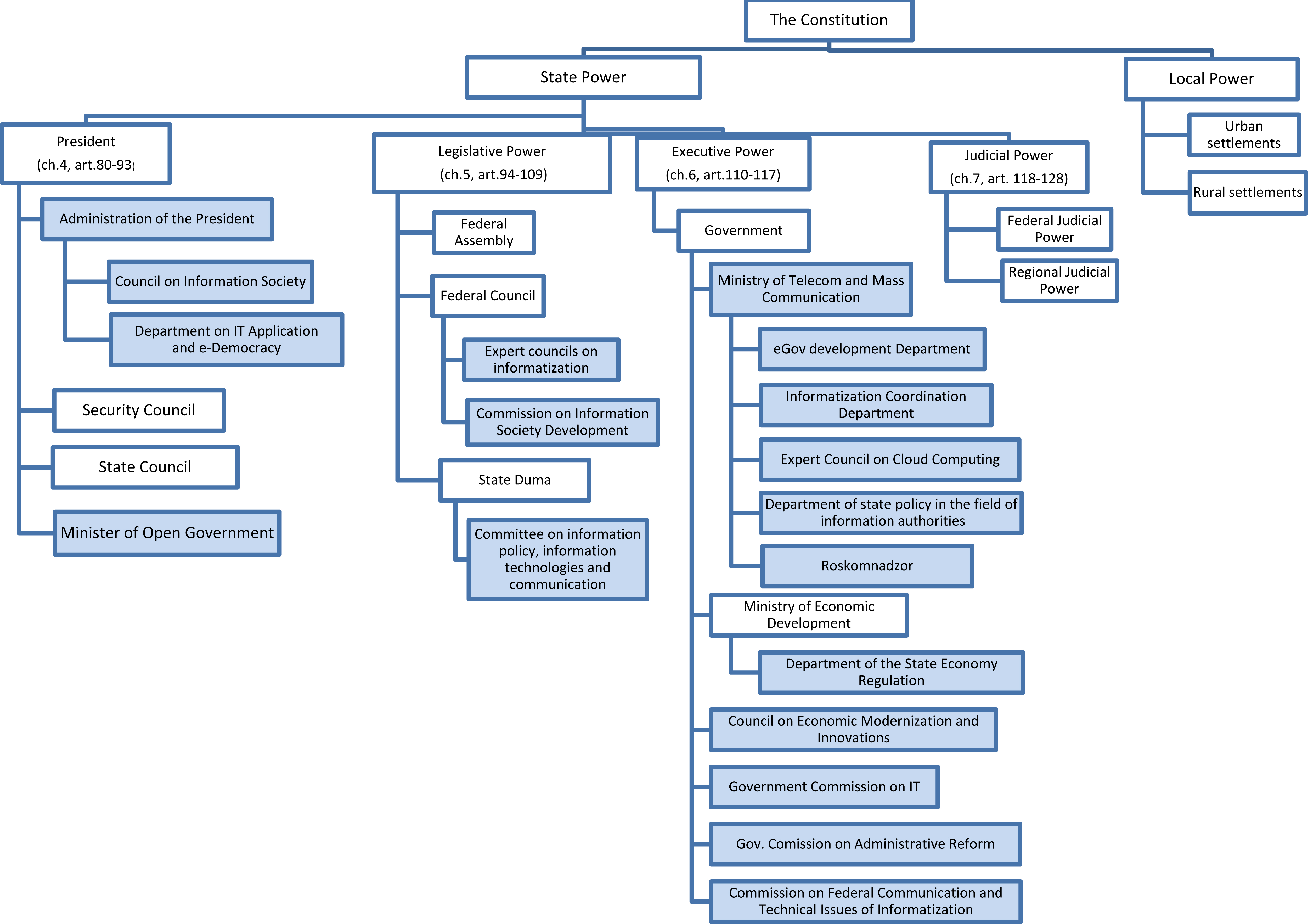
The central government of the Russian Federation is organized into 21 ministries and more than 50 federal agencies and departments. Russia also comprises 83 regions and more than 22,000 municipalities. The complex of federal, regional and municipal authorities employs more than 2.2 million civil servants. The heads of regional authorities are elected and the interests of each region are represented in the State Duma but in their actions, regional authorities are subordinated to and reflect the powers of federal authorities. Citizens are the source of local power and elect local administrations to address the issues of their territories.
State power in Russia is based on the separation of presidential, legislative, executive, and judicial powers (Art. 10 of the Constitution). Accordingly, the associated national public authorities are independent in their daily activities. Under the Russian Constitution, the President is a separate institution, not the head of executive power, although the President can and does influence the other branches and several ministries are directly subordinate to the President’s administration. The Presidential Administration, Russian Federation Government, and Federation Council are the most important institutions in the decision-making and legislative processes. Each has its own sub-structures responsible for IT, e-governance, and related topics. Figure 1 summarizes this Constitutional scheme of Russian authorities. The organizations responsible for some aspect of e-governance development are shaded.
The Presidential Administration includes the Department on IT Application and e-Democracy and the Council on Information Society. Several non-government and expert structures such as the Information Democracy Fund and Expert Center of E-State work closely with the Presidential Administration helping with analytics and reviews. In addition, a special Minister of Open Government (without a Ministry) was appointed by Presidential decree in 2012.
In the legislative authority, the Federation Council of the Federal Assembly has the Commission on Information Society Development and two expert councils (on regional and federal informatization). These provide a venue for discussion and decision making processes, as well as for preparing e-governance-related regulations. The State Duma Committee on Information Policy, Information Technologies, and Communication is responsible for legislative regulation of information technologies and mass communications.
Within the executive authority, two ministries have primary responsibility for e-governance: the Ministry of Telecommunication and Mass Communications (for ICT, digital transformations and inter-departmental communications) and the Ministry of Economic Development (for administrative reform) The Ministry of Telecom and Mass Communication has its own e-Government Development Department which is responsible for e-services for citizens and businesses, and development of the whole e-government technical infrastructure. The Department of Informatization Coordination organizes the expertise to support national ICT projects in areas such as health care, education, and emergency “112” systems. The Department of State Policy on Information Authorities develops and implements policies that regulate the flow of e-documents among various authorities. This department also monitors implementation of the State Information Society Program. The Federal Service for Supervision of Communications, Information Technology and Mass Media (Roskomnadzor) controls IT and personal data processing and the Expert Council on Cloud Computing serves a consultative function.
Within the Ministry of Economic Development, the Department of the State Economy Regulation is responsible for policy, legislation, and regulation to increase the quality of government e-services and government information systems.
Other executive structures outside these ministries serve consultative functions for e-governance. These include the Council on Economic Modernization and Innovations, the Government Commission on IT, the Government Commission on Administrative Reform, and the Commission on Federal Communication and Technical Issues of Informatization.
Several actors outside the formal organizations of government are also important although their actions are not always compatible. The Expert Center on Digital Russia is associated with the science and education community. IT Dialogue, is oriented to business practioners, and the third combines non-profit organisations and activists (Angry Citizen, Information Democracy Fund) who make substantial efforts for e-governance popularization.
Such a large array of institutional players can, on the one hand, provide considerable attention to e-governance development in Russia. On the other, they also represent fragmented responsibility because their structures are disconnected from one another and sometimes do not even communicate [63]. The bureaucratic structure of the Russian authorities rests on explicit and detailed guidelines for interaction among official institutions which all parties must strictly follow [64]. At the same time, Russia lacks a Chief Information Officer (CIO) function to serve as the central point for strategy, coordination, and assessment of e-governance development and performance as is the case in most developed countries [3]. Instead, different government organizations play separate and sometimes overlapping roles. As a result, the processes of e-governance development tend to be complicated, uncoordinated [65] and ineffective [66].
Official e-governance-related goals and associated performance indicators
We turn now to the legal authority for egovernance development in Russia. Table 3 lists the key provisions of the main laws and official programs and shows whether a formal performance indicator is associated with each goal. The items selected for analysis 1) appear in the regulatory base of the Russian Federation Government and the Ministry of Telecom and Mass Communication of the Russian Federation; 2) were adopted at the federal level, but apply on the regional level as well; 3) created either a common framework for e-governance development or addressed specific components of e-governance such as public participation.
The state “Information Society” program (2011–2020) was developed to establish clear information society goals and tasks, as well as provide financing for all related initiatives [56]. The goals include the following:
Improving the quality of life of citizens through the use of ICT. Increasing benefits to citizens and organizations from the use of ICT. Creating the conditions for rapid and effective interaction between government, citizens, and businesses. Developing a technological basis for the information society. Increasing ICT-based interactions among citizens, organizations, and the state. Developing special ICT systems to support the activities of public authorities. Developing e-services in health care, education, science and culture, and other areas. Disseminating information society best practices within the Russian Federation. Preventing threats emerging in the information society.
The key performance indicators described in the program include the position of the Russian Federation in international IT development indexes, the percentage of citizens who use electronic mechanisms for obtaining public and municipal services, reduction in the proportion of the population that does not use the internet or telecommunication networks for security reasons, closing the digital divide between Russian regions; and the proportion of households with access to the Internet. A special sub-program related to e-governance called the “Information State” concentrates on such indicators as sharing electronic documents between public authorities, the use of high-speed Internet within the authorities, and the use of e-signatures and e-passports among citizens.
The 2012 decree of the President of the Russian Federation No601 “On the main directions of governance improvement” concentrates on e-participation [57]. It provides for the following initiatives:
A platform for bill discussions to be built within 60 days. “Russian public initiative”, an e-petition portal. Active publishing of open government data. Mechanisms for citizen assessment of the authorities’ efficiency and performance. Enhancing citizens and business control of government actions. Development of a court system and broadcasting judicial proceedings.
The key performance indicators for these initiatives include the level of citizen satisfaction with online services, the percentage of citizens with ability to obtain online services, the percentage of citizens who receive online services, and reduction in the time in the queue when contacting authorities.
The Systematic Project of e-Government in Russia [58] was drafted in 2016 by the Ministry of Telecom and Mass Communications as a strategic document reflecting e-government scenario development. Actually this document focuses not just on e-government but also on the development of partnerships between government, civil society, and business, which represents a substantial step toward the concept of e-participation in decision making. The main goals expressed in this document include:
User orientation, meaning a strong focus on current customer requirements and planning on the basis of consumer expectations. Social and economic efficiency through optimization of administrative processes, citizen involvement, and open G2C dialogue. Inclusiveness, covering all government branches, levels of state and local authorities, types of organizations, and social groups. Security and confidentialty to establish trust relations between consumers and e-government. Flexibility and adaptability to rapidly changing socio-economic conditions. Orientation toward electronic data to reduce document flow. Continuity and sustainability of e-government in conditions of change and innovation.
To accomplish these goals, the document provides for the establishment of systems to ensure participation of civil society and business in the development, adoption and implementation of state and municipal decisions. It provides for portals for different types of e-participation, as well as a national inspector function and related activities of professional and expert communities. The performance indicators are described as the level of citizen satisfaction with e-government services, the proportion of e-services among other types of services, reduction in the average cost of providing public services, and the percentage of citizens who select e-forms for communication with government.
Federal law 59 “On the Procedure for Consideration of Appeals by Citizens of the Russian Federation”, last updated in 2015, regulates implementation of the constitutional rights of citizens to appeal to state and municipal authorities [59]. This law guarantees the right to make an individual or a collective application to the government by electronic means for the following types of applications:
A proposal – recommendation of a citizen for improving laws and regulations, the activities of state bodies and local self-government, the development of social relations, or socio-economic and other spheres of activity of the state and society. A statement – the request of a citizen to assist in the realization of his or her constitutional rights and freedoms or the constitutional rights and freedoms of others, or a message about violation of laws and other normative legal acts, or shortcomings or criticism of the work of state bodies or local government and officials. A complaint – the request of a citizen for the restoration or protection of violated rights, freedoms or legitimate interests of on behalf of him – or herself or other persons.
According to this law, authorities must respond to all applications within 30 days except for violations of migration laws which impose a limit of 20 days.
The pattern is clear – e-governance goals focused on technical development and e-services are usually accompanied by specific and appropriate measures, while those focused on citizen engagement, participation, and overall government reform lack such measures.
Analysis of formal documents is a very useful way to analyze e-governance development in a highly bureaucratic country like Russia. Across its history, the State has prevailed over all aspects of society. Civil society and individual rights as they are understood in the West have generally not existed. Instead, from the imperial era through the Soviet and contemporary governments, a huge and complex bureaucracy exercises the authority of the State through media control, explicit procedures, and rules to regulate all forms of activity. Text analysis allowed us to see the semantic and thematic patterns of individual terms and clusters of terms for the period 2002–2015.
Relevant terms for analysis were identified in three ways. First, TLibra calculated the frequency of terms,2
TLibra calculates the frequency of terms by first discarding irrelevant words such as articles like “an” and “the”. It then calculates the frequency of each remaining word as the ratio of the occurrences of that word to the total number of remaining words in the acts adopted in a particular year, expressed as a percent. For example, if a word appears 100 times in a total volume of 1000 words in the acts adopted in a given year, the frequency of that term for that year is 0.1 or 10%.
Frequency of selected terms in Russian e-governance laws and regulations, by year
After TLibra calculated the frequency of all terms in the entire body of laws and regulations, we successively examined the top 20 terms discarding those that did not pertain to our research questions until we had accumulated the 20 relevant terms that occurred most often in each year. Table 4 below shows the results for both high and low frequency terms selected from the body of laws and regulations over the period 2002–2015. The high-frequency terms (e.g., “authoritative body”, “service”, and “power”) appeared in the top 20 every year. The low frequency terms address our research interest in understanding the full story of e-governance development (e.g., “participation”, “monitoring”, and “assessment”). As shown in Table 4, these terms remained at low frequency from year to year, even after 2011 when the open government movement with its emphasis on participation became a worldwide phenomenon.
High frequency terms in Russian e-governance laws and regulations, by year
We then selected for each year the terms with frequencies that exceeded the average rate of 3.2%, i.e., these terms occurred most often in the texts of the laws and regulations. As shown in Table 5, almost none of these terms denote citizen involvement, participation, or monitoring of government performance.
Thematic clustering of terms
In the last analysis, a group of five experts participated in a process to cluster the 37 relevant terms described above into thematic groups. This expert group consisted of linguists, political scientists and e-governance professionals who discussed each term in the context of the laws and regulations, taking into consideration the nuances of the Russian language. The closest match in meaning in the Russian language served as the criterion for clustering. Following their review, the terms were clustered into five themes: power, citizens, governance/administration, technologies and channels, and results of interaction which are presented in Table 6.
We then applied an integrated index for calculating statistically standardized values for each cluster, using the formula:
To determine the weight we used fractions of a unit. For example, if a term appeared 9 times over a period of 12 months, the weight would be counted as 9/12 or 0.75. If the frequency of that term was 20, then the integrated index for it would be 15.
Integrated indexes for semantic groups in Russian e-governance legislation, by year
The integrated calculation showed the same tendency as the analysis of single terms, i.e., themes denoting citizenship and citizen participation are much less evident in these documents than terms that denote administration, authority, and the technological component of e-governance development. This pattern is consistently repeated from year to year.
This study showed that Russia ranks in the first or second quartile in the summary results reported by several international indices of e-governance development. However, specific institutional factors that contribute to overall rank or rating often show quite low scores, in the third or fourth quartile. Higher scores on the availability of e-services and technological factors such as number of Internet users and households with computers contribute substantially to the overall scores, masking these institutional deficits unless one looks for them specifically. In a sense, this practice of formulaic summarization and comparison of widely diverse indicators across widely diverse settings is akin to reporting “the average temperature in the hospital”. It tells us little that is useful about a particular situation. Previous research [8, 68] has documented the disadvantages and limitations of these indices which tend to focus on outputs (e.g., e-services, websites) and environment (e.g., broadband coverage, internet access) over inputs (e.g., government resources, commitments, and capabilities), processes (e.g. interactions) or impacts (e.g., improved citizen experiences and satisfaction). This emphasis on the supply-side [69] relies mainly on easily obtained data, often self-reported, that represent low-cost trade-offs among scale, scope, context and data quality [70]. The formulas may or may not apply weights to different measures but when weighting is used, it is applied globally and therefore does not account for different national conditions or priorities. However, because these widely published overall rankings receive so much political and international attention, they have become readily accepted as the factual situation in each country. For Russia, they give the impression of good progress toward accomplishment of the full range of internationally accepted e-governance objectives.
The component indicators of the major benchmarks, other relevant studies such as the World Governance Indicators and Corruption Perception Index, and some of the domestic studies reported here tell a different story. In these, institutional factors such as rule of law, political stability, control of corruption, and citizen experiences show substantial deficiencies. In studies that focused directly on administrative barriers to e-governance development, experts identified patterns of major weaknesses in the adequacy of the legal framework, commitment to the quality of public management, processes for goal-setting and program design, and federal and regional government capabilities to carry them out.
We also documented how institutional structures of Russian government contribute further barriers to achieving e-governance goals. Authority and responsibility for e-governance-related policies, strategies, infrastructures, and assessment are distributed among four separate seats of power, and invested in nearly 20 different organizations. Long-standing bureaucratic norms and legal requirements reinforce procedural rigidity, opacity, and strong pressures for vertical accountability, while offering little or no incentive for flexibility, simplification, transparency, or horizontal coordination that would improve citizens’ interactions and offer more opportunities to contribute to policy development.
Content analysis of the key formal documents that authorize and guide e-governance in Russia offered another view of institutional influences. E-services and technical infrastructure development have been set out as target goals of Russian e-governance legislation since 2002. E-participation goals that would animate the “new concepts of citizenship” put forth in the UNESCO definition are less prominent. Moreover, while these documents clearly state participatory goals, almost no measures of performance are tracked to see if they are implemented or effective. Nearly all performance measures focus on e-services, access to the internet, or similar technology-dominated topics.
Finally, semantic analysis of Russia’s e-governance-related laws and regulations offered a different way to consider the institutional dimension. Fifty-six statutory and regulatory acts concerning e-governance show the prevalence of terms related to state power and authority throughout the period 2002–2015 indicating strong emphasis on the roles and actions of formal institutional actors. At the same time a strong supply–side and technology-dominated pattern emerged. Among the most prominent terms were those oriented to government-defined and provided services and implementation of associated technical platforms. The demand-side in terms of citizen participation and interaction were much less in evidence, as have attention to monitoring and assessment of results.
Taken together, the findings of this study provide evidence of regulative, normative, and cultural institutional factors that both shape and limit e-governance development in Russia. The multi-method approach taken in this study shows how different assessment techniques highlight different types of institutional influences. Regulative factors such as the authorizing statutes and assignment of formal organizational roles, rules, and procedures are addressed by the e-governance international rankings, the content analysis of salient laws and program documents, and the emphasis on government power and authority revealed by the semantic analysis. Normative factors appear prominently in different international rankings such as the governance indicators on accountability, political stability and rule of law. They are also evident in the domestic analyses that address stakeholder satisfaction, resource allocation, priorities and effectiveness. The content and semantic analyses also contribute some understanding of normative factors in their focus on decisions about priorities and performance measures as well as on terms that highlight the authority of the state compared to the influence of the public. Cultural factors such as typical behaviors, and public expectations about government operations and effectiveness are very visible in the domestic studies and the semantic analysis which are both more deeply embedded in social, economic, and political contexts. In short, a multi-faceted combination of assessments addresses all three types of factors and together they reveal the institutional traps that shape e-governance development and results.
E-governance is a fairly new idea but it is influenced by, or trapped within, long-established structures, patterns, and expectations for institutional, organizational, and individual behavior that are extremely difficult to change. Long-standing institutional arrangements have created inflexible bureaucratic structures and commonly accepted practices and expectations. These contribute to institutional traps that prevent or impede progress toward stated e-governance goals. They jointly shape and reinforce the rules of interaction among different social actors through vertically structured, highly regulated procedures and requirements for all kinds of activities from applying for a service, to expressing a grievance, to offering an opinion, all of which take place in an environment in which the vast majority of citizens expect to encounter public corruption. At the same time multiple government departments with fragmented responsibilities for solving specific problems or addressing specific goals exacerbate the problems. Disconnected internal evaluation efforts by separate government organizations for different purposes serve to reinforce this trap of internal fragmentation. The international benchmarks themselves create a kind of institutional trap in which all countries, regardless of political culture or administrative capability, are held up to a global yardstick that may have little to do with what is really needed, acceptable, or feasible for each one. Attempts to measure up to universal standards and to emulate the leading countries encourage easily measured technological progress, but unrealistic reform goals and even less realistic deadlines for achieving them have produced very little underlying institutional change.
Conclusion, limitations, and future work
This research was focused on the influence of institutional factors on e-governance development and performance. Using the case of the Russian Federation, the analysis focused on underlying regulative, normative, and cultural factors revealed in international and domestic studies, government structures, legal foundations, and the choices made about what to monitor and measure. In this case, we found vertically-oriented hierarchical structures with fragmented, overlapping and uncoordinated responsibilities, and authorizing and implementing laws and regulations that focus heavily on the role of authorities, formal power and technologies. In terms of performance, most attention is paid to monitoring e-services and technical infrastructure with almost no attention to monitoring progress related to citizen engagement, empowerment, or participation. These dominant trends contribute to institutional traps that significantly limit the development of e-governance and its promises of administrative reform, better public services, and new concepts of citizenship.
The study was limited in several ways. First, it represents only one national case and therefore the specific findings are bounded by the history and environment of e-governance in Russia. Second, the diverse measures and data sources we used are not exhaustive but were selected because they represent the best available national and international studies and governing documents for our research purposes. Third, we have many reservations about the validity of the international composite measures and the reduction of multiple diverse data points to single scores or rankings. For these reasons, we have not attempted and do not recommend trying to establish a composite “institutional index”. Instead our focus has been on uncovering the patterns of institutional factors that seem stable across these different sources, especially when looking at their constituent parts. Such patterns of institutional strengths and weaknesses should be useful for targeting additional research as well as for public engagement and policy decisions about priorities and resources needed to take the next steps in e-governance development in individual national contexts.
This study also suggests several directions for future research. First, an institutional approach to understanding patterns of e-governance development and performance could be used to compare countries with important similarities to our case, such as other BRICS countries or other post-Soviet countries that share the Russia’s political history. Cooperative research among scholars in countries which are close to the Russian context by economic trends, political structure, or cultural aspects might also stimulate a community of research and practice around e-governance development. It would also be useful to compare the e-governance and administrative reform histories of developed Western democracies [71] to see what patterns of institutional factors are associated with better performance or stronger foundations for further development. Also, although we do not advocate a composite index, this work could be a basis for developing quantitative approaches to defining and measuring important institutional variables.
Further exploration of semantic and discourse analysis is another avenue for future work. In this study we analyzed formal documents on the supply side of e-governance. A complementary approach would be to focus on data available from the demand side by accumulating texts, tweets, blogs, e-petitions, and other forms of social and traditional media that represent the experiences of citizens, businesses, and civil society. In addition, because national legislation is developed in diverse national languages, collaborative work by international researchers, including computer scientists, could contribute to better, more flexible automated tools for semantic analysis in comparative settings.
In terms of practical contributions, we agree with other scholars that over-reliance on a few global measures to understand e-governance development is misleading and can be counterproductive. The diverse kinds of data used in this study are available to any government or scholar wishing to look more deeply and more comprehensively into the institutional factors that influence development and performance. A deconstructed view that uses a variety of data types and sources offers a richer, more nuanced way to understand the patterns of institutional factors that affect achievement of e-governance goals in any particular country. In addition, the study suggests that an integrated national-level assessment program for e-governance would be a worthwhile investment for better understanding socio-economic and political effects, as well as for evaluating administration, services, engagement, participation, and satisfaction with e-governance development and performance.
Footnotes
Acknowledgment
This work was conducted with the support of RFBR grant No. 16-36-60035, “The research of social efficiency of e-participation portals in Russia”.