



Abstract
With increasing importance of data, the interest in the availability of public sector information (PSI) has also increased. Because of its public attributes, PSI directly impacts the national administration as well as the lives of citizens. With the changing technological environment, the value of data is observed to change along with the manner in which data exist and the manner in which data are handled. Further, the usage of PSI should be easy and safe in the age of open data. The relation between the state and citizen with respect to PSI should also be re-established. Therefore, the following questions arise: what is the new-era governmental role in PSI use? What is the policy direction that will ultimately guarantee the right to use PSI?
South Korea (hereinafter referred to as “Korea”) has one of the highest levels of information and communication technology (ICT) infrastructure, and considerable amount of data has been collected through government-led policies. Because of such policies, Korea has demonstrated excellence in the United Nation’s e-government survey, ITU (International Telecommunication Union)’s ICT development index, and OECD (Organization for Economic Cooperation and Development)’s public data openness index. Korea is currently working on further upgrading its data policy to achieve data-based innovation throughout the country. Thus, the current situations that are faced by Korea and their case studies can be good subjects for research, advancing the innovation of PSI management and activating the right to use of PSI.
Hence, based on the awareness of the problem, this study sought to introduce the key tasks of future data policies and propose the future direction of the PSI policy. Therefore, this study demonstrated based on the media theory that the management method of PSI changed according to the advancing technology. In addition, this study analyzed the nature of the legal relation that appears with a change in data management and attempted to derive the role of the government to enforce the law ultimately. To do this, we analyzed the role of the government as a data manager and the role of the law as the coordinator of legal rights. Also, by examining the changes in Korea’s PSI policies and the responses experienced by Korea, we determined the essential elements that should be considered by the government for developing future data policies.
Thus, the governments should be able to actively support the reuse of data and the participation of stakeholders; the law should go a step further and provide the basis for governments to actively encourage the use of PSI, protect privacy and security, and solve the disputes that arise in the overall process. Thus, the key elements of data management in the future will be the quality of data (accuracy and reliability), standardization of the data form (compatibility and availability), and data security (safety).
This research results can be used as guidelines by the government; however, it has limitations in that it provides only key elements to increase citizen’s right to use PSI in the open data era. After Korea’s data usage legislation (the Legislation of Promotion of Data-based Administration) is implemented based on the above factors, new results can be derived through comparative analysis with the PSI policies that have been established overseas.
Keywords
Introduction
The age of data has arrived. The data revolution is based on emerging technologies, such as the Internet of Things (IoT), Artificial Intelligence (AI), Big Data, mobile devices, and cloud computing. A revolution is defined as a complete change of the existing traditional order (Dale, 1926). Moreover, at the core of this age is openness, resulting from the technical nature of the Internet. During the early stages of Internet proliferation, even government regulators perceived the cyberspace, formed by the openness of the Internet, to be uncontrollable (Lessig, 1999). Even as the Internet technology advanced, Internet still positively affects the democracy (Best & Wade, 2009). Hence, from a democratic stance, this characteristic can be observed in the form of public demands for ensuring government transparency. As the network accelerated and the technologies dealing with the data developed, the data became valuable. Thus, the question about who possessed more data became an issue, and even governments began to show signs of the so-called “enclosure movement” following the vendors who were sensitive to the Internet economy (Benkler, 2000). Soon, countries began to understand the economic feasibility that can be introduced by data and sought to realize the value of opening and sharing data after confirming the amount by which a country’s economic power would vary depending on the manner in which that country used the data that it possessed. Thus, the notion of open data, to share the public sector data held by the government and public institutions and to make it available for all, proliferated (Zuiderwijk & Janssen, 2013). Although the government made large strides by opening and sharing its PSI, people found it difficult to utilize the transparent information well. Therefore, a government-level data policy is being demanded that could enhance the quality of the PSI itself and manage it.
Public sector information (PSI), which is created and used by governments and public institutions, is often, by nature, closely related to the everyday issues or interests of people. In addition, most public services are based on PSI, so the quantity and quality of PSI significantly impacts the quality of public services (Park et al., 2013). Moreover, the private sector, such as business operators, can reuse PSI to create value-added and commercialized information. The direct economic effect of phenomenon is expected to be about 75.7bn EUR in 2020, which is 36.9% more than that in 2016. The total market size combined with the indirect economic effects of added value, such as the reuse and industrialization of PSI, is expected to reach 265–286bn EUR in 2020 (Carrara et al., 2015).
The government of South Korea (hereinafter referred to as “Korea”) began to digitalize administrative information and disseminate information systems in the mid-1980s and has since accumulated vast and diverse PSI through e-government services and a national database construction project (Choi, 2012). The modernization and informatization of Korea have progressed very rapidly. Korea pursued a national informatization policy with economic growth as its top priority, as it pursued industrialization in the absence of national infrastructure after the Korean War. Informatization occurred very rapidly on the national level, following the slogan, “Late industrialization, fast informatization” (National Information Society Agency, 2011). It may be useful to examine the case of Korea to identify the key issues surrounding the proper use of PSI and draw out the main challenges.
Data is changing: its value, the way it exists, the way it is handled. The relationship between the state and the citizen, with regards to data, also needs to be re-established. What then is the new-era governmental role in PSI use? What is the policy direction that will ultimately guarantee the right to use PSI?
Considering all these factors, this study proposes key elements in the PSI management governance by theoretically deducing the legal issues arising from the process of utilizing PSI, examining the managing environment and development of PSI, and deriving some of its major challenges and implications through the case study of Korea, where the policy in managing public data is evaluated to be excellent worldwide.
To achieve these purposes, this study used the media theory to demonstrate that the management method of PSI has changed with advancing technology. In addition, this study analyzed the nature of the legal relation that appears with the change in data management and attempted to derive the role of the government to enforce the law ultimately. Therefore, we analyzed the role of the government as a data manager and the role of the law as the coordinator of legal rights. Also, by examining the changes in Korea’s PSI policies and the responses that have been experienced by Korea, we have determined the essential elements that should be considered by the government for developing future data policies. Section 2 explains how the current data environment and governmental roles are changing as well as the legal attributes of these changes. In particular, the legal relationship between data management governance and PSI provision and utilization was summarized through theoretical analysis. Section 3 shares Korea’s experiences and policies on information disclosure, PSI reuse, and data sharing. The current status of legal response to issues, such as personal information and privacy, copyright, and national security, is also reported. Most importantly, the necessity of seeking an active governmental role is emphasized through the analysis of recent data-based administration concepts and related legislations being discussed in Korea. Finally, in Section 4, the main issues and direction of PSI policy are suggested by deriving implications from the theoretical analyses of data management governance, examples, and tasks in Korea.
Paradigm shift of data environment and principle of PSI management
Changes in data management and governmental role
Data is a medium of human thoughts and knowledge. In the past, data was an object that could not be handled directly. In other words, it had to be recorded somewhere. As such, recording media have evolved to accommodate and transmit as much data as possible for as long as possible. It has developed from mural paintings and paper to computers and Internet; since the invention of printing, Internet has been considered to be the most important medium among the existing media (Dutton et al., 2010). However, the situation has changed. With the development of Big Data, the limitation of data storing media can now be overcome. Furthermore, messages containing human thoughts and emotions are collected at all times and embodied in the form of electronic data. Data has become a medium and an object of management itself. Due to the innovative structural changes resulting from technological advances, the existing management system has been completely transformed from media to data itself.
The change in management has brought about changes in related attributes. Instead of being recorded on paper documents, data is now used independently through Application Programming Interfaces (APIs). Furthermore, mashups, which work with APIs to mix and match contents or services from different sites to create more valuable services, have broken the boundaries of data domain. Developing a service to provide map-based traffic information with Web 1.0 required the preparation and subsequent combination of map and traffic information databases. However, with Web 2.0, this service can be implemented by just invoking the map information and traffic information using an open API (National Information Society Agency, 2007).
These mashup services are being deployed in public services, combined with useful contents in the public sector. Public services using mashups increase opportunities for public and private companies to participate in policy development. Through this, the possibility of citizens’ access to PSI and analyzing and evaluating government activities have increased, and transparency of government policy, as well as public participation opportunities, has also increased. The possibility of developing a successful cooperation model between the government and private sector has also increased through changes in data management methods and the provision and utilization of PSI by public institutions.
Such technological changes require a new governmental role paradigm. A key element in ensuring the use of PSI is ensuring the availability and accessibility of data and ultimately creating a sustainable ecosystem in which new value-added content can be created, both publicly and privately, through the unconstrained circulation of data (OECD, 2015). The data availability here refers to providing a variety of data produced by the public sector in an open format, while data accessibility refers to the ease with which data, including meta data, can be accessed and the ability to provide machine-readable formats (e.g., Comma-Separated Value (CSV)).
Governments should strive for balanced national economic growth, respecting the freedom and creativity of individuals and businesses as well as the people’s right to know. Therefore, a government should not only guarantee the availability of all data in the course of providing PSI but also be able to recognize societal needs and contribute to public interest (Prins, 2004). In other words, data processing should be used to construct high-quality datasets, and PSI should be provided in a way that is more convenient for the private sector, ensuring usability as well as the availability and accessibility of data.
PSI governance improves government efficiency, productivity, and transparency. It also promotes corporate, NGO, and citizen participation in policy decision-making.
Ultimately, governments should be able to actively support innovative data reuse and stakeholder engagement. Note that this data management approach is directly linked to overall governance, including that of policies, institutions, organizations, people, and standards, and eventually leads to participatory democracy, where all members of a society voluntarily participate in the decision-making process to expand the range of communication and opportunities. Therefore, the government should also support the private companies and citizen’s capability to actively use PSI.
Legal perspective on environmental change of PSI
Changes in legal relations of PSI utilization
With the above changes in technology and governmental role, the structure of legal relations has also changed. Data itself has become the medium, and the data generated and utilized by citizens’ tax in the public sector has increased in value. As the importance of PSI has increased, social demands and the need for utilization in the private sector have also increased. In addition, governments have established and implemented various systems and policies at the national level. The PSI issue focuses on making the information that has been generated, collected, and utilized in the public sector available to the public as well as actively available to the private sector.
As such, ensuring and strengthening the right of PSI use has also become a role of the state, requiring corresponding legal action. Unlike in the past, when the people’s right to know was satisfied by simply requesting information disclosure, the PSI system ensures that the government first discloses and provides high-quality data to the public so that citizens can know their rights and contribute to economic development. Ultimately, the government must make it easier for citizens to use high-quality data and expand their participation based on “on-demand” services, through data management and continuous communication, thereby leading to transparency and implementing the value and innovation of participatory democracy.
Legal attribute of PSI utilization requirement
The right to request information disclosure, which is the right to access information held by the government, is guaranteed as a fundamental right: the freedom of information (Eechoud & Janssen, 2012). The foundation of all nations that guarantee individual dignity and freedom and secure a democratic political process is based on the ideology of freedom of information. Especially in this new age of information, efficiently supplying accurate information is a core responsibility of the modern state. The role of the constitutional state, which should confirm and guarantee the basic right to information, manifests itself as the free circulation of information by the state and the establishment of a suitable foundation for it (Jeong, 2001). This leads to the duty to use public information in the public’s interest.
Furthermore, in recent years, not only has the information of the public domain been provided, but increasingly more attempts have been made to utilize the effective information constructed and managed in the public domain through the use of various everyday devices. Also, because the area of administration is diverse and detailed, a vast amount of information can be accessed by the users. Therefore, legislation that can appropriately deal with the progress of technology and diversification of methods should be continuously studied and realized. If such demand is utilized industrially and used as a driving force for technological development, it could be said that a large amount of the money spent on the public domain during the early stages of informatization is reused. And, of course, it will be important to protect the privacy of the general public as well as the rights of copyright holders.
To solve these problems fairly so as not to cause damage is a preliminary legislative response in the expansion of PSI use to prevent diverse kinds of legal disputes (Janssen et al., 2012). From this point of view, the government’s role in guaranteeing citizens’ rights is derived. The government should improve the quality of PSI that is produced, possessed, and managed by the public sector, consider the manner in which the data should be provided, and cooperate with the private sector (Attard et al. 2015).
PSI governance and issue of rights in the age of data
Considering these environmental changes, the government should look at the whole data process and various legal rights issues. Data governance determines who is responsible for making decisions about the data assets of an organization (Khatri & Brown, 2010). Therefore, the issue of rights in data governance arises from determining who owns the data, who makes the decision to use it, and who is responsible. Who is eligible to access the data?
Freedom of information allows people to know their rights and acquire the data necessary to claim them. It also indicates the right to access and verify a variety of data and evidence on the systems and policies that can implement the rights. Furthermore, people should have access to as much information, opinions, and debates, on political, economic, and social issues, as possible. Expanding awareness and ensuring communication through the access of such information will provide opportunities for further democratic development.
For the various existing information policies that have been promoted with focuses on the smooth creation and efficient management of information, how to use information in accordance with the continuous development of information technology has become a major concern, with the value of PSI being reconsidered. In other words, the information disclosure or informatization policy, for the realization of the right to information, is required to fundamentally change and strengthen public services and promote industries using PSI. Therefore, overall PSI governance, especially the ability of the private sector to use it flexibly, needs to be perceived as the role of the state, legislators, and law, subject to public request (Kwon, 2013).
There are various issues in the governance process that deals with PSI. The process of collecting, generating, processing, analyzing, disclosing, and reusing data has inherent problems due to the data itself, its use, and the attributes of the fields where the data is applicable. First, depending on the nature of the data itself, there are security and privacy protection problems (Kshetri, 2014). The identification of individuals is increasing in the process of data collection and processing. In addition, considering the many values of PSI, security in the current environment is essential and should be guaranteed by law. Second, there is the problem of copyright. Copyright protects the creative production of expressions of human thoughts and emotions. Therefore, PSI is also protected by copyright law even if it is merely based on copyrighted property. However, copyright law aims to encourage creation and contribute to the development of creative industries. PSI is naturally generated in the process of carrying out work for the state by receiving taxes. In fact, the generator of PSI can be considered to have already been compensated by the taxes paid by the people, similar to how copyright gives a sense of compensation to the creator. Third, there are problems of trade secrets and national security. Information related to trade secrets and national security, such as the technology or business plans of a specific company, cannot be easily disclosed by public request or the right to information, because it needs to remain proprietary to maintain its competitive advantage. Finally, due to the above problems of providing PSI, dispute settlement is also a necessary function of the law. In the process of providing PSI, people need access to dispute resolution to coordinate conflicts among various rights (Fig. 1).
Role of law and government in PSI governance.
Current status of informatization and PSI policy in Korea
Korea has achieved rapid economic development and democratization through high-level growth during the 60 years since its foundation. At the center of this high-speed growth was the state-led national informatization policy.
Korea started to computerize major administrative tasks in the late 1970s and invested heavily to modernize the communication infrastructure and promote informatization in the 1980s. From the 1990s, the government started promoting full-fledged informatization centered around the unit tasks and functions of major administrative agencies. Since the 2000s, the value of informatization has shifted to improving public satisfaction of government services and active participation in national administration, and an electronic process based on e-government has been established (Korean Government, 2017). As a result, the efficiencies of administration and public convenience have been significantly improved. PSI has begun to be used as an effective tool to deepen and develop the foundation of democratic society, and e-government has become a core management system and an infrastructure for improving national competitiveness.
Due to these efforts, Korea ranked first in the UN e-government evaluation during 2010–2014 and third in 2016 (United Nations, 2016). In addition, Korea achieved the highest ICT development index ranking during 2015–2016 and the second highest ranking in 2017 (ITU, 2017). In 2015, Korea was ranked highest in the open data index (OECD, 2015). As of 2016, 205 institutions have opened 21,358 PSI, recording 18,842,250 usage cases (Korean Government, 2017).
Currently, Korea has the highest level of ICT environment, network infrastructure, and databases. The success of Korea’s informatization policy is attributed to government-led rapid technology adoption and innovation efforts related to public data disclosure and PSI utilization. The innovation of the Korean government is also highly regarded by the international community as a successful case of government innovation (OECD, 2017). Therefore, it is necessary to review the specific strategies and processes of the Korean government’s PSI policy. Through these case studies, future challenges in the activation of PSI-related policies can be identified.
As the relationship between the government and public is reshaped in response to the rapid transition to an information-based society, it becomes necessary to discuss the activation of the private use of PSI. Therefore, based on the recognition that the government’s role should no longer be that of a one-sided service provider, the Korean government is making efforts to further enhance and revitalize the PSI disclosure policy.
The Korean government established the “Master Plan for Promotion of Government 3.0 (2013)” and “Development Plan for Government 3.0 (2014)” in the process of promoting Government 3.0, which is a public information campaign to open up public information to government agencies to create new value through easy use. The Korean government defines this as a public-oriented government innovation paradigm that opens public information, eliminates divisions between departments, makes people’s lives easier, and creates jobs. The Government 3.0 committee launched key tasks for the national goal and created an environment for smoothly promoting government goals by establishing a legal and systematic basis for government innovation by enacting the “Act on Promotion of the Provision and Use of Public Data” in 2013 and amending the “Official Information Disclosure Act”.
Promotion of PSI policy
Advancing information disclosure
The background of advanced information disclosure is the actively promoted computerization of administration. Korea started promoting the computerization of major administrative tasks in the late 1970s, and since the 1980s, it has made a national investment to expand telecommunication infrastructure and promote information technology. The first main legal system was based on the Presidential Instruction of Computerization Act in 1975, establishing the national basic information system with the “Act on Expansion of Dissemination and Promotion of Utilization of Information Systems”, promoting the informatization in the state and society with the “Framework Act on Informatization Promotion”. The “Framework Act on Informatization Promotion” was completely revised as the “Framework Act on National Informatization” to contribute to the realization of a sustainable knowledge- and information-based society. In 1996, the Official Information Disclosure Act was enacted to secure citizens’ right to know and to operate a transparent government through democratization.
In the era of Big Data, data and information are key resources that drive industry development and social change, and the government is an important data warehouse with considerable quantities of valuable information. Although Korea’s initial e-government policy focused on protecting PSI rather than disclosing it, PSI became a key means of creating new value, and policy goals were gradually revised from a passive information disclosure policy to one enhancing the opening of data.
To overhaul the information disclosure system, the government needs to 1) significantly strengthen record management as a prerequisite for information disclosure, 2) dissolve the sanctuary and exceptional areas of information disclosure, 3) disclose source data that can be verified by the private sector, and 4) expand the intelligent government business monitoring system (Committee of Government 3.0, 2014). Specifically, in 2011, the “Enforcement Decree of the Official Information Disclosure Act” was revised to include “activation of information disclosure”. In 2013, the act was revised to include disclosure of not only the PSI “list” but also the “original” without request. In addition to providing a legal basis, the government is organizing and operating a PSI disclosure team composed of academics, civic groups, and the general public in order to realize the policy’s purpose. Furthermore, the government developed a preliminary information standard model that presents the types and contents of PSI to be disclosed specifically for each type of institution.
Activation of PSI use
The policy of revitalizing the use of PSI is a strategy for the national capitalization of new public resources. The Korean government established the Public Data Master Plan (2014–2016) to successfully bring the PSI industrialization implicated in the “Act on Promotion of the Provision and Use of Public Data” into practice in Korea. Furthermore, in December 2013, in accordance with Article 5 of the Act, the Open Data Strategy Council was established to serve as a PSI policy control tower, to review and coordinate major government PSI policies and plans. In April 2016, the act was revised to further refine the concept of PSI and establish a legal basis for promoting, growing, and developing start-ups using PSI. In December 2016, the Public Data Master Plan (2017–2019) was established, which focuses on resolving social issues and enhancing private utilization through the expansion of high-quality data openness. It also focuses on building a new data industry ecosystem that will lead the fourth industrial revolution, strengthening private–public cooperation, and building an efficient PSI management system. As a major project for these purposes, the government promoted a new type of data opening, expanding data openness in new industries such as autonomous vehicles, and establishing a system to integrate and manage PSI across national and international boundaries by actively using excellent private data and services in the public sector (Open Data Strategy Council, 2016).
The Open Data Strategy Council led the data opening by finding high-demand, high-value, and large-capacity national core open data. The national core open data has 526 species in 33 fields, achieving a total of 9.6 billion data releases (Open Data Strategy Council, 2016). To improve the quality as well as quantity of PSI, the government is also promoting the establishment of open standards, expansion of the open format ratio, and evaluation of the quality control level. In addition, the government has established an open data portal to establish channels and utilization processes that enable citizens to obtain PSI easily and operates a public service that can access PSI scattered across institutions through a common channel. Furthermore, in December 2013, the “Committee on Mediation of Disputes over Provision of Public Data” was established and operated to coordinate various disputes that may arise in the use of PSI at the national level.
Providing customized service to the customer
If the public information disclosure system and PSI activation policy are focused on reforming the structure and system of the government, they can also maximize the effect of policies by reforming the contact point with people by implementing the “service government,” which allows the public to easily access PSI.
In the existing e-government service, the government had to limit the needs and preferences of the people. However, since 2010, various analytical and intelligent technologies such as Big Data and AI have developed so rapidly that the government has had to provide pre-emptive services tailored for them.
Accordingly, the Korean government is providing a “customized service” of various government policies and services based on individual characteristics of from a consumer-centered perspective: a “visiting service” that provides information and services on a pre-emptive basis by tracking the time required by the public, an “integrated administrative service portal (Gov.kr)” that can eliminate all inconveniences that need to be found from one place, and a “national design group” system in which civil servants and the public work together to implement consumer-oriented public policies and services.
Activation of information sharing
It is difficult for one department or organization to solve the social problems of information sharing. Thus, the PSI of various departments is shared and combined according to purpose of use. Cooperation and communication among various departments and institutions are essential factors for innovation. The traditional Korean bureaucratic government clearly divides authority and responsibilities centering on the division of labor and specialization. This practice has inevitably led to the phenomenon of “information islands”, in which different ministries have different information systems and only partial work is carried out with limited information by each organization.
Therefore, the Korean government has initiated an effort to build a system of full-knowledge sharing at the entire governmental level, which eliminates the partition between departments. The government has set a mid-term plan to convert the work environment that focuses on personal PCs to cloud PCs and turns the government’s data center into a cloud center. In addition, to promote collaborative work, the government has developed a “collaboration map” that automatically summarizes the work status of departments so that it is easy to search for organizations that are involved in their work (Committee of Government 3.0, 2014). Using the map, AI can analyze various documents, press releases, and job report data without any written report, so that the status of the entire government can be rapidly and accurately grasped. Since the sharing and common use of information have recently been emphasized, the administrative information sharing policy, which has been promoted by the Korean government since 2005, has recently achieved considerable success. As of 2016, information from 153 administrative agencies has been jointly used by 647 institutions; the total number of document reductions through the sharing of information is about 60.27 million, and the social cost-saving effect is estimated to be about 309.1 billion won (Committee of Government 3.0 & Ministry of the Interior and Safety, 2017).
In addition, the Ministry of Interior and Safety annually examines the information-sharing demands of all government agencies and whether PSI can be shared as well as how and when to share it. In addition, a standard legislative model has been prepared and disseminated to all departments in consultation with the Ministry of Government Legislation, so that there is no disagreement on the basis of information-sharing requests in consultation, and efforts are continuously being made to disseminate cases through information sharing and collaboration.
Construction of data management system
For the government to use data through qualitative data innovation, it is necessary to establish a systematic and unified data management system at the national level.
Currently, government agencies are collecting and storing different databases for different departments and functions, facing various problems, such as redundant investment of funds necessary for data construction and connection, inefficiency of inter-agency data linkage, data accuracy, and quality degradation. In May 2016, the Ministry of Interior and Safety announced plans to launch an Information Strategy Planning project to establish a national master data designation and management system. The main objective of the project was to designate data frequently used by each ministry as “national master data” and establish a unified management system in cooperation with the related ministries. The master data can be collected and managed only by the designated representative organizations. The government also plans to establish a national master data management center to register and store the national master data and provide it to each organization.
If the unified national data management system is established through this project, the efficiency of administrative work might be enhanced, service consistency can be ensured, and the quality data necessary for the evidence-based scientific administration can be continuously acquired.
Responding to legal issues in PSI policy
PSI is a result of public administration and contains a variety of content related to the nation and people, and thus requires security. For example, maps of countries that can be widely used in location information services may be abused as means of terrorism. In addition, the quality of data is important for PSI to be utilized by the private sector. If security is not guaranteed, the integrity of the data may be hindered, resulting in misuse. Article 56 of the Electronic Government Act requires the government to prepare security measures to ensure the safety and reliability of information and communication networks, administrative information, etc. necessary for the realization of e-government. In addition, the public sector is protected through the “Act on the Protection of Information and Communications Infrastructure” and the “Regulations on the National Cyber Security Management”. In Korea, business process reengineering was set up in 2003 for the e-government roadmap, and the National Computing & Information Agency (now changed to the National Information Resources Service) was established. The center recognized the necessity of security in terms of integrating and managing information and government agency systems, and in 2012, it intended to establish a cybersecurity department to operate a safe and stable information system.
What about the problems that require the consent of the information subject? In principle, Korea accepts the eight principles of OECD privacy guidelines and requires consent from the information subject (Article 15 of Personal Information Protection Act). Obtaining the consent of the informant in the process of opening and reusing PSI hinders the effectiveness of the policy. Above all, consent can have a negative impact on both the use of information and assurance of information rights, since it can only be a formal system (Solove, 2013). Accordingly, a de-identification policy that de-identifies personal information and exempts consent requirements is emerging as a major solution. In June 2016, Korea announced the “Guidelines for De-identification of Personal Data” jointly with the Office for Government Policy Coordination, Ministry of Interior and Safety, Korea Communications Commission, Financial Services Commission, Ministry of Science and ICT, and Ministry of Health and Welfare. The guideline is based on the following criteria. 1) Preliminary review, during which it is verified whether the specified data is personal; data that is confirmed to be non-personal can be used freely without legal restrictions. 2) De-identification, during which measures are taken to make individuals unidentifiable by means of, for example, deleting or replacing all or some of the elements from the dataset. 3) Adequacy assessment, during which it is assessed whether an individual is identifiable by easily combining the de-identified data with other data. 4) Follow-up management, during which necessary measures, such as safety measures for de-identified data and monitoring the likelihood of re-identification to prevent re-identification in the process of using de-identified data, are carried out (Korea Joint Ministerial Working Group, 2016).
The problem of copyright is solved through the open government license. Public works may be subject to commercial availability and changeability of the terms and conditions of the license to which they are affixed. Article 24-2 of the Copyright Act provides for the free use of public works. According to this, works published by the government or local governments are the first type that can be used without permission. The free use of public works, governed by an “Open Government License” in Korea, basically requires all types of sources to be labeled. There are four types of licenses: the first type allows the creation of secondary works for commercial and non-commercial use and transformation; the second type prohibits commercial use; the third type prohibits modification; and the fourth type prohibits both commercial use and modification, allowing only non-commercial use (Ministry of Culture, Sports and Tourism & Korea Culture Information Service Agency).
The issue of trade secrets and national security also has a significant impact on the scope of PSI disclosure. Article 17 of the “Act on Promotion of the Provision and Use of Public Data” sets the scope of PSI to be provided, and Article 9 of the “Official Information Disclosure Act” specifies some exceptions (such as information related to national security, life of the people, prevention of crime, investigation, and privacy).
Furthermore, Korea has a PSI dispute settlement procedure. If an agency improperly denies or stops providing PSI, it may be reported to the “Committee on Mediation of Disputes over Provision of Public Data.” If the related party accepts the mediation, it has the same effect as that of a court settlement.
Managing data and communication
Along with the continuous improvement of various issues, Korea has recently focused on the governance of data management. As data management methods change, PSI governance changes from collaborative to integrative. Public data governance, which was established as a collaboration of existing institutions, is being reorganized into an integrated system at the national level. These cycles include data generation, cloud-based management, and provision of a single window (Open Data Strategy Council, 2016), in order to establish a legal system for the data range and authority setting that requires the same standards at the national level. A future goal is to build a cloud-based infrastructure for efficient data management and to provide data through a single window. To deal with these issues, data law is being actively discussed in Korea.
Most notably, “Legislation on Promotion of Data-based Administration” is pending in the National Assembly. In an environment where the use of data throughout the lives of the people serves as a key resource that affects national competitiveness, the bill stipulates matters to promote data-based administration and enhance the accountability, responsiveness, and credibility of the administration. Article 4 of the bill stipulates key areas of data-based administration, which require public authorities to gather opinions from the people to establish key policies and resolve economic problems. It is also said that data-based administration can be carried out in areas where it is necessary to anticipate risk factors and suggest and implement ways to eliminate them. In other words, the bill seeks public participation in policy and administration. In addition, the Data-based Administration Promoting Committee is established under the Prime Minister (Article 6); a Data-based Administrative Officer is appointed in each department (Article 15); the Government-integrated Data Management Platform for managing data that needs data-based administration (Article 14) and a data analysis center (Article 16) that collects, processes, and analyzes institutional data need to be established. For data management, cooperation is mandatory when inter-agency data requests are required, and when public institutions request data provision to facilitate interactions with the private sector, determining and negotiating costs through agreements are required (Article 10). Each agency maintains up-to-date, accurate, and interlinked data (Article 12), and the Ministers of Interior and Safety integrate and link the metadata and data relations of each institution and manage the data association by policy, standardization of various collections, connections, procedures, and techniques (Article 13).
These policies enable the government to naturally enhance the data quality by activating data sharing, unifying collection and analysis, and establishing relevant standards. If data management is implemented in the public sector and data-based administration is realized, concrete measures should be set up to decide how to share and collaborate with the private sector, as well as how to create a better environment by directly connecting with people’s lives.
Main challenges and direction of PSI policy
Ultimately, to guarantee citizens’ right to use PSI, it is necessary to ensure the quality of data and communication channels. Therefore, communications and exchanges with the private sector should be promoted by expanding the base of private data utilization and collected opinions. The key factors for this are education, training, and publicity for spreading internal and external awareness of PSI and enhancing the expertise of the person responsible for opening data. It is necessary to continuously evaluate and diagnose the level of data openness, identify the facts that impede the opening of the data, and actively communicate with the private sector. The key to spreading PSI use, is having the government provide data and the private sector use it. This means that to communicate and coexist with the public, the government should not play all the roles but rather support real services in a more innovative, relatively flexible, and creative private sector. To realize this, it is possible to consider boldly abolishing public services similar to those of private services. In addition, Korea currently prohibits the development and provision of services that are duplicated or similar to those provided by the private sector through the Article 15-2 of the “Act on Promotion of the Provision and Use of Public Data”. Furthermore, open data portals provide the ability to report similar services through “The Public Service Reporting Centers similar to Private Services” (
Main consideration in the PSI provisioning process.
The key elements of data management in the future.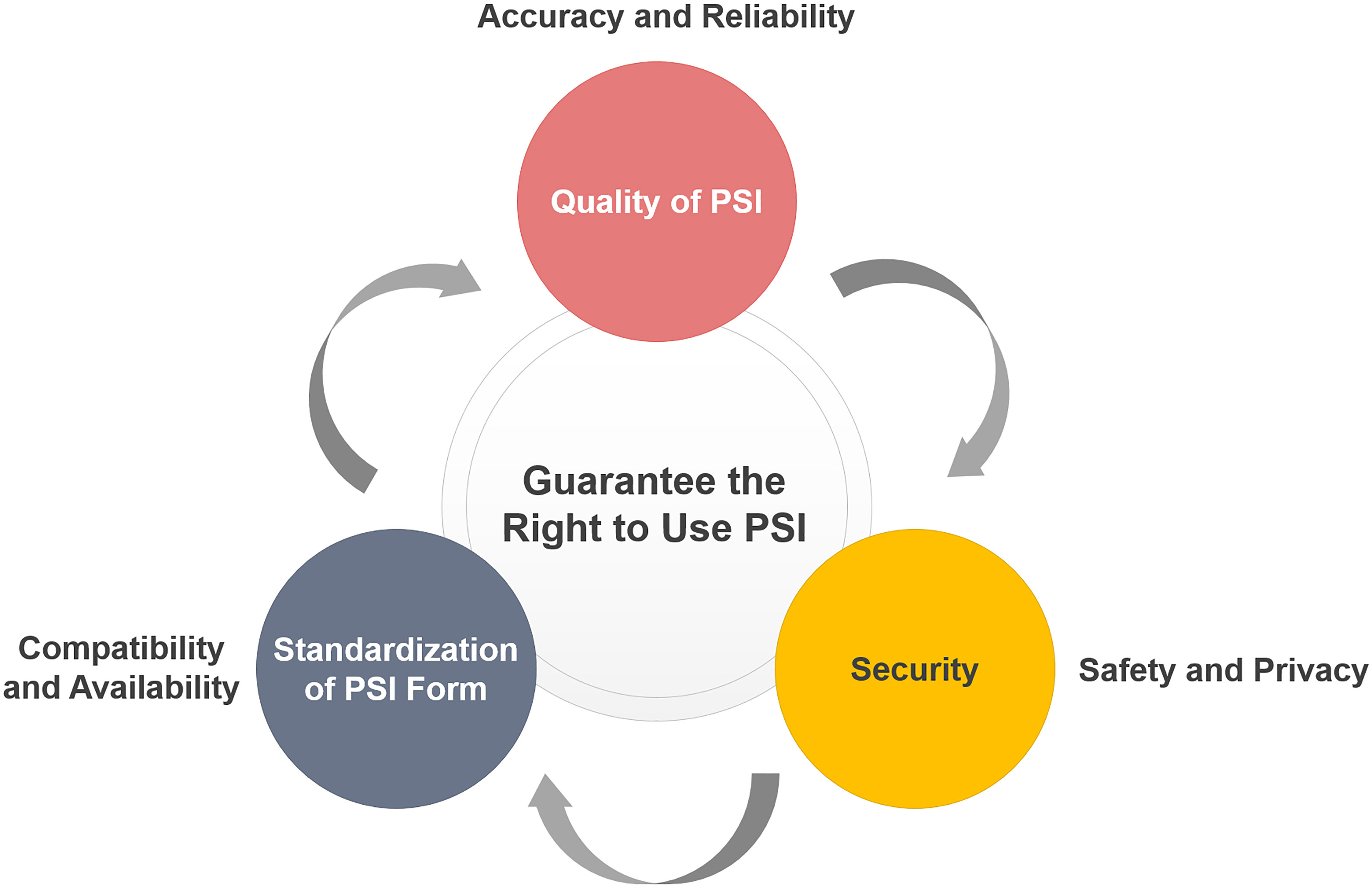
Above all, the basic premise of PSI policy is to provide a sufficient amount of information. Therefore, it is possible to consider expanding the scope of data provision under the “Act on Promotion of the Provision and Use of Public Data or the Information Disclosure Act” so that various PSI that the public needs can be preemptively provided. In particular, the validity of the cause of data non-disclosure should be periodically checked to encourage each institution to actively open up more PSI.
The quality of PSI should also be improved. The method is to designate national master data to identify and provide data in core areas and to improve the quality of data by communicating with the people. For example, it is necessary to designate, find and provide national master data in important areas, such as land, public health, and finance. As of April 2018, the Korean government has selected and provided a total of 45 national master data. In this regard, if the law specifies the selection criteria of data, scope of the provision, and involvement of the private sector, it will surely guarantee the citizens’ right to use PSI and make it possible to actively seek ways to use PSI to create added value.
At the same time, the policy that should be implemented is the standardization of data. If the data is provided machine readably by the open API method, the data itself should be standardized so that it can be used efficiently by the private sector. It is necessary to improve the public by unifying and standardizing data, format, providing procedure, and platform. To do this, it is necessary to investigate whether or not standardization of the current PSI is provided. In addition, a legal basis and budget for conducting the survey should be established, and a collaboration system should be established between relevant agencies, such as administration and statistics. Also, PSI provision should expand open API application; this is a friendly delivery method to software developers, who are considered to be major users of PSI.
Overall, these considerations should be established and reviewed at every stage of the process, from the construction of data to the provision and utilization of data (Fig. 2).
The PSI policy is directly related to the goal of “securing the power for economic development”, unlike general information disclosure, which seeks to promote administrative transparency and the public’s right to know. Therefore, focusing on the quantitative aspects of “provision” and obsessing with ranking competition should be avoided. Korea is building the foundation of PSI policy based on sophisticated ICT and e-government. In this regard, it is necessary to establish and promote a policy to improve PSI utilization, keeping in mind that the entity that actually creates economic added value through PSI is in the private sector rather than the public sector.
The government has also played a role in ensuring and encouraging the right of PSI use in the private sector. The private sector includes not only companies that can lead industrial development but also civic groups and individuals. A good system is useless unless it is utilized by the citizens. While the law provides the basis for such a useful institution, it should give the government the obligation and responsibility to utilize said system and freely develop the related services. Although there may be ways to support various funds, places, and start-ups, the government should enable the private sector to provide public services.
From this viewpoint, the government should be able to actively support the reuse of data and participation of stakeholders, and the law should also go a step further and provide the basis for governments to actively encourage the use of PSI, protect privacy and security, and solve the disputes that arise during the overall process. Thus, the key elements of data management in the future will be the quality of data (accuracy and reliability), standardization of data form (compatibility and availability), and data security (safety). In particular, as the boundaries of data in each field collapse, the role of individual organizations that own the existing data will be redefined, and further discussions on how to establish such a detailed framework or governance will be needed (Fig. 3).
In the coming data age, the distinction between public and private sectors will be unclear. Evidence-based administration, the transparency of government policy, and the pursuit of small government must inevitably expand the private sphere, a process that will require communication and collaboration. Administration and policy data, which come from authority granted by the people and the taxes they pay, should be able to be surveilled and contained by the people.
The government’s role in data management has begun to expand. If the relevant policy is established and implemented in earnest, the subsequent tasks will be increasing how much the public knows about the relevant system and the level of government capacity to support it. In particular, Korea has achieved success through government-led informatization policies. Establishment of a culture of exchange and communication with the private sector is not an easy path but guaranteeing this will ultimately be the government’s role. In the future, based on communication and collaboration between public and private sectors, the roles and responsibilities of collecting and processing PSI, conducting data quality control, and determining the suitability for reuse related to the disclosure of PSI should be divided among different organizations so that a system of checks and balances can be effectively applied to the process of provisioning and promoting effective and safe reuse of public data in private sectors.
Footnotes
Acknowledgments
This paper is an extended version of a conference paper presented at the dg.o 2018: 19th International Conference on Digital Government Research, Delft, Netherlands, May 30–June 1, 2018.