



Abstract
Smart cities are urban spaces where massive amounts of data are generated and shared creating an ecosystem of service providers. Translating these opportunities into appropriate citizen services requires diagnosis of citizen’s expectations and a projection of the value that these services can generate for them. This article offers a methodology that provides a systematic approach to understand the interaction between citizens and services aimed to improve the design of smart city services and presents a pilot test. The four-phased methodology results in a description of the service, a model to evaluate it and offers quantitative indicators to operate and to improve the design of the service.
Introduction
Smart cities’ topic is a multidisciplinary field shaped by advancements in technology and urban development (Albino et al., 2015; Angelidou, 2015; Gil-Garcia et al., 2018; Meijer et al., 2016). Nam and Pardo (2011) state that smart cities present three main dimensions: technology, people, and institutions; and Meijer and Rodríguez Bolívar (2016, p. 392) state that “smart city governance is about crafting new forms of human collaboration through the use of ICTs to obtain better outcomes and more open governance processes”.
Kuk and Janssen (2011) and Lee and Lee (2014) highlight that in order to be considered as a smart city, the development and management of a variety of innovative services to provide information on all aspects of city life to citizens is required. Some of these services are delivered by their own means and others by a surrounding ecosystem of companies and other organizations (Abella et al., 2015a; 2017). In a smart city, it is possible to tailor the design and delivery of services in a way that meets the specific demands and preferences of different population segments, specific situations, and even individual citizen’s needs. And, the successful management of the delivered services directly impacts their attractiveness (Lee & Lee, 2014). Therefore, to develop better services, it is necessary to bridge the technological tools, the political decisions and the personal perspectives, as citizen’s expectations and experiences (Liu et al., 2014).
In smart cities, the value of Information Technologies -IT- enabled citizen services maintain the interaction between individual citizens and service providers (Webster & Leleux, 2018). In that sense, advanced information technologies and government policies provide the foundational substrate for smart cities (Buck & While, 2017), but translating it into appropriate citizen service requirements and express recognition of citizen preferences requires a projection of the value that these services can generate for the citizens (Belanche-Gracia et al., 2015; Liu et al., 2014).
Vanolo (2016) explores the role played by citizens in smart city projects. No clear conclusions can be drawn. On one hand, it is found that the voices of the citizens are not accounted for in some projects but, on the other hand, in some other projects, they are empowered and the results impact citizens’ lives positively. Therefore, studying the citizen experience in smart cities in relation to the implementation of smart services is a key element to create value (Belanche-Gracia et al., 2015).
Yeh (2017, p. 556) states that “smart city services provide citizens with an improved living environment and increase their overall quality of life”. The users of the services are the citizens and it is necessary to consider their ideas and perspectives for the management of them (Yeh, 2017). Alruwaie et al. (2012) highlight that few researches have analysed the citizens’ motivations to adopt and continuously use e-government services, and there is a lack of models that take into consideration the expectations of service user (citizen). One exception is the method for the Design of Smart Citizen Service provided by Liu et al. (2014) that considers the citizen needs and experiences into the design of services, but it is a qualitative method that has not been empirically validated so far.
In that context, our research question is: How can smart city services be improved considering citizen’s expectations and experiences? Therefore, the main objective of this article is to provide and test a methodology aimed to improve the design of smart city services by considering citizen’s expectations and experiences using them. After accomplishing this objective, we will be better able to (a) make a qualitative and quantitative evaluation of the smart city services from a citizen’s perspective; (b) run efficiently the services by considering a better resource allocation; and (c) to develop a control scorecard to improve the design of smart city services.
The article is structured as follow: Section two explains the role of citizens in smart city services design. Section three presents the research design and methods. Section four describes the proposed methodology and the results of a pilot test, and section five presents the discussion and implications. The conclusions are offered in section six.
Citizens and smart city services
In public sector, managers look for solutions to optimize services and citizens and other stakeholders ask for better services; then, they have influence, through their previous experience, in the development of e-governance and the quality of services (Alruwaie et al., 2012). Some authors have highlighted the role of citizens’ engagement with a city to facilitate the citizen inclusion in governance processes (Klijn et al., 2012; Belanche-Gracia et al., 2014; Elelman & Feldman, 2018). Zubizarreta et al. (2016) affirm that the citizen is the protagonist of the smart city and it is necessary to develop active citizen participation. Vanolo (2014) uses the term ‘smart citizen’ to indicate that people need to adapt to and live in smart cities and that they can participate in the development of smart cities. Then, the citizen is the focus of the design process, as main user of the smart city services (Opromolla et al., 2017). In that sense, in smart cities, the empowerment of citizens, the citizen’s engagement and the ‘democratic innovation’ should be considered (Komninos et al., 2013; Pereira et al., 2018).
A smart city provides citizens with services based on Information and Communication Technology -ICT- (Lee J & Lee H, 2014). Pérez-González and Díaz-Díaz (2015) identify services developed by smart technologies at 26 Spanish smart cities and find that most widely implemented services are those that allow direct reductions in local administration expenditure. The use of smart city technologies and applications to prioritize the knowledge of updated citizen experience problems such as transport, education, and provision of energy or health has been considered of key importance in different regions worldwide (Yeh, 2017). In that sense, U.S., Eastern countries and Europe are strongly investing in specific projects related to those particular areas of interest and oriented to increase the wellbeing of citizens and offer growth opportunities to industries. San Francisco, Dubai, Singapore, Hong Kong and London are good examples of it. In the European Union (EU) some initiatives have also been identified in metropolitan city regions as for example, Amsterdam, Manchester, Barcelona, etc. (Lee et al., 2013).
Stratigea et al. (2015, p. 47) state that “ICTs have enhanced the role of citizens in the production of urban information. Digitization tools and technologies have empowered users as co-producers”. In that sense, a citizen experience in the urban space allows him to report inefficiencies, positive and negative views. According to Kogan (2014), succeeding in smart cities means opening the smart city to the citizen. In her views, the main factor that determines success in smart cities’ initiatives is civic engagement. Civic engagement emphasizes the idea that citizens are customers of city services and, even more, that their active participation in services should be encouraged (Meijer et al., 2012).
In that context, citizens in smart cities demand increasing levels of services, which require higher standards of public resources (Belanche-Gracia et al., 2014). Additionally, there is a growing demand by citizens for participation (Granier & Kudo, 2016; Safarov et al., 2017; Smith & Sandberg, 2018). In that sense, Joss et al., (2017) consider the citizen-centric approach for smart cities and study the citizen dimensions based on the concept of citizenship regime. And, Meijer and Potjer (2018) study 25 cases of citizen-generated open data in different countries and their influence on public governance.
In general, Opromolla et al. (2017, p. 35) state that “citizens have gained more influence in the public decision-making processes and a central role in the definition of the delivered public services”. Citizens claim that services offered by smart cities add apart from technological value, social value too, that make citizens be in a better position to use them. To ensure regular use of smart cities’ services, concepts such as customer service, customer satisfaction, and service quality can be applied (Yeh, 2017). Yeh (2017) studies the factors that determine the use of services based in smart cities’ ICT and finds that citizens present a better willingness to use these services when they are considered of high quality, include innovative concepts, and assure personal privacy.
Previous academic research shows linkages between the perceptions of service quality and customer satisfaction (Pugh et al., 2002). From a rational perspective, an increasing investment in smart city services should create increased satisfaction for citizens using these services. Filtenborg et al. (2017) find that citizens’ expectations are an important predictor of their satisfaction with public services. However, the citizens’ perception of the services provided is not well known.
Emotions involved in the service, ranging from frustration, worry or insecurity can result into engagement when services exceed expectations. Citizens do not usually remember the last time they accessed a service unless some emotions are involved. For future relations with the service, users will be partially influenced by the emotional attachment they remember. Conversely, there are some differential factors that can make the difference for a user’s perception (González-de-La-Hoz et al., 2015). Those factors are the ones that are able to link the citizen (user) with the service. Service designers look for these factors, and especially for those that trigger recommendation-oriented citizens to share the service.
Irani et al. (2012, p. 303) present the ideas of Al Shafi and Weerakkody (2007) that affirm that “citizen satisfaction is a composite performance indicator from various e-government implementations in what it is determined by citizens’ needs such as perceived services, expectation, and the level of the Government-to-Citizen (G2C) relationship”. In that sense, Zenker, Petersen, and Aholt (2013) develop the citizen’s satisfaction index model to understand the role of satisfaction in the urban research field (Zenker & Rütter, 2014) and the importance of citizens’ opinion of the city to the decision makers (Nigro & González Císaro, 2016). This index analyses the location factors that are basic elements for measuring city perception: urbanity and diversity, nature and recreation, job opportunities and cost-efficiency; but it only considers an item for smart city services, “the availability of different services”; however, it does not consider the role of smart cities’ services design in the satisfaction of citizens.
In addition, due to the public character of public services as services to the citizens, the need to take one step beyond Key Performance Indicator (KPI) management was clear. This step consists of assessing citizen’s satisfaction. Citizen’s satisfaction can be measured by surveying users after or during the service. With this information, service managers could ensure the efficient use of resources, by measuring KPI, and determine what service is mostly delivered based on citizen’s expectations. In that sense, Irani et al. (2012, p. 303) explain that “citizens’ expectation can be measured by key performance indicators related to e-government such as efficiency, accessibility and availability”.
In that context, there is an increasing citizen’s engagement in designing public services. Some authors such as Opromolla et al. (2017) describe an example of a project of the Municipality of Bergamo (Italy), SPAC3, that involved the citizens in the design process. But, a method to understand the design of smart city services from a citizen-centric perspective is not yet enough developed. In that sense, Liu et al. (2014) describe a method for Design of Smart Citizen Service (Shèjì Zhìhuì Shìmín Fúwù) with four stages: 1) identify scenarios and episodes; 2) specify service blueprints; 3) characterize citizen experience; and 4) design service constellation. This methodology considers the values, the citizen needs and experiences into the design of services, but it only presents a brief characterization of citizen experience and it is not empirically validated. Liu et al. (2014) model does not consider the quantitative measurement of citizen’s expectations, and does not propose a way to solve the problems identified in the service.
Thus, we consider that citizen’s inclusion in developing smart services is key to improve the attractiveness and success of the smart city. To study the role of citizens in the smart city service design, it is necessary to analyse the citizen’s perception on services (experiences, expectations…) and their satisfaction with city services. Previous literature arguments that this is a necessity; however, there is not a methodology to integrate all the factors related to citizen’s perception on services. In addition, there is a lack of proposals of key performance indicators (KPIs) to evaluate the smart city services by considering citizen’s expectations and experiences. So, developing a methodological approach including citizen’s expectations aimed to analyse how smart cities’ services can be enriched would offer the possibility of improving the design of the services.
Research design and methods
Some ideas and concepts inspired from the Experience Economy (Pine & Gilmore, 1998) and the Customer Experience Management of Brain Trust Consulting Services -CS- (González-de-La-Hoz et al., 2015) have been applied. The customer experience model provided by the company Brain Trust Consulting Services (CS) has been adapted to smart cities services. Their model is based in three international indexes: The Customer Experience Index (CxPi), the Customer Effort Score and the Net Promoter Score (Balan, 2012; De Haan et al., 2015; Spiess et al., 2014). Brain Trust CS model includes five phases: 1) analysis of needs; 2) design and services deployment; 3) modelling the experience; 4) action plan, metrics and tasks; and 5) monitoring and continuous improvement.
To adapt the model of Brain Trust CS to smart city context, we have considered some interesting sources of knowledge. First one is the participation in European projects such as Legal Aspects of Public Sector Information -LAPSI II- (2010–2014) oriented to know the barriers to the use of data in smart cities; in the project Apps for Europe (2013–2015) some ideas about the innovation oriented to the citizen and the creation of apps based on smart city data are developed; and, Finodex (2014–2016) helps us to understand the development of innovative services in smart cities. In addition, the participation in committees such as the CTN 178 (Smart Cities Standardization Committee of the national standardization body of Spain) to the elaboration of the UNE 178301:2015 norm; and in the Smart Cities’ Committee of AMETIC (the Spanish Association of Information Technology Companies) offer us the possibility to maintain informal interviews with academic and business experts to better understand the role of citizens in the design of smart city services.
Then, we have developed a methodology to improve the design of smart city services considering the citizen experience. First, the interest for developing a methodology on citizen’s experience has been identified (Abella & Ruiz, 2015) and early proposals adapting the five phased model of Brain Trust CS company to the context of smart cities have been provided (Abella et al., 2015b). Second, by having into account expert’s opinions and our own experience on this topic, the five proposed phases were consolidated into four. Third, the development of content for each phase has been improved, in such a way that for each of them, the objective, the actions to perform and the outputs are described. The methodology is developed in Section 4.1.
Once the methodology has been developed, a pilot test has been run. The city council of Alcobendas (Madrid) offers citizens a free service to obtain the certificate of residence and it was interested in knowing the opinion of citizens to improve the service. For this reason, the city council signed an agreement with Brain Trust CS to perform this pilot test. The pilot test is explained in Section 4.2.
Results
A methodology to improve the design of smart city services
The methodology developed for the improvement of the design of services in smart cities defines and evaluates in a qualitative and quantitative way the attributes, channels and different group targets for each service; it identifies the aspects to improve the service and proposes a roadmap of actions to enrich the service and the creation of a scorecard to help in the implementation and control of processes. The methodology consists of four phases.
Phase 1 – Service identification
Objective: The goal is to determine the scope and the main dimensions of the service to be considered prior to be designed or redesigned.
Actions to perform:
The benchmark of the equivalent service in other smart cities. The identification of the strategic goals of the services. Common goals include an increase on the efficiency of the service, an increase on the involvement of the citizen, or to launch innovative services. The identification of the attributes, that is the elements of the service appreciated by the user of the service. Focus groups or other qualitative survey method can be used to determine the needs of the users, not only explicit but also implicit, and to identify these attributes, for example, innovation, save time or trust. These focus groups, or equivalent tool, have to take into account the potential target groups for the service. And according to this, the final design has to consider the relative weight of the different target groups and how they are weighted into the final design. The deployment of attributes into KPIs. KPIs and the metrics to assess them must be identified in each service in order to be able to manage the service and to determine if expectations will be met. For example, in the pilot test, one of the attributes was the time to obtain the census certification once in front of the civil servant.
Output:
A matrix with the attributes and KPIs of the smart city service (Fig. 1, Phase 1).
Matrix: Phases 1 and 2.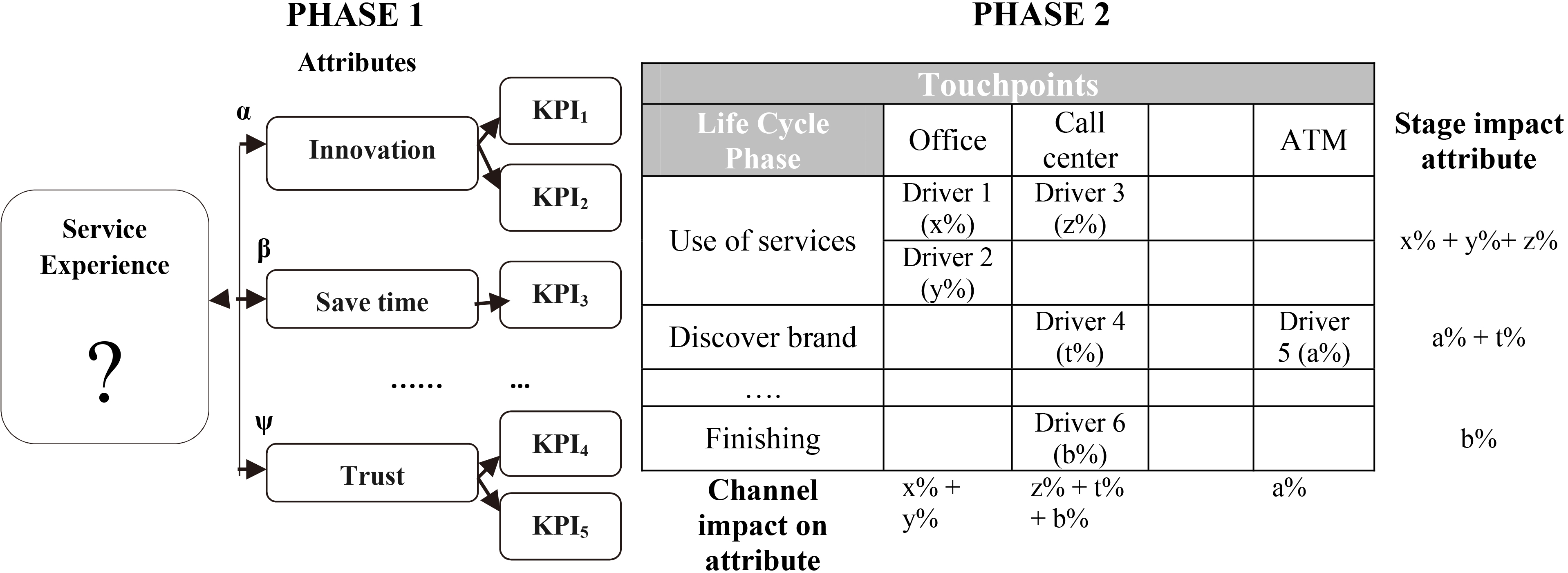
Objective: The goal of this phase is the identification of the contact moments between the citizen and the service, and the measure of KPIs based on them.
Actions to perform:
To identify the different channels. It is common in smart city services to repeat the same service (i.e., retrieving information about transport passes and purchasing them) via different channels such as call centres, the city’s web pages, apps (internal or external), kiosks. The design of the service and the identification of the citizen’s life cycle of the service for every channel managed by the city. Based on González-de-La-Hoz et al. (2015) and Abella et al. (2015b), the generic stages of the citizen’s life cycle are: awareness, contact, use, citizen management, billing and engagement.
Awareness. This stage of the process determines the citizen’s knowledge on the service and its specific processes in order to increase awareness (promoting advantages, features, availability, etc.). It is rather important because previous knowledge could dramatically determine the expected results, and, therefore, the citizen experience. In previous examples (i.e., purchase of transport tickets), awareness includes awareness of marketing and advertising of the smart city public transport pass.
Contact. This stage includes all the processes that offer any possibility for the citizen to start his relationship with the service including the provision of the contact details and available mechanisms for accessing the service. In the example, contact could include the information available in the call centres, web pages, etc., about the options, prices, etc., of the bus pass.
Use. This stage includes the processes to subscribe, use and request the service including those services considered compulsory for citizens (tax payment). In the example, it could include the use of the pass ticket in the different public transport facilities.
Citizen Management. This stage includes the internal processes of the city that finally impact the delivery of the service to the citizen except those defined in next stage. In the example, it could include the design of the ticket, the subscription options, etc.
Billing. This stage includes the processes that involve any bureaucratic and billing procedures and any processes addressing any incident/change related to these (i.e., in the ticket example, the option to pay for the pass with a credit card, PayPal, in person at local public offices, claims on wrong billings, etc.)
Engage. This stage includes any process addressing the continuous contact with the citizen after the service is delivered including those activities that assess the performance of the service, the citizen experience, and those processes that ensure a proper service delivery or the chances for the citizen to recommend the service. It also includes the potential renewal/change of the service once the service has been delivered. The identification of the moments of truth (MoT). MoT are those interactions between the citizen and the service in which there could be some kind of emotional involvement of the user. The triggers will be identified. Those triggers (i.e., answering on time in a call centre) could affect several attributes differently to several groups of citizens. The attributes were identified in previous phase. These triggers are the components of the service that can be changed/improved, as it is described in next phase. To identify target groups with a similar behaviour/perception of the service. This classification does not necessarily involve grouping citizens according to economic welfare, age, gender, etc., but it considers other kinds of factors relevant to the appreciation of the service. Every group presents different needs and expectations. For every one of these target groups, the set of attributes expected for every contact point is defined.
Output:
To present a complete matrix that contains information about the contact points (MoT) for every stage and each channel. The resulting information is a sparse 3-dimensional matrix with (Fig. 1, Phase 2):
Six stages in the first dimension, corresponding to the life cycle of the service described previously. N channels in the second dimension, corresponding to every channel available for the service (App, in person, telephone, etc.). M target groups in the third dimension; and for every point, a description of what should be delivered in order to meet or exceed a citizen’s expectations is provided. Thanks to this matrix it is possible to estimate how the modification of certain attributes of the service would quantitatively affect to the different target groups.
Objective: To define a project plan to implement a new or updated version of the service.
Actions to perform:
To identify a set of changes. To identify changes, it is required to analyse where the problems are located: in what attributes of the service, what channels are involved and what the target groups are. The systemic innovation policy framework proposed by Wieczorek and Hekkert (2012) provides a guide to group problems according to four structural dimensions: actors, institutions, infrastructure and interactions. By considering these dimensions, for each of them, the following aspects can be analysed: where the problems in order to identify the required changes are. Previous authors define four systemic problems that can be also used to analyse smart cities services:
The presence or capabilities of the actors (citizen, target group…). The presence, capacity or quality of the institutional set up (smart city). The presence, intensity or quality of the interactions (citizen’s life cycle, moments of trust). The presence, quality or capacity of the infrastructure-physical, financial and knowledge (channels). To define the actions and to estimate the efforts for the actions to implement these changes. Due to the limited resources available, actions have to be grouped, filtered and prioritized. They have to be planned identifying the responsible people involved, resources that need to be committed, and a Gantt chart to synchronize the actions. This global action plan compiles all this information and proposes several cycles of improvement according to the availability of resources (budget, time to implement solutions, need for new procedures, etc.). Actions could include the development of new applications, training for people in contact with citizens, changes in the requirements for subcontracted services, or launching new internal regulations on how to deliver the service to the citizens. The implementation of the activities of the project plan according to an incremental approach.
Output:
The project plan sets a roadmap of the actions to be implemented according to availability of resources. To present a list of aspects oriented to improve the service.
Objective: Once actions are implemented, monitoring has to be carried out to determine if the actual impact differs from the expected impact. If there is a difference, then the model should be reviewed accordingly.
Actions to perform:
To make verification tests for each channel and point of contact before and after implementing changes in the service. Internal training on the metrics, indicators and impact on citizens’ needs must be provided to the people involved in the management of the service. The creation of scorecard of the redesigned services to follow the evolution of the KPIs.
Output:
A report assessing the smart city services comparing expected and actual results. A change plan to implement corrective actions due to the differences between expected and actual results, and their impact on KPIs.
Based on the proposed methodology, a pilot test has been developed between November 2015 and April 2016. The pilot test consists on analysing the citizen’s opinion on the service provided by the Alcobendas town hall to get a certificate of residence. Alcobendas is a municipality located in the north of the Madrid region in Spain. In 2017, it had 115,896 inhabitants. The global aim of the pilot test was to understand the low percentage of use of the online channel to obtain the certificate. This channel was the most efficient in terms of resources of the municipality. Eventually, measures to change the channels share of users will be considered.
Phase 1 – Service identification
To identify the strategic goals and attributes of the service, an online questionnaire was built based on experts’ opinions (qualitative study). This questionnaire was answered by 1,968 citizens who spent approximately 10 minutes completing it, which allowed for a quantitative analysis of the different aspects studied. With this information, a proposal of KPIs for each attribute has been performed (Table 1).
Pilot test: Matrix of results
Pilot test: Matrix of results
Source: Author’s elaboration based on Brain Trust survey data.
For the processing of the census certificate, three channels were analysed: face-to-face, online and telephone. The following dimensions of the life cycle were tested:
Awareness. Citizens were asked about their level of knowledge of the service. Ninety percent of the respondents considered the service to be of interest to them.
Contact. Citizens were asked about the contact channel used to request the service. Twenty-three percent used the face-to-face channel, 16% online, 1% telephone and 60% did not use this service in the last year. Regarding the reasons for using the face-to-face and telephone channels versus the online channel, it was remarked that:
They did not know that it could be processed online (58% for the face-to-face channel users and 38% for the telephone users); This channel was more convenient (19% for face-to-face channel users and 50% for telephone users); The remainder mentioned other reasons such as not having credentials (11% and 8% respectively), not being able to print it (8% for face-to-face users) or because the citizen tried using the online channel but the census certificate never arrived (6% for telephone).
Use. They were asked about the use characteristics of the service: accessibility, ease of use, and reasons to use it. Among the users of the face-to-face service, 56% used the census certificate to get an ID or passport and residence permit. For the users of the online service, 50% requested it to get an ID or passport for the civil registry. Among those who used the telephone channel, 50% used it to get an ID or passport and the civil registry.
Billing. The service is free.
Engagement. We propose a list of reasons for recommending the service by considering the opinion of experts: speed/agility, treatment, service offered, ease of use/simplicity, comfort/convenience, accessibility and efficiency. The citizens were asked about the importance of each reason.
A matrix has been elaborated from the obtained results, and the KPIs are incorporated for each attribute and phase of the service (Table 1).
Considering the actor’s problems, interaction problems, institutional problems and infrastructure problems, a proposal of potential problems of the service has been developed. In that sense, citizens were asked about aspects that could be improved such as waiting time, internet usage, schedules of the council’s premises, speed, travel and service offered. For each channel, the obtained results were identified. The users of the face-to-face service indicated that the main aspects that needed improvement were the waiting time (20%) and the fact that they would have preferred to do it online (17%). Users of the online service identified only two aspects that needed improvement: service operation (50%) and ease of use (21%). Furthermore, the citizens who carried out the procedure by phone did not identify any aspect to improve.
Based on the results obtained, action proposals were recommended for the improvement of the service, such as the putting into practice of a communication plan recalling the service and the different channels to manage it, limiting the citizen’s need to have to request the census certificate, and encouraging and facilitating the access for online requests.
Phase 4 – Feedback and control phase
Results were presented to the manager of the service and a proposal for the building of a scorecard to control and improve the service and to assess timely evolution of the service according to citizen’s expectations was provided. Main conclusions derived from the study were that the citizen was very interested in the service but, in many cases, he did not know all the available channels, specially, online ones. The need to build a friendlier access to online processing was diagnosed. The implementation of the change plan was out of the scope of the presented project.
The pilot test contributed to the revision of the methodology and to the development of each of its phases. It was useful to diagnose the convenience of identifying a group of KPIs that can be applied to the evaluation of most part of a smart city services, in such a way that can become key points of start aimed to promote a quantitative evaluation of services.
Discussion and implications
The proposed methodology offers different contributions to previous literature. On one hand, it is a methodology that adapts other proposals used by firms in the context of smart cities. On the other hand, it enriches and widens other methods developed to design services in smart cities in the following aspects: it considers the characteristics of the service (attributes, channels…) and the citizen’s perception of the service by target groups, it proposes the use of key performance indicators (KPIs) to evaluate the attributes of the smart city services, and it includes an action plan and scorecard to improve the design of the services. Therefore, the proposed methodology suggests combining qualitative and quantitative techniques to know citizen’s opinions on a service. This methodology helps in doing a personalised evaluation for each service, since it promotes the development of a matrix based on the attributes (with their KPIs), channels and groups identified for that particular service. The proposed methodology allows offering a list of changes to develop the service and it can be applied at different moments of service life cycle to analyse the evolution of the service and improve its design. Even more, it helps the service managers to practice an efficient use of resources from a citizen-centric approach and to assess how potential changes would affect citizen’s perception.
The proposed methodology condenses to a set of instructions and directions on how to manage a full service from the perspective of the experience lived by the citizen using a multichannel approach. Multichannel means addressing the face-to-face, telephone and digital interaction. Digital interaction includes web interaction and app interaction. Therefore, the user experience (UX) interaction is embedded in this methodology.
From citizen’s perception, the methodology provides a mechanism to consider the rational aspects of the process, but especially the emotional ones. So, implicit and explicit needs have to be identified including those expectations, former knowledge, motivations and commitments of citizens that affect their experience. The resulting design takes into account the emotional involvement of the user of the service and design differential experiences for them.
Hence, key performance indicators (KPIs), which measure some simple elements of the service, provide some basic answers about the used resources and primary elements of the service provided. Currently, with the easy access to data in digitalized services, KPIs can provide extensive information. Performance management was based on those KPIs, and it is necessary to pay special attention to the control of the customer and learning and growth perspectives (Sofiyabadi et al., 2016). Therefore, dissatisfactory services can continue having excellent KPIs but many annoyed users. The relation between involved resources and service KPIs can initially help to redesign and optimize a service.
This research also presents practical implications for governments and citizens. In this sense, Madyatmadja et al. (2018, p. 869) state that “the goal of e-government initiatives is to assure how the government improves services so that public trust and satisfaction are increasing”. Aloud and Ibrahim (2018, p. 5022) stress “developers should consider user requirements during design and development of services”. So, as citizens observe that their opinion is considered to improve the design of smart cities’ services, there are more chances that they keep on using these services, have more trust and be more satisfied. This way, the investment done by the government for the putting into practice of these services is optimized. Yeh (2017, p. 557) highlights the ideas of James (2009) and Zenker and Rütter (2014) that indicate: “more frequent use of city services relates closely to good service performance, more satisfaction with urban management, and a better quality of life in the city”.
The emergence of a fully connected citizen in current cities would allow citizens to turn into active agents of smart city services and creates the opportunity for cities to benefit from citizens’ co-creation. Their will to participate, however, varies extraordinarily between citizen’s groups.
Furthermore, the improvement in the design of smart cities’ services impacts on citizens’ quality of life (Yeh, 2017). Annibal et al. (2013) stress that an improvement in citizen’s quality of life has a positive impact on smart city competitiveness as it facilitates the creation of new businesses and the political and cultural life of the citizens
The described methodology allows the smart city managers to understand the real expectations, determine the target groups, identify the service attributes, improve existing services, and optimize resources while maintaining the same delivered experience while using the same, or less, resources.
Conclusions
The experience of citizens becomes a basic element in the design of smart city services. The high technological component, the potential innovation in services and the lack of stable references make citizens’ involvement in smart cities’ services more necessary than in other environments. For that, in this article, the following research question has been been considered: How can smart city services be improved considering citizen’s expectations and experiences?
To answer the research question, a four phased methodology to analyse and improve the design of the smart city services considering the citizen perception of the service has been built. We have observed that the real challenge for smart cities is being able to classify which elements of the service are really appreciated by the citizens, which ones are considered essential and which others are taken for granted. Therefore, investments should be increased to ensure service for those elements that are considered basic and indispensable, but also for those elements of the service that citizens perceive as differential or exceeding their expectations.
In addition, the pilot test performed offers a first proof of the usefulness of the proposed methodology. To promote an effective evaluation of service is key to do a right definition of service’s attributes and its measurement indicators. To segment opinions coming from different channels and target groups is important to consider specifics and be able to deliver improvement measures aligned to each group of citizen’s specific needs. However, as it is a methodology that has to be customized to each service, there is a need to develop more cases of study aimed to improve it. Future evolution of this methodology could involve the identification of best practices in the design of smart cities services.
There is a need for research on effective strategies for cities to become smarter that account for the particular context, strengths, opportunities, urban development objectives, and approaches mobilizing the participation and intelligence of citizens, companies and societal organizations (Corrales-Garay et al., 2019; Komninos et al., 2013).
Finally, the increasing affordability of big data facilities, and their user-friendly implementation process, opens the opportunities of a massive customization practice for smart city services. In that sense, Kitchin’s explanations (2014) on big data impacts on cities and the development of the real-time smart city may serve as starting point.
Footnotes
Acknowledgments
To Mr. José Luis Ruiz and Mr. Juan Bosco De La Rocha from Brain Trust CS for their invaluable collaboration in the elaboration of this research. To the anonymous reviewers for their valuable comments which have improved the clarity and quality of the paper. This research was supported by Project ECO2015-67434-R of Spanish Ministry of Economy and Competitiveness (Spain) and by 2