



Abstract
Local governments are increasingly developing electronic participation (e-participation) initiatives, expecting citizen involvement in local community affairs. Our objective was to assess e-participation and the extent of its change in local government in Greece. Using content analysis for 325 Greek municipal websites, we assessed e-participation status in 2017 and 2018 and examined the impact of change between these years. The assessment regards two consecutive years, since the adoption of digital technologies by municipalities has been rapid. The main findings show that Greek local governments have made significant small- to medium-scale changes, in order to engage citizens and local societies electronically. We conclude that the integration of advanced digital technologies in municipalities remains underdeveloped. We propose that Greek municipalities need to consider incorporating new technologies, such as mobile apps, social media and big data, as well as e-decision making processes, in order to eliminate those obstacles that hinder citizen engagement in local government. Moreover, the COVID-19 outbreak has highlighted the need for enhancing e-participation and policymakers’ coordination through advanced digital technologies.
Introduction
Local government constitutes the level of government with which citizens interact more often, since it has a direct impact on the daily life of local communities. Specifically, 50%–80% of most Europeans’ interactions with government occur with local government (UN, 2018). Local governments provide a variety of services (e.g., social, cultural, environmental, and health), and have developed unique components and functions that are encountered only at this level of government (UN, 2018). As citizens show an increasing interest in participating in local community issues (Costopoulou et al., 2017), local governments can play a key role in increasing citizen electronic participation (e-participation) following a bottom-up approach, especially during the COVID-19 outbreak.
E-participation promotes citizens’ empowerment by enhancing government-citizen interactions, improvement of access to information and services, and the public’s engagement in policy and decision-making through Information and Communication Technology (ICT) (UN, 2016; Zheng, 2017). It reinforces democratic and instrumental values (Lee & Kim, 2018) and fosters civic engagement, and open and participatory governance focusing on citizens’ needs thus creating opportunities for consultation and dialogue between citizens and governments, and making societies more inclusive (UN, 2016; Wirtz et al., 2018).
Lately, research interest in e-participation has gradually increased, as new tools, platforms, applications, and the advent of social networking have transformed citizen interaction, voting and decision-making, democratic processes and transparency, and politicians’ and public officers’ accountability (Rodríguez-Bolívar et al., 2018). However, at the local level, evidence from literature shows that these tools are mainly used merely to provide information and services to citizens rather than to support two-way transactions, transparency, inclusion, and participation (Dolson & Young, 2012; Zheng et al., 2014; Norris & Reddick, 2013; Cumbie & Kar, 2016; Bearfield & Bowman, 2017; Mossberger et al., 2017; Feeney & Brown, 2017). According to Rodríguez-Bolívar et al. (2018), who analyze the thematic evolution of e-participation research, future studies should further examine whether e-participation tools are promoting citizens’ inclusion and identify the role citizens play in local government and decision-making processes.
In light of the above, our objective is to empirically study citizen web empowerment in Greek local government for two consecutive years, since the adoption of digital technologies by municipalities has been rapid. Assessing the status of e-participation in Greek society is meaningful, as it can be linked to citizens’ quality of life and constitute a potential political barometer of democratic diffusion.
Specifically, we present quantitative evidence from the evaluation of all 325 Greek municipalities, based on the Citizen Web Empowerment Index (CWEI) (Bellio & Buccoliero, 2013a; Buccoliero & Bellio, 2010). Thus, this article seeks to contribute to the emerging field of e-participation by providing data from Greek local government. We believe that research in citizen empowerment and e-participation is extremely important not only for policymakers but also for the society as a whole, as it can strongly reinforce citizens’ participation in local matters, thus fulfilling the essence of democracy, which is the real representation of the voice of the demos or people.
We review the current literature in local e-participation in light of the objectives of the study. Next, we present the CWEI index as the key e-participation metric in our research, and the statistical analysis of the results of the total of Greek municipalities’ websites for 2017 and 2018. Finally, we conclude by highlighting the key findings, limitations, future research directions, and further proposals for policy makers and government authorities.
Background
Literature review
In recent years, e-participation has received considerable attention from the research community, resulting in an increase in knowledge in this multi-disciplinary and fragmented field (Rodríguez-Bolívar et al., 2018). For instance, research initiatives have focused on e-participation from different perspectives, targeting the complex public administration system (e.g., social, organizational, and technological) (Steinbach et al., 2019) and different government levels, that is central or local. In this section, we review the current literature on e-participation from the perspective of local government, focusing on particular case studies.
The literature review methodology adopted in this study has the following three steps: a) identification, referring to the specification of the research focus and search strategy; b) selection, regarding the review conduct; and c) results analysis. In the following, the identification step is described:
Research focus: The literature review was undertaken with a view to identifying case studies in local government. Selection of data sources: The search focused on high-quality peer-reviewed articles. Two international research databases, namely Scopus and Web of Science, were selected. The search was carried out in September 2020. Definition of the keywords: The keywords included several combinations and synonyms, to ensure that papers with similar content were not excluded. These combinations of keywords include three sets. The first set includes the terms “e-participation” OR “electronic participation” OR “eParticipation”; the second includes the terms “local government” OR “municipal*” OR “city” OR “local level” OR “regional level”; and the third, the term “case study”. At least one keyword from each set had to occur in the title, abstract, and/or keywords. Exclusion criteria: These were identified for the selection of the articles. Only studies in English, in peer-reviewed journals or conferences, published from 2016 onwards were included in the search. It should be noted that studies published earlier than 2016 have been reviewed in the study by Steinbach et al. (2019). Studies focusing on central government and individual sectors, for example, health and tourism, were not included.
The literature search in the two selected databases was refined on the basis of the exclusion criteria. Figure 1 presents the result analysis. The Scopus database search resulted in one hundred and seventy-four (174) documents in the English language, of which eighty-five (85) are journal articles and eighty-nine (89) are conference papers. Their publication distribution is as follows: thirty-four (34) in 2016; forty-one (41) in 2017; thirty-one (31) in 2018; forty-four (44) in 2019; and twenty-four (24) in 2020. They are categorized according to subject areas. One article can belong to more than one of the subject areas. The categorization is as follows: “Computer Science” (128); “Social Sciences” (74); “Mathematics” (29); “Business, Management and Accounting” (27); “Decision Sciences” (20); “Engineering” (12); “Environmental Science” (7); “Energy” (4); “Medicine” (3); “Earth and Planetary Sciences” (2); “Psychology” (2); “Arts and Humanities” (1); “Materials Science” (1); and “Pharmacology, Toxicology and Pharmaceutics” (1).
The Scopus database provides a list of keywords for the documents included in the search results. The ten most popular keywords in order of number of occurrences are the following: e-participation (121); e-government (60); decision making (35); government data processing (35); social media (30); social networking (online) (29); citizen participation (26) and smart city (16).
The Web of Science database search resulted in twelve (12) documents in the English language, all of which are journal articles. The publication distribution of these articles is as follows: two (2) in 2017; four (4) in 2018; two (2) in 2019; and five (5) in 2020. The articles are categorized according to particular research areas. One article can belong to more than one of the research areas. The categorization is as follows: “Environmental Sciences” (3); “Green Sustainable Science Technology” (3); “Communication” (2); “Environmental Studies” (2); “Information Science Library Science” (2); “Political Science” (2); “Regional Urban Planning” (2); “Public Administration” (1); “Business” (1); “Economics” (1); “Environmental Engineering” (1); “Management” (1); and “Geography” (1).
Selection steps of literature search.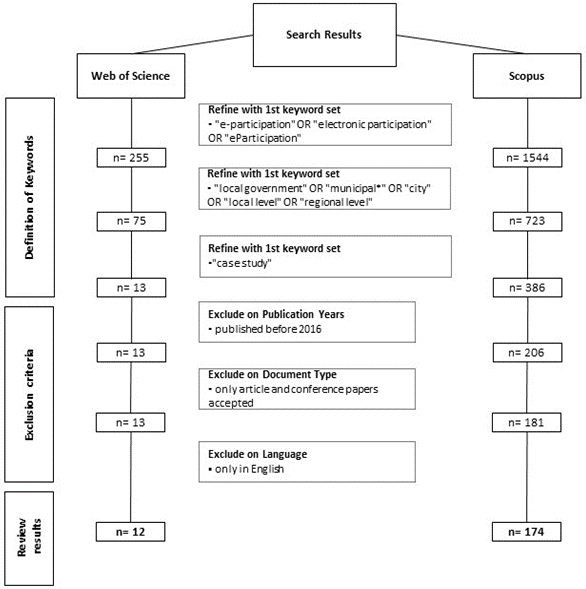
Many governments worldwide have been adopting decentralization reforms as a means of enhancing democracy in local governance and increasing local community participation in such acts. According to Barnett and colleagues (1997), democratic local governance is the development of reciprocal relationships between local government and citizens. In Europe, Greece is considered to be one of the countries with the most centralized administration (Hlepas, 2020). Decentralization has been on the political agenda of several governments since the 1980s.
According to Hlepas and Getimis (2011), several waves of decentralization reforms have been implemented by the Greek government. During the period between 1982 and 1995, reforms for broadening legitimacy and transferring competence to local government were undertaken. Between 1996 and 2000 the reform mainly concerned the evaluation of territorial reform orientation, as well as efficiency in the context of Europeanization. The most significant reform was entitled the “Kapodistrias Plan” and was launched in 1997. It succeeded in amalgamating 5,825 local government agencies into 900 municipalities and 133 communities. Thus, the total number of local government agencies was reduced by nearly 80%. Finally, between 2010 and 2011 territorial and functional reforms were launched throughout Greece. In particular, in 2011 Greece applied a structural reform of local government entitled the “Kallikratis Plan”, which promoted political values, such as accountability, transparency, fair policy, democratic decentralization, and participation (Sofianou et al., 2014).
Currently, Greek local public administration is organized on the basis of the Kallikratis Plan. It consists of 7 decentralized administrations, 13 administrative regions, and 325 municipalities. It should be noted that before the Kallikratis Plan there were 1,033 municipalities and communities. Municipalities and administrative regions are self-governed. A municipality is governed by a council and the mayor. A region is governed by a council and a governor. Municipal and regional councils, as well as mayors and governors, are elected every five years by citizens (Sofianou et al., 2014). The Monastic State of the Holy Mountain, which is autonomous and self-governed, was exempt from the aforementioned reforms. Before the aforementioned programs, the role of local government was limited in the Greek administration system. Greek local government changed substantially after these reforms, resulting in a more active civil society (Hlepas, 2010).
Greek administration is characterized by a tradition of strong political representation, weak welfare, and clientelism (Batzilis, 2019). It also lacks a citizen participatory culture (Nikolaidou & Kolokouris, 2016). As stated by Hlepas and Getimis (2011), between 1995 and 2000 there has been a sharp decline in citizen participation in local government issues. The advent of Web 2.0 and social networking has improved citizen participation with the development of new communication tools, such as blogs, social media and participatory platforms (Martzouki et al., 2017). However, a significant driver of citizen e-participation is trust in government (Zolotov et al., 2018; European Commission, 2019a). Greece is ranked second lowest among EU countries in terms of trust in national government. Practically, only about two in ten people (22%) tend to trust the national government (European Commission, 2019b). Thus, it is extremely important to assess the status of e-participation in Greek society, as a means of examining the extent of democratic engagement.
e-participation metrics
The notion of e-participation is continuously evolving to incorporate and promote different aspects of democracy (UN, 2016). It is defined as the use of ICT to broaden and deepen political participation by enabling citizens to connect with one another and with their elected representatives (Macintosh, 2004). Factors influencing e-participation development include international drivers of change, demographic characteristics, level of ICT development, level of democracy, types of participation, decision-making and legal framework, institutional and political resistance, digital divide, security and trust, privacy concerns and autonomy, attention to the demand side, and evaluation (Vidiasova et al., 2017).
ICT has the capacity to facilitate citizen participation in public affairs. Basic tools (i.e., email, online chatting, online discussion forums), Web 2.0 tools (i.e., blogs, Facebook, Twitter, and other social networking sites), mechanisms (i.e., electronic voting and reputation systems), and tracking and analysis techniques (i.e., data mining, simulations, and data visualization) can encourage citizens to contact government, express themselves, participate in discussions, and propose public issues.
The ultimate goal of citizen e-participation is to enhance citizen empowerment, which has been facilitated through ICT, thus introducing e-empowerment. Macintosh (2004) defines e-empowerment as “using technology to empower citizens and support active participation and facilitate bottom-up ideas to influence the political agenda. Citizens are considered as producers of policies rather than just consumers, as in the previous levels”. According to Wimmer (2007), e-empowerment can support the conveyance of influence, control, and policymaking to citizens, thus enhancing democracy in societies.
The evolution of global e-participation is captured every two years by the United Nations (UN) in its e-government survey (UN, 2018). The survey uses the E-Participation Index (EPI), which is based on three criteria: electronic information (e-information) provision over the Internet, electronic consultation (e-consultation) available publicly online, and electronic decision-making (e-decision-making) for direct citizen involvement in decision processes. The EPI index depicts at a particular time the availability of e-participation tools on national government portals for serving the three aforementioned criteria. The UN ranks countries around the world according to the EPI index, thus highlighting key global trends in the evolution of citizen engagement (UN, 2014; 2016).
EPI is measured annually and can take values between 0–1. According to the 2018 UN E-Government Survey, Denmark, Finland, and the Republic of Korea all have an EPI equal to 1 and are jointly ranked first, followed by the Netherlands with an EPI of 0.98. Greece is considered to be among the leading countries in e-participation development, with an increasing EPI. From an EPI score of 0.61 in 2016 (65
While EPI offers worldwide and easily accessible secondary data about e-participation adoption at the national level, it is not suitable for local government assessment (Steinbach et al., 2019). Recently, the UN proposed the Local Online Service Index (LOSI), a pilot multi-criteria instrument for local e-government assessment. The index comprises four criteria, including a “participation and engagement” criterion with indicators, such as real time communication, online deliberation processes, and feedback about consultation processes (UN, 2018). Although LOSI appears promising, it is still under development by the UN.
The CWEI index was selected to assess municipal websites. CWEI is a specialized index to measure e-empowerment at the local level and has been implemented by scholars particularly for the case of municipalities (Bellio & Buccoliero, 2013b; Ntaliani et al., 2015; Costopoulou et al., 2017). CWEI has four sub-indicators, namely E-Information (EI), Web 2.0 Tools and Strategies (WTS), E-Consultation (EC) and E-Decision making process (ED) (Bellio & Buccoliero, 2013a; Buccoliero & Bellio, 2010). Each sub-indicator is composed of specific criteria. The sub-indicators and their criteria are as follows:
E-information (EI) refers to the information provided by the municipality to citizens to assist them in daily life activities, and raise awareness of municipality issues, events, and decisions. It comprises seven criteria: government structure; segmentation or life events; contact details; policies and procedures; budget; city council minutes; and newsletter/web magazine.
Web 2.0 tools and strategies (WTS) concerns the various tools used by the municipality to establish different types of communication with its citizens. It comprises six criteria: blog/forum; chat; social networking tools; mobile services; Web TV; and open government data strategy.
E-consultation (EC) refers to ways of gathering information from citizens, their opinions and complaints. It comprises four criteria: online polls and surveys; online complaints; reputation systems; and the Mayor’s direct online relationship with citizens.
E-decision making process (ED) refers to information on how citizens’ opinions are expressed through different tools (e.g., polls) and taken into account in the decision-making process, as well as the resulting actions undertaken by the municipality. It comprises two criteria: citizen opinion consideration and evidence for complaint consideration.
Table 1 presents the aforementioned criteria and sub-indicators.
Criteria per CWEI sub-indicator
As explained above, the purpose of this research endeavor was to contribute to the emerging field of e-participation provision by examining the CWEI in Greek local government (i.e., municipalities). To this end, we focus on the following research questions:
Research Question 1: What was the status of e-participation provision in local government in 2018? Research Question 2: What was the actual progress of e-participation in local government in 2017 and 2018? Research Question 3: What was the association between CWEI 2017 and CWEI 2018? Research Question 4: Is there a significant change in the extent of e-participation in local government?
In this section we present the measurement of e-participation in Greek municipalities for 2017 and 2018. According to the Digital Economy and Society Index country report for Greece (European Commission, 2019c), e-government services remain one of the most challenging areas for the digital economy and society. Greece’s performance in digital public services and digital skills further improve and contribute to the development of the digital economy and society.
As regards connectivity, the shift to fast broadband connections is slow-paced in comparison to other European countries. On the positive side, 4G coverage has increased in Greece (88%) and is now close to the EU average (91%). Greeks are active users of internet services, but the integration of more sophisticated digital technologies remains low. Greece is making progress in e-government, but its performance is well below the EU average and it ranks last among the 28 member countries. 38% are active e-government users submitting forms online, whereas the EU average is 58%. On the supply side of online public services, Greece made some progress in 2017, with a score of 14/100 for pre-filled forms compared to 5/100 in 2016, but it remains far below the EU average of 53/100, ranking 27
Data collection
To assess the 325 Greek municipal websites with CWEI, three steps were followed:
Website existence investigation: only Greek municipalities with an active official website were included in the assessment process.
CWEI criteria evaluation: the evaluation examines the existence of CWEI criteria on a municipality’s official website. The CWEI criteria evaluation was assigned to coders. We simplified the assessment criteria and asked the coder to rate with the value of “1” if the criterion was fulfilled and a value of “0” if it was not. According to existing literature, in practice at least two coders are needed for the evaluation (Buccoliero & Bellio, 2010; Bellio & Buccoliero, 2013b; Ntaliani et al., 2017; Costopoulou et al., 2017). Coders are either experts in e-government or researchers trained on the CWEI index. In a specific time period, the coders search for the criteria in each municipal website of the sample. Each coder works independently. After the initial coding has been carried out by each coder, the coders compare their results. Both coders discuss critical cases of municipalities where their evaluations disagree and they search the municipality websites again to reach a consensus on whether the criteria are fulfilled.
CWEI assessment: the coders’ evaluations for each municipal website provide the scores for each sub-indicator, and the CWEI score for each municipality. The CWEI value is calculated according to the following formula (Buccoliero & Bellio, 2010; Bellio & Buccoliero, 2013b):
CWEI can take values from 0–100. The higher the value of CWEI, the higher the level of the provision of e-participation services by a municipality.
Data collection occurred in May 2018. Out of 325 Greek municipalities, 322 have an official website (portal or Facebook page); at the time of the measurement, the portals of three municipalities (Zacharo, Serifos island, and Fourni islands) did not exist or were under construction. Two experts were involved in assessing websites of Greek municipalities using the CWEI criteria. As regards the comparison between 2017 and 2018, municipalities were grouped according to the administrative region to which they belong, to provide more concrete results.
In this section we present the descriptive statistics and the analyses performed to examine the key research questions of the study.
CWEI 2018 results
The results for 2018 per CWEI sub-indicator are presented below. Table 2 shows the E-information sub-indicator results, regarding the provision of information for each criterion.
Greek municipalities’ provision of E-information
Greek municipalities’ provision of E-information
Greek municipalities’ provision of Web 2.0 tools and strategies
Table 3 shows the Web 2.0 tools and strategies sub-indicator results, regarding the availability of each criterion.
As regards the social network presence criterion, municipalities have a presence on the following social media: Facebook (68%); Twitter (34%); YouTube (30%); Flickr (3%); Instagram (2%); LinkedIn (2%); issuu (1.5%); and Pinterest (1%). In the municipalities that provide mobile applications, the most popular applications are related to tourism, or are designed for communicating with the municipality, and for people with disabilities.
Table 4 shows the E-consultation sub-indicator results regarding the availability of each criterion.
Greek municipalities’ provision of E-consultation
Greek municipalities’ provision of the E-decision making process
Number of municipalities with highest values of CWEI and sub-indicators in 2018
Turning to the municipalities that enable users to submit online complaints, these mainly use online forms (69%) and email following user registration on the portal (7%). Table 5 presents the E-decision making process sub-indicator results, showing the availability of each criterion.
The municipalities that scored top CWEI values per sub-indicator are given in Table 6. Regarding the sub-indicators, the number of municipalities that reached top values are as follows: E-information: 34 municipalities (value: 100/100); Web 2.0 tools and strategies: one municipality, Rethymno (value: 83/100); E-consultation: 7 municipalities (value: 100/100); and E-decision making process: 27 municipalities (value: 100/100). It is worth noting that only one municipality, Platanias, has the highest CWEI value.
The municipalities were ranked according to their overall CWEI value. Table 7 shows the 14 municipalities that are in the top three places. Platanias municipality holds first place (78.95), two municipalities – Heraklion and Skydra – hold second place (73.68), and 11 municipalities hold third place (68.42). The highest value is 78.95/100, showing that e-participation remains at moderate levels. Moreover, none of the three largest municipalities in terms of population, namely Athens (the municipality of the Greek capital), Thessaloniki, and Patras, are among the top municipalities. In addition, four of the top 14 municipalities (Platanias, Heraklion, Agios Nikolaos, and Rethymno) belong to the region of the island of Crete.
Municipalities with highest CWEI value
Table 8 shows the average CWEI and sub-indicators values for 2017 and 2018.
CWEI for the years 2017–2018
CWEI for the years 2017–2018
Municipalities were grouped according to the administrative region to which they belong, in order to facilitate the clear presentation and comparison of the results for 2017 and 2018.
Descriptives for the CWEI 2017–2018 for Greek municipalities (grouped by administrative region)
Note: CWEI
Table 9 presents the number of municipalities per administrative region (N), as well as the mean, standard deviation (SD) and the confidence intervals (CI) for the mean. Our results show that Attica is the largest administrative region in terms of the number of municipalities included. As regards the CWEI 2017, the mean value for the administrative regions is 43.74 (SD
The descriptive boxplots for CWEI 2017–2018 are presented in Fig. 2, which indicates the existence of few outliers in the years examined. However, this did not have any significant effects on the subsequent analyses.
Rankings, unit, percentage and ranking change of Greek municipalities (grouped by administrative region) according to CWEI 2017–2018
Boxplots for the CWEI 2017–2018. Note: Y-axis presents the number of the administrative regions as presented in Table 9.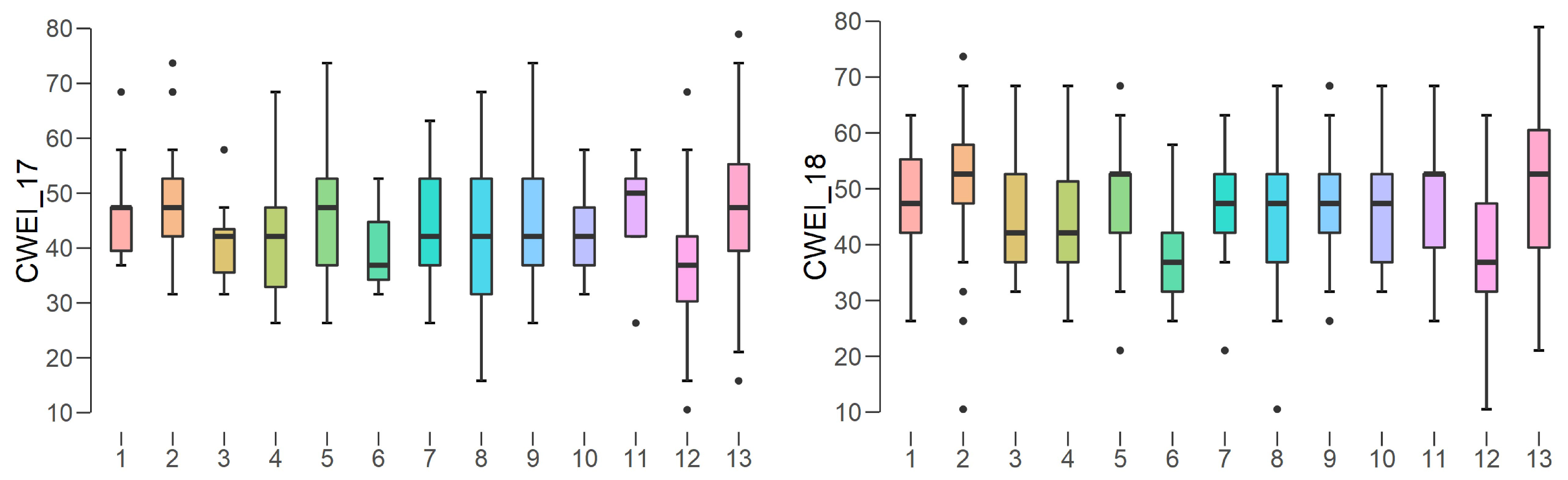
Table 10 shows the rankings, unit and percentage change of CWEI, as well as the change in ranking for the administrative regions of Greece in 2017–2018. It is clear that there is a positive average percentage change of approximately 5% for all Greek administrative regions, except for the Ionian Islands, which portray a decrease of 1.50 units (
Correlations among CWEI 2017–2018 indicators and sub-indicators
Note:
Table 11 shows that, with the exception of the relationship between e-Decision making (2017) and Web 2.0 tools (2018) (
Table 12 shows the CWEI
Scientific and government interest in e-participation is increasing given its significant role in local communities and its impact on citizens’ daily quality of life. At the global level, the adoption of e-participation is still a challenge for local governments. In this research endeavor, we tried to extend our knowledge of the state of e-participation in Greek municipalities.
To this end, the CWEI index was used to provide a useful and concrete evaluation for the municipal websites. The research questions were answered as follows: overall for 2018 our results show that e-Information achieves high scores, as a result of the municipalities’ efforts over the past decade to offer online information to citizens. However, the adoption of Web 2.0 tools, e-consultation services and e-decision making processes still lags behind. This can be attributed to the fact that only a handful of online tools are used for collecting citizens’ opinions (e.g., chat and social media), and more effort should be made to provide evidence for citizen consideration and enhancing citizens’ trust (Research Question 1). The comparison of 2017 and 2018 showed that e-participation in Greek local government is progressing slowly. In particular, with the exception of the Ionian Islands administrative region, all other administrative regions presented a positive change, ranging from 1.31% (South Aegean Region) to 8.51% (Western Macedonia) (Research Question 2). As regards the association between CWEI 2017 and CWEI 2018, results show a significant and strong relationship between the two indices (r
For future research, there are concerns regarding the number of experts used for coding the municipal websites and the simplified procedure adopted in coding CWEI. We acknowledge the fact that by simplifying the coding procedure it is possible that some valuable information hidden in our data may have been missed. Certainly, we firmly believe that future research studies should pursue more elaborate and analytical approaches in order to highlight more delicate issues pertaining to the use of CWEI. In addition, the inclusion of an additional expert would have further increased our confidence in the coding scheme selected.
This research reveals that the Greek government, practitioners, scholars and ICT researchers should work towards a strategic e-participation framework that will combine Web 2.0 tools, e-consultation services and e-decision making processes. Specifically, this approach should take into account drivers for the development of blogs, chat, mobile services, Web TV, online polls and surveys, and reputation systems. As the digital e-government environment evolves, it is necessary to explore the new challenges associated with citizen e-participation, such as government citizen co-production, citizen sourced-data platforms and citizen generated data (Allen et al., 2020). Moreover, the ongoing COVID-19 outbreak has made it clear that e-government directions should be revisited, local governments should play a key role in communication and collaboration between public agencies and society, and digital technologies need to be deployed in the service of citizens.
Finally, for an integrated framework to work effectively, citizens’ needs, opinions, and requirements have to be taken into account. It should be emphasized that a consideration of citizen opinions and complaints plays an important role in sustaining long-term citizen engagement and continuous usage of e-participation services thus supporting and preserving democracy. According to the European Commission (EC) (2019a), e-government research and development requires optimization of supply and demand sides, namely the services that public agencies provide and what citizens need. Specifically, it urges a greater focus on making citizens and businesses capable, willing, and trusting to eventually increase their e-participation services rather than on service delivery and technical requirements. Thus, future research on e-participation in local government should incorporate both governments’ and citizens’ perspectives.