



Abstract
While the financial sector was the first to investigate the potential of Blockchain, and in more general terms, Distributed Ledger Technology (DLT), with an initial focus on digital currencies including cryptocurrencies such as Bitcoin and Ether, the study of potential uses of this technology is gradually expanding to also include other areas of application including public-sector applications. Academic and non-academic publications on the subject have so far burgeoned mainly in and around the so-called fintech (financial technology) area, a fact that is underlined by a surprisingly high number of literature reviews already performed in this relatively novel area of research. For the public sector and the study domain of Digital Government, Blockchain and DLT have remained under-researched topics, and the number of respective publications is still relatively low. The aim of this meta-level literature study is to map the existing Blockchain and DLT-related body of knowledge and link its prevalent concepts to known needs and requirements studied in the context of the public sector and in Digital Government. Among the concepts, which intersect the existing literature on Blockchain strongly with the public sector-related research and practice, the study found cost reduction, innovation, regulation, taxation, security, privacy, transparency, among others, all of which deserve increased attention from scholars active in the domain of Digital Government research.
Introduction
Blockchain, and more generally, Distributed Ledger Technology (DLT), initially came into the public eye via the success of and debate about cryptocurrencies such as Bitcoin and Ether, which promised to provide cost and safety advantages over traditional currency and exchange systems including jurisdictional independence, stricter emission controls via mining as in the case of Bitcoin, and elimination of a central counterparty (Tsukerman, 2015). Meanwhile much of the initial hype has given way to more measured expectations, after serious security breaches, wallet thefts, anti-money laundering (AML) and combating the financing of terrorists (CFT) issues among other problems had emerged in the crypto and general DLT arenas. Besides the investing in and trading of crypto, other uses of DLT/Blockchain have since materialized including the use of “tokenized” security assets, utility assets, as well as other tangible and intangible assets, which are expected to give rise to a DLT-based “token economy” (Scholl et al., 2020). Before this backdrop and given advantages of reduced cost, transparency, safety, and security, potential uses of DLT/Blockchain/Token in the public sector have mainly put emphasis on the need of their regulation in jurisdictions around the world (Werbach, 2018).
Potential implementation areas include identity management, attestation, government records, title, and permit/license management, entitlement and citizen services management (healthcare, consent) as well as voting, taxation, and customs management (Mylrea & Gourisetti, 2017). By 2018, more than 200 public-sector Blockchain projects had already been launched in 46 countries (Berryhill et al., 2018) involving big data, decentralized, and data-intensive applications for IoT (Karafiloski & Mishev, 2017) or improving security issues (Meng et al., 2018). However, these projects must still be seen as humble beginnings, and with quantum computing looming around the corner it remains open whether or not blockchain can ultimately live up to its claimed potential as a disruptive technology with the capacity to revolutionize the way transactions are performed also in the public sector (Rodenburg & Pappas, 2017; Kiktenko et al., 2018).
While Blockchain is still at an early implementation and development stage in the public sector, groundbreaking research on its effectiveness, efficiency, and usefulness in public administrations is needed. For a still nascent academic topic of Blockchain it is remarkable to find a number of literature reviews on the subject published as early as 2016 or shortly after. These literature reviews cover the technology side (Risius & Spohrer, 2017; Johansen, 2018), while others focus on particular private-sector applications (Schedlbauer & Wagner, 2018) such as on supply chain management (Queiroz et al., 2019), education (Yumna et al., 2019), tourism (Calvaresi et al., 2019), or cybersecurity issues (Taylor et al., 2019), and even on private-sector organizations at large (Ferreira et al., 2019; Li et al., 2018), most of which aim at documenting the state of the art and proposing agendas for future research.
However, most, if any, of these literature reviews have not focused on the public sector, nor have they provided for a full overview of the current status of the research in this field of knowledge (Batubara et al., 2018; Casino et al., 2019; Shen & Pena-Mora, 2018; Yli-Huumo et al., 2016), hereby leaving its topical trajectory unknown. As it appears the majority of existing literature on this particular subject has been dedicated to exploratory studies.
Based on previous comments, this paper seeks to contribute to the prior literature in several ways. First, this paper tries to find out where the foci and potential impact areas of Blockchain in the public sector may lie as they are represented in the literature. Second, this paper seeks to increase the understanding of how the discussion on Blockchain uses in the context of the public sector has evolved over time along with the use of theories, if any. Finally, based on the results, this paper also attempts to suggest future avenues for research on Blockchain uses and resulting improvements in the public sector.
The remainder of this paper is structured as follows. The next section investigates the relevance of Blockchain use in the public sector. Then, a review of the literature is undertaken followed by the specification of the research questions; next, the methodology is presented for addressing the research questions (sampling, data collection, analytical tools and methods, etc.), followed by the presentation of the results, which are finally discussed. The conclusion section then specifies this paper’s contribution and outlines future research directions.
Blockchain in public administration
To the authors’ knowledge, so far, no generally accepted formal definition of distributed ledger technology/Blockchain technologies has emerged. Most definitions have been focused on the description of the characteristics of this technology and have been based on its role as the underlying technology of cryptocurrencies (Natarajan et al., 2017). Although the definition of Blockchain has been faced from different perspectives (Atlam & Wills, 2019), it could be defined as “A technology that enables immutability, and integrity of data in which a record of transactions made in a system are maintained across several distributed nodes that are linked in a peer-to-peer network” (Viriyasitavat & Hoonsopon, 2019, p. 33).
This way, Blockchain is one particular type or subset of so-called distributed ledger technology (DLT) (Belotti et al., 2019), which can be defined as a way of recording and sharing data across multiple data stores (also known as ledgers), which each have the exact same data records and are collectively maintained and controlled by a distributed network of computer servers, which are called nodes (Houben & Snyers, 2018).
As seen above, Blockchain-based applications have been introduced in public sector services so far mainly on the basis of finding appropriate use cases and testing their usefulness and robustness (Casino et al., 2019), that is, practical and academic knowledge revolving around Blockchain in the context of the public sector is still emerging. As before with traditional Digital Government, the search for adequate application areas of the new technology appears to be focused on cost reductions, service improvements, and increased efficiency in government operations (Konashevych, 2017). Blockchain is expected to also have a positive impact on government transparency, accountability, and trust (Berryhill et al., 2018; Nugent et al., 2016). In addition, other authors point out that the potentially most promising application of Blockchain in the public sector might be found in the context of smart cities in terms of smart living, smart governance, smart mobility, smart citizens, smart environment, and smart economy (Efanov & Roschin, 2018). Blockchain along with, for example, the Internet of Things (IoT), could make cities smarter, when managing energy supply, medical records, or property-related transactions among others according to the authors. Hence, opportunities for using this technology in the public sector are numerous, which makes some authors believe Blockchain to be one of the most disruptive technologies of our time (Nofer et al., 2017; Swan, 2015).
Nonetheless, the indiscriminate implementation of Blockchain for any kind of use cases appears unnecessary (Wüst & Gervais, 2018). As the authors hold, permissionless, permissioned as well as central database implementations have their distinct areas of application. Other authors indicate that the use of Blockchain technologies makes also sense from a data management perspective (Casino et al., 2019). As a document issued by the OECD summarizes (Berryhill et al., 2018), Blockchain can help address two main problems: (1) the integrity of shared documents and information and (2) the elimination of the ‘trusted third-party’ logic. Beyond that, the use of Blockchain might not add sufficient added value to already established technical solutions, which puts into perspective the potential uses of this technology in the public sector. Blockchain can likely help public entities improve in various areas; however, some implementation challenges have to be anticipated, which include the need for undertaking certain public sector reforms first. Respective reforms need to address privacy and security issues as the main challenges (Yli-Huumo et al., 2016). However, these reforms are not only focused on modifying processes, but rather also legislative changes leading to new governance models as prerequisites, which could present major barriers to Blockchain adoption (Batubara et al., 2018).
In brief, as outlined above, comprehensive academic and practical research is needed about prerequisites, choices, suitable application areas, technical and non-technical barriers regarding the uses of Blockchain, which leads to a better understanding of the technology’s appropriate and most beneficial uses in the public sector, in general, and more specifically, in the context of smart cities. A broad review of the current academic literature on the use of Blockchain and other distributed ledger technologies in the public sector, hence, is a starting point for systematically building academic knowledge, which this paper attempts to provide.
Research questions and methodology
Research questions
As shown in Fig. 1, this paper uses a Kitchenham-inspired approach of a systematic literature review (SLR) that includes three phases: Planning, conducting, and reporting on the review (Kitchenham, 2004). A systematic literature review is a means of identifying, evaluating and interpreting all available research relevant to a particular research question, topic area, or phenomenon of interest (Kitchenham & Charters, 2007), and ensure that study selection process and inaccuracy in data extraction are unbiased, helping us to identify and map research areas related to Blockchain technology and public sector (Yli-Huumo et al., 2016; Batubara et al., 2018; Anwar et al., 2019).
The first phase of planning identifies the research questions and the methods to be used when undertaking a specific systematic review. For this research, four research questions have been formulated:
Research Question #1 (RQ#1): How is Blockchain (as a technology-related topic) connected to other technology-related topics investigated in public sector-focused research? Research Question #2 (RQ#2): How have Blockchain-related topics evolved in the context of the public sector over time? Research Question #3 (RQ#3): What theories, if any, have been used to investigate the use of Blockchain-based applications in the public sector? Research Question #4 (RQ#4): What are major topical foci and themes found in peer-reviewed academic research on Blockchain in the public sector?
Sample, sub-samples, data collection, and research methods
During the second phase (“conducting’) of a Kitchenham-inspired SLR approach researchers identify the sample of entries that need to be collected, inspected, and included in the study. Also, in this phase, data quality assessment, data extraction, and monitoring process as well as data synthesis are performed. Complementing the approach, a five-stage grounded-theory method for conducting a rigorous literature review is used (Webster & Watson, 2002; Wolfswinkel et al., 2013), which includes the definition of the criteria for inclusion/exclusion of papers, the identification of the field of knowledge, the sources used for the literature search along with the specific terms used in the searches, the refinement of the searches, the coding of the results, and the structure of the content of the selected papers.
To collect references of both peer-reviewed academic research papers and so-called grey papers, that is, non-peer-reviewed papers such as articles in technical magazines and the like, first, formal queries were launched to the Web of Science (WOS), Elsevier Scopus (SCO), EBSCO, and ProQuest digital libraries, which index publications of major journals and conferences across a number of disciplines. Also, version 14.5 of the Digital Government Reference Library (DGRL) database was inspected, which contained 11,211 bibliographic entries of papers published from 1981 to 2018 (Scholl, 2019).
Since this paper is focused on the analysis of Blockchain in the public-sector context, the query was defined as the intersection of the terms (“Blockchain” OR “DLT” OR “Distributed Ledger Technology” OR “Block chain”) AND (“public sector” OR “government” OR “public administration”) within title, abstract, keywords and topics of the papers across all fields of knowledge with the aim of capturing the highest number of published papers. These terms were selected after inspecting highly cited papers on Blockchain and related technologies with the aim of retrieving a maximum number of relevant papers and a minimum number of non-relevant papers. The results of the initial search were used as starting points for the systematic database search, as they are treated synonymously throughout the Blockchain community in the public sector. Terms with a hyphen were also considered as equivalent, for example, block-chain and Blockchain.
The queries were performed in May 2019, and a total of 1,072 reference entries in RIS format was retrieved from WOS, SCO, EBSCO, ProQuest and DGRL repositories, respectively. The retrieved RIS references were imported into an EndNote X9.2 (Bld 14655) reference library. Duplicate entries were removed, and the entries were categorized as either “peer-reviewed” academic papers or “non-peer-reviewed” grey papers. In the next step, each record was inspected one by one with regard to relevance relative to the focus on Blockchain in the public sector. Based on the methods used in this research, initially, the keywords and abstracts of all research papers were assessed looking for the connection between Blockchain technologies and its implementation and/or analysis into the public sector framework. When the link to the public sector was not clear, the introductory sections and the conclusions of the papers were assessed for relevance in our research. Entries, which failed the relevance test, were excluded. In the next step, spellings and keywords were normalized (for example, “blockchain,” “blockchain technology,” “blockchain technologies,” “blockchains,” “Blockchain,” Block chain,” and “Block-chain” along with other variants of spelling were normalized to “blockchain;” likewise, keywords with identical meanings such as “digital government,” “eGovernment”, “e-government,” “electronic government” and the like were subsumed as “digital government.” The data sample finally included a total of 455 papers, of which 230 were peer-reviewed academic papers and 225 grey papers, as listed in the Appendix, see also Fig. 1 below.
The investigators used VOSviewer, version 1.6.13, a robust bibliometric analysis tool developed under the auspices of the Centre for Science and Technology Studies, Leiden University, The Netherlands (Van Eck & Waltman, 2009, 2011). VOSviewer creates tables and conceptual maps based on network data using connections or a relation between two items (links). One example of links is the co-occurrence link between terms or keywords, indicating the number of publications in which two terms or keywords occur together. VOSviewer does not show the strength of a link, but create a network with the items and their connections (links). Furthermore, VOSviewer highlights non-overlapping clusters, which are shown as sets of items included in a map. In this study, the cluster analysis has focused on the keyword “Blockchain” and its links with other keywords or terms.
Based on Zhao et al. (2016), Blockchain technologies have evolutioned over time, giving place to three generations of this technology focused on digital cryptocurrency transactions in the financial sector (Blockchain 1.0), as well as on a set of applications in SCs and in other areas such as government, health, science and IoT (Blockchain 2.0 and 3.0) – emerged almost in parallel in an explosive manner mainly from 2016 –. Therefore, in order to identify topical trends over time (addressing research question RQ#2) the sample was divided into two sub-samples, one of which contained 132 records of papers published between 2013 and 2016. The other sub-sample with the remaining 323 entries contained papers published in 2017 and later. These two numbers indicate that the vast majority of publications (that is, 71 percent) fell into the latter sub-sample of more recently published work. Furthermore, the analysis was also performed separately for the peer-reviewed academic papers and the grey papers.
VOSviewer representation of keyword nodes and link strengths (all papers).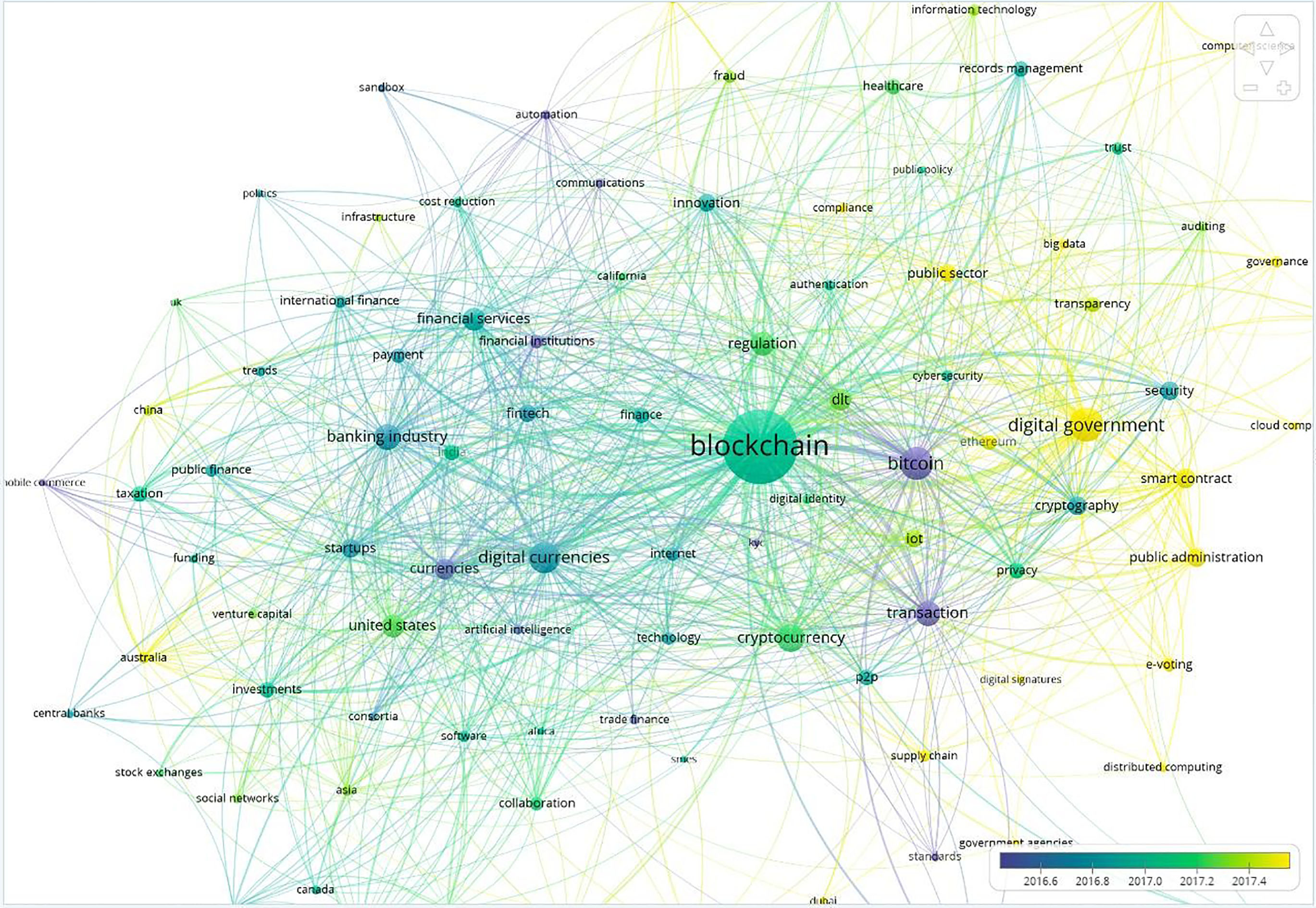
Top 25 keywords sorted by node link strength (all papers)
In VOSviewer, maps (and tables) were created based on bibliometric data, which were directly entered via the respective RIS documents representing the aforementioned sub-samples (each separately exported from the main EndNote reference library). The type of analyses performed in VOSviewer was “co-occurrence,” and the unit of analysis selected was “keywords.” The minimum number of occurrences per keyword was deliberately set to “5.” Since many grey paper entries had ten or more keywords specified, which is unusual for academic papers, the inclusion quorum suppressed noise and enforced the disregard of infrequent keyword terms, which were only found in grey papers. For each keyword that met the quorum the total strength of co-occurrence with other keywords was calculated. The VOSviewer concept maps (see figures below) then show the nodes and links with the greatest link strength.
In terms of data representation and data visualization, linlog modularity (Noack, 2007 and 2009) was chosen for more equal cluster distribution – use of the normalization method to determine the strength of the links between items – within the so-called overlay visualization (Newman, 2004). Linglog modularity is a model that seeks to group nodes according to two well-known clustering criteria, namely the density of the cut and Shi and Malik’s normalized cut (Novack, 2007). In the overlay visualization, color-codes both nodes and links representing the color codes of the time line are displayed. For example, nodes and links predominantly representing newer publications were visualized with brighter colors (such as yellow) while nodes and links predominantly representing older publications appear in darker colors (such as dark purple or dark blue).
Ad RQ#1: (“How is Blockchain (as a technology-related topic) connected to other technology-related topics investigated in public sector-focused research?”)
In the following the results of the bibliometric analyses are shown, major keyword nodes and the strengths of their links between and among each other are discussed along with select papers that were found under the links. These papers serve as illustrations (rather than as representatives). Within the total sample of 455 articles published between 2013 and early 2019 that represent the topical intersection of “Blockchain” and “Public Sector/Public Administration,” the top 25 keywords ranked by the strengths of links to other keyword nodes are shown in Table 1. After Blockchain as the central and strongest node with the highest link strengths in the sample, the next ten strongest nodes measured by link strength are (in this order), digital currencies, digital government, Bitcoin, banking industry, cryptocurrency, financial services, United States, currencies, regulation, and transaction, at least seven of which directly relate in one way or the other to financial services and (crypto) currencies. Furthermore, although not listed among the top-ten keyword nodes, the keywords fintech, investments, financial institutions, and finance add another four nodes, which indicate strong topical relationship and emphasis on (crypto) currency-related finance topics. Blockchain is portrayed in the literature as providing an alternative payment infrastructure characterized by low costs and transparency, supporting the creation, adoption, and use of cryptocurrencies (Nguyen, 2016) without the need for any trusted third party to monitor or check transactions (Treleaven et al., 2017). While cryptocurrencies brought Blockchain to broad public attention, prior research had already recognized the possibilities and great impact that the technology could have across the board in the form of distributed databases or ledgers by safely preserving metadata of current and past transactions (Kuo et al., 2017), although some characterized the concept of a distributed ledger as puzzling (Mills et al., 2016).
VOSviewer – keyword representation of “DLT” node and link strengths (all papers).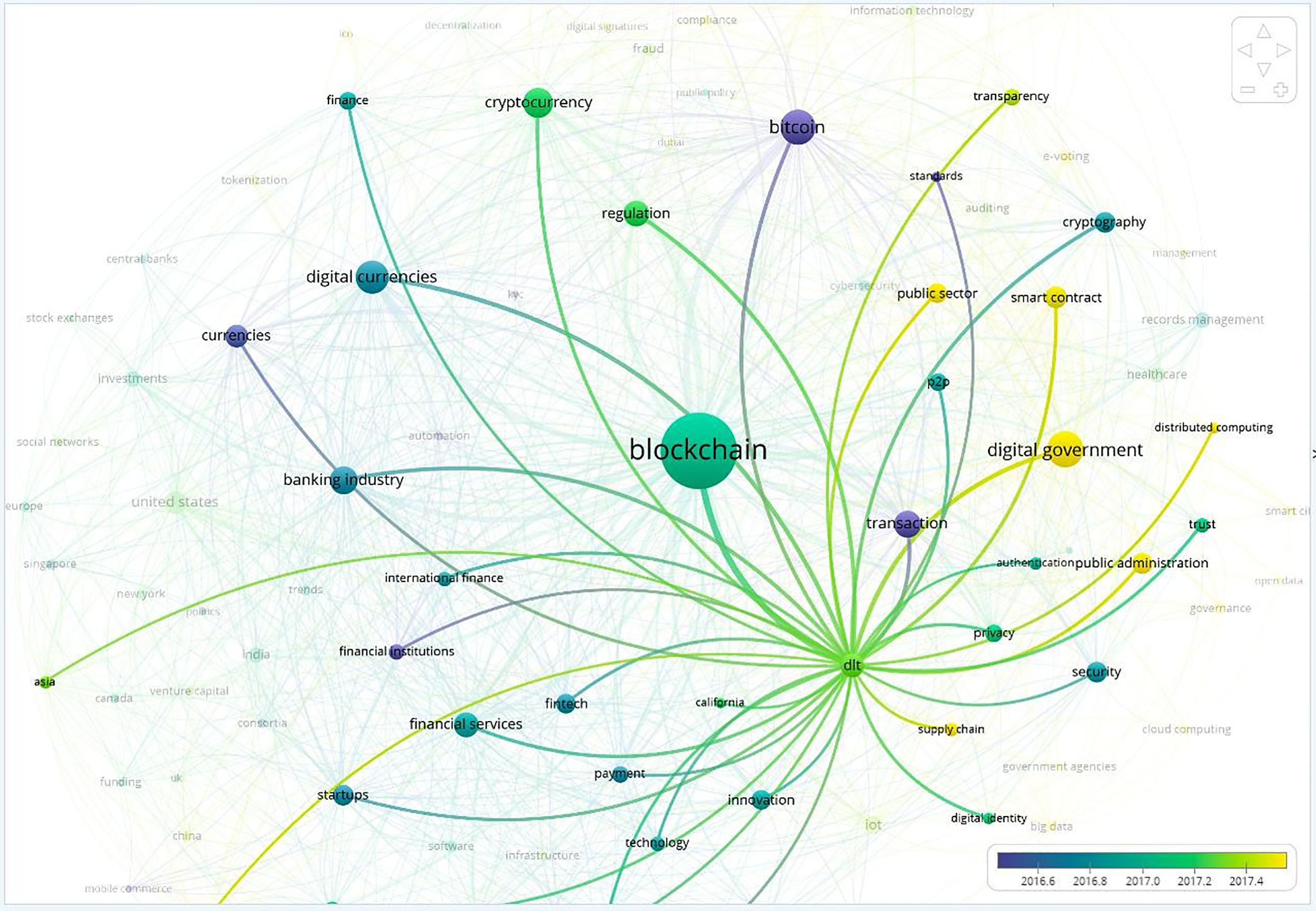
The results appear to further suggest that Blockchain is a phenomenon that has so far geographically mainly been linked to financial services in the United States and India, and to technological innovations. Blockchain has been portrayed as providing the capacity to transform businesses due to meeting greater requirements for reporting, transparency, and dissemination of data (Fanning & Centers, 2016), although high levels of investment would be needed to adopt the technology (Iansiti & Lakhani, 2017). As it has turned out so far, the financial sector has led the way in developing Blockchain-based applications and business models (Beck et al., 2017). It remains to be seen how strong of an impact Blockchain will finally have in digital government and its academic field of knowledge.
VOSviewer – keyword representation of “digital government” node and link strengths (all papers).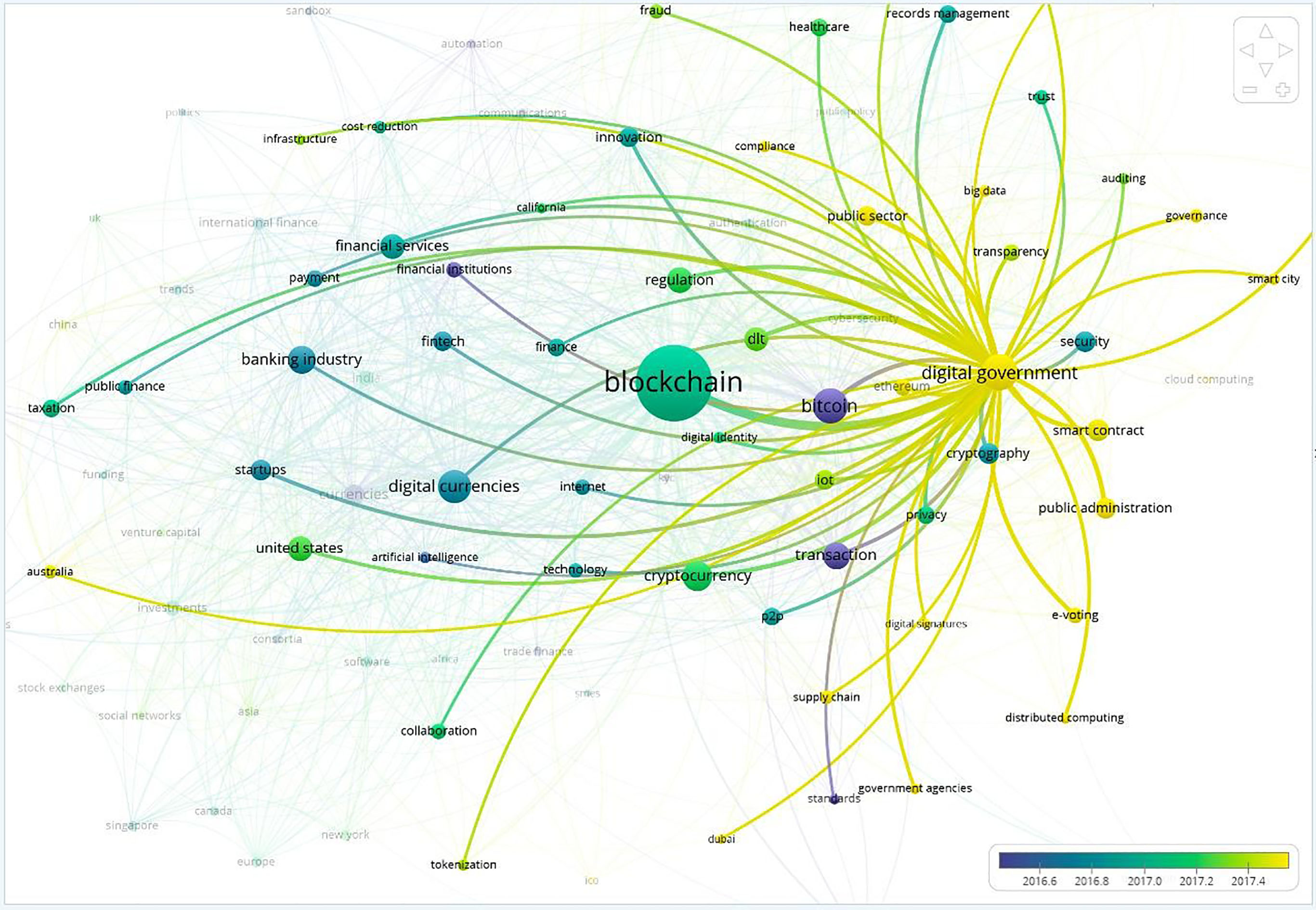
While the terms Blockchain and Distributed Ledger Technology (DLT) are frequently (and incorrectly) used interchangeably, besides their respective node sizes and link strengths, they have slightly different emphases in their links. Although the keyword DLT has also strong links to the cryptocurrency and financial service-related keyword nodes similar to Blockchain, some other links were also found (see Fig. 2). Among these are prominently digital government, public administration, public sector, but also, and less prominently, digital identity, authentication, smart contract, transaction, innovation, privacy, security, transparency, standards, and regulation. DLT-based Canadian e-services systems and Estonia’s e-residency initiative are examples of these particular application areas (Chalaemwongwan & Kurutach, 2019; Sullivan & Burger, 2017; Wolfond, 2017).
However, it is also remarkable that digital government represents the third strongest node in terms of Blockchain-related link strengths in this otherwise heavily finance-oriented sample. The keyword regulation is also found among the top ten keyword nodes, which appears to connect the two top foci (finance/crypto and digital government) found in the overall sample. As Fig. 3 shows, the keyword node digital government has strong links to regulation (Simpson, 2018), records management (Chorley, 2017), IoT (Leitner & Stiefmueller, 2019; Potts et al., 2017), e-voting (Bartolucci et al., 2018; Hsiao et al., 2018; Kshetri & Voas, 2018), transparency (Ølnes & Jansen, 2018), trust (Lemieux, 2017; Meijer & Ubacht, 2018), cryptography (De Filippi & Wright, 2018; Peters et al., 2018; Sylim et al., 2018), cryptocurrency (Schaupp & Festa, 2018; Zharova & Lloyd, 2018), compliance (Li, 2017), innovation (Karo & Kattel, 2016), healthcare (Mettler, 2016), privacy and security (Gabison, 2016), smart contracts (De Souza et al., 2018), taxation (Akdemir Altunbasak, 2018), and transaction (Kuhi et al., 2018) along with links to the financial services sector-related nodes. While, for example, the concept of smart contracts was already considered and discussed in the late 1990s (O’Shields, 2017), appears to gain relevance through practical Blockchain-based implementations for financial services in the public sector (Berryhill et al., 2018).
Under the private business approach, some authors have divided the evolution of the Blockchain-related research into three different stages, (1) digital currency, (2) digital economy, and (3) digital society (Efanov & Roschin, 2018; Zhao et al., 2016). Nonetheless, this evolution does not fit well at the intersection of Blockchain and the Public Sector/Public Administration because it has been focused on the implementation of Blockchain-based technologies for improving public-sector services avoiding digital economy as essential. The first publications at that intersections fall into the year 2013. As shown in Table 2 and Fig. 4, only 136 publications were identified in this first period; whereas in the following period from 2017 to early 2019 publications on the subject matter more than double.
Publications breakdown by year
Publications breakdown by year
Publications by year.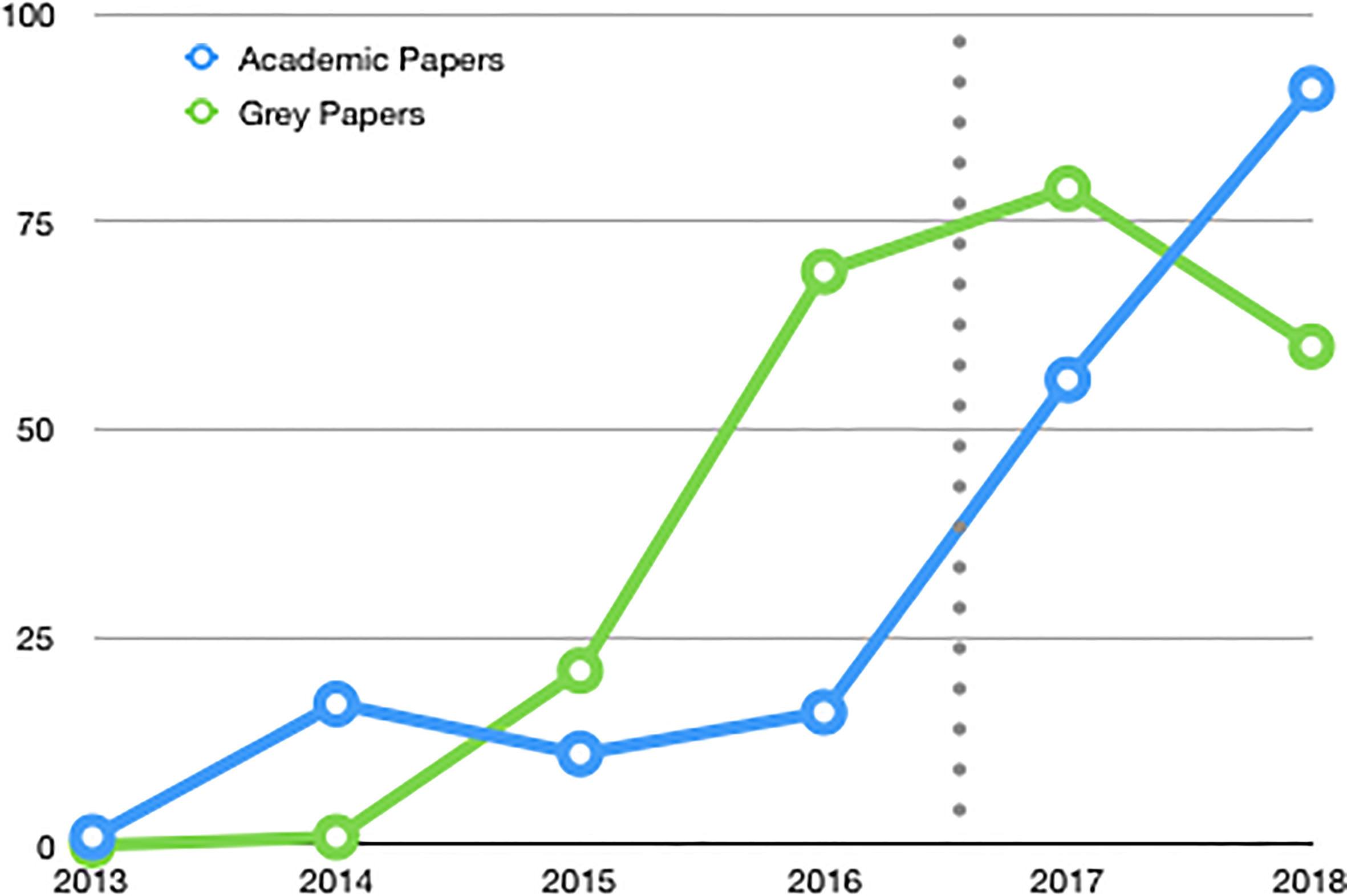
Nevertheless, it is informative to determine how topical emphases have evolved during the two periods under investigation. As Table 3 shows, the strong connection between Blockchain and digital currencies and cryptocurrency has remained. However, the periodical breakdown reveals that topics connected to digital government, or more general, to public administration and the public sector have only more recently received more attention in the context of Blockchain. Between the first period of 2013 and 2016 and the second period of 2017 to 2019, eight topics have dropped from the top-25 keyword list:
Shifts in topical emphases between the two publication periods
On another hand, collaborative technologies such as the networked use of digital currencies both inside and outside the financial sector were in the focus. Some studies discuss, for example, how social media connect buyers and sellers of debt and equity securities, which was touted as the “democratization of the capital markets” (Wales, 2015). Other studies investigate realization of higher Bitcoin returns via social media (Mai et al., 2015). Yet other examples in the literature of the first period include investigations on the use of search term volumes and social media impact in anticipation of Bitcoin trading volumes (Garcia et al., 2014; Matta et al., 2015).
On the one hand, eight new topics entered the top-25 keyword list: most prominently, digital government in third place, as well as smart contract, IoT, public administration, privacy, public sector, India, and transparency, while six formerly listed keywords/topics rose in their ranking in the second period: cryptocurrency, United States, regulation, DLT, startups, fintech, and investments.
The growing interest in Blockchain-based applications in the field of Digital Government (formerly, “e-government”) is linked to the delivery and provision of public services (Hou, 2017) or to voting systems (Ayed, 2017; Lee et al., 2016) among others. However, it appears that this particular research is mainly focused on understanding the impact of Blockchain on very specific government services rather than in terms of the overall impact and with regard to core applications in public administration. When it comes to ”smart contracts”, recent research in the second period has put an emphasis on identifying and tackling some known smart-contract issues such as codifying, security, privacy, and performance issues (Alharby & van Moorsel, 2017).
Finally, the term Blockchain has been found linked to the terms “IoT” and “smart city” in the second publication period. Novel Blockchain-based smart city services and respective support systems are proposed to be using IoT sensory and smart contracts for demand detection and service delivery (Potts et al., 2017; Ruta et al., 2017; Fan et al., 2018). Also, with regard to the increased need for cybersecurity, Blockchain-supported IoT technologies are seen as pillars of a smart city infrastructure (Huh et al., 2017; Koehler, 2017; Kshetri, 2017).
A mere 8 publications in the sample of 455 publications (or, 1.8 percent) make a keyword reference to any given theory. Among those few theories referenced were “coding and information theory,” “Dempster-Shafer theory,” “game theory (2),” and “chaos theory.” Other theories from Social Sciences or Mathematics (like grounded theory and optimization theory) were also invoked for framing the research method of the study. In brief, Blockchain-related research in the context of the public sector has so far not been found guided by any theories except for theories from reference disciplines typically for the purpose of knowledge gap identification. Non-technical Blockchain-related research has rather been identified as of mostly exploratory nature, for example, case studies, and without ex-ante theoretical guidance.
The one paper that used Dempster-Shafer theory did so in the context of cyber security for detecting breaches and cyberattacks when monitoring network traffic (Malomo et al., 2018). Likewise, the paper, which invoked optimization theory, did so for creating algorithms, which guard against fraudulent transactions (Munsing, 2018).
Although Blockchain has more recently been applied to public-sector contexts as seen above, no theories from public administration or political science were found to help explain the use and rationale for use of these technologies in the public sphere along with their estimated future impact on reforms of administrative structures.
Ad RQ#4: (“What are major topical foci and themes found in peer- reviewed academic research on Blockchain in the public sector?”)
When inspecting and comparing the network graphs of all 455 papers (Fig. 1) to the one of the 230 peer-reviewed academic papers (Fig. 5), it turns out that the network graph of the latter is less dense and shows fewer strong nodes and links. In other words, the included (non-peer reviewed) grey papers have significantly contributed to the overall density and node/link strengths shown in Fig. 5. However, since these papers have influenced the academic discussion as seen by their citations in academic work, the grey papers represent and important share and weight in the overall discussion, corroborating their overall inclusion in this analysis. On the other hand, it is important to identify and distinguish, what foci and themes have emerged in particular in academic research.
VOSviewer – keyword nodes and link strengths in academic papers.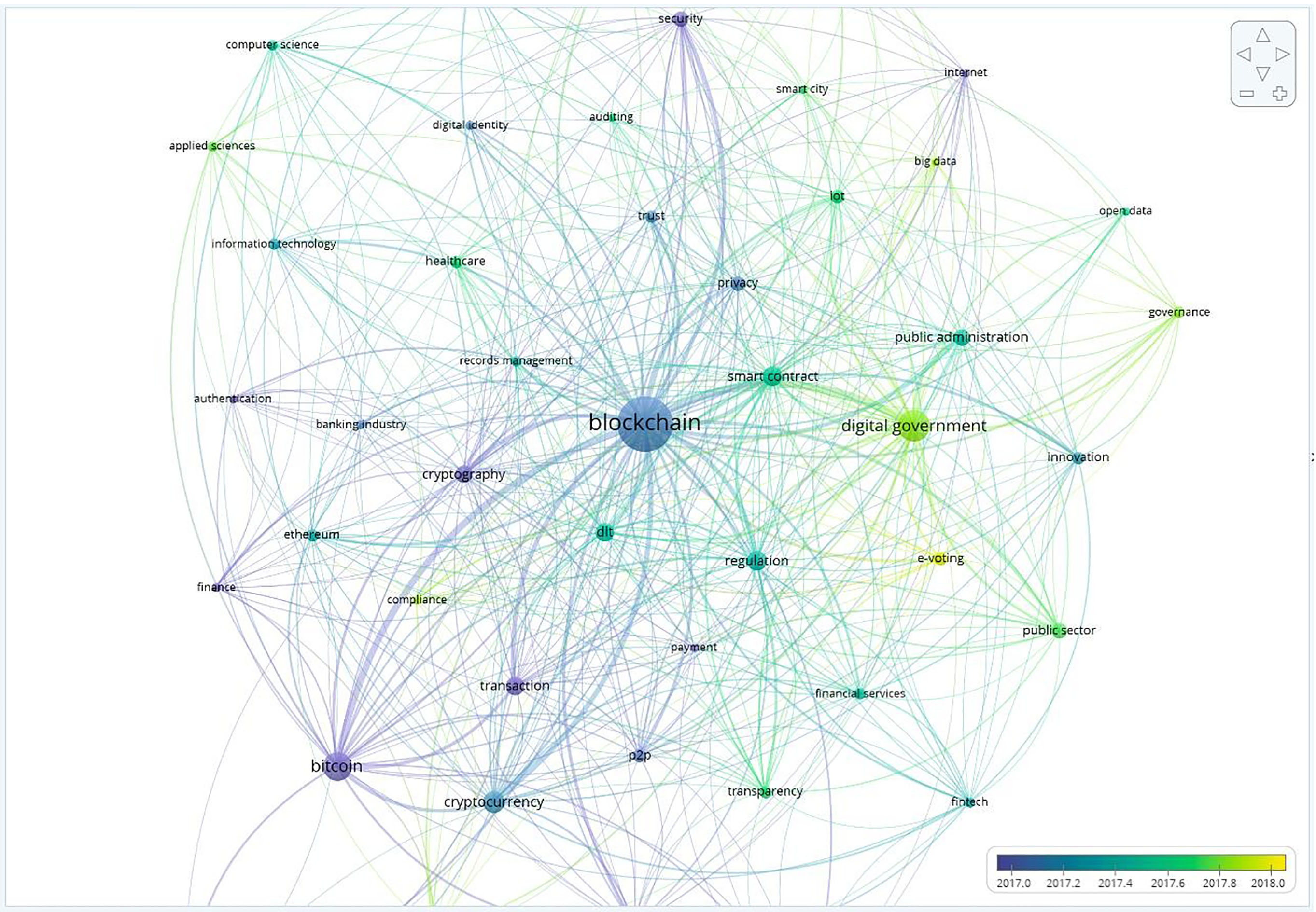
As Table 4 reveals, finance and (crypto) currency-related keywords (Bitcoin, cryptocurrency, digital currencies, fintech, and financial services) are prominent in the peer-reviewed academic research; however, they represent only 5 (or, 20 percent) out of 25 most frequent keywords used in academic research at the intersection of Blockchain and Public Sector/Public Administration. Keywords with markedly higher link strength rankings in academic research when compared to the overall literature include smart contract, regulation, cryptography, transaction, public administration, security, privacy, public sector, transparency, among others. While the keyword digital government is the highest ranked apart from Blockchain in academic research, Bitcoin also has a somewhat higher ranking in academic research than overall, whereas the keyword digital currencies ranks far lower in academic research than overall.
Top 25 keywords sorted by node link strengths (academic papers)
Smart contracts in the context of the public sector have attracted the attention of a number of researchers (Liao & Wang, 2017; Lee M & Lee E, 2018; Zhang et al., 2018). Also, the regulation of DLT and Blockchain uses have been addressed in research (Simpson, 2018; Yeoh, 2017). Other important foci and attributes are linked to security and privacy issues that Blockchain technologies have to face. Revealing and addressing limitations from privacy and security perspectives has been the focus of earlier Blockchain research, which was also dedicated proposing technical solutions. Privacy as a challenge when implementing new technologies (Kosba et al., 2016), for example, has been significantly improved in Blockchain-based applications with the introduction of protocols that help users keep their personal data safe, thus retaining transactional privacy from the public view (Zyskind & Nathan, 2015). Most privacy and security issues when using Blockchain technologies, however, appear to have been addressed in the meantime (Dorri et al., 2017).
Peer-to-peer, decentralization, smart contracts, data integrity, scalability, efficiency, or data storage follow as additional key areas of academic focus in recent Blockchain studies. As examples, studies such as (Beck et al., 2016) evaluate the decentralized nature of the technology, which facilitates the creation of environments, in which transparency, integrity, and immutability of data are needed without a trusted third party (Seebacher & Schüritz, 2017). Thus, a consensus mechanism in the Blockchain network is required, through which non-trusting members interact with each other for transferring assets and sharing data in a verifiable manner (Christidis & Devetsikiotis, 2016). Also, when the number of Blockchain nodes increases, again, security and privacy issues and other challenges are introduced, which limits the scalability in terms of number of consensus nodes and clients (Eyal et al., 2016).
Finally, other foci such as information transparency, verifiability, trust, and accountability are identifiable themes and foci that are discussed in the context of Blockchain uses and implementations. For example, research highlights and portrays the role of Blockchain technologies in tracing transactions for enhanced information transparency (Cong & He, 2019; Ølnes et al., 2017) and for monitoring recorded transactions (Hawlitschek et al., 2018). Verified transaction recording (Notheisen et al., 2017), visibility of recordings to all its participants, and the resulting auditability and trust (Fanning & Centers, 2016) were also highlighted as benefits of the technology. The relative importance of Blockchain within the overall context of information and communication technologies per se has so far not received much academic scrutiny, which might explain the absence of this particular keyword in the data.
The results above show the conceptual path that research on Blockchain has taken in recent years. However, it can be expected that future Blockchain research will go beyond these topics and concepts and also focus on outcomes and reforms that the implementation of Blockchain-based applications will have in public administrations. In this regard, transparency, trust, efficiency, and governance will be likely central topics in future of Blockchain research.
This paper sought to document and portray how the academic discussion and grey literature about the foci and potential impact areas of Blockchain applications evolved over time. One main finding from the literature suggests that Blockchain cannot to be seen as a suitable technology solution for every problem occurring in the public domain. Private sector-based research once indicated that organizational size positively influences the implementation and use of innovative ICTs (Damanpour, 1992). While it has remained unclear, whether or not this correlation of organizational size and ICT-based innovation also strictly holds for organizations in the public sector, the question becomes what would motivate large public administrations to use Blockchain as a technological foundation for public services or other internal and external activities? Would larger organizational size be a positive influencer for implementing innovative ICTs such as Blockchain also in public administration? What drivers and barriers (including legal barriers) would policymakers and public managers have to take into account if Blockchain was going to be implemented? Future research could analyze these topics using empirical data or literature reviews based on papers examining these topics. In this last case, the SciMat method (Cobo et al., 2011), mapping the literature reviews over time in a dynamic way, and the meta-analysis method, examining factors and drivers of Blockchain implementations-could be of high relevance to obtain interesting findings in these matters.
Another finding from the analysis using the VOSviewer software indicates that, although increasingly relevant, Blockchain has been mainly studied as an underlying technology that supports cryptocurrencies or digital currencies. However, the potential of Blockchain for improving other public-sector activities such as smart contracts, in general, but also, in particular, in the context of public procurement, or information distribution, or transactions of financial and non-financial assets, has to be studied.
Also, it would be interesting to reflect on the normative and contextual impact that the relationship between Blockchain and finance can have both on public sector practices and on scholarly perspectives. This way, future research could foster the analysis of this issue and the new paradigms arising from it in current public sector reforms.
On a sideline and as mentioned above, a tendency was found in the reviewed literature to use the terms Blockchain and Distributed Ledger Technology (DLT) indiscriminately and interchangeably, which, however, makes the use of these two terms potentially confusing and even misleading. While every Blockchain is a DLT, not every DLT is a Blockchain, which demands from future research to determine and define these terms more clearly (please read definitions in Section 2 of the paper).
Initially, Blockchain technology did not receive much academic attention when it emerged and was linked to cryptocurrencies in 2008. However, with growing maturity of cryptocurrencies some years later, researchers developed an interest in the underlying technology and its potential impact on economy and society, at large. Meanwhile, Blockchain-based applications have been implemented in the realm of financial services and a few public services such as electronic medical records. Apart from applications in the financial or public sectors, little research has been expended into the use of DLT and/or Blockchain as a potentially powerful support for the roots and proper functioning of modern Western-style democracy. Concepts like accountability, compliance enforcement, non-repudiability, transparency, or public trust appear as likely candidates for Digital Government-related research in the effects of DLT and Blockchain implementations in the public sector.
Interestingly, despite the still fairly manageable quantity of publications on the subject matter, the number of reviews of the Blockchain literature have been growing rapidly over recent years. This might be owed to the fact that Blockchain has been promoted as a highly disruptive technology with a direct impact on various areas of application, so that it seemed necessary to undertake studies investigating the state of the art to consider the actual impact and determine future paths for research.
Most literature reviews have so far focused on the technological aspects of Blockchain, on its impact on private-sector organizations, or on specific Blockchain-based applications, the equivalents of which have been missing for the public sector. The findings of this study demonstrate that Blockchain-related studies are only beginning to appear with a focus on the public sector, and in that, mainly linked to applications benefitting public services. Other highly relevant areas still await academic attention such as the impact of Blockchain on existing laws and regulations along with the deliberation of new laws and regulations, on effective governance models, in general, on trust, on transparency, and, on democracy at large, as well as on public sector reforms (and the underlying organizational issues). Future theoretical and empirical research on these topics is not only needed, but may rather significantly advance this field of knowledge.
Unsurprisingly, and again according to our findings, much of Blockchain-related research is either of technical or exploratory nature focused on studying cases and analyzing the various applications of the technology without much theoretical support, which is characteristic of a new field of study, and it is typically not before a mature stage is reached that theoretical underpinnings guide research into systematic testing and further development of concepts. The arrival of Blockchain and DLTs and their impact in, for example, the financial and public sectors, is no exception in this regard. It is too early to speculate about, which particular existing theories might provide adequate lenses for guiding future research on the subject. New theories might also be developed in this particular context, which would not only guide academic research but would rather also help public managers and politicians in their decision-making processes.
Finally, findings of this paper confirm that Blockchain applications are initially mainly associated with expectations of reducing transaction costs and with security and privacy issues. Financial-sector issues and making cryptocurrencies work have been center stage. In recent years, different purposes and application areas have moved into the focus also outside the fintech sector.
In summary, Blockchain and DLTs have been praised (and warned against) as potentially disruptive technologies, which has drawn remarkable attention in a number of academic fields and beyond. Recently that attention has been expanded into the public sector and respective Digital Government research. While digital currencies may have blazed the trail, other innovative and emerging technologies (IoT, big data, Artificial Intelligence, smart contracts, etc.) have drawn researcher attention to the technology itself and its application to different fields. Over time, theoretical support and deep analyses are expected to emerge, which will ultimately benefit both subject-related academic research and public administrative practice. Future research will be dedicated to tracking studies on both Blockchain and DLT implementations in the public sector, to assessing the maturity of theoretical developments around Blockchain and DLT-related concepts, and to evaluating the extent to which these technologies finally lived up to the promise (or threat) of their disruptive nature in the public sector.