



Abstract
The sharing economy has experienced tremendous growth as a result of rapid advances in information technology and user demand. Through a case study analysis of bike-sharing service providers in one of the largest cities in China, this paper examines the phases of regulation of the sharing economy from problem discovery, enacting regulation, and the aftermath of regulation. The public interest theory is used as a way of understanding the evolution of regulation of the sharing economy. Our analysis of the case study showed that the government took on three roles as protector, coordinator, and regulator that demonstrate working within the public interest theory. The results of this case study show the evolution of regulatory roles in a new and emerging industry within China and the lessons learned for public administrators.
Introduction and background
The sharing economy has been called many things from collaborative consumption, peer-to-peer economy, access economy, gig economy, and the platform economy (Acquier et al., 2017). Sharing economy platforms offer products and services that you would get in traditional businesses, but the delivery of these services is different because they use technology, particularly Internet-based solutions to connect up the buyer and seller (Paik et al., 2019).
The sharing economy has been developing rapidly worldwide in the past decade. It is broadly characterized by peer-to-peer exchanges for renting goods or services utilizing Internet platforms, facilitating the sharing or renting of space, assets, and labor in real-time (Ganapati & Reddick, 2018). It has changed the way people throughout the world shop, commute, and travel (Cohen & Sundararajan, 2015; Zervas et al., 2016), significantly reducing costs by connecting consumers with those willing to provide their underutilized assets at prices lower than those offered by traditional suppliers (Hong & Lee, 2018).
Acquier et al. (2017) believe that the sharing economy can be related to three foundational concepts: (1) the access economy – sharing underutilized assets to optimize their use, (2) platform economy – intermediating decentralized exchanges among peers through digital platforms, (3) and community-based economy – coordinating through community-based sharing. The public sector has taken three approaches to policymaking of the sharing economy, to regulate, not regulate, and wait and see (Ganapati & Reddick, 2018).
The sharing economy is widely viewed as a form of innovation, which has triggered transformative changes in living patterns in modern cities (Ma et al., 2018). The value of the sharing economy holds the promise for a more sustainable world (Munoz & Cohen, 2017). Take ride-sharing, for example, aligned with the government strategies of clean and smart cities, it promises an eco-friendlier, more accessible and inclusive transportation for urban residents (Cohen & Kietzmann, 2014; Manzi & Saibene, 2017; Ma et al., 2018). However, new challenges were brought by the sharing economy to public agencies. Ganapati and Reddick (2018) emphasized the four challenges: the creation of new class divisions and more inequality; Internet platforms are not necessarily egalitarian; the long-term sustainability benefits are unclear; and security and trust concerns. Sharing economy also raised related legal issues, that the service marketplaces create uncertainty for participants and the businesses in the sharing economy confused insurance, tax, employment, and civil rights violations (Cohen & Zehngebot, 2014; Katz, 2015).
We analyze the regulation of the sharing economy in the context of bike-sharing in one of the largest cities in China. Government responded to protect the public interest when regulating this industry while attempting to correct the market failure of the bike-sharing economy. Our analysis show that the government was acting in the public interest as protector, coordinator, and regulator.
To examine public interest theory in the context of government regulation through our case analysis, we divide the paper into the following sections. The next section explains two of the most common regulation theories, leading to the discussion of the emerging literature on regulation and the sharing economy. This is followed by the presentation of our research question and then a discussion of the research methodology of our case study analysis. We then present our case study analysis where major findings are highlighted. Finally, conclude with the major takeaways, limitations, and future research possibilities.
Theories of regulation
Regulation is the use of government authority to constrain the behavior of private actors (Gerber & Teske, 2000). This does not involve large amounts of government expenditures but directs private entities to expend resources to work in certain prescribed ways. Regulations can help to correct market failures and correct externalities by introducing legislation (James, 2000). The most significant costs of regulation are compliance costs, which are not typically borne by the government (Levi-Faur, 2011).
Regulation of behavior can be understood with the agency theory in economics. The principal-agent theory argues that information asymmetry exists between two contracting parties. Here we have the principal (government) attempting to monitor the agency (contractor) that works in their own self-interest, which may not align with the interests of the principal. Therefore, monitoring becomes costly because the principal does not know what the agent is doing. This presents the agency with a problem because of asymmetric information between the principal and agent (Gerber & Teske, 2000).
There are two competing theories of regulation. The first theory is public interest regulation, which is derived from the political science literature. The basic claim here is that civil servants act according to the general law set out to further the public interest. Lawmakers are supposed to act by the mandate of the voters and embody the approximation of the public interest (Christensen, 2011). In other words, if lawmakers do not work in the public interest they get elected out of office. The public interest theory is based on two assumptions: (1) unhindered markets often fail because of problems of monopoly and externalities, and (2) governments are capable of correcting these market failures through regulation. This theory has come under criticism for its failure to recognize the ability of competition to address these market failures (Shleifer, 2005), which has given rise to the capture theory of regulation (discussed next). Protecting the interests of consumers is one of the primary reasons for economy regulation (Koopman et al., 2014). The public interest theory argues for the protection of consumers from negative externalities from inadequate competition, price gouging, asymmetric information, and other market failures.
The second theory of regulation is a challenging theory to the public interest, which is the theory of regulatory capture and it was first derived from the public choice literature in economics. It has a different perspective than the public interest theory and assumes that public officials pursue strategies that benefit their own self-interest and those of the agencies where they work (Christensen, 2011). This theory has been applied to regulatory reform from both lawmakers and bureaucrats. Therefore, since bureaucrats are self-interested they will be cognizant that they may work with the same agencies they regulate when leaving office, so they are captured by the very agencies they regulate.
Bureaucrats carry out duties that are within a strictly ordered and specialized hierarchy within a political landscape. The public interest theory applies to the behavior of the role of bureaucrats in government in regulating the city of Guangzhou. The public interest may be served by bureaucrats as interpreted by lawmakers. We examine both of these theories in the context of our case study on the sharing economy in the regulation of bike-sharing in a large Chinese city. Table 1 provides a comparison of the two major regulation theories and the impact on the sharing economy. As will be discussed our results indicated that the public interest theory shaped the response by the City of Guangzhou to the negative externality created by bike sharing, we did not find much evidence for regulatory capture by city officials.
Theories of regulation and the sharing economy
Theories of regulation and the sharing economy
The sharing economy has forced regulators to rethink what public interest means in a digital age (Ferreri & Sanyal, 2018). The regulation of the sharing economy is paradoxical (Ganapati & Reddick, 2018). On the one hand, the sharing economy is innovative in using platforms to better utilize idle assets. On the other hand, regulations need to be placed on these new companies because of the negative externalities imposed. Sharing economy platforms do not fit neatly into traditional regulatory frameworks (Murphy, 2016). Many of the platforms do not comply with local regulations, others face ambiguities because of gaps in the laws (Hofmann et al., 2019). This sharing economy for services needs new rules that are consistent with what they provide (Katz, 2015). However, there is a challenge in regulating the sharing economy, specifically in obtaining data to enforce new regulations to balance corporate interests with the interests of the public good.
Regulation refers to the use of legal instruments to implement social and economic objectives. There is asymmetric information in which many forms of peer-to-peer exchanges are characterized by not having all of the information. The asymmetric information leads to a moral hazard problem in which parties with imperfect information limit their ability to contract with one partner trading with another. Before we had the sharing economy, government could regulate industries such as Taxicabs through regulatory agencies. Third-party intermediaries such as Airbnb, Uber, and Lyft came along to offer alternative solutions through peer-to-peer technology that partially addressed market failure. For example, these platforms offer feedback that allows guests to rate the service they received and social platforms have been a way to interact and engage with customers, therefore, bypassing the role of government (Cohen & Sundararajan, 2015).
There are several arguments in favor of regulating the sharing economy such as unfair competition, externalities, monopolistic power, and information asymmetry. While the arguments against the regulation of the sharing economy are limits to innovation, protect incumbents, limits property rights, and solve market failure (Pawlicza, 2019). The regulation of the sharing economy in the literature indicates a loose or non-engagement of many of the startups by the government at the early stage of their development (Cheng, 2016). Sometimes start-ups that take advantage of loopholes in the laws and governments are often left with regulating later on when they know more about their impact.
An example of the evolution of the sharing economy and regulation can be seen in Taiwan that went through three stages with Uber (Chen et al., 2019). First, there was the unregulated stage in which Uber entered the market in 2013, it quickly became one of the fastest-growing markets by 2016. Second, was the suspension where the Taiwanese government suspended Uber for two months in 2017 and fined the company. Third, is the regulation where the Taiwanese government imposed several regulations upon reinstating Uber.
The new sharing economy pits fierce conflict between new sharing firms and established firms (Rauch & Schleicher, 2015). Because of this relationship, the city government needs to rethink how they approach local regulation. Besides, local governments can do three things to better protect consumer interests with sharing services: (1) subsidizing sharing firms to encourage expansion to generate more consumer surplus, (2) harnessing sharing services as a tool for economy redistribution, and (3) contracting with sharing services to provide traditional government services (Rauch & Schleicher, 2015).
In the regulation of the sharing economy, if regulatory decisions are made by local governments, they become very sensitive to democratic influences and politicians will act faster if being threatened by elections (Hong & Lee, 2018). Research shows that if regulatory decisions are made by local governments they are more likely to oppose the adoption because they are more sensitive to electoral politics and supporting the public interest theory of regulation. With China’s rapid urbanization and population growth, many of its citizens have moved to major cities (Zhang, 2019). The widespread use of smartphones has facilitated the growth of the sharing economy. China’s regulatory stance on Uber has evolved in three distinct stages (1) massive growth of Uber and the regulatory vacuum before 2015, (2) its official legalization in 2016–2016, (3) enactment of numerous local regulations in 2016 with specific and more demanding requirements of Uber. As a result of these major issues of safety, fair competition, and worker wellbeing consumer protection laws were updated.
Research question
As mentioned, the regulation of sharing economy is paradoxical and it is innovative in using the platforms to utilize the idle assets at capacity. On the one hand, it has several negative consequences such as externalities (Ganapati & Reddick, 2018). However, given this paradox, what kinds of roles do governments need to play in regulating the sharing economy that has not been well discussed in the literature.
In this study, we conduct case study research of bike-sharing in China to answer the following research question: What kinds of roles should government play in regulating bike-sharing development in China?
We will show from our case study that the public interest theory is a good way to understand the regulation of this emerging industry in China.
Research methodology
In this study, we adopted a qualitative case study approach to present the overall view, the issues, and conflicts at different stages, and the countermeasures from the government. The case also served as a base for discussing government roles in the regulating sharing economy and related obstacles. In this part that follows, we explained the rationale for choosing “ofo” in Guangzhou as our case analysis and the data collection methods used.
Case study context
Bike sharing in China
The sharing-bike services in China started in 2014 and experienced rapid growth since 2016. The numbers of enterprises providing sharing-bike services in the mainland of China were more than 70 in 2017 (Sun & Liu, 2019). The sharing bike enterprises concentrated on short-distance services for people who opt-out from taking a shuttle or subway, which was called “the last kilometer” compared to sharing motor vehicle platforms like Uber, Didi, and so forth.
Comparing with traditional bike renting services requiring renting and return at fixed locations, the sharing-bike services have their advantages (Karki & Tao, 2016). The automated lock and payment systems enable users to rent and return anytime and anywhere literally, which maximizes user convenience and efficiency. These services meet the needs of users for short-distance commute needs, especially between their apartments and public transportation stations, like bus stops or subway stations. High discount, brand new bicycles, advanced business models, environmentally friendly services, attracted a large number of users and resulted in rapid growth.
Along with the development are problems, risks, and challenges. In the long history of urban planning in the mainland of China, the space of bicycle riding was not well respected and was often given away to motor vehicles. Thus, millions of sharing bikes are expected to ride in the streets and crowded pedestrian spaces which brings a lot of safety issues. Besides, without parking areas and supporting facilities, the sharing bikes are placed “everywhere” in disarray, leading to management issues and costs to the government. Some illegal issues are lack of appropriate laws and regulations becoming big challenges for urban management.
After 2017, the intense market competition, insufficient and unstable financial support, decreasing interest and usage, and increasing regulations from governments lead to the bankruptcy of many sharing-bike enterprises. Comparing with more than 70 sharing-bike enterprises, the current representative enterprises still in operation are only Alipay bike, Meituan bike, and Qingning bike. More than 90% of the enterprises could not provide service anymore. The investors became more rational and there was no more “hot money” flowing into this market. Besides, citizens’ complaints and urban problems pushed governments to make strict rules to regulate sharing-bike services. Since April 2017, large cities like Shanghai, Beijing, Guangzhou, and Shenzhen, all took initiatives to address the issues brought by sharing-bikes.
The case of “ofo”
The ofo is a bicycle sharing enterprise founded in 2014 in Beijing. With the smartphone lock system, the bicycles could be unlocked with mobile applications and returned conveniently. The services expanded quickly and covered 250 cities and 20 countries with 10 million bicycles in 2017. The company was once valued at up to USD 2 billion and has over 62.7 million active users.
However, lack of operation experiences and mature management mechanism, the ofo bikes brought many urban issues. For example, thousands of bikes were not parked properly, blocking pedestrian and handicapped access. Damaged bicycles were not repaired and deposits were not refunded in time, negatively affected users’ experiences. After five years’ of development, the enterprise went into bankruptcy and was viewed as a big failure case in sharing economy development in China.
Guangzhou, the third-largest city in China, is located on the south coastline with a population of around 15 million. The government tried a lot of ways to address the issues brought on by sharing bikes, especially ofo. In June 2019, the government adopted bidding as the way to set up the qualification standards for sharing bike services and conducted the “total amount control”. Only three enterprises were found to be qualified to deliver sharing bike services in the future. Only after three years of development, the sharing of bike services in Guangzhou stepped into a new period with consistent and direct regulations from the government.
In this study, we chose ofo in Guangzhou, which could serve as a relative complete case study, to discuss the development of sharing bikes at the city level, the problems and issues it faced, and the measures taken by Guangzhou government to address the problem. Then, we discuss the roles of government in regulating the sharing economy and related obstacles.
Data collection
We collected the primary data through a variety of sources. The purpose of the data collection phase was to get a holistic view of the bike sharing in the city. The research team started with first collecting documents from the websites of Guangzhou government, municipal transportation bureau, municipal people’s congress, the municipal political consultative conference, etc. In addition, documents and research reports from official media, like Guangzhou Daily, were also collected and analyzed. These documents helped to understand the rapid development of ofo. From the website and documentary analysis questions were constructed for an interview of the department director of the Guangzhou municipal transportation bureau, who is directly responsible for the management and supervision of sharing-bike services. The interview lasted for one hour and a half.
During the past three years, measures have been taken to regulate sharing-bike development and address related issues. In addition, the suggestions from the interviewee helped us to go through the second round searching for the documents and related data from some specific government websites. These documents and interviews served as the base to understand, identify, and discuss the major roles, from the perspective of this bureau, that government should play in regulating sharing economy development, taking the ofo sharing-bike as an example.
Ofo and its development in Guangzhou
The representative case: Ofo
Ofo is a bicycle sharing company founded in 2014 in Beijing by Wei Dai with other four partners, and all of them were students of Peking University. Supported by mobile technologies, the bicycles could be located, unlocked, and charged with smartphone apps. This led to the innovative model rebuilt on service and sharply promoted the convenience of usage, bringing its great expansion afterward. However, along with its rapid growth are a series of problems and challenges that have not been well addressed, resulting in its bankruptcy in early 2019.
Development of ofo.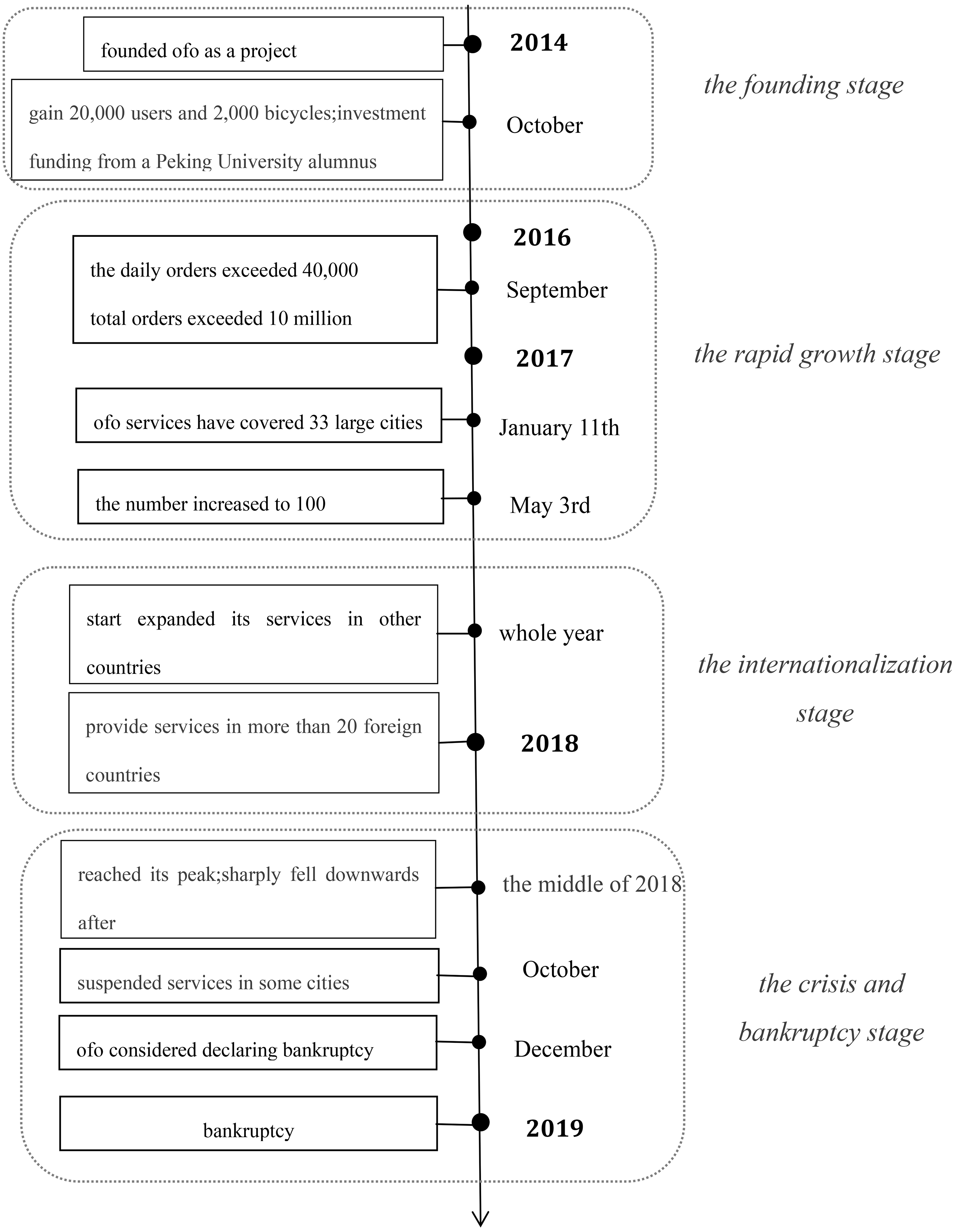
As shown in the Fig. 1, the development of ofo could be divided into four stages. First, was the founding stage in which Wei Dai founded this enterprise as a project in a cycling club with his other four members in 2014, named “ofo”. Later on, the service was launched in Beijing, gaining 20,000 users and 2,000 bicycles by October with investment funding from a Peking University alumnus. Second, was the rapid growth stage, from 2016, ofo experienced rapid growth with increased users and expansion of its services from Beijing to other large cities in China. In September of 2016, the daily orders exceeded 40,000 and total orders exceeded 10 million; on January 11
In June 2016, ofo started to provide sharing bike services on campus at several universities, like Sun Yat-sen University, and the bikes could only be used inside of campus during this period. Then a contract was signed with the Haizhu district government in Guangzhou in December, one of the central districts of the city, 60,000 ofo bicycles were launched and used openly in this district. The number kept increasing sharply and more sharing-bike enterprises entered into this market.
With more and more bike-sharing enterprises getting launched, more and more management issues and problems surfaced. For example, the data isolations led each enterprise to make inaccurate market predictions and the supply of bicycles was far greater than users’ demand. The total supply from different enterprises almost reached 800,000 and seriously exceeded the public demand. This brought inefficient use of these bikes and wasted resources. Sharing bike services being a new service delivery model, there was no enterprise experienced in managing their operation. Ofo, along with other enterprises, was not well managed and the bicycles piled up in the streets and brought a lot of urban issues, such as inappropriate parking and public safety.
In March of 2017, the Guangzhou municipal transportation bureau met with ofo and the other four large enterprises, requiring them to address the related issues and informing them that Guangzhou government will take measures to regulate sharing bike services and their use. Five months later, the bureau forbade ofo and other suppliers from increasing their bicycles on Guangzhou streets. In February 2018, ofo opened the sharing bike data to the Guangzhou government for better supervision and management of its services. The data, including the, unlock, ride, and return of all the ofo bikes, helped Guangzhou government to better understand public demand to improve transportation services and urban planning. In September 2018, the bureau started to do the “total amount control” regulatory approach based on the evaluation of the public demand, and regulated ofo and other enterprises with strict measures.
The hardest time came to ofo in Guangzhou at the end of 2018 when more and more users started to apply to refund their deposits since ofo services could not compete with others, which brought a big cash flow problem. In April 2019, the Guangzhou government released a bidding announcement and set the total amount of 40,000 bicycles in 6 central districts (Guangzhou has 11 districts in total). In June, three enterprises (Mobike, Meituan, and Qingning) were qualified to continue their sharing-bike services. Based on the bidding results, ofo was not allowed to deliver its services any longer and has to remove all the bicycles out of the 6 central districts. Reporters also found that the office of ofo in the Haizhu district has been closed. After three years of development, ofo withdrew from Guangzhou. The timeline is shown in Fig. 2.
Development of ofo in Guangzhou.
We analyzed the documents and data collected including our interview and divided our findings into four stages. In each stage, we described the development of sharing bikes, the issues brought about and their negative effects, and the measures taken from the government to address these issues.
Rapid expansion and disorder competition (June 2016 to June 2017)/problem discovery
During this period, a large number of ofo bikes were put in Guangzhou, competing with other sharing bike enterprises. To achieve higher market share and active users, ofo along with other enterprises kept putting more bikes in the central districts, especially at bus stations, subway stations, and hospitals. In addition, ofo made the policy that the early users can ride the bikes without deposit and get the services for free in the future with paying 150 RMB. A lot of discounts and special rates were offered by ofo, which brought its rapid expansion.
Individual users got benefits at this stage as they could ride brand new and well-designed bicycles with very low prices (almost free), and could rent and return them anytime and anywhere, which optimized the traditional service delivery model. The ofo enterprise developed fast as the high growth satisfied the investors’ expectations, attracting more investment and financial support. As a result, ofo expanded rapidly from the first-tier cities in China (Beijing, Shanghai, Guangzhou, and Shenzhen) to others.
However, after experiencing a short “honeymoon” period, problems and conflicts came about. To get higher market share and users, ofo heavily emphasized on services increase and expansion while ignoring the issues brought to urban management. Without proper management responsibility for these issues, ofo bicycles headed into chaos. Too many bicycles were located at the entrance of subway stations, bus stations, school gates, sidewalks, and even motor vehicle lanes, which brought serious troubles to city traffic and public safety. There was a lack of supervision and regulation which resulted in destroyed bicycles and dangerous behaviors. For example, some parents put their children in the front basket representing a serious safety concern.
To solve the problems, the bureau first reacted to this market failure by analyzing the problems and helped ofo set up an effective mechanism to improve its bicycle management. Then, the bureau set goals and made regulations that ofo needed to follow, like staffing, bicycle distribution, that helped the company correct the market failure. In addition, the Bureau collaborated with the department of police and city management to regulate the inappropriate behaviors of users, such as riding and locating bikes in the wrong places. The collaboration among different stakeholders helped the bureau to better understand the characteristics of bike-sharing, the problems that existed, and the responsibilities of government and enterprises. As a result, regulations and laws were enacted for bike-sharing in the city.
Balanced market and operational problems (June 2017 to early 2018)/problem discovery
After the disorder of hyper-competition, many sharing bike enterprises eventually closed down, as the low prices could not generate profit and the investment and financial support from outside sources dried up. There were only two enterprises left, ofo and mobike. Both of them, as early “players” in this market used a “low price strategy” (which did not even meet operational costs) to drive other enterprises out of the market.
The closing down of the competitors gave the balance of the sharing bike market to ofo, who had to rethink its strategy, realizing that the current operational model could not be sustained any longer. The achievement of the first stage goals (high market share and active users) led investors to set the second stage goal of generating a profit. This gave ofo pressure to improve its operation and services. However, the young ofo company lacked the required management experience to be successful.
One serious problem was the management and maintenance of damaged bicycles. After long and high-frequent use, many bicycles were damaged, including electronic locks, chains, and brakes. This greatly increased maintenance costs for ofo enterprises. Once the damaged bicycles could not be well fixed in time, the low service quality negatively impacted users’ satisfaction. Besides, unlike the first stage when ofo offered many special rates and discounts to attract users, the price gradually increased and deposits were required to new users as ofo enterprise wanted to generate a profit. The lowering of service quality and increased prices brought more and more complaints from users, many switched to other suppliers (like mobike).
The increasing amount of damaged bicycles in the street and complaints from users attracted the attention of the local government in Guangzhou. The bureau of transportation, collaborating with departments of police and city management, took measures to regulate the operation of ofo enterprises, requiring them to fix and clean the damaged bicycles in the streets and improve service quality. The bureau also worked with the department of market regulation, supervising the operation of ofo enterprise to ensure that users’ rights were protected. In addition, the bureau coordinated a variety of public sector agencies and sharing bike enterprises in Guangzhou (like ofo) to make an agreement on protecting the city environment and safety. Our case study showed that bike-sharing market failure explains the government intervention in markets and associated regulatory rules as a response that seeks to protect the public interest.
Ofo’s bankruptcy and “total amount control” (until end of 2018) enacting regulation
Though most of the bike-sharing enterprises were driven out of the market, the competition between ofo and mobike never stopped. They increasingly put more bikes on the streets to maintain their market share, while the damaged bikes were not fixed and removed. Without accurate prediction of the demand in Guangzhou, the supply continued to increase and exceeded demand. Data showed that the supply of sharing bikes in Guangzhou once exceeded 800,000, resulted in a lot of wasted resources. It also brought a great burden to the city, as such a large number of bicycles on the street is a big challenge to local government management.
Even with the two-remaining bike-sharing enterprises raising their prices, they still could not generate a profit, especially facing intense competition. Comparing with mobike, the bike quality of ofo was not that good, which brought even more problems. Users often found problems such as flat tires, damaged brakes, and so forth with ofo bikes. Some users began to apply to refund their deposits to their ofo accounts but found out that they could not do it as ofo was experiencing cash flow issues. The following media reports brought more worriers, leading to the increase of users applying for deposit refunds until the ofo admitted that they faced a big cash flow problem and could not refund any more deposits. Shortly thereafter the enterprise went bankrupt.
In June 2018, the bureau of transportation decided “total amount control” stating that no more sharing bicycles would be allowed to enter the city. After the bankruptcy of ofo, mobike became the only player in the market of the city. Although new bike-sharing enterprises were set up (like Meituan and Qingju). They wanted to deliver their services in Guangzhou, the bureau of transportation still implemented the “total amount control” and did not allow it. As a result of failures from ofo enterprise, the government serves as an instrument for improving market operation while emphasizing that regulations should maximize social welfare to protect the public interest. Besides the bureau of transportation collaborated with ofo and mobike to create a better management to address their bikes issues.
Bidding and market reshuffle (until now) aftermath of regulation
Since late 2018, the Guangzhou government started to prepare to use bidding to regulate the entry and running of sharing bike services, as the whole city suffered a lot from the disorderly competition from these enterprises. After three years, the government accumulated enough experience on how to address these problems. They had to rethink the whole operational model and redefined bike-sharing in Guangzhou as “time-sharing lease” services. That’s to say, it’s “renting” instead of “sharing”, and these services providers need to take responsibilities to improve their services and protect users’ rights. In connection to public interest theory, the government serves as a protector while establishing relationships with the bureau of transportation, department of police, and city management to protect user’s rights. As a result of market failure, the government’s reaction was to enact regulations and laws for bikes-haring in the city. The government addressed the issue by coordinating the bidding process that set up the standard for sharing bike services.
Before the bidding, the government set clear standards with the sharing bike enterprises. Based on the third-party evaluation and analysis, only four enterprises were qualified to bid (ofo, mobike, Qingning, and Meituan). The contractual agreements comprehensively list responsibilities, rules, and related penalties for violations. Specifically, services are delivered with the real name registered, which is connected with an individual’s credit system to regulate the inappropriate behaviors of users. Sharing bike enterprises need to provide insurance to protect users if an unexpected accident occurred. Finally, the police department collaborated with sharing bike enterprises to address the traffic violations, and the city management department was designed to help regulate parking of the sharing bikes.
Four stages and related issues/measures
Four stages and related issues/measures
In June 2019, the bidding process was opened to the public and it was determined that the three enterprises (Mobike, Qingning, and Meituan) were allowed to provide services in the downtown districts of Guangzhou. Ofo for the quality and management of its poor services were not qualified to deliver services anymore. Based on the third-party report, the demand for sharing bikes in Guangzhou is around 400,000. Thus, based on the evaluation of the three enterprises’ service capabilities and quality, the Guangzhou government assigned 180,000 to Mobike, 120,000 to Meituan, and 100,000 to Qingning. The government indicated that it will dynamically manage and adjust the quota according to their performance and services. Table 2 summarizes the four stages of development of regulation of the bike-sharing services in Guangzhou.
Currently, the sharing economy is quite popular worldwide and has advantages compared with traditional service delivery models. However, along with the rapid development are the challenges and issues that need to be addressed. It seems that governments all over the world are not well prepared. Without mature laws, policies, regulations, and management experiences, governments, especially at the local level, face intense pressure to reform and regulate. Thus, the government’s roles in regulating the sharing economy need to be clarified and discussed. In this case, three important roles were played by the Guangzhou government in regulating sharing bike services.
Government roles at different stages.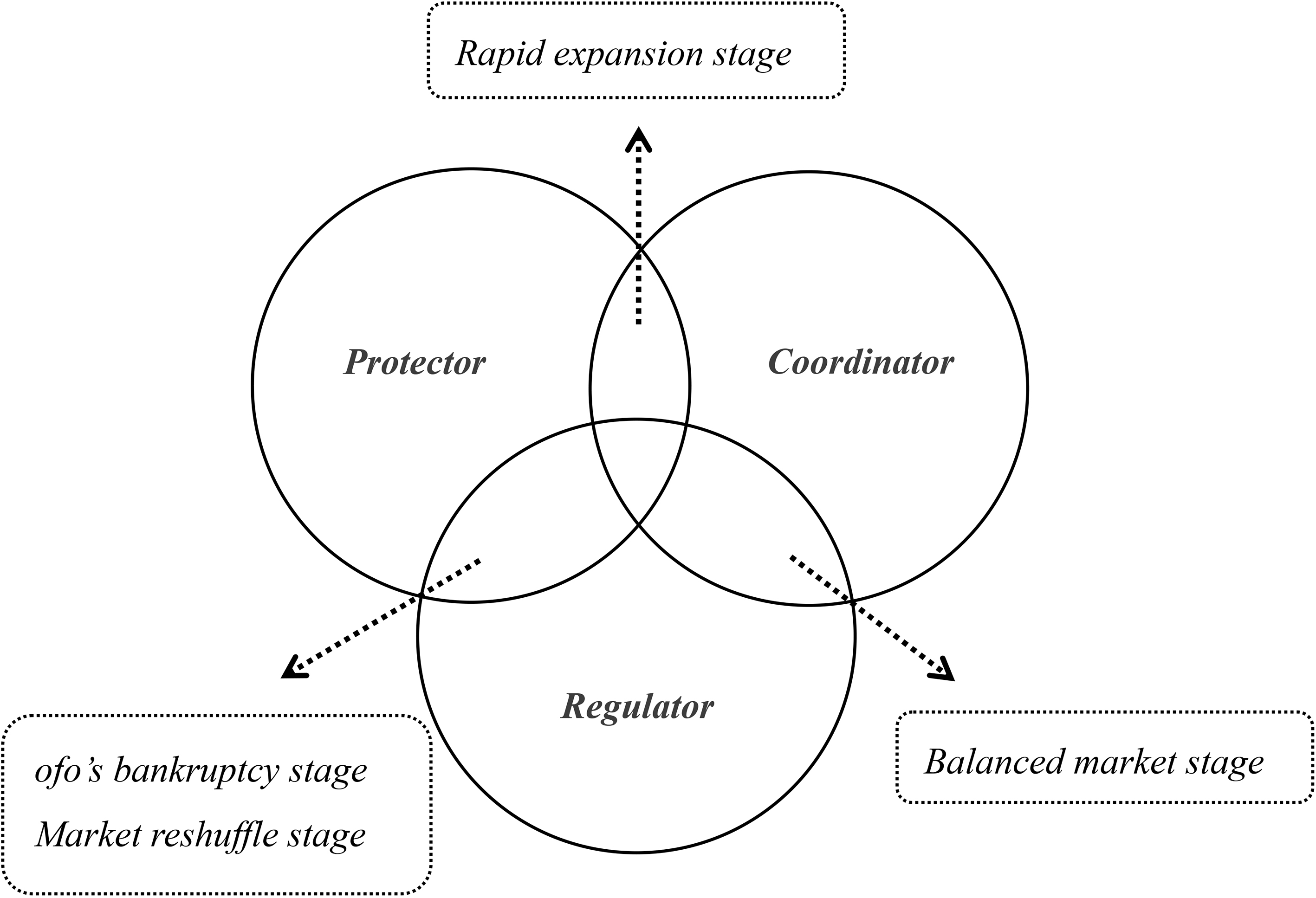
In the case of Guangzhou, the new emerging industry of bike-sharing led to the incremental adoption of the new innovation. The government response as a protector, coordinator, and regulator is shaped by public interest to reduce conflict between the public and the bike-sharing company ‘ofo’. The incremental approach was intended to ultimately improve the quality and functionality of this new innovation of automated lock and payment system as opposed to the traditional bike renting services. To regulate sharing-bike development and address related issues, the “wait and see” or incremental approach decision allowed the government to accumulate enough experience to address bike-sharing problems resulting in the government roles as protectors, coordinator, and regulator (see Fig. 3). These roles are spurred by experience and information gathered to improve the operation process and ensure that public interest is taken into account when responding to bike-sharing problems.
Protector
Sharing economy usually occurs between service providers (private sectors or individuals) and users (individuals). With limited experience and capabilities in operation, the young sharing economy enterprises often perform poorly, which harm the public interest. Thus, the government needs to play the role of a “protector” to protect users’ rights and interests. In this case, the service quality of ofo is poor and users could not refund their deposits. Guangzhou government had to take measures to protect users.
The sharing economy has spread all over the world and its contribution has been widely accepted. Take bike sharing, for example, it brought a lot of convenience to users serving as a complementary service to public transportation. Bike-sharing can promote environmental sustainability as more people would like to ride these bikes for work, exercise, and leisure. Sharing bikes services also stimulate related technology innovations and industry development. As a new phenomenon, sharing economy is not mature enough and needs time and space to grow. The government needs to protect the reasonable interests and innovation of the enterprises, especially at the startup stage.
Coordinator
The sharp increase of users attracted more investors and enterprises to join in and the competition became intense, as they want to gain more active users and market share. The disorderly competition continued to benefit users with high discounts or special rates, resulted in the overall inefficiency since the costs (i.e., externalities) were transferred to the city as a whole.
In this sharing bike case, more than 70 different enterprises delivered these services. The competition made the price very low to the users. However, the disorderly competition brought troubles and challenges to the whole city. For example, the shortsighted goals of the enterprises emphasized market share and an increased number of active users. Essentially, they aimed at “winning” over competition and market share, instead of providing sustainable and high-quality services. This is opposite to the initial value proposition of the sharing economy seeking increased sustainability and improved health. Without accurately evaluating the public demand, these enterprises kept putting more bikes on the streets to increase their market share, bringing a lot of management costs to local government and to the city. Initially, there is no effective way to regulate users, resulting in many bikes being damaged in the streets and elsewhere. In addition, low-quality services created a lot of conflicts between users and bike-sharing enterprises.
In this case, the Guangzhou government, based on the third-party evaluation report, stated that the demand for the whole city is around 400,000 bikes, which is much less than the supply of 800,000. The intense competition harmed enterprises themselves and the whole market. The government negotiated with the enterprises to better understand the situation to adjust their strategy. Besides, the Guangzhou government collaborated with local reporters and media to call the public’s attention toward using bike-sharing responsibly. The bureau also coordinated a variety of public sectors and departments to address management issues.
Regulator
Our case study showed that the government needed to act as a regulator to protect the public interest. In this study, there was pressure from investors and competitors promoting bike-sharing enterprises only to focus on the short-term goals, instead of sustainable services. For example, ofo bikes are made with low-quality materials, easily broke down and were not safe to ride. Furthermore, to reduce the operational costs, bike-sharing enterprises did not buy insurance for the users. The bankruptcies of many sharing bike enterprises made many users lose their deposits. Guangzhou city government, as a result, set strict regulations on bike-sharing enterprises to improve their operations to protect users’ rights and promote service quality.
As the sharing bike development stepped into the third and fourth stages, the Guangzhou government enacted regulations, making the enterprises take responsibility for their product. For example, the government required these enterprises to correct the market failure and remove and maintain their destroyed bikes, to ensure that the bikes were parked in the appropriated places. After the bidding, more comprehensive and strict regulations were made. In the end, only three qualified enterprises could continue to deliver services and were required to promote service quality and sustainability. However, these three enterprises needed to follow the strict regulations to reduce the negative externalities to the city. The regulator role of government-provided greater protection for the users, enterprises, local government, and city residents.
Conclusion
The rapid growth of the global economy and technological development bring about a variety of challenges that the government is required to address. This is especially true in today’s turbulent times when policy, environments, and citizens need to interact in a highly variable and unpredictable manner (Hong & Lee, 2018). However, the mismatch between the characteristics of the environment and the way organizations are governed (Janssen & Van der Voort, 2016; Hong & Lee, 2018) result in policy failures, which lead to public dissatisfaction and distrust and loss of public interest.
Our case analysis showed the role of government in the regulation of evolving enterprises of bike-sharing is a process whereby decisions are made, incrementally aimed to help solve issues caused by bike-sharing. The government in Guangzhou focused on an incremental approach to identify the roles needed to regulate bike-sharing development in China. The incremental approach allowed the government to slowly gain knowledge of this new service and enact laws and regulations for the benefits of the public interest.
Our analysis found that the public interest theory was the most applicable theory to explain the response of city government to our bike sharing case study. The City of Guangzhou had to respond to the public interest to correct this market failure. The regulatory capture theory was not applicable. We did not find that the city government was captured by the bike sharing companies. We found that the public interest theory was consistent with an incremental approach to planning in the roles of government to work in the public interest to protect, coordinate, and regulate bike sharing. The role of government in planning is very consistent with Lindblom’s (1959) incremental approach. The government essentially took a “wait and see” approach, by slowly responding to public pressure and implemented measured reform. This incremental approach to planning is consistent with the e-government research on the adoption of new technology in government innovation (Norris & Reddick, 2013).
The rapid development of the “sharing economy” has brought controversial issues, through its innovation. Besides the strong disruptive effects this new service model generated to the traditional service suppliers, it brings a lot of urban and administrative issues that the government was not well prepared for. Governments worldwide have adopted substantially different solutions, while there is a lack of widely agreed manner and an acceptable way forward for shared economy services. One important reason underlying this is that the role of governments in regulating the sharing economy has not been clarified. As a result, the boundary and relationships among different stakeholders and the responsibilities that governments need to take are not clear.
Through the case study of sharing bike company “ofo” in Guangzhou, we discussed the three roles of government in sharing economy development including “protector”, “coordinator”, and “regulator”. The three roles indicated the same bottom line that governments are responsible for protecting the public interest in regulating this industry. On one hand, the government needs to protect the reasonable interest of individuals and private sectors; on the other hand, the government has to regulate the inappropriate and even illegal activities to protect the public welfare. Thus, it’s required that the government play these roles well and better collaborate with different stakeholders to improve the welfare of its residents.
This study has limitations in several aspects. For example, the single case of bike sharing industry may not have implications for other emerging areas of sharing economy regulation. Furthermore, the institutional environment of China, the background of the case, has its unique features, and some issues discussed in this case may not be the same in other countries. In addition, limited interview and documents in this study may not enable us to fully understand the regulations to the sharing economy from the viewpoints of suppliers and users. Despite these limitations, this study serves to help readers better understand the sharing economy, the issues, problems it brings, and the roles of government in regulating the sharing economy.