




Abstract
The amount of acceptance literature stands in sharp contrast to the persistently low adoption rates of public e-services in most European countries. Despite huge investments on the one hand and a vast body of literature on success factors on the other hand, citizens are surprisingly uninterested in the use of public e-services. However, only few studies explicitly address phenomena of resistance or non-adoption. In order to explain citizens’ non-adoption and adoption of public e-services, this article builds on the Inhibitor Theory as an analytical framework, based on which a dual factor-model is proposed and tested with survey data from 495 German citizens. The results of this study indicate that non-adoption of public e-services is less driven by technical issues than suggested in current literature. Instead, the need for personal consultation and status quo bias are the strongest predictors of citizens’ non-adoption.
Introduction
Public administrations are the catalysts for the government’s work, executing policies, regulations, and laws. As such, they are not only obliged to adhere to the government and its decisions, but also to the interests of citizens. Even more, public administrations are dependent on the cooperation of those they serve. Without the citizens’ willingness to adhere to rules and support the administrative work, public administrations cannot perform their duties with success (e.g. Thomas, 2013). Thus, investments in digital infrastructures – steadily increasing since the late 1980s when public administrations started to exploit the potentials of digitization (Garson, 2005) – only pay off if they are actually utilised by the intended users, especially by citizens. However, it is the citizens’ non-adoption of public electronic services (public e-services) that challenges administrations throughout Europe. With the exception of some successors such as Denmark, Iceland, Sweden, Norway, Finland, and Estonia, many countries still face usage rates below 50% (Eurostat, 2020a), despite often quoted benefits for both public administrations and citizens (Jaeger, 2003) such as increased transparency and accountability (Carter et al., 2016). At the same time, the Internet – the medium through which public e-services are mostly accessed – is becoming increasingly widespread; in 2018, 89% of the European households had access to the Internet (Eurostat, 2019). Thus, this article examines the phenomenon of non-adoption of public e-services.
In order to measure the success of ICT (information and communication technologies) in general and public e-services in particular, academics and practitioners alike have developed instruments that capture the use rates (e.g. Krcmar et al., 2018), satisfaction with public e-services (e.g. Welch et al., 2005), and critical success factors (Rana et al., 2013). E-government research as a discipline in its own right has made considerable contributions to the understanding of IS (information systems) success and adoption. Commonly used models of technology adoption have been systematically adapted to the public sector context (e.g. Belanche et al., 2012; Dwivedi et al., 2016) and have been further developed (e.g. Carter et al., 2016). In addition to empirical literature, researchers have contributed to the field through conceptual works (e.g. Bélanger & Carter, 2012; Layne & Lee, 2001) and comprehensive literature reviews (Rana et al., 2012, 2015). While this past research has contributed to important strides for both the general IS discipline and the e-government field, more research is needed with regard to the prevailing gap between supply and use of public e-services by citizens. The stagnating user rates of public e-services in highly developed countries such as Germany stand in sharp contrast to the governmental investments in the development and proliferation of these services. Therefore, the aim of this article is to examine the phenomenon of citizens’ non-adoption of public e-services in Germany in-depth and identify factors that influence citizens’ decision to either use public e-services or to fall back on service provision on-site.
This article is built on the premise that non-adoption is a user decision in its own right and is, consequently, influenced by a different set of factors than adoption decisions. Most research on citizens’ use of public e-services is grounded in behavioural research and stands in the tradition of technology adoption research. Accordingly, theoretical concepts and models used in the mother discipline (Information Systems) are applied in the context of public e-service provision (Belanche et al., 2012; Sipior et al., 2011; Wang & Liao, 2008). Commonly, this line of research investigates the success of IS (e.g. Scott et al., 2016) by studying factors positively impacting the use of those technologies (e.g. Belanche-Gracia et al., 2015). In a nutshell, researchers studying the use of ICT from this perspective take the advantages of an innovation as compared to the status quo as their starting point and argue that the technology comes with benefits that outweigh the advantages of this status quo (e.g. Belanche et al., 2012; Verdegem & Verleye, 2009). This perspective has been criticised for being too technology-deterministic (Coursey & Norris, 2008; Heeks & Bailur, 2007), yet most of the research on the use of public e-services is based on this argumentation (Rana et al., 2012). Only few contributions take potential disadvantages of an innovation as compared to the status quo and shed light on the question whether it might be reasonable from a user’s perspectives to adhere to this status quo (e.g. Distel & Ogonek, 2016; van de Walle et al., 2018). Mostly resistance, rejection, and non-adoption of IT are treated as a black box or ‘simply’ explained by reversing success factors (Cenfetelli, 2004; Laumer & Eckhardt, 2012). A literature review from 2012 on the non-adoption of ICT (Laumer & Eckhardt, 2012) reveals only nine different approaches that open this black box, which stands in sharp contrast to the vast amount of technology adoption literature. Accordingly, only few articles explicitly deal with the non-adoption of public e-services (e.g. Rey-Moreno et al., 2018; Rey-Moreno & Medina-Molina, 2017). Works in this line of research are also part of behavioural research streams but mostly grounded in organizational literature and research on resistance behaviour (Laumer & Eckhardt, 2012). Authors investigating this topic treat non-adoption as a phenomenon independent from adoption. The rationale underlying most studies here is that the non-adoption of a technology may be a decision in its own right and, thus, may be impacted not only by a lack of success factors but by a whole new set of factors (Laumer & Eckhardt, 2012). Whereas the reversal of success factors, such as user-friendliness to lack of user-friendliness, may explain some of the variance in citizens’ behaviour, it is assumed here that a considerable proportion of this variance is explained by additional factors that only have a negative impact on the users’ behaviour. This article addresses this gap in e-government research by explicitly focusing on non-adoption of public e-services and investigating factors that contribute to citizens’ reluctance to use public e-services.
Thus, deepening the understanding of non-adoption of public e-services among citizens may advance the understanding of diffusion processes of IS for both public administration research and IS research in general. By taking this resistance perspective on citizens’ use of public e-services, this article offers a new perspective on and explanation of an often-observed phenomenon. Thereby, this article contributes to research by providing a much-needed change of perspective and derives implications for the development, design, and implementation of public e-services.
The following sections set the scope of this research and discuss the theoretical grounds on which this article is based. For the empirical part, a mixed-methods design was chosen to gain insights into citizens’ behaviour and to better understand non-adopters’ behaviour. In a first step, semi-structured interviews with German citizens were conducted (Distel, 2018) to gain a better understanding of how citizens perceive public administrations and their digital initiatives. The results of these interviews are reviewed here only briefly and are contrasted with current research and substantiated with theories from research on e-government and the use of ICT in general. Based on this preparatory work, hypotheses are generated and translated into a conceptual research model. To test the hypotheses, a survey among 495 German citizens is conducted. Data resulting from this survey is analysed using regression analyses. The article concludes with a discussion of implications for research and practice.
Contextualization of the research: E-government in Germany
In order to set the study’s scope, the terms ‘e-government’ and ‘public e-services’ are delineated and the case, i.e. Germany and its e-government landscape, is briefly analysed.
E-government and public e-services
In this study, e-government is defined as the provision of public services by electronic means, mainly through the internet (Wang & Liao, 2008). Thus, instead of e-government the term ‘public e-services’ is mostly used throughout the article. By taking this rather narrow definition of e-government, other aspects that have been summarised by the term ‘e-government’, such as accessibility, transparency, participation, and democratic decision making (van Duivenboden, 2005), are not treated here. Instead, this article is focused on the provision and consumption of public e-services (Meijer, 2015). This understanding comprises public services which the citizen consumes in her role as a customer (Thomas, 2013; van Duivenboden, 2005). Hereunder fall, for example, tax filing, submitting applications or searching for information online. This definition excludes, however, public services that enable participation, e.g. taking part in citizen surveys, the formation of public will or the co-creation of public services.
E-government in Germany
This study was conducted in Germany for several reasons. First, Germany is among the fifteen most developed countries with regard to e-government (United Nations Department of Economic and Social Affairs, 2016) together with other European countries such as Finland, Sweden, the Netherlands, Denmark, France, and Estonia. While these countries also perform well with regard to the average usage of public e-services by citizens with, for example, 74% of the Finnish citizens downloading forms from the Internet, the usage rate in Germany is considerably lower than in these countries, with only 35% of the German population downloading forms from the Internet and even less, 21%, submitting forms through the Internet (Eurostat, 2020b). According to a yearly study on e-government use in Germany, the average usage rates did not considerably increase in the past years, varying between 45% in 2012 and 48% in 2019 (Scheiber et al., 2019). Thus, Germany creates an interesting context for this research endeavour as the gap between the development of public e-services on the one hand and citizens’ use of these e-services on the other hand is particularly prominent here.
Second, the German government has made considerable efforts to advance the digitization of public administrations on all federal levels. Attempts to develop a sustainable e-government infrastructure in Germany date back to the beginning of the new centuries (Akkaya et al., 2012). The first e-government programme BundOnline 2005 was launched in 2000. The aim was to make all federal services available online by the year 2005 (Chief Information Officer of the Federal German Government, 2019). This initiative was followed by several further programs and in 2010, the National E-Government Strategy was adopted. Developed by the IT Planning Council, this strategy aims at harmonizing the supply of public e-services at all administrative levels (IT Planning Council, 2015). More important, though, was the Digital Agenda 2014–2017, which forms the framework for the Federal Government’s actions in digitizing all life areas and the economy (Federal Ministry for Economic Affairs and Energy et al., 2014). The agenda contains concrete measures for implementing digitization, includes a package of measures for digitizing the public administration (Federal Ministry of the Interior, 2014), and explicitly focuses the user perspective. In addition to these strategic initiatives, the federal government passed the e-government law in 2013, which led to the development and passing of similar laws on the state level. Existing initiatives as well as the current governmental programs stipulate large resources for the development of citizen-centric public e-services (Bundesregierung, 2018).
Third, the usage rates for citizens have remained at a consistently low level over the past years (Krcmar et al., 2018) – despite the above sketched efforts which stands in sharp contrast to the German citizens’ overall use of e-services and online media. More than 90% of the population have accessed the Internet in 2018, 75% of the citizens have watched videos online (Kupferschmitt, 2018), and still 67% of the citizens have used online shopping within the last 3 months in 2018 (Statistisches Bundesamt [Destatis], 2018). There are many reasons for this discrepancy between general online use on the one hand and use of public e-services on the other hand. Many of the above mentioned initiatives concern public services of federal agencies, to which citizens typically have little or no contact (Grunow, 2003). In addition, services at the state or municipal level are often not fully offered online or not all necessary services are provided electronically. However, this rather supply side-oriented approach is only one part of the explanation of the phenomenon. Studies from other European countries show that, in addition to structural barriers, the individual technology usage behaviour may also play a prominent role in explaining non-adoption of public e-services (Rey-Moreno et al., 2018). At present, however, research hardly examines and explains non-adoption of public e-services from a more demand-side and behaviouristic perspective.
Fourth, the use of public e-services in Germany is not mandatory. While e-government laws on the federal and regional level equate the digital channel with conventional channels, such as making a phone call or writing a letter, it is also specified that the digital channel may not supersede conventional ways of contacting public administrations (Federal Ministry of the Interior Germany, n.d.). As such, it is up to the citizens to decide which mode of contact they choose and concepts such as ‘digital by default’ are not used within German public agencies. In face of this situation, it is especially important to comprehend how citizens decide whether or not to use public e-services. From the practitioner’s perspective, a deeper understanding of this situation is important, because low usage rates may undermine the legitimacy of e-government initiatives. From a researcher’s point of view, a deeper understanding of the phenomenon is of interest in terms of advancing our current knowledge of and theoretical views on the use of public e-services.
Theoretical development
In this section, the theoretical foundation for this article is laid. The Inhibitor Theory is described and translated to the public administration context. Here, central terms in the canon of this theory are defined. The section concludes with the derivation of hypotheses.
A dual-factor approach to study non-adoption of public e-services
As a theoretical framework, this study uses the Inhibitor Theory as proposed by Cenfetelli (2004). Only recently, academia turns its attention towards the question of why people refrain from using a given system. In a recent literature review, Laumer and Eckhardt (2012, p. 64) state that while scholars have “[…] come across resistance phenomena as well […they] have also ignored the possibly vital difference between a lack of arguments for IT usage and IT resistance.” This is the basic argument used within the Inhibitor Theory. This theory builds on commonly used approaches in the field of e-government research, such as the Theory of Planned Behaviour (Ajzen, 1991) and technology acceptance (Davis, 1989), but also on psychological approaches to an individual’s positive and negative perceptions (Baumeister et al., 2001). Since these approaches and theories can be regarded as well-known, they are not reviewed here. Instead, this section focuses on the core constructs and relationships used within the Inhibitor Theory.
It is commonly assumed that users have as well enabling perceptions of a system and its attributes as inhibiting perceptions. These perceptions are the individual’s external beliefs about the system (Cenfetelli, 2004). Beliefs can be defined as “[…] the prevailing determinants of a person’s intentions and actions” (Ajzen, 1991, p. 189). Thus, depending on whether specific attributes of a system are perceived or not, the individual’s perceptions may either be positive or negative. These positive and negative perceptions are mostly understood as opposite ends of the same continuum. In this understanding, if a public e-service is perceived as being easy to use, the probability of adoption is higher. If the service is perceived as being not easy to use, the probability of adoption is lower.
The Inhibitor Theory, however, proposes to consider inhibitors as an independent set of factors that exert only negative influence on usage decisions. In contrast, enablers may either have a positive or negative impact on usage decisions, depending on whether they are perceived favourably or not. Furthermore, Cenfetelli (2004) proposes that negative perceptions may have a stronger impact than positive perceptions. Based on the Prospect Theory by Kahnemann and Tversky (1979), the Inhibitor Theory postulates that losses, even potential losses, are feared more than gains and that whether change is perceived as either a loss or a gain depends on the individually perceived status quo (Kahnemann & Tversky, 1984). By focussing on both enabling and inhibiting perceptions that impact an individual’s behaviour, the theory delineates a so-called dual-factor concept comprising two sets of different and sometimes even competing factors that influence the user’s behaviour, i.e. it considers the influence of both enablers and inhibitors. Based on this, the major constructs are defined and adapted to this study. Enablers are factors that either are positively related to the intention to and use of public e-services if they are perceived by the citizen or are negatively related to the behavioural intention and behaviour if they are not or unfavourably perceived. Inhibitors are conceptualised as factors that are independent from enablers and that are only negatively related to the individual’s behavioural intention and behaviour if they are perceived but that exert no influence if they are not perceived. Behavioural intention is defined as the individual’s own assessment of its probability to use public e-services in the (near) future, whereas behaviour is defined as the citizen’s actual use or non-use of public e-services. Although inhibitors and enablers are defined as independent constructs, the behaviour of citizens is conceptualised as duality; the decision to not use public e-services implies that use cannot occur in parallel and vice versa. In accordance with Laumer and Eckhardt (2012), this article distinguishes between resistance, rejection, and non-adoption of (public) e-services. Whereas rejection and resistance relate to general assessments of a change, non-adoption can be understood as a choice between two competing yet equally reasonable choices.
The Inhibitor Theory has – so far – not gained much attention as is the case for other theories and concepts that aim at explaining non-adoption of or resistance to IT (Laumer & Eckhardt, 2012). Within e-government research, only few articles explicitly use the Inhibitor Theory as a conceptual framework but offer empirical support for the theory. Among the first to use the Inhibitor Theory within this domain are Harfouche and Robbin (2012) who study the first-time use of public e-services in Lebanon through the theoretical lens of inhibitors and enablers as separate constructs. They identify fear of government control, lack of trust in security, and lack of trust in privacy as the most influential inhibitors to citizen’s use of public e-services. Ochara et al. (2016) also use this dual-factor approach in order to measure the use of public e-services in South Africa. However, instead of only considering inhibitors to the use of public e-services, they also conceptualised resistance enablers – factors that enable resistance behaviour – and resistance inhibitors, “[…] which are attributes that typically suppress the urge to resist e-Government innovations” (p. 130). In their conceptualization, resistance enablers are maladaptive defence mechanisms and switching costs. The latter have been repeatedly conceptualised as inhibitors to IT use in prior research (e.g. Kim & Kankanhalli, 2009). A more nuanced adaption of the Inhibitor Theory within e-government research is offered by Rey-Moreno and Medina-Molina (2017) who study the non-use of public e-services in comparison to use among Spanish citizens. Their results indicate that non-users’ behaviour is largely influenced by the inhibitor habit and the enabler performance expectancy and that for non-users, the relation between behavioural intention and behaviour is less consistent than for users of public e-services, i.e. although non-users may express the intention to use public e-services in the future, their actual behaviour is contrary to their intentions.
Hypotheses
As can be seen in the accounts above, the Inhibitor Theory has so far not received much attention in e-government research, although it offers persuasive explanations for both adoption and non-adoption of IT. The theory is used here as the analytical framework along which empirical evidence is structured and explained. Owing to both the scarce literature on non-adoption of public e-services and the few uses of the Inhibitor Theory in our field, a qualitative pre-study was conducted (Distel, 2018). This way, a) potential inhibitors to public e-service use can be identified that are so far not covered by the more success-oriented e-government research, b) the usefulness of the Inhibitor Theory for the public sector context can be examined, and c) potential enablers and inhibitors that are relevant in the German context can be revealed.
In 18 semi-structured interviews, citizens were asked about their perceptions of public administrations and public e-services in Germany. The interviews were then analysed with regard to perceived enablers and inhibitors to the use of public e-services. The analysis of these interviews confirmed that citizens do perceive enablers and inhibitors to the use of public e-services. Moreover, the interviews can be seen as a first indicator for which factors may impact their decision to use or not use public e-services. More details on the qualitative study are given in (Distel, 2018). Based on the knowledge gained through this preparatory study and considering the Inhibitor Theory as the framework for this study, hypotheses are derived in this section.
Enablers of intention to and actual use of public e-service in Germany
The following enablers – raised by the interviewees and substantiated with existing literature – impact the adoption decision: user-friendliness, trust in the internet, trust in the government, efficiency expectations, perceived competences, information about services, and the image of public administrations (see also Fig. 1).
Not surprisingly, the user-friendliness of public e-services plays an important role for citizens in Germany. The positive relation between the user-friendliness of an offer – understood as the amount of work associated with its use – and the use or intended use on the other hand has already been extensively investigated. Since this factor plays an outstanding role in previous studies and was also mentioned by the interviewees, the influence of user-friendliness on use and intention of use in comparison to the perceived barriers of use will be explicitly examined here. In accordance with the Inhibitor Theory, user-friendliness is here conceptualised as an enabler.
H1 – Citizens’ perception of user-friendliness will be positively related to their (a) behavioural intention and (b) behaviour.
The same argument holds for the trust constructs, efficiency expectations, and perceived competences. These factors were also reported by the interviewees as being influential and were already extensively tested by prior research for their impact on behavioural intention and behaviour. Trust is an important factor in modern societies and functions as a bypass to risk perceptions (Luhmann, 1968). Thus, trust has repeatedly been treated as a major influence on citizens’ intention to use public e-services (e.g. Bélanger & Carter, 2008; Horst et al., 2007). In how far trust may relate to non-adoption, however, has so far not been studied and shall be subject matter of this article. Moreover, we aim at identifying the importance of trust on the citizens’ decision as compared to other factors. Bélanger and Carter (2008) have proposed distinguishing between trust in the government (here: administration) and trust in the electronic environment, i.e. the internet. This distinction is applied in the current study. While research on trust is a field of its own and its understanding varies across disciplines (Schoorman et al., 2015), this paper follows a commonly used definition provided by Rousseau et al. (1998, p. 395) according to which trust can be defined as “[…] a psychological state comprising the intention to accept vulnerability based upon positive expectations of the intentions or behaviour of another.” In the context of the public sector, we define trust as a psychological state of the service user (trustor) comprising her willingness to accept vulnerability based on her positive expectations of the administration’s (trustee) intentions and behaviour (trust in the administration). While trust in the government refers to the service-providing agency, trust in the internet refers to the mediating technology, i.e. the internet, and structures or regulations that exist to secure this environment (Bélanger & Carter, 2008; McKnight et al., 2002). Trust in the internet is, thus, defined as the citizen’s willingness to make herself vulnerable when interacting with administrations over the internet, based on the positive expectation that structures are in place that make the internet (trustee) a safe or secure environment for such interactions (McKnight et al., 2002).
H2 – Citizens’ trust in the internet will be positively related to their (a) behavioural intention and (b) behaviour.
H3 – Citizens’ trust in the administration will be positively related to their (a) behavioural intention and (b) behaviour.
Efficiency expectations have as well been identified as enablers in the interviews and in prior research. The more time citizens can save and, thus, the more efficient they believe conducting public services to be, the more willing citizens are to use public e-services. In this case, efficiency may relate to saving time but also to reduced workloads. Mostly, prior research studied the constructs ‘relative advantage’, ‘perceived usefulness’ (e.g. Carter & Bélanger, 2005), and effort expectancy (e.g. Chan et al., 2010). These constructs capture increased efficiencies in terms of usefulness, effectiveness in searching information or conducting a service, and easier interactions with public agencies. Raised through the analysis of the qualitative interviews, the construct used here – efficiency expectations – is similar to these conceptualizations and refers the potential efficiency gains explicitly to the conventional way of conducting public services, i.e. at the office.
H4 – Citizens’ efficiency expectations will be positively related to their (a) behavioural intention and (b) behaviour.
Another major aspect seems to be the degree to which individuals believe that they are capable of dealing with and learning a new system. It seems that interviewees were especially aware of this factor, because they consider public services in general as complex and view technology as adding more complexity. Thus, it can be hypothesised that being more competent in handling new technologies would increase the intention to and actual use of public e-services.
H5 – Citizens’ perceived technical competencies will be positively related to their (a) behavioural intention and (b) behaviour.
We also found that having a positive image of administrations and more information about the existence and functioning of public e-services could have a positive effect on the intention to use those services. Many interviewees reported a need for more information not only about the existence of public e-services but also in terms of functionalities of services. Thus, even though some citizens may be informed about the existence of public e-services in their municipality or in their state, they may lack information about how these services work as many interviewees reported that public e-services were not provided in a consistent manner.
With the term ‘image’ we refer to the citizens’ general view of public administrations, following a psychological interpretation which assumes that: “[…] receivers construct meaning – images – from their personal observations of reality or from the symbols given to them by other people. […] That is, people literally ‘see’ an image, although what they see is not an exact picture of reality” (Grunig, 1993, p. 126). This image can have either a positive or a negative connotation, leading the citizen either to higher or lower adoption intention. Interestingly, the citizens’ image of public administrations has only seldom been related to their intention to and actual use of public e-services and most often, image relates more to the user’s image in the eyes of other citizens, e.g. family and friends (e.g. Carter & Bélanger, 2004).
H6 – Citizens’ image of public administrations will be positively related to their (a) behavioural intention and (b) behaviour.
H7 – Having more information will be positively related to the citizens’ (a) behavioural intention and (b) behaviour.
Inhibitors of intention to and actual use of public e-service in Germany
The same way that citizens reported enabling perceptions during the interviews, they also reported inhibiting perceptions, which have only been rarely studied in prior research or are not conceptualized as inhibitors to use (see also Fig. 1). The latter argument accounts for data security and privacy concerns. Though trust and data security and privacy concerns are closely related, they are still different concepts. Security and privacy concerns relate to the citizens’ belief of the public administrations’ competence to securely handle sensitive data as well as to the technical security level of a system (Belanche-Gracia et al., 2015). In contrast, trust in the Internet relates to more general assessments of the Internet as a secure and reliable infrastructure through which transactions can be conducted safely. This aspect is detached from perceptions of the public administration. In this conceptualization, security and privacy concerns address technical issues and the adequate (technical) protection of data during its transmission, processing, and storage. Trust, however, is a broader concept in that it addresses the intentions of the trustee with regard to a variety of situations, detached from the (electronic) handling of data. Here, the congruence of interests and values is focused.
While a lot of adoption studies investigate the impact of these concerns on the adoption (intention) of public e-services (e.g. Beldad et al., 2011; Horst et al., 2007), here these concerns are conceptualized as an inhibitor to adoption. Data security and privacy concerns may only inhibit the intention to use public e-services, but not exert a positive influence on the behavioural intention if the citizens do not have any concerns. Current statistics on data protection concerns in Germany show that citizens express considerably fewer concerns than they did in 2017 (Krcmar et al., 2018). In particular, with regard to the intentions of public administrations to use personal data and their diligence in handling this data, citizens express less and less concerns. This finding is consistent with statements from the qualitative interviews, in which the interviewees often mentioned a role model function of the authorities with regard to the handling of personal data and their obligation to legal frameworks and data protection laws (Distel, 2018). As such, it can be assumed that citizens will perceive a secure environment for interactions with public administrations as a normal one, whereas only a deviation from this normal state is perceived unfavourably.
H8 – Citizens’ data security and privacy concerns will be negatively related to their (a) behavioural intention and (b) behaviour.
Most interviewees did not perceive any need for public e-services in their private lives, because the conventional way seemed easier and more convenient (Distel, 2018). This perceived convenience is a state in which the citizen does not perceive enough incentives to change her current behaviour, to deal with learning a new system or to acquire needed devices, because the current mode of conducting public services (i.e. offline) is perceived as sufficient or even superior to the new mode of conduction. This behaviour has been referred to as status quo bias (Kim & Kankanhalli, 2009), i.e. a behavioural pattern that acts in favour of the incumbent system and relates to “[…] people’s preference for maintaining their current status or situation” (Kim & Kankanhalli, 2009, p. 569). Since some interviewees explicitly mentioned to prefer the conventional way of public service provision, i.e. going to the office, this status quo bias was included in this research as an inhibitor to behavioural intention and behaviour.
H9 – Citizens’ status quo bias will be negatively related to (a) behavioural intention and (b) behaviour.
Similar to this bias, interviewees stated that for most services personal consultation is needed or that citizens are asked to come to the office in person, e.g. to sign a form. Both aspects seem to deter people from using public e-services. In fact, for most of the interviewees, the need for personal consultation was one of the major reasons for going to an office instead of using online channels. So far, there is only anecdotal evidence that the need to appear in person at the office or a perceived need for personal consultation may impede the use of public e-services. A work by Barth and Veit (2011b) on barriers to public e-services use in Germany suggests that personal consultation may act as a barrier as well as synchronism requirements which relate to the participants needs for immediate results. Thus, if a citizen, for example, wants to have an immediate answer to a question or an application, this may lead them to go the office instead of conducting a service electronically – without the opportunity to negotiate issues or prompt a direct answer.
H10 – Citizens’ perceived need to appear in person will be negatively related to (a) behavioural intention and (b) behaviour.
H11 – Citizens’ perceived need for personal consultation will be negatively related to (a) behavioural intention and (b) behaviour.
Figure 1 summarizes the hypotheses in a conceptual model, where enablers and inhibitors are treated as separate constructs with a unique influence on citizens’ intention to use public e-services and their actual behaviour. The Inhibitor Theory postulates a direct effect of intention to use a system on actual system use; this relationship was not tested in this study.
Conceptual model for explaining public e-service use.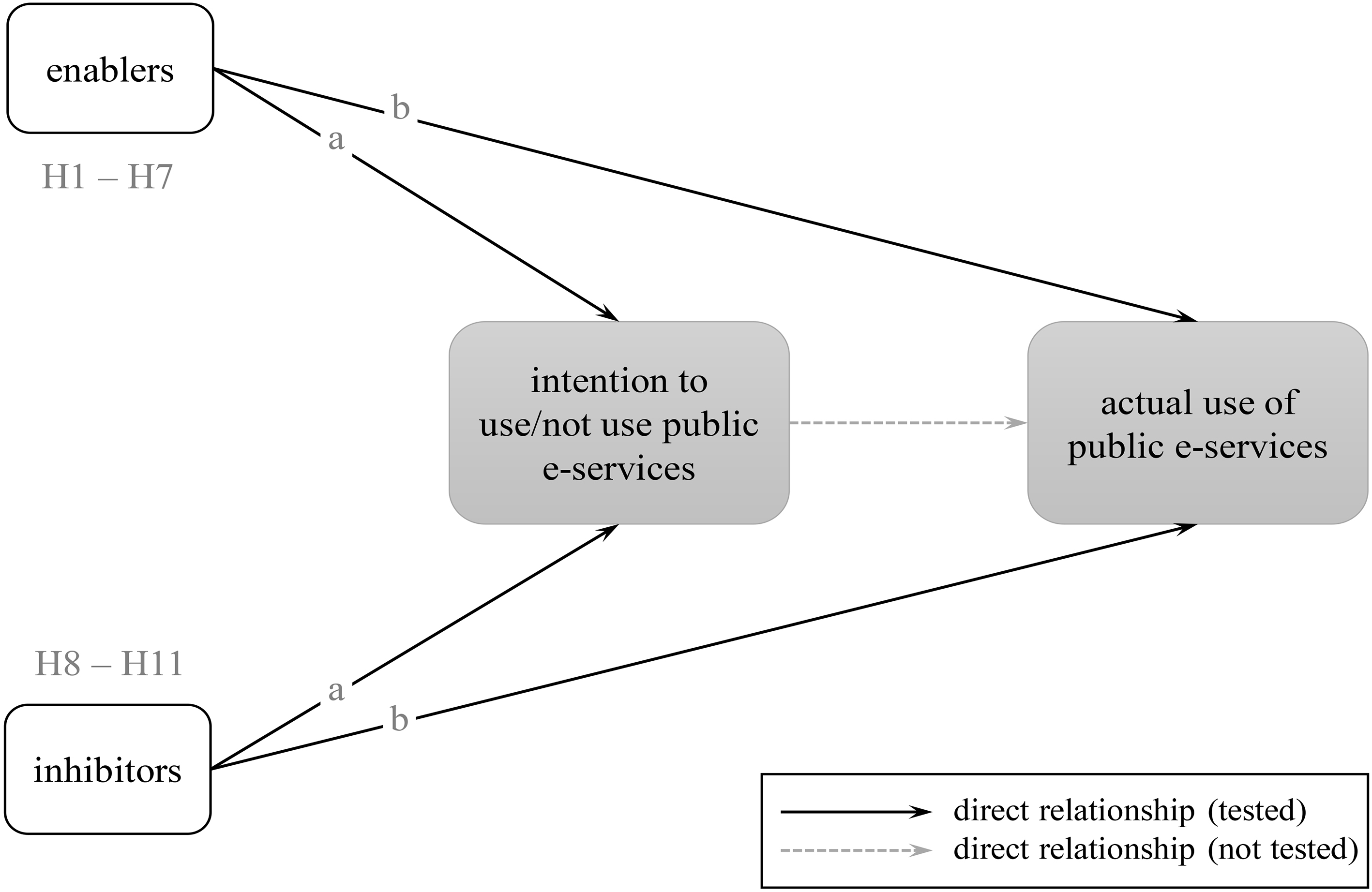
This study focuses on transactional services such as electronic tax filing. Moreover, we only considered services provided at the local or state level but not at the federal level. Commonly, it is the local or regional authorities that provide public services to the citizens. In Germany, the estimated share of public services offered by the local authorities is about 80% of all public services offered (Grunow, 2003). The scope of this research was narrowed to transactional local public services, because prior research – especially in the German context – takes a broader perspective on e-government in general and, thus, also takes into consideration information and communication services. However, these services differ substantially from transactional services (Huang, 2007).
For each hypothesized construct, items from prior research were pooled, depending on how well they represented the original statements from the interviews. Where necessary, we adapted the wording to our context. Only a few items had to be newly developed. In order to reduce the pool of items to a manageable size and to test the reliability of the scales, three pre-tests were performed. First, the initial set of items was evaluated by three e-government researchers. They were asked to rate both the representativeness and the clarity of each item for the underlying construct. Further, they were asked to comment on revisions if the item was not clear or not representative. Based on this first evaluation, items were revised or completely dropped. In a second pre-test, a preliminary version of the questionnaire was tested by four researchers from different research fields, using an online survey. Changes suggested by these researchers were included in a revision of the questionnaire. Third, a pre-test was run, also using an online survey to collect responses (
Demographics of the sample (
495)
Demographics of the sample (
Items were measured on a 5-point scale, ranging from “strongly disagree” (1) to “strongly agree” (5) with the middle value representing “partial agreement/partial disagreement”. The scales, Cronbach’s alpha, the number of items, and the inter-item correlation from the actual survey are presented in Table A.1 (see appendix). The survey was programmed as an online survey and was distributed through a polling institute to German citizens aged 18 or older. The age was set at 18 as this is the age in Germany at which adolescents become adults and therefore able to conduct public duties on their own. In order to ensure that conclusions can be transferred to the general population, quota sampling was chosen. Quotas describe how certain attributes such as age or education are distributed in a population. Quota sampling, thus, ensures that the distribution of these attributes is the same in the sample as they are in the target population. For the purpose of this study, age, gender, and education were chosen as quotas; hence, the sample is representative only with regard to these three attributes (see Table 1). Whenever a quota was fulfilled, further respondents with this specific attribute were excluded from participation. For example, we needed 17% of the sample to be aged between 18 and 29. Once this quota was reached, further respondents within this age range were excluded from participation. With this procedure, a total of 495 questionnaires were completely filled out. The resulting data were tested for the necessary assumptions, which were met. Although not required, the data set was also analysed with regard to the pattern of missing values, using Little’s test, which indicates no problems with missing data (
We conducted two analyses in order to receive meaningful results. In both analyses, socio-demographic variables (age, gender, education) were included as control variables. A sequential multiple linear regression was run to analyse the contribution of socio-demographic variables on the outcome (intention to use public e-services) in a first step and the contribution of the hypothesized predictors on the outcome in a second step. Accordingly, actual use of public e-services was tested with multinomial logistic regression and forward stepwise entering of variables, where the socio-demographic variables are entered into the model in one step and the predictors are entered subsequently based on their statistical significance. Analysing the data by two different methods was carried out because intended use was measured on a continuous five-point scale, whereas actual use had to be measured with categories (offline use, offline and online use, online use only).
Inhibitors and enablers of behavioural intention
For each construct, we built an index based on the mean. The multiple linear regression was run with these 11 indices as predictors and usage intention as the criterion (also as a mean-based index). In a first block, the socio-demographic variables were entered and in the second block the eleven predictors were entered. As can be seen from Table 2, the first model with only the socio-demographic variables age, gender, and education accounts for merely 1.7% (
While age and gender do not impact the respondents’ intention to use public e-services, education does: Higher education is positively related to behavioural intention, when only considering socio-demographic variables. However, the effect becomes insignificant once the predictors are entered into the model, indicating that the citizens’ perceptions of public e-services, the mediating technology, and the perceptions of public administration are more important for citizens than their socio-demographic characteristics. It is important to keep in mind that the first model explains only a very small proportion of the variance in usage intention and, furthermore, the change to
Multiple linear regression of behavioural intention
Multiple linear regression of behavioural intention
The effects of all other predictors held constant, trust in the administration and status quo bias affected the outcome the most, closely followed by efficiency expectations, the respondents’ perceived technical competencies, their perceived need for personal consultation and, finally, the respondents’ data security and privacy concerns. All other predictors seemed to have only small effects on the outcome and are consequently insignificant (H1a – user-friendliness, H2a – trust in the internet, H6a – image, H7a – amount of information, H10a – perceived need to appear in person).
H3a is supported. The more citizens trust their administrations, the more they are willing to use public e-services. This relationship is significant (
The data reveal another significant though unexpected result: greater security and privacy concerns are, in this sample, positively related to citizens’ intention to use public e-services, although literature suggests a negative relationship. H8a cannot be supported; instead, data unexpectedly suggest the reversed effect. However, one should also keep in mind that the effect of privacy and security concerns on intention to use public e-services is – especially compared to the other significant predictors – rather small with B
Thus, while trusting the administration, expecting a more efficient conduct of public services, and having technical competencies enables the intention to use public e-services, status quo bias and the need for personal consultation enable the intention to not use public e-services.
In order to come to a holistic understanding of usage decisions, we also examined the influence of the predictors on the actual use of public e-services. In the chosen survey design, behaviour could be reported only retrospectively and might be biased. Bearing this limitation in mind, we examined in how far remembered use of public e-services could be predicted from our enablers and inhibitors for users and non-users of public e-services. The results of this analysis are reported in Table 3.
Multinomial logistic regression for users vs. non-users of public e-services
Multinomial logistic regression for users vs. non-users of public e-services
In contrast to the intended use of public e-services, the multinomial logistic regression reveals that only two predictors (the image of public administrations and the need for personal consultation) significantly influenced the use of public e-services. Of the socio-demographic variables, again, education is the only significant predictor of actual use of public e-services, increasing the subjects’ odds of preferring the online over the offline channel with their education being higher. Thus, only the sixth and the last hypothesis, H11b, can be supported (
Discussion of the results
The analysis of the results leads to three major findings. First, we find that trust in the administration has a significant influence on the behavioural intention, while trust in the Internet is not significant – a finding that is consistent with prior research (e.g. Akkaya et al., 2013; Cabinakova et al., 2013; Teo et al., 2008). In their seminal work on trust, Mayer et al. (1995, p. 726) argue that in interpersonal relationships “[…] the level of trust is compared to the level of perceived risk in a situation. If the level of trust surpasses the threshold of perceived risk, then the trustor will engage in the RTR [risk taking in a relationship]”. In the present case, we did not measure trust in general but two forms of trust (in the administration and in the Internet), wherefore we argue that the perceived risks associated with the Internet are less salient than the citizens’ trust in the administration in terms of its ability to handle citizens’ cases adequately. This finding also indicates a need for new or different measures of technology trust, especially with regard to the fast advances in technology development and the advent of more human-like technologies. Most articles as well as the present one use very similar measures for technology trust that are quite focused on security aspects (e.g. Bélanger & Carter, 2008). The results of this study suggest that trust in the Internet, a weak and insignificant predictor of use and usage intention, may need another measurement and should be discussed in the context of public administrations and public services, rather than in the context of the Internet in general. On the other hand, the analysis suggests that citizens do trust administrations to take their interests into account. Thus, it might be that the influence of trust in the Internet on the citizens’ intention to and actual use of public e-services is moderated by the citizens’ trust in the administration. The fact the public administrations in Germany are perceived rather positively can also be seen in terms of the citizens’ actual use of public (e-)services. While neither trust in the administration not trust in the Internet seem to influence citizens’ behaviour, the data suggest that citizens with a positive image of their administration are more likely to use online services than those with a more negative image. Again, this indicates that citizens – at least in Germany – value their perceptions of public administrations higher than their perceptions of the technology or technological infrastructure used to provide services.
Second, the analysis shows the importance of consultation for citizens when requesting public services. This finding extends prior research and sheds more light on the context in which individuals interact with administrations. Apparently, public services are less amenable to digitization as they require a high degree of consultation. Thus, consultation can be seen as the core element of public service provision in addition to the outcome. Even in cases where the use of e-services is mandatory, citizens still need to interact personally with public administrations as a recent study by Madsen et al. (2019) shows. Their study reveals five different reasons for citizens’ need to personally interact with public administrations, namely need for information, need for explanation, need for documentation, need for negotiation, and finally need for revision. Especially the three latter action-related problems (Madsen et al., 2019) are difficult to solve digitally as they often trigger unstandardized processes and require an individual assessment of the citizen’s case. Research such as this suggests that non-use or multi-channel use is less dependent on technical issues than on service-related issues.
However, service design mostly focuses on technical aspects (e.g. usability, help functions) and less on the context in which the technology will be used, i.e. the public service context. In this context, citizens cannot develop routines for their interactions with public administrations due to the infrequency of contacts and diversity of matters to be handled. Hence, they lack habituation with public services and need more guidance or room for negotiations. Especially for consulting-intensive services the question arises how suitable these are for virtualization. Including this article, there are only few studies addressing this aspect (e.g. Barth & Veit, 2011a, 2011b; Ofoeda et al., 2018). Overby (2008, p. 279) has posed the question in how far processes in general can be virtualised and defines process virtualisation as the degree to which “[…] a process is amenable to being conducted without physical interaction between people or between people and objects”. He argues that virtualisation is negatively influenced by the four factors sensory, relationship, synchronism and identification, and control requirements. Our findings raise the questions whether the provision of public services should be focused on services that score low on one or more of the four requirements. For example, the need for personal consultation falls in the category ‘relationship requirements’ and indicates that for certain services, e.g. the registration of a civil marriage as Barth and Veit (2011b) could show, having contact to a person is more important than promised benefits of e-service provision. The results of this study suggest that citizens do trust their administrations but that they do not feel comfortable using the Internet for conducting public services, which is expressed in low trust in the Internet. Overby (2008) argues that personal interactions between the user and the provider may establish trust between the two parties, a side effect that could be diminished through virtualisation. Administrations should, therefore, carefully evaluate which of their public services should be provided by electronic means and for which services the provision on-site is more appropriate. Moreover, the evaluation of process virtualisation should not only be conducted from the administration’s perspective but should take into consideration needs of the demand side, i.e. citizens or businesses.
Third, the analysis reveals important insights on the status quo of public e-service (non-) use in Germany, relating to the gap between intended and actual use of public e-services and the influence of socio-demographic characteristics on the citizens’ (intended) behaviour.
While intended use is predicted by a larger number of variables, citizens seem to use different heuristics when deciding their behaviour. It seems as though thinking about public e-service use leads respondents to a larger set of factors they need to consider, whereas the decision to not use public e-services is by and large solely predicted by the need for personal consultation and the image of public administrations. This being the case, the technology and its characteristics, the provider, and other variables such as trust are no longer considered. Heuristics expressing behavioural intention are marked by far greater consideration of what citizens value as important and would want to experience in the online environment than are the heuristics that actually decide their behaviour. Deciding whether to use public e-services may depend largely on the availability of these services and their consistency. Although citizens may intend to use public e-services, they may be restricted to services providing only information, or to services they do not need. A recent study of the maturity of e-government in Germany showed that nearly all German state capitals have room for improvement when it comes to the provision of public e-services (Distel & Becker, 2018). As a preliminary indicator of the overall maturity of public e-service provision in Germany, this could partially explain why citizens express strong intentions to use e-services but in reality, most often fall back on offline channels of interaction.
The impact of socio-demographic variables was tested in both models. While age and gender do not impact intention to and actual use of public (e-)services, education seems to be a driver of public e-service use – a finding that is consistent with current research. As a comprehensive study by Cruz-Jesus et al. (2016) shows, the use of ICT and specific e-services varies in Germany – as in many other European countries – with the citizens’ degree of education. Higher educated citizens in Germany score both above the European average for general ICT adoption and for specific uses such as e-learning and civic participation. However, lower educated citizens are both below the average for general ICT adoption and for specific e-services uses. This finding is in particular interesting when considering the citizens’ need for more and better information on public e-services – which turned out to be an insignificant predictor of both intention to and actual use of public e-services – and their perceived own technical competencies, which turned out to be a significant predictor for behavioural intention. The provision of information on the available public e-services alone seems to be insufficient if citizens do not have the necessary technical competencies to understand and use this information. This finding is aggravated by the previously addressed finding that citizens perceive a high need for personal consultation when consuming public services. Thus, the study at hand does not only highlight a persisting second-order digital divide in Germany that needs to be addressed by increasing citizens’ technical competencies in general, but also highlights the need to increase their competencies in conducting public services.
Implications for theory
In the light of this discussion, the results contribute to e-government research in two ways. The primary contribution for theory lies in the proposition and testing of a dual factor model for non-adoption of public e-services. By using the hitherto less considered Inhibitor Theory, this article proposes a new perspective on the phenomenon of non-adoption of public e-services. So far, this is the first study to propose such a model for the German context and among the very few to use a dual-factor concept at all to explain citizens’ behaviour in the context of e-government. Non-adoption or rejection of technologies and the Inhibitor Theory in particular have received considerably less attention than adoption models or theories. However, the anecdotal evidence of this and other studies (e.g. Kim & Kankanhalli, 2009; Rey-Moreno et al., 2018) highlights the added value of incorporating both enabling and inhibiting perceptions of a technology into a model that aims at explaining a user’s behaviour.
Secondly, we combine factors for adoption and non-adoption, whereas prior research mostly considered success factors for public e-services use. Non-adoption was mainly explained by a lack or non-fulfilment of these success factors (e.g. Gilbert et al., 2004). With our approach, we contribute to the current adoption debates by showing that the proposed benefits of public e-services use do not necessarily prevail and that the context in which the public services are provided plays a decisive role for the usage decision as well. It is now necessary to further test and refine the proposed model in order to gain a better understanding of the inhibitors and the behaviour of citizens in relation to public e-services. This study indicates that the adoption debate can only be meaningfully brought to a conclusion if we also deal intensively with the reasons for non-use and regard non-use as an independent decision. It also adds to the resistance debate as it applies the inhibitor theory in the e-government domain. Inhibitors are more of an issue today than are success factors.
Implications for practice
The results of this study also provide some recommendations for administration practice. First, when developing public e-services, public managers should not only focus on technical aspects of public e-services such as usability and data security but also consider the services themselves and analyse potential barriers to citizens’ use of public e-services. The need for personal consultation could be reduced by providing more and easy-to-understand information on the services, but more so in increasing citizens’ digital literacy. In addition, however, the services offered should also be reviewed with a view to the necessary degree of complexity, i.e. the underlying structures and processes should be revised and, if possible, simplified before public services are digitized. Second, our results suggest that public administrations should enhance and align the availability of public e-services in accordance with the demand-side needs and expectations. The results show that the conventional consumption of public services is perceived as more convenient than using public e-services and that citizens have a high need for personal consultation. In accordance with prior research, we thus suggest to better align the different channels through which citizens can access public services. In concrete terms, this means not relying on an online-only principle, but rather optimally coordinating the various advantages of the channels with one another and understanding them as complementary to one another. A study from 2016 (Thiel, 2016) shows that almost 80% of Germans consider seamless switching between online and offline channels to be important. For consulting-intensive services in particular, it therefore seems important to maintain an on-site offer without completely foregoing an electronic offer. We therefore recommend administrations to analyse their services precisely and, for example, to offer information bundled online as well as the possibility to prepare important forms online. At the same time, however, the consulting offer offline must remain in place as a supplement or main component.
Limitations and future research
Bearing this study’s limitations in mind, several avenues for future research arise. The first limitation of this study is related to the research design. As is the problem with many surveys, this study was designed as a cross-sectional analysis that does not allow for the observation and analysis of long-term trends, such as changing behavioural intentions, perceptions, and the continuing use of public (e-) services. While survey research yields important insights, we suggest to broaden the methodological repertoire within e-government research to designs that allow, for example, for the observation of long-term trends or for the analysis of causal relations.
Second, this research is highly context-sensitive as the survey was tailored to the German administration and e-government landscape. We propose that future research should include more comparative designs that allow for the generalization of results or models beyond single countries. This approach is already being pursued in some cases.
Within this study, we have focused on transactional services in general and studied factors that would impact citizens’ intention and decision to conduct these services either on-site or electronically. However, we did not determine in how far citizens combined the offline and online channels when interacting with public administrations. The results show that some citizens make use of both electronic and conventional ways of interacting with public administrations. However, we cannot analyse the extent to which a combination of these channels is made for the same service or only for different services. Thus, thirdly we propose to investigate the combination of the different channels of service delivery more intensely than before and to relate this behaviour to the type of services consumed. Future research should, for example, investigate whether the combination of channels occurs only when transactional and, hence, more complex services are used or whether this behaviour occurs also for informative or communicative services.
This research is among the limited studies that investigate in-depth end-user non-adoption in the context of public e-services. By developing a dual-factor model that covers both adoption behaviour and non-adoption behaviour, this article goes beyond prior research. In explicitly focusing non-adoption as an active decision, this study highlights the importance to bring inhibitors into the focus of research on public e-services usage. Thus, the article contributes both to research and practice by offering an explanation for adoption and non-adoption of public e-services and thereby highlighting important aspects for the design of public e-services.
Footnotes
Acknowledgments
This work was enabled by the Research Training Group “Trust and Communication in a Digitized World”, which is funded by the German Research Foundation (DFG) under grant number 1712/2.
Appendix
Scale reliability
Scale
Number of items
Cronbach’s alpha (
Inter-item correlation
1. user-friendliness
3
0.844
0.643
2. trust in the Internet
3
0.896
0.742
3. trust in the Government
4
0.924
0.756
4. efficiency expectations
0.727
0.574
5. technical competencies
6
0.808
0.415
6. image of public administration
7
0.877
0.511
7. amount of information
3
0.829
0.618
8. data security and privacy
8
0.918
0.584
9. status quo bias
6
0.911
0.625
10. perceived need to appear in person
2
0.559
11. perceived need for personal consultation
4
0.929
0.771
12. usage intention
2
0.867