



Abstract
This study examines social media use for public engagement during the Cape Town water crisis in South Africa. The study applies technology affordance and attribution theories to explore social media features (affordances) utilised by local authorities and the public, meanings embedded in the social media posts and the attributions of the water crisis cause among the actors. Data gathering and analysis followed mixed methods. Qualitative data were gathered using key informant interviews and netnography (data scrapping on Twitter) while a household survey (
Introduction
This study focuses on the use of social media for public engagement by the local authorities during and after the water crisis in Cape Town, South Africa.1
The term crisis can be used to refer to “corporate crisis” (Lee, 2019) but in this study, our focus is on Cape Town’s unprecedented 2017/18 water crisis [also known as “day Zero”] (Rodina, 2019:1); also see “Cape Town water crisis” (Weaver, 2017). Also, we interchangeably use local authorities and the city to refer to the administrative unit (City of Cape Town).
Communication during crisis times – i.e., what to communicate, how frequent and what medium to use – is challenging (Coombs, 2010a). Evidence from Enqvist and Ziervogel’s (2019) study suggest that communication between the local authorities, City of Cape Town, and the public during the water crisis was controversial. In a crisis, communication involves bi-directional relaying of multiple messages like official announcements (e.g. relating to state of the crisis, warnings and progress made towards averting the crisis) and public opinions (inquiries, confronting, blaming, and general humorous messages) (Roshan et al., 2016). To ensure that messages are delivered to the target audience, actors in a crisis must carefully decide on the communication channel since the choice of a communication channel affects the nature of communication (Coombs, 2010b; Yang et al., 2010). However, decisions on the communication channel are dictated by many factors such as the magnitude of the crisis, the target audience (age, social dynamics), and spatial distribution. In some instances, these decisions can benefit from existing guidelines developed based on past experiences, if available.
However, the ubiquity of social media platforms has disrupted conventional crisis communication. In the past few years, local authorities, corporates, and the public, are almost by default increasingly turning to the multiple social media platforms available for engagement during a crisis (Roshan et al., 2016). One of social media’s key attractions to users are the multiple affordances (Stamati et al., 2015). Technology affordances are defined in many ways but Bucher and Helmond (2018, p. 235) indicate that affordances are “what material artifacts such as media technologies allow people to do” However, material artifacts are broad, including door handles, large machines, and digital platforms (Gaver, 1991). However, this study focuses only on social media platforms, specifically the Twitter platform to understand what the platform “allowed” the local authorities and citizens to do during the Cape Town water crisis. The study’s focus on social media is motivated by Raupp’s conceptualisation of social media as a rhetorical arena which is defined as “a space that opens during a crisis …where different actors, including corporations, political actors, activists, experts, and the media, talk to and about each other” (Raupp, 2019, p. 2).
In Africa, large populations are still without Internet access (GSMA, 2019). However, social media use continues to grow (Poushter et al., 2018). In contrast to traditional communication channels, social media creates opportunities for citizens to participate in discussions on issues affecting them including during times of distress (Bosch, 2017; Gwaka & Smit, 2018). However, the use of social media for crisis management, including communication during a crisis and the types of communication which occur remains unclear (Reuter & Kaufhold, 2018). Part of the challenge is that social media can assemble multiple audiences for a particular context making it difficult for governments to address its messages to appropriate targets (Marwick & Boyd, 2011).
While there are existing studies on social media use during different forms of urban crisis (e.g., Palen, 2008; Alexander, 2014; Graham et al., 2015; Hunt & Specht, 2019), cities are different, and a crisis in each city carries different meanings. This study attempts to add to the existing literature by focusing on the water crisis in Cape Town. The study context promises new insights since Cape Town is characterised by complex socio-economic dynamics, which are, to an extent, shaped by the historical events (McFarlane & Silver, 2016). In addition, the city’s population is characterised by stark differences evident in everyday societal challenges which are an embodiment of urban politics (Larkin, 2013). To understand all these issues, Barbehön and Münch (2017) suggest that a detailed analysis of actions, including social media posts during a crisis, can reveal deep societal aspects. To achieve this, our study attempts to push the boundaries by combining technology affordances with the attribution theory to understand how social media was used during the water crisis and decipher the meanings of actions and words shared on social media. Therefore, by extending our analysis beyond simplistic causal relationship between social media, water crisis and public engagement, we aim to reveal the complex intertwining of these aspects.
Adding to the foregoing, the Cape Town water crisis has been studied across different disciplines e.g., engineering, geography, sociology and politics. Ziervogel (2019) recommends further exploring the crisis using multiple viewpoints. As a contribution towards this, our study applies human-computer interaction and communication (public engagement) perspectives to study the Cape Town water crisis. The study proceeds as follows: the next section provides a contextual background of the study followed by a discussion of the theoretical frameworks. The study then discusses the research methods followed by a section presenting the study findings. The final two sections comprise of a discussion of study findings and the study conclusion.
Cape Town ranks as one of the world’s most beautiful cities and is a popular tourist destination. The city consistently attracts a high number of tourists each year as well as economic migrants from other cities in South Africa and across the globe. Over the past decade, the city experienced a steady (
In times like Cape Town’s water crisis, local authorities must develop and implement robust crisis management strategies and central to these strategies is communication with the public. Public engagement is a central tenet of robust crisis management strategies. Coombs and Holladay (1996) argue that poor public engagement during a crisis damages the reputation of an organisation and in turn, impacts future interactions between the organisation and its publics. Cognisant of this, the local authorities in Cape Town, to their credit, disseminated information in many ways. For instance, on arrival at the Cape Town international airport, travellers were reminded of the water crisis by large banners throughout the airport. Messages were spread in public places including public transport such as the local taxis. Third parties such as The Golden Arrow bus company also participated in information dissemination, and water saving practices to an extent that company adopted the motto “Saving water one dirty bus at a time”. In addition to these efforts and keeping up with technological advances, the city used social media platforms to interact with residents on the water crisis.
Given the foregoing, our study builds from two perspectives. Firstly, Neresini and Bucchi’s (2011) think that different platforms achieve different effectiveness when used for public engagement during crisis. It is the study’s supposition that it is critical to determine the extent to which social media was useful for public engagement during the water crisis. However, metrics for determining “usefulness” are largely absent and the study argues that determining the use (actual and intended) is a critical step towards this. Secondly, Guidry et al. (2017) argue that different public engagement platforms enable co-construction of different narratives. Given this, it is possible that there are unique narratives which emerged from the use of social media for public engagement during the water crisis. Therefore, based on these perspectives, our study asks: In what ways did Cape Town local authorities and residents use social media for engagement during the water crisis and what narratives emerge from the information shared on social media relating to the water crisis.
Theoretical perspectives
This study adopts two congruent theoretical perspectives. On social media use for public engagement, we draw on the technology affordances theory and to explore the nature of conversations which occurred on social media, we turn to the attribution theory. The compatibility of the two theories was established in related studies (see, Oz et al., 2018). We now turn to discuss each of the two theories.
Technology affordances theory
This study applies the technology affordances theory to examine the potential of social media as public engagement tools during the water crisis. Majchrzak and Markus (2012: np) suggest that “uses and outcomes of information systems and technology are best understood in terms of relationships between individuals or organizations and technology features.” This suggestion makes the technology affordances theory appropriate for this study which attempts to examine social media use for public engagement during the Cape Town water crisis. Reflecting on Bucher and Helmond’s definition of affordances as well as Majchrzak and Markus’s suggestion, there is an emphasis on the relationship between and interaction of individuals and technology features. Technology affordances are subjective and technology can have different affordances for different people depending on several factors. Gaver (1991, p. 80) illustrates this arguing that “[w]hether a handle with particular dimensions will afford grasping depends on the grasper’s height, hand size etc.” In this study, we argue that social media use during water crisis depended on the different attributes of the local authorities (e.g., institutional policies) as well as the public (e.g., literacy, interests, and access).
In addition to this, the technology affordances theory suggests that technology affordances are independent of individual perception and/or appropriation (Gaver, 1991). This means technologies are designed with affordances and whether individuals appropriate these (or are unaware of the affordances) does not invalidate the technology affordances. Applied in this study’s context, it means whether local authorities and the citizens appropriated social media affordances (or not) during the Cape Town water crisis, does not mean social media lacks the affordances. To substantiate this, studies exploring the intersection of social media and the affordance theory have developed a taxonomy of social media affordances. There are several classifications of social media affordances (Bucher & Helmond, 2018) but one of the comprehensive reviews on social media affordances is Chen et al’s. (2016) synthesis of existing literature to identify common social media affordances. In their study, Chen et al. identify at least ten technology affordances which include visibility, persistence, editability, association, metavoicing, generativity, communicability, interactivity, collaboration, and anonymity as the common social media affordances (Chen et al., 2016). These affordances are defined in Table 1.
Definition of technology affordances
Definition of technology affordances
Source: Chen et al. (2016, p. 315).
In building the taxonomy, Chen et al. (2016) distinguish between affordances relating to government service innovation and government openness and accountability. This suggests that some affordances are applicable to specific actions but not others. In this study, we frame our findings on three selected technology affordances which are metavoicing, persistent engagement, and visibility. These were considered relevant to the study’s objective and the rationale is presented in the results section.
Despite the attractions of the technology affordances theory for this study, its application is limited as it does not provide a lens to understand the nature of the conversations occurring on social media platforms. In this study, we also examine the nature of the conversations to establish the extent to which local authorities and individuals assumed and/or shifted responsibility and blame for the water crisis. To achieve this, we turn to the attribution theory.
The attribution theory seeks to explain the relationship between an actor’s interpretation of events and their actions. It has been applied in crisis studies for many years (Coombs & Holladay, 1996). The theory suggests that actors perceive a crisis in different dimensions which are: stability (assesses if the event’s cause happens frequently (stable) or infrequently (unstable)), controllability (whether the event’s cause is controllable by the actor or others) and locus (if the event’s cause is something about the actor or something about the situation). The ascriptions of problem cause reveal critical insights about the actors and to an extent, help to develop future expectations (should similar challenges occur) and guide future actions. From a governance standpoint, responses of local authorities to a crisis are often driven by how they perceive the crisis. Yet, these responses play a critical role in the legitimacy of the governing authorities. Coombs and Holladay (1996, p. 292) think that:
The more publics attribute responsibility for the crisis to the organization, the greater the risk should be of reputational damage (a threat to legitimacy is a pan of the reputation). Crisis response strategies can lessen the reputational damage by mitigating the affective feelings generated by the attributions and/or altering the attributions themselves.
In this study, we pursue the notion that by analysing social media posts on the Cape Town water crisis, we can reveal the ascriptions of both the local authorities and communities. This might explain the poor communication and lack of trust between the authorities and citizens during the Cape Town water crisis (Enqvist & Ziervogel, 2019) which contributed to a near panic situation. The attribution theory provides a lens for researchers to explore the human behaviour (action, attitudes, and responses) during a crisis. For instance, if the crisis is ascribed as external, it is possible that individuals will expect behaviour change from other actors and not themselves. Linking the attribution theory to the technology affordances theory, we argue that social media afford users opportunities to post (ascribe blame) without fear, and at times, without revealing their identities. Overall, this study reflects on the social media posts (tweets) to understand the Cape Town water crisis using the dimensions of attributions which are locus, stability, and controllability.
Research methods
As an exploratory study, mixed (qualitative and quantitative) data gathering, and analysis methods were adopted. The study is based on a triangulation between qualitative (interviews and netnography) and quantitative methods (survey questionnaire). Ethical clearances were obtained from the local authorities (City of Cape Town) and the university ethics community. In addition to ethical clearance, permission to engage local authority employees was granted by City of Cape Town.
Qualitative methods
Qualitative data were obtained using key informant interviews and netnography. Focus group discussions were considered but were insurmountable due to logistical challenges and lack of financial resources.
Key informant interviews
The local authorities are charged with the responsibility of delivering basic services to residents. As the water crisis unfolded, the local authorities engaged with the public and these experiences are central to this study. Thus, city officials, especially those in public relations and communication departments were targeted as key informants. We also inquired from the City of Cape Town of other departments involved in public engagements during the crisis to select the most appropriate participants We recruited participants at different organisational levels to gain different insights (i.e., we included executive, management, and operations level employees). Following authorisation, interviews with the officials were scheduled for periods they anticipated to be free from critical work tasks. An interview guide was used and permission to audiotape the interviews was requested at the start of each interview. Participants were informed of their rights during the data collection e.g., right to withdraw or not respond to questions they did not feel comfortable. In total, we conducted five interviews with city officials summarised in Table 2. The number of interviewees were limited due to commitments of city officials. However, while this provides a potential point of improving future studies, we attest that our engagements were extensive and produced sufficient insights to the satisfaction of the researchers. Further, the positions of the participants were sufficient to gain insights needed for this study.
Summary of key informant interviews
Summary of key informant interviews
Qualitative data were also obtained from the Twitter platform, through netnography (Kozinets, 2015). Social media platforms are now important sources of research data. Discussions on social media generate large amounts of unstructured data which can be useful for research. In this study, the Cape Town water crisis drew discussions on different social media platforms, including Twitter. Following the pairing of Twitter and R (an open-source software), data collection involved searching for tweets using a variety of combinations such as (“cityofCT
Qualitative data analysis
Qualitative data analysis was conducted using computer assisted data analysis using (R) and a more hands-on approach (Frost, 2008). Firstly, data from the key informant interviews was transcribed by listening to the audio-recordings repeatedly. The researchers transcribed the interviews, developed notes individually before comparing notes. Despite a broad analysis of the interview data, results presented in this study reflect purposively selected interview quotes applicable to the study.
To analyse data obtained from the social media platform, the analysis started with data cleaning mainly removing (URLs, hashtags, punctuation, emojis, stopwords and numbers), whitespaces and converting data to lower case. This process of content transformation was critical to ensure that only relevant data were used for analysis. We read through the data developing notes and headings. Initial data analysis classified data into updates and notices by the city, questions by citizens and general discussions. Further, we drew from the affordances and attribution literature to classify tweets into affordances and dimensions of attribution. This process was iterative, allowing the researchers to refine the data classification and reduce the number of categories. Interpretation of the categories was our discretion. The focus of the analysis of social media data was to establish narratives emerging from the messages. In addition, we used computer assisted analysis to detect common themes (categories) in the cleaned data. Data were manipulated using R to produce word cloud.
Quantitative methods
Quantitative data were collected using household survey questionnaires administered to residents in the Cape Flats, Cape Town CBD, Northern and Southern suburbs. Proportional quota sampling was applied to select areas representing different socio-economic status of Cape Town. Within each community, participants were randomly selected with 96 total participants Survey data was important to quantify our exploratory dimension (Boynton & Greenhalgh, 2004) which qualitative methods could not achieve. Therefore, in this study, only descriptive analysis is used.
Study findings
Demographics of household survey respondents
Social media use can be influenced by an individual’s demographics (including their households). Respondents were asked about their location, household size, gender of respondent, education and employment status with results presented in Table 3.
Demographics of the respondents
Demographics of the respondents
As Table 3 shows, 51% of the respondents were female and 49% male. In terms of age groups, the 18–30 age group had the most participants (57%) followed by the 31–40 with 29% while the 41–50 age group had 13% and only 1 participant in the 51
Cape Town experienced a critical water shortage between 2016 and 2018 but Muller (2017) argues that the city’s water problem had been known for many years. This claim is supported by the water consumption trend shown in Fig. 1. The sharp decline in water consumption from 2015 reflects the time when concerns on the potential water crisis were growing.
Water consumption trends in Cape Town 2010–2019. Source: City of Cape Town (unofficial).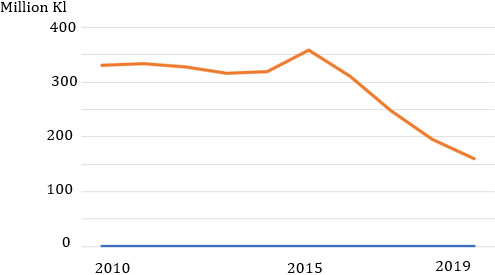
As residents of Cape Town, the authors experienced the reality of the water crisis. During this period, residential areas experienced incessant water rationing for several hours a day. As part of the water saving strategy, the city reduced the water pressure for households. To counter these incidences, individuals resorted to bulk water stocking.
In Cape Town, the water crisis affected all social groups, albeit in different ways. The local authorities set up water collecting points giving individuals access to water. These access points were frequently updated on the different platforms including social media. Despite vivid pictures painted in many reports, the extent of the water crisis remains debatable. We asked the city officials to describe the extent of the water crisis and from the interviews, one official reiterated the seriousness of the situation indicating that:
“the city was at a bleak point, even as local authorities, we started to contemplate the unthinkable”.
Similarly, social media posts echoed the dire situation seen through cautionary tweets such as one from @ EFCatUNC suggesting that:
“Cape Town and Chennai should serve as cautionary tales: cities need to act now, before city water shortages”.
The seriousness of the Cape Town water crisis was reflected by several other elements such as discussions at a global level, government commitments (e.g., forming ministerial task teams) and ongoing efforts towards disaster preparedness. Furthermore, discussions on the crisis have continued to date. During the crisis, however, there were discussions on the crisis on social media and in the next section, the study focuses on these discussions applying an affordance lens.
In this section, we apply the technology affordance lens to explore social media use during the water crisis. Studies have established different categories of social media affordances. Building on Chen et al. (2016) this study focuses on three affordances applicable to the water crisis: metavoicing, persistent engagement and visibility. The selection of the three affordances, consistent with the qualitative nature of the study, was subjective and purposive. We considered affordances which are relevant to crisis communication over those which are common and more applicable to other dimensions. For example, we did not include the anonymity affordance considering that it is more appropriate when discussing use of social media for whistleblowing (see for example, Lam & Harcourt, 2019). Further, we opted for affordances which provided insights relevant to the research questions and to an extent, complementary to the attribution theory. Overall, through the selected affordances, the study addresses important public engagement dimensions which are collective voices, how frequent (timelines) and who engaged in the process. Since the selection was subjective, it is possible that some affordances not selected for this section can also provide new insights.
Metavoicing
Metavoicing on social media relates to “adding opinions in the form of expressing likes, comments, and ratings for the original content of others” (Liu-Thompkins et al., 2020, p. 395). This process generates extensive qualitative data as responses often take form of a discussion. As the water crisis unfolded, Cape Town residents and those from other cities, including outside of South Africa, started to discuss about the crisis online. Discussions on Twitter were in the form of original tweets, comments, and retweets The design and features of the Twitter platform allowed people to simultaneously discuss the water crisis and collective voicing (echoing). Majchrzak et al. (2013) identify this affordance as metavoicing.
Using R software and observing the word-mention limits (min
Word cloud developed from social media tweets.
As the water crisis deepened, the local authorities made key decisions, including frequent switching-off of water in residential areas. Through the metavoicing affordance, residents weighed in and discussed the local authorities’ decisions and actions. The contributions of the residents to the discussion and decisions transcended the geographic dispersion of residents which, in the absence of technology, could be difficult to achieve. However, the metavoicing affordance has its downsides. For example, during a crisis, decisions must be made swiftly and yet metavoicing (inclusive decision making) often takes more time as reaching a decision when there are mixed reactions (conflicting reactions) is challenging.
In addition to metavoicing, another important social media affordance during the water crisis was persistent engagement. This refers to social media’s ability to enable on-going engagement and retention of past engagement (Cabiddu et al., 2014). Given the nature of a crisis, it was important for engagement between local authorities and the public to be ongoing and timely. Using the Twitter search function, the study findings (Fig. 3) show conversations (engagements) between the local authorities and the public on water crisis in Cape Town.
Twitter extracts on engagement between @ CityofCT and other users.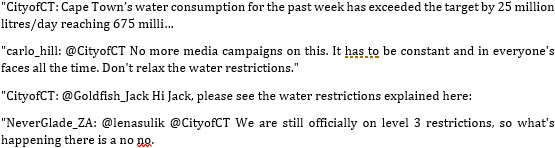
In this study, it was established that despite avoiding a total collapse of the water system, water shortage remains a potential threat to Cape Town and other cities. The persistent engagement affordance however enables discussions on the matter to continue, often building on previous social media posts. The local authorities and the public continued to post reminders on water restrictions and reminding citizens of the importance of conserving water.
The third affordance which social media enable is visibility. This study considers visibility as making visible actors and concerns previously invisible or hard to see. Through social media, previous social groups who had not been able to voice out their concerns and/or draw the attention of the local authorities, could air out their problems relating to the water situation. For instance, Twitter users were able to direct their questions to officials, previously hard to reach as demonstrated in this tweet:
“I want to know from the minister whether they will put in place any means of even [distributing] water national”.
In Cape Town, water shortages affected all areas but the situation was much worse among the already marginalised groups. These groups were already experiencing water problems before the water crisis and could not afford to buy drinking water. On the contrary, Robins (2019) report that other social groups however benefitted financially from the water crisis. This intensified speculations that the water crisis was an engineered one. In this vein, our study findings show that through tweets, individuals highlighted social inequity, corruption practices and mismanagement by the local authorities (and government) through discussing the water crisis. These issues are often invisible (or hard to see) but social media posts increase their visibility. This is substantiated in a @WRI Governance’s tweet highlighting that:
“When
Social media and public engagement
During the water crisis, appropriate public engagement was critical to preserve the reputation of local authorities and ensure coordinated actions to avert the crisis. Literature reports the potential of social media towards public engagement and this study explores the use of Twitter for public engagement. In framing our findings and subsequent discussion, we acknowledge that some of the social media affordance effects on the government side could be moderated by social media policy guides (Chen et al., 2016) The City of Cape Town has an official Twitter account since 2010 with more than 370 000 followers. While this study only focuses on Twitter, City of Cape Town also has other social media accounts. We asked interviewees about the city’s use of social media and one official indicated that:
“as a local authority, we use Facebook, Twitter, YouTube and LinkedIn. Facebook and twitter are our most popular platforms that we use to engage the public. Social media plays a key role in three facets. Firstly, we can communicate to the public the City’s IDP values and the strategies of our key directorates. Secondly, we use social media as a conduit between the residents and the city with a great deal in facilitating a conversation between the two particularly around service delivery. The third is to benchmark the sentiments of the residents when they are referring to CoCT.”
In line with these remarks, we asked respondents in the household survey their experiences on engagements with the local authorities. Findings show that in the CBD, at least 52% used social media to engage local authorities while in other areas surveyed engagement using social media remains less than 50%. Further, when all locations were combined, only 40% of the respondents indicated that they engaged the local authorities using social media. Internet access challenges are among the explanations on the limited use of social media by respondents to engage local authorities. However, there are efforts by the local authorities and government to promote e-governance in the study area through the Cape Access program (Kassongo et al., 2018). Alternative options to engage local authorities include visits to the city’s offices. However, the study found that using social media resulted in swift responses (persistent engagement) from the local authorities. The results suggest that on social media, local authorities responded within five hours. Despite the limited use of social media among the survey respondents, our observation was that the local authorities and the public engaged on Twitter extensively during the water crisis. We asked city officials about their use of social media during the water crisis and one respondent indicated that:
“[social media] helped identify key themes that the residents were discussing. We picked up that a lot of disinformation in that some residents were confused around the cause of the water crisis, as some blamed it on the water usage in townships, some blamed on the lack of experience with regards to leak repair.”
Since respondents engaged the local authorities using other formats, we asked survey participants about the general accessibility of the local authorities to the public. Survey findings show that 79% think that local authorities were “occasionally” accessible, while 17% suggested that officials were never accessible and only 4% think that officials are always accessible. The finding was similar across all the locations contradicting the city officials who indicated that they are mostly available to the community other than in exceptional circumstances.
This section shows that social media has affordances for public engagement. Part of the affordance was persistent engagement affordance which is critical during crisis management. However, the findings also show that local authorities used other platforms to engage the public and these include written notices posted in public places. It is possible, therefore, that social media and other platforms had different contributions towards averting the water crisis. Unfortunately, it is challenging to accurately determine the contribution of social media in the process. Gwaka (2015) argues that metrics to measure social media effectiveness are not well developed which potentially frustrates efforts to determine the effectiveness of social media for public engagement during crisis. Given this limitation, it is the study’s supposition that a critical analysis of the messages relayed on social media provides further important information useful to determine the importance of social media in addressing a crisis.
Social media stories – a narrative analysis
In the preceding section, we show that both the public and local authorities turned to social media platforms during the water crisis In this section, the study applies the attribution theory to extract narratives in the messages shared on social media. We argue that analysing the content of the tweets helps to establish the different attributions made by community members and the local authorities on the water crisis. For the analysis we apply the attribution theory’s three dimensions (i.e., locus, stability and controllability).
Locus
In terms of locus (whether the event’s cause is something about the actor or something about the situation), the causes of the Cape Town water crisis can be identified as either internal or external between the local authorities and communities. Study findings indicate that in Cape Town different groups identified the causes of the water crisis mainly as external. For instance, the local authorities suggested that high water consumption and water waste were the causes and/or contributing to the water crisis in Cape Town. For example, the local authorities often pointed how water consumption was exceeding the target tweeting that:
“Cape Town’s water consumption for the past week has exceeded the target by 25 million”.
On the other hand, communities believed that poor investments in water infrastructure contributed to the water challenges as demonstrated in these tweets:
“Have the authorities in @WesternCapeGov and @CityofCT made sufficient investments in new bulk water storage”
It is unlikely that local authorities would admit that internal factors contributed to the water crisis despite allegations of mismanagement and corruption matters relating to the crisis (e.g., evidence presented at the state capture inquiry commission, see for example, Hoffman, 2019). However, Patricia De Lille’s message suggest that the water crisis could be linked to internal matters problems within the local authorities (which are not known to the public) and one message from Twitter asked:
“Thank you. @PatriciaDeLille Who exactly are the “laptop boys”? Give us the story about #DayZero …as a former resident of
However, there are internal affairs within local authorities known to the public which were attributed to be part of the causes of the water crisis. For instance, the community members perceived the cause of the water crisis to be external as they argued that the water crisis was a result of poor administration (internal to local authorities) as suggested in the following tweet:
“@CityofCT With the DA falling apart so is your service. It has now been a month and still you have not been able to resolve this problem [water shortage]”
Further to the above, the study established that among the community members, there was realisation that the community needed to be cautious about its use of water. Thus, the community admitted that the cause of the water crisis could be internal. For instance, one community member tweeted:
“Water restrictions should not be relaxed. The world’s population has grown, resources have not”.
In terms of locus, it is prudent to argue that both the community and local authorities suggested that the main causes of the water crisis were external (i.e. difficult task and bad luck). It is the study’s proposition that the extent to which actors identify the water crisis as internal or external contributes to whether there is behaviour change or not. If a problem is attributed as external, it is unlikely that there will be behaviour change.
Stability
This causal (stability) dimension suggests that causes of a crisis can be constant or varying over time and event’s cause happens frequently (stable) or infrequently (unstable). Findings in this study suggest that causes of the water crisis vary over time thus can be classified as unstable. For instance, the study established that individual efforts and attitudes towards conservative use of water change over time demonstrated in the following alert by the city:
“cape town’s water consumption for the past week has exceeded the target by [number] million litres/day”.
In addition, the study found that there was general appreciation of how collectively the Cape Town community made efforts to avert DayZero. One community member indicated that:
“@Derek_Hanekom You’re right. We did collective water savings in #CapeTown it worked. Let’s #DayZero #Eskom now.
This remark suggests that the city survived the water crisis through collective efforts. The statement also confirms Graham’s observation that communities attribute success, in the context of this study averting DayZero, to competence and how hard they try (Graham, 1991). Furthermore, success generates positive affective feelings such as:
“Cape Town is putting out the word
However, this perspective seems to contrast earlier suggestion of how the crisis divided the society. In this section, social media stories and posts seem to show that failures are attributed as external while success is internalised by actors.
Controllability
The controllability dimension refers to the event’s cause is controllable by the actor or others, personal responsibility, or whether a cause is subject to one’s own volition (Graham, 1991). In this study, we found several comments suggesting that the water crisis was controllable. Firstly, reflecting on the crisis, community members suggested that local authorities should have put in place measures such as the development of appropriate infrastructure to avoid the situation. Referring to the drought, one post blamed the Democratic Alliance arguing that:
“the DA was blamed because they didn’t heed a warning given 20 years before.”
In addition, we also found that those who experienced the Cape Town water crisis were cautioning other cities on the possibility of water crisis unless specific action was taken. One tweet highlighted that:
“Cape Town and Chennai should serve as cautionary tales: cities need to act now, before city water shortages”.
On the other hand, others argue that the water crisis was a result of an uncontrollable cause drought (natural occurrence). One of the tweets supporting this claim reads:
“Cape Town faced the unprecedented prospect of having to turn off water supplies due to the worst drought in the century”.
The study findings suggest that local authorities and the public think that the water crisis had elements which are controllable and other elements which are uncontrollable. These perceptions had implications on the behaviour of residents and the local authorities. For instance, residents who felt that the crisis was due to poor actions of the city complained that they were suffering because of the local authorities’ poor plans. In the same context, there are studies arguing that the crisis was human engineered, strengthening the notion that it was a controllable situation. However, others acknowledged that the crisis was a natural disaster and uncontrollable.
Discussion and conclusion
Water challenges in Cape Town are far from over. However, the dreaded DayZero has been averted, at least for now. Our study discussed social media (Twitter) use during the water crisis, focusing on the social media affordances, and attempting to establish meanings of the actions afforded by social media to crisis actors. In terms of affordances, the study focused on three affordances: metavoicing, persistent engagement and visibility while on the attribution, the study discussed locus, stability and controllability. We confirm the compatibility of the technology affordances and attribution theories as well as extend their application in a different context.
Even though use of social media is growing, most of our survey respondents did not use it to engage local authorities. However, tweets gathered reflect that there is considerable public engagement on the Twitter platforms, and this was the case during the Cape Town water crisis Our findings match previous research spotlighting transitions towards e-governance in Africa (Thakur & Singh, 2012). In addition, the different uses of social media by the public enabled by the different affordances suggest an important role which technology (social media) play towards inclusive development. Through the metavoicing affordance, social media enable citizens to engage in story (e.g., the water crisis story, poor governance) co-construction (cf. Wang et al., 2017) while the visibility affordance allowed individuals and social groups to participate in discussions which they previously could not (see Gwaka & Smit, 2018).
In the study, we also applied the attribution lens to understand the meanings of the messages posted on social media. Different narratives emerged from the tweets on the Cape Town water crisis pointing to topics such as corruption, politics, and incompetence among the local authorities. To an extent, these findings align to the diverse perspectives through which the Cape Town water crisis is discussed in literature including as a political crisis (Robins, 2019). Picking from the narratives, both local authorities and residents seemed to accept only minimal responsibility and ascribed the crisis as external. In a way, there are studies supporting this perspective attributing the global water shortages in major cities to climate change (Matikinca et al., 2020). Despite this unfortunate situation, we also argue that both local authorities and residents have responsibilities in managing the situation. For instance, the water crisis in Cape Town had been predicted before and the local authorities were encouraged to invest in infrastructure (including repairing leaks). Residents tweeted that the situation could have been better had the local authorities heeded this call and made timely investments. On the other hand, the local authorities highlighted that some water use practices among the residents expedited the crisis.
An important part of the study is that we connect the affordances theory and attribution to show how social media enable local authorities and the public to engage as well as the type of the engagements which occur. This aligns with Neresini and Bucchi’s (2011, p. 66) suggestion to go beyond simple “mapping [of] communication and public engagement activities to comparing them in such a way that their [usefulness] can be assessed in both absolute and relative terms”. This is demonstrated in the two main conclusions we draw.
Firstly, social media platforms (in this study Twitter) play an important role towards public engagement during crisis. In the case of the Cape Town water crisis, Twitter was used extensively and continue to be used by the local authorities and the public for engagement (persistent engagement). Both the local authorities and the public acknowledge the usefulness of social media even though there appears to be no defined metrics to measure the usefulness of the platforms.
Secondly, in terms of the narratives which social media platforms enable, we conclude that social media messages reflect structural elements of the society such as corruption and segregation. Those in the marginalised communities were among the worst affected as they could not afford to buy water. In addition, analysis of the statements revealed attributions. In the study, we found statements showing blame, (external attributions), denial, apologising, reminders and celebrations. A close analysis shows that no group was willing to accept blame for the water crisis, but every group seemed prepared to take recognition when there was success. Through the attribution analysis, we can make speculations about expectancy of success in future crisis, not only relating to water but other challenges as well (e.g., energy crisis and transport shortages). By showing the cause of the water crisis an unstable factor – we provide suggestions on potential areas local authorities can look at when addressing future challenges.
There are several limitations in this study which must be considered when interpreting the results of the study and planning for future work. This study gathered data from Twitter only and yet, there are engagements between citizens and local government authorities on many platforms. It is possible that public engagement on other platforms addresses different issues compared to what has been reported in this study. Further, we focused only on three technology affordances from those provided in Chen et al. (2016) and a close look at other affordances not discussed in this study might provide additional insights. In terms of data analysis, while we attempted to decipher meaning from statements, but future studies can perform advanced analysis to further breakdown these statements to extract emotions, positive and negative statements. Against the limitations identified, further work can explore public engagement on other platforms, explored affordances not addressed in this study, and perform advanced analysis. Further, South Africa is plagued with many challenges including energy shortages (loadshedding), mobility disruptions (train failures), and corruption which are all being discussed on social media platforms. Future work can compare the nature of conversations facilitated by social media on these different topics.
In conclusion, our study is not the first to explore social media use for public engagement during a crisis, but we offer new insights on the Cape Town water crisis. This is an attempt to make a theoretical contribution towards communication during crisis using social media and associated disciplines In practice, we make a case for social media use for public engagement in times of crisis with a caveat to always be wary of the teething issues with social media which include fake news