



Abstract
This article contributes to the debate on the effect of social media usage on political attitudes. Our research question is: Does the use of social media affect citizens’ political trust? We test this research question using Egypt’s Arab Barometer Wave V country data (2018–2019). We expect social media usage to increase political distrust among citizens through the three mediating variables: corruption perceptions, perceptions of poor government performance, and perceptions of missing guaranteed freedoms. Our quantitative study results confirm these mediating relationships; that is, social media usage significantly increases political distrust among Egyptian citizens by increasing corruption perceptions, perceptions of poor government performance, and perceptions of a lack of guaranteed freedoms.
Keywords
Introduction
Political trust is one of the most critical indicators in social capital studies (Putnam, 2000; Dubos, 2017; Newton et al., 2018). We can approach the significance and value of political trust from two perspectives: first, trust brings benefits to the political system, such as citizens’ obedience and support for the policies and laws of society without resorting to force and violence, and the stability of the system (Nunkoo & Smith, 2013). Second, trust reinforces the link between citizens and the government. (Weber et al., 2017). Citizens elect most of today’s governments, and government survival depends on the citizens’ support and will. At least in democracies, governments cannot survive without citizens’ trust in political authorities and institutions.1
Even if it is not the focus of this paper, political trust is also important at the elite level. For example, Hassan et al. (2020) illustrate that higher levels of inter-elite trust contributed to the successful establishment of a democracy in Tunisia and its failure in Egypt.
Many researchers have focused on the factors that influence the decline of political trust in different societies (Webster, 2018; Torcal, 2014; Hetherington, 2005; Newton & Norris, 2000). Social media usage has become one of these explanatory variables (Bekmagambetov et al., 2018; Hanson et al., 2010; Parmelee & Bichard, 2011). In the current period, social media is an integral part of our lives; with the advent of the information age and the networked society, we are witnessing a new communication era. Being dependent on social media-based relationships, receiving personal and business information and news through electronic devices, as well as using network tools for entertainment and information exchange, are all components of modern life in the digitalized world (Howard, 2011). Yet, social media’s influence does not stop at the private or economic spheres; the growing importance of social media has some impact on politics. It plays a significant role in how people perceive their government and procedural rules of a country by influencing, monitoring, and directing public opinion (Porumbescu, 2017). As such, the Internet and several messenger services have become irreplaceable means of communication about politics. Moreover, the vast geographical range allows users to exchange information within national and international borders. Millions of citizens worldwide receive their political information from social media and have their views shaped through online interactions (Pirannejad & Janssen 2019).
Contrary to traditional media outlets, social media tools are hard to control by governments and institutions with power (Christensen & Groshek, 2020).Therefore, social media usage can weaken governments’ authority (Trottier & Fuchs, 2014), even more so because, by 2021, governments lost their hegemonic role in standardizing information – despite their best efforts in the case of some autocracies (see Keremoğlu & Weidmann (2020) for an overview essay). Modern citizens are not merely recipients and importers of messages but take an active part in communicating information. Social media can also make individuals aware of other citizens’ lives in the world, who might demand better living standards, more freedoms, or the resignation of their government. Communications on social media might also expose governments and their wrongdoings (Khazaeli & Stockemer, 2013). Citizens might become aware of a corruption scandal, poor government performance, or human rights abuses through social media. These failures, in turn, might then reduce these citizens’ trust in political institutions (Jha & Sarangi, 2017; Stockemer, 2018).
Focusing on Egypt, a country where social media usage has contributed to recent political events such as the revolution in 2010/2011, we examine the importance of social media in explaining Egyptian citizens’ political trust. In doing so, we contribute to the literature in several ways: first, we contextualize studies (e.g., Wolfsfeld et al., 2013) that see the spread of information and communication technologies (ICTs), including social media usage, as one of the main reasons for the recent instability in the Middle East and Egypt. Second, the findings from our case study have the potential to be of importance to other countries in the Middle East. Egypt has many similarities with other countries in the Middle East in terms of cultural structures, the significance of religion in society, the existence of traditional political systems, rapid economic modernization from the mid-twentieth century onwards, the expansion of the new middle class, the increase in urbanization, and a young educated population. Consequently, the present study’s results might be relevant for other countries such as Morocco or Tunisia. Third, and most importantly, we present some mechanisms through which social media usage affects political trust.
Political trust is central to the functioning of any political system. In Easton’s words (1975, p. 447), “the presence of trust would mean that members would feel that their interests would be attended to, even if the authorities were exposed to little supervision or scrutiny.” More recent definitions linked to political trust support principles such as procedural rules, institutions, and support for political actors (see Norris 2011). Studies examining the level of trust in governments and political institutions, show declining trust, in particular, but not exclusively in developing countries (Catterberg & Moreno, 2006). A decrease in political trust can lead to political instability, the rise of populism and authoritarian leaders, to name a few consequences (Putnam, 2002). It can also affect other attitudes such as tolerance among indivdiuals and groups in a society (e.g. Hassan & Shalaby, 2019). Because of its importance, many researchers have studied the causes of political trust (Van Erkel & Van Der Meer, 2016; Brosius et al., 2020; Godefroidt, Langer & Meuleman, 2017).
Political trust as an aggregate measure is an important indicator of political legitimacy that accurately defines citizens’ belief in the political institutions and the regime of which they are a part (see Turper & Aarts, 2017). The indicator is also important at the individual level. There are two competing individual theories that explain the roots of political trust: cultural- and institutional theories. The premise that political trust is external and built outside the political sphere is the cultural approach’s premise. According to this approach, trust in political institutions forms in a long socialization process; trust or distrust becomes one of the core individual beliefs. Through such a lens, trust, or distrust levels depend on somebody’s cultural norms, personal relations, and education in the early years of a person’s life (Mishler & Rose, 2001). Seen this way, political trust is rather static and does not change much during an adult’s life, regardless of the external conditions (Norris & Inglehart, 2019). In contrast, the institutional theories, which form the basis of our study, consider political trust to come from within the political space; political trust or distrust directly results from citizens’ cognitive evaluations of the well-functioning of political institutions (Foster & Frieden 2017). In other words, individuals develop trust in the political system if they believe that the procedures are fair and if the institutions function to citizens’ satisfaction. (Easton, 1975; Mishler & Rose, 1997). In contrast, poorly functioning institutions create political pessimism and distrust in the political system (Kim, 2010; Rockers et al., 2012). Therefore, political trust is essentially a function of citizens’ evaluation of political institutions’ performance (while not ignoring the impact of socialization and social communication (Wang, 2016)).
Through such an institutional lens, macro-level indicators such as inflation, unemployment, political corruption, or the inability of the political system to cater to citizens’ needs, as well as victory or defeat in war, economic growth, and the crime rate in a society can influence trust in the political system (Newton, 2001; Hutchison & Johnson, 2011). An institutional approach to political trust is also dynamic. Contrary to the Cold War period, where citizens might have granted governments legitimacy if they pointed to an external threat, citizens in 2021 demand concrete actions to improve their lives (Giddens, 2013). For example, governments can achieve such legitimacy by building security, reducing class divisions, democratizing society, and generally by increasing citizens’ political and economic satisfaction (Hetherington & Rudolph, 2008). Which of these items matters the most depends on citizens’ views and agendas (Guggenheim et al., 2011; Pattyn et al., 2012; Jomini Stroud et al., 2011; Manoliu, 2017).
Even in the same political context, there are citizens, who trust the government more and citizens who trust the government less. Why do some citizens fall into political cynicism and negatively evaluate the policies of their governments, whereas others do not? In this article we suggest that the type of media somebody uses might be one critical factor in explaining political distrust among citizens in the same country. Norris (2001) makes several critical assumptions on social media consumption’s potential effects on political trust. First, social media may inform, organize, mobilize, and engage civic individuals, marginalized groups, and younger people. In particular, by providing political opportunities, such as obtaining information about political parties and groups, access to internet conferences, virtual political groups, chat rooms, and political activists cyberspace can give people access to different information and sometimes reduce their trust in political institutions and authorities. Second, as a platform for protest, social media can help spread distrust. In other words, political groups and activists can use new technologies to expose political and economic corruption, discrimination, political repression, and government inefficiencies. Third, social media can influence the disseminating of democratic political values, such as participation, freedom of expression, tolerance, and justice. The spread of these values can further create a platform and an environment of empathy for social movements and international support networks, which, in turn, could expand political participation globally.
In support of Norris’ framework (2001), a whole array of researchers (e.g., Hanson et al., 2010; Ebrahimipour et al., 2014; Song et al., 2020) argue that increasing access to political information through the Internet can spread negative news about the performance of governments and political institutions and thus decrease political satisfaction (Ceron, 2015). Turcotte et al. (2015) also illustrate that when peer groups share political information, citizens tend to trust the information they receive more. Yet, this also implies that if such groups publish anti-government content, citizens will still trust this content more (Messing & Westwood, 2014). This could then strengthen public skepticism in political institutions (DeCamp et al., 2013; Fuchs, 2017).
Social media also forms a contrast to traditional media. In particular, mass media such as radio and television, if controlled by the state, could promote national unity and cohesion by disseminating the state’s ideology and views, especially in an authoritarian context (Tunstall, 2008). Through traditional media, elites mainly seek to maintain the status quo (Hermida et al., 2014). However, social media has become more and more a competing tool for these traditional media. Not only can platforms such as Twitter or Facebook expand social relations among citizens, but they can also enable opposing forces and political groups in countries to operate through such media and reach out to the larger public (Bode & Makarychev, 2013); this applies even more so, considering that social media is mostly controlled by outsiders (Ananny, 2014). Government critical groups can present news without catering to the interests of the power elite, enabling them to challenging traditional gatekeepers’ agendas (Feezell, 2018). We can find evidence of this effect in authoritarian China. For example, Zhu et al. (2013) show that Chinese citizens, who receive news mainly from state (traditional) newspapers have a lower perception of government corruption than those who receive non-traditional news sources. Ball and Vincent (1998) also add that citizens often perceive social media news as credible because of emotional responses or direct experiences. For this reason, peoples’ trust in the government might decrease when they receive negative news about the government from such media.
Another mechanism by which social media can influence political pessimism, especially in authoritarian countries, is through the spread of political polarization in society (Tucker et al., 2018). Political polarization is a process, which divides public opinion into two distinct, opposing, and reciprocal groups; each of these two groups progresses toward more and more attitudinal and behavioral extremism (Dimaggio et al., 1996: p. 693). Although not the cause of this polarization (a long-standing practice), social media may exacerbate it. Citizens on social media generally tend to network more with like-minded citizens, and thus activists gradually see a reinforcement of their views about the legitimacy of their political position (Farrell, 2012). In addition, the Internet and social media can potentially create collective identities in the form of social movements, or networks of likeminded people, which could challenge people’s trust in government institutions. By communicating and exchanging information and beliefs in cyberspace, users can share critical and challenging public opinion, and cultivate distrust in political institutions, parties and political organizations. Diani and Dellaporta (1999) believe that individuals join a social protest if the movement network can create a link between individual and collective grievances on specific issues. Similar to personal networks, the exchanges through social media can create mutual empathy, which, in turn, could increase individuals propensity to participate in protest activities.
Therefore, in the absence of free political parties, free and private radio and television in authoritarian countries, social media channels can be an essential vehicle for dissidents to share their plight. Above all, critical voices can use these alternative channels to report on a corruption scandal, human rights abuse, or merely report some dismissal of government performance. Therefore, we hypothesize that social media usage will indirectly increase political distrust through negative corruption perception, poor government performance perceptions, and a lack of guaranteed freedoms.
Theoretical model.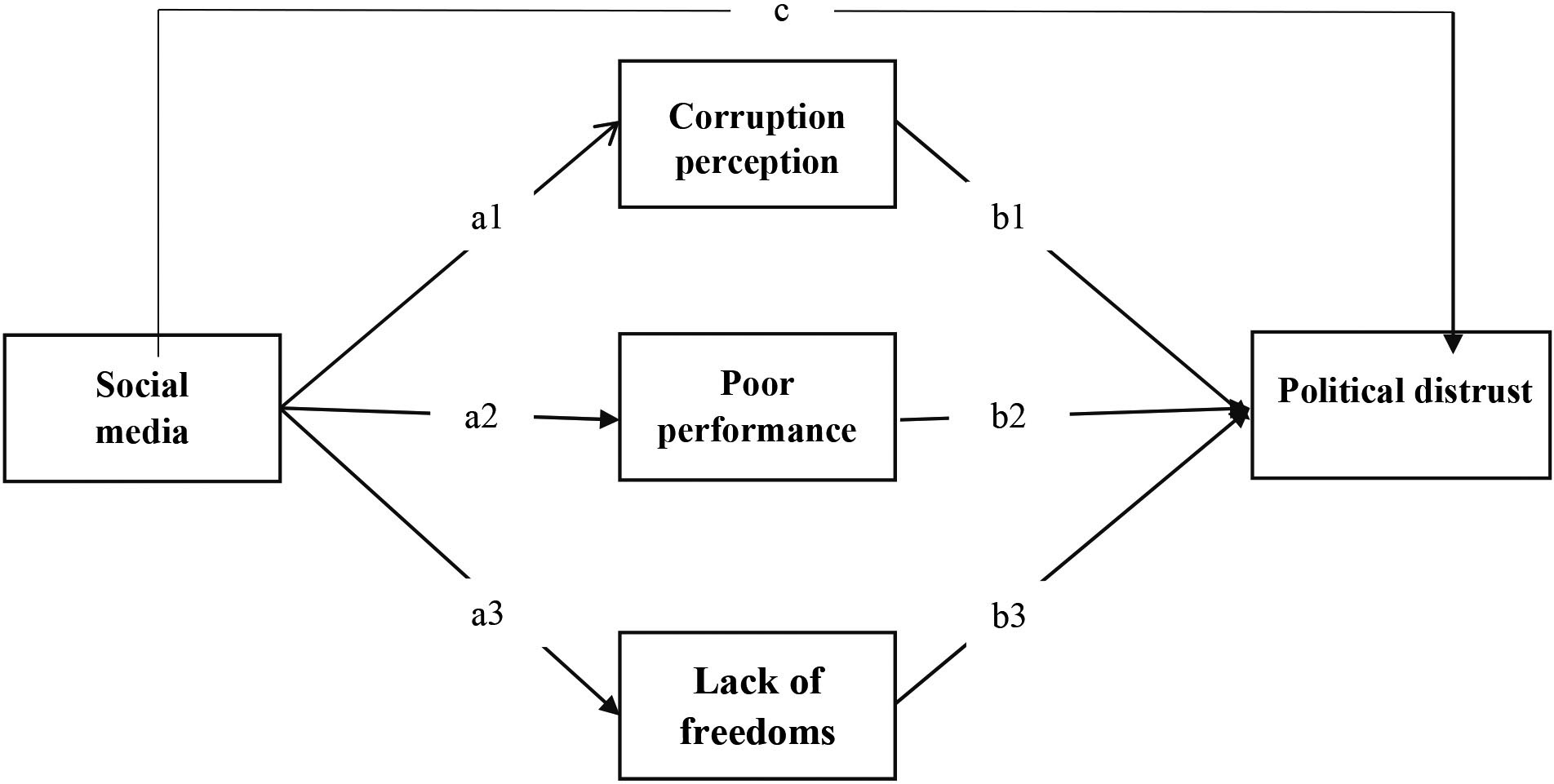
Figure 1 summarizes the theoretical research expectations. Track c measures the direct link of social media consumption on political distrust. Paths a1, a2, and a3, explain the effect of social media usage on corruption perceptions, perceptions of poor government performance, and perceptions of a lack of guaranteed freedoms. Paths b1, b2, and b3 then display the effect from these mediators on the dependent variable, which is political distrust. Thus, this study has three indirect paths of the impact of social media usage on political distrust through the mediating variables corruption perception (a1b1), perceptions of poor government performance (a2b2), and perceptions of a lack of guaranteed freedoms (a3b3). In particular, we expect the indirect paths to matter; social media consumption should increase political distrust in society through the mediating variables citizens’ corruption perceptions, their perceptions of poor government performance and their feelings of a lack of freedoms (see also: Hanson et al., 2010; Ceron, 2015; Tucker et al., 2018; DeCamp et al., 2013; Fuchs, 2017; Newton, 2001; Hutchison & Johnson, 2011).
We test the mediating relationship of negative assessments of corruption, perceptions of poor government performance, and perceptions of a lack of freedoms between social media usage and social trust with data on Egypt, one of the countries where social media usage has influenced its political climate (Awad & Farghaly, 2018). Due to the increase in the young and educated population, Egypt’s internet and social media usage social media usage has grown significantly over the past two decades. Social media has been instrumental for various protests and social movements, including the Arab Spring in early 2010 (Sadiki, 2014; Huang, 2011). Even if the level of political instability and protests in Egypt has decreased in recent years, citizens still have relatively little political trust in their government. According to the World Value Survey (WVS 6), 60.4% of Egyptians have little trust in their government (Inglehart et al., 2014).
As a data source, we use data from the Arab Barometer Wave V (2018–2019) Project, a joint project between the Universities of Michigan and Princeton, and research centers in the MENA region. The survey project polls citizens about attitudes and behaviors, especially in political, cultural, and social spheres. The Egyptian sample, which includes 2400 citizens, serves as the data source for this article.
Political distrust is our dependent variable, which we define by a lack of trust in political institutions. We operationalize this variable with the help of an additive index combining three original Likert-type scale items. These three items are: (1) trust in government (Council of Ministers); (2) trust in the courts and legal system; (3) trust in the elected council of representatives (the parliament). Higher values indicate individuals’ distrust in these institutions (Range
For the three questions respondents had the following response choices: a lot of trust, quite a lot of trust, not a lot of trust, no trust at all.
Our main independent variable is social media usage. The question from the Arab Barometer survey that gets at this variable is: how many hours on a typical day do you spend on social media platforms [such as Facebook, Twitter, or WhatsApp]?3
Response choices in the survey ranged from 0 hours (coded 1) to 10 hours and more (coded 5).
Our three mediating variables are corruption perceptions, the government’s performance, and guaranteed freedoms. We measure the first mediator corruption perceptions by an additive index of two items: (1) To what extent do you think there is corruption within your country’s national state agencies and institutions?4
The first item has four response choices: not at all, to a medium extent, to a small extent, and to a large extent. Response choices for the second are: hardly anyone is corrupt, not a lot of officials are corrupt, most officials are corrupt, and almost everyone is corrupt.
Respondents had four response choices for the three indicators: very good, good, bad, very bad.
The two questions had the four response categories: guaranteed to a great extent, guaranteed to a medium extent, guaranteed to a limited extent, not guranateed at all.
The control variables have the following operationalization: Age is the actual age of the respondent at the time she took the survey, gender is a dummy variable coded 1 for men and 2 for women, education is a 7-value ordinal scale ranging from 1 no formal education to 7 a Master’s degree or higher, respondents finances is a four value ordinal variable with the following categories: Our net household income covers our expenses and we are able to save; our net household income covers our expenses without notable difficulties; our net household income does not cover our expenses; we face some difficulties; our net household income does not cover our expenses; we face significant difficulties.
Histogram of the dependent variable political distrust.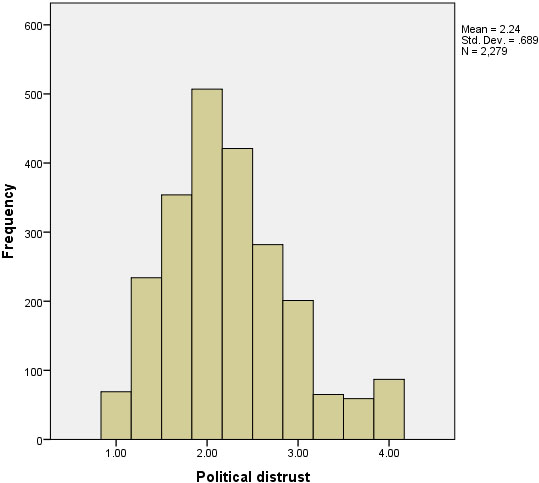
Unstandardized path coefficients with standard errors, without controlling for demographic variables. Note: ***, **, and * denote significance at 99%, 95%, and 9% levels, respectively. Entries are unstandardized regression coefficients with standard errors in parentheses.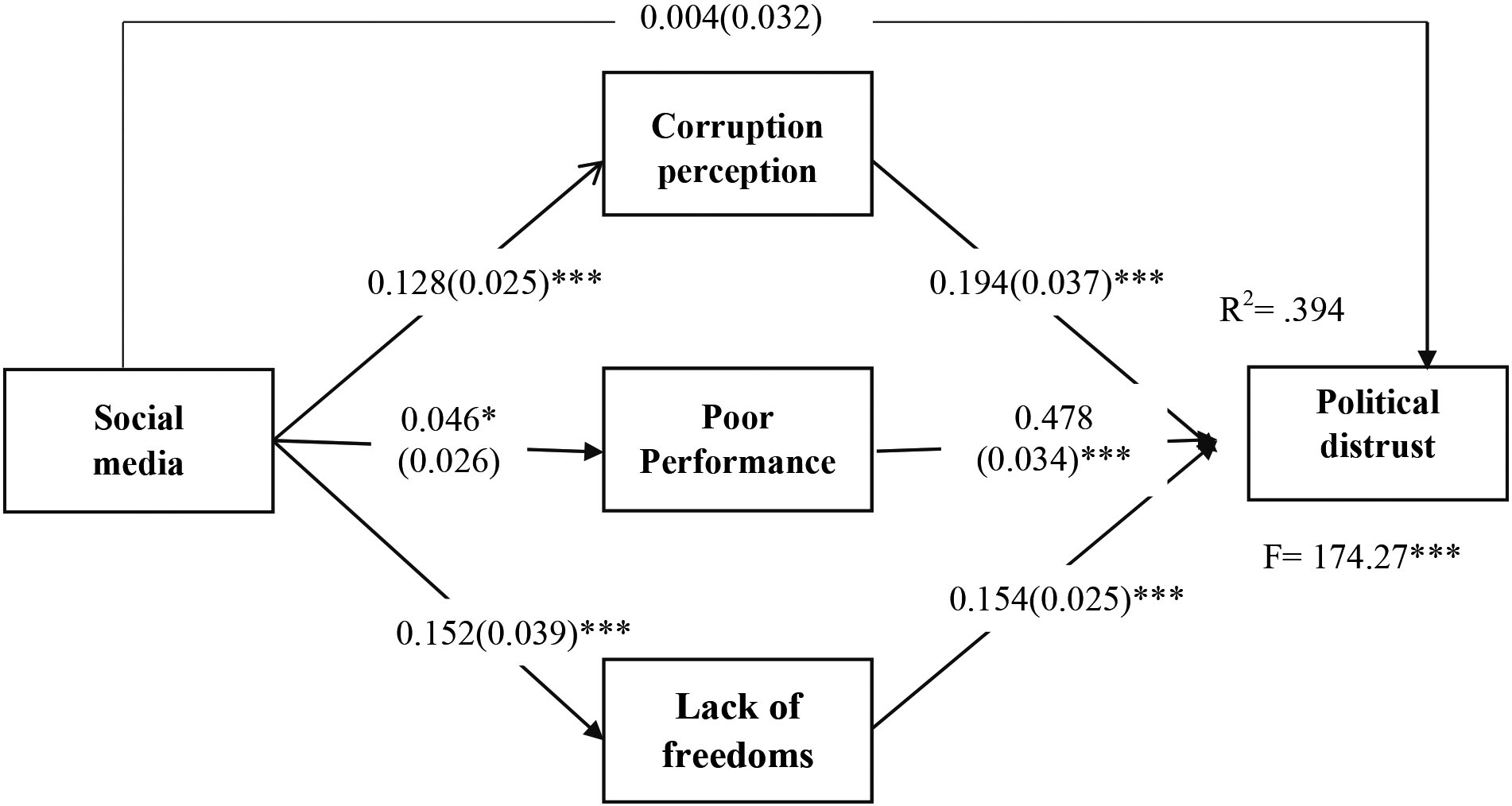
We use three types of methods to determine the direct and indirect effect of social media usage on political distrust. In a first, more preliminary analysis, we graph our dependent variable, political distrust. This univariate statistics provides us with an idea of the variation in the sample. Second, we employ path modeling. Figure 2 is a path model that measures the direct and indirect effect of social media usage on political distrust without control variables. The figure displays the direct influence of social media usage on political distrust (i.e. path c) as well as the indirect influence through corruption perceptions (i.e. paths a1 and b1), perceptions of poor government performance (path a2 and b2), and perceptions of a lack of freedoms (a3 and b3). We have mediation if both path a and path b are statistically significant for any of the mediators. Figure 3 is a replication of Fig. 2 with the addition of the control variables age, gender, education, and respondents’ finances. Third, we use the Macro Preacher and Hayes (2008) version of the Bootstrapping method included in version 24 of the SPSS software package to test our three indirect effects of interest (Bootstrap-resamples (k) are 1000). Table 1 presents the estimates of these indirect effects without control variables. In Table 2 we add the same control variables as in Fig. 3.
Indirect effects of social media on political distrust through proposed mediators (ab paths), without controlling for demographic variables
Indirect effects of social media on politicaldistrust through proposed mediators (ab paths), with controlling for demographic variables
Specified figure shows unstandardized path coefficients with standard errors in parentheses, with controlling for demographic variables. Note: ***, **, and * denote significance at 99%, 95%, and 9% levels, respectively. Entries are unstandardized regression coefficients with standard errors in parentheses.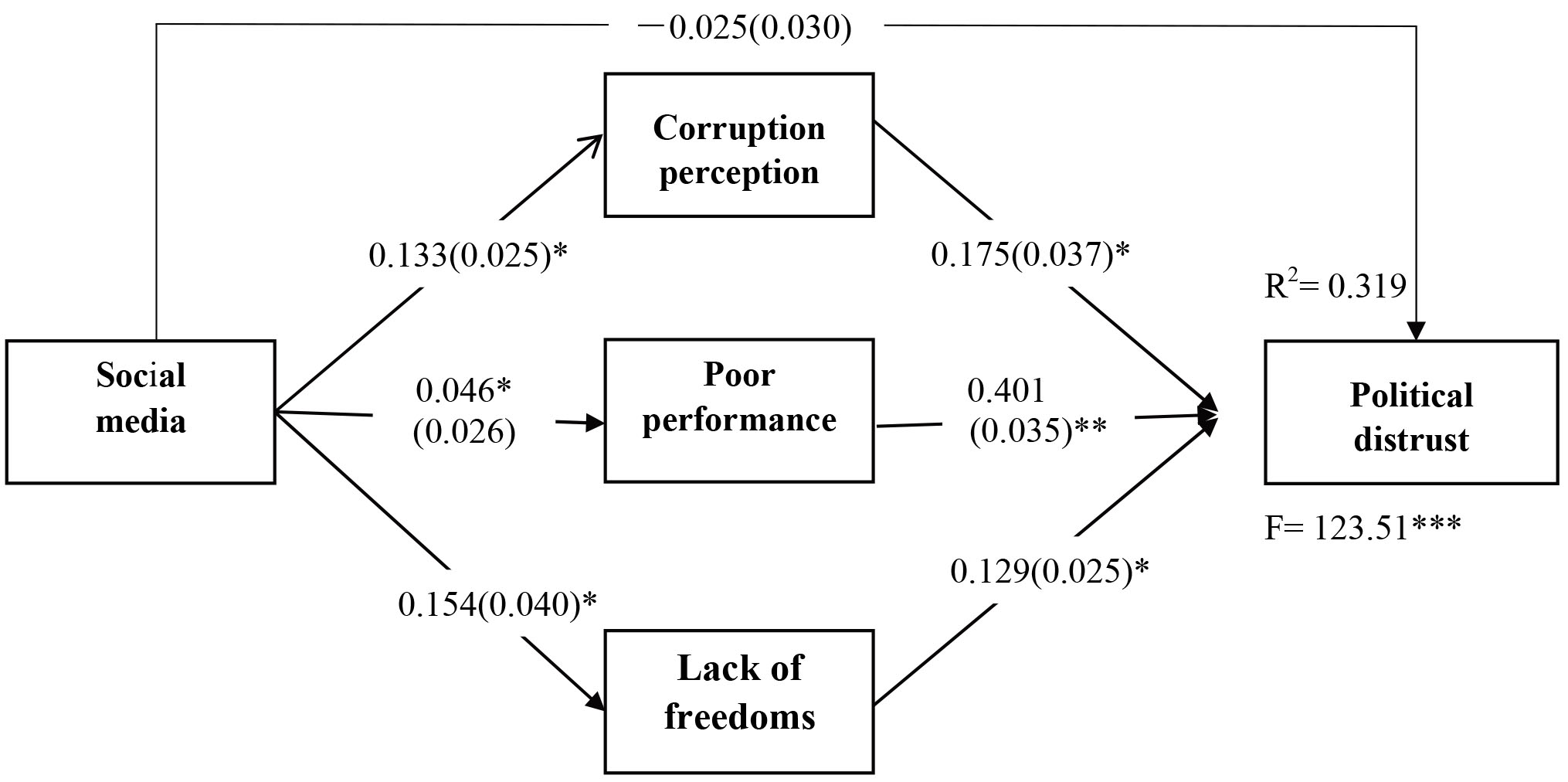
The histogram in Fig. 2 displays an average value of 2.2. on the trust to distrust scale, while at the same time pointing to wide variation in levels of distrust, with some people exposing high levels of distrust, while others displaying low levels of distrust. The graph also displays that most people locate themselves somewhere in between 2 (quite a lot of trust) and 3 (not a lot of trust). Given that in an autocratic context, individuals might be hesitant to reveal their real level of distrust with their government, these figures might be embellished because citizens might engage in self-censorship to protect themselves (see: Tannenberg 2021). Yet, despite this potential underestimation of “real” distrust levels, Figs 3 and 4 confirm our conjecture that social media usage can account for some of this variation in political distrust. In conformity with our theoretical expecations we find that the influence of social media usage is indirect rather than direct. In more detail, we find that paths a(1), a(2) and a(3) are all statistically significant and in the expected direction; that is social media usage directly impacts citizens levels of corruption perceptions, their evaluations of the performance of the government, and their perceptions of a lack of basic human freedoms. Yet, the certainty with which we can make these predictions is a bit less strong for the link between social media usage and perceptions of poor government performance, which is only statistically significant at the 90 percent level; the other two parts are statistically significant at the 99 percent level. Our results further indicate that higher perceptions of corruption, poor governance performance, and lack of freedoms increases political distrust (the paths b1 to b3 are all statistically significant at the 99 percent level). In contrast to the indirect effects, our path model indicates that social media consumption has no direct effect on political distrust (i.e. path c is not statistically significant at any conventional level). These relationships are robust if we add control variables (see Fig. 4).
Tables 1 and 2, which use the bootstrapping method, corroborate the results from Figs 3 and 4. Without control variables (see Table 2) and with control variables (see Table 2), we find that the effects of social media usage on political distrust are mediated by poor government performance, perceptions of higher corruption, and lack of perceptions of guaranteed freedoms. All indirect effects are again statistically significant. Our results further confirm that the certainty with which we can make predictions about these effects is lower for perceptions of poor government performance (
Conclusion
Most studies see that fundamentals to create political trust are guaranteed freedoms, perceptions of transparency in the governing process and administration and positive evaluations of government performance (e.g. Job 2005; Blind, 2007). In this sense, one of the essential preconditions for a culture of trust in society is government accountability (see: Sztompka, 1999). If the state’s institutions are rich, accessible, and well-functioning, the community’s sense of security and trust will increase (Offe, 2000). In particular, in cases where democratic laws, equality before the law, and access to justice compromise citizens’ relationships with the government, political distrust could be high, at least among some parts of the population. Our case study of Egypt illustrates that in such a context social media usage plays an essential indirect role in shaping political beliefs. In such a context, it seems that social media exposure remains one of the few sources where citizens can get non-government sanctioned information about the political, economic and social life of their country. The more they consume these alternative sources of information the more critical they are about their government’s performance in the areas of corruption, general government performance and human rights. These more negative output assessments, then translate into increased distrust into the government.
We are confident that the threefold link between higher social media consumption, more negative assessments of the government’s transparency, performance, and the human rights’ situation, as well as increased political distrust applies not only to Egypt, but also to other Middle Eastern autocracies. Yet, the magnitude of the indirect effect of social media usage on political distrust might differ in various autocratic regimes. For sure, by definition of being autocratic, all autocratic regimes infringe on basic human rights, and social media channels can always be means to expose these infringements. However, not all autocratic governments perform badly and are riddled by corruption scandals. Singapore, for instance, would be an autocracy with an efficient bureaucracy and good economic performance indicators. This southern Asian country is also a frontrunner in the fight against corruption. Hence, in such a situation social media channels have less negativity to expose, and the indirect relationship between social media usage and political distrust through the three mediating variables, corruption perceptions, poor governance performance and perceptions of missing human freedoms might be less strong. Future research should explain the degree to which this is the case.
The broader implications of our study are multifold. It seems that critical social media channels have become an important means for critical actors to diffuse information using the Internet. The more citizens consume these alternative sources of information, the more they might learn about rampant corruption in the government, poor institutional performance and human rights abuses and the less trust they may have in their institutions and their government. In other words, citizens might learn through these alternative news channels about the government’s weaknesses in economic, political and social governance (Bode & Makarychev, 2013; Gerbaudo, 2012), which the state-controlled traditional news sources do not talk about. They portray the official state of affairs, which consists of a glorification of the autocratic regime. In places like Egypt, social media usage can contribute to a gap between the political system that supports formal discourse and the citizens who seek to challenge such formal discourse (Tucker et al., 2018; Dimaggio et al., 1996). In extreme cases, social media usage by fostering distrust and opposition can be a contributing factor for people demanding active change (see the revolutionary period in 2010/2011).
Footnotes
Authors biographies
Dr. Hossein Masoudnia is Professor of Political Science at the University of Isfahan, Department of Political Sciences, Isfahan, Iran.
Dr. Maryam Ghorbani is Lecturer of Political Science at the University of Isfahan, Department of Political Sciences, Isfahan, Iran.
Dr. Daniel Stockemer is Professor of Political Studies and the Holder of the Konrad Adenauer Research Chair in Empirical Democracy Studies at the University of Ottawa, Ottawa, Canada.