Abstract
Digital platforms are suitable alternatives to help governments open policy-making and public service delivery to external ideas. Platforms are very flexible and customizable, which makes them effective for a variety of participatory purposes, such as co-creation, co-production, innovation, or transactions. However, this diversity makes it difficult to define how different technical designs could shape the performance of these platforms. Literature has described different types of platforms, based on their participatory goals, but we still do not know enough about the diversity of platforms in terms of technical design. To address this gap, we conducted a cluster analysis to find patterns in the technical design of 52 participatory platforms worldwide. We observed three main architectures: Ideas for the City; Decisions and Debates; and Mapping. These findings are one step forward to better understanding how digital platforms could impose certain dynamics on the participatory processes.
Keywords
Introduction
During the last decades, governments worldwide have begun to open up the government to external ideas (Mergel, 2015; Torfing et al., 2019; Janowski, 2015; Janssen & Estevez, 2013; Meijer et al., 2019), empowering and involving citizens and non-state actors in government action (Alford, 2009; Bovaird & Loeffler, 2012; Emerson et al., 2012; Linders, 2012), or emphasizing the value of innovation in the public sector (Torfing, 2019; Chen et al., 2020; Mergel & Desouza, 2013; Greer & Lei, 2012). Opening governments to external influence is not only expected to spur innovation in the public sector but also contribute to addressing contemporary social demands for a more active role of citizens in democratic institutions (Norris, 2001; Dalton, 2008), and to help to recover citizens’ trust in government (Nabatchi, 2010; Fung, 2015).
In this context of change, platforms are becoming a referent for opening governments and transforming their interactions with citizens (Liu, 2017; Chen & Aitamurto, 2019; Taeihagh, 2017; Prpic et al., 2015; Ranchordás & Voermans, 2017). Digital platforms help governments reach a larger and more diverse crowd (Ansell & Gash, 2018). Digital platforms bring data, services, and people together, not only to enable the inflow of external ideas into organizations (Mergel, 2015; Mergel, 2018), but also to make governments more efficient (Cordella & Paletti, 2019), and to empower citizens (Janowski et al., 2018). Several scholars have sought to capture the distinctiveness of what Janowski et al. (2018) named the “platform paradigm” of government (Ansell & Gash, 2018; Meijer et al., 2019; Mergel, 2018; Janssen & Van Der Voort, 2016; Linders, 2012; Janssen & Estevez, 2013; Meijer & Boon, 2021; Torfing et al., 2019).
However, the technical designs and functionalities of digital platforms for citizen participation are so diverse that one can find in the literature a large number of typologies or taxonomies of digital platforms for citizen participation (Ansell & Miura, 2020; Prpic et al., 2015; Nam, 2012; Liu, 2021; Ghezzi et al., 2018), or crowdsourcing platforms – a well-known term for digital platforms (Schenk & Guittard, 2011; Vukovic, 2009; Rouse, 2010; Geiger et al., 2011; Doan et al., 2011; Quinn & Bederson, 2011; Aris, 2017). This is because platforms are very customizable, adaptable, and reconfigurable – therefore with a high degree of uniqueness (Baldwin & Clark, 2006; Pil & Cohen, 2006), which makes it difficult to trace how certain platforms can dynamize, scale, or transform the participatory processes.
Most of these typologies and taxonomies have focused on describing the participatory processes, paying less attention to the types of technological artifacts being used by governments to manage citizen participation. When we study technological artifacts, it is important to understand their technical designs because, through their affordances and constraints, they can shape the behavior and interaction of their users, and therefore the process of participation (Orlikowski & Scott, 2008). Yet, despite their potential to generate public value, we still do not know enough about what the platforms are, what are their attributes, how they are shaping the participatory process or the participatory goals; that is, how governments are generating public value from certain technological designs (De Reuver et al., 2018; Bonina et al., 2021; Ansell & Miura, 2020; Meijer et al., 2019). Therefore, to better understand how governments are using digital platforms for citizen participation, it is important to describe and characterize the main technical configurations and functionalities and their association with diverse types of participatory processes.
To better understand the variety of technical designs of digital platforms, we mapped the technical design and functionalities of digital platforms deployed by governments worldwide for citizen participation. The research question guiding this study is: what are the common patterns in the technical design of digital platforms? As we explained above, a key challenge in mapping technical designs is that each platform is likely to be unique – if we consider a wide range of design points. Therefore, we used the framework of core and peripheral architectures, a known framework to identify core technical features of architecture from lesser relevant features for a platform’s functioning (Baldwin & Woodard, 2009). We did a systematic literature review and a subsequent framework to identify the key decision points that would help us to seek major patterns among the platforms, and thus distinguish core from modules. We used this framework to collect data on the technical design of fifty-two digital platforms deployed by governments around the world. We then conducted a cluster analysis to identify patterns in the core architectural designs and their respective modules.
The result of this article contributes to the current conversation about platforms for citizen participation by providing a model to assess the technical design of digital platforms and describing the main platform architectures being used by governments worldwide. This is a key step toward better understanding how certain technical designs can shape the dynamics of participatory processes.
This article is composed of seven sections, including the foregoing introduction. In Section 2, we review the literature about digital platforms for citizen participation. In Section 3, we describe the research design for the empirical analysis. In Section 4, we present a conceptual framework to assess the technical design of digital platforms for citizen participation. In Section 5, we present the three platform architectures that we identified in our analysis. In Section 6, we discuss our findings and their implications in the broader literature about citizen participation. Finally, in Section 7, we present our conclusions.
Literature review
Platforms could be understood differently, depending on the field of study (Bonina et al., 2021). By platforms, we could be talking about a set of organizational capabilities enabling the re-combination of organizational resources to adapt to shifting demands (Thomas et al., 2014; Baldwin & Clark, 2006). We could also be talking about a product family sharing core components, processes, knowledge, or people but differentiating in secondary features (Baldwin et al., 2009). We can also think about platforms as artifacts through which the organization relates to the external, and where value is created by transferring knowledge, ideas, and labor from citizens to governments. This notion of platforms referred to as intermediary or multi-sided platforms has been highly associated with technology, engineering, and design (Gawer, 2011). Multi-sided platforms are spaces enabling open or free interaction among multiple parties, but where owners of the platform control the technological architecture, and thus the dynamics of the interactions and their outcomes (Eisenmann, 2008). In this context, the notion of digital platforms adds a technological dimension to enable and mediate the interaction between two or more groups of users (Cusumano et al., 2019).
Since the emergence of digital government, digital platforms have been used to increase the spaces for interaction between governments and citizens. For some, digital platforms are attractive because platforms foster efficiency or efficacy. For example, platforms help scale up participation, mitigate costs of participation, or dynamize interactions among the groups of users (Brabham, 2008; Aitamurto & Landemore, 2016; Ghezzi et al., 2018; Bonina et al., 2021). For others, platforms could also substantially transform the dynamics of the participatory processes, for example, by accessing knowledge and ideas from far-fetched actors (Afuah & Tucci, 2012), finding collaborators or co-producers outside government (Meijer & Boon, 2021), enacting and operating governance networks (Ansell & Gash, 2018; Ansell & Miura, 2020). Therefore, our main argument is that each digital platform could seek a different purpose through different functionalities or technical design.1
We refer to the technical design as the overall configuration of a platform. We refer to decision points as the elements of a platform where designers could choose among different “decision rules.” We borrow from Ansell and Gash (2018, p. 26) the term design rules to refer to the “design of modules or platform interfaces, access rules and participation eligibility and requirements” that facilitate or manage interactions or collaboration. Finally, we use the term “design choices” to refer to all the possible design rules that can be applied in a given decision point.
However, one challenge of studying how certain digital platforms shape the participatory processes is that technical designs are diverse. Several typologies and taxonomies give an account of this broad landscape of technical designs in digital platforms. For example, Clark et al. (2016) classified domains of action for participatory initiatives based on two factors: administrative expertise and the diversity of the contributions. These bring four categories, namely, collective opinion, individual opinion, the wisdom of the crowds, and the wisdom of experts. Liu (2021) proposed a typology of crowdsourcing initiatives, based on two binary variables: participation in the design or execution of policies, and complementing or substituting the government’s internal tasks. Prpic et al. (2015) look further at the dynamics set up by the platform and propose three types of dynamics through which governments and citizens can engage: virtual labor market, tournament crowdsourcing, and open collaboration. Bonina et al. (2021) described a typology of digital platforms based on two dynamics: transactions and innovation. These criteria have been echoed in the classification of governance platforms, where Ansell and Miura (2020), building upon Thomas et al. (2014)’s concept of leverage, described four types of governance platforms, namely, interaction, open innovation, production, and co-creation platforms. Other frameworks have sought to bridge emergent digital platforms with established frameworks on policy-making or public management (Taeihagh, 2017; Ansell et al., 2017; Janssen & Helbig, 2018; Linders, 2012; Janowski et al., 2018; Meijer et al., 2019; Zuckerman, 2014).
These typologies are highly informative to describe how cases of participation platforms may fit into certain categories, particularly into certain types of interaction. However, these are less focused on analyzing technical designs. To fill this gap, we opted for the analytical framework of platform architectures, which helps us to focus on functionalities or technical designs. Platform architecture is “the scheme by which the function of a product is allocated to physical components” (Ulrich, 1995, p. 419). This scheme includes the description of functions, the physical components needed for those functions, and the arrangements of these components (Baldwin & Woodward, 2009). Following these definitions, Baldwin and Woodward (2009) argue that the fundamental feature of the architecture is that it conveys a set of technical designs that remain stable and govern the relationship among components.
Several studies in the field of public administration have begun a conversation around the framework of platform architectures to describe the design of spaces of interaction between governments and other actors (Bonina et al., 2021; Ansell & Gash, 2018; Ansell & Miura, 2020; Janowski et al., 2018). We seek to join this discussion by framing our analysis and results in terms of common architectural features of participatory platforms (that is, technical designs that remain stable across cases), rather than describing how platforms, as a whole, fit into predefined categories.
We narrowed down our study to a specific type of participatory platform, known as crowdsourcing. Crowdsourcing is a managerial practice of collaboration through a virtual platform, where citizens can share their knowledge or skills with governments. Compared to other forms of participation, crowdsourcing platforms are innovative in their use of information technologies to outsource tasks to a large group of potential participants – and in a relatively inexpensive effort. For example, crowdsourcing can help scale up the amount and diversity of participants, reduce the costs of participation, or dynamize the interaction among participants (Ghezzi et al., 2018). Crowdsourcing contributes to participatory democracy, not only by collecting ideas but also by networking a wider net of citizens and setting up a dynamic space for deliberation (Chen & Aitamurto, 2019; Christensen et al., 2015; Gellers, 2016; Guth & Brabham, 2017). However, there is still a point of contention on whether these contribute to a fairer decision-making process or reinforces inequalities in the practice of citizen participation (Aitamurto & Landemore, 2016).
To observe the architectural diversity in digital platforms, we conducted a multi-stage inductive study on crowdsourcing platforms. In the first stage, we sought to define relevant design rules that would convey a distinctive architecture. To do so, we did a systematic literature review of peer-reviewed academic articles about crowdsourcing in government; that is, articles that matched the keywords “crowdsourcing” and “government” (or the alternatives “public sector,” and “public administration”), which amounted 126 articles after scanning their abstract. Then, we narrowed down the list to articles presenting or discussing a taxonomy or typology of crowdsourcing platforms, ending up with 19 articles that met the criteria for the analysis.2
The scanning of manuscripts began in October 2019 and ended in December 2019. See the list of the 19 articles in Section E in Supplementary Material.
In the second stage, we collected data about the design choices in government crowdsourcing initiatives. We obtained the cases from CrowdLaw, a repository that scans crowdsourcing initiatives around the world and from all levels of government.3
The repository can be accessed at https://crowd.law/. Data was last accessed on 9/10/2019.
The unit of analysis was a single crowdsourcing platform. Some crowdsourcing initiatives are composed of two or more platforms. For example, the initiative Decide Madrid is composed of three different platforms. In these cases, we decomposed the initiatives into several units. For example, we decomposed the initiative Decide Madrid into three platforms: (1) Decide Madrid, Procesos, (2) Decide Madrid, Votaciones, and (3) Decide Madrid, Debates.
Although CrowdLaw is a useful and broad repository of platforms for citizen participation, it is far from being exhaustive. Furthermore, the data collection process might impose selection bias in the dataset, mostly related to language, geographical region, and size of cities. Therefore, we acknowledge that our primary source of data is not representative, nor exhaustive. However, the diversity of the types of platforms in this dataset is useful for describing the diversity of technical designs.
List of platforms analyzed, by geographic region
To collect the data, two researchers conducted, independently, a web content analysis6
Web content analysis is an interpretive qualitative technique for coding symbols or themes from content communication in Internet research (Herring, 2009).
This means that each researcher collected the complete data set independently. Then, the researcher shared their results and talked over the decision points where their coding was different so that they agreed on a common coding.
Further details about the intercoder reliability analysis can be found in Section D of Supplementary Materials.
The data collection of the second stage was conducted between October 1
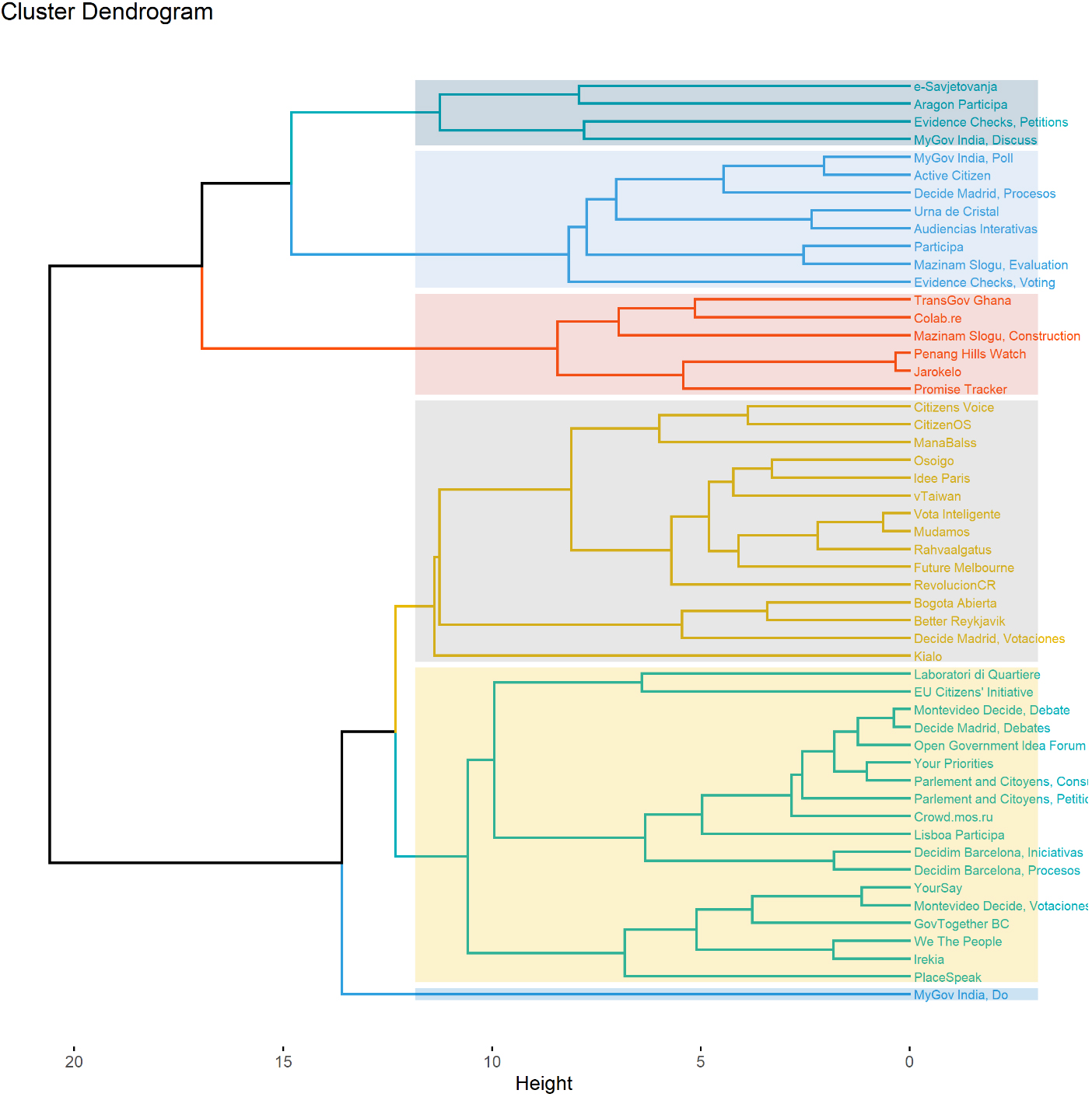
In the third stage, we did a hierarchical cluster analysis on this data set to seek patterns in the architectural design of crowdsourcing platforms (see Fig. A.1 in the Appendix). Hierarchical cluster analysis is a useful method for inductive studies seeking to explore underlying patterns in the data (Aldenderfer & Blashfield, 1984; Romesburg, 2004).10
A cluster analysis will always yield clusters, even if the patterns (i.e., the cluster structure) are weak or are not of substantive interest (Kassambara, 2017). We validated the presence of a cluster structure with the Hopkins statistic (
Our study began with the definition of relevant design rules to be observed over different decision points in a platform (see Section 3). We organized our mapping of decision points based on Berlo’s model of communication (Berlo, 1960). We chose this framework because it portrays through a simple, yet powerful scheme, the main stakeholders, and interactions that we could find in a platform. We used this framework to identify the points where that literature suggests as relevant enablers of interaction (see Fig. 1). Based on this, we open-coded the diverse types of design rules that the literature describes for each of these decision points. Therefore, based on this framework and literature review, we organized the stakeholders as senders and receivers, who interact (i.e., send “messages”) through a channel. We represent the government as the sender, who initiates the interaction by posting a task on the platform. Therefore, the type of task handed out is the first relevant decision point.
We represent the citizen as the receiver, who then decides whether to respond (or not) to the government by submitting a contribution through the platform. Since citizens participate voluntarily, a relevant design rule is creating the conditions so that citizens regard participation as worthwhile; we labeled this decision point as schemes stimulating participation. Governments need also to define the type of response they receive from citizens; that is, the type of human skills that citizens should be sharing through the platform (Brabham, 2008; Mulgan, 2017). As the type of human skill sought can also vary, independently of other decision points (Nam, 2012), we considered this as a fourth relevant decision point. Likewise, the type of human skill sought could be digitized in a variety of forms. It could be captured through a simple survey, a face-to-face interaction, a peer-to-peer system, or a text box. Therefore, we incorporated the decisions about the content or how the contributions are submitted as a relevant decision point. Finally, we also observed that the literature emphasizes variations in the type of interaction that the platforms enable, thus we included it as our fifth decision point. In the next paragraphs, we briefly describe these decision points and their associated design rules described in the literature.
Model of interaction in citizen participation platforms.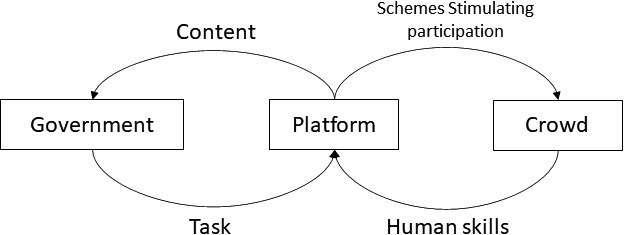
The task handed out in a platform is an action expected to be executed by a citizen. We identified many publications that have characterized the types of tasks that can be observed in platforms (Alabduljabbar & Al-Dossari, 2017; Nakatsu et al., 2014; Hosseini et al., 2015). These studies differ in their approach to classifying the tasks; some opted for discussing the nature of the task (i.e., its complexity, or solvability), whereas others classified them by their functionality or expected outcome. We followed a functional approach to identify the design rules of tasks and built upon the work of Alabduljabbar and Al-Dossari (2017), who conducted a literature review on the typologies of tasks. Following this work, we narrowed down the variety of design rules over tasks into five categories: providing an opinion (e.g., evaluating, rating, ranking, or providing feedback), generating content (e.g., writing down proposals, or designing a logo), converting content (e.g., reviewing, summarizing translating, transcribing, or proofreading content), processing data (verifying, validating, matching, or tagging data), and doing research (finding information). We adapted these categories into the context of government-citizens interactions and refined the listing to four design rules: collecting data, submitting ideas, assessing information, and building artifacts.
Schemes stimulating participation
We observed a long list of schemes to stimulate participation in the literature, such as rewards, a sense of membership, passion for the subject matter, leisure, novelty, personal branding, altruism, social status, caring for the community, or skill development (Nam, 2012; Aris, 2017; Geiger et al., 2011; Hosseini et al., 2015; Ghezzi et al., 2018; Brabham, 2008; Corney et al., 2009; Doan et al., 2011; Schenk & Guittard, 2011; Rouse, 2010). Nevertheless, we also observed that these concepts were barely systematized. Instead, they were often listed as anecdotical references, or authors’ suggestions or expectations. Therefore, we opted for trying to provide some cohesion and structure to this listing by using the framework of Self-Determination Theory (SDT) (Ryan & Deci, 2002). This framework helps us to map design rules by linking the potential triggering of motivations through certain platform schemes for stimulation. The SDT categorizes motivation into three big tents: intrinsic motivation, extrinsic motivation, and absence of motivation. Intrinsic motivation mobilizes people due to an innate psychological need in some individuals to feel competent and a feeling of self-determination toward success, whereas extrinsic motivation is based on factors external to the person that drive action (Ryan & Deci, 2002). Based on this framework, we used the list of schemes for stimulation described above as part of the coding scheme to inform six potential schemes for stimulating participation: platforms could use schemes potentially stimulating three internal (to know, sense of accomplishment, and experience a stimulating sensation), or three external (external regulation, introjected regulation, and identification) motivations.
Human skills
The literature describing the types of human skills sought by using platforms is closely associated with the literature describing the type of participatory processes for which platforms could be useful (e.g., transactions, innovation, or collaboration) (Liu, 2021; Taeihagh, 2017; Prpic et al., 2015; Nam, 2012; Brabham, 2008; Hosseini et al., 2015; Quinn & Bederson, 2011; Doan et al., 2011; Rouse, 2010). We observed that the human skills suggested most frequently in this body of literature were creativity, knowledge (e.g., knowledge over a policy domain, or a neighborhood), complaints, rankings, ratings, and opinions. Based on these insights, we formulated five design rules associated with the human skills sought: local knowledge, expert knowledge, professional skills, creativity, and customer feedback.
Type of interaction
A major source of interest in the literature was the type of interactions that the platforms afforded; not only between governments and citizens but also among citizens (Vukovic, 2009; Nakatsu et al., 2014; Hosseini et al., 2015; Nam, 2012). We observed several terms to describe the type of interaction, being the most common collaboration, networking, voicing opinions, competition, tournaments, and feedback. We suggest that these descriptions could be grouped into two design rules: independent and interdependent contributions. We refer to independent contributions are those where citizens do not interact among them, rather each person submits a contribution without influencing or being influenced by (sometimes, not even being aware of) others’ contributions. Common examples of this type of interaction are polls or the collection of data (e.g., reporting a malfunction of public infrastructure). On the other hand, interdependent contributions are those where a citizen’s contribution can influence, be influenced by, or build on top of others’ contributions. This interaction among citizens can be collaborative (e.g., collaborating in a peer-to-peer system) or competitive (e.g., competing for a prize).
Content
Finally, the fifth decision rule, content, refers to how the platform captures the human skills sought. This decision point was not explicitly discussed in the articles reviewed but emerged as a relevant discussion and decision point across the literature, particularly in discussions about data and data management (Aris, 2017). For example, customer feedback (i.e., complaints) could be collected through closed questions in a simple poll, a face-to-face interaction, or written in a text box. These differences are relevant because they impose the format of the raw data that managers must then aggregate and process this data. We formulated three design rules associated to describe how the content was collected: structured (e.g., responses to closed questions), unstructured (e.g., writing down an idea), or mixed (e.g., a combination of structured and unstructured).
Analysis of clusters
We present the findings of our study in two parts. In the first part, we report the descriptive statistics on the design rules observed across the platforms analyzed. We also show a descriptive analysis of the main patterns we observed in the cluster analysis. In the second part, we describe the findings that emerged from our interpretive analysis of the patterns observed in the analysis. To do so, we came back and forth between the websites of the clustered platforms and the cluster analysis to provide more qualitative richness to the results.
We begin by reporting the descriptive statistics of our web content analysis in Table 2, which shows the distribution of design rules for every decision point. The Table shows that creation (54%) is the main task observed. The type of interaction in the platform was relatively even between independent (40%) and interdependent (60%), and the external motivators had a strong presence among the platforms (92%). The main type of intelligence sought by the government was sharing of ideas (58%). Finally, 63% of the platforms collected mixed content.
Distribution of design choices from web content analysis
Distribution of design choices from web content analysis
The dendrogram in Appendix 1 presents the results of the hierarchical cluster analysis, which resulted in six relevant clusters. We then identified three meaningful clusters by blending a set of statistical insights and qualitative interpretation of the clusters.11
See Section B.2 in Supplementary Material.
Architectures and variations of participatory platforms.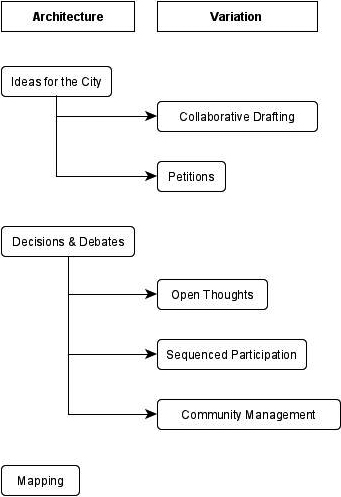
This architecture is characterized by the generation of ideas as the main type of human skills collected through the platforms. The main task of citizens is to provide opinions and ideas for policy design on a broad range of policy issues, such as urban policy, law-making, healthcare, or education. Although governments may ask citizens to bring ideas to address public problems, often citizens are the initiators of the deliberations. This architecture is also characterized by having some degree of interdependence among citizens. Often, citizens can read others’ contributions to inform their views, ideas, and opinions.
A good example of this architecture is the Icelandic platform Better Reykjavik, where citizens engage in topic-based virtual communities to submit ideas to the metropolitan government of Reykjavik. The ideas are also discussed and rated by the citizens, and every month, the top five ideas must be addressed by the City of Reykjavik Council. These ideas seek to influence the city council’s decisions or improve the citizens’ neighborhoods through city planning. The platform Better Reykjavik was developed by the Citizens Foundation – a non-profit organization – in collaboration with the City Council; the software built for this interactive platform was released as an open-source artifact and has subsequently been adopted by other cities in the world.
We observed two variations of this architecture: (1) Collaborative Drafting, and (2) Petitions. Both share the same functionalities described above but differ in some secondary functionalities. For example, Collaborative Drafting requires a higher level of interdependence among citizens, where citizens could not only see other citizens’ contributions, but often they may build on top of previous contributions. We observed this variation in platforms seeking to collaboratively draft a policy, urban development plan, or lawmaking. A good example of this variation is the platform Future Melbourne. The city of Melbourne sought to create s strategic 10-year plan for the decade of the 2020s in collaboration with the citizens. To do so, the city used a collaborative editing tool – similar to Wikipedia – where users could create and edit the content of the plan or provide suggestions for the plan.
A second variation is Petitions, which is a well-established form of political participation, where citizens hand petitions to governments through signed documents, expecting with more endorsements, the more likely politicians will hear and act. These platforms are often owned by citizens or non-government organizations, but some governments have adopted this type of platform to collect social demands. This variation is distinguished because it does not require nor promote interaction among citizens. Although these platforms allow endorsers to share a petition through their social media, the endorsers do not need to interact with other endorsers to complete their tasks.
Decisions and debates
This architecture is associated with local knowledge as the main type of human skill in the platform, as well as an emphasis on the generation of opinions and ideas. Compared with the previous architecture, where governments are often the initiators of the interactions by handing out proposals, which then citizens are encouraged to assess, discuss, and sometimes vote. This architecture is often designed to guide a decision process with spaces for some deliberation. The content submitted by the crowd is often mixed. Citizens could contribute by handing complete documents with proposals, writing down their opinions, or expressing their preferences in surveys.
The European Union’s EU Citizens Initiative is an example of this architecture. Through these platforms, either public servants, citizens, or other stakeholders from the European Union can hand out legislative proposals. The task of the citizens is to assess the proposal and decide whether to endorse it or not. If an initiative reaches one million endorsements, the European Commission is mandated to present an official statement or position about the proposal. Compared with the system of petitions described above, these platforms are focused on submitting complete proposals for policymaking.
We observed three variations in this architecture: (1) Open Thoughts, (2) Sequenced Participation, and (3) Community Management. Platforms designed as Open Thoughts differentiate from their main architecture because they emphasize the process of deliberation as the main outcome. In these platforms, debates are an essential process for citizens to develop or discover their preferences as they exchange ideas on the platform. In these platforms, the process of selecting or aggregating citizens’ opinions is often handed out to the citizens themselves. To do so, these platforms make extensive use of tools to let citizens vote, rate, or rank other citizens’ contributions.
A good example of this architecture is the platform Decide Madrid. Through its platform Decide Madrid Debates, citizens can expose issues they feel concerned about and share points of view with other citizens. The goal is to promote the debate and exchange of points of view among citizens or with public officers. Also, through its platform Decide Madrid Voting, citizens can contribute to deciding over policy alternatives issued by the Municipality of Madrid. Another innovative example is the Spanish platform Irekia, which is designed to kick-start open conversations about a given topic by compelling citizens to take a clear-cut stance about a proposal or question, and then express their opinion. For example, governments could hand a proposal through the platform, to which citizens must stand in favor or against, and then write down their rationale for or against the proposal. Arguments in favor and against are open to being seen by all users, which helps to inform their decisions about whether to endorse or oppose other citizens’ positions or arguments.
We labeled a second variation as Sequenced Participation. This variation differs in that these platforms flesh out that process, adding more steps, and provide a tighter and more structured process, and giving governments a stronger locus of control over the participatory process. However, the role of government is often as a listener, leaving the exchange of opinions among citizens. In these platforms, the participatory process is initiated by the government through an open call, often for public consultations. In the second stage, citizens have a period to submit their contributions. In the third stage governments process and respond to the contributions and based on these contributions, hand proposals for action. In the fourth stage, citizens have a period to review the government’s responses and proposals for action, and then vote or decide whether to endorse the proposals or not.
A good example of this variation is Barcelona Decidim, which is structured in the following participatory sequence: (1) government hands an open call for proposals through a survey, (2) citizens have a period to fill in their opinions in the survey, (3) the government process the opinions to make some proposals for action, (4) citizens can review the proposals and exchange opinions with other citizens, and finally (5) citizens can rank the proposals. Throughout the process, the government has strong control over defining the number of stages, the period in which each stage is open, and the processing of citizens’ opinions to draft policy proposals.
We labeled the third variation as Community Management. These platforms are virtual spaces to manage and document community work by local networks or communities of residents. Based on an architecture that allows users to hand over proposals, exchange opinions, and decide, this variation makes the platform a supporting system of offline community work. The platform complements offline work by documenting and organizing the outcomes from offline meetings of neighbors, or by enabling other parties to consult, extend or enrich that information. A good example of this variation is the Italian platform Laboratori di Quartiere, where every community in the city of Bolognia has an open channel to organize and document the interaction and collaboration among members of the community.
Mapping
This architecture relies on maps and mobility to collect citizens’ contributions. The main task of citizens is collecting data for the government, and the main type of human skill collected is local knowledge. This architecture emphasizes the geo-location of the data collected and submitted by the citizens; thus, mobile phones often play a key role in these platforms. The main purpose of these platforms is to foster the co-production of public services, particularly to improve the citizens’ material surroundings. For example, citizens can report infrastructure malfunctions or negative externalities affecting public spaces by submitting a geo-referenced image or video as evidence. The Malayan platform Penang Hills Watch is an example of this architecture. On this platform, citizens can report illegal hill-clearing sites by submitting geo-referenced images as evidence. The information sourced is stored and deployed in maps in the platform and is publicly available for all users.
We also observed interesting innovations in the two architectures discussed above (Ideas for the City, and Decisions and Debates) associated with mapping. Some platforms from those architectures have sought to use geo-location and geographical proximity as additional referents of relevance. Citizens may be informed about the consultations, participatory budgeting, or open calls happening near their residence or geo-location, thus probably more relevant to them. The dynamics of interaction, however, would be the same as described in the two previous architectures. An example of these innovations is PlaceSpeak. This platform provides spatial references to a variety of public problems through maps. Neighbors registered on the site receive notifications about reports, open calls, or public consultations occurring near their residences. Another good example is Lisboa Participa, a participatory budgeting platform where citizens can see on maps the location of the proposals competing for funding.
Discussion
Due to their potential variation in their technical design, digital platforms represent an opportunity to innovate in the way governments open to citizen participation. Several studies have highlighted the diversity of platforms and their expected performance on efficiency, innovation, and government legitimacy (Liu, 2021; Ghezzi et al., 2018; Taeihagh, 2017; Mergel, 2015; Cordella & Paletti, 2019; Meijer & Boon, 2021; Torfing et al., 2019). Our study joins this conversation by describing the variation of technical designs, as well as organizing this variation into three major platform architectures: (1) Ideas for the City, (2) Decisions and Debates, and (3) Mapping. By empirically assessing how governments design these architectures, how users interact with them, and what purposes these platforms are serving, we incorporated additional features that should be taken into consideration when we study digital platforms.
Some of the architectures we identified are consistent with the literature. For example, Collaborative Drafting is a generalized form of crowdsourcing legislation, where formal participation in the processes of lawmaking, city planning, or policymaking is open to the crowd. These forms of collaborative drafting have been discussed in previous studies about lawmaking processes (Landemore, 2015; Aitamurto & Landemore, 2016; Ranchordás & Voermans, 2017; Aitamurto & Chen, 2017). Further, the two architectures Ideas for the City and Decisions & Debates are also consistent with the notion of crowdsourcing deliberation, proposed by Aitamurto and Landemore (2016). Indeed, the architectures fostering deliberation have been suggested by several scholars, in particular, the potential to scale the deliberative process from small groups or forums into a “mass deliberation” (Aitamurto & Landemore, 2016; Christensen et al., 2015; Haltofova, 2018; Gellers, 2016; Guth & Brabham, 2017). However, as pointed out by Aitamurto and Landemore (2016), fulfilling this potential depends primarily on the design of the platform. Our findings advanced this discussion by showing the mechanisms through which the two architectures Ideas for the City and Decisions & Debates (and their variations) are managing deliberative processes.
On the other hand, we did not find evidence of platforms designed to set up tournaments or foster competition among citizens. This is contrasting with some articles that laid out the potential of platforms for setting large groups of citizens to compete or to leverage virtual labor markets to get the best out of the crowds (Nam, 2012; Prpic et al., 2015; Taeihagh, 2017). This inconsistency between our findings and the literature is particularly interesting, considering that the wisdom-of-crowd hypothesis has been one of the main arguments promoting the adoption of these platforms in governments (Brabham, 2008).
We identified an architecture that was not considered previously in the literature about platforms. We observed that geo-location and maps were commonly used in digital platforms, which took into consideration either proximity or ubiquity in their dynamics of participation. We also observed several platforms using the practice of endorsing – either a petition or a proposal – to interact with the government, particularly for decision-making. Petitions are a well-known mechanism of political participation in the literature on civic culture (Bennett & Segerberg, 2012), which has been barely taken into consideration in the literature about citizen participation. However, we observed that this functionality is being deployed by governments to collect social demands or policy proposals. Vota Inteligente is a particularly interesting case, where the petitions system is converted into a multi-sided market: on the one side, citizens supply social demands or proposals, and on the other side politicians incorporate them into their political agenda.
Another contribution of our study was the development of a framework and a coding scheme to identify the decision points and decision rules that convey the technical design of a crowdsourcing platform. We used this framework as a map for exploring the empirical terrain of crowdsourcing platforms. Not only this map helped us structure our exploration, but we also consider it robust in the sense that we were able to find, in the field work, the decision points and rules defined in the framework. However, we observed that the set of crowdsourcing platforms that we analyzed did not cover all the possible choices specified in the framework – as discussed in the preceding paragraphs. Further, the framework was instrumental in better understanding the link between technical designs and participatory practices and explaining the decision points that may lead to subtle variations of these practices. Therefore, we consider that this framework helps move forward the conversation about digital platforms as socio-technical artifacts, and how their technical design, through its affordances and constraints, could shape participatory processes. Future studies may expand and refine this framework or generate new frameworks to better characterize the technical design of digital platforms and, consequently, to better understand how governments could harness the potential of platforms and get the best out of the crowds.
Finally, during the analysis, we observed an interesting pattern: the design choices of platforms became less diverse in recent years. This is indicative of the process of the social construction of technologies, which transitions from an initial stage of “interpretative flexibility” towards “closure” and stabilization of modes of practices around technological innovations (Pinch, 2008). We speculate that open-source and language may be two important facilitators of the stabilization and “closure” of these modes of practice. For example, we observed that the platforms Decide Madrid and Better Reykjavik, which published their deployment as open-source software, have been reproduced in other Spanish-speaking countries and across European countries. An interesting venue for research may be studying the factors or processes driving the technological stabilization and “closure” of digital platforms.
Conclusions
Digital platforms represent opportunities for innovation in governance, participation, and innovation, as they offer opportunities to access and capitalize on external knowledge or enable effective collaboration or co-production with citizens. Although the diversity of technical designs fosters innovation and customization of participatory platforms, it also raises questions about how to design these platforms to enable certain dynamics of participation. This is important because the technical design, through its affordances and constraints, represents a material embodiment of how governments seek to connect with citizens.
In this study, we found some patterns in the technical design of digital platforms, which we presented as three main architectures, each with distinctive common functionalities and purposes, and some of them with variations on secondary functionalities. Some of the architectures we identified are consistent with functionalities discussed in the literature, such as crowdsourcing deliberation, and crowdsourced lawmaking models. We observed that mapping is an architecture being used by governments that have not been reviewed in the literature, and we also noticed that the platforms associated with tournaments or virtual labor markets are not being used by governments – contrary to what the literature had suggested. This study joins the conversation about digital platforms by providing a model and a coding scheme to analyze the technical design of participatory platforms, as well as describing the main technical designs being used in participatory platforms. These findings are one step forward to better understanding how digital platforms could become effective tools for opening governments to external ideas. Future research could build upon these insights to study these technical designs that could shape the dynamics of citizen participation.
Footnotes
Supplementary data
The supplementary files are available to download from https://dx-doi-org.web.bisu.edu.cn/10.3233/IP-211520.
Author biographies
Appendix 1 results of hierarchical cluster analysis
Hierarchical clustering of the crowdsourcing initiatives.