



Abstract
Though ‘digitalization’ has become a buzzword and policy objective in public-sector development, the struggle to grasp and define it as a modern phenomenon continues. Furthermore, research has long shown that it is difficult to extract the value with which digitalization is associated. Against this backdrop, the aim of this paper is to uncover the enactment by a specific set of actors of digitalization as production and reproduction practices. We interviewed a group of governmentally sanctioned regional digitalization coordinators to identify how digitalization was translated and implemented by the appointed professionals. We applied Orlikowski and Gash’s three levels of technology (nature, strategy, and use) and combined these with Feenberg’s matrix of four views on technology to produce an analytical framework. Our findings show that the making of digitalization can be described like ‘nailing jelly to a wall’, owing to the lack description of its capabilities and functionalities, coupled with a raison d’etre that is highly elusive beyond ‘change’, in very general terms.
Introduction
‘Digitalization’ has become a buzzword and a central objective in the European context, with the European Union (EU) and individual European countries implementing policies that promote a ‘digital Europe’ and making large investments in associated activities (European Commission, 2018; 2021). Public management studies have shown that digitalization is now a dominant idea in the public sector (Greve, 2015); and in the field of e-Government, the prefix e- (meaning ‘electronic’ or ‘digital’) is defining the focus for governmental development (Yildiz, 2007). In addition, in studies of policy enactment, digitalization has sometimes been understood either as a floating signifier to which almost any meaning could be assigned (Sundberg, 2019) or as a myth or professional imagining (Nyhlén & Gidlund, 2021). This has provided a frame for interpreting what digitalization could and should be and do, revealing the need for more knowledgeable translations (Gidlund & Sundberg, 2021).
At the same time, information-systems research has long shown that digitalization initiatives in both the private and public sectors have poor track records (Wade & Shan, 2020; Dwivedi et al., 2015; Heeks, 2003). This correlates with what was referred to in 1970s and 1980s information-systems research as ‘Solow’s productivity paradox’ (Triplett, 1999) and which emerges again in studies of productivity and digitalization in the public sector (Otieno et al., 2016; Brown, 2015; Foley & Alonso, 2009; Savoldelli et al., 2012). According to Wade and Shan (2020), in studies empirically measuring digital transformation failure, the aggregated failure rates are as high as 87.5%, and the common causes of failure are as follows: unrealistic expectations, limited scope, poor governance, and underestimation of cultural barriers. In a similar manner, Wilson and Mergel (2022) identified two barriers to digital government: structural (capacities, resources, and governance structures) and cultural (institutional culture and a lack of awareness). Thus, aspects of how the idea of digitalization in the public sector is made into different doings aiming at some kind of value creation is important, especially since the efforts are financed by tax money that elected politicians are expected to handle wisely.
Nonetheless, digitalization has survived as a policy objective, and in this paper, we argue that it is therefore vital to dig more deeply into the enactment of the idea of digitalization, – how can we understand how digitalization travels and reproduces? Our ambition is thus not to contribute to the endeavour of defining digitalization,1
For example, Brennen and Kreiss draw a distinction between ‘digitization’ and ‘digitalization’ (Brennen & Kreiss, 2016), and another definition is offered by Schumacher et al. (2016). In addition, there have been literature reviews (Reis et al., 2019) and investigations combining ‘digitalization’ with concepts of ‘inflation’ and ‘innovation’ (Charbonneau et al., 2017; Parida et al., 2019). There is also the closely related concept of ‘digital transformation’ (Henriette et al., 2015; Reis et al., 2018).
The idea of targeting actors and inviting them to elaborate on their understanding of a technological phenomenon and their own actions in relation to it is far from new. Bijker has long argued that technology (in this case, the analysed instance of technology is digital technologies are analysed and the theoretical underpinnings from technology studies are used as analytical frameworks)2
In the philosophy of technology and more phenomenologically oriented studies, digitalization is simultaneously addressed as a topical phenomenon with some unique characteristics and as a continuum of the concept of technology. There are thus arguments for a more historically aware positioning of digitalization (e.g., Lindblom et al., 2022). However, this study does not seek to find demarcations, even though they appear in the empirical material to some degree, but rather to look deeper into the doing, making, and enacting of the idea to better understand its resilience.
Gidlund and Sundberg (2021) note that there are various sanctioned and legitimised groups in public, private, and voluntary organisations that are important to study closely. Gidlund and Sundberg (2021), for example, highlight the disciplinary closures that occur when governments appoint expert advisory groups on digitalization. Again, stressing Bijker’s argument, it is important to observe that the making of technology is not simply the creation of artefacts, it is also the making of knowledge, sociotechnical ensembles, and cultures (Bijker, 2010).
Against this backdrop, the aim of this paper was to uncover the enactment by a specific set of actors of digitalization as production and reproduction practices (in line with Gidlund & Sundberg, 2021).
The identified group of actors comprised 21 ‘digitalization coordinators’, each representing one of the regional councils in Sweden given responsibility for coordinating, communicating, and promoting the idea of digitalization of the public sector in their region. The argument is that the digitalization coordinators are given the task of enacting the idea of digitalization for their regional councils, and this study was designed to gather from them a set of sanctioned translations and stories of digitalization (‘sanctioned’ in terms of their position in the region as a central coordinator). Hence, their actions were of interest for understanding how they used the term ‘digitalization’, dealt with occasionally conflicting interests, and viewed their everyday professional practices and what they were expected to perform.
The paper is structured as follows: in Section 2, earlier research and the theoretical positioning and analytical framework of this study are presented. In Section 3, the methodological choices made and the process of gathering empirical material are described in more detail. This is followed by Section 4, which presents the results of the study; whilst Section 5 comprises the discussion and conclusion, returning to the study aims and the questions highlighted above.
As explained in the previous Section, this study focuses on translations and translators (i.e., the enactment of the policy of objective digitalization). ‘Enactment’ is thus the central term. According to Braun et al. (2011), ‘enactment’ refers to the dual processes of interpretation and translation by a range of policy actors in a variety of situations and practices. This is in line with the philosophy of technology-oriented research that seeks to understand technology by unravelling how it is made (Bijker, 2010).
As such, this study hopes to contribute to the body of existing literature, including the study by Giritli-Nygren and Lindblad-Gidlund of leaders as mediators and translators of technology and the insights provided through these translations (Giritli-Nygren & Lindblad-Gidlund, 2009); the study by Nyhlén and Gidlund on professional imagining of digitalization (Nyhlén & Gidlund, 2021); the study by Gidlund and Sundberg on sanctioned and legitimised groups and disciplinary closures (Gidlund & Sundberg, 2021); the study by Wihlborg and Söderholm on mediators of sociotechnical change, showing that actors contribute to the process of translating, rather than transferring specific knowledge (Wihlborg & Söderholm, 2013); the study by Mergel et al. that involved expert interviews and sought to define digital transformation (Mergel et al., 2019); as well as Wilson and Mergel’s study of digital champions and barriers to digital government (Wilson & Mergel, 2022). As Wihlborg and Söderholm explain, ‘this is a general potential for mediators, i.e., to encourage development of improved system sustainability through interactive and adaptive processes’ (Wihlborg & Söderholm, 2013, p. 275). As such, the mediators are key actors for how digitalization is made.
To contribute to the field described above, this study is positioned in a theoretical tradition in which technology (in this case, digitalization) is considered a co-constructed phenomenon rather than a stable and essential study object. An analytical framework was constructed, combining the four-field matrix of Feenberg’s ‘views on technology’ (Feenberg, 2014) and Orlikowski and Gash’s further development of Bijker’s (1987) concept of ‘technological frames’, with three domains of technology: nature, strategy, and use (Orlikowski & Gash, 1994).
As Bijker states, ‘a technological frame is built up when an interaction “around” an artefact begins’ (Bijker, 2010, p. 69). Artefacts are described differently by different social groups: in effect, there is an inherent ‘interpretive flexibility’. Bijker further notes that, ‘demonstrating the interpretive flexibility of an artefact makes clear that the stabilization of an artefact is a social process and hence subject to choices, interest, and value judgements – in short, to politics’ (Bijker, 2010, p. 68). This is in line with Orlikowski and Gash’s statement that, ‘the concept of technological frames and the broad domains of technological frames proposed here are a useful starting point for examining key actors’ interpretations of technology, and the nature and extent of difference among them’ (Orlikowski & Gash, 1994, p. 39). Orlikowski and Gash argue that it is useful to understand the interpretation of technology that is present in an organisation3
A study by Guenduez et al. (2020) used Orlikowski and Gash’s concept of ‘technological frames’ (Orlikowski & Gash, 1994) to better understand the views of public managers in Switzerland regarding Big Data. It applied nine frames and two parameters (techno-enthusiast or techno-sceptic and the extent to which the managers focused on internal or external effects). The results showed that different managers had different views of technology and that analysing and addressing these views before implementing Big Data could reduce hindrances and prevent problems (Guenduez et al., 2020). By looking at the practices of key actors, the current study partially replicates that study to explore the question of why digitalization as a policy objective is so resilient to empirical evidence of failures.
Nature of technology – this domain concerns ‘people’s images of the technology and their understanding of its capabilities and functionality’ (Orlikowski & Gash, 1994, p. 13).
Technology strategy – this refers to individuals’ understanding of why their organisation has acquired and implemented the technology (Orlikowski & Gash, 1994, p. 13).
Technology-in-use – this concerns people’s understanding of how the technology will be used, as well as the conditions and consequences associated with such use (Orlikowski & Gash, 1994, p. 13).
In addition, Feenberg’s four-field matrix ‘views of technology’ was used to structure the analysis of the first domain, ‘nature of technology’ (see Table 1 below). The matrix was constructed around human actions – such as whether technology can be humanly controlled, whether it can be considered neutral, and whether it has certain values. The first concept, which is displayed on the vertical axis in Table 1, concerns the concept of means and ends: if technology is viewed as the means, separate from the ends, it is considered neutral. Feenberg (2003) provides the example of ‘guns don’t kill people; people kill people’. Specifically, this view is neutral: the mean is the gun and it is separate from the end, since it is the person wielding the gun who decides what will happen (the end). On the horizontal axis is the second concept, which takes on whether technology can autonomously develop or whether it must be human-controlled. Clearly, technology cannot develop itself and is built by humans. However, the question remains as to whether humans can necessarily control what technology develops into.
A matrix showing the different views of technology, as highlighted by Feenberg (1999)
In summary, the combination of Orlikowski and Gash’s three domains and the elaboration of the domain of ‘nature of technology’ in Feenberg’s matrix formed the analytical lens used in the current study to structure the gathering and analysis of empirical material. This was done to uncover the enactment by a specific set of actors of digitalization as production and reproduction practices.
As stated in the introduction, the aim of this paper was to study the enaction of digitalization by regional digitalization coordinators, examining their daily practices to uncover the sanctioned translations and stories of digitalization. Our argument is that these digitalization coordinators comprise a relevant social group (key actors) because they are responsible for enacting a nationally sanctioned initiative and are expected to promote and coordinate digitalization in their regions.
The empirical context and the Swedish public administration structure can be separated into three levels: national (the government), regional (regional country councils), and municipality. The 290 municipalities comprise the 21 regional councils. Sweden’s digitalization is governed by the Ministry of Infrastructure, whilst governmental agencies such as the Agency for Digital Government (DIGG) and the Swedish Agency for Economic and Regional Growth also play a role. The municipalities have a high degree of autonomy, though they are also expected to cooperate with each other, with agencies, and with governmental bodies. The regional digitalization coordinators are hired by the regional councils and funded by the government, whilst the initiative is centrally controlled by the Swedish Agency for Economic and Regional Growth. The overall aim of the regional digitalization coordinators is to promote digitalization in a regional growth context (though we show in the analysis that their job descriptions differ widely). Thus, the coordinators have various tasks and objectives, promoting digitalization in the public and private sectors.4
This could be identified in the policy documents tied to the digitalization coordinator initiative (e.g., Swedish Government, 2018; 2021).
As the aim was to enhance understanding of the key actors’ production and reproduction (i.e., enactment) of digitalization, this study was conducted in an interpretive manner, focusing on the key actors’ narratives (Klein & Myers, 1999). The main data source was the interviews, considered a primary source in interpretive case studies, and the interview guide was semi-structured, striking a balance that ensured the questions were neither too narrow nor too open, as recommended by Walsham (1995). As such, the research process remained largely open, allowing the respondents to reflect freely upon the subjects. As Walsham puts it, ‘It is desirable in interpretive studies to preserve a considerable degree of openness to the field data, and a willingness to modify initial assumptions and theories’ (1995, p. 76).
The empirical material consisted of semi-structured interviews with 15 of the 21 coordinators,5
Most of the coordinators had educational backgrounds in the fields of economics and business or computer and information systems. In addition, most had prior experience of working in the regional council or one of its municipalities.
The interviews were conducted in autumn of 2020, during the pandemic. For this reason – and because the coordinators were located across Sweden – the interviews were conducted on digital meeting platforms Zoom and Microsoft Teams. The interviews were recorded with the approval of participants and the recordings were then transcribed.
Table 2 below illustrates the operationalisation of the analytical framework described in the previous section. Since the interviews were semi-structured and interpretive in nature, the questions were not asked in precisely the same way in every interview, and follow-up questions emerged through the discussions.
Themes, theoretical concepts, and interview questions
When asked to position themselves on Feenberg’s four positions matrix (determinism, instrumentalism, substantivism, and critical theory), the respondents were shown five illustrative charts with statements that each reflected a particular view of technology and asked to choose the one that most closely reflected their own stance. One of the charts can be seen in Fig. 1. The illustrations made it easier for the respondents to see all four statements at the same time, reflect on them, and choose one.
Examples of the stances that the coordinators were invited to take on digitalization.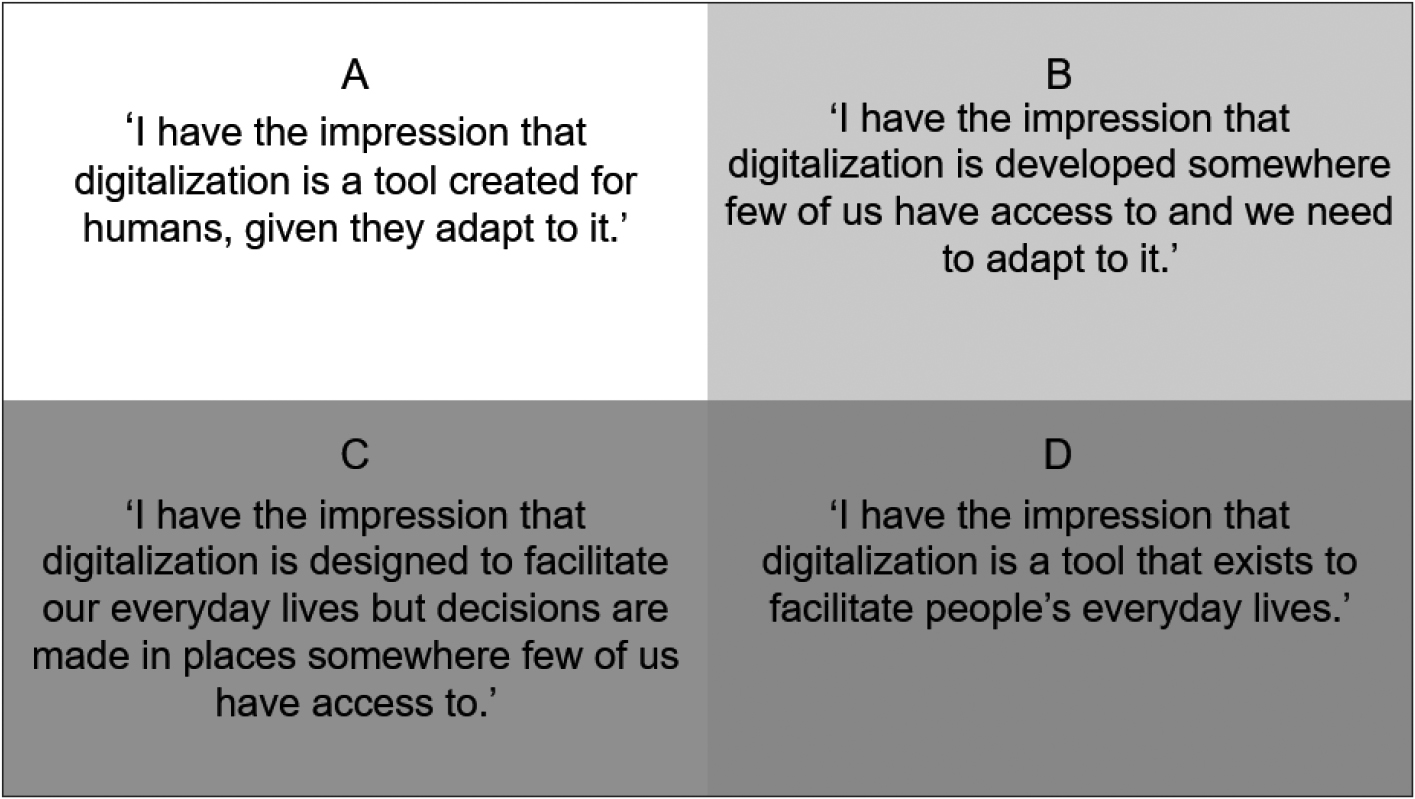
However, after nine interviews, halfway through the process, the statements were slightly adjusted, as a majority of the respondents were choosing (and rejecting) the same options – not because this option reflected their views of technology, but because the statements were formulated in a way that asked them to make quite strong judgements. As a result, the formulations were changed slightly from, ‘We must adapt to the digital society …’, to, ‘We adapt to the digital society …’. Despite this slight change in formulation, the results remained the same after nine interviews. The two most common answers were positions B and D, which had not been changed halfway through the study; hence, these changes did not affect the study’s results.
A: Deterministic statement reflecting that technology is a universal tool and cannot be controlled (neutral). B: Statement rooted in substantivism, with technology autonomously developing and the ‘means and ends’ being connected. C: Critical theory statement, where technology is developed with purpose and its development can be controlled by humanity. D: Instrumentalist statement, referring to the human-controlled development of technology, viewed as neutral.
Taken together, the analytical framework is concerned with three elements: (i) how the coordinators describe the nature of digitalization, (ii) the kinds of strategies and guidelines the coordinators employ, and (iii) practical examples of the coordinators’ everyday work.
The coding process was inspired by Ranerup and Henriksen’s (2019) six steps for qualitative analysis, particularly step one, two and six. However, step three to five were not applicable to the same extent since we had our theoretical frameworks predefined and constructed questions based on these. Step one consisted of the first author reading and re-reading the transcripts to identify the different themes and then, in the second step, sorting the material based on the themes. This first part of the analysis took a deductive approach, analysing and coding each question in turn to create a draft of all the results to which the interviews contributed. Deductive analysis is favoured when codes and themes are predefined (Cho & Lee, 2014). In our case, these were the technological frames and views on technology by Feenberg. The analysis was carried out based on similarities between the answers (i.e., several interviewees giving similar answers) – and in some cases, differences between them. These were noted throughout the interview process and then confirmed with the help of the transcripts. By choosing to analyse question by question the different answers varied in length from a few words (with several mentioning a specific EU project) to longer and more elaborate answers.
In the second part of the analysis, the second author had an important role, inspired by Ranerup and Henriksen’s sixth step (2019). Here, the second author was presented with the draft of all the results and performed the re-analysis by connecting each aspect back to its theme. The results of the re-analysis were iterated several times between the two authors, ensuring that the re-analysis was aligned with the interview findings. The outcomes of this second part are reported in the results section below.
In the third and final part of the analysis, the horizontal aspects were highlighted and patterns between the themes and concepts were observed. This was done not only to report in a strict deductive manner in relation to the themes in the analytical framework, but also to shed light on the question of how digitalization as a policy objective travel and is enacted in practice. The third and final part of the analysis is detailed in the final Section, ‘Discussion and conclusion’.
In this Section, the results of the semi-structured interviews are presented in relation to the theoretical framework, beginning with the nature of digitalization (further operationalised by Feenberg’s matrix), followed by the digitalization strategy and an examination of digitalization as everyday use.
The nature of digitalization
The ‘nature of technology’ domain concerned the individuals’ views of digitalization and their understandings of its capabilities (derived from a combination of Feenberg, Orlikowski, and Gash). The key takeaways from the interviews were that, for some coordinators, digitalization was associated with a general understanding of change – as in, a change of processes or a change in society at large – where digitalization makes things easier for the citizen. It also concerned change management, business development, and changing an organisation by – for example – finding new ways of performing tasks.
‘So I think the role of digitalisation coordinator is very much about change. It is also about the view that digitization as an enabler is about being able to spread knowledge about what opportunities there are and it can be anything from sharing documents and working together to actually start looking at data and what you can do with data.’ (Respondent D)
Some of the coordinators described digitalization in terms of the three dimensions of physical artefacts, skills and procedures, and social arrangements; and they referred to a simplified version of the Gidlund pedagogical model, which occurred in their context (e.g., Gidlund & Sundberg, 2021). Some also described digitalization and change as disruptive factors or forces that entailed a change journey and created the need for lifelong learning.
These change statements often came combined with statements about ‘using technology’ (Respondent C) or digital tools, whilst others drew a clear distinction, noting that digitalization was much more than technology and actually referred to a broader concept:
‘… it is more than just technology. It is a change in behaviour in humans or in society, if we are looking at the big picture; but it is much, much more than just technology.’ (Respondent E) ‘Digitization itself is really different types of technologies, but what enables change is when you connect the soft skills around change management, creativity in finding other ways and work. So, if you have a broader definition of digitization, you have both the technology and what you do with it that becomes digital business development.’ (Respondent B)
Explaining how their previous experiences had affected their views of technology and digitalization, their answers differed significantly, as the participants each had different undergraduate training and work experiences. However, most talked about the perspectives granted by their occupations and experiences, saying these had affected their views of which competencies were important for digitalization. The answers given here were very varied, but most agreed that no single competency was required – and only rarely could one person have all the competencies required. Hence, they felt that it was important to create teams of individuals with various competencies. This question elicited a variety of responses, citing competencies such as business development, change management, and technology. However, some coordinators stated that a general understanding of technology6
When talking about taking an interest, the respondents referred to the concept of ‘technology’, rather than ‘digitalization’.
When the respondents were asked to briefly explain what digitalization was, the lengths of their respective answers were highly varied. Some coordinators gave short and clear answers of just a sentence or two, whilst others referenced numerous actors, digital technologies, and concepts. In many cases, the coordinators began their answers with qualifiers such as, ‘For me, digitalization is …’ (Respondent O), or, ‘Digitalization, to me, is …’ (Respondent C & E), indicating that they wanted to highlight the interpretative character of the concept.
When presented with Feenberg’s matrix statements, most respondents chose either statement B or statement D, which represented the substantivism and instrumentalist stances, respectively. Few of the coordinators referred to determinism or critical theory, and some described the determinist statement as rather dark. This is interesting because substantivism and instrumentalism are on opposite sides of the matrix, meaning they share none of the attributes of Feenberg’s questions.
The answers to the Feenberg-inspired questions, along with the responses to the statements, revealed that the respondents were somewhat split as to whether technology was neutral or value-laden (in line with the first question inspired by Feenberg). However, the important finding was not necessarily the responses they chose, but rather what they said after making their choices. For example, one coordinator said, ‘From my perspective, I think it is neutral, but seen from the user perspective, I think that it is probably value-laden’ (Respondent D). Another respondent stated, ‘It is value-laden. It should not be, but it is’ (Respondent F). Furthermore, the latter point was actually made by several of the respondents, who stated that technology was neutral but people viewed it as value-laden or that values were inserted along the lifecycle of the technology. Hence, technology was deemed neutral by some of the coordinators and value-laden by others. In response to the second question inspired by Feenberg, the respondents made comments such as, ‘Both’, or, ‘We can control it to a certain extent’. Few choose one of the two statements that indicated we could control it in short-term but not the long-term. Many coordinators gave the example of artificial intelligence, stating that this type of technology would be difficult to control in the future.
The role of the digitalization coordinators was explained as strategic, intended to promote and coordinate digitalization efforts with a regional growth perspective. There was some variation in how the respondents described their roles, as well as how the roles were structured within the regional council. Although the initiative is centrally controlled by the Swedish Agency for Economic and Regional Growth, the coordinators had been given only vague descriptions of their roles in relation to their own organisations. The role is focused on the digital readjustment of society and working towards sustainable regional growth, but the coordinators stated that the role itself was not connected to a project or sector and did not have an IT focus.
One consequence of this vague description was that the regions themselves had had to define the roles, which meant that each coordinator had a slightly different job description. These differed in their respective focuses on the public and private sectors, with some working towards both and others having a stronger focus on one or the other. The coordinators were also positioned within different sections and offices in the regional councils, which then reflected on their work. This was highlighted by several respondents. In some cases, the region had placed the coordinator in a specific office or department that they considered appropriate and, in this way, had defined the sector in which the coordinator was intended to be working. This variety was explained by one coordinator as follows:
‘… and it has shaped how I interpret regional development when it comes to digitization, the concept itself is difficult to define and also characterises the function itself because it is interpreted differently in the region.’ (Respondent J)
On the problem with both regional development and digitalization being loosely defined, which had resulted in each region and its coordinators reached their own interpretations.
As noted above, the role has a strategic perspective; and several of the coordinators explained that their own roles depended on how their regions’ digitalization strategies or policies had been formulated. In short, each coordinator worked towards the goals and challenges highlighted within that document. In some cases, the coordinator had responsibility for the digitalization strategy, document, or policy and part of their job was to construct it and ensure that all the departments and actors within the regional council were included within it. Other coordinators explained that a normal workday (covered in detail in the following section) contained much strategic work. They said that they worked with different IT and digitalization strategists, and some had built networks with them. They emphasised the importance of their coordination work, bringing together various actors who could help one another.
Digitalization in everyday doing/use
The coordinators reported that their everyday work consisted primarily of meetings (internally, within the regional council and the municipality and with external actors); writing strategies and action plans; monitoring their environment; and keeping up-to-date with new technologies, initiatives, and possibilities. It was difficult to describe a normal workday, but the work processes were explained by several participants. They described working in different networks to connect people and organisations who could collaborate to find new solutions and apply for project funding, operating as catalysts or enablers in the region.
‘… I try to work through my colleagues who run the networks … otherwise it is completely impossible for me to work and try to educate everyone on [the topic of] digitization.’ (Respondent E)
The coordinators themselves put in substantial time at the beginning of these collaborations; and when the actors began working independently, the coordinators took a more passive role.
‘… so what I work with now is to set the direction and then you find partners and then you try to engage them in trying to get a [regional/municipal] mission so that they can do something.’ (Respondent B)
Most of the coordinators much appreciated their network. They reported finding them very useful and said that they met up as a group a handful of times each year, coordinated by the Swedish Agency for Economic and Regional Growth. More importantly, they had created smaller sub-networks within the larger one. These networks were geographically bound, so the southern regions worked closely together and those in the centre worked together. These smaller networks met as often as every week. This provided an opportunity to obtain updates on their neighbouring regions, share experiences with each other, and tackle problems as they arose.
The topic of broadband and the Swedish broadband coordinators came up in several interviews. Some of the interviewees had previously worked with the broadband coordinator community, and some had even been – or were, at the time of the interviews – broadband coordinators themselves. One coordinator explained the relationship between regional development and broadband as follows:
‘And there we had a very clear picture of how the broadband issue connected into regional development in a very natural way and it has proven to work very well.’ (Respondent J)
The provision of broadband, in simple terms, involves digging into the ground to lay cables that provide internet access. This is a known concept, and some coordinators mentioned that this type of clear definition and concept was missing for digitalization. This meant that the topic of digitalization was often bounced around between offices and usually ended up in the IT department. This emphasises the importance of the coordinator’s view of the nature of technology and how the concept of digitalization is translated and interpreted, both in the regional council and by the coordinators themselves.
Discussion and conclusion
The aim of this study was to uncover the enactment by a specific set of actors of digitalization as production and reproduction practices. By looking more deeply into a governmentally sanctioned daily practice. By examining how the digitalization coordinators viewed the idea of digitalization and understood their everyday professional practice and what was expected of them, we sought to explore the doing of digitalization in the public sector in a more practical manner.
For this purpose, we used an analytical framework comprising three themes: nature, strategy, and use (a combination of Orlikowski & Gash, 1994; Feenberg, 1999). The first theme referred to the respondents’ views of the ‘nature’ of digitalization and what they expected it to contribute. The second theme (‘strategy’) concerned how they thought it should be made and why; and the third theme (‘use’) referred to how they actually used it in their daily professional practice.
The results for the ‘nature’ dimension show that the key actors shared a view of digitalization as an ambition that had been assigned weight before meaning, shedding some light on how the ‘unrealistic expectations’ travelled in combination with the ‘limited scope’ – or what Wade and Shan describe as ‘digital for the sake of digital’ (Wade & Shan, 2020). The coordinators were expected to drive development and change but were given little definition of the development or told why the organisation needed to change. Some described it as if digitalization were coupled with importance before being given any definition or put into context. In that respect, digitalization was enacted as change, development, and transformation (used interchangeably), but there was little guidance on what this change, development, or transformation was from or to. Some respondents drew comparisons with broadband coordinators, as another group of regional actors, and noted that this group had a much more clearly defined practice that was commonly agreed upon. Digitalization was linked to new ways and disruptive change, and the coordinators often began their responses by stating, ‘It is not a clearly defined concept, but for me, it is …’, or, ‘From my perspective, I think it is …’
To further capture the nature of digitalization, questions were asked about the kind of knowledge and professional training needed when working in the field, and the answers varied greatly. However, the participants agreed that no single individual could have all the required competencies, and they stressed the importance of creating skilled teams. The competencies mentioned included business development and change management – and, to some degree, technological skills or at least an interest in technology (though one coordinator said that technological competence could obstruct a focus on change and development). The coordinators highlighted what Wade and Shan describe as ‘poor governance’ and the ‘underestimation of cultural barriers’ (Wade & Shan, 2020). They stressed that digitalization could not be captured by IT-related expertise alone; rather, a multitude of competencies were needed. For digitalization to be successfully governed, multiple managers with diverse portfolios are vital.
When asked about strategy, the respondents said that they were often left alone to develop their own ideas of digitalization (or transformation and change, as mentioned above). Their role descriptions were vague, and their jobs involved constructing ideas of digitalization and determining how their role as regional coordinator would contribute. Whilst the Swedish Agency for Economic and Regional Growth is the national coordinating organisation – thus, the initiative is centrally controlled – most of the coordinators noted this vagueness, and some explained it with the observation that ‘digitalization’ itself was a rather vague concept. This vagueness again touches upon Wade and Shan’s four factors, namely ‘unrealistic expectations’ (Wade & Shan, 2002). The digitalization coordinators had been given the task of promoting and coordinating digitalization in their region, but the lack of a job description had given the impression that the goal was simply to do it (digitalization), – and to do it quickly – even whilst the roles, responsibilities, and stakeholders were unclear. As such unrealistic expectations is not only that digitalization would create infinite value per se but also that this would happen without any deeper knowledge of how it was to come about.
Finally, regarding the daily professional doing and use of digitalization, the coordinators described their roles as networkers, matchmakers, catalysts, and enablers. They said that large parts of their everyday professional practice were devoted to keeping up-to-date with new technologies, as well as creating or finding ways into spaces in which transformation, change, and new ways of doing things were the focus. The ideas of digitalization in practice tended to bounce between offices, making the coordinators the central interpreters of how digitalization should be translated in the region. This could be seen as a positive initial phase, in which the coordinators were given the role of matchmaker for the different stakeholders, if they were to succeed. Of course, this would depend on how the following phases were constructed and whether there were mechanisms and processes in place to collect and use those experiences and lessons learned.
In conclusion, digitalization as an abstract representation surfaces as transformation, and the contextualisation of digitalization as a local practice in the specific contexts is a change agent. The making of digitalization can thus be compared to ‘nailing jelly to a wall’, with few descriptions of its capabilities and functionalities and a raison d’etre that is highly elusive (beyond ‘change’, in very general terms). In line with Wilson and Mergel (2022) in their study of digital champions, and Gidlund and Sundberg (2021) in their study of makers of digitalization, we therefore argue that the study of how different actors navigate their contexts and pursue their ideas of digitalization is a valuable method for unveiling critical aspects of its realisation.
The roles of the key actors in the making of digitalization – as sanctioned by national and regional governmental agencies – unfolds as a hard work of enacting (understanding, translating, and mediating) a policy objective (to digitalise), whilst attempting to capture ‘the why’ (the kind of value digitalization should be given) and the ‘with whom’ (matchmaking of stakeholders).
In many ways the result of this study pin points one important aspect among many in order for the idea of digitalization to transform into practical undertakings: we need to be more aware of the way digitalization is reproduced as a policy imperative.
Footnotes
Authors biographies
Marcus Heidlund is a PhD student in information systems at Mid Sweden University in Sundsvall. He is part of the Forum for Digitalization research group and his research interest include values, translations and evaluation of digitalization in the public sector. The research is conducted with the e-Government domain, with a focus on the Swedish public sector.
Katarina L. Gidlund is a Professor in informatics and research leader for the Forum for Digitalization (FODI) at Mid Sweden University, working with critical studies of digitalization and societal change. Katarina holds various positions nationally and internationally, e.g. as member of scientific councils of The Swedish International Development Cooperation Agency and the Swedish Agency for Accessible Media, and in the World Bank’s newly launched Global Influencer Panel.