



Abstract
The increasing diffusion of digital government has led to numerous reports on both significant progress and failure in terms of digital transformation. Previous research highlights the role of digital competence as a pre-requisite for successful digital transformation, yet few studies have addressed the actual state of digital competence demand in the public sector. We study the development of digital competence demand in the Swedish public sector for the period 2006–2020. Utilizing a complete, open dataset of all job postings, we find that the digital competence demand in public sector recruitment has significantly increased. At the same time, the public sector lags behind the private in terms of digital competence demand. These findings are discussed from the perspectives of both the need for further research into human resource-related aspects of digital government and the national digital government policy. We also discuss the potential impact of disruptive events such as the COVID-19 pandemic and the 2009 financial crisis on digital competence demand.
Keywords
Introduction
Over the past decades the public sector has made substantial investments in digital government (Cordella & Tempini, 2015; Gil-Garcia & Flores-Zúñiga, 2020; Janowski, 2015) to cope with demographic shifts, migration, economic shocks, and, more recently, the global COVID 19 pandemic (Ågerfalk et al., 2020; Meijer et al., 2020). Together, such investments create new material, organizational, and environmental conditions that, in turn, build up pressure for digital transformation (Hanelt et al., 2021; Mergel et al., 2019). As public organizations take on digital transformation, they must be prepared to reconsider organizational tenets, such as infrastructure (Wimelius et al., 2021), leadership and culture (Mergel et al., 2019). However, since digital transformation is highly situated, there are few templates to follow. Contemporary research suggests digital competence – the ability to apply digital technologies in a particular context (Cahen & Borini, 2020) – plays an important role as organizations seek to shape adequate, tailored, and practically feasible paths for digital transformation (Eden et al., 2019; Mergel et al., 2019).
To avoid that digital competence materializes at the expense of situated competence (Vieru et al., 2015) public organizations must actively seek to bridge potential gaps between existing and emerging, digitally mediated practices (Frennert, 2019). Hence digital transformation entails workforce transformation (Eden et al., 2019), as digital competence extends broadly across organizations (Magnusson et al., 2020; West, 2005). Put differently, it becomes a matter for the many rather than for the few.
In this research, we investigate digital competence in the public sector, with the objective of contributing to the study of digital transformation. More specifically, we evaluate the growth in demand for digital competence in the public sector, explore differences within the public sector, and compare it with the private sector. The rationale for comparing the development in public- and private sectors lies in contextualization, i.e., placing the observation of the public sector in relation to other elements of the field while avoiding the normative comparison (i.e. to a “standard” or a norm). Identifying de facto digital competence in an organization is a resource-intensive task, calling for qualitative methods. Tracking down digital competence in a meta-analysis of an entire industry is overwhelming. Therefore, we use articulations of demand for digital competence as a proxy for the desired level of digital competence. The overall question guiding our research is: How has the demand for digital competence developed within the public sector?
To investigate the demand for digital competence we rely on a dataset of 7.1 million job postings issued between 2006 and 2020. The dataset is complete in that public organizations in Sweden are bound by law to publish job postings through the Swedish Public Employment Service. In line with Mankevich and Svahn (2021), we apply natural language processing (NLP) to assess and surface the pattern (Miranda et al., 2022) of the intensity of digital competence demand. We do that by comparing job post descriptions with DigComp, the European Digital Competence Framework, developed by the European Commission in 2010 and regularly maintained since then (Vuorikari et al., 2016).
In what follows, we briefly introduce the literature on digital government and research on digital competence in digital government. We then account for the method employed in the study and present our analysis of digital competence demand in the public sector. Finally, we relate our findings to previous studies and discuss the implications of our research for research, practice, and policy.
Background
Digital government, here understood as a strategy for public sector digital transformation, is portrayed in the literature as the natural successor to e-government (Gil-Garcia & Flores-Zúñiga, 2020; Janowski, 2015). Whereas e-government addresses the emerging use of digital solutions to support government operations, digital government addresses issues of how government as such is transformed through digitalization (Bannister & Connolly, 2020; Gong et al., 2020; Mergel et al., 2019). In seeing technology not as an external force acting on operations but rather as forming an assemblage of digital and physical artifacts, actors, and processes (Orlikowski, 2009; Vial, 2019), digital solutions become methods for developing operations and meeting new needs from citizens in, at times, a novel manner. Digital government research has evolved into a rich and diverse field, providing insights into how digitalization has improved the transactional relationship with the citizens (Johnson et al., 2020), an eminent digital sclerosis (Andersen et al., 2020), how twitter analytics can predict elections (Singh et al., 2020), and architectural flexibility (Gong et al., 2020) – a few recent examples with diverse methodological and theoretical entry-points.
Digital competence is highlighted as a necessary pre-requisite for successful digital transformation by several researchers within both the field of digital government and in general (Andriole, 2018; Butschan et al., 2019; Eden et al., 2019; Hofmann & Ogonek, 2018; Khitskov et al., 2017; Mergel et al., 2019; Osmundsen). Yet, still, too often digital competence is considered to be governed by an IT department, the approach that creates barriers to innovation in the public sector (Magnusson et al., 2020). Instead, the increasing spread of digital infrastructures and emergence of digital platforms requires governance decentralization, i.e. digital competence and decision-making needs to be distributed across organizational units (Tiwana & Konsynski, 2009). For example, some of the greatest gains from data analysis are expected by self-service analytics performed by line-of-business professionals (Dinsmore, 2016).
Past research in the public sector highlighted digital competence leveraged by specific groups of public sector professionals. For example, the study of European parliamentarians investigated digital competence as an individual trait, albeit indicative of the larger societal context (Elvebakk, 2004). Another study in the public sector demonstrated how the meaning of digitalization and competence is shaped by the thought leaders, those who establish norms and are surprisingly homogeneous in their approaches to digitalization (Gidlund & Sundberg, 2021). Finally, recent research indicated that the narratives in the public sector while may draw on digital competences as innovative and promoting change, largely reflect the status quo of the role and position of the management in digitalization (Nyhlén & Gidlund, 2021). These trends might illustrate the reaction to higher vulnerability experienced by public sector organizations engaged in digital transformation (Snijkers, 2004), struggling to respond to crises (Janssen & van der Voort, 2020; Meijer et al., 2020) and adjust their workforce (Knudsen & Lien, 2015). An important insight is that organizations must engage across units like HR (Agarwal & Ferratt, 2001) and continue to build upon deliberate efforts by Chief Digital Officers (Giebe, 2019) to leverage digital competences.
We adhere to Vieru et al. (2015) definition of digital competence as the knowledge, skills, and attitudes for using digital solutions to investigate and solve problems and to develop new knowledge. Digital competence does not only refer to the ability to develop technological solutions, it is to a large extent related to the work with organizational processes and transformation while maintaining core value of the public organization – the element of digital competence is sadly lacking in the public sector (Frennert, 2019). With an increased influx of digital solutions in the operations of public sector organizations, often in direct response to an increased demand for digital services by citizens (Janowski, 2015), the need for digital competence has increased (Lindgren et al., 2019). With the increase in demand, the tendency often has been to discuss digital competences either as narrow capabilities to operate tools, such as java programming, or abstract high-level areas such as cybersecurity. Few studies integrate both of these approaches, investigating digital competences and their demand by including current digital tools while honoring conceptual and organizational capabilities (Ala-Mutka, 2011). As seen in Mergel et al. (2019), digital competence has so far been under-researched within digital government studies and more research on this topic is needed.
Method
To answer the posed researched question, we have leveraged Natural Language Processing (NLP) – an interdisciplinary field of studies that provides techniques to computationally analyze and understand natural text. NLP is growing in importance for management scholars (Kang et al., 2020), as the availability of large data volumes calls for new methodological approaches (George et al., 2016). Public sector researchers addressed this opportunity, for example computationally analyzing citizens’ input (Ingrams, 2020) and investigating how social media narratives are shaped by public policies (Yaqub et al., 2021).
One of the advantages of applying NLP is that it gives the possibility to conduct a macroanalysis over the entire dataset without resorting to sampling (Jockers, 2013). Combined with longitudinal data, researchers have a unique opportunity to see how phenomena develop over time and inductively understand the unfolding dynamics (Hannigan et al., 2019). One of the challenges of using NLP is its sensitivity to data structure and input analysis parameters. Below we present the research context in which data was generated and collected, a detailed description of data and data processing procedures, and finally the analysis choices made in the study.
Research context
We selected the case of Sweden for our study. We analyzed a complete dataset of all job postings from the Swedish Public Employment Service between 2006 and 2020 (Arbetsförmedlingen, 2020). Sweden is ranked as one of the most digitally mature countries in the world (Russo, 2020). However, in a recent study by the OECD (2020), Sweden scored surprisingly low in terms of openness, transparency, etc., with regard to digital government. One interpretation of these scores is that Sweden has been an early adopter of digital technologies for the government but has not made ample changes in the manner in which these technologies are used to transform the government. As noted by the Agency for Digital Government in response to the recent OECD study, this signals that Sweden needs to understand the new demands being placed on the government through digital transformation (OECD, 2020). In other words, both policy-makers and organizational leaders should be compelled to increase their insight into the current state of digital competence in public sector organizations.
The Swedish government has three administrative levels: national, regional, and local.1
The Swedish model of government administration, Government offices of Sweden. (2015). www.government.se/how-sweden-is-governed/the-swedish-model-of-government-administration/.
Public sector expenditure, SCB (2014). www.scb.se/en/finding-statistics/statistics-by-subject-area/public-finances/general-statistics/statistical-yearbook-public-finances-in-sweden/pong/tables-and-graphs/public-sector-expenditure-in-relation-to-gdp/.
Gainfully employed by region and sector, SCB. (2019). www.scb.se/en/finding-statistics/statistics-by-subject-area/labour-market/employment-and-working-hours/labour-statistics-based-on-administrative-sources/pong/tables-and-graphs/gainfully-employed-by-region-and-sector-2019/.
We relied on a dataset comprising 7.1 million job postings that span 15 years. Even though Swedish Public Employment Service operated since 1997, data before 2006 was not available for analysis (it was not archived by the service). The data was retrieved as an archive JSON file from Swedish Public Employment Service. We analyzed a subset of 1.4 million job postings created by public sector organizations. All job postings were analyzed on the aggregate, but also across varying levels of the public sector: municipalities, regions, and agencies. Three levels of the public sector differ in volume of recruitment, proximity to the large metropolitan areas, budgets, and governance structures – to name a few factors that may potentially impact demand for digital competence.
Data overview
Data overview
Data subset used for the analysis.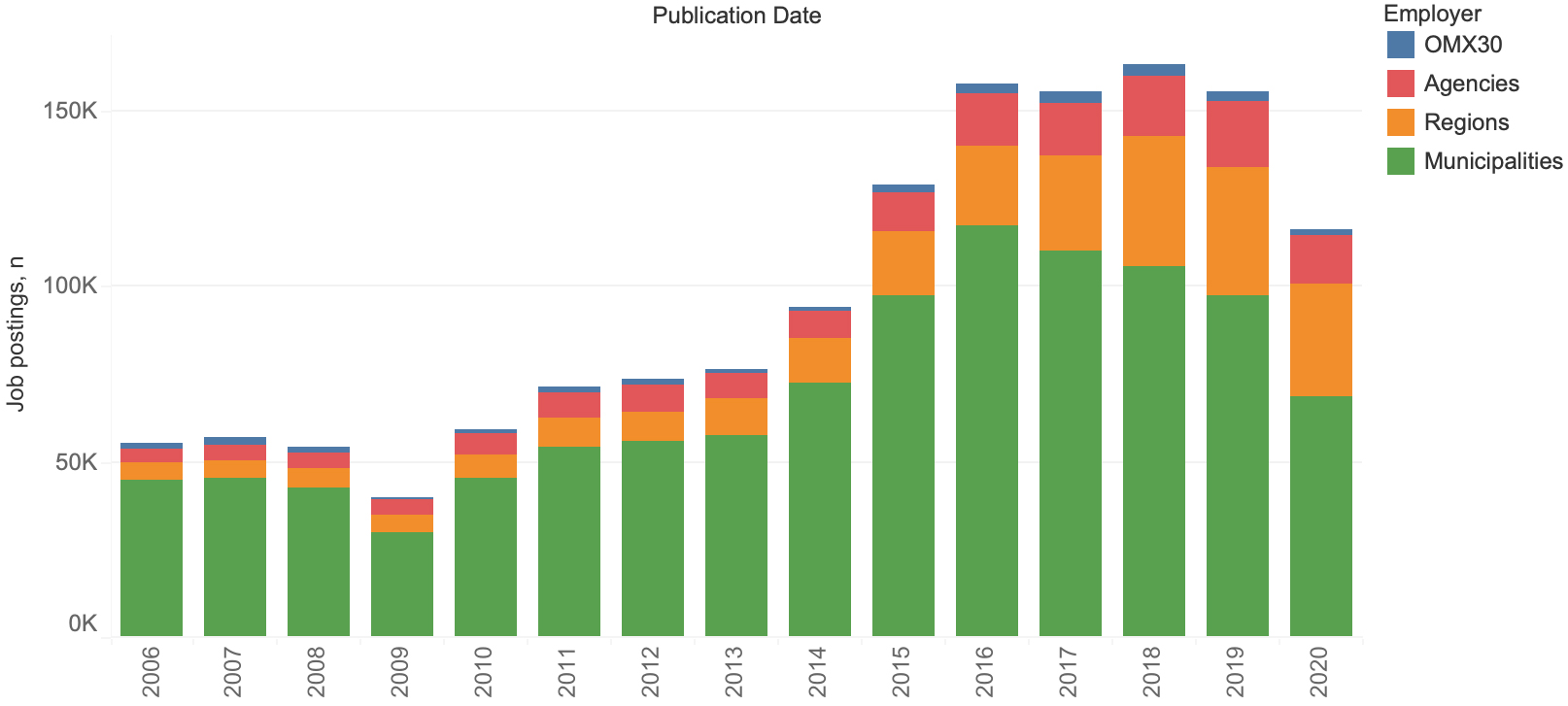
Public sector competence landscape is not developing in isolation, there is an established link to the private sector employment (Behar & Mok, 2019) as well as wages (Lamo et al., 2013). The private sector employs the majority of workforce, and often is a source of public sector recruitment (Kankaanranta et al., 2007). In particular, the technical competence gap in the public sector is closed with private sector services and employees (Christensen, 2005). As public sector recruitment and competences are consistently compared with private (e.g. DeSantis & Durst, 1996; Hofmann & Ogonek, 2018), we have included in the analysis a subset of the private sector job postings to highlight the broader context of competence demand. We have included in the analysis 28,000 job postings created by the 30 most traded companies in the Nasdaq OMX Stockholm 30 (OMXS30) market index.4
Nasdaq OMX Stockholm 30 http://www.nasdaqomxnordic.com/index/index_info?Instrument=SE0000337842.
The dataset did not include a unique identifier for organizations, so we relied on the free text description of the employers. To identify the three levels of government, we used lists of the unique names of the agencies, regional administrations, and municipalities. To identify OMXS30 companies, we relied on manual processing for specific unique company names. See Table 2 for the summary of the inclusion criteria. In Fig. 1, we present the counts of jobs posted over time.
Inclusion criteria
In the analysis, we used job postings and articulations of digital intensity demand for digital competence as a proxy for the level of digital competence. To this end, we relied on the European Skills, Competences, Qualifications, and Occupations (ESCO) framework developed by the European Commission in 2010 and regularly maintained since then. The framework contains a dictionary “describing, identifying, and classifying professional occupations, skills, and qualifications relevant for the EU labor market and education and training.” For analyzing digital intensity, we draw from a DigComp reference vocabulary in ESCO. This vocabulary comprises five digital competence areas, each containing a detailed description and more specific competences. See the description of competence areas in Table 3. Together, all the descriptions of the digital competences provided us with the reference text, and by computing the text similarity between the reference text and the job postings description text, we obtained the digital intensity measure.
Digital Competence framework
Digital Competence framework
There are certain limitations in using DigComp ESCO. Namely, it is a vocabulary that delineates terminology, but with a time lag it takes researchers to survey professionals and institutions and integrate it into the updated framework version. Digital technology is developing at a high pace, which means that the use of ESCO with some terms missing probably plays down the demand for digital competence. Another concern is the use of language translations. It is also not clear to which parts of ESCO are drawn from which local context (since ESCO like all other EU documents is composed of versions for each country’s language). This means that some of the local lingo of Swedish digital professionals is missing from the analysis.
We processed the job postings description text and computed the similarity between individual job postings and the reference digital competence text in several steps. First, the job postings descriptions were cleaned from punctuation, digits, and the most common words in Swedish (e.g., articles and pronouns). We used a widely applied NLP technique of term frequency-inverse document frequency (TF–IDF) (Beel et al., 2016) for representing each job posting with a series of scores (features) for the words used in the description. Scores were weighted to account for the varying lengths of the job descriptions and varied popularity of the terms. Next, we used the TF–IDF scores to compute text similarity using the cosine distance between the job postings feature sets and the composite dictionary derived from the ESCO framework. Cosine similarity between two documents is measured as the angle between their vectors that measure term frequency in the number of dimensions that correspond with the number of terms used for comparison. It is recognized as a robust approach for text classification and clustering (Huang, 2008) and is widely used in NLP practice and information systems research (Li et al., 2021). Using the cosine distance between each job posting and the composite ESCO dictionary, we operationalized the digital intensity of the job postings. In other words, it allowed us to develop a measure of comparative similarity of job postings to a dictionary of digital competences. A higher score indicates a higher similarity to the description of digital competences. We define this measure as digital intensity since it describes a measurable presence of terms indicating its similarity to descriptions of digital competences. Further, we rely on a common approach of relating the presence of skill competence description in job ads as a signal for competence demand (e.g. Rios et al., 2020; Verma et al., 2019; Zheng et al., 2020). The demand itself can be interpreted in several ways. It might be seen as a proxy for a digital competence presence in the public sector, or a signal for the lack of competence. There are several considerations here, one of which is that the recruitment of new competences represents only a part of the all workforce movement. Up to 60% of vacancies target existing positions where people quit (Mercan & Schoefer, 2020) hence signaling the presence of competences in an organization. Given the relative stability of government institutions, the percentage of replacement employment in the public sector is likely even higher. Further, the articulation of competence in recruitment means a degree of awareness of organizational needs that is consistent with at least partial prior competence. It is a strong signal for change, after all the transformation of human resources is critical for the digital transformation (Eden et al., 2019). As we set to contribute to digital transformation discourse, the focus is on change – which we did with longitudinal data spanning 15 years of public sector recruitment.
Finally, we searched for breakpoints in the average digital intensity throughout the investigation period. Breakpoint analysis (also known as a Chow test) allows for finding such breakpoints by assessing time-series data against structural changes (Bai, 1994; Zeileis et al., 2003). We used the dynamic programming algorithm (Bai & Perron, 2003) over the monthly averages of digital intensity for organizations on each of the three levels of government.
We present the results in three sections. First through an intra-sector analysis of the digital competence intensity in the public sector and second through a cross-sector comparison of the development of digital competence demand in both the three levels of the public sector (Agency, Region, and Municipality) and the public vs. private sectors. We conclude the analysis with the section on the impact of the COVID-19 pandemic.
Distribution of job posting digital intensity, selected years.
Between 2006 and 2020, we observed an increase in the demand for digital competence among public sector employers. The average digital intensity in job postings increased from 0.028 to 0.061. As seen in Fig. 2, the development of intensity for the period resembles a wave of digital competence entering the public sector.5
Since digital intensity is a continuous variable, probability of a variable to fall within a range is an integral of probability density function over that range.
Comparison of select jobs
Table 4 presents a comparison between two job postings created in the years 2006 and 2020. The job ads were selected according to their digital intensity score: each is as close to the mean of the respective year. This selection gives a general feeling of what was average recruitment like in the public sector in relation to digital competences. Also, the two examples allow comparing how the changes in text manifest in the changes in the digital intensity score. As the examples illustrate, the job posting with an average score of 0.03 (mean score for 2006) barely mentions digital competences. The above-zero score is attributed to mentions of complementary skills often associated with digital competences, such as project management and engineering. The job posting with a mean score of 0.06 characteristic for the year 2020 contains explicit digital terms, such as various business IT systems, computers, and software development.
The trend of increasing demand for digital competence could also be observed at the level of specific occupations. For example, the top five positions in terms of demand – preschool teacher, assistant nurse, nurse, social worker, and youth worker – all showed a steady increase in demand for digital competence (Fig. 3). See Appendix for the illustration of how Digital intensity unevenly increased among various professional areas and across government levels.
Digital intensity among the top five professions.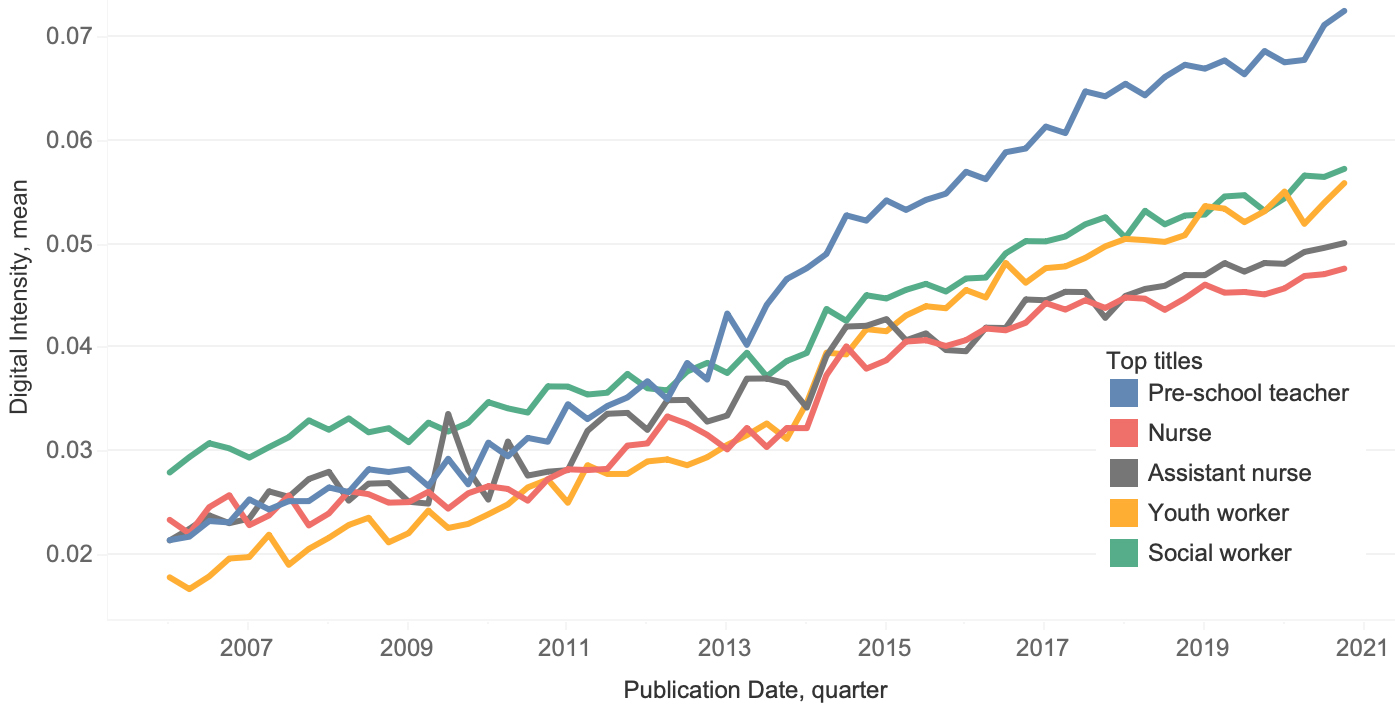
Structural breakpoints in digital intensity in agencies, regions, and municipalities.
We identified a number of structural breakpoints in recruitment trends in all three levels of government (Fig. 4). The dashed vertical lines in Fig. 4 show the structural breakpoints: the points of significant change in linear regressions. Trends were calculated from monthly averages of digital intensity. The red whiskers at the bottom of the dashed lines show the area of 95% confidence interval of where the estimated breakpoint occurred. We report three main findings of the breakpoint analysis: 1) multiple structural breaks on all three levels of government, 2) changes in digital intensity during the economic recession of 2008–2009, and 3) a turning point in digital intensity that occurred in the beginning of 2014.
The first finding indicates that the growth of the demand for digital competence was not consistent nor in sync between the three levels of the public sector. A number of breaks occurred throughout the investigation period and in some cases impacting one, but not other levels of the public sector. See appendix for the geographical breakdown of the municipalities and regions by their average digital intensity. The second finding demonstrates that the crisis of 2008–2009 impacted the demand for digital competence on all three levels of the public sector. There has been a break in the upwards trend, resulting in a decrease (or leveling) of the demand. Agencies and regions experienced a period of turbulence, while the municipalities’ overall trajectory persisted after a brief pause. Lastly, the demand for digital competence has been on an upward trajectory since 2014 without significant breaks (with an exception of Regions and a 2017 break).
Top and bottom scoring posting in terms of digital intensity relative to election cycles (gray lines denote the forming of a new government).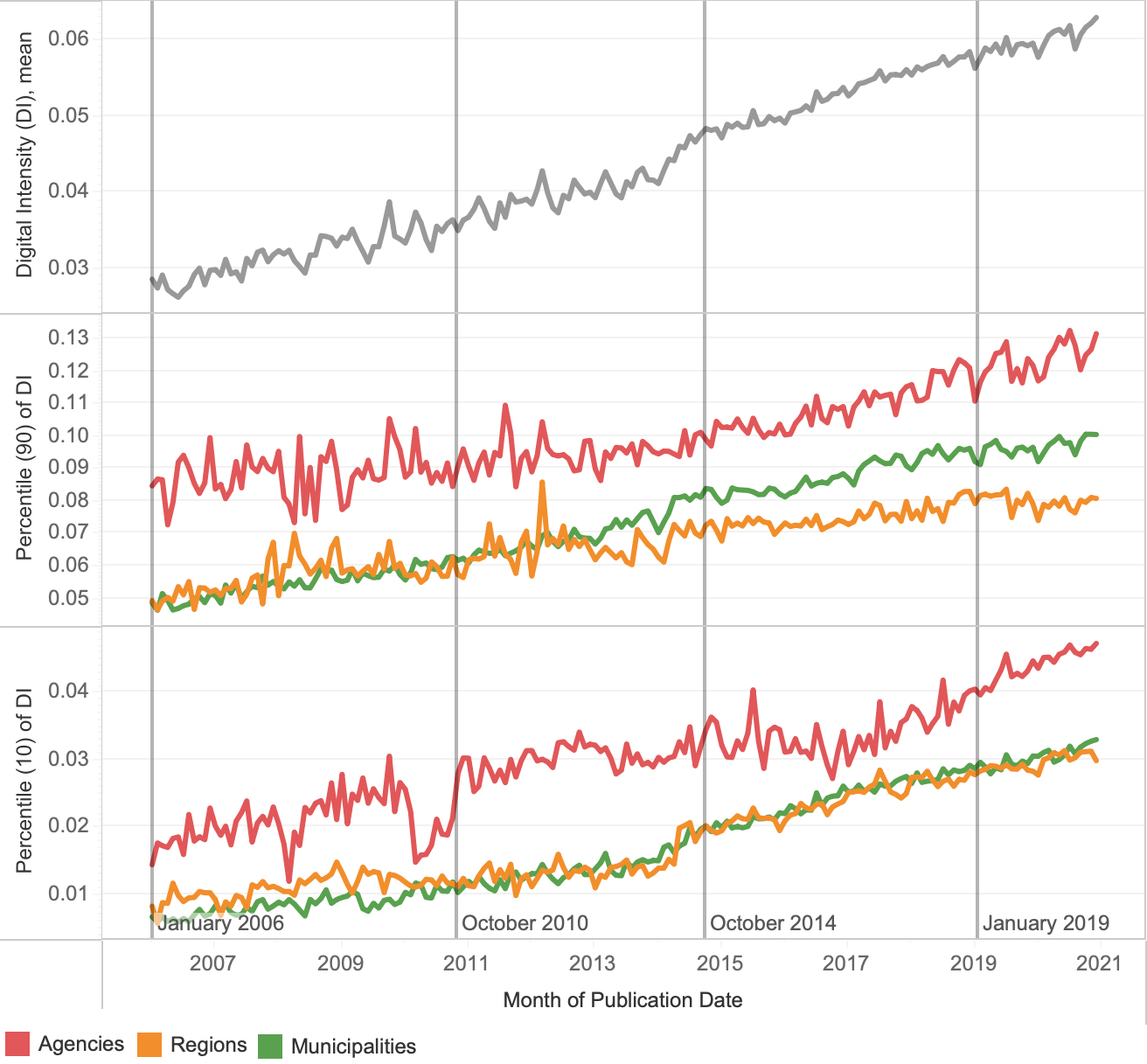
In probing for potential explanations for the breakpoints not associated with the financial crisis of 2008–2009, we explored the electoral cycle and its influence on public sector recruitment and digital intensity. Past research indicates that public sector employment increases in election years (Dahlberg & Mörk, 2011), and political ideology influences investment in information technology (Pang, 2017). Figure 5 visualizes digital intensity of recruitment and marks the forming of new Swedish governments (either on the day of the election or on the day coalition was formed). This preliminary visualization is inconclusive. There does not seem to be a dramatic shift of digital competence demand around elections. However, there is clearly at least one instance (2019) when during the election period the recruitment for highly competent digital positions decreased. The results of the preliminary analysis of the effects of the electoral cycle on digital intensity call for further, in-depth investigation.
We observed how demand for digital competence developed among the three different levels of the public sector organizations. Three levels of the public sector differ in volume of recruitment (municipalities
In the cross-sector comparison, agencies displayed the highest average digital intensity. However, the relative increase in digital intensity between 2006 and 2020 of municipalities (134% increase, from the mean of 0.026 in 2006 to 0.061 in 2020) surpassed that of agencies (71% increase, from 0.048 to 0.082), regions (74% increase, from 0.03 to 0.052), and OMXS30 companies (77% increase, from 0.044 to 0.077). See the comparison in Fig. 6 for a detailed view broken down by year, quarter, and month.
Average digital intensity by year, quarter, and month.
In comparison between the selected public sector organizations and the private sector companies, on average, the digital intensity among the OMXS30 companies increased through the years, but we observed a decline in digital intensity in postings published in Swedish during the financial crisis and after 2014.6
In the last five years, of the number of job postings among OMX30 published in English has increased. These postings were not analyzed in this study.
The levels of demand varied among the OMXS30 companies. Telia (telecom), Nordea (bank), and Essity (hygiene) showed the highest average demand for digital competence across all years. Tele2 (telecom), Hexagon (consulting), and Handelsbanken (bank) had the lowest. Swedbank (bank) showed the highest increase in digital intensity between 2006 and 2020. Under the assumption that the current trend identified in the development of digital competence demand is exponential, the two sectors would converge in terms of digital competence demand around the year 2023. Under the assumption of linear development, convergence would occur by the year 2030. There are however difficulties in forecasting the trend since the development of digital competence demand over the past 15 years was neither linear nor consistent, as seen in the structural breakpoint analysis (Fig. 4).
The year 2020 was a difficult year in every regard. How did the COVID-19 pandemic affect recruitment and demand for digital competence? We processed all job postings from the year 2020; therefore, besides public sector jobs and Swedish leading OMXS30 companies, we probed into all available data for 2020 (in total, 467,292 jobs posted). See Fig. 7 for results.
Jobs posted and digital intensity during the pandemic year.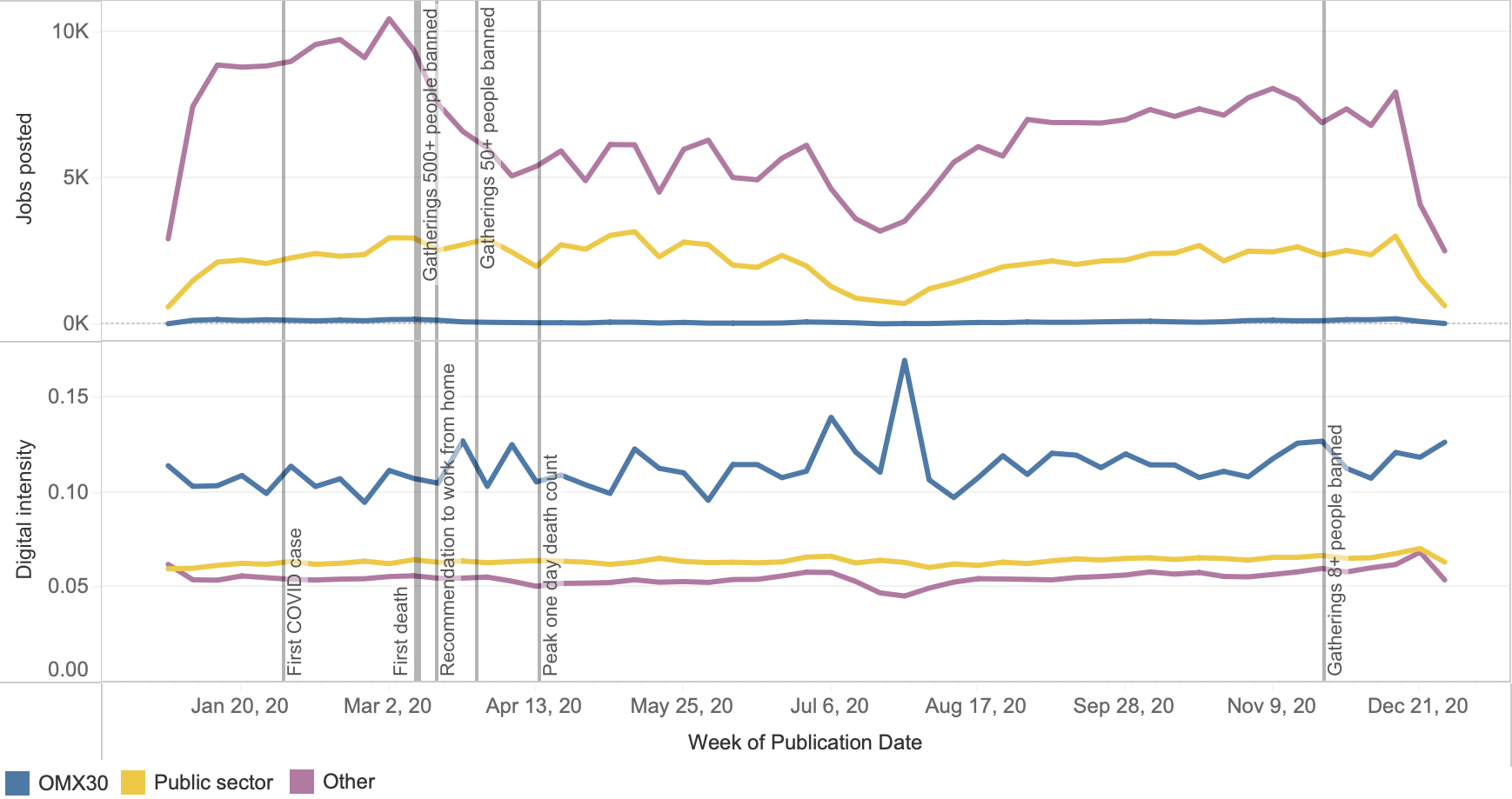
Our first finding is based on the total number of jobs posted during the pandemic. We observed a dramatic decrease in the overall number of job postings, especially by non-public sector employers (designated as “others”). This decrease occurred in March, 2020, when the government implemented the first measures to control the pandemic. On March 10, 2020, an official warning to the risk groups and elderly was published. On March 11, 2020, all gatherings of more than 500 people were banned. On March 16, 2020, employees were recommended to work from home, and the elderly were recommended to isolate themselves. On March 27, 2020, gatherings of more than 50 people were restricted. On April 14, 2020, Sweden reached a peak in its death count, with 115 deaths in 1 day. Among these dramatic challenges in society, we did not observe a notable decrease in public sector recruitment.
Our computational analysis did not show a significant change in digital intensity during the pandemic, except perhaps for OMXS30 companies: during low recruitment – that is, the peak of the pandemic and summer months – digital intensity increased. This might be attributable to the strong demand for digital competences among the leading companies that did not subside during the recruitment season. These findings however need to be carefully interpreted because the sample of OMXS30 job postings was rather small (for 2020, 4,690 job postings).
This study answers the calls for research into the development of digital competence demand within the public sector (Hofmann & Ogonek, 2018; Mergel et al., 2019) and aspires to contribute to increased digital transformation success in the public sector. The findings show a punctuated yet steady increase in digital competence demand from the public sector, with clear differences between agencies, regions, and municipalities. Whereas agencies displayed the highest demand for digital competence, municipalities displayed a higher increase in demand during the period. During 2014–2020, the regions’ demand plateaued and is no longer increasing. These findings offer direct input for policymakers and leaders involved in digital transformation. If the divergence between digital competence demand continues between the sectors, this may be an early warning that we can expect to see a sub-par performance in digital transformation in the lagging sectors.
Our findings also show a difference in pattern between the digital competence demand in the public and private sectors. In direct conflict with the findings of Hofmann and Ogonek (2018), this difference can be understood through two different perspectives. First, we see the previously addressed differences between the digital intensity of the two sectors as an explanatory factor. Because the public sector has lower digital intensity than the private sector, it would warrant a lower demand for digital competence in recruitment. The public sector has a long tradition of spending less money on information technology (IT) than the private sector and hence has more limited exposure and inclusion of digital solutions (Magnusson et al., 2020). At the same time, a number of technologies are poised to transform the public sector. For example, Blockchain technology that enables decentralization of public sector, after years of hype now becomes a viable option to deliver value (see Lindman et al., 2020). Internet of Things is another broad field, which offers sensor-based technologies and is increasingly (yet unevenly) integrated into the public sector operations (Saarikko et al., 2020). And finally, Artificial intelligence is drawing interest as potentially improving public service and addressing environmental concerns (Sousa et al., 2019). The shift towards these and other cutting-edge technologies has brought about significant changes for the public sector, increasingly moving it toward high digital intensity (West, 2005).
Here, we see an expected convergence of the public and private sectors in terms of digital competence demand in the future (2023 or 2030, depending on exponential or linear development, respectively). This does not mean that we expect to see a convergence of the types of digital competence that are in demand in the two sectors, as Hofmann and Ogonek (2018) raise concerns about. As seen in our analysis of the top vs. bottom percentile developments within the public sector, the spread of digital competence demand is vast and increasing – that is, the multifaceted nature of the construct of digital competence allows for pluralism that is not captured in an index such as digital competence intensity. In addition, our assessment of convergence is preliminary at best, as further investigation would require additional forecasting modeling, which is out of the scope of this study.
Second, the dominance of on-the-job training as a source of digital competence found in much of the previous literature (e.g. Mergel et al., 2019) seems to assume steady-state and zero employee turnover. Previous research on how financial recessions (i.e., major changes brought about by external macro pressure) impact the choices of organizations for developing competence shows that organizations will be increasingly prone to utilizing recruitment as a means of competence development if they are forced to innovate (Knudsen & Lien, 2015; Magnusson et al., 2020). Our findings show that the influx of new competence through recruitment is an important source for competence development in the organization. It might address the problematic levels of uniformity and group-think in relation to digitalization practice identified by previous studies (Gidlund & Sundberg, 2021). We also acknowledge the risks identified by Frennert (2019) regarding the loss of important situated knowledge and competence as we shift toward recruitment with increased digital competence intensity. In other words, organizations meeting increased demands for digital competence need to balance training and recruitment, ensuring that as little as possible of the situated knowledge and competence deemed relevant for future operations is lost in the shift toward increased digital competence among its personnel.
Research implications
This study makes two main contributions to research. First, our finding of the significant increase in demand for digital competence (i.e., the big wave, see Fig. 2) in the public sector is deemed a core contribution. Here we answer the calls for empirical research by Mergel et al. (2019) and Hofmann and Ogonek (2018), showing that demand for digital competence in the public sector has doubled in the investigation period. Second, the identification of a lagging digital competence demand in the public sector compared with the private sector is a direct contribution to the literature on digital government. Because the role of digital competence in digital transformation is still under-researched (Mergel et al., 2019), this finding may be explanatory for the reported lagging pace of digital transformation in the public sector. The private sector has been noted to outperform the public sector in terms of digital transformation, and the study of the lagging demand for digital competence may offer insights into further explaining the why and how of this difference in performance. At the same time, the results do not venture to assess causality – that is, whether the relatively lower digital intensity in the public sector recruitment is a cause or an effect of lagging demand. We limit our contribution to identifying that there is a distinct difference in demand between the two sectors.
Practice implications
The study offers two main contributions to practice. First, the identified pattern of lagging digital competence demand should be taken as a clear indication that action is required. With digital transformation not being an option but a necessity for sustained relevance (Papadopoulos & Charalabidis, 2020), the identified lag should be considered a deterrent and shortcoming of the current competence set-up. Here, we would advise managers and executives to partner with their respective Human Resource departments and create a concrete roadmap for how the lag should be counteracted. As previously noted in IT governance and Chief Information Officer literature (Agarwal & Ferratt, 2001; Giebe, 2019), partnerships between Information Systems- and Human Resource departments to ensure increased digital capabilities are cumbersome yet rewarding. Second, managers should strive to conduct similar and re-occurring studies of their organizations’ and organizational units’ digital competence development, inspired by the use of NLP and open datasets (see also, Papadopoulos and Charalabidis (2020) and Sousa et al. (2019)). We advise organizations to establish analytical capabilities and solutions that continuously map and monitor their own digital competence demand as compared to other organizations. Here, the use of open datasets should be seen as a cornucopia for increased insights, and the organization should strive for increased utilization of open datasets over time.
To support organizations in this work, we have created an online service where our analysis and data is made available to individuals involved in recruiting digital competence. Through the website7
Available at
This study offers three main contributions to policy. First, the lagging pattern of digital competence demand displayed in the results should be cause for concern. As noted by Alam et al. (2018), access to digital competence offers a significant dimensioning factor for successful digital transformation, whereas a lag in digital competence intensity could be directly translated into sub-par digital capabilities. Here, we suggest that policymakers should identify not only the supply of digital competence (Olofsson et al., 2020) as an area in need of policy making but also the factual demand from the public sector. Policy makers should as part of this charge e.g., the Swedish Public Employment Service agency to create digital services like the aforementioned we created to support future analysis. Second, the development of digital competence demand displayed between 2016 and 2020 in the regions shows the direct threat to increased digital maturity in the Swedish public sector and should be further investigated. Counter-movements to digital transformation are described in the literature (Agarwal et al., 2010; Effah & Nuhu, 2017; Yoo et al., 2010), and one potential interpretation of the development of digital competence demand in the last few years could be that we are now seeing a counter-movement play out. Albeit difficult with the existing dataset, this should be further investigated. Third, the method applied for data-driven analysis using NLP in this study should offer inspiration for policymakers regarding which types of analyses are employed to drive policy. As this study shows, the increasingly easy access to large, open datasets holds significant promise for the future of policy-making (Matheus et al., 2020).
Future studies
We see three direct future research projects as a natural consequence of this study. First, we propose a replicated, cross-national study that utilizes similar datasets in other countries to compare the development of digital competence demand in the public sector. This may further be combined with general metrics – that is, digital maturity indexes such as OECD and United Nations – to explore the relationship between digital competence demand and international rankings. Second, we propose an in-depth study wherein a select group of organizations of particular interest in our population will be targeted for additional inquiry. Here, we see the benefits of utilizing a combination of qualitative and quantitative methods with the aim of creating a richer basis for understanding the micro-foundations of digital competence demand and impact on performance, particularly pertaining to issues such as the pace of digital transformation and digital transformation constraints (Wimelius et al., 2021). Third, with the COVID-19 pandemic as a major disruptor of operations within both the public and private sectors, we propose an in-depth follow-up study of the impact of the pandemic on digital competence demand. Owing to the physical distancing requirements of the pandemic, digital transformation is reported to have accelerated (Janssen & van der Voort, 2020; Meijer et al., 2020), and the follow-up study would be able to determine whether the pandemic has led to an increase in the demand for digital competence. Our analysis seems to indicate a different pattern of response to crisis (like the financial crisis of 2009), where the demand for digital competence decreased; the proposed study would be valuable for identifying the contingencies for changes in digital competence demand.
Limitations
Our study has three main limitations. First, the construct of digital competence from the ESCO framework used in this study could be criticized for merely capturing a rising tide rather than a wave. With digital competence increasingly becoming part of the general vernacular in job postings, this general development has not been controlled for. ESCO is a framework in development, with new updates regularly posted, but might be a time gap between the widespread term usage and its inclusion into the framework.
The second limitation is in the data and sampling used in the study. We relied on organic data – collected from a job posting repository, which is opaque in terms of data generation and storage (Xu et al., 2019). This means that we were unable to comment on the scope and properties of recruitments that were not stored in the repository or stored as misattributed entries. We acknowledge that some public sector job postings were not identified due to job postings using incorrect organizational names (e.g. specifying department instead of hiring agency) or due to entry error. This limitation applied to the private sector recruitment as well. Private sector recruitments more often happen informally, on the other hand, the demand for digital specialists is so high that companies tend to use all possible channels, including the most visited job repository that was investigated in this paper. Large private companies also tend to have many subsidiaries or divisions that have their own brand (that was not included in the matching search). Focusing on the large companies we are also limited to that part of the private sector, which is a limitation, but digital competence in small companies has been studied elsewhere (Vieru & Bourdeau, 2017).
Finally, as noted by Bannister (2007), with the public sector displaying significant differences over national settings, the transferability of our findings is problematic. The results are, perhaps, most relevant to the countries with a similar public sector profile: countries with strong demand for digital public services, high public sector spending and employment (e.g. Austria, Canada, France, Northern Europe; see EU countries comparison by Thijs et al. (2017)). We acknowledge all of these limitations yet deem that the explorative nature of our study warrants the research approach.
Conclusions
This study aimed to answer the research question of how digital competence demand has developed in the public sector. Looking at data between 2006 and 2020, we find patterns of significantly increased demand for digital competence, resembling a big wave of digitalization. To further enrich our understanding of the development of digital competence demand, we performed a parallel analysis of this development in the private sector by selecting the 30 most traded firms on the Stockholm Stock Exchange. Comparing the public and private sectors, we find similarities in terms of increased demand yet a significant lag of demand in the public sector; this is in direct conflict with the findings of Hofmann and Ogonek (2018). We also found clear break-off points in demand development within the different levels of public sector organizations (national agencies, regions, and municipalities) that we explored in the analysis. Finally, we demonstrated how leveraging NLP techniques one may analyze a large open dataset and we hope for and encourage further cross-national replication studies.
Footnotes
Appendix
Digital intensity increased among almost all professions but not at the same time. In Fig. A1, we see examples of certain professions on certain levels of government displaying high digital intensity at the beginning of the investigation period (e.g., unit managers and case officers). Meanwhile, certain professions displayed relatively low digital intensity all the way through to 2020 (e.g., nurses and occupational therapists).
Change in digital intensity in the top five professions by level.
Figure A2 visualizes the average digital intensity among municipalities and regional administrations over the investigation period. The results are counterintuitive: one could expect large metropolitan areas (Stockholm, Gothenburg, and Malmö) to lead in digital intensity. However, the picture is much more irregular. A potential relationship between digital intensity among municipalities and regional administrations is also observed. The direction of this relationship needs to be further studied.
Average digital intensity by municipality and by region.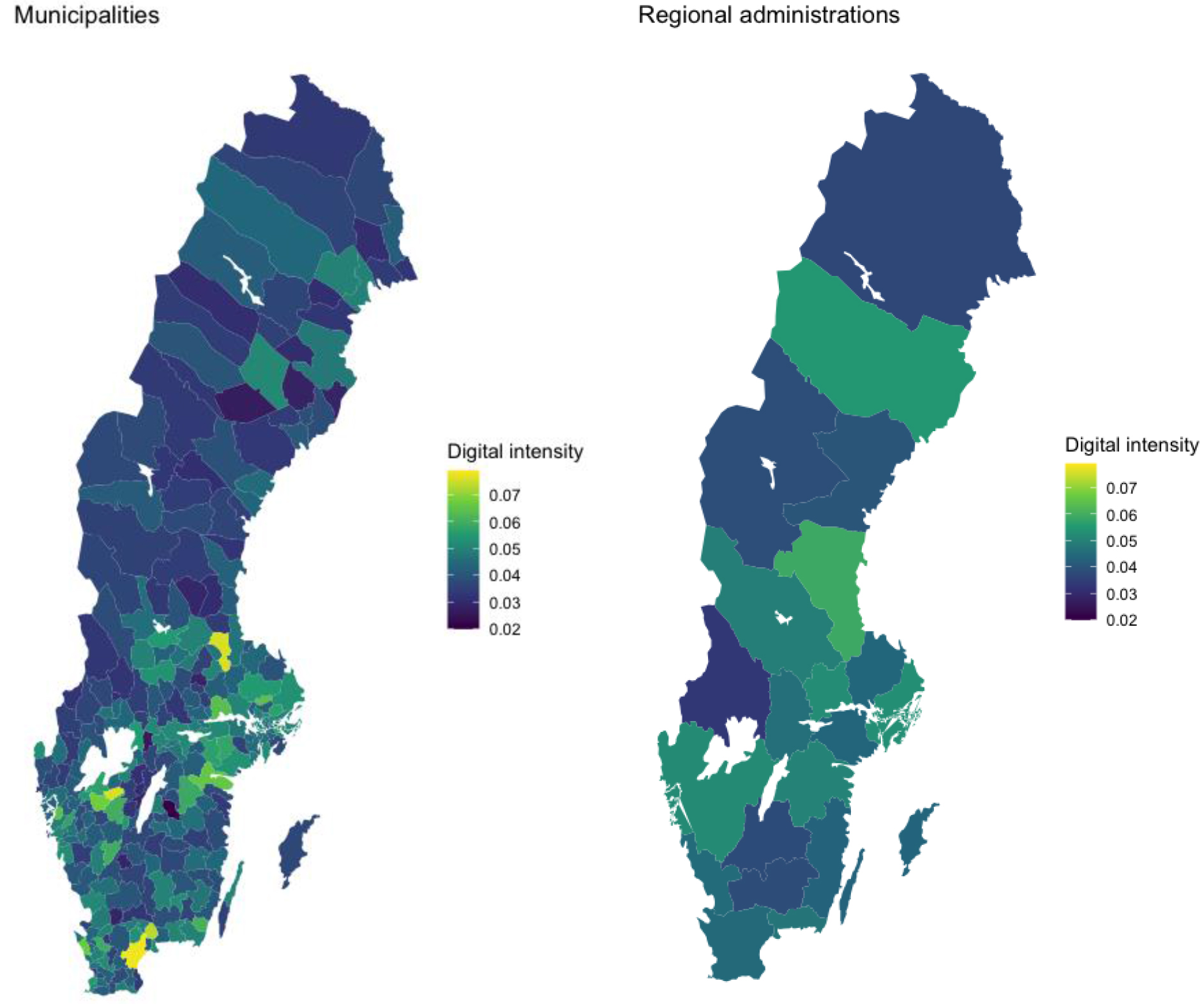
Online tool for public sector organizations to compare their digital intensity https://digital-competence-uxwql.ondigitalocean.app.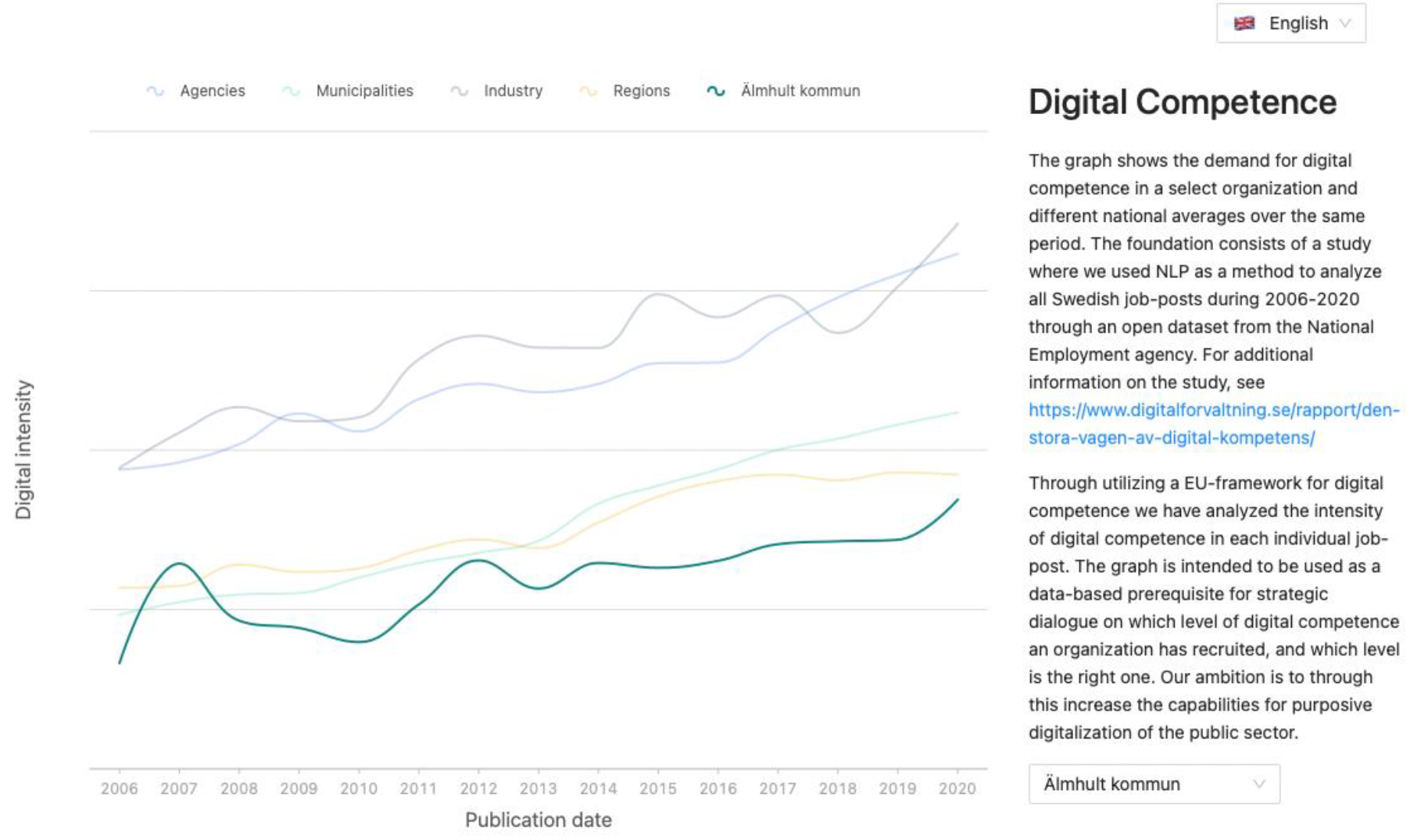
Authors biographies
Vasili Mankevich is an Assistant Professor at the Department of Applied IT, University of Gothenburg. He earned his Ph.D. in Information Systems at Umeå University in 2019. In his research Vasili relies on computational methods, such as network analysis and natural language processing, to study digitalization. Vasili’s current research is focused on the resourcing of digital competence in established firms and the public sector.
Johan Magnusson is a Professor at the Department of Applied IT, University of Gothenburg, director of SCDI Gothenburg, and research leader for the Digital Government Research Consortium. He earned his Ph.D. in Business Administration (Accounting) at Gothenburg University in 2012 following his Licentiate degree in Information systems in 2005. Johan’s research is directed towards the balance of innovation and efficiency in the organization and governance of internal functions, pursuing notions such as the disintegration of value creation and shadow innovation.
Fredrik Svahn is an Associate Professor at the Department of Applied Information Technology, University of Gothenburg, since December 2017. He has a background in software engineering, working with companies such as Saab, Ericsson, and Volvo Cars. Fredrik has also worked as an applied researcher at RISE, together providing more than 15 years of experience in the defense, telecom, and automotive industries. He received his Ph.D. in Informatics at Umeå University in 2012 and conducted postdoctoral studies at Chalmers University of Technology.
His research broadly focuses on digital innovation in incumbent firms, including studies of organizational capability, platform design, and innovation strategy. The research is often implemented as collaboration projects within the Swedish Center for Digital Innovation. Fredrik uses qualitative methods, but increasingly explores how large datasets and social network analysis can open up new frontiers in information systems research. His research is published in journals such as Journal of Information Technology, MIS Quarterly, and Sloan Management Review. Over the years, Fredrik has developed an international network and spent periods abroad, e.g. as visiting scholar at Penn State University and Georgia State University.