Influenced by the global uptake of digital transformations, governments in developing countries are making considerable investments in digital transformation initiatives; however, these often result in very high failure rates. The overall purpose of this study is to identify why digital transformations in the public sector of developing country contexts fail. This paper reports on a rich revelatory case study of a Sri Lankan government agency that experienced digital transformation failure. Data was collected primarily via semi-structured interviews and augmented with document analysis that enabled us to derive deep insights into why digital transformations fail. We identified 23 failure factors which were grouped into 5 meta-themes, namely, Organisational, Implementing Agency, Cultural, Leadership and Macro-Level Factors, forming a failure factor model. The analysis also unveiled complex interrelationships between these themes/factors, which formed the basis for 6 evidence-supported propositions detailed in the paper. The findings will benefit public sector organizations in developing countries and their implementation partners to effectively plan their digital transformation strategies.
Berghaus and Back (2016, p. 2) define digital transformation as a “technology-induced change on many levels in the organisation that includes both the exploitation of digital technologies to improve existing processes, and the exploration of digital innovation, which can potentially transform the business model”. Governments in developing countries have engaged in digital transformation (in e-government form) since the 1980s, with the aim of enhancing their service delivery to address ever-growing public demands (Alves et al., 2014; Kassahun & Molla, 2011; Rajapakse, 2013). However, the success of these transformations is still a challenge for many government agencies (Dwivedi et al., 2011).
Recent literature explains that digital transformation failure is a continuing challenge in the public sector in developing countries (Fakhoury, 2018; Syed et al., 2018), with an approximate failure rate of 60% to 85% (Fakhoury, 2018). Despite their high failure rates, billions of dollars are spent on digital transformation in developing countries (Bhatnagar, 2004; Fakhoury, 2018). Hence, there exists a necessity to understand why these failures occur.
Even though digital transformation success studies are plentiful, failure studies are rare, which can be attributed to the difficulties of accessing such cases. Yet studying failures has a profound impact on challenging and improving established practices in scientific disciplines (Beynon-Davies, 1995). While it is important to understand the success factors, a deep appreciation of failure factors is also important to avoid future mistakes (Bourdeau, 2010; Grainger et al., 2009). That is while the absence of a success factor can reduce the likelihood of success and potentially increase the likelihood of failure, there are likely to be other failure-specific factors contributing to such outcomes. Such insights can only be revealed through studying failure cases, which are seldom published in literature (Klara & Cormac, 2020). A deep awareness of the factors and contexts of failure will aid in preventing finger pointing and facilitate valuable learnings (Edmondson, 2011).
In this paper, by using a revelatory case study of a failed government digital transformation in a developing country, we seek to provide insights into why digital transformations in the public sector fail in developing countries.
In answering this research question, we contribute to knowledge by developing a conceptual model grounded in data and reinforced through literature explicating five meta factors that influence the likelihood of digital transformation failure. Such a model has important practical implications as it can be used by public sector organisations in developing countries to identify which factors they need to address (and in which priority/temporal order) to minimise the chances of failure.
In the next section, related works are introduced. The study design is then presented, followed by the findings describing the failure factors. Then, a conceptual model demonstrating the interrelationships between factors evidenced through case data and supporting literature is presented followed by a discussion that includes areas for future research.
Background literature: Public sector digital transformation in developing countries
Public sector digital transformation in general, is still an under-researched area (Kutzner et al., 2018; Waller & Weerakkody, 2016) especially in developing countries (AlGhazi et al., 2018). According to Heeks (2003) public sector digital transformation can be evaluated as a success, a partial failure, or a total failure. A successful digital transformation is one in which the goals and objectives of the digital transformation were attained with minimal disbenefits. For instance, the Consular Division of the Ministry of Foreign Affairs in Sri Lanka successfully transformed through adopting an electronic document attestation system, coupled with business process re-engineering, which greatly enhanced efficiency and citizen service (Syed et al., 2018a). A digital transformation that has partially failed is when a transformation is unable to achieve the intended objectives or results in unwanted outcomes. For instance, a state healthcare department in Australia was engaged in a transformation initiative to standardise payroll processing, which resulted in the system being implemented 18 months behind schedule and 300% over budget with substantial issues, resulting in staff either not being paid or being paid incorrectly (Glass, 2013). Total failure is when the systems foundational to the digital transformation were either not implemented or not used, which the case study presented in this paper reports on.
Despite decades of research on diverse project contexts, literature in general lacks consensus on digital transformation success, calling for detailed understanding that goes beyond the common dimensions of time, cost and quality (Laursen & Svejvig, 2016; Padalkar & Gopinath, 2016). One such approach that has been reflected in broader literature to understand success and failure is the Critical Success Factor (CSF) approach. According to the seminal work of Rockart (1979) failure to adequately address CSFs will lead to less-than-desired results and potentially outright failure. CSFs can, therefore, be used to systematically manage a program of work by highlighting the key areas of activity that require careful management attention (Eden & Sedera, 2014). A wide array of context-specific CSF typologies pervades the literature (Dobbins & Donnelly, 1998; Finney & Corbett, 2007). In the context of business process management in the public sector, Syed et al. (2018) synthesised literature and identified 14 CSFs, with core differences between developing and developed nations. Specifically, in developing nations, CSFs that were considered pivotal to the success of transformation initiatives related to top management support, communication, preparedness for change, external stakeholder involvement, a sound team, overcoming resistance, empowerment, infrastructure, project management abilities, ICT awareness, culture, governance, alignment, and the external environment. As evident from Syed Bandara French et al. (2018, p. 31), “prior research is heavily skewed towards the developed [country] context. The ability of these factors in a developing country context can be argued and provides an opportunity for further analysis and investigation”. To date, only a handful of studies explain the key CSFs in this domain (AlGhazi et al., 2018; McAdam & Donaghy, 1999; Syed et al., 2018).
In contrast to CSFs, which are largely informed by success studies, failure factors informed by failure cases have seldom been investigated. This oversight is magnified in the context of digital transformation of public sector organizations in developing countries. Public sector digital transformation efforts can be significantly hindered by digital transformation being perceived as a threat to existing organisational culture (Filatova et al., 2018), which limits the commitment and willingness of political leadership (Dobrolyubova et al., 2019; Dwivedi et al., 2011; Irani et al., 2010; Syed et al., 2018a). As well as creating role ambiguity, the rigid bureaucratic structures and regulatory frameworks implicit in public sector organizations further restrict information sharing, inter-agency coordination and collaboration (Al-Ruithe et al., 2018; Dawes et al., 2009; Gil-Garcia et al., 2019). In addition to cultural and organizational considerations, a lack of digital capabilities (Filatova et al., 2018; Omar et al., 2017) and challenges associated with the use of technologies such as cloud computing, Internet of Things, and artificial intelligence create loss of control and mistrust of transformation in developing countries (Al-Ruithe et al., 2018; Sharma et al., 2011).
As explained above, to date, literature on public sector digital transformation in developing countries provides a disjointed view and there exists a need for studies to explain the associated factors and their interrelationship to provide a holistic view.
Research design
A single exploratory case study of revelatory nature was conducted, applying an inductive design (Gioia et al., 2013). Single case studies are known to provide rich insights and are well-suited for exploring a novel and revelatory phenomenon (Lee, 1989). Below, we introduce the case study and detail the data collection and analysis techniques used. Appendix A holds further information about the case study design.
Case background
Our study occurred in Sri Lanka, a country at the forefront of digital transformation reforms in the developing world. We examined a public sector organisation known as the Bureau of Motor Vehicles (BMV)2
Details are anonymised to meet agreements and set research ethics procedures.
and its digital transformation: “eMotor Registration”. The eMotor Registration initiative was considered a complete ‘failure’ by its stakeholders (staff, ICTA, and public) due to multiple failed attempts since its inception in 2005 and inability to meet expectations. The BMV is a large government department and a microcosm of Sri Lankan public sector culture and bureaucratic norms. We gained access to this digital transformation through the national Information Communication Technology Agency (ICTA) of Sri Lanka, which has the responsibility of public sector digital transformation.
The Bureau of Motor Vehicles (BMV) was established in 1928 prior to the independence of Sri Lanka. The head office of the organisation is in the capital city of Sri Lanka, with offices in each province. The key operations involve issuing new registration of vehicles, registration of transferring of vehicles, issuing drivers’ licenses, and technical services that include vehicle inspections for road safety and control of emissions.
The concept of eMotor Registration digital transformation was introduced by the ICTA in 2005 with an estimated cost of approximately $US 2,300,000 to modernise processes such as vehicle import, registration, changes to ownership and vehicle attributes, management of revenue collection, management of citizen queries, and implementation of a centralised document management system. The digital transformations were designed by the ICTA and jointly implemented with the BMV. The ICTA appointed a dedicated project manager to coordinate the digital transformations and closely work with the BMV. The contract to conduct a system and process issue study was awarded to a top tier global consultancy, Digital Consultant Corp (DCC)3
Details are anonymised to meet agreements and set research ethics procedures.
in 2008. The ICTA was responsible for coordinating with the DCC and software vendors. The BMV took responsibility for the implementation, change management, and operations of the digital transformation. By 2009, only the activities related to process analysis and design were completed by the DCC. The initiative remained dormant due to stiff resistance by the BMV staff as well as changes in the political regime in the country. In 2012 through cabinet approval, the eMotor Registration was re-launched with an additional budget of $2,000,000 using a build-operate-transfer strategy. A senior staff member from the BMV was formally appointed as the Chief Innovation Officer (CIO) to liaise with the ICTA for process innovation and assist in digital transformation. Since 2015, the initiative had been placed under tender stage – the status quo to date continues and a new plan is in progress to re-introduce e-MR in 2020 (IANS, 2018).
Data collection and analysis techniques
While a single revelatory case study provides in-depth insights where little is known about the phenomenon of interest (Eisenhardt, 1989; Siggelkow, 2007), concerns can be raised regarding the credibility and transferability of the study’s findings. As detailed below (per Yin, 2015), we performed several steps to improve credibility through explicit and methodical reporting providing transparency into the data collection and analysis procedures underpinning the findings (see Appendix A), and through performing both data triangulation and investigator triangulation. The study collected interview data as the primary source of evidence, which was augmented with data from selected documentations.
Fifteen (15) in-depth semi-structured interviews with an average duration of one hour each were conducted. Table 1 represents the profiles and designations of the selected participants. Respondents were selected based on their engagement with the eMotor Registration initiative (see Appendix A_ Supplementary material file Section 2.1). First, responsible staff were identified via preliminary discussions with the senior programme manager of the ICTA to gain initial insights and background understanding of eMotor Registration. Next, other participants were identified using a chain-referral sampling procedure (Noy, 2008) in multiple iterations, sharpening external validity (per Eisenhardt, 1989). Selected respondents served as “knowledgeable agents” (Gioia et al., 2013, p. 26) who were a cross-sample of different departments Respondents 2 to 7 were long-term employees of the BMV and the ICTA and provided a detailed account of historical development of multiple digital transformation attempts.
Respondent profiles
Respondent
Organisational designation
Number of interviews
Affiliation
Role in digital transformation
Respondent 1
Assistant Commissioner
2
BMV
Chief Innovation Officer
Respondent 2
Assistant Commissioner
1
BMV
Process owner/End user
Respondent 3
Director-Information Technology
2
BMV
IT Subject Matter Expert
Respondent 4
Chief Financial Officer (CFO)
1
BMV
Sponsor/End user
Respondent 5
Assistant Commissioner
1
BMV
Process owner/End user
Respondent 6
Commissioner R&D
1
BMV
Process owner/End user
Respondent 7
Program Manager, Re-Gov Programme
3
ICTA
Programme Manager
Respondent 8
Project Manager, eMotor Registration
2
ICTA
ICTA Project Manager
Respondent 9
Process Consultant
2
DCC
Process Expert
A variety of documents such as annual progress reports, media releases, digital transformation strategy and system design documents, technical architecture, including the BMV’s confidential/non-confidential project and process design reports were collected and analysed (see Appendix A_ Supplementary material file Section 2.2). These documents served multiple purposes, such as to provide the contextual background to help customise the interview questions, probe during the interviews, and also to triangulate interview findings (data triangulation per Yin, 2015).
The interview data was analysed inductively across 4 coding-rounds to identify failure factors and understand their interrelationships (see Appendix A_ Supplementary material file Section 3). The evidence management, data coding, and analysis was enabled by the use of NVivo, a qualitative data analysis tool. Generic coding guidelines and a coding rule book (DeCuir-Gunby et al., 2011) was designed and applied as a guide (see Appendix A, _ Supplementary material file Sections 3.1–3.2) for transparency (per Yin, 2015) in our analysis approach. The coding was primarily conducted by two researchers and rigorously quality assured through multiple corroboration sessions, which took place within each round of coding (investigator triangulation per Yin, 2015).
The coding started (Round 1) with the derivation of failure factors from the interview data (and documents as deemed relevant). Inductive coding guidelines of Glaser & Strauss (2017) and Urquhart & Fernández (2013) were applied here to identify any direct or implied mention of failure factors. Statements were reviewed in terms of mentions such as negative impacts and consequences. 295 verbatim open codes were created in this round of coding using short phrases taken from interview data to maintain the original meaning (Bazeley, 2007; Saldanña, 2009). Any potential interactions that were emerging were noted within relationship-memos here. Coder corroboration in this phase focused on confirming that all relevant data was delineated and aligned to the definition of failure factors.
In Round 2, the coding was highly iterative, where the open codes were grouped to form coding-families, which resulted in 23 failure factors (themes) and five meta-themes. We analysed data using constant comparison (Glaser, 1978) to group the data into themes. This grouping took place inductively over several coder corroboration rounds. The summary categories were also exposed to parties outside the research team for further confirmation.
Round 3 was specifically focused on identifying the interrelationships between these failure factors. In addition to revisiting the relationship-memos created in Round 1, this phase used the ‘Matrix Query’ function of NVivo to aid in the discovery of associations between themes. NVivo’s matrix coding query performs as a “qualitative cross-tabulation … the numeric output of a matrix query provides a basis for comparative pattern analysis where it can be seen how often different groups reported a particular experience” (Bazeley, 2007, p. 146). The query results pointed to where the coding overlaps and/or proximities existed, so that the related content can be analysed in-depth to identify potential relationships. For example, a repeated mention of one factor influencing another can indicate a potential causal relationship between the two factors. These potential relationships were extracted and independently analysed by two coders and exposed to coder corroborations to confirm the existence and nature of the potential relationships.
A 4 round of coding took place through “enfolding literature” (improving internal validity and construct reliability, per Eisenhardt, 1989), when we applied Williams and Ramaprasad (1996) framework of factor-criticalities to categorise the factors (see Table 4). Again, two coders were involved here, each independently categorising each factor across the three dichotomies of the framework (investigator triangulation per Yin, 2015). Rationale for the categorisations were noted by the coders, and mismatching categories were resolved through discussions (see Appendix A, Supplementary material file, Section 3 for further details).
Study findings
In this section, we present our findings of the salient factors that contributed to the failure of the digital transformation at BMV. We present the identified five meta-themes and the associated factors in Table 2. The factors within each meta-theme are described in the following sections.
Explanation of the meta-themes that influenced the digital transformation failure
Meta-theme
Description
Factors (resulting themes)
Organisation-related
Factors related to and controlled by the organisation (i.e., BMV) that influenced the failure of the digital transformation.
1. Lack of administrative coordination 2. Inefficient administrative procedures 3. Frequent administrative changes 4. Lack of ICT knowledge 5. Absence of performance-based evaluation systems 6. Failure to manage corruption
Implementing agency-related factors
Factors related to and controlled by the implementing agencies (i.e., ICTA, DCC).
7. Lack of authority 8. Inter-agency conflicts 9. Lack of understanding of organizational complexities 10. Lack of trust in implementation agency 11. Inter-organisational dependency
Cultural factors
Factors related to the values and beliefs, norms, and structures exists in participating organisations (i.e., BMV, ICTA, DCC).
12. Rigid bureaucratic values 13. High power distance 14. Negative attitude towards change and innovation 15. Individualistic attitude
Leadership factors
Factors associated with the nature of actual and expected leadership actions of individual stakeholders in both organisations (i.e., BMV & ICTA).
16. Absence of a shared vision 17. Ineffective communication 18. Lack of ownership 19. Lack of technology capabilities awareness 20. Inadequate resources allocation 21. Ineffective decision making 22. Lack of empowerment
Macro-level factors
Factors resulting from political and economic forces beyond the control of both the organisation and the implementing agencies.
23. Instability of the political environment
The role of organisation related factors
As depicted in Table 2, we identified six organisation-related factors that contributed to the failure of the BMV digital transformation, which are explained below:
Lack of administrative coordination refers to coordination issues between key stakeholders. The coordination between the department head and the CIO was weak because of the hierarchical organisational structure. Coordination between the leadership, the technical staff, and the senior management’s ability to comprehend technical advice from the technical leadership roles (i.e., CIO) were regarded as critical; “… two people I am referring to – one is the leader of the organisation and the next is the CIO who is responsible for the IT implementation. These two are the key people. So, when we have a problem with either one of them, things don’t work” (Respondent 7).
Inefficient administrative procedures negatively influenced the digital transformation. During process analysis workshops conducted by the DCC, an expectation was created that the BMV will have improved and efficient processes within a stipulated time. The respondents highlighted that rigid procurement processes resulted in major delays that caused staff frustration and loss of trust; “… they felt it was a never-ending process, and when they were expecting the system to be implemented, it took another one year, because we had to do competitive bidding processes which take a minimum of 9 months, and that really led the people to change their attitude” (Respondent 7).
Frequent administrative changes refer to continual staff movement due to transfers and promotions. Government regulations require staff at senior leadership positions to transfer every five years. Moreover, the volatile political environment where regime change is frequent also leads to changes in senior management. Transfer of senior management staff was mentioned as a major issue for the sustainability of the digital transformation; “…every few years the commissioners changed, whoever comes as the new commissioner adapts to this because this has come from above” (Respondent 3).
Lack of ICT knowledge refers to the limited understanding of the interdependencies between ICT and process innovation. The staffs’ lack of ICT knowledge was mentioned as a contributing factor that led to ineffective process innovation and design and resulted in the staff’s reluctance to adopt technology-enabled processes, and ad-hoc processes emerged; “… the IT/computer knowledge of citizens is just about 18%. Therefore, it is difficult to introduce all these automated systems” (Respondent 6).
Absence of performance-based evaluation system refers to the lack of a suitable performance-based evaluation system at BMV. Senior management claimed the implementation of a financial incentive system had positively influenced staff attitude and boosted staff morale and work attitudes. On the contrary, staff mentioned that public sector employees enjoy their job security, and unlike private sector, they do not have annual performance objectives. Hence, staff do not see a reason for putting extra effort to improve their processes due to job security and absence of performance measures for promotions and appointments; “In the government system, whether you perform or not you get paid. We don’t have a performance evaluation-based salary system. I think it is one of the problems in implementing digital transformations” (Respondent 5). The data also reflected an important distinction; the ICTA by design follows private sector structure and operational strategies where ICTA staff performance is reviewed based on the targets. This distinction created a conflict between the two interdependent organisations where the ICTA staff’s push to achieve the implementation objectives were not well received by the BMV staff; “We are on an annual contract, we are not permanent, starting from the CEO, everyone here is on a contract, on a renewable contract, and it’s based on a very strict performance evaluation.” (Respondent 7).
Failure to manage corruption was considered a contributing factor towards the digital transformation failure. The digital transformation would have blocked loopholes for fraudulent transactions (e.g., elimination of fake documents). Enticing staff by offering illicit financial incentives to bypass formal procedures was common practice; “Corruption is present to a certain extent … due to the registration of fraudulently imported or assembled vehicles and the issuance of forged driving licences, we were criticised as a department as we are the only institution which has the authority to register motor vehicles and issue driving licenses. If there is any fraudulent activity around it, it is the fault of the department” (Respondent 6). Furthermore, some external vendors approached senior management to gain unfair advantages; “there are other forces also. Some vendors try to approach them and give them bribes … you know that the problem is there. I can’t provide evidence for it, but you can understand. So those types of issues are very rampant” (Respondent 7).
The role of implementation-agency related factors
We identified five implementation-agency related factors which contributed to the BMV’s digital transformation failure, as described below.
Lack of authority refers to the absence of formal authority of the ICTA to implement the digital transformation. This factor was commonly acknowledged by staff from both organisations. The “private enterprise” nature of the ICTA created a “not-acceptable in public sector” issue amongst public sector organisations. A respondent from BMV mentioned that the ICTA’s role was more of a consultant and advisory in nature. The ICTA was not given formal authority or the power to enforce the digital transformation strategy; “They [ICTA] don’t have the proper authority that can force the government departments to act. But if ICTA can force the government departments or the government department heads, then those initiatives could be successfully implemented” (Respondent 5).
Inter-agency conflicts refer to the absence of joint planning of the digital transformation and the nature of the relationship between the two organisations and the consultant (DCC). Staff positively commented on the knowledge and support from the consultant. However, respondents pointed out that efforts to improve processes and systems by internal staff were not considered by DCC and ICTA in designing the digital transformation strategy. This led to the emergence of conflict between the two agencies. Outsourcing of the software development to a private company resulted in data confidentiality and privacy concerns; “We were doubtful about the handling of this information as it was going to a third party.” (Respondent 6). BMV’s senior management focused on the recommendations by the ICTA and ignored the internal IT department; “What the ICTA has done is that they suggested a project called eMotor Registration and all the while criticizing what is inside, what we have done” (Respondent 3).
Lack of understanding of organisational complexities refers to how the key complexities were ignored in the scope and strategy. Respondents mentioned continuous changes in the scope of the eMotor Registration project resulted in staff losing motivation. The digital transformation strategy lacked understanding of complexities associated with public sector organisations; “… the scope of the eMotor Registration project suggested in 2002 and 2003 and then after that in 2008 … even now there is a big issue regarding the scope of the project” (Respondent 3). The process issue study was conducted by DCC. DCC’s transformational approach to processes innovation was considered by the staff as ‘superfluous’ since it did not incorporate the staff’s tacit knowledge of the processes and relationship between various government departments.
Lack of trust in implementation agency signifies ICTA’s role in managing digital transformation, coordinating with candidate departments, allocating of consultants, conducting process improvement workshops, change management, administrative support for procurement, and system implementation; “you have to have the political hierarchy and the bureaucratic hierarchy on your side … as far as they (staff) are concerned if they see the boss trusted the facilitator, they also trust the facilitator. They don’t have any issues” (Respondent 9). In the case of BMV, ICTA’s implementation strategy was disputed by staff, who stated they required a supportive role rather than forcing the department to use the systems. Respondents emphasised the unsuitability of a digital transformation strategy and that a systematic redesign approach (by involving IT staff) would be more effective compared to the transformational approach adopted by DCC and ICTA; “What the ICTA has done is that they suggested the eMotor Registration and all the while criticizing what is already inside [the department], what we have done”. (Respondent 3)”.
Inter-organisational dependency refers to the ability to access required information for relevant processes external to BMV. The absence of inter-government data exchange resulted in BMV to continue maintaining physical documents from citizens. This resulted in a slow flow of information between organisations and negatively impacted citizen satisfaction and organisational efficiencies; “… the other institutes and public sector organisations are not ready for a digital transformation like eMotor Registration, which is the reason for delays”. (Respondent 2).
The role of culture
As described below, we observed culture at multiple levels (e.g., national, organisational) which contributed to the failure of the digital transformation.
Rigid bureaucratic values refer to the hierarchical structures in public sector designed to enable very controlled and centralised decision making. Thus, citizens feel their problems can only be effectively addressed by talking to the head of the organisation. The hierarchical and bureaucratic nature has a direct negative effect on the implementation of innovation and ideas from staff; “… the organisational culture is based on the bureaucratic structure – top to bottom. There are some possibilities for exceptions, but most things are governed by the normal hierarchy of the organisation” (Respondent 1).
High power distance refers to the strong superior-subordinate approach by executive staff and lack of empowerment of their subordinate staff. Respondents mentioned the existence of a gap between staff and management and that discouraged staff from suggesting ideas related to the digital transformation; “As a manager I sit here [in office], in Sri Lankan culture the manager sits in his room and others work” (Respondent 5).
Negative attitude towards change and innovation was described by participants to be indicative of Sri Lanka’s public sector culture; “In our culture, people are negative minded. I think it is a cultural problem in Sri Lanka. Most people don’t like innovative and new things” (Respondent 5). Respondents mentioned employees of BMV were highly resistant to change; “Resistance to change is a major hurdle; the employees prefer the old systems and procedures. It is difficult to change attitudes” (Respondent 1). The controlling culture was a source of resistance, for instance, the management preferred autonomy over decisions (by solving problems themselves with direct citizen interactions) as opposed to rule-based decision making. “The new process design meant placing information kiosks at the entrance; “The organisation head wasn’t too happy and rejected it because it would’ve stopped people at the entrance. The management love talking to people and give solutions after learning their problems. They don’t like giving rule-based decisions- they like giving the solutions themselves” (Respondent 7).
Individualistic attitude refers to staff at BMV being resistant to engage in the digital transformation as they wanted to keep their knowledge about the processes to themselves, assuming they would lose authority by sharing knowledge with others. This had a considerable impact on the ICTA and the DCC’s ability to understand the requirements for an effective process; “… they [staff] didn’t want to understand the value of sharing knowledge. I suppose everyone has the same mentality, they want to hold the ownership to show that this is something they have done, they don’t want to say someone else did it and they are continuing” (Respondent 7). Many attributed this individualistic attitude to the digital transformation failure and highlighted the need for a team culture; “I think more team culture has to be developed, so that there would be space for ideas from all the people in different levels” (Respondent 1).
The role of leadership
We identified eight leadership factors that contributed to the BMV digital transformation failure as discussed below:
Absence of a shared vision created confusion amongst the staff. Creating a firm policy and goals for the digital transformation was a critical responsibility of leaders; its absence contributed to delays and failure of the initiative; “We need a firm policy and vision, we should have a goal to get the eMotor Registration project. For any project, we need a firm timeline, a proper target, and a proper plan” (Respondent 2).
Ineffective communication refers to the poor communication practices between the various stakeholder groups in the digital transformation. The scope and details of the eMotor Registration were poorly communicated with key stakeholders, and limited efforts had been made to get them involved in the planning and design stages; “No one has the time to talk with each other on how to implement this project, on how to regularise everything, most of the time we don’t talk of new ideas” (Respondent 5). It was highlighted that leadership in public sector organisations should comprehend and balance conflicting interests of internal and external stakeholders. Failure to do this can cause staff demotivation; “The first thing that needs to happen is they should consider all our suggestions and if there are many suggestions they should go through each one of them, discuss it and come to a conclusion. When eMotor Registration was suggested, eventually our suggestions and eMotor Registration suggestions didn’t go in parallel” (Respondent 3).
Department heads lacked ownership of the digital transformation. The ability of the leadership to act as the driving force was mentioned as both a motivation for staff to embrace change and a factor to overcome bureaucratic hurdles and ‘red tape’ in the public sector; “If they are a driving force, yes, the transformation will succeed, but the moment they are taken out we will never be able to do anything there, because it solely depends on that person. The first leader was really very interested in the digital transformation and how it has to be done and he took up on his own … so when you have those types of people, even the staff at lower levels get motivated towards the digital transformation” (Respondent 7).
The BMV leaders largely lacked an awareness of technology capabilities. Participants highlighted the need for leaders to possess strong awareness of technology capabilities to drive digital transformation and build staff confidence; “rather than being a bureaucratic leader, they should be very dynamic and communicating and also I think they should be knowledgeable on the new trends, not the technology, but what is happening around” (Respondent 1).
Inadequate resource allocation was closely associated with the failed digital transformation. Budgetary constraints, staff competencies, and physical resources were key issues. Respondents stressed the ability of leaders to effectively identify and allocate resources and discover talent amongst the staff to drive the department towards effective digital transformation; “what I mean by leading is they should have the capability of gathering all the resources, different teams and different sections of the department and to gather all the ideas and support; they need to drive them (Respondent 1).
Ineffective decision making was considered a key issue related to the failure of the digital transformation. Respondents regularly highlighted that senior management struggled to make difficult decisions related to digital transformation strategy. Decision making should consider the inputs from technical staff and involve them when deciding on the technical requirements. The digital transformation strategy must not be enforced without proper alignment of the department and individual staffs’ goals; “here [eMotor Registration] the decisions they take are wrong. That is why work was not done” (Respondent 3). Decision making is centralised in government organisations, where all key decisions are made either by the head of the department after consultation with the seniors; “I always try to do new things but here also I am not given a chance. This is the thing; a leader should identify the person who is willing to do those things. That is the problem in Sri Lanka” (Respondent 5).
Staff lacked empowerment to make decisions related to the digital transformation, this was due to the centralised, bureaucratic structure of BMV. Staff in technical areas mentioned several innovative ideas emerged at different levels in the department, but these ideas were not operationalised due to limited delegation; “there are several ideas like that [staff delegation and empowerment], but implementation again in the current scenario has to be top to bottom” (Respondent 1). Therefore, leaders should encourage stakeholder involvement and new ideas from staff; “The leader’s main responsibility is to keep all the parties involved and intact and move in the required direction” (Respondent 1).
Other than organisation-related or agency-related factors, the success of the digital transformation is also influenced by intra-organisational, economic, and political forces. Instability of the political environment refers to the volatility of the political environment that is directly associated with the changes in the administrative structure of government departments. Each political party coming to power influenced the appointment of heads of the organisations to suit their political agenda. These regime changes negatively affected the digital transformation; “… we had a regime change in February, and in August we had the general election. Then we had new ministers, and the secretaries changed. These are some of the political problems that we face” (Respondent 4).
Discussion
Our analysis revealed a total of 23 factors which were grouped into five meta-themes namely, organisational, administrative, cultural, leadership, and macro-level. Studies investigating critical success factors or failure factors often tend to oversimplify things resulting in only an inventory of potential factors, with minimum to no indication of any interrelationships between these (for example, Al-Ruithe et al., 2018; Dawes et al., 2009; Gil-Garcia et al., 2019; McAdam & Donaghy, 1999). To overcome these limitations, we conducted a further synthesis to unveil some of the intricacies of digital transformation failure in the BMV’s case. Adapting the taxonomy by Williams and Ramaprasad (1996), we provide a deeper explanation of the underlying failure factors observed in the BMV initiative.
Failure factor classifications
To further understand the nature and criticality of the failure factors identified in this study, we apply Williams and Ramaprasad (1996) framework of factor-criticalities, which describes three dichotomous dimensions: (D1) standing and instigating, (D2) enhancing and inhibiting, and (D3) direct and indirect. These dimensions work in tandem. For example, standing factors can also be enhancing or inhibiting factors. Both standing and instigating factors can either work directly or indirectly to influence the outcome of the digital transformation. Table 3 introduces these three (see D1-D3) and outlines how they have been adapted in our study.
Adapting the Williams and Ramaprasad (1996) taxonomy to this study context
Dimension (D)
Application
D1: Standing and instigating
These are distinguished by their temporal properties. A standing factor is one which is present over a long period of time (represent constancy) and produces an environment for failure. An instigating factor is one which is localised in time (represent change) and whose occurrence brings about failure (i.e., act as a trigger for failure).
D2: Enhancing and inhibiting
These are distinguished by their contributions to the probability of failure. Enhancing factors are those that decrease the probability of failure whereas inhibiting factors are those that increase the probability of failure and can act as a catalyst for failure.
D3: Direct and indirect
These are distinguished by their direct versus indirect influence over the failure. A direct factor is an essential contributor to failure, whereas an indirect factor may affect failure by influencing another direct factor, the relationship between a direct factor and failure, or both. Furthermore, a factor may have both a direct and indirect impact on failure.
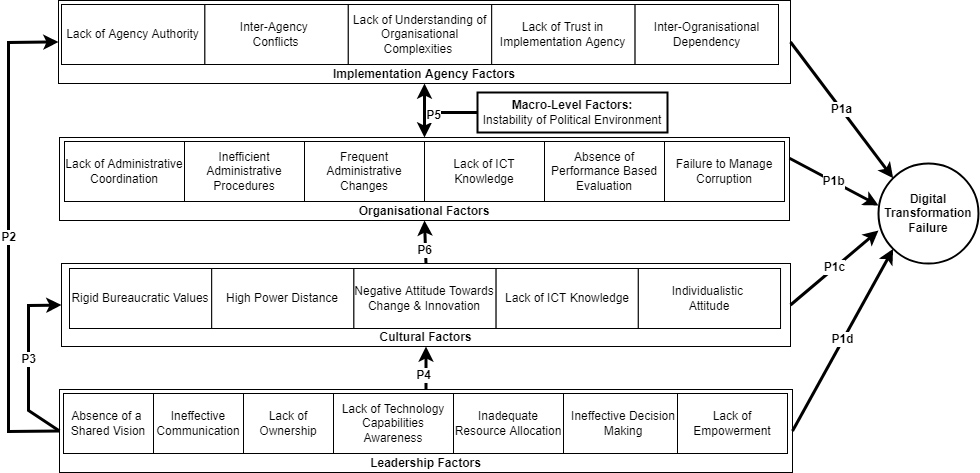
We analysed each factor within each meta-theme to determine whether they are considered standing or instigating, enhancing or inhibiting, and direct or indirect. The outcome of this analysis was used to develop the failure factor model (Fig. 1). Table 4 presents summary results. Additional analysis details are provided in Appendix A (see Supplementary material file Section 3.3.2).
A further classification of the extracted failure factors
Failure factor
Type of criticality
D1
D2
D3
Organisation-related factors
1. Lack of administrative coordination
Standing
Inhibiting
Direct
2. Inefficient administrative procedures
Standing
Inhibiting
Direct
3. Frequent administrative changes
Standing
Inhibiting
Direct
4. Lack of ICT knowledge
Standing
Inhibiting
Direct
5. Absence of performance-based evaluation systems
Standing
Inhibiting/Enhancing
Direct
6. Failure to manage corruption
Standing
Inhibiting
Direct
Implementation-Agency-related factors
7. Lack of authority
Standing
Inhibiting
Direct
8. Inter-agency conflicts
Instigating
Inhibiting
Direct
9. Lack of understanding of organizational complexities
Instigating
Inhibiting
Direct
10. Lack of trust in implementation agency
Instigating
Inhibiting
Direct
11. Inter-organisational dependency
Standing
Inhibiting
Direct
Culture-related factors
12. Rigid bureaucratic values
Standing
Inhibiting
Direct
13. High power distance
Standing
Inhibiting
Indirect
14. Negative attitude towards change and innovation
Standing
Inhibiting
Indirect
15. Individualistic attitude
Standing
Inhibiting
Direct
Leadership-related factors
16. Absence of a shared vision
Standing
Inhibiting
Direct
17. Ineffective communication
Standing
Inhibiting
Direct
18. Lack of ownership
Instigating
Inhibiting
Direct
19. Lack of technology capabilities awareness
Instigating
Inhibiting
Indirect
20. Inadequate resources allocation
Instigating
Inhibiting
Indirect
21. Ineffective decision making
Standing
Inhibiting
Direct
22. Lack of empowerment
Standing
Inhibiting
Indirect
Macro factors
23. Instability of the political environment
Standing
Inhibiting
Indirect
Note: Indirect relations depict the interrelationship between sub-factors as illustrated in Fig. 1.
A failure factors model.
Overall, all failure factors by definition are inhibiting in nature, as they increase the likelihood of digital transformation failure. A notable exception is the ‘absence of performance-based evaluation systems’, as our analysis revealed the presence of both positive and negative perceptions when it comes to the provision of financial benefits.
The failure factors within the organisation-related, culture-related, and macro-related meta-themes were all standing in nature, prevailing within both the organization and the broader environmental context for a sustained period of time. This means they are likely to be institutionalised and difficult to amend, requiring long term planning and effort. However, though they are stable in nature, they can be susceptible to change. For instance, institutional work (Zietsma & Lawrence, 2010) and culture work (Eden & Burton-Jones, 2018) can be performed to address these factors. Agency-related factors and leadership-related factors are a combination of standing and instigating factors, meaning that some have been sustained over time while others are localised in time and are a product of the local context. Due to the combination of standing and instigating factors, we recommend that project/program managers should focus more on the instigating factors in the short term and set long term action plans to tackle standing factors.
The direct/indirect aspect of the factors enables the unveiling of potential relationships between factors, which assists in determining the order in which the failure factors need to be addressed. As Table 4 indicates, organizational factors, implementation-agency factors, cultural factors, and leadership-related factors all directly influence the likelihood of digital transformation failure. In addition, culture, leadership, and macro-level factors indirectly influence digital transformation failure through influencing other failure factors. This implies the need to first consider culture, leadership, and macro factors, as they will influence the presence and impact of failure factors in other categories. However, considering culture and macro factors are all standing factors while leadership is a combination of standing and instigating factors, it
Failure factor classification and explanation
Factor
Classification
Explanation based on details provided in Section 4.0
Organisationrelated factors
1. Lack of administrative coordination
Standing, Inhibiting, Direct
Poor administrative coordination due to archaic, silo-based structure is a long-standing attribute of Sri Lankan public sector that restricts technical information comprehension between senior staff. In this context, the planning and design of technical aspects of the initiative come under the purview of the ICTA, however, the internal coordination issues create a direct impact on technical aspects of digital transformation.
2. Inefficient administrative procedures
Standing, Inhibiting, Direct
Government policies and processes contains rigid checks & balances and red tape that slows down the resourcing/procurement decisions leading to a directly effect on stipulated transformation timeframes and deadlines.
3. Frequent administrative changes
Standing, Inhibiting, Direct
The frequent transfers have been government’s long-standing institutional policy still maintained due to various reasons. The changes cause redefinition of the aims and designs of digital transformation that directly affects technical priorities, processes, and resource allocations, as per the perspective of the new administration.
4. Lack of ICT knowledge
Standing, Inhibiting, Direct
Staff in general, lack ICT knowledge and process thinking that causes negative perception and fear of technology. The implementation of digital transformation is the responsibility of the ICTA, however, staff’s lack of ICT knowledge directly affects the transformation due to resistance to change and slow-adoption of new technology in government organisations.
5. Absence of performance-based evaluation systems
Standing, Enhancing/Inhibiting, Direct
Government staff promotions and salary increments are based on seniority rather than performance. Government staff receive comparatively low salaries (but high job security). However, the introduction of financial incentives can result in either positive or negative perception and directly impacts staffs’ acceptance/reject of digital transformation depending on the way the financial incentive is introduced.
6. Failure to manage corruption
Standing, Inhibiting, Direct
Corruption is a major issue in developing countries. Corrupt practices such as briberies is commonly used by stakeholders to entice government employees to bypass formal procedures. Because digital transformations are handled by ICTA, the prevalent corruption directly influences staff to find workarounds for digital controls and develops resistance to change against digital transformation.
Implementation-Agency-related factors
7. Lack of authority
Standing, Inhibiting, Direct
The ICTA is perceived as an ‘external’ body and since the ICTA staff are not appointed from Sri Lanka Administrative Services (SLAS), they don’t command the required respect by public sector. The status results in the lack of required level of authority and respect that directly causes decision delays, conflicts, and staff resistance against digital transformation in.
8. Inter-agency conflicts
Instigating, Inhibiting, Direct
Digital transformations are designed as projects by the ICTA in collaboration with external consultants, whereas the implementation and operationalisation responsibilities rests with the beneficiary department. The differences between the objectives, policies, and methods between participating organisations leads to misalignment, misunderstood resource capabilities, and confusions. These inter-agency conflicts directly affect the scope, requirements elicitation, and digital transformation strategy.
9. Lack of understanding of organisational complexities
Instigating, Inhibiting, Direct
The ICTA’s lack of understanding of internal operations, interdependencies of staff and processes, and organisational internal politics results in improper determination of digital transformation scope and design attributes. As a result, the initiatives directly suffer with unprecedented changes in the scope and transformation design cause frustration and waste of effort.
10. Lack of trust in implementation-agency
Instigating, Inhibiting, Direct
A professional tussle between the IT staff of public sector organisations and the ICTA emerges because of improper stakeholder engagement. The lack of trust in ICTA and external software development contractors’ capabilities and rapport in designing appropriate technical strategy directly influences stakeholders’ loss of confidence and criticism for technical design and implementation approach.
Explanation based on details provided in Section 4.0
11. Inter-organisational dependency
Standing, Inhibiting, Direct
Most public sector organisations in Sri Lanka are not digitally linked with each other and sharing of information between public sector organisations is yet in its preliminary stages. The data-sharing and the lack of required infrastructure Directly impacts the capabilities and expected outcomes of software systems designed for digital transformation.
Culture-related factors
12. Rigid bureaucratic values
Standing, Inhibiting, Direct
Sri Lanka public sector still follows pre-independence traditional bureaucratic, command and control structures, and a top-down decision-making culture. Although there are some exceptions, the widely practiced centralised decision making restricts the innovation and improvements capabilities of the public sector staff. This incurs as a direct impact on the ICTA’s approach for potential technology and process innovations needed for digital transformation.
13. High power distance
Standing, Inhibiting, Indirect
Strong superior-subordinate type of culture in public sector organisations creates a high emphasis on hierarchical and mechanical relationship between the top-management and staff. The lack of open communication discourages staff interactions and participation in the design and implementation of digital transformation and indirect resulting in a lack of appreciation and sharing of their encyclopaedic subject-matter-knowledge with the digital transformation team.
14. Negative attitude towards change and innovation
Standing, Inhibiting, Indirect
Public sector staff in Sri Lanka follow a rather laidback and complacent lifestyle and generally prefer using known and stable practices over innovative, transformational ideas. The complacent work-related attitude and micro-management mindset leads to an environment of negative attitude and indirectly discourages staff to develop resistance towards digital transformation.
15. Individualistic attitude
Standing, Inhibiting, Direct
Sri Lankan public sector staff do not like sharing their subject matter knowledge and prefer individual objectives over team objectives to maintain their position and value in organisations. This attitude directly impacts the requirement identification for digital transformation design and implementation activities.
Leadership-related factors
16. Absence of a shared vision
Standing, Inhibiting, Direct
In most cases, public sector reforms (such as digital transformation) are ‘imposed’ on public sector departments by the political leadership rather than home-grown strategies desired by the top-management and staff. Top management is more focus on their day-to-day objectives and consider digital transformation as an additional activity. Hence, this super-imposition logic leads to the lack of developing a shared vision by the leadership within the organisations that directly impacts organisation-wide awareness and buy-in of the transformation initiatives.
17. Ineffective communication
Standing, Inhibiting, Direct
The power-distance culture and rigid bureaucratic norms creates communication barriers in Sri Lankan public sector organisations between the top management and the staff. Most communication is one-sided, mechanical, and done through memos and circulars without incorporating staff’s inputs, resulting in a direct impact on staffs’ motivation to share their subject matter knowledge with the digital transformation team.
18. Lack of ownership
Instigating, Inhibiting, Direct
In general, top management in Sri Lankan public sector are not concerned with the technical projects and believe that that is not their area of responsibility and should be handled by implementation agencies such as the ICTA. Hence, this lack of ownership and avoidance of responsibility of their department’s digital transformation directly influence the leadership interventions to overcome bureaucratic hurdles, derive organisation-wide change, and their staff motivation to embrace digital transformation.
19. Lack of technology capabilities awareness
Instigating, Inhibiting, Indirect
Top management positions in Sri Lanka are selected from the elite Sri Lankan Administrative Services (SLAS) and their primary aim is on developing their knowledge in their areas of concern only. Information technology development and digital innovation is considered as a job for IT people. This mindset leads to a general lack of understanding technology affordances in public sector organisations at senior management level that indirectly impacts the digital transformation design and features for their relevance to the organisational needs.
Explanation based on details provided in Section 4.0
20. Inadequate resources allocation
Instigating, Inhibiting, Indirect
Digital transformation initiatives are funded by the central government through internal funds or from various international donor bodies such as the World Bank, Asian Development Bank, and foreign countries. However, due to limited funds and access to resources for digital transformation, there is a need for the top-management to actively support resource availability. Budgetary, infrastructure constraints and lack of staff capabilities, indirectly impacts top-management’s ability to effectively perform resource-identification and allocation needed for digital transformation.
21. Ineffective decision making
Standing, Inhibiting, Direct
Top management in Sri Lankan public sector prefer to work with a selected group and ignore other staff who may have the requisite knowledge and motivation to engage with digital transformation. This myopic approach leads to the ignorance of stakeholders’ interests, and critical information that is required to align stakeholders’ interests and prioritisation for digital transformations.
22. Lack of empowerment
Standing, Inhibiting, Indirect
The top-management makes all decisions in public sector organisation, whereas the hierarchical organisational structure restrict internal technical staff to become part of key technical decisions. Staff lack the required level of empowerment and expected to perform their tasks according to rigid policies and procedures. The isolated approach creates a feeling of dejection and loss of morale and indirectly impacts staffs’ willingness to engage with digital transformation activities.
Macro factors
23. Instability of the political environment
Standing, Inhibiting, Indirect
The political environment of Sri Lanka is very volatile and government changes without completing their full term are quite frequent. The stability of the political environment of the country impacts the administrative sustainability of public sector organisations. Frequent changes in government results in changes in the reporting ministries, funding structures, organisational leaders of ICTA and beneficiary departments resulting in an indirect effect on strategic policies and priorities for transformation initiatives.
is speculated that it may be beneficial to focus efforts in the short term on addressing the leadership-related factors. To further shine light on whether the failure factors directly or indirectly influence digital transformation failure, in the following section we drill down on the interrelationships present.
A digital transformation failure factors model
A deeper understanding of interrelationships between factors is important to unveil complex networked interactions between the factors, furthering our understanding on which factors to focus on, and how they influence other factors leading to success or failure (Fortune & White, 2006; Peffers et al., 2003). Using NVivo, we ran matrix queries to identify potential interrelationships. Examining the findings of the matrix queries coupled with our coding and re-examination of raw interview transcripts, we conceptualised a failure-factors model (Fig. 1) highlighting the factors that contribute to digital transformation failure both directly and indirectly. Below, we discuss the relationships (when a meta-theme directly influences digital transformation failure) and the interrelationships (when a meta-theme influences another meta-theme) between the failure factors.
As our findings explained, failure to adequately address the meta-themes of leadership, culture, organisational, and implementation-agency leads to digital transformation failure.
Our findings support extensive literature which recognises the importance of leadership in the success and failure of digital transformation in both the public and private sectors (Eka & Abidin, 2011; Luk, 2009; Napitupulu & Sensuse, 2014; Syed et al., 2017; Van den Bergh et al., 2016). The presence of strong leadership to drive change in digital transformation has also been emphasised by Westerman et al. (2014).
In terms of culture, we observed that rigid bureaucratic values, high power distance, and negative and individualistic attitudes towards change initiatives contributed to the BMV transformation failure. This concurs with existing literature, which has demonstrated the importance of power dynamics (Manda, 2021) and culture on the success of digital transformation (Gil-Garcia et al., 2019). For instance, Eden et al. (2019) identified the importance of culture for serving as a foundation for effective workforce transformation during a digital transformation in the public sector.
We further found that organisational factors and agency factors influenced the digital transformation failure. However, the organisational and agency factors identified in this study largely differ to those reported in past literature reviews on IT-enabled process transformation (e.g., McAdam & Donaghy, 1999; Syed et al., 2018b). The dependency on formal designations and the actions and strategies adopted by the head of the organisation were key issues in the digital transformation failure. Our findings confirmed Eka and Abidin’s (2011) findings on the importance of leadership and extended their work by identifying the sub-factors of leadership needed to align staffs’ interests. We further confirmed the critical role of government agencies in digital transformation as advocated by Sagarik et al. (2018). The ICTA’s role was confined to advise and support. The absence of a formal role with suitable authority to enforce the digital transformation is another factor that negatively influenced the digital transformation. Frequent changes in the top management of the organisation are a recognised key failure factor (Fortune & White, 2006). As such, we propose P1.
P1: In digital transformation in public sector organisations in developing countries, failure to address (P1a) agency-related factors, (P1b) organisation-related factors, (P1c) cultural factors, and (P1d) leadership factors influence the likelihood of the failure of the digital transformation.
The senior leadership’s vision and ownership of digital transformation was mentioned as vital for creating a cohesive relationship between the organisation and the ICTA (i.e., the agency). The ICTA follows a private enterprise organisational structure; therefore, it is not considered a fully public sector organisation by other government departments. The nature of the ICTA’s operational model has been a crucial issue and hindered its recognition as the apex ICT advisory body. This has a negative impact on its ability to assert itself as a formal authority: “We solely depend on CIO’s role. However, we don’t have any formal power to stop them from transfers and promotions” (Respondent 8); We are considered as toothless tigers in the public sector” (Respondent 7). Prior studies also show that leadership can empower the agency role through open communication and proper engagement of all the stakeholders of the project (Dawes et al., 2009).
P2: In digital transformation in public sector organisations in developing countries, the leadership influences agency related factors leading to failure or success.
The interrelationship between leadership and organisational factors
Participants regularly highlighted the criticality of leadership in contributing to or conversely overcoming challenges associated with organizational factors. In line with Uhl-Bien and Carsten (2007), participants highlighted the need for leadership to support the endeavour through open communication or allocation of resources; “Leadership is the key. Whatever you do, without the support of the leader, it’s a major hurdle … something we learned along the way; it doesn’t work to go to the 2nd or 3rd levels because certain things need to be approved by the 1st level” (Respondent 7). The support from the Head of Department and an effective working relationship with the CIO was mentioned as a vital factor to maintain administrative coordination; “for transformation to be successful, these two positions (the Head of Dept., and the CIO) should have an excellent coordination and rapport between each other, since the design and operational activities of the digital transformation is the responsibility of the CIO whereas without active support from the HoD, implementation and strategy for the digital transformation initiative will be quite challenging” (Respondent 7). The findings concur with Syed et al.’s (2018b) study on the importance of developing and maintaining a network-type leadership to effectively handle the complex organisational issues in a public sector digital transformation.
P3: In digital transformation initiatives in public sector organisations in developing countries, the leadership influences organisational factors leading to the failure or success.
Leadership was also recognised as a key resource to instigate the mechanism of creating a successful culture of change in the organisation. The analysis explained that the organisational culture and its subcultures resulted in further debacles for the ICTA’s long-term goal to introduce digital transformation. “Leadership is important, especially from the Head of Department because in order to implement such a big technological change in an organisation we definitely need the support of the Head of Department” (Respondent 1). The direct involvement of leadership has been mentioned as a strong factor to address resistance to change, negative attitudes, and reduced power distance in previous studies (Alves et al., 2014; Syed et al., 2018a). Moreover, in accordance with Schein and Schein (2019), it is the responsibility of leaders to create and manage the culture of the organisation.
P4: In digital transformation initiatives in public sector organisations in developing countries, the leadership influences cultural factors leading to the failure or success.
Our analysis further unveiled that administrative changes due to political regime changes have a strong influence on the success of digital transformation; “we had a regime change in February, and in August we had the general election. Then we had new ministers, and the secretaries changed. These are some of the political problems that we face, when regime changes they change officers according to their political will” (Respondent 4) “… every few years the commissioners changed, whoever comes as the new commissioner adapts to this because this has come from above” (Respondent 3), “Process owners kept changing because of transfers; as soon as they understood and started to implement the process, the leader and the CIO had to be changed, we were not able to hold them back in the system that really killed the implementation” (Respondent 7). This concurs with Chen et al. (2006) who highlight that availability and access to specialised knowledge, resources, and macro-level administrative policies for digital transformation are heavily influenced by the stability of the political climate.
P5: In digital transformation in public sector organisations in developing countries, macro-level factors (e.g., stability of political environment) influence organisation-related factors leading to the failure or success.
BMV has a change averse culture, which reinforced the tedious administrative procedures; as a participant notes: “One main thing I observed was the resistance to change, so lot of work must be done to change the attitude of the people to realise them, the importance of having such a system and also the benefits of it. Most of the time they preferred to stick to the old systems and procedures, that was one of the main reasons, and I think another issue is related to the budgetary problems (Respondent 1). “… they [staff] don’t want to come out of their comfort zones to test something new and that is very challenging” (Respondent 7). The bureaucratic culture of public sector organisations leads to taller and more powerful hierarchical structures, which leads to further difficulty with administrative coordination and procedures. The public sector culture itself is a significant research topic because of the socio-economic, ethnic, and political dynamics that exist in developed and developing countries (Chen et al., 2006; Tregear & Jenkins). The distinct differences between Western and Eastern cultures that affect organisational planning and management are also likely to apply to developing countries (Chen et al., 2006; Weerakkody et al., 2011). Our findings provide support to this literature by demonstrating a link between culture and organisational factors.
P6: In digital transformation in public sector organisations in developing countries, cultural factors can influence organisation factors contributing to failure or success.
Conclusion
Despite the high failure rates and a need for further investigation, digital transformation in the public sector, particularly within developing country contexts, are rarely studied. While success studies exist on digital transformation in the public sector, studies on what causes failures are rare in the developing country public sector context. Thus, failure studies in this context can provide a unique lens and opportunity for new learnings.
In this paper, we used a rich revelatory single case study to develop a digital transformation failure factor model, which details 23 failure factors consolidated into 5 meta-themes. Applying William and Ramaprasad’s (1996) framework, these factors were further analysed for their varying criticalities. Furthermore, factor interrelationships were identified via tool-supported data analysis techniques, forming a comprehensive failure factors model and the basis for six propositions. These findings provide important insights into Sri Lanka’s public sector and can be applicable to similar organisations in other developing countries.
First, in identifying the failure factors, our study confirmed the relevance of common failure factors within the context of digital transformations in developing country public sector contexts; for example senior management’s involvement, communication, shared vision, technology awareness, staff resistance, rigid bureaucracy, empowerment, and stakeholder engagement (AlGhazi et al., 2018; McAdam & Donaghy, 1999; Syed et al., 2018). The findings also explained new factors unique to this context (e.g., Inter-Agency Conflicts, Lack of Trust in Implementation Agency). The meta-themes derived from the factor clusters summarise the key focal areas. Public sector organisations in developing countries need to place mechanisms to overcome challenges with leadership, culture, organisational factors, and agency-specific factors.
Second, the findings extend the current body of knowledge by categorising the failure factors into relevant types of criticalities by adapting Williams and Ramaprasad (1996) taxonomy and investigating potential interrelationships within the factors/themes. For example, this analysis indicates that foremost attention needs to be placed on strengthening the leadership capabilities, as it can either enhance or diminish the challenges associated with the other factors. In addition, there needs to be a recognition that there are macro-level factors that can undermine the organisational factors. These are largely outside the control of the adopting organisation; for example, instability of political environment. However, challenges associated with organisational factors can be overcome through focusing on both culture and leadership.
Third, this study extends beyond the typical inventory of failure factors often reported in literature by developing a novel model of digital transformation failure factors with six key propositions (Fig. 1). Of particular value are the novel insights about the inter-relationships between agency-related, organisation-related, cultural, leadership, and macrolevel factors, and their interplay in the failure of a digital transformation. These propositions lay the foundations for future research directions.
Like all studies, this work has limitations, which future research can seek to address. First, our findings are informed from a comprehensive, in-depth analysis of a single organisation in a developing country. While we assert that the findings will be relevant to other developing countries with similar contexts, this needs to be tested with future research. Second, we responded to common calls to provide a richer analysis of factor studies (as summarised in Bandara et al., 2021), through using Williams and Ramaprasad (1996) taxonomy to classify the different factors and identifying the interrelationships between factors. Future research should examine other ways to extend this analysis. For example, Pawson and Tilley (1997) highlight the need to better understand and account for ‘context’ (how factors and their relationships are not fixed but are contingent) and ‘embeddedness’ (how factors manifest in different layers of reality) in factor studies. We propose future work to validate the findings in different contexts and organisational structures by using additional case studies. We also call for future research that can provide evidence-based normative guidelines to operationalise the identified factors, and to guide practice to strategically address these failure factors from the outset to reach target levels of success.
Footnotes
Appendix A: Further details pertaining to case-study design
Further details about the case study design is presented through a supplementary information file made available and downloadable from an anonymous URL (Click to Download). This consists of: (i) a listing of the case study goals, (ii) further details about the data sources used, and (iii) further details of the data analysis procedures followed.
Authors biographies
Wasana Bandara is an international expert in Business Process Management (BPM) and Information Systems (IS). She is committed to producing innovative research that advances society. She leads the Management branch of Queensland University of Technology’s distinguished Business Process Management (BPM) research group, specifically focused on the ‘human-centric’ aspects of BPM, and is the co-leader of QUT’s ‘Enfranchising Enterprises’ research program that aims to enable organizations to radically change their business operations to empower and positively impact the eco-systems they function in. She has published 120 refereed articles in leading IS and BPM outlets, has won best paper awards, and has received grants to support her research. She is a passionate educator and an expert education consultant with 20 years of experience. Her pioneering teaching practice has been recognized by prestigious awards and fellowships.
Rebekah Eden is a senior lecturer in the School of Information Systems at the Queensland University of Technology. Since completing her PhD in 2017, her research interests have focused on understanding the effective use and impacts of digital transformation initiatives particularly in the healthcare industry. She has published in leading Information Systems journals and conferences receiving runner up best short paper award at the international conference of information systems 2018 and best AIS paper award 2020.
Rehan Syed is a lecturer in the School of Information Systems at Queensland University of Technology. Syed maintained his technical expertise through active engagement with professional consultancy work with public sector ICT agencies, funding bodies for ICT for development, and the software industry. Syed has published his research work in top tier Information System conferences and journals. His PhD research thesis received the Best Australian Information Systems Thesis Award. Syed’s research interests are in the areas of socio-technical aspects of process automation, digital leadership, and business process management for transparency (BPM4T) in the public sector.
References
1.
Al-RuitheM.BenkhelifaE., & HameedK. (2018). Key issues for embracing the cloud computing to adopt a digital transformation: A study of saudi public sector. Procedia Computer Science, 130, 1037-1043. doi: 10.1016/j.procs.2018.04.145.
2.
AlGhaziA.LiM.CuiT.FossoS., & ShenJ. (2018). Exploration of the Misalignment Between Business and IT Strategic Objectives in Public-Sector Organisations: An Empirical Study in Saudi Arabia. In W. Cho, M. Fan, M.J. Shaw, B. Yoo, & H. Zhang, Digital Transformation: Challenges and Opportunities Lecture Notes in Business Information Processing.
3.
AlvesC.ValençaG., & SantanaA. (2014). Understanding the Factors That Influence the Adoption of BPM in Two Brazilian Public Organizations. In I. Bider, K. Gaaloul, J. Krogstie, S. Nurcan, H. Proper, R. Schmidt, & P. Soffer (Eds.), Enterprise, Business-Process and Information Systems Modeling, Springer, Vol. 175, pp. 272-286. doi: 10.1007/978-3-662-43745-2_19.
4.
BandaraW.GableG.G.TateM., & RosemannM. (2021). A validated business process modelling success factors model. Business Process Management Journal, 27(5), 1522-1544. doi: 10.1108/BPMJ-06-2019-0241.
5.
BazeleyP. (2007). Qualitative data analysis with NVivo. SAGE.
6.
BerghausS., & BackA. (2016). Stages in Digital Business Transformation: Results of an Empirical Maturity Study. Mediterranean Conference on Information Systems (MCIS).
7.
Beynon-daviesP. (1995). Information systems ‘failure’: The case of the London Ambulance Service’s Computer Aided Despatch project. European Journal of Information Systems, 4(3), 171-184. doi: 10.1057/ejis.1995.20.
8.
BhatnagarS. (2004). Building blocks of e-government: lessons from developing countries. World Bank. Retrieved Oct, 2021 from http://www1.worldbank.org/prem/PREMNotes/premnote91.pdf.
9.
BourdeauA. (2010, Mar 2010). Failure factors: The magazine for canadian entrepreneurs. Profit, 29(1), 24.
10.
ChenY.ChenH.HuangW., & ChingR.K. (2006). E-government strategies in developed and developing countries: An implementation framework and case study. Journal of Global Information Management, 14(1), 23.
11.
DawesS.S.CresswellA.M., & PardoT.A. (2009). From “Need to Know” to “Need to Share”: Tangled Problems, Information Boundaries, and the Building of Public Sector Knowledge Networks. 69(3), 392-402. doi: 10.1111/j.1540-6210.2009.01987_2.x.
12.
DeCuir-GunbyJ.T.MarshallP.L., & McCullochA.W. (2011). Developing and using a codebook for the analysis of interview data: An example from a professional development research project. Field Methods, 23(2), 136-155. doi: 10.1177/1525822X10388468.
13.
DobbinsJ.H., & DonnellyR.G. (1998). Summary research report on critical success factors in federal government program management (Acquisition Review Quarterly, Issue. D. S. M. College.
14.
DobrolyubovaE.KlochkovaE., & AlexandrovO. (2019). Digitalization and Effective Government: What Is the Cause and What Is the Effect? In D.A. Alexandrov, A.V. Boukhanovsky, A.V. Chugunov, Y. Kabanov, O. Koltsova, & I. Musabirov, Digital Transformation and Global Society Cham.
15.
DwivediY.K.WeerakkodyV., & JanssenM. (2011). Moving towards maturity: Challenges to successful e-government implementation and diffusion [Review]. Data Base for Advances in Information Systems, 42(4), 11-22. doi: 10.1145/2096140.2096142.
16.
EdenR., & Burton-JonesA. (2018). The dynamics of organizational culture: The case of culture work in a digital hospital. Proceedings of the 39th International Conference on Information Systems (ICIS) 2018.
17.
EdenR.Burton-JonesA.CaseyV., & DraheimM. (2019). Digital transformation requires workforce transformation. MIS Quarterly Executive, 18(1), 1-17. https://aisel.aisnet.org/misqe/vol18/iss1/4.
18.
EdenR., & SederaD. (2014). The largest admitted IT project failure in the Southern Hemisphere: a teaching case. Proceedings of the 35th International Conference on Information Systems.
19.
EdmondsonA.C. (2011). Strategies for learning from failure. Harvard Business Review, 89(4), 48-55.
20.
EisenhardtK.M. (1989). Building theories from case study research. The Academy of Management Review, 14(4), 532-550. doi: 10.2307/258557.
21.
EkaP.J., & AbidinM.Z. (2011). Opening the Black Box of Leadership in the Successful Development of Local E-Government Initiative in a Developing Country. International Journal of Actor-Network Theory and Technological Innovation (IJANTTI), 3(3), 1-20. doi: 10.4018/jantti.2011070101.
22.
FakhouryR. (2018). Digital government isn’t working in the developing world. Here’s why. https://theconversation.com/digital-government-isnt-working-in-the-developing-world-heres-why-94737.
23.
FilatovaO.GolubevV., & StetskoE. (2018). Digital Transformation in the Eurasian Economic Union: Prospects and Challenges. In D.A. Alexandrov, A.V. Boukhanovsky, A.V. Chugunov, Y. Kabanov, & O. Koltsova, Digital Transformation and Global Society Cham.
24.
FinneyS., & CorbettM. (2007). ERP implementation: A compilation and analysis of critical success factors. Business Process Management Journal, 13(3), 329-347. doi: 10.1108/14637150710752272.
25.
FortuneJ., & WhiteD. (2006). Framing of project critical success factors by a systems model. International Journal of Project Management, 24(1), 53-65. doi: 10.1016/j.ijproman.2005.07.004.
26.
Gil-GarciaJ.R.GulerA.PardoT.A., & BurkeG.B. (2019). Characterizing the importance of clarity of roles and responsibilities in government inter-organizational collaboration and information sharing initiatives. Government Information Quarterly, 36(4), 101393. doi: 10.1016/j.giq.2019.101393.
27.
GioiaD.A.CorleyK.G., & HamiltonA.L. (2013). Seeking qualitative rigor in inductive research: Notes on the gioia methodology. 16(1), 15-31. doi: 10.1177/1094428112452151.
28.
GlaserB. (1978). Theoretical Sensitivity: Advances in the Methodology of Grounded Theory Procedures and Techniques. Sage Publications, CA, USA.
29.
GlaserB., & StraussA. (2017). Discovery of Grounded Theory: Strategies for Qualitative Research. Taylor & Francis. https://books.google.com.au/books?id=GTMrDwAAQBAJ.
30.
GlassR.L. (2013). The queensland health payroll debacle. Information Systems Management, 30(1), 89-90. doi: 10.1080/10580530.2013.739899.
31.
GraingerN.McKayJ., & MarshallP. (2009, 2–4 December). Learning from a strategic failure. 20th Australasian Conference on Information Systems, Melbourne.
32.
HeeksR. (2003). Most eGovernment-for-development projects fail: how can risks be reduced? iGovernment-Information Systems, Technology and Government.
33.
IANS. (2018). Sri Lanka plans to introduce E-motoring for vehicle registration. Business Recorder. https://www.business-standard.com/article/news-ians/sri-lanka-plans-to-introduce-e-motoring-for-vehicle-registration-118041001037_1.html.
34.
IraniZ.KamalM.AngelopoulosS.KitsiosF., & PapadopoulosT. (2010). New service development in e-government: Identifying critical success factors. Transforming Government: People, Process and Policy, 4(1), 95-118. doi: 10.1108/17506161011028821.
35.
KassahunA.E., & MollaA. (2011). BPR Complementary Competence For Developing Economy Public Sector: A Construct And Measurement Instrument. PACIS.
36.
KlaraB.L., & CormacM. (2020). Failure as a catalyst for learning: Towards deliberate reflection in academic development work. International Journal for Academic Development, 25(1), 1-4. doi: 10.1080/1360144X.2020.1717783.
37.
KutznerK.SchoormannT., & KnackstedtR. (2018, 23–28 June). Digital transformation in information systems research: a taxonomy-based approach to structure the field. European Conference on Information Systems (ECIS 2018), Portsmouth, UK.
38.
LaursenM., & SvejvigP. (2016). Taking stock of project value creation: A structured literature review with future directions for research and practice. International Journal of Project Management, 34(4), 736-747.
39.
LeeA.S. (1989). A scientific methodology for MIS case studies. MIS Quarterly, 33-50.
40.
LukS.C.Y. (2009). The impact of leadership and stakeholders on the success/failure of e-government service: Using the case study of e-stamping service in Hong Kong. Government Information Quarterly, 26(4), 594-604.
41.
MandaM.I. (2021). Power, politics, and the institutionalisation of information systems for promoting digital transformation in the public sector: A case of the South African’s government digital transformation journey. Information Polity, Preprint, 1-18. doi: 10.3233/IP-200233.
42.
McAdamR., & DonaghyJ. (1999). Business process re-engineering in the public sector. Business Process Management Journal, 5(1), 33-52. doi: 10.1108/14637159910249135.
43.
NapitupuluD., & SensuseD.I. (2014). The critical success factors study for e-Government implementation. International Journal of Computer Applications, 89(16), 23-32.
44.
NoyC. (2008). Sampling knowledge: The hermeneutics of snowball sampling in qualitative research. International Journal of Social Research Methodology, 11(4), 327-344.
45.
OmarA.WeerakkodyV., & SivarajahU. (2017). Digitally enabled service transformation in UK public sector: A case analysis of universal credit [Article]. International Journal of Information Management, 37(4), 350-356. doi: 10.1016/j.ijinfomgt.2017.04.001.
46.
PadalkarM., & GopinathS. (2016). Six decades of project management research: Thematic trends and future opportunities. International Journal of Project Management, 34(7), 1305-1321.
47.
PawsonR., & TilleyN. (1997). An Introduction to Scientific Realist Evaluation. In E. Chelimsky & W. R. Shadish (Eds.), Evaluation for the 21st Century: A Handbook (pp. 405-418). SAGE Publications, Inc. doi: 10.4135/9781483348896.
48.
PeffersK.GenglerC.E., & TuunanenT. (2003). Extending critical success factors methodology to facilitate broadly participative information systems planning. Journal of Management Information Systems, 20(1), 51-85. doi: 10.1080/07421222.2003.11045757.
49.
RajapakseJ. (2013). e-government adoptions in developing countries: A sri lankan case study. International Journal of Electronic Government Research, 9(4), 38.
50.
RockartJ.F. (1979). Chief executives define their own data needs. Harvard Business Review, 57(2), 81-93.
51.
SagarikD.ChansukreeP.ChoW., & BermanE. (2018). E-government 4.0 in Thailand: The role of central agencies. Information Polity, 23, 343-353. doi: 10.3233/IP-180006.
52.
SaldanñaJ. (2009). The coding manual for qualitative researchers. SAGE.
53.
SharmaR.SharmaA., & PandeyU. (2011). E-Governance: A Successful Implementation of Government Policies using Cloud Computing. IJCA Proceedings on International Conference on Web Services Computing.
54.
SiggelkowN. (2007). Persuasion with case studies. Academy of Management Journal, 50(1), 20-24.
55.
SyedR.BandaraW., & FrenchE. (2018a). Effective Leadership in BPM Implementations-eDAS MoFA: A Case Study of BPM in a Developing Country, Public Sector Context 39th International Conference on Information Systems (ICIS), San Francisco.
56.
SyedR.BandaraW., & FrenchE. (2018b). Effective leadership in BPM implementations-eDompe Hospital: A Case Study of BPM in a developing country, public sector context International Conference on Business Process Management, Sydney.
57.
SyedR.BandaraW.FrenchE., & StewartG. (2017). What does leadership entail in public sector BPM initiatives of developing nations: Insights from an interpretative case study from Sri Lanka International Conference on Research and Innovation in Information Systems (ICRIIS),
58.
SyedR.BandaraW.FrenchE., & StewartG. (2018). Getting it right! Critical Success Factors of BPM in the Public Sector: A Systematic Literature Review. Australasian Journal of Information Systems, 22.
59.
TregearR., & JenkinsT. (2007). Government Process Management: A review of key differences between the public and private sectors and their influence on the achievement of public sector process management. BPTrends.
60.
UrquhartC., & FernándezW. (2013). Using grounded theory method in information systems: The researcher as blank slate and other myths. Journal of Information Technology, 28(3), 224-236. doi: 10.1057/jit.2012.34.
61.
Van den BerghJ.IşikÖ.ViaeneS., & HelsenE. (2016). Re-Positioning Business Process Management: Exploring Key Capabilities For Successful Business Transformation. BPTrends. http://www.bptrends.com/repositioning-business-processmanagement.
62.
WallerP., & WeerakkodyV. (2016). Digital Government: Overcoming the Systemic Failure of Transformation. Digital Transformation Through Policy Design with ICT-Enhanced Instruments [Working Paper]. Brunel University. https://bura.brunel.ac.uk/handle/2438/12732.
63.
WeerakkodyV.El-HaddadehR., & Al-ShafiS. (2011). Exploring the complexities of e-government implementation and diffusion in a developing country. Journal of Enterprise Information Management, 24(2), 172-196. doi: 10.1108/17410391111106293.
64.
WestermanG.BonnetD., & McAfeeA. (2014). Leading digital: Turning technology into business transformation. Harvard Business Press.
65.
WilliamsJ.J., & RamaprasadA. (1996). A taxonomy of critical success factors. European Journal of Information Systems, 5(4), 250-260. doi: 10.1057/ejis.1996.30.
66.
YinR.K. (2015). Qualitative research from start to finish (2nd ed.). Guilford publications.
67.
ZietsmaC., & LawrenceT.B.J.A.s.q. (2010). Institutional work in the transformation of an organizational field: The interplay of boundary work and practice work. 55(2), 189-221.