



Abstract
The intensified use of digital technologies in the public sector, which is commonly referred to as “digitalization,” is associated with the pursuit of a range of values. Values reflect notions of desirability, and they are expressed in strategic government documents. In this paper, we argue that the study of narratives in policies is important since they constitute starting points for the operationalization of strategic intent. The purpose of this paper is to gain an understanding of the narratives of the digitalization strategies that have been articulated by Swedish local government. We applied a theoretical framework that consists of four value ideals (professionalism, efficiency, service, and engagement), and we combined it with directed content analysis to analyze the strategies in question. Most of the statements in the strategies anticipate beneficial outcomes of digitalization and articulate few risks. The most common value proposal refers to the congruence between values of improved service and increased efficiency, while engagement values are less common. Moreover, the strategies draw on a repository of general and identical optimistic statements, which we refer to as the “parrot syndrome.” In addition, the methods that are used to evaluate values lack specificity. These findings contribute to the literature on the discursive landscape of digitalization by a comprehensive analysis of the value positions that are articulated in local government strategies. The paper concludes with three proposals for further research, namely to perform similar studies in other contexts, to study the enactment of digitalization strategies, and to investigate the aforementioned “parrot syndrome.”
Keywords
Introduction
The intensified use of emerging digital technologies in the public sector, which is commonly referred to as “digitalization” (see Brennen & Kreiss, 2016), is associated with the pursuit of several objectives, such as increased efficiency, higher levels of service, and the fulfillment of democratic goals. Narratives of digitalization are present in policy, in the media, and in academic discourse. As noted by Nyhlén and Gidlund (2022), these narratives are rarely questioned. As a result, there is a risk that they may fuel stories and myths (Bekkers & Homburg, 2007) about the superiority of digital technology and contribute to their propagation. As Nyhlén and Gidlund (2022, p. 340) note, digitalization in policies becomes the solution to everything:
“No matter which societal problem is discussed, the solution is always the same: more, faster, better digitalization. Digitalization will bring about increased democracy, improved efficiency, increased participation, increased growth, increased sustainability or [insert any positive word]. We argue that there is a need to search for the what ifs: What if digitalization does not lead to more and increased democracy at all points? What if digitalization does not depend on ‘brave’, ‘innovative’, ‘urban-based’ citizens?”
Through such narratives, government documents may stabilize and materialize certain discourses (Lindberg et al., 2022), for example by reinforcing notions of an “ideal” type of active, “digital” citizen (Schou & Hjelholt, 2019). Previous studies have also pointed out that policies on the topic of digital technology in the public sector tend to rely on a techno-deterministic reasoning that is not aligned with everyday practice. Such a misalignment can result in the exclusion of user groups and a failure to achieve critical societal objectives (Lindberg et al., 2022).
A potential remedy for this far-reaching technological optimism is to focus on the values that are associated with digitalization initiatives in the public sector. Values can be considered as the “output” of these endeavors (Lindgren et al., 2021). Digitalization entails changes in both the relationship between governments and citizens (Lindgren et al., 2019) and in the values that are produced in the public sector (Bannister & Connolly, 2014). Values reflect common perceptions of the good and the desirable (Keeney, 1996). By viewing values as ends or goals, one can study the motivations that underlie the implementation of e-Government in various contexts. As Rose et al. (2015) wrote, focusing on e-Government values enables one to transcend the one-sided rhetoric of efficiency and transformation. A focus on values, unlike grand narratives of digitalization and transformative change, serves as a useful theoretical lens through which the outcomes of e-Government can be examined. Failure to express relevant values adequately may lead to a loss of fiscal funds as well as to value destruction (Cui & Osborne, 2022).
Scholars have investigated values in a variety of government settings and materials. One interesting strand of the literature revolves around the identification of values in government policies (see, e.g., Toll et al., 2020; Sundberg, 2019:2; Persson et al., 2017). Persson et al. (2017) studied the values that had been expressed in Danish e-Government strategies between 1994 and 2016, concluding that further studies should explore values in other contexts, including local government. As noted by the authors (2017, p. 1), “Clarifying what value new information systems (IS) may help to create for government organizations and society is a central concern in the public sector. National e-government strategies present such efforts to clarify the value entailed by IS, however, what is considered valuable is influenced by value positions deeply enshrined in the traditions of public administration.”
In this paper, we focus on documents that were produced by Swedish local governments. Since municipalities are responsible for a variety of matters that are important to citizens, including education and caring for the elderly, it is essential to understand the strategic narratives that guide investments in digital technology in this heterogeneous environment. Echoing Guenduez and Mettler (2023), we argue that the study of narratives in policies is important because they constitute starting points for the operationalization of strategic intent. Thus, these documents can be indicative of the expected values of government investments in digital technology. They also contribute to shared understandings and common problem definitions (and solutions), and they influence internal and external stakeholders because they “carry purpose and intention” (Guenduez & Mettler, 2023, p. 2).
Moreover, we argue that using values as a point of departure in the study of government documents on digitalization makes it possible not only to scrutinize the rationales and the motivations behind government investments in digital technology but also to outline narratives and stories that are often neglected and receive less attention (Nyhlén & Gidlund, 2022). Furthermore, the study of the strategic narratives that promote digitalization is related to the question of how strategic objectives should be enacted in order to become more than just rhetoric. Therefore, we are also interested in the evaluation of values. As noted by Heidlund and Sundberg (2022), previous e-Government research on evaluation has been performed under narrow assumptions. Thus, additional research on the topic of evaluation is needed, and it should be rooted in government practice (see, Córdoba-Pachón, 2017).
Against this backdrop, the purpose of the paper is to gain an understanding of the narratives of the digitalization strategies that Swedish local governments articulate. To that end, we adopted the theoretical framework that Rose et al. (2015) proposed as an analytical lens, combined with the methodological approach from Toll et al. (2020). Accordingly, we formulated two research questions.
RQ1: How are values distributed in the digitalization strategies that Swedish local governments articulate? RQ2: What methods for evaluating values do the strategies mention?
This approach has several advantages. First, it has a solid foundation in extant e-Government theory (see Section 2). Second, it builds on the established methodological procedures that are presented in Section 3 (Toll et al., 2020). Third, it builds on the literature by providing empirical material that pertains to the evaluation of values, which is presented in Section 4. The findings are discussed in Section 5, which is followed by the concluding remarks in Section 6.
Theoretical background: Value positions in e-government
Previous research has attempted to classify the different values of the public sector (see Bozeman, 2007; Jørgensen & Bozeman, 2007; Andersen et al., 2012). Rutgers (2008) noted that many classifications of values lack a foundation in prior theory. Rose et al. (2015; see also Rose et al. 2018) proposed a remedy for this problem. Their theory of values has a strong theoretical foundation that is based on managerial paradigms from the public sector. They differentiated between professionalism, efficiency, service, and engagement values (2015: 539), as summarized in Table 1. A value position is defined as (a) a dominant ideal that is (b) located in a public administration tradition, (c) expressed by a set of representative values with (d) associated assumptions about the purposes of e-Government, and (e) based on a technological frame, which is defined as a “core set of assumptions, expectations, and knowledge of technology that are collectively held by a group or community” (Orlikowski & Gash, 1994, p. 199). Orlikowski and Gash (1994) suggested that technological frames are an appropriate theory for explaining different perceptions of the role of technology in organizational settings. The theory originates from the literature on the function of technology in society, in particular from the work of Pinch and Bijker (1984). Since different individuals hold different views, perceptions, and expectations about the nature of technology and its purpose, the trajectory of technological development varies with the decisions of (dominant) groups about the design of artifacts, such as IT systems. Rose et al.’s (2015) framework has been adopted successfully in recent research, for example in policy studies (Sundberg, 2019:2; Toll et al., 2020; Wilson, 2022), case studies (Rose et al., 2018; Ranerup & Henriksen, 2019; Ranerup & Svensson, 2022; Toll et al., 2021;), and surveys (Sundberg, 2019:1).
Value positions in e-government (Rose et al., 2015)
Value positions in e-government (Rose et al., 2015)
The following sections describe the four value positions and the roles that IT and e-Government perform in each. It should be noted that Rose et al. (2015) referred to “IT” rather than “digitalization.” Since their theory was presented in 2015, the terminology has changed slightly: “e-Government” is now more commonly called “digital government,” and the term “IT” has been replaced by “digitalization” (Sundberg, 2019:2). However, the core values of the public sector remain the same, even if their manifestations have changed.
As noted by Rose et al. (2015), in traditional Weberian governments, rules, due process, and neutrality are the core values that determine the actions of officials in the public sector. The public manager is a rational-legal authority that is limited by its sphere of competence and operates within a hierarchical organization that is structured around fixed jurisdictional boundaries and a division of labor. A bureaucracy is characterized by specialization, hierarchical authority, formal selection on the basis of skills and competence, rules and requirements, impersonal relationships, and career orientations that reflect domains of expertise (Weber, 1968, reprint of the original from 1922). Moreover, the bureaucracy ought to be independent, robust, consistent, and governed by a law-based system of rules in which the public record serves as the basis for accountability. According to this ideal, the role of e-government is to provide a flexible and secure digital public record that can support a standardized administrative procedure. The infrastructural role of IT is to maintain the bureaucratic record in a secure manner and in accordance with the law as well as to enable its faithful reproduction. Meanwhile, a bureaucracy also enables important values, such as accountability, durability, equity, and legality, to be realized (Rose et al., 2015).
The efficiency ideal
The 1980s witnessed the emergence of an ideal that is closely connected to the market economy, namely new public management (NPM). The reasoning that animates NPM is that Weberian bureaucracy fails to respond to customer needs, which leads to underperformance and low legitimacy. NPM, in contrast, is characterized by a focus on independent management, standards of performance, output controls (as opposed to bureaucratic procedures), decentralization, competition, the incorporation of ideals from the private sector, and cost reductions (Hood, 1991). The dominant value of NPM is efficiency. Public administration should be streamlined and efficient in order to minimize the dissipation of public resources, and citizens are perceived as customers whose demands can be satisfied through the provision of an adequate supply of public goods by the government. The ideal organization is structured into small competing units that are inspired by private sector corporations (Hood, 1991), and IT can enhance performance and reduce costs through the automation of administrative tasks (Rose et al., 2015).
The service ideal
The main criticism of NPM has to do with its emphasis on achieving efficiency by copying the features of the private sector. According to Moore (1995), individuals can refrain from consuming a product in the private sector if they perceive its value to be limited. In the public sector, conversely, the government exerts its coercive power of taxation to produce services whose consumption may be mandatory. The challenge for the public manager is to identify consequences that generate value for the public. The role of e-Government, as far as this ideal is concerned, is to produce online services. Meanwhile, IT serves to extend the range, availability, and quality of the services that are provided to citizens through, for example, the creation of electronic services (e-services; see Lindgren & Jansson, 2013). Dunleavy et al. (2006) invoked the term “digital-era governance” to refer to this paradigm shift and identified three characteristic themes: reintegration (as opposed to fragmentation), needs-based holism (i.e., reorganization to create seamless solutions), and digitization of processes (electronic service delivery).
The engagement ideal
The engagement ideal builds on the idea of active citizen engagement through participatory processes. In keeping with liberal democratic ideas, the members of civil society are expected to act as co-creators of, among others, policies. For example, social networks are technologies that may facilitate the realization of engagement values (Rose et al., 2015). According to the engagement ideal, which is sometimes called “new public service,” governance is based on democratic citizenship, community, and civil society. The primary role of the public servant under the engagement paradigm is to help citizens to articulate and further their shared interests rather than to attempt to control or steer society (Denhardt & Denhardt, 2000). The role of IT in this context is to facilitate networking by underpinning communicative interactions between governments and citizens (Rose et al., 2015). In e-Government research, technologically facilitated engagement processes form part of the e-Participation subfield (Medaglia, 2012; Susha & Grönlund, 2012; Sæbø et al., 2008).
Relationships between values
According to Rose et al. (2015), many researchers have adopted congruent views of values. However, since values diverge, the complexity of enabling the realization of multiple values through digital technology entails trade-offs and prioritization. For example, engaging with citizens may produce social capital, but this is not necessarily recognized as a value when the focus is on efficiency. Efficiency and service may also diverge because cost reductions can be achieved by providing fewer or lower-quality services. As Bertot and Jaeger (2008, title) put it when referring to “the E-Government paradox,” “better customer service doesn’t necessarily cost less.”
Materials and methods
This paper draws on a directed content analysis (Hsieh & Shannon, 2005) of the digitalization strategies of Swedish local governments. We employ the approach that was proposed by Toll et al. (2020), and we adopt the theoretical framework that was advanced by Rose et al. (2015). In this section, we first present our materials (local government strategies on digitalization) and the process by which we collected them (Section 3.1). Then, in Section 3.2., we describe our analytical procedure.
Materials
The Swedish local government consists of 290 municipalities, each of which enjoys a high degree of autonomy vis-à-vis the national government. The 290 municipalities are divided into 21 regional country councils. In order to define a digitalization strategy, we set the following criteria: there must be a document with a clear focus on digitalization, it must have been produced at a strategic level by a government body, and it must provide a formal and overarching strategy for an entire municipality. The strategies were gathered from the official websites of the Swedish municipalities. The search was conducted in two stages.
Search engines and/or website navigation tools were used along with keywords such as “digitalization AND policy OR strategy OR plan” (in Swedish). If no strategic documents could be found in Step 1, we used Google to search for “MunicipalityName AND digitalization,” with further refinements introduced as needed.
When these steps did not yield any documents, we would conclude that the municipality in question did not have a digitalization strategy. The search also revealed that many municipalities are currently working on formulating such strategies, as expressed in, for example, city council protocols. If multiple documents were found (e.g., both a strategy and a policy), the most recent one was used. This process resulted in the identification of 85 strategies, which are referred to as S1–S85 in the results section.
We uploaded the 85 documents to Atlas.ti, a software tool for the analysis of documents and transcripts. In order to develop a formative categorization matrix (see, Mayring, 2004), we used the theoretical framework that was proposed by Rose et al. (2015). It employs four predefined categories, which take the form of value positions (professionalism, efficiency, service, and engagement). We combined them with the three categories (benefits, considerations, and risks) that were suggested by Toll et al. (2020). As noted by other scholars (Flak et al., 2009; Córdoba-Pachón, 2017), e-Government initiatives must be evaluated; therefore, we were interested in determining whether and how the municipalities proposed to evaluate the statements in the documents (RQ2). We thus used evaluation as an additional category. A total of eight categories were used to guide the analysis. Since our categories were predefined, we used directed content analysis, as proposed by Hsieh and Shannon (2005).
Our unit of analysis in the documents was the statement. A statement takes the form of sentences. One statement can represent between one and four values, and it could also refer to a benefit, a consideration, or a risk (see, Toll et al., 2020). Benefits are defined as the desirable or positive effects of digitalization on a municipality or on society. Considerations, to the present ends, are matters that public sector actors must think about carefully and persistently when implementing digitalization initiatives. Finally, the term “risks” captures the undesirable or negative effects of digitalization.
We coded the statements in the strategies on the basis of the examples that were provided by Rose et al. (2015). They reflect different perspectives on IT and the purpose of e-Government, and they are linked to the four value ideals and the content of the corresponding technological frames. Examples of the coding follow.
Professionalism. Since the ideal of professionalism emphasizes the importance of creating robust and safe infrastructures, IT and cybersecurity-related topics were coded into this category. In addition, since the professionalism ideal is coupled tightly with observance of the rule of law, legal matters were also subsumed into this category, as were sentences that made clear references to the importance of equity and the equal treatment of citizens.
Efficiency. This ideal emphasizes increases in productivity as well as cost reductions, for example through automation efforts. Swedish has one word for efficiency and effectiveness (effektivitet), which made coding challenging. Sometimes, it is not entirely clear which of the two English terms a specific statement refers to. Therefore, we only included statements that made it clear that technology would be used to increase outputs relative to inputs or simply to conserve resources.
Service. Statements about making life easier for citizens were coded into this category. The examples include statements about the creation of services that citizens can use whenever they wish and proposals to increase service quality through the provision of e-services.
Engagement. Since the engagement ideal refers specifically to the benefits, considerations, and risks that are associated with participatory and emancipatory processes and the provision of deliberative technologies, we focused on avoiding confusion with statements about higher service levels (which are not participatory per se). We strove to identify uses of digital technology that would include citizens in decision-making and similar efforts that would enable citizens to make their opinions known to their local governments.
The frequencies with which these statements occur in the materials were summarized via descriptive statistics and presented visually in the results section. The example statements were translated from Swedish and are presented in tables. We also determined how often specific values were mentioned together in a statement so as to measure value congruence. If two values were mentioned together frequently, they were deemed to exhibit a relatively high degree of congruence; values that were seldom mentioned together were deemed divergent. To visualize these relationships between values, we used a chord diagram. A chord diagram is useful for representing connections between entities (in our case, values). These connections (e.g., the number of service-value statements that also include efficiency-related statements) are represented by arcs. The stronger the connections between two value positions, the larger the corresponding arc.
Both authors participated in the coding of the documents. To ensure inter-coder reliability, we performed regular iterations and discussed specific statements and recurring themes in order to agree on the most appropriate codes. During coding, we encountered statements that were difficult to code into a specific value ideal. For example, the word “smart” was often used outside of a supporting context that would enable its meaning to be grasped easily. The word “quality” was also used frequently in a context that made it difficult to associate with a particular value position. Where a value position could be identified by reference to context, the statements were coded into the corresponding category. When this was not possible, we would refrain from coding the statement. The list of terms that were used frequently without a clear value proposal includes general statements about “innovation,” “improvements,” and “benefits.”
As mentioned earlier, we also focused on the evaluations of values. Coding the evaluation statements required us to change the unit of analysis from statements to paragraphs. At this stage, we combined the evaluation codes with the value codes. However, as the analysis progressed, we noticed that many evaluation proposals could not be tied to a specific value position. As noted by Humble (2009), content analysis may shift between deduction and induction. Since we did not have a theory to depart from at this stage, we generated additional codes inductively (e.g., “digital maturity”) from the empirical material by adding a “what” code – in effect, it refers to an object of evaluation. The next step in the analysis included a “how?” question because we were interested in the methods and tools that are used for evaluation.
We expected that our analytical approach, taken in its totality, would help us to initiate a discussion about the content of the strategies and the relevant omissions. Nevertheless, directed content analysis has certain limitations, in that it does not necessarily unveil broader patterns and dynamics in the content of the materials. To overcome this limitation, we remained open to the additional impressions that we obtained from the texts. This enabled us to reflect on the discursive patterns that we would discover during the analysis.
This section presents our findings from the analysis of the strategies. First, we present a map that visualizes the frequency of municipalities with digitalization strategies in each Swedish region. Then, in Section 4.1, we describe the distribution of the values in the strategies. In Section 4.2, we visualize the relationships between the value positions through a chord diagram. Finally, Section 4.3 presents the findings from the analysis of the evaluation-related statements.
Figure 1 displays the percentages of the municipalities in a that has a digitalization strategy (the region of Gotland, an island in the southeast, only has one municipality and therefore has 100%). No clear pattern could be identified on the map (e.g., differences between north/south, large cities/rural areas) – a majority of regions account for between 20% and 40% of municipalities with digitalization documents divided by the total amount of municipalities in the region.
Frequency of municipalities with digitalization strategies per region.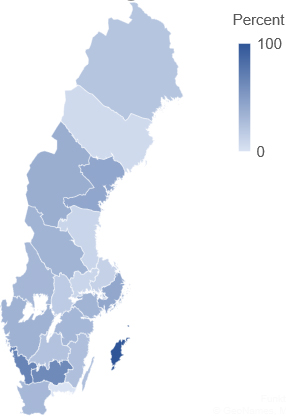
As illustrated in Fig. 2, the most common statement category is “benefits,” (
We attempted to analyze differences between the distribution of values across municipalities on the basis of political alignment (left or right) and status (urban or rural) but found that no major differences could be explained by these factors.
Statements related to the professionalism ideal
Statements related to the professionalism ideal
Statements related to the efficiency ideal
Value distribution.
Tables 2–5 below include example statements from the policies. The statements are distributed among the value positions that were articulated by Rose et al. (2015) and among the categories from Toll et al. (2020). As is evident from Table 2, the statements that are related to professionalism include may refer to adherence to rules and legislation (legality), to notions of IT security and cybersecurity, and to the robustness of public administration. The ideal of efficiency (Table 3) involves automation efforts that are directed at reducing the use of public resources, while the risks of this ideal are associated with increased costs. The service ideal often manifests in statements about digital services (or e-services) that are intended to make tasks easier for citizens while ensuring that the service reflects user needs and life events rather than administrative processes. The engagement-related statements include ideas such as the involvement of citizens in government affairs through digital tools and dialogue, while the considerations and the risks are related to citizen trust and the understanding of digital tools.
While coding the statements, we noticed that the strategies contain several identical statements. While this may have been coincidental in some cases, many of these identical statements were lengthy and reflected optimism about the effect of digitalization on several types of values. Three examples follow:
“Strategic governance and increased coordination of digitalization and development efforts will lead to better services and lowered costs” (S30 and S82). “By taking advantage of the opportunities of digitalization in [Municipality X], the service can be improved, quality and efficiency raised, and, thereby, we can free time and resources to meet the demands of those for whom we exist” (S63, S66, and S82). “The opportunities associated with robotics and AI (artificial intelligence) must be seized to create efficient processes” (S37, S6, and S47).
Statements related to the service ideal
Statements related to the engagement ideal
Since we were interested in the relationships between value ideals, we determined the frequency with which different ideals were expressed in the same statements. If two values are embodied in the potential benefits that are mentioned in a given statement, they can be seen as congruent outcomes of a digitalization initiative. As described in Section 3, we investigated list statements that include several values. To determine value congruence, we analyzed how often the value positions in these statements occur together. The results of this analysis are presented in the chord diagram in Fig. 3.
It is evident from Fig. 3 that there is a relationship between efficiency and service, which suggests that local governments are striving to improve services for citizens while keeping costs low. There is also congruence between engagement and service, with citizens being informed about the services that they can logically expect, as noted in previous research (see, e.g., Sundberg, 2019:1; Rose et al., 2015:2). While the efficiency ideal (and NPM) are often associated with departures from the heavy bureaucracy of the professionalism ideal, the ideals in question also exhibit commonalities, such as a focus on internal administrative processes, which may explain why they were mentioned together in the materials. Finally, engagement values were rarely mentioned alongside professionalism or efficiency, and there was no strong connection between service and professionalism.
Evaluation-related statements, including values
Evaluation-related statements, including values
Value relationships.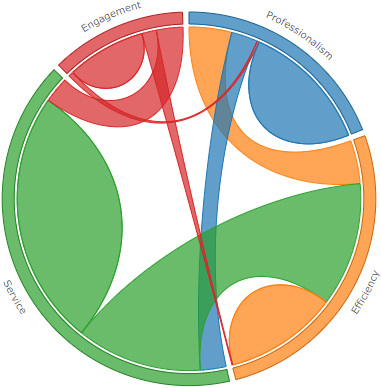
As shown in Table 6, of the 120 paragraphs that mentioned evaluation, 22 concerned efficiency, 19 concerned service, eight concerned professionalism, and three concerned engagement. Outcome evaluation is important because it serves as the basis of accountability under the NPM-based efficiency ideal (see, Rose et al., 2015). Therefore, is unsurprising that accountability is the most frequently evaluated value, usually as a part of budget-related works that refer to monetary indicators. The evaluations of service involved indicators of the use of (digital) government services by citizens. Several municipalities had used a specific national tool that is provided by the Swedish Association of Local Authorities and Regions (SALAR) to evaluate both efficiency and service values. Interestingly, several of the indicators that are used with the tool involve the assessment of participatory practices in local government and of values associated with professionalism. However, the tool is not mentioned as a means of evaluating these values. The evaluation of engagement-related values is sparse, and as mentioned, values that are related to this ideal appear relatively infrequently. No specific methods for evaluating professionalism were identified in the materials, although IT security efforts are mentioned frequently.
As noted in Section 3, we coded the other evaluation-related paragraphs inductively on the basis of the characteristics of the materials, with a focus on “what?” and “how?” questions (Table 6). The most common finding (
Evaluation-related statements without references to value
Evaluation-related statements without references to value
Our analysis of the digitalization strategies yielded several interesting findings about the distribution of values and the relationships between them, as well as about evaluation efforts. In this section, we discuss those findings by reference to the two RQs.
RQ1: How are values distributed in the digitalization strategies that Swedish local governments articulate?
Our findings, in line with those of Toll et al. (2020), indicate that most of the statements in the strategies anticipate the beneficial outcomes of digitalization and articulate few risks. Moreover, we encountered several statements that are difficult to associate with a value position, many of which reflect optimistic narratives about the outcomes of digitalization (e.g., “smart”). Therefore, the strategic narratives that we found in the documents can be described as predominantly optimistic. In addition, the strategies draw on a repository of identical statements; a sort of “parrot syndrome”. A plausible explanation is that the municipalities borrow from the discourse in higher-level documents, such as those produced by national and pan-national bodies. It appears that, unlike in other policy areas (see, Verhoeven et al., 2022), in the context of digitalization, municipalities are apt to use content from higher authorities rather than adapting digitalization to local conditions.
These results lend support to the argument that the process of digitalization is characterized by techno-optimistic narratives. As Büchner et al. (2022, p. 23) noted, “Similar to the well-known discourses on innovation, digital technologies are often connected in a persuasively positive sense or appear as universal solution strategies.” One of the negative consequences of the aforementioned “parrot syndrome” becomes apparent in this context: municipalities refrain from facilitating local translations of strategies and instead circulate common and universal stories from other sources. There is thus a risk of the narratives becoming rigid, overoptimistic and expressing an agenda about the superiority of digitalization. Ideally, the documents in question would express and assess a diverse range of technological frames (Orlikowski & Gash, 1994). Instead, these narratives may lead to the stabilization and institutionalization of the dominant positions and representations of problems (and solutions) that are associated with digitalization (Lindberg et al., 2022). These overly optimistic stories may, in turn, lead to failed implementations that neglect risks or lack clear value-enabling purposes (Cui & Osborne, 2022). As noted by Sundberg (2019:2), similar stories can be found in strategic documents on IT from the 1990s, with setbacks and disappointments after the turn of the millennium.
Meanwhile, the strategic narratives that we observed were closely linked to a service-dominant logic, often in congruence with efficiency benefits. This result is in line with previous studies on values in the Swedish government (Sundberg, 2019:1; Sundberg, 2019:2). Those studies indicate that values have shifted over the last decade, with government institutions adopting an increasingly service-oriented logic. Our analysis shows that efficiency and service values are often mentioned together in strategic documents. This tendency may be inherently contradictory because efficiency is often gained by limiting services, which reduces costs (Bertot & Jaeger, 2008). We find this narrative to be potentially questionable, especially given the lack of evaluation procedures. As Wilson (2022, p. 8) noted in a study of national AI strategies, “the consistency of congruent relationships is worth noting and might raise concerns about whether the policy frames and value ideals advanced by national strategies are acknowledging the policy trade-offs necessarily implied by AI design and implementation.”
The relatively low frequency with which engagement-related values occur in the texts, which accords with past research (see, e.g., Persson et al., 2017; Toll et al., 2020), is important. One implication is that in local government, digitalization is not intended to promote e-democracy. The professionalism ideal, unlike the other value positions, entails an equal number of benefits and considerations. A plausible explanation is that bureaucratic values are often expressed in terms of obligations and means rather than in terms of outcomes and ends: they are built on a rule-based logic rather than by reference to outcomes and consequences.
RQ2: What methods for evaluating values do the strategies mention?
Interestingly, most of the paragraphs that refer to evaluation simply state that it is necessary to evaluate the outcomes of digitalization without identifying precise methods or tools. A few tools concerned evaluation of efficiency and service values. Quantifiable indicators such as citizens’ access to broadband, and references to tools for digital maturity are also present in the materials. Overall, the discussions of evaluation tools and methods lacks specificity with regards to the outcome of digitalization in local government. Although the strategies are overarching in nature, their legitimacy and utility, we argue, can be greatly improved by establishing links between digitalization initiatives and the assessment of outcomes in relation to values. While benchmarks and comparisons between the levels of digital maturity that different organizations exhibit may be useful, the tools in question are not tied to the outcomes (values) of said maturity.
These results have important implications for practice. We could not tie some of the terms from the strategic documents to specific value ideals. Although this finding may be partially explained by the use of everyday language in the documents, it is also possible that their content was diluted by the introduction of terms such as “smart” and “quality” as well as by references to general notions about the benefits of digitalization. We argue that these general notions may generate difficulties for municipalities that attempt to evaluate the strategies. While evaluation efforts are mentioned in the materials they are expressed at a high level of generality. The materials comprise strategic documents that are designed to be interpreted by a wide range of actors in a municipality and therefore include statements that those actors would need to refine in practice. This said, clarifying the expected outcomes, in terms of the forms of the values that digitalization should realize, and proposing means of evaluating these values would arguably be beneficial. Echoing Córdoba-Pachón (2017), we contend that such a clarification would likely contribute to grounding evaluation in the day-to-day operations of e-government stakeholders as well as support continuous learning.
Accordingly, we argue that the next generation of digitalization strategies would benefit from a shift from techno-optimism (i.e., an exclusionary focus on the potential benefits of digitalization) to a more nuanced narrative that reflects more risks and links values to evaluation efforts. Thus, as noted in Heidlund and Sundberg (2022), additional studies on e-Government evaluations that are based on best practices (if such practices exist) are needed – our search for such evaluations in the digitalization strategies only identified a few general statements.
Conclusions, limitations and suggestions for further research
The purpose of this paper was to gain an understanding of the narratives in the digitalization strategies articulated by the Swedish local government. The findings generated insights into the distribution of values in these documents as well as important knowledge about the proposed evaluation efforts. The study builds on the theoretical and methodological foundations of value positions that are derived from previous research on e-Government. The results contribute to an overall understanding of the strategic narratives that surround digitalization, including the distribution and evaluation of values.
The findings generated insights into the distribution of values in the policies, which enables comparisons with previous research in the field. In line with the results obtained by other scholars, we found that participatory and democratic values feature in a minority of statements, which suggests that local governments in Sweden do not focus on the use of digitalization to promote e-democracy. Instead, a recurring narrative in the strategies binds the values of service and efficiency together. The dominant story is based on digitalization promoting services and reducing costs or the time that it takes for a service to be provided. As Nyhlén and Gidlund (2022) suggested, that there is a taken for granted logic of digitalization being a solution to many problems even though existing research has shown that this reasoning is fallacious (i.e., Bertot & Jaeger, 2008). At the same time, highlighting service and efficiency values obscures narratives about the story of democracy and engagement (intentionally or unintentionally, as suggested by Bekkers and Homburg, 2007).
Most of the statements in the strategies anticipate the beneficial outcomes of digitalization, and few risks are articulated. We also noted that the strategies share a repository of identical statements from national strategies as well as general assumptions about benefits. Numerous vague statements that cannot be tied to a value position are employed. This vagueness, together with a general lack of specificity about evaluation methods, may pose challenges for organizations that wish to use the strategies to guide their work on digitalization.
In addition to these practical implications, the study makes a twofold contribution to the literature. First, we applied and extended Toll et al.’s (2020) methodology for policy analysis. We merged the methodology that those authors developed with directed content analysis, and we extended the scope of the analytical exercise to examining value congruence, and evaluation statements as objects of study. Second, we contributed to research on the mapping of the discursive landscape of digitalization (i.e., Nyhlén & Gidlund, 2022; Bekkers & Homburg, 2007; Schou & Hjelholt, 2019) by highlighting how certain values are prominent in certain narratives while others are left out. In the case under observation, the missing narrative or alternative story is that of democracy, which we believe to be vital for both government and e-Government.
Limitations and suggestions for further research
Based on the results of this study, we propose three directions for future research.
First, our study solely focuses on the Swedish local government context. Many studies of values have been conducted in the Scandinavian context (Toll et al., 2020; Ranerup & Henriksen, 2019; Ranerup & Svensson, 2022; Rose et al., 2015; Persson et al., 2017; Rose et al., 2018). An interesting avenue for further research would be to compare strategies from vastly different nations, for example by focusing on developing economies.
Second, our study is limited to studying government documents. As such, we encourage others to study the practical enactment of strategic narratives. Without a strong link between policy and practice, there is a risk that the narratives that surround digitalization will remain techno-optimistic stories rather than important strategies that can guide implementation.
Third, we identified numerous similar statements in the strategies. We referred to this tendency as the “parrot syndrome.” Further research should investigate the underlying practices and the discursive linkages behind these formulations. A fruitful approach to this endeavor would be to inquire how and why government digitalization strategies are created and to identify the actors that construct them.
Footnotes
Acknowledgments
This research was funded by Örnsköldsvik’s municipality.
Authors’ biographies
Marcus Heidlund is a PhD student in Information Systems at Mid Sweden University. He is part of the Forum for Digitalization research group and his research interest include digitalization, values, and modernity studies. The research is conducted within the e-Government domain, with a focus on the Swedish public sector.
Leif Sundberg is a researcher in Information Systems at Mid Sweden University. Leif’s research interests include digital government, public values, e-participation, and artificial intelligence. His work has been published in international conferences such as IFIP-EGOV-CeDEM-ePART and journals, such as Safety Science.