



Abstract
How has the adoption of internet-based platform politics impacted Latin American party systems? This paper fills an important gap by creating novel categories and tracing patterns for understanding how political parties of 18 Central and South American countries practice politics online. Our work is informed by the equalization versus normalization debate between that sees the Internet as either consolidating institutional parties’ strength or giving strategic advantage to new and smaller parties.
Our analysis takes a four-step approach to address the initial question. First, we conceptualize platform politics in a Latin American context and generate hypotheses. Second, we create a dataset to map online and offline national party systems across Latin America. Third, we introduce four categories (equalizers, normalizers, laggards, marginals) to capture different parties’ online positioning. Last, we explore platform politics by comparing four parties belonging to the different categories – FMLN in El Salvador, Novo in Brazil, PPC in Peru, and MORENA in Mexico – and showing how they use social media to overcome their structural limits. Overall, this work finds great regional variation to extend the validity of the cyclical nature of equalization and normalization to the Latin American context.
Introduction
In Latin America, political parties have established themselves as the primary vehicle for citizen representation during the 20th century (Di Tella, 2017), in many cases even surviving interruptions of democratic order (Mainwaring & Scully, 1995). The region’s political stabilization after 1989 brought a catch-all mentality to the whole region, and many parties’ brands and ideologies have significantly diluted over time (Lupu, 2016). Once respected for their institutional role, current Latin American political parties are often accused of having oligarchical traits and of catering to private interests (Casal Bertóa et al., 2014; Cameron, 2020).
In recent decades, the Internet and social media platforms have been proposed as vehicles to fill this democratic gap, by dis-intermediating the relationship between political parties and the electorate. The advent of information technology took Latin America by storm, and nowadays, most political parties practice platform politics, using online infrastructures to connect with members, sympathizers, and potential voters. Its political parties can now directly reach the public through Facebook, Twitter, and Instagram, offering parallel accounts of political events against a corporate-owned media landscape.
Lacking previous characterization, this work addresses several core questions at a regional level: (a) Who benefits from the introduction of platform politics in Latin America? Does platform adoption advantage large mainstream political parties (normalization) or do platforms strengthen political alternatives (equalization)? (b) Where are different Latin American countries located in the transition? (c) How can we categorize Latin American parties and party systems in reference to online and offline support? (d) Do different party types practice different forms of platform politics (open and closed)?
Empirically, this work uses a novel dataset gathering data from Facebook, Twitter, and Instagram to generate findings that will shape future research. Throughout the region, we find slight support for equalization, as many small parties established a robust Internet presence. These “equalizers” exist alongside many “marginals”, electorally small parties with negligible online presence. Conversely, among larger parties, some “normalizers” use resources to cultivate a substantial Internet following. The last category identifies “laggards:” electorally important parties whose vote base dwarfs their meager online support.
Our results capture how (1) equalization and normalization are temporally determined as steps in party systems’ Internet adoption; (2) Latin American party systems are less fragmented online than at the electoral level; (3) country size and Internet diffusion do not dictate intensity of platform use within a party system; (4) some nations such as El Salvador and Uruguay are at a mature adoption stage, while others like Mexico and Argentina are still behind. Last, through four short case studies from Brazil (Partido Novo), Peru (PPC), El Salvador (FMLN), and Mexico (MORENA), we show that (5) Latin American political parties creatively use social media to overcome their structural limits.
Conceptualization and methodology
In Western Europe the introduction of web-based platforms in the early 2000s had important consequences at intra-party and party system levels (Margetts, 2001). It accelerated parties’ organizational transformation making them akin to networks (Heidar and Saglie, 2003) and empowering some components over others (Lioy et al., 2019). This transformation is now also happening across Latin America, where Internet diffusion surpassed 70% in 2019, while after 2015 widespread political alternation has empowered new political actors (Alcántara Sáez, 2019). A parallel survey of these interacting processes is overdue.
Conceptually, a study of Italian and Spanish political parties (Lioy et al., 2019) formalized platform politics as:
“the introduction of digital intermediaries (e.g. software applications, websites, social networking services) into the structure of political parties, to facilitate internal communication, engage in political decision-making, organize political action, and transform the overall experience of participation in political parties.”
In other words, platform politics is an attempt to bring political parties’ activities on the Internet, encompassing different kinds of online activity, ranging between the opposite styles of open and closed platform politics. Here, platform is used to indicate “a container, a structure, a tool for deliberation and the creation of shared content.” Full-open platforms are collectively owned, transparently governed, designed for members’ user experience, and encompass multi-directional information flows. Conversely, a closed platform is proprietary, based upon exclusive owners’ rights, and generally used to disseminate top-down information, as shown in the table above, taken from Lioy et al. (2019). The word participation – the act of taking part in politics, opposed to political inaction – also warrants some reflection, since citizens’ online political activities have been and are still made an object of widespread skepticism. On a general level, we stand with Vissers and Stolle (2014) in treating political participation on the Internet with the same dignity of its offline counterpart, at a minimum as part of political discourse, even when it does not result in direct physical political activity or mobilization.
General criteria for platform openness.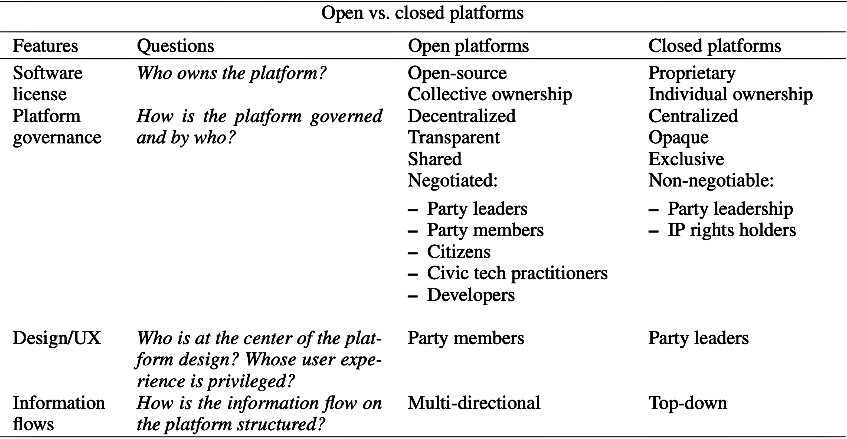
Ideally, parties interested in internal democracy develop applications or members-only websites to practice open platform politics. This was the route for movement-based parties like Italian Movimento Cinque Stelle (“5 Star Movement”) and Spanish Podemos (“We Can”) with their platforms Rousseau and Participa. Yet, even they have been accused of plebiscitarianism and practice direct, not deliberative, online democracy (Gerbaudo, 2021). Their experimentation has not been followed by traditional parties in Italy and Spain, although other European formations such as the UK Labour Party are catching up (García Lupato & Meloni, 2023). Following these findings, one can imagine the existence of a connection between national levels of political support online in Latin America and the level of democratic openness in platform use. Please note that the following conjecture is
Within this study, a political party is an organization that competes in national-level legislative elections.
After the global spread of Web 2.0, social media platforms became one way to practice platform politics – arguably the most popular – since most political parties have yet to adopt custom-made platforms. At present, both the scholarship and the general public are aware that social media is not neutral, due to automatic filtering and heavy content moderation, incorporating implicit bias and reflecting their owners’ normative commitments (Chander and Krishnamurthy, 2018; Hallinan et al., 2022). Moreover, since private companies can modify proprietary algorithms, control by political parties starts and ends with page management. Even so, many ways – more and less open – remain to engage party members, followers, and sympathizers using Facebook, Instagram, or Twitter profiles. This has been fundamental for social movement organizations, and even in places like Syria and Egypt, where democracy was absent and freedom of speech limited (Ozgul, 2019).
In a Latin American context, since proprietary platforms are not currently popular among political parties, social media platforms are the main medium for engaging party members and the electorate. Furthermore, although some argued for the effectiveness of non-political content on social media (Pal, 2015), a recent Brazilian study showed that politicians mostly use political content (Oliveira et al., 2020), as only outsiders benefit from initially proposing generic content to create their audience. In Mexico, social media has lowered access barriers to institutional politics, allowing outsiders to run campaigns without mainstream media support or outside of a major political party (Ramirez Plascencia, 2020). In parallel, the evolution of Latin American mainstream media towards corporate ownership (Lugo, 2008) opens a vital role for alternative, radical, and citizen media use by political activists across the region (Harlow & Harp, 2013). Parties use online platforms to act as independent media, control event framing, and challenge traditional channels (Kalsnes, 2016). Social media adoption by social movements is similarly well-documented and in Brazil, it catalyzed the coalition behind Dilma’s impeachment (Cavalcanti et al., 2019). Last, the capacity of online platforms to connect supporters’ niche positions led to arguments that Internet politics favor fragmentation (Galais & Cardenal, 2017). Following this argument, we propose:
Where by (national) party system we indicate the system composed by electoral parties competing for government in their interactions, in a specific country, following common practice in political science.
Beyond communication, Internet usage by political parties has broader consequences, as parties’ online presence shapes their tools for reaching the public and, in a broader sense, their networks for electoral mobilization (Jacobs & Spierings, 2016). In particular, given how access to mainstream media is constrained, with most space dominated by larger political actors, the advent of the internet was looked at with curiosity because of its potentially transforming power. Since this paper covers both party-system and single-party-level issues, it is informed by the debate between equalization and normalization, which follows a disagreement about the Internet’s transformative political power (Severin-Nielsen, 2023).
Proponents of normalization argue that larger formations are generally able to successfully leverage superior monetary, professional, and motivational resources in their internet usage (Jackson & Lilleker, 2011; Kruikemeier et al., 2018; Luna et al., 2022). In other words, the process of normalization sees larger political parties consolidate their electoral and/or organization advantage by extending it to the internet. This approach sees the adoption of platform politics as just than an element that – despite its novelty – reinforces existing patterns and reproduces current inequalities within party systems. Conversely, proponents of equalization find that internet and social media have helped smaller parties to bridge the support gap and grow stronger within existing party systems, thanks to low economic and technological access barriers (Gibson & MacAllister, 2015; Steffan & Venema, 2020). In other words, the process of equalization sees smaller political parties improve upon their electorally and/or organizationally subordinate position through a competent use of internet platforms.
The two hypotheses were recently tested through comparative material in the context of the 2019 European Parliament elections, finding equalization in advertising and activity, while normalization prevails when the parties’ online reach is considered (Bene, 2023). This binary choice comes with its own problems, since using this dichotomy in isolation portrays a landscape in constant flux as if it were static. In reality, the progressive introduction of platform politics within national party systems shapes the equilibria observed at a specific moment in time. Countries where political parties adopted early technologies, like Australia, the Netherlands, or Norway, offered evidence of a cyclical component, with alternation between normalization and equalization (Potter & Dunaway, 2016). Similarly, Jacobs and Spierings (2016) differentiate between (a) an early adoption phase with some tendency towards equalization, as small parties modernize first, by adopting the new technologies at low cost and with little to lose; (b) a phase of widespread use where bigger parties normalize their roles within the party system, with leaders strategically choosing which innovations to adopt; (c) a laggard phase where non-early adopters consolidate their subordinate status without disappearing from the party system. Following this discussion, two opposite hypotheses are cast for Latin America:
To address these hypotheses, our data collection recorded followers on three platforms for all Latin American parties that had parliamentary representation in mid-2020. The 18-country dataset includes 157 parties, from a minimum of 5 for Bolivia and Dominican Republic to a maximum of 15 for Brazil. We collected all follower-related data on May 15–30, 2020, while legislative voting figures came from parliaments’ or electoral tribunals’ websites. In bicameral legislatures, we chose the lower chamber.
Our analysis has three parts:
Addresses our hypotheses 1-2-3 regionally, creating four comprehensive categories for the 157 parties in the dataset. Performs a comparative analysis selecting four parties from the 18-country dataset to see whether higher online support implies more open platform politics. Analyzes the Facebook content of selected parties and compares online patterns.
The following section addresses an important scholarly gap at Latin American level: while the classifications of parties and party systems based on their presence on the ground and their electoral performance are abundant, there is no such thing for their activities online. Scholars of government, and many among the Latin American public, know which parties are large and small or traditional or innovative at electoral level. In contrast, this study offers for the first time the same classification for their use of internet technologies to perform platform politics. Academic classifications of party systems begin by counting the number of relevant parties,3
The number of parties that have relevance when it comes to government formation.
Where the
As of 2020, the 157 political parties in our dataset cumulatively received 209 million votes in the last legislative elections in 18 countries. Their online numbers were also large, at 16.5 million cumulative followers on Facebook, 9.7 million on Twitter, and 3 million on Instagram, with a total of 29.2 million followers over the three platforms, and setting the average voter-to-followers ratio across Latin America at 7.15. A party, or party system, whose cumulative followers over the three platforms number over 1/7 of its voters has therefore above-average online support.4
How high is a 7.15 voter/follower ratio? Lacking global data, we can compare Internet-savvy European parties. For instance, the British Labour party had 2.1 million combined followers, vis-à-vis 10.2 million voters in the 2019 election. Italy’s movement-party Movimento Cinque Stelle is on similar levels (10.7M voters, 2.2M followers). Both have therefore a voter/follower ratio around 5. Beyond Europe, India’s Bharatiya Janata Party has 229 million voters and 35 million combined followers (ratio
Table 1 provides stylized facts. It includes the average ratio between online followers and legislative votes for the main parties, the most recent legislative votes cast for parties, the number of relevant parties (LT index) both electorally and online, and societal Internet penetration. Three main findings are important. First, against
Latin american party systems, online and offline (2021)
NOTES: *more online support at low values; **only parties in sample; ***positive values indicate more fragmentation offline **** arithmetic, unweighed average of single-country values.
The Uruguayan, Chilean, Salvadoran and Venezuelan party systems have the largest social media presence compared with votes, with ratios below 5. It is no coincidence that those countries’ political parties have with strong organizational ties. Established mass parties like Uruguayan Frente Amplio (FA, Broad Front) and Salvadoran Alianza REpublicana NAcionalista (ARENA, National Republican Alliance) have a ratio of 2 and are active through a varied social media agenda. The opposite is visible in Bolivia and Nicaragua, where parties neglect the Internet, even if 77% of Bolivians go online. Tellingly, Bolivia’s Movimiento al Socialismo only has 3,200 followers, despite having received almost 3 million votes in 2019. Certainly, Evo Morales’ personal appeal partially determines this low figure, but scarce online support remains problematic. Mid-way into the spectrum, six of Brazil’s 16 largest parties have a ratio over 20 – one follower every twenty votes – since many national organizations have a negligible Internet presence. Yet, historical rivals Partido dos Trabalhadores (PT, Workers’ Party) and Partido da Social Democracia Brasileira (PSDB, Brazilian Social Democracy Party) have a ratio of 3 and a strong Facebook presence exceeding one million followers. These parties could support normalization, which sees larger parties maintain their resource advantage oline.
Within Latin America, some innovative smaller parties have narrowed the electoral and organizational gap through social media. Progressive Movimiento Ciudadano in Mexico and environmentalist Alianza Verde in Colombia are good examples, both with a massive Facebook presence. Grassroots Movimiento Semilla has an even stronger role in Guatemala, with the highest number of followers nationally, despite a modest 5% electoral share. Brazil has produced libertarian Partido Novo, one of only two parties in the dataset with more combined followers than voters. All of these cases could support the equalizing theory, that platform politics benefit fringe parties.
The existence of such different cases justifies the necessity of a regional survey. After establishing a general relationship, we propose a party-level (as opposed to national- or party-system-level) categorization. Table 2juxtaposes Latin American political parties’ electoral strength and their social media following. Here “major” is any party with a more-than-average vote share (
Crossing these two measures of party strength online (on social media) and offline (electoral), we obtain four analytical categories:
Conversely, Before examining the other two groups, notice how the case study literature on online party politics focuses largely on these first two categories. This is due to a salience bias, as it is more interesting to study successful phenomena. Electorally Finally, electorally
Online and offline positioning of latin american political parties
Before selecting four case studies analysis, Table 3 is ordered by voter-to-followers ratio at party system level, to show the relevant discrepancies across the continent. It separates Latin American countries between advanced (
Equalization and normalization in latam party systems (2021)
The countries with the highest social media support rates – El Salvador and Uruguay – show evidence of normalization: their largest parties have a strong Internet following and only marginal formations fall behind. Conversely, equalization at the systemic level dominates in Chile, as both large parties – conservative Renovación Nacional and Unión Demócrata Independiente – are laggards in Internet support, while 8 out of the 11 smaller parliamentary parties act as equalizers.5
Luna et al. (2022) discuss the prevalence of normalization in Chile, but their study targets electoral campaigns at the candidate level.
To choose our short case studies for analysis we followed a two-round procedure, first among party systems (countries) and second within selected countries’ political parties. We followed common practice to apply a criterion of diversity, which guarantees that our sample is representative at country and party levels (Seawright & Gerring, 2008). The variation here was provided in terms of party system fragmentation or institutionalization, ideology, age of organization, and finally by the four categories in this article’s model. It will provide important leverage for arbitrating the first conjecture (C1) and for beginning a comparative discussion of the online behavior of Latin American political parties, one that is currently missing from the literature.
Our case selection grants evidence from the Salvadoran, Mexican, Peruvian, and Brazilian party systems, which share a Presidential system of government and democratic consolidation. The first two party systems have higher institutionalization and fewer parties in the legislature, while the others have lower entry barriers and higher fragmentation. Then for the parties, we selected across the electoral and online strength/weakness axis, also picking different characteristics and diverging ideological leanings. Within this setup, we chose two traditional political parties at ideological opposites – conservative PPC in Peru, socialist FMLN in El Salvador – and two newer partisan organizations – left-wing MORENA in Mexico, and libertarian Novo in Brazil. Notice how each choice also fits a category – equalizer, normalizer, marginal, laggard – for online and offline support, and can illustrate how the different dynamics work.
For the four party-case-studies, we collected data from their national page on Facebook, the most popular platform across Latin America, during the whole month of June 2020 and then also for the month before the last national election. In practice, we recorded quantitative metrics concerning likes, shares and comments, and the basic features of each post such as the choice of media (video, text, photo, infographic…), the main color, the length, and the presence of specific politicians, for all posts on September 1–15, 2020, in what can be considered a mixture of inductive and deductive qualitative coding (Skjott Linneberg & Korsgaard, 2019). To ensure validity, we focused on straightforward features of social media posts, not subject to interpretation, as we were not interested in performing a thematic or discourse analysis. We recognize that ideally one would have been able to also reconstruct the activity of the party’s main leaders and regional/local chapter, but believe that for an exploratory study like ours, this methodology is able to provide some generalizable evidence. Table 4 summarizes qualitative findings for selected features across the four case studies.
FMLN in El Salvador as a Normalizer (strong party, large Internet support)
After the civil war, El Salvador’s two-party party system gravitated around ARENA6
Alianza REpublicana NAcionalista (National Republican Alliance).
Frente Farabundo Martí para la Liberación Nacional (Farabundo Martí Front for National Liberation).
Gran Alianza por la Unidad Nacional (Great Alliance for National Unity).
FMLN was constituted in 1980 as a coalition of revolutionary political parties9
Including the Partido Comunista de El Salvador, founded in 1930.
Summary statistics on social media usage for the four case studies
ratic opening. Having institutionalized as a mass political formation, FMLN maintained legislative and local representatives for several years, until in 2009, it won the presidential elections, breaking the 20-year hegemony of right-wing ARENA. These elections sparked changes in El Salvador’s party system (López Bernal, 2016) bringing alternation in government and important strategic changes in the two hegemonic parties. If ARENA had to reestablish its internal leadership, FMLN needed to reevaluate its priorities as a new government party. The presidency almost returned to ARENA in the 2014 elections, as Salvador Sanchez Cerén (FMLN) won with 50.1%. Then FMLN only gathered 24% in the 2018 legislative election. Finally, the party lost the presidency in 2019 to Nayib Bukele (53%) from GANA, a new party registered in 2010. The FMLN candidate Hugo Martinez gathered only 14.4% of votes.
Looking directly at our case study, FMLN has massive online support despite the country’s small size, with over 300,000 Facebook followers and 450,000 combined on the three platforms, remarkable in comparison to its 520,000 votes in the last legislative election. El Salvador shows evidence of advanced adoption and FMLN absolves the role of a normalizer, as a large mass organization leading its party system in online support. Among the four parties analyzed, FMLN is also the most open in its platform politics, as its social media managers aim to create dialogue channels with followers by asking for their opinion on public matters, and creating active conversations, unlike MORENA, PPC, and Partido Novo, which solely maintain a top-down style of communication and information flow.
The party produces its online content. The information on the Facebook page focuses on the party’s history and its ideology of “institutionalized revolution,” while keeping variability among posts. Common examples that illustrate thematic variations are posts that aim to accuse other parties’ representatives of neglecting the common good, declarations about FMLN’s goals and the party’s work in different municipalities, event announcements, and posts that explicitly call the population to vote for the party’s candidates. There is also some positive variability in terms of formats, relying on images, photos, videos, and live streams. Similarly, it maintains a consistent ratio of engagement across different periods.
Within a consistent communication style, the two periods present some important differences: during the non-campaign month, FMLN showed more reposts from other media, encouraging followers to visit its other platforms, Youtube and Twitter, and it is the only political party in this analysis that reported more posts during the non-campaign period than the month before the 2018 elections, with a daily average of 2.6 posts during the campaign. The party also showed a higher number of non-campaign posts aiming to increase the number of electors than in the campaign, suggesting that it maintains an active online strategy, as a result of the overwhelming defeat in the last elections. Beyond Facebook, the party does not have a custom-made platform, nor uses a specific application to reach its members online. Both features limit its online capacity, and its social media usage is not open enough to conversation and bottom-up information flows to make it up.
Differently from El Salvador, Brazil is in an intermediate phase of online adoption, where there is a window of opportunity for internal equalizers to increase their power. Brazil also has a fragmented party system (
We examined Partido Novo (New Party), one of two Latin American parties whose combined followers exceeded their votes.10
The other is the small Paraguayan movement-party Movimiento Cruzada Nacional, founded in 2018, which received 56,000 votes (2.7%) in the last legislative election, and has almost 60,000 combined followers (17%).
It is a truly new formation since its founders came from unaffiliated professionals from the Rio and São Paulo states. The Internet has been in its core agenda since its origins in the Região Sudeste (Silva de Oliveira et al., 2019) and Novo had 1.3 million Facebook followers in 2016 and has over 2 million today. On Twitter and Instagram, the party has over 200,000 and 400,000 followers respectively and its online presence intends to bring members from political frustration to action. Novo also shows how platform politics can bring a rapid cadre-to-mass party transformation, as the party saw the largest membership growth in Brazil over the past decade. Ideologically, it is a classic liberal party with a twist, using the Internet to empower individuals. The party statute hopes to reduce the state’s economic interference and the gap between high taxation and low-quality public services.
Yet, Novo’s social media content is generally traditional and its platform politics remain rather closed. The Facebook page mostly uses top-down communication, sharing declarations and policy proposals coming from elected representatives over several topics. Most posts contain an internally-produced image with text, often a politician’s photo. The campaign period also had many videos (40%) with an average of 50,000 views. There is also a high amount of platform exchange, using Facebook to highlight Twitter and Instagram content. Among its candidates, Rogerio Chequer was popular for his activism in the Vem Pra Rua (“Come to the street”) social movement to impeach Dilma Rousseff. On September 20, a video featuring his candidacy reached a staggering 610,000 views. The electoral results’ announcement also had resonance, gathering 357,000 views and 28,000 likes, helping consolidate the positive electoral performance. Engagement is constant, with around 1,100 likes, 135 comments, and 190 shares per non-campaign post (June 2020) and 2,107 likes, 198 comments, and 591 shares in the campaign period (September 2018).
Last, the party has specific campaign requests for its followers. In September Novo’s leaders appealed to include João Amoedo in televised presidential debates – he needed 6% in pre-electoral polls – and asked supporters to pressure TV networks to ask for his participation. This ambitious goal failed, but it exemplifies the party’s mixed approach to platform politics. In the pre-electoral week, it similarly exhorted followers to convince friends and family to vote for Novo, participate in rallies, follow local candidates’ accounts, and wear orange (the party’s color).
Overall, Novo established itself as a very unique political party in Latin America, and its challenge is now to grow into a larger formation. Yet, its internet reach appears to have plateaued and lost its initial innovative aura, as shown by the application Partido Novo 30, that the party developed for the Android operating system. While it could have represented an opportunity to open dialogue with members and followers, it only works as a private media outlet, with nothing more than a contact form for people to reach the party.
The Mexican party system is also transitioning to full Internet adoption. A 10.8 voters/followers ratio indicates that almost all parties are much more popular electorally than online. It offers a drastic departure, as its party system is significantly more fragmented online (
In this scenario, MORENA11
MOvimiento REgeneración NAcional (National Regeneration Movement).
Partido de la Revolución Democrática (Democratic Revolutionary Party).
Partido de la Revolución Institucional (Institutional Revolutionary Party).
MORENA’s Facebook account shows a decentralized communication style: several independent accounts use different schemes with followers, serving the party’s regional branches and local organization. Morena Sí is the main account from which the federal-level party interacts with people, accounting for 600,000 followers, much fewer than its 21 million legislative voters. Notice that MORENA, while having won the largest parliamentary representation, has only the fourth-largest online following in Mexico. Coherently with this positioning as a laggard party, with large electoral support and a small Internet presence, it is only present on 7 of 12 social media surveyed and even lacks a YouTube channel.
MORENA produces little self-made Facebook content and mainly uses this space to repost statements and announcements about events from other accounts, such as the official news agency and MORENA’s representatives. Being the government party, the topics are varied. For example, in the non-campaign period of June 2020, daily press conferences, announcements, and COVID-related information stood out. The party posts an average of 1–2 posts per day, with followers’ engagement ranging from 518 to 11,770 likes, 10 to 908 comments, and 82 to 5100 shares. Although the page creates engagement, MORENA has a consistent top-down communication style, with content that neither promotes dialogue or citizen participation nor invites followers to interact with the party’s other social media.
In the campaign period, the party included more self-produced content and fewer reposts linked to party representatives. During June 2018, the month preceding the victorious Presidential elections, Facebook videos were the primary content format, except for the last-day-of-campaign Livestream, which reached a staggering 114,000 likes, 73,000 comments, and 92,000 shares. The other campaign period posts saw more engagement, with an average of 2,450, 1,264, and 1,622 respectively, and 32 more likes, 1,797 more comments, and 1,691 more shares than materials from non-campaign months. The campaign period also saw an average of 2.9 daily posts –
Finally, this analysis shows how MORENA currently faces the parallel challenges of institutionalization at both the electoral and the platform politics levels. While the party was arguably born out of a patchwork of political organizations and had a participatory component, its online presence is nowhere near as open. This is even more evident since the application created for its followers, RED MORENA, is virtually irrelevant, as it has only been downloaded a few hundred times.
Last, attention shifts to the hyper-fragmented Peruvian party system (Fig. 1). The 1990 election of Alberto Fujimori on an anti-parties platform transformed parties into volatile electoral vehicles. At a sub-national level, independent candidates constantly erode existing parties’ bases (Carter, 2020). Simultaneously, Peru is a clear regional late-comer in its Internet party support. The average voters/followers ratio is high at 16.5, and 10 of its 11 parties qualify as marginals or laggards. Only Keiko Fujimori’s Fuerza Popular has a substantial Internet following. Similarly to Brazil, the party system’s cohesion increases significantly online (LT falls from 8.8 to 4.3).
In a party system that is weak online and offline, the PPC,14
Partido Popular Cristiano (Christian Popular Party).
The party practices closed platform politics. Its online communication style is top-down and completely ignores the queries in followers’ comments. The party has a meaningful presence only on Facebook, and is barely present elsewhere, which limits its reach. Yet, it is far from inactive, as its social media managers use Facebook at a high intensity and with a clear strategy. In its social media stream, PPC attempts to capture attention with frequent event announcements, resembling the structure of a physical bulletin board. Obituaries of party members or former representatives are also sadly frequent. Little of the party’s life happens online, with few conversations or interactions taking place, and engagement levels are minimal. The average Facebook post in the sample has only 78 likes, 8 comments, and 21 shares).
Its platform politics reflect its nature as an older party. Most contents shared on social media are video-based and produced internally to reflect the leaders’ daily activities, showing debates, rallies, online/offline forums, and campaign events. Party secretary Alberto Beingolea is the party’s face through his frequent media interventions, while PPC’s communication team even uses the party’s founder, 101-years old Luis Bedoya Reyes,15
Bedoya Reyes died on March 18, 2021, in Lima.
The pre-electoral month saw more frequent materials, with a total of 120 posts. Its most viewed video in the sample months (January, and June 2020) had 52,000 views combined, portraying the intervention of young PPC candidate Lillian Alvarado Villela on a TV Peru debate. It contained an impassioned defense of a party with values, pursuing the common good. This popular post fit a broader narrative of transparency, highlighted in Facebook posts from the pre-electoral weeks tagged as #UnEquipoQueJuegaLimpio.16
“A team that plays fair”.
After this analysis one might ask whether the party’s Internet presence makes any difference. Its electoral support was stable between the 2016 and 2020 elections, despite PPC’s decision to separate from traditional ally APRA in 2020. The renewal of the party’s candidate slate has meant many of its aspirants to public office look inexperienced, and the public presentation of countless candidates has overshadowed the party’s electoral platform. The efforts made towards online activity do not hurt the party’s electoral chances, yet its Internet support is too marginal to help. As to be expected, the party does not have a proprietary technological platform or a mobile phone application.
To conclude our examination of the case studies, Fig. 1 offers a graphic representation of the four party systems, capturing the different parties’ positions.
The four party systems.
Examining four different Latin American parties helps characterize social media use, even if none of them practice anything resembling open platform politics. Information flows are top-down, and despite different engagement levels, their Facebook and Twitter pages mostly exist for information purposes. Notice how even if the two more modern parties have elaborated mobile phone apps for their members, neither is designed as a participatory tool. Nor are they used at any meaningful level by party officials and members alike. Therefore, C1 is unconfirmed: there is no correlation between higher social media support and more openness on the Internet emerging from their usage of social media and other platforms. This is important in parallel with the earlier finding for C2, which showed that online party systems in Latin America are less fragmented than their electoral counterparts. Combining the two, we can claim that although some Latin American political parties are using the internet to improve their position in the national party system, they tend to do so in a top-down manner.
As for C3, concerning equalization and normalization – where the region-wide analysis had given a slight advantage to the former – the cases show them as two ongoing processes operating in parallel both regionally and nationally. Novo and FMLN show that the Internet can matter for both small parties’ electoral growth (equalizers), and for parties with strong on-the-ground presence (normalizers). In their party systems, other parties absolve those same roles, with PT in Brazil (normalizer) having recently lost the presidency and Cambio Democrático in El Salvador (equalizer) remaining a smaller party. Whether either effect prevails depends upon national specificities, with some balanced party systems at intermediate Internet adoption (Brazil) and others where main parties have consolidated positions (El Salvador).
Simultaneously, the comparatively limited Internet presence of the other categories, laggards, and marginals, puts them at risk. It will be important to evaluate how their position evolves as the continent incorporates more digital natives into its electoral registries. In particular, while in Peru there is space for small formations to gain traction online, none of them has done so, with PPC one of many marginals. By contrast, the Mexican party system is more balanced, leaving room for transformation, with equalizer Movimiento Ciudadano facing three large laggards.
The two newer parties MORENA and Partido Novo also make for an appropriate comparison. Both portray themselves as modern organizations, but while Novo was created by professionals with little political experience (Lohbauer, 2018), MORENA’s elected politicians have a long institutional history, conveniently overlooked to cast a young image. Regarding platforms, the Brazilian libertarian formation Novo uses them strategically to expand its reach, whereas, for MORENA, the Internet is an afterthought. Novo has become a regional leader, with a modernizing online brand, encompassing the constant use of orange. Conversely, AMLO’s leadership dominates MORENA’s online presence across platforms. His actions monopolize communication and his social media account has a much stronger online presence than the party, with 7.8 million followers only on Facebook. While Novo openly approaches innovation to expand interaction formats, MORENA combines AMLO’s winning brand with content produced by representatives and news agencies. Partly because of its presidential victory, MORENA is comfortable as a laggard which resembles its under-institutionalized organization.
Regarding the other two parties, PPC’s crisis hurts its online presence even if the party’s social media managers follow a clear communication strategy combining its legacy with current leaders’ interventions. The party’s background stifles its online expansion, as the membership is old and technologically illiterate. A comparison with FMLN is possible concerning programmatic content, as the leftist party enjoys clear ideological positioning and is rooted in the country’s democratic history. Its normalizing role drove the technological modernization of Salvadoran politics, and Nayib Bukele’s success transformed the party system, making the Internet politically necessary. Faithful to its participatory politics, FMLN is the most open in asking followers’ opinions and engaging them in conversation, while PPC mostly prompts supporters to attend events and watch videos. Both are set in their respective normalizing and marginal roles.
Conclusions
Even as exploratory work, this paper covered much ground. At the regional level, the analysis shows very slight evidence of equalization over normalization, while some countries are clear technological frontrunners within partisan politics. At a granular level, comparing four political parties with different combinations in their online and offline support – equalizers, normalizers, laggards, and marginals – resulted in a rich characterization of each typology.
The study’s main limitation lies in its sources. Beyond scarce academic sources, Latin American political parties do not eagerly share their online political strategies and structures, perhaps aware of their lack of public openness, or a deficient comparative positioning. Social media data is also generally limited or restricted, creating obstacles to more comprehensive analysis. Even finding all the social media pages for all Latin American parties was a cumbersome task. Professional social media analytics have prohibitive costs in the absence of consistent grant funding if the aim is for a continental survey. Related to this is the desirability of reconstructing the full architecture of a political party’s online presence, encompassing the social media accounts of its MPs, internal leaders and local chapters, an effort that would be more appropriate for a single case study analysis of a specific party.
Another limitation is that our analysis constitutes a snapshot of Latin American parties and party systems’ Internet use in 2018–2020. Future research shall assess whether social media proficiency and support gives electoral advantages, and we offer our dataset to those who want to track evolving electoral and social media support. Yet, at least in one case, we can say that the equalizing hypothesis has some electoral evidence in its favor: Movimiento Semilla has won the presidency in Guatemala in 2023 and has now moved out of its previous status of equalizer, with which it had entered this study. One more issue arises from the study’s short time frame and is linked to the case studies treated. This work compares parties at different levels of institutionalization and age since fundation, each with their own path-dependent patterns for media usage, public image and strategic positioning. Future work could incorporate these components to offer a more complete picture.
Finally, on a complementary level, content analysis of social media posts would be a fruitful move forward. Even after some of the most popular analytics initially approved by Facebook have since been closed by the company,
Footnotes
Acknowledgments
The authors would like to thank the reviewers for their pointed comments and for holding us to the highest standards. The quality of the paper has greatly improved as a result of the review process, and for this we are extremely grateful.
Authors’ biographies
Alberto Lioy has received his Ph.D. in Political Science from the University of Oregon in September 2020 and is currently an assistant professor in the Department of Political Science of the University of Hradec Králové (Czech Republic). He holds MS degrees from the University of Oregon (United States) and the University of Macedonia (Greece), respectively in Political Science and in the Economics and Politics of Eastern/Southeastern Europe. His publications in peer-reviewed journals cover topics related to electoral participation, public protests, political personalism and the politics of the internet in a European, Central Asian and Latin American context.
Diego Contreras Medrano has received his Ph.D. in Sociology from the University of Oregon in the summer of 2022 and is currently a Senior Research Analyst within the Multilingual and Migrant Education Team of the Oregon Department of Education located in Salem (OR). His academic work mainly focuses on the societal and political impact of migration to the United States, with a specific focus on the reproduction of precarious labor in the agricultural industry.