



Abstract
This study investigates the significant influence of patriarchy on the potential acceptance and use of local digital government innovations in resource-constrained countries, building on studies that highlight patriarchy’s impactful role in shaping innovation. The Unified Theory of Acceptance and Use of Technology (UTAUT) was adopted as the evaluation theory (
Keywords
Introduction
Governments are the primary agents working through policies that support innovation for the development of the economy, society, and culture (Sorn-in et al., 2014; Nugroho et al., 2015; Choi & Chandler, 2020). The failure of digital government in resource-constrained countries is mostly attributed to culture, the growing digital divide, computer illiteracy, insufficient infrastructure, and lack of skills and competences for designing, implementing, using, and managing digital government systems (Abu-shanab & Shehabat, 2018; Syed et al., 2023; Twizeyimana & Andersson, 2019; Yavwa & Twinomurinzi, 2021). Another contributing factor is the limited adoption and utilization of digital innovations (Abu-Shanab, 2017; Alshehri et al., 2012). Local digital government innovations are essential for offering precise, relevant, and contextual information to government employees, particularly during unpredictable periods like the COVID-19 pandemic (Ahn et al., 2020; Duffet & Wakeham, 2016; Meijer et al., 2020). This trend emphasizes the increasing move toward digitalization in government (Esselaar et al., 2007; Ikuabe et al., 2020; Lazar et al., 2020).
However, there are not many studies that demonstrate the adoption of local digital government innovations; even fewer report on the influence of social factors and their influence on digital innovations in traditional societies of resource-constrained countries (Ali et al., 2019; Janowski, 2015; Senshaw & Twinomurinzi, 2020). Early adopters of digital government innovations, for example, were typically young men, particularly those who were educated and came from higher-income families (Goh et al., 2020; Miranda et al., 2018; Regan et al., 2019; Tang & Ho, 2019).
In this study, the influence of patriarchy as an important social factor was investigated. Patriarchy is a societal system in which men predominantly hold power and authority in political leadership, moral guidance, social privilege, and property control, significantly influencing cultural norms, behaviors, and attitudes (Khelghat-Doost & Sibly, 2020). Patriarchy is known to influence innovation (Syed et al., 2023) and has resulted in disparities between men and women, in the division of labor, the share of benefits, in law and state, in how households are organized, and how these are interrelated (Kassa, 2015; Masika & Bailur, 2015; Nyadera & Kisaka, 2019; Purushothaman & Zhou, 2014; Robinson & Gottlieb, 2021; Wolf & Frese, 2018). For example, gender is reported as influencing the adoption of digital technology in models such as the Unified Theory of Acceptance and Use of Technology (UTAUT) (Suki & Suki, 2017; Venkatesh et al., 2003). This study, therefore, aimed to explore the moderating effects of patriarchal norms on the acceptance and adoption of digital innovations within resource-constrained country governmental settings, utilizing Ethiopia as a case study. While the UTAUT framework guides the investigation of technology acceptance, this research extended its gender moderation analysis to examine how patriarchal norms, as a broader societal context, influence technology acceptance and usage patterns. Specifically, the study sought to elucidate how societal gender norms and power dynamics inherent in a patriarchal system shape individual and organizational responses to digital innovations (Raman et al., 2014; Tai & Ku, 2013). The study sought to answer the research question: How do patriarchal norms influence the adoption of local digital government innovations in resource-constrained countries?
The remainder of the paper is organized as follows: Section 2 comprises the literature review which examines digital government, women and gender disparities, the WoredaNet in Ethiopia and local digital innovation, and the adoption of digital technology. Next, the hypotheses are presented and this is followed by the methodology adopted. Section 5 consists of the analysis and results, Section 6 the discussion, and Section 7, the conclusion.
Literature review
Digital government
Digital government, often referred to as e-government, involves the application of information and communication technologies (ICTs) to enhance the delivery of government services, improve transparency, and increase citizen engagement (Dombeu & Rannyai, 2014; Macueve, 2008; Misuraca & Pasi, 2019). The evolution of digital government has been driven by the need to make public services more accessible, efficient, and cost-effective. This transformation has progressively shifted traditional bureaucratic processes toward more streamlined and user-friendly digital interactions (Alshehri et al., 2012; Persaud & Persaud, 2013). Over time, digital government initiatives have expanded from basic online portals to more sophisticated platforms that integrate various government functions, including electronic payment systems and the digitization of public records (Siddiquee, 2008; Irani & Kamal, 2016; Mawela et al., 2017; Mensah et al., 2020). These advancements are critical in enabling more seamless interactions between citizens and government agencies.
The successful implementation of digital government relies on several key components. Service delivery platforms provide citizens with a single point of access to a wide range of government services, while electronic payment systems facilitate secure and efficient transactions. The digitization of public records ensures the integrity and accessibility of government records, reducing the need for physical storage. Additionally, interoperability, the ability of different government systems and organizations to work together seamlessly, plays a crucial role in the effectiveness of digital government initiatives (Misuraca & Pasi, 2019). However, the implementation of digital government is not without challenges, particularly in resource-constrained environments. Issues such as inadequate infrastructure, lack of digital literacy, and resistance to change are common barriers that can hinder the success of these initiatives (Hai et al., 2021; Siddique, 2008; Irani & Kamal, 2016). Moreover, the sustainability of digital government projects often depends on strong political will, user-friendly interfaces, and robust cybersecurity measures. In regions where these factors are lacking, digital government efforts frequently fail to achieve their intended outcomes (Mensah et al., 2020; Hai et al., 2021).
In resource-constrained countries, the adoption of digital government is further complicated by socio-economic challenges. The digital divide, characterized by unequal access to digital technologies, exacerbates the difficulties of implementing digital government (Senshaw & Twinomurinzi, 2020). These countries often face additional hurdles such as poor infrastructure, low levels of ICT skills among the population, and limited financial resources, which collectively impede the successful deployment of digital government services (Esselaar et al., 2007; Abu-Shanab, 2017).
Case studies from various countries provide valuable insights into both the potential and pitfalls of digital government. For instance, the WoredaNet initiative in Ethiopia aimed to improve government efficiency by providing digital services to remote areas. However, the success of such initiatives is contingent on the adaptive capabilities of local administrations and their ability to overcome infrastructural and cultural challenges (Miruts & Asfaw, 2014; Senshaw & Twinomurinzi, 2020). These examples underscore the importance of contextualizing digital government initiatives within the specific socio-economic and cultural contexts of the regions in which they are implemented.
The future of digital government also lies in its ability to respond to the evolving needs of society. Continuous assessment and adaptation are essential to ensure that digital transformation efforts are inclusive and sustainable. Addressing the digital divide and ensuring that all citizens, regardless of their socio-economic status, can benefit from digital government services will be critical in realizing the full potential of digital government in the coming years (Choi & Chandler, 2020).
While digital government holds great promise for transforming public service delivery, it is crucial to recognize that its impact is not uniformly experienced across different demographic groups. In particular, the role of gender in the adoption and utilization of digital government services is a significant factor that shapes outcomes in resource-constrained environments (Samuel et al., 2020). The following section, engages with the critical issue of gender disparities, examining how societal norms, particularly patriarchy, influence the engagement of women with digital government innovations.
Women and gender disparities
The role of gender in digital innovation is influenced by the society’s culture (Ameen & Willis, 2019; Glavee-Geo et al., 2017; Kusuma et al., 2020; Orser et al., 2019). For example, in both Turkey and the United Kingdom, significant differences between men and women were observed due to the impact of culture, whereas no such disparity was observed in the United States or Kuwait (Samuel et al., 2020). Many African cultures, including that of Ethiopia where this study was done, are highly collectivist and high power distance cultures (Workineh & Gebremeskel, 2021). A collectivist culture is a culture that prioritizes the needs of the community over those of the individual; and a high-power distance culture is a culture that defines clear boundaries and roles accepted by the members of the community.
For example, women in Ethiopia are not treated similarly to men with regard to economic opportunities like many other resource-constrained countries (Bayeh, 2016; Demeke & Gebru, 2015; Kvasny et al., 2008). Women in Ethiopia have restricted access to employment in the public sector, despite the emergence of several policies that support and encourage women’s participation in development (Ketema & Ferede, 2020). Women are often relegated to unpaid, tedious household work that forces them into an impoverished part of society (Kassa, 2015; Pashapa & Rivett, 2017). Although the government of Ethiopia has made certain improvements, women are still deprived of access to training, modern technology, and education (Bayeh, 2016; Demeke & Gebru, 2015). Women also suffer from an over-generalized belief in the society that they can only have a lower status and engage in economically invisible work (Abubakar & Dasuki, 2018; Bekana, 2020; Güney-Frahm, 2018; Mpiima et al., 2019). They end up in lower socio-economic positions, resulting in limited access to resources, services, and employment (Abu-shanab & Al-jamal, 2015; Kassa, 2015; Uduji & Okolo-obasi, 2018). Understanding the impact of gender on digital innovation, particularly in resource-constrained and patriarchal societies like Ethiopia, provides important insights into the broader factors that influence the adoption of digital technologies. These societal dynamics are not only theoretical concerns but also have practical implications for digital government initiatives. The WoredaNet platform in Ethiopia offers one such initiative about how these cultural and gender-based challenges manifest.
The WoredaNet in Ethiopia and the local digital innovation
The WoredaNet is a digital government platform using fiber and satellite infrastructure across Ethiopia that was implemented by the government of Ethiopia to provide government services to the lowest administrative regions (Woredas). The name WoredaNet comes from “Woreda” which is Amharic for an administrative region with a population of about 100,000. It has the equivalent meaning of a district. The WoredaNet provides various digital government services to different arms of the government in Woredas. Among the services provided are video-conferencing, internet, electronic messaging, and voice-over IP between federal, regional, and Woreda sites. Web services provide civil servants with access to government-restricted information, and access to content available on the Internet in different sectors such as education, health, agriculture, and governance. WoredaNet is used to offer timely information to the lowest level of government sectors, thereby reducing travel and administrative costs. It also enables sharing of the same information to several government sectors and increases collaboration among themselves. This has also enhanced the efficiency of government sectors by shortening the execution time, reducing service shutdowns and speeding up decision-making. There are 1,050 Woredas in Ethiopia, of which 976 (93%) have access to the WoredaNet. Despite the access, only a few Woredas actively use the WoredaNet (Miruts & Asfaw, 2014).
Considering the lack of usage, a digital government web-based app was created based on the adaptive capabilities of Woredas that were actively using the WoredaNet. Adaptive capability refers to an organization’s ability to identify and respond to changes in its internal and external environment. This includes the ability to learn from past experiences, detect opportunities and threats in the environment, and make necessary changes to strategies, processes, and resources (Ogunkoya, 2018; Wilden & Gudergan, 2015). A case study with a qualitative-interpretive approach was adopted to identify the adaptive capabilities of three innovative Woredas. The Elaborated Action Design Research (EADR) approach of Mullarkey and Hevner (2018) was followed to create the web-based app. The app was used as the case study to better understand the moderating effect of patriarchal norms in the gendered adoption of government digital innovations (Senshaw & Twinomurinzi, 2020) (Fig. 1). This approach was considered easy to follow especially in resource-constrained environments where the context has not been well articulated. The approach also influences the app as it follows a co-creation process between the domain experts (local government employees) and the web developer. While understanding the technological advancements and local digital innovations like WoredaNet is crucial, it is equally important to consider the social dimensions that influence the success of local digital innovations, such as the role of gender in digital innovation in a patriarchal society.
Digital government adaptive capability web-based app.
UTAUT is an enhanced technology adoption model developed from previous technology acceptance models to examine the intention to use information systems and ultimately enhance use behavior. It presents a more comprehensive model by integrating the key features of the following individual adoption models: the Theory of Reasoned Action (TRA), the Technology Acceptance Model (TAM), the Motivational Model (MM), the Theory of Planned Behavior (TPB), the combined TAM and TPB (C-TAM-TPB), the Model of PC Utilization (MPCU), the Diffusion of Innovation Theory (DIT), and the Social Cognitive Theory (SCT) (Liebenberg et al., 2018; Raman et al., 2014; Tai & Ku, 2013).
The UTAUT model was chosen for this study because of its demonstrated accuracy of up to 70% in predicting the adoption of digital innovations. This represents a significant enhancement compared to the predictive capabilities of prior models (Lin et al., 2013; Moran et al., 2010). The UTAUT was selected in this study, instead of the newer UTAUT2, because it is better suited to the attainment of learning tasks in the workplace of government organizations (Ramírez-Correa et al., 2019). The UTAUT is also an important tool for digital government managers to measure the possibility of adoption and acceptance of a new digital government innovation within an organization. The UTAUT, therefore, enables an examination of the factors that influence the acceptance of new digital government innovations (Gupta et al., 2008). The UTAUT consists of four important constructs, namely, performance expectancy (PE), effort expectancy (EE), social influence (SI), and facilitating conditions (FC) that are core determinants of behavioral intention (BI) to use digital technology (Venkatesh et al., 2003). Moreover, the UTAUT identifies four variables: experience, gender, age, and voluntariness of use, as moderating the influence of the four key constructs on the behavioral intention and usage of technology.
Hypotheses
The key constructs of the UTAUT model are described as follows:
H1: Performance expectancy positively influences the behavioral intention of government employees to use the app, moderated by gender.
H2: Effort expectancy positively influences the behavioral intention of government employees to use the app, moderated by gender.
Therefore, the following hypothesis was tested:
H3: Social influence positively influences the behavioral intention of government employees to use the app, moderated by gender.
H4: Facilitating conditions positively influence the behavioral intention of government employees to use the app, moderated by gender.
Methodology
Data collection and evaluation
A random sampling technique was adopted to select 10 Woredas among those with access to the WoredaNet. The Amhara Regional State Science, Technology, and Information Communication Commission (STICC) assisted the principal researcher in distributing the online questionnaire using Google Forms, deploying the web-based app on its server, and assigning WoredaNet experts in each Woreda. The principal researcher provided brief training to these experts to facilitate the evaluation process. To ensure the sampling process was not biased, the WoredaNet experts were given responsibility by their respective offices to have the web-based app evaluated by randomly selected local government employees. In this regard, the principal researcher provided a short training for WoredaNet experts on how they can conduct the evaluation process. Responses were sent back to the principal researcher’s email and smartphone.
The evaluation of the web-based app was conducted by a diverse group of participants working at different levels including organization managers, experts, and district administrators/representatives from various government organizations within each district.
The online questionnaire consisted demographic questions and a 5-point Likert scale ranging from strongly disagree (1) to strongly agree (5). Following the suggestions by Owoseni and Twinomurinzi (2018), the 20 questions were modified from previous literature to determine scale validity as shown in Appendix 1. Of the 400 questionnaires administered, 270 complete responses were obtained in the period between 3rd and 27th December, 2019. The sample size was determined by considering the minimum required sample of 200, necessary to employ structural equation modeling using AMOS26 for hypotheses testing (Sideridis et al., 2014).
SPSS 26 and AMOS 26 were used to capture and analyze the data (Adil et al., 2018; Fan et al., 2016; Owoseni & Twinomurinzi, 2018). The normality of the data was assessed to ensure compliance with the assumptions of the general linear regression model. The skewness and kurtosis of the constructs (for each item) were calculated, with most items falling within the acceptable range of
The number of women in the survey was significantly lower than the number of men; however, it was still sufficient for analysis due to the overall large sample size (Sideridis et al., 2014). The low number of women could be attributed to a variety of factors, but more especially the patriarchal nature of Ethiopian society and the consequent limitations on opportunities for women (Kassa, 2015). Table 1 depicts the diverse demographics.
Respondents’ demographic data
Respondents’ demographic data
For this study, covariance-based structural equation modeling (SEM) using AMOS 26 was used to assist with data analysis. A covariance-based SEM technique is suitable for exploring models and testing hypotheses based on large sample sizes (Owoseni & Twinomurinzi, 2018).
The analysis of covariance-based SEM is divided into measurement model analysis and structural model analysis (Owoseni & Twinomurinzi, 2018; Riskinanto et al., 2017). The first deals with confirmatory factor analysis (CFA) to examine the reliability and validity of the latent variables while the second tests the hypotheses by examining path coefficients (Chatterjee et al., 2021; Parsad et al., 2020).
Moderating variables are generally left out of measurement and structural models as their effect is exclusively for moderation (Faqih & Jaradat, 2015; Gupta et al., 2008; Hoque, 2016; Hoque et al., 2016).
Measurement model using confirmatory factor analysis (CFA)
Measurement model analysis involves a confirmatory assessment of reliability, convergent validity, and discriminant validity (Riskinanto et al., 2017). To assess the model, the factor loadings of the model’s variables were examined to ensure they satisfied the minimum requirements. This was performed using AMOS 26 software. The output of the execution is described in Table 2.
Measurement model results
Measurement model results
Notes: ***: Significance at 0.000 levels, CR
As shown in Table 2, the constructs’ reliability was assessed by examining the values of Cronbac’s
To assess convergent validity, which measures the extent to which different indicators agree in evaluating the same concept, the average variance extracted (AVE) was examined for all constructs. All constructs met the minimum requirement of 0.5 (Liébana-Cabanillas et al., 2014) as indicated in Table 2. This shows that the convergent validity of the scales is good.
The final measurement of the research model was assessing the discriminant validity. This was done by examining the variance shared between the construct and other constructs (Rahi et al., 2018). The computation is described in Table 3.
Correlation and square root of AVEs matrix
As illustrated in Table 3, the square roots of the AVE were greater than the corresponding coefficients of correlation with other factors. This shows that all constructs met the discriminant validity tests. These results indicate that both convergent and discriminant validity analyses met the necessary requirements. The measurement model (
Based on the acceptable results from the CFA, the structural model was developed.
Maximum likelihood, using AMOS 26 was applied to create the structural model. Consequently, the results of regression weights as indicated in the structural model are represented in Table 4. The structural model with a chi-square (
The independent and dependent variables will have a significant relationship if the
Regression weights (Groupnumber1-Default model)
Regression weights (Groupnumber1-Default model)
Structural model.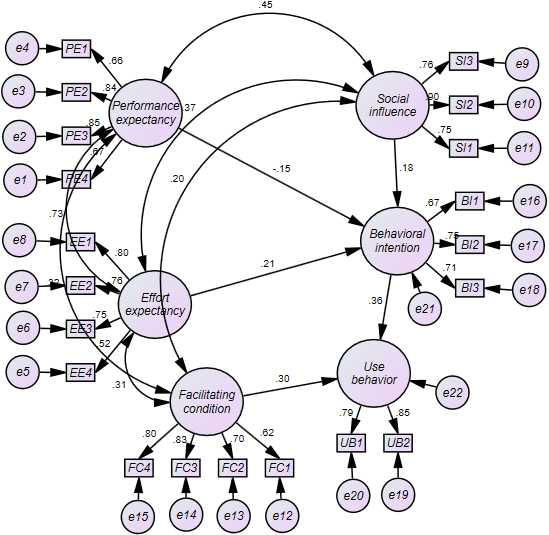
As shown in Table 4, the results indicate that PE (
One possible explanation is patriarchy (Al-Gahtani et al., 2007; Leidner & Kayworth, 2006), particularly when comparing resource-rich societies with culturally distinct ones such as Ethiopia. PE has been shown to have less impact on BI in more collectivist and high power distance cultures, like Ethiopia, where users often conform to the expectations of others in higher social roles (Im et al., 2011).
The results also reveal that EE (
On the other hand, SI (
The results also show that BI
The results show that FC (
Maximum likelihood using AMOS 26 was used to test the influence of gender on the relationship between PE and BI, EE and BI, SI and BI, and FC and use behavior of government employees to accept and use the digital government innovation. A moderating variable demonstrates if the variable could affect the direction of the relation or the strength of the relationship between the dependent and independent variables (Hung et al., 2018).
To evaluate the moderating effect of gender, cross-multiplication of the observed variables and moderating variable, gender, was carried out. The higher proportion of men to women is not significant when testing for moderating effects (Al-Gahtani et al., 2007; Chen et al., 2010; Gupta et al., 2008). The standard regression coefficients (
Moderator analysis results
Moderator analysis results
*: Significance at 0.05 levels.
Apart from the moderating factor of gender on the relationship between FC and use behavior, this research further explored which group of gender (men or women) produced the highest impact.
A multi-group analysis based on gender was implemented to examine the influence of each group on the moderation effect. As a result, the standardized regression coefficients (
The effect of gender on the moderation effect
*: Significance at 0.05 levels.
Overall, the digital government innovation was perceived as difficult to use despite being designed with intuitiveness in mind. This difficulty could mainly be due to the users not having received prior training and support in its use. This suggests that even if a digital innovation is seen as beneficial and intuitive, the absence of necessary training or understanding can hinder its adoption (Chouki et al., 2020). Thus, the need for comprehensive training and support mechanisms when implementing any digital innovation is highlighted. Nonetheless, users acknowledged that they would still use the innovation because of the social influence of their peers and bosses.
SI had a positive impact on the intention to accept and use the local digital government innovation
The finding that for the men there was a negative relationship between FC and use behavior implies that even when these conditions are improved or become more favorable, it leads to a decrease in their use behavior. This means that despite better facilities or support systems being offered to increase usage among men, the opposite trend is observed, that is, as FC improve, their use behavior diminishes. Conversely, for women, the relationship between FC and use behavior is positive and significant, with a
Similarly, Hilbert (2011) using data collected from 13 African countries, found that the lower access and use of digital technology by women in resource-constrained African nations were direct consequence of unfavorable conditions with respect to employment, education, and income. However, when these variables were controlled, women were found to be more active users of digital technology than their male counterparts. Previous research indicates that women are more easily encouraged by external facilities and resources to use a new digital innovation than men (Alam et al., 2020; Mandari & Chong, 2018). The positive influence of FC on the use of local digital government innovations emphasizes the importance of providing women with an enabling environment for technology adoption. This could include creating supportive policies, particularly for women, and ensuring that the infrastructure is in place to support the use of the digital innovation. The availability of enabling resources, training, and implementing conducive policies that target women, significantly increases the potential usage of the digital government innovation.
Limitation and future research direction
The research was limited to using only Woredas from one regional state, which may not capture the diverse experiences, needs, and challenges faced by other regions with different cultural practices, and languages. Future studies should consider including districts from multiple regional states to encompass a broader range of cultural and linguistic diversity. This expanded approach would provide a more comprehensive understanding of how regional variations influence the adoption of digital government innovations, allowing for more nuanced policy recommendations that are sensitive to the specific needs and contexts of different areas.
Conclusion
This study highlights the complex relationship between patriarchy and the adoption of local digital government innovations in resource-constrained environments, using Ethiopia as a case study. By integrating the UTAUT within a patriarchal context, this research demonstrates that patriarchy significantly moderates the relationship between FC and usage behavior in terms of digital innovations. Contrary to the traditional belief that suggests systemic barriers heavily restrict women’s engagement with technology, our findings reveal that women, despite not perceiving direct job-related benefits, engage with digital innovations at higher levels than men. These findings challenge prevailing gender stereotypes and reveal women’s resilience in overcoming patriarchal limitations.
The findings also reveal important insights that extend the boundaries of existing knowledge in information systems theory and gender studies. Theoretically, the study highlights how entrenched patriarchal structures in resource-constrained settings uniquely shape technology adoption patterns, particularly emphasizing the differential engagement of women and men with digital government innovations.
The study also contributes to the UTAUT model by integrating gender dynamics and contextual influences, offering a refined lens through which to examine technology adoption in distinct socio-cultural environments. It enriches the UTAUT model by revealing the moderating role of patriarchy, thus providing a deeper understanding of the gendered dimensions of technology acceptance and utilization. This addition not only broadens UTAUT’s applicability but also prompts a reevaluation of its constructs in light of gendered societal structures, offering a pathway for future theoretical advancements in the field.
Practically, the findings have implications for the design and implementation of digital government policies and initiatives. They reveal that women, despite not perceiving direct job-related benefits and facing patriarchal barriers, engage more actively with digital technologies. The study highlights the necessity of crafting gender-aware digital government strategies. Policymakers and practitioners are encouraged to consider these insights to foster inclusive digital ecosystems that empower all users, particularly women, in navigating and leveraging digital government services.
For the professional community, this study serves as an action call to reexamine existing practices and policies through a gender-inclusive lens, promoting equity and effectiveness in digital governance. It offers actionable guidance for designing supportive environments that mitigate patriarchal constraints and enhance women’s digital engagement, ultimately contributing to more resilient and responsive government institutions.
The study is generalizable across various contexts due to its rigorous methodology and insightful analysis of gender dynamics in technology adoption frameworks, utilizing UTAUT and SEM. By highlighting how patriarchal norms impact digital government innovation, it offers a transferable model for diverse settings, particularly in resource-constrained and patriarchal environments.
Footnotes
Appendix 1
Question items of the survey adapted from (Tan, 2013) Note: PE
Construct
Question items
PE
PE1
I find the web-based app useful to learn about what others are doing.
PE2
Using the web-based app increases my chances of getting important information.
PE3
Using the web-based app helps me obtain important information more quickly.
PE4
Using the web-based app increases my productivity at work.
EE
EE1
Learning how to use the web-based app is easy for me.
EE2
My interaction with the web-based app is clear and understandable.
EE3
I find the web-based app easy to use.
EE4
It is easy for me to become skillful at using the web-based app.
SI
SI1
People who are important to me think that I should use the web-based app.
SI2
People who influence my behavior think that I should use the web-based app.
SI3
People whose opinions that I value prefer that I use the web-based app.
FC
FC1
I have the resources necessary to use the web-based app.
FC2
I have the knowledge necessary to use the web-based app.
FC3
The web-based app is compatible with other technologies I use.
FC4
I can get help from others when I have difficulties using the web-based app.
BI
BI1
I intend to continue using the web-based app in the future.
BI2
I will always try to use the web-based app in my daily life.
BI3
I plan to continue to use the web-based app frequently.
UB
UB1
I have never used a web-based app.
UB2
I often use web-based apps.
Appendix 2
Normality assessment
Variables (constructs)
Item
Skew
Kurtosis
Performance expectancy
PE1
1.190
3.944
PE2
2.381
PE3
0.704
PE4
1.261
Effort expectancy
EE1
0.013
EE2
EE3
2.732
EE4
2.213
Social influence
SI1
0.849
SI2
0.372
SI3
0.362
Facilitating conditions
FC1
0.008
FC2
FC3
0.840
FC4
0.056
Behavioral intention
BI1
0.123
BI2
0.925
BI3
0.512
Use behavior
UB1
0.741
UB2
0.751
Biographical details
Debas Senshaw BSc (Computer Science), MSc (Computer Science), PhD in Computer Science. He is assistant professor in the School of Computing at Bahir Dar University, Ethiopia. His primary research interests focus on Digital Government, Digital Innovation, Digital Transformation and ICT for development.
Hossana Twinomurinzi BSc Hons (Mathematics), Masters (IT), PhD (IT) MSc (Computer Engineering) is a C2 South Africa NRF Rated Researcher and 4IR Professor with the Centre for Applied Data Science at the University of Johannesburg in South Africa. He is currently the Vice Dean for Research, Innovation and Internationalisation for the College of Business and Economics. His primary research interests are in the areas of Probabilistic Machine Learning, Digital Skills, Digital Government, Digital Innovation and ICT for Development.