



Abstract
Agile approaches are increasingly being used in the public sector. What is driving the adoption of agile ways of working, however, remains unclear. In this paper we ask the following two questions: Which agile approaches are being used in public sector organizations? Under which circumstances do public sector organizations use which agile practices? To analyze these questions, we conducted a standardized survey among over 450 civil servants in Austria, Germany, and Switzerland. Results from the logistic regression analyses indicate that various forms of agile practices are used in the public sector in all three countries. PSOs operating in constantly changing, uncertain environments are more likely to adopt agile. Political and managerial leadership is vital if the aim is to become more agile as a government. Finally, the results show that tasks that require constant internal and external stakeholder involvement and those that require radically new ideas and ways of working lead PSOs to introduce more comprehensive forms of agile working. This work advances the state of literature by providing the first quantitative analysis of the state of agile in the three countries, developing an analytical framework and measurement of agile government, and analyzing the external circumstances under which agile is being used in the public sector.
Introduction
The responsibilities placed on public sector organizations (PSOs) today are rising because of shifting citizen expectations and technological advancements (Cordella & Bonina, 2012). These demands are novel in their extent and content. In this context, “agility” is currently one of the most important buzzwords when it comes to innovation in the public sector. The importance of agile working styles, driven by complex environments and uncertainty, grows in times of crisis or external shocks as has been seen in events of recent years (Janssen & van der Voort, 2020; Moon, 2020). The concept of agility offers the promise of making PSOs more flexible, adaptive, and responsive by enabling collaboration beyond organizational silos, strengthening the ability to learn, and increasing stakeholder involvement (Mergel et al., 2020).
As with all new management trends, agility is not the answer to all tasks and challenges in public administration (Bornewasser, 2020; McBride et al., 2021). Therefore, it is important to question when and how such approaches add value. This study is based on the assumption that context matters for the choice of public management approaches like agile (McBride et al., 2021; Nuottila et al., 2016). Depending on the PSO’s operating environment and its demands and tasks, agile approaches may be useful. However, in a different context, they might not be appropriate. With the aim of contributing to an understanding of the contexts in which agile practices are used in PSOs this paper analyses the state of agile as well as external drivers for agile government to answer the research question: Under which circumstances do PSOs use which agile practices? Our intention is to contribute to the understanding of the contexts in which agility can add value in the public sector.
To answer this question, we provide a conceptualization of being and doing agile based on previous literature (McBride et al., 2021) that acknowledges both the individual occurrence of each and their co-occurrence in the context of PSOs (Section 2). Further, we establish an analytical framework of three different sets of external drivers that explain the circumstances under which PSOs use which agile practices (Section 3). To empirically confirm our conceptualization and test drivers for either of the two forms of agile, we conducted a standardized online survey among public officials in Austria, Germany, and Switzerland (Section 4). Logistic regression analysis shows that PSOs that perceive their environment to be constantly changing are more likely to adopt agile. Political and managerial leadership seems vital if the aim is to achieve a more profound agile transformation in the public sector. Finally, we observe that tasks that require constant internal and external stakeholder involvement and those that require radically new ideas and ways of working lead PSOs to be agile (Section 5). With our study, we contribute to the literature by conceptualizing and operationalizing agile management for standardized survey research and identifying the external circumstances that make the use of agile management in PSOs more likely, thereby complementing research on external drivers (Section 6 and 7).
Literature review
As a management concept, agile is quite common in the private sector today (Denning, 2016). Like other management concepts, it has started to make its way into the public sector. There are several innovation efforts and new management techniques geared towards making PSOs more agile (Bartonitz et al., 2018; Dib et al., 2017). While this trend is taking place, and being observed or even advanced by public management practitioners and consultants (e.g. Aghina et al., 2015; Rieckhoff & Maxwell, 2017), the scientific analysis of it is still in its early stages.
Defining agile government
Research on agile practices has only recently gained momentum in administrative sciences. A significant part of the literature attempts to define the concept of agility and to establish a theoretical framework of what it is and how it can or should be applied in the public sector (Anders & Schenk, 2019; McBride et al., 2021; Mergel et al., 2018, 2020). Currently, there is no prevailing definition of agile government in the field of administrative sciences but rather several different perspectives on it. Agility is discussed in public management (e.g. Mergel et al., 2020) and strategic management (e.g. Walter, 2021) as two separate contexts. We combine the two arguments by deducting a basis for the distinction between “doing agile” and “being agile”.
In the field of public management, Mergel et al. (2020, p. 161) take an instrumental view, defining agile as “a new package of routines and processes embedded within formal work groups and structures – as a pathway for ‘nudging’ organizational behaviour toward higher-valued outcomes.” These routines and processes are based on the four core values and twelve principles of agile developed in the Manifesto for Agile Software Development (Beck et al., 2001). Among them are the clear focus on user needs in every step, a decision-making process that relies on self-organized, cross-functional teams, and incremental development of solutions that can be adapted to change in the environment. Even though initially developed in the context of software development in the private sector, these values and principles are not incompatible with the public sector (Mergel et al., 2020).
In strategic management literature, agility is seen as a specific dynamic capability of an organization (Piening, 2013; Teece et al., 1997; Walter, 2021). Dynamic capabilities are an organization’s capacity to innovate, adapt to perceived problems, and react to changes. This research strand can thus be understood to provide a more intrinsic view on agility, that focuses on continuous adaptability to changes. While the concept of dynamic capabilities has primarily been applied in the context of business strategy, it can also be adapted to the public sector (Lember et al., 2018; Piening, 2013; Trivellato et al., 2021). It provides a lens through which researchers analyze and practitioners can enhance the agility of PSOs.
The concepts of agility in research as outlined here aid in understanding the distinction often made by practitioners and adopted by researchers between “doing agile” and “being agile” (Eilers et al., 2020; Jurisic et al., 2020; McBride et al., 2021). The former, doing agile, focuses on implementing specific agile work practices and methodologies and thus corresponds to the instrumentalist view discussed above. Being agile refers to the capability of an organization to adapt to external change as described by the intrinsic perspective. Being agile, being agile emphasizes the importance of embracing an agile mindset, culture, and values by the organization and its members without necessarily specifying the agile methods and practices as conceptualized in the instrumentalist view. Thus, an organization can be agile without using specific methodologies of agile software development or agile project management. And, conversely the use of these methodologies does not always help a PSO to be agile in practice. Unfortunately, the current discussion around agile government sometimes conflates the organizational-level attribute of agility with a particular kind of development method (see also McBride et al., 2021). To acknowledge these two perspectives on agile government and at the same time clarify definitions, we follow the definition of Neumann et al. (2024, p. 17) that agile government is “a form of governance innovation consisting of organization-specific mixes of cultural, structural, and procedural adaptations geared towards making public organizations more flexible in changing environments, ultimately pursuing the goal of increasing efficiency, effectiveness, and user satisfaction.” To be more precise we argue that PSOs can do agile or be agile or both (see Fig. 1). Yet, the circumstances under which one of these occurs, that is, the circumstances under which a certain “organization-specific mix” arises are not yet known; this is the subject of our research. By bringing together the hitherto separate streams of literature, we conceptualize agile government as a government that either uses agile methods and processes and/or can understand and adapt to change, in either case with a focus on adapting to internal and external change.
Defining agile government.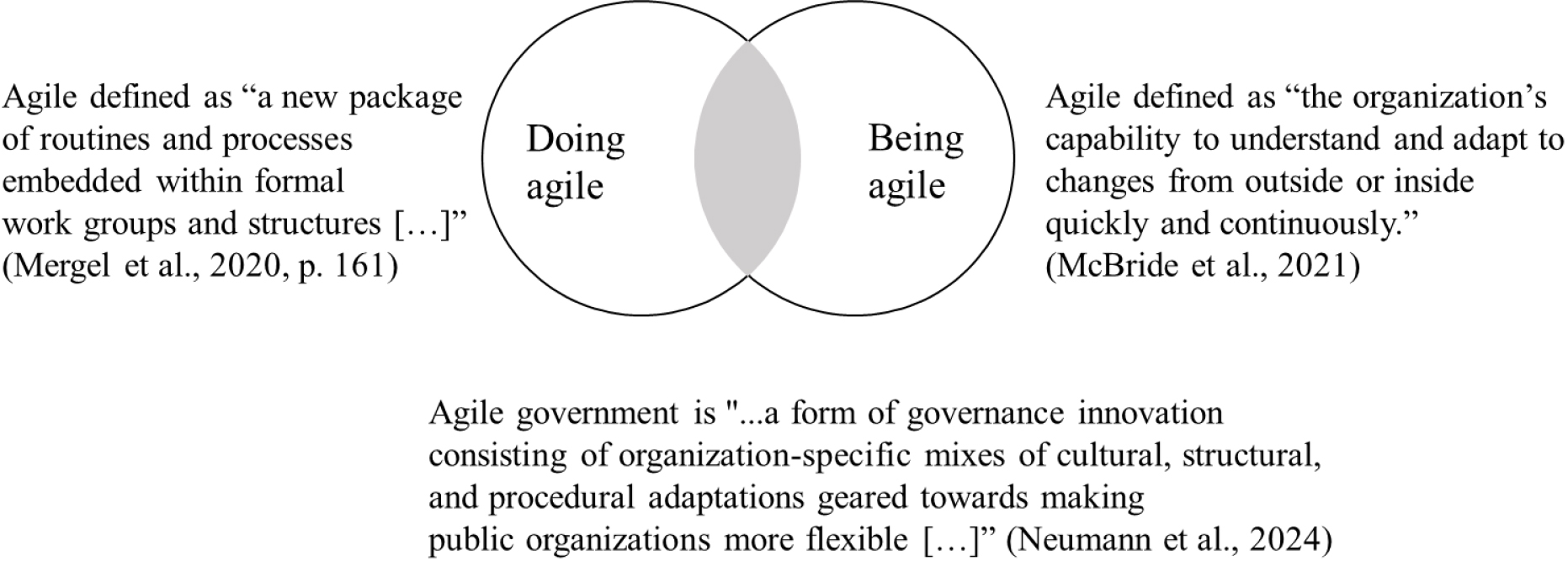
Empirical investigations into agility in the public sector focus on the process of implementation. They explore how agile practices can be adopted (Berkani et al., 2019; Moon, 2020; Ribeiro & Domingues, 2018; Soe & Drechsler, 2018; Van Engers & Boer, 2011; Ylinen, 2021), what challenges PSOs face when adopting agile practices (Baxter et al., 2023; de Almeida & Sano, 2018; Ikeanyibe et al., 2021; Nuottila et al., 2016), and how the state of the agile transformation can be measured (Kirkpatrick et al., 2020; Looks et al., 2021; Nazar & Vahid, 2009; Sanatigar et al., 2017). There have been several studies, particularly in German-speaking countries, attempting to assess the usefulness of agile practices (Bartonitz et al., 2018; Bornewasser, 2020; Kaune et al., 2021; Rölle, 2020; Schachtner, 2019; Wirth, 2020) and to guide (Richenhagen et al., 2022; Stucki-Sabeti et al., 2022) or analyze (Clases et al., 2022; Looks et al., 2021) their implementation. Regarding the empirical breadth of these studies, most have focused on public IT departments (Berkani et al., 2019; Nuottila et al., 2016; Ylinen, 2021). The method most commonly used to study agility in public-sector organizations has been the case study (Berkani et al., 2019; Moon, 2020; Nuottila et al., 2016; Ylinen, 2021). A few researchers have conducted literature reviews (Mergel et al., 2018) and comparative research study designs (Bogdanova et al., 2020).
The term agility is used primarily in the context of public administration when it comes to the challenge of digital transformation (Anders & Schenk, 2019; McBride et al., 2021; Mergel et al., 2019). As government has become more committed to introducing digital solutions, user needs and rapid technical adaptation have become an increasing priority. Consequently, it is not surprising that proponents of agile approaches in public administration are becoming more vocal. Government must adopt an anticipatory approach to handle longer-term trends in addition to short-term responsiveness, collaborative and tailored efforts and leveraging agile and scaling up tactics (Lindquist & Buttazzoni, 2021).
With our study, we strive to add to this body of literature. First, there is only very little literature that tries to explain why and under what circumstances public organizations adopt agile practices. In the private sector, there is some initial research on this question: Walter (2021) provides a good overview of external drivers (e.g. market changes, technology changes) and internal drivers (e.g. organizational structure, management style). Felipe et al. (2016) build on the concept of capabilities to explain the introduction of agile practices. Lee and Chen (2019) develop a theoretical framework deduced from neo-institutionalism to explain the introduction of agility. The question of when and under which circumstances PSOs introduce agility is at least as relevant as in the private sector since the aspects of public administration for which a more agile way of working can be beneficial are not yet clear. In a first step into this direction, our research aims to shed light on the drivers of agile practices in the public sector to determine under which circumstances agile government is currently implemented.
Analytical framework and hypotheses
To understand the state of agile government in Germany, Switzerland, and Austria, we develop a theoretical framework that consists of three sets of external drivers of agile government. Based on Lee and Chen (2019) and Walter (2021), who distinguish between various internal and external drivers, we conceptualize environmental drivers, network drivers and problem-based drivers. In the following, we develop hypotheses on the effect of these three drivers on the introduction of agile practices in general (H1a, 2a) and on the specific practices of being and doing agile more specifically (H1b, 2b, 3).
Environmental drivers: VUCA world
The concept of agility is often argued to be the answer to a so-called “VUCA-world” (e.g. Baran & Woznyj, 2021; Kaune et al., 2021). This world is characterized by high levels of volatility, uncertainty, complexity, and ambiguity. In such an environment, traditional management approaches seem to be less effective (Janssen & van der Voort, 2020; Walter, 2021). Agility is seen as a response to continuous and unpredictable changes (Kirkpatrick et al., 2020). Both academics and practitioners argue that agile work practices enable organizations to respond quickly to changes, embrace uncertainty, and manage complexity by fostering collaboration, iterative development, and continuous feedback (Bennett & Lemoine, 2014; Petry & Konz, 2021) reinforcing the argument that agility is a key factor in thriving within a VUCA world (Sambamurthy et al., 2003). From this, we conclude that the more a public sector organization perceives itself to be surrounded by a VUCA world, the more likely it would be expected to adopt agile practices in general. Further, we assume that higher degrees of VUCA tend to lead organizations to choose practices of being agile.
H1a: Public organizations which perceive a higher level of VUCA are more likely to use agile practices.
H1b: Public organizations which perceive a higher level of VUCA are more likely to choose practices of being agile.
Problem-based drivers: Problem situations
Agility as a set of management practices is associated with several promises to solve the problems a PSO might face. In this set of drivers, we focus on the problem situations an organization faces and for which agility promises to provide a solution. Based on previous literature, we develop a list of problem situations that may cause PSOs to introduce agile practices.
One of the central elements of agile government is the creation of self-sufficient cross-functional teams with significant decision-making power (e.g. Denning, 2016). This aspect seems particularly important and appealing for public organizations that repeatedly perceive the need to collaborate on cross-cutting issues but at the same time are prevented from doing so due to the effects of their silo organization and the resulting turf (Bardach, 1996; Kavanagh & Richards, 2001). Thus, we assume that if a public sector organization perceives an increased need for collaboration on cross-cutting issues as one pressing problem, there is an elevated likelihood that agile practices will be introduced and lead the organization to be agile.
One of the most well-known promises of agile management is the establishment of more efficient and effective customer relations through enhanced user-centricity (e.g. Denning, 2016; Karlshaus & Wolf, 2021). PSOs are very often confronted with a situation in which a diverse set of stakeholders is involved, putting various requirements on the public sector which somehow must be considered when providing public services (Hitt et al., 2023). This realization typically leads to increased collaboration between different internal and external stakeholders (McBride et al., 2021). In this situation, agility can be perceived to improve stakeholder relations by applying the concept of user-centricity.
Further, agility is conceptualized as a management technique that can further innovation. It yields the promise to guide organizations in new problem situations, when new ideas are to be advanced when a solution or result of a process is yet unknown or when previous methods have failed (Mergel, 2016; Mergel et al., 2020). Therefore, a typical agile approach of iteration and prototyping new solutions though several rounds of testing allows for the possibility of continuous feedback by accepting the non-linear evolution of innovation (Scognamiglio et al., 2023). If public organizations perceive either of these challenges, they can be expected to introduce agile practices and to be agile.
Agility also promises to optimize processes and thereby reduce costs and efficiency losses (Tripp & Armstrong, 2018). Thus, public organizations confronted with inefficient processes or cost and efficiency pressure more generally, can be expected to introduce agile practices and to be agile.
Agile management practices are frequently proposed as a solution to implementation problems of digitalization or technological advancements (Lindquist & Buttazzoni, 2021; Mergel, 2016). Thus, we expect that if a public sector organization perceives digitalization of its services or organizations as a particularly important problem, it is more likely to introduce agile practices and to be agile.
Finally, there is a vast amount of literature on agile government in the face of crises (Gasulla et al., 2022; Harrald, 2006; Joyce, 2021; Lai, 2018; Moon, 2020; Nelan et al., 2018; Raut et al., 2022; Room, 2011). PSOs might aim to manage recent crises by introducing agile practices. Therefore, we can hypothesize that if actors perceive one or multiple crises as a current problem situation for their organization, it is more likely for their organization to use agile practices and to be agile.
H2a: The problem situations public organizations perceive influence the likelihood of the use of agile practices.
H2b: The problem situations public organizations perceive influence the likelihood of being agile.
Network drivers: Isomorphism
As already argued by Lee and Chen (2019), neo-institutionalism can provide a theoretical framework that explains the adoption of agile practices. In this theoretical account, organizations change because they want to or perceive the need to become more similar to other organizations in their organizational field (DiMaggio & Powell, 1983). We assume this pressure to be especially relevant in the context of being agile. Organizations that perceive other organizations in their network as agile are more likely to strive to be agile as well. Neo-institutionalism assumes that organizations are subject to three types of institutional pressures: mimetic, coercive, and normative. Coercive isomorphism is understood as “pressures exerted on organizations by other organizations upon which they are dependent and by cultural expectations in the society within which organizations function” (DiMaggio & Powell, 1983, p. 150). According to this mechanism, we would expect organizations to adopt practices of being agile practices if political or organizational leaders express their support for those. Mimetic isomorphism occurs when an organization, in the attempt to deal with uncertainty, copies or mimics the behavior of other organizations that they perceive are more successful by being agile. Finally, normative isomorphism is associated with professionalization and professional networks through which common practices are diffused. Thus, we expect that organizations that perceive other members of their networks (collaboration partners, customers, etc.) being agile will be more likely to strive to be agile (DiMaggio & Powell, 1983).
H3: Public organizations that perceive higher levels of coercive, mimetic, or normative pressure to be agile from their network are more likely to choose practices of being agile.
Data and methods
We tested these hypotheses using a quantitative research design consisting of a standardized online survey to collect data and logistic regression analysis to analyze it. We chose logistic regression analysis because the dependent variable in each of the models is binary (experiences with agility: yes/no; doing/being/both: yes/no). Data analysis was carried out in R using the glm function from the stats package, and the results exported using Stargazer (Hlavac, 2015).
Operationalization and survey design
Data was collected using a standardized online survey. The survey consisted of several questions to collect data on the dependent and the independent variables (see Appendix). Information on the dependent variables was collected by asking respondents if they had any experience with agile practices in their working life. To facilitate a shared understanding of the term “agility”, we gave respondents a short definition (see Appendix). Further, we distinguished between doing agile and being agile based on the form of agility respondents indicated experiences with. Within these concepts, and based on previous literature (McBride et al., 2021; M. Neumann, 2022; Walter, 2021) and our conceptualization, we identify three forms of doing agile, namely: agile project management, agile product or systems introduction, and agile methods and three forms of being agile, namely: agile collaboration in cross-functional teams, agile organizational structures, and agile mindset.
Further, data on the three independent variables were collected. To operationalize the VUCA concept for a standardized survey, we developed items that make these abstract concepts more tangible for the respondents’ work environments and asked them to indicate their level of affectedness by the VUCA trends on a scale from 1 (not affected) to 5 (very much affected). For our analysis, we used the mean value of all four responses, a measure that exhibits high levels of reliability (see Appendix). Operationalization of the three neo-institutionalist isomorphisms was done similarly through reformulating the mechanisms into items related to the respondent’s work context and asking about applicability on a scale from 1 (does not apply) to 5 (fully applies). Finally, respondents were given a list of problem situations and were asked to indicate whether these were reason to introduce agile practices or whether they perceived agile practices to be beneficial when confronted with these issues. These are included in the analysis as binary variables.
The survey was implemented using the Qualtrics software. Qualtrics also recruited the respondents and administered the field time in May 2023. The sample after data cleansing consists of 463 public officials from Germany, Austria, and Switzerland.
Case selection
Austria, Germany and Switzerland were selected following the technique of a most similar systems design (Przeworski & Teune, 1970). The three countries belong to the Germanic tradition of public sector systems. The literature has identified several public administration traditions with their own ideational, institutional, procedural, and behavioral characteristics (Kuhlmann & Wollmann, 2014; M. Painter & Peters, 2010; Peters, 2021, p. 21; Sager et al., 2012). These different traditions also influence public management styles and possibly the likelihood of introducing privat sector management methods such as agility. Contextual factors related to public administration traditions and management practices, but also “legal entrenchment, civil service career structures and the politics-administration nexus” (Koop & Lodge, 2014, p. 1315), are held constant with this case selection. This approach additionally closes a gap in systematic, comparative knowledge on agility in Germanic public administration traditions. In all three countries, a political will to introduce agile practices into government, mostly in the areas of digitalization, can be found (Digital Austria, 2023; Marti, 2022; phoenix, 2018). Thus, an assessment of the effects of these advances is needed. Choosing the three Germanic countries allows us to account for a multitude of observable and non-observable characteristics of the public sector system while avoiding overemphasizing country specifics.
Results
Descriptive results
Our results indicate that the public sector employees in our sample have ample experience with agility. Overall, nearly 40% of our respondents indicated experiences with agile practices, with variations across countries (Table 1).
Experiences with agile practices per country
Experiences with agile practices per country
Responses from those who indicated experiences with agility confirm our conceptualization of doing and being agile as complementary and possibly combined. Some respondents indicated that they have experience with either doing or being agile, while others reported both (see Table 2). Again, variation across countries becomes evident.
Doing and being agile per country
Distribution of independent variables
When it comes to the distribution of our independent variables (see Table 3), it is observable that respondents perceive an above-the-mean level of VUCA (2.73 out of 4) and isomorphic pressure to adopt agility (3.42 to 3.59 out of 5). Regarding the problem situation encountered, the most pressing issues for which agility was or could be a solution seem to be advancing new ideas (42%) and process optimization (38%), while crisis management (15%), failure of existing methods (18%) and unknown solutions or results (19%) are mostly not seen as problems that could be solved with agility.
As regards the characteristics of the respondents, public servants from Germany are overrepresented (59%) compared to Austria (21%) and Switzerland (20%). However, considering the higher population of Germany, this likely does not distort the overall results. Of the respondents 17% are from the federal level, 20% from the regional level (Kantone/Länder), 45% from local governments and 17% from an intermediate level between local and regional (Bezirke, Landkreise, Regierungspräsidium). This can be explained by the varying sizes of the public sector on these levels. Further, 32% of the respondents work in an IT department and 39% have a leadership position, 50% of the respondents are male and the other 50% female, and 43% are in possession of a university degree. Thus, our results are not strongly biased by these factors, although our respondents are on the young side, with a mean and median age of 28 years.
Determinants of “experiences with agile practices”
Note: ∗p< 0.1; ∗∗p< 0.05; ∗∗∗p< 0.01.
Determinants of “doing and being agile”
Note: ∗p< 0.1; ∗∗p< 0.05; ∗∗∗p< 0.01.
We tested hypotheses H1a and H2a which assume that perceptions of VUCA and the problem situation influence the adoption of agile practices. We ran four models to test these hypotheses (see Table 4). Model 1 includes VUCA as sole independent variable and model 2 the problem situations. Models 3 and 4 include both explanations, with the latter also using control variables. We control for factors that could influence both the dependent and independent variable. For example, it can be assumed that if a person works in an IT department, they are more likely to perceive higher levels of VUCA and different problem situations but are also more likely to have encountered agile practices because these originated in software development (Beck et al., 2001). Further, we control for country because there could be different levels of perceived VUCA, different problem situations and different experiences with agility between them. The model fit indicators show that the full model has a better fit than the partial models.
Our results indicate that the more VUCA the environment is perceived by a person employed in the public sector, the more likely it is that the person will have experiences with agile practices. This result is constant across model specifications. Further, we find that some problem situations where agility is assumed to be the solution can indeed be associated with a higher likelihood of experiences with agile practices. In the case of cross-cutting issues, a higher number of stakeholders and cost and efficiency pressure we find more experiences with agile practices. Failure of existing methods and crisis management, which few perceive to be solvable with agility (see above), are, as expected, negatively associated with actual experiences with agility. When the control variables are included in the model, it becomes evident that respondents working in an IT department are more likely to have experience with agility. This can be interpreted against the background of the origins and popularity of agility in software development. Nonetheless their inclusion does not significantly alter the coefficients of the other variables.
In the next step, we attempted to learn what determines if a public sector organization can be agile, do agile or use a combination of being and doing agile (H1b, H2b, H3). We again ran several model specifications to test the assumptions. Table 5 presents the full models for the three dependent variables doing agile, being agile, and being and doing agile combined.1
Models 1 and 2 include all respondents who indicated the respective form of agility, regardless of whether both forms are implemented. This is separately tested in Model 3.
Summary of findings
To explain the conditions under which agile practices (doing agile) are used, our independent variables have low explanatory power. The only significant factor is working in an IT department. Against the background of our conceptualization this intuitively makes sense because the practices we classify as doing are based on the Agile Manifesto (“Manifesto for agile software development”, Beck et al., 2001). Forms of being agile, however, can best be explained by certain problem situations. Where agility was seen as a solution to advance new ideas, where solutions are unknown or previous methods have failed, experiences with being agile are significantly more likely. Further, organizations where agility was introduced to achieve digitalization or technical advancements were more likely to exhibit practices of being agile. Finally, experiences with both forms (being and doing agile), which we interpret as more comprehensive experiences with agility due to the more encompassing and holistic use of practices, are also determined by those four problem situations, with the addition of cross-cutting collaborations and the involvement of many stakeholders Isomorphic pressure seems to additionally play a role in determining these more comprehensive experiences with agility. Coercive isomorphism, meaning political or managerial pressure to implement agile practices, leads to a higher likelihood of combining being and doing agile. Further, and contrary to our expectations, mimetic isomorphism decreases the likelihood of comprehensive experiences with agile practices. This means that when other organizations are perceived to be successful and worth imitating, combined forms of agility are significantly less likely to be used.
Our analysis shows that it is important to distinguish between different forms of doing agile and being agile (see also McBride et al., 2021) while also acknowledging the possibility that both occur simultaneously. Some PSOs have introduced agile methods and techniques without engaging in a more fundamental change of their organization. Other PSOs have internalized values of being agile, namely flexibly reacting to changes in the environment, without necessarily using the methods developed in the aftermath of the Agile Manifesto (Beck et al., 2001). A third group of PSOs uses these methods and additionally has a culture, mindset, or organization, thus being agile (see also McBride et al., 2021).
Our research demonstrates that context matters for the choice of management techniques and that public administrations are very conscious of their environment. We find evidence for all three types of drivers: environmental drivers, network drivers and problem-based drivers (see Table 6). First, public sector employees’ elevated VUCA perception levels increase the likelihood of experiences with agility. This suggests that these organizations are very perceptive to external environmental changes and are willing to change their management techniques in a way that better deals with these environmental developments.
Second, isomorphism as conceptualized by neo-institutionalism can explain why and under what circumstances PSOs combine practices of doing and being agile and thus are more advanced in their use of agile practices. If political or management strategies support or stimulate the introduction of agile, there will be more ventures towards profound changes in the direction of an agile government. Thus, if the aim is to become a more agile public sector, political support and strategic leadership seem to be important drivers of an agile transformation.
Third, the problem situations of public administrations have an influence on the likelihood of being agile. Advancing new ideas, finding unknown solutions, and replacing methods that previously failed and also in digital transformation contexts, PSOs have a higher likelihood of being agile (sometimes combined with practices of doing). Thus, PSOs are more likely to be agile when radically new approaches are required. These are situations in which flexibility and iterative problem-solving approaches as guiding principles of an agile organization are expected to materialize. Further, forms of being and doing agile combined are more likely when an organization is confronted with problem constellations involving a high number of actors, be it in the form of stakeholders or collaboration on cross-cutting issues. This can be understood against the normative goal of agility to adapt products and services to user needs. These “users” of government are the external and internal stakeholders who usually represent different interests for public sector activities. Thus, including a high number of stakeholders and getting internal and external stakeholders to collaborate on cross-cutting issues with the aim of finding a compromise between various interests is perceived as something that can be done in an agile government.
It needs to be noted that our research is still explorative. We deduced several hypotheses from existing literature and exploratively developed a measurement of agility that can be applied in a standardized survey and in the context of the public sector. This measurement must be further developed and tested in future research. It remains unclear how representative the respondents, even though they seem to be not significantly biased (apart from their age), are of the full sample of civil servants in the three countries. It is possible that young people are more attracted to job profiles related to innovation in the public sector and that as a result experience with agile might be overrepresented in this sample. Even though the service provider uses methods of random selection, it cannot be ruled out that public employees who have experiences with agile practices are more likely to answer to the survey request by the service provider. Further, the results of the study need to be interpreted against the background of the study design in which both the dependent and the independent variables were collected within the same questionnaire; we therefore cannot exclude the possibility of a common source bias (Favero & Bullock, 2015). It is possible that people who have experiences with agile practices overestimate the level of VUCA, isomorphic pressure or certain problem situations. To account for this possibility, we specifically acknowledge that the independent variables in our model are measured as perceptions.
Conclusion
This study investigated the state of agile government in Austria, Germany and the German-speaking part of Switzerland, and thereby provides an overview of countries with a Germanic public administration tradition. Agile practices are on the rise in the public sector. Nonetheless, not all problems confronting PSOs can be solved with agile practices. The aim of this research was to better understand the circumstances under which agile practices are being used. We found evidence that the environment of a PSO, the network it is embedded in, and the specific problem situation it is confronted with determine if agile practices are being used in the first place and, where they are, which agile approach is being chosen.
Conceptually, we bring together two hitherto separate strands of literature that both engage with the topic of agility. Originating from the Agile Manifesto and transcending to the public sector is an instrumentalist view of agile as a set of methods and procedures with the aim of making organizations more adaptive and responsive (e.g. Mergel et al., 2020). In strategic management literature, organizational agility is a dynamic capability of an organization to deal with uncertainty (Teece et al., 1997). These two views culminate, as we argue, in the distinction between being and doing agile. Yet, going beyond this classification, we conceptually argue and empirically show that practices of being and doing agile, while often used separately, can be and are combined.
Empirically, we show that PSOs that perceive their environment to be constantly changing are more likely to adopt agile practices. Political and managerial leadership seems vital if the aim is to achieve a more profound agile transformation of the public sector. Finally, tasks that require constant internal and external stakeholder involvement and those that require radically new ideas and ways of working lead PSOs to be agile.
This paper represents an attempt to understand how agile the public sector is and under what circumstances. By proposing an analytical framework and measurement of agile government, we hope to spark further research. While our research leaves us cautiously optimistic that agile practices are being purposely applied by PSOs to specific problem-based, environmental and network drivers, we see potential for future research when it comes to the perceived success of agile approaches to reach goals and meet promises such as improved collaboration, learning, effectiveness and adaptability.
Footnotes
Appendix: Survey items
Concept
Survey item(s)
Dependent variable: Experiences with agility
Have you already had experience with agility in your working life? (yes/no) The term “agility” is broadly defined. We include both agile methods such as Kanban, Scrum or Objectives and Key Results (OKR) or agile structures such as cross-departmental or self-organised teams, matrix organisations or role-based organisational models such as holacracy or squads.
Dependent variable: Doing or being agile
Which of the following forms of agile have you had experience with? (Multiple answers possible) “agile project management”; “agile product or systems introduction”; “agile methods” (doing agile) “agile collaboration in cross-functional teams”, “agile organizational structures”, “agile mindset” (being agile).
Independent variable: VUCA
In the following, we outline some recent societal trends. Please indicate to what degree your organizational unit is affected by each of these trends (1
not affected, 5
very much affected). “The framework conditions of my work change frequently, quickly and unpredictably.” (volatility) “My organization faces many uncertainties.” (uncertainty) “The complexity of my job and organizational environment has increased.” (complexity) “The information on which I base my work is ambiguous and not always clearly interpretable.” (ambiguity).
Independent variables: Neo-institutionalist isomorphism
To what extent do the following statements apply to your organization (1
does not apply; 5
fully applies): “In our organization, there are policies or a political strategy that includes agility.” (coercive); “Our organization observed that other organizations were achieving good results with agile approaches and wanted to do the same.” (mimetic); “Following suggestions from customers or collaboration partners, our organization has adopted an agile way of working.” (normative).
Independent variables: Problem situation/ Value proposition
For which of the problems mentioned in the following do you think an agile way of working could be beneficial?/For what reason were agile methods introduced? (Multiple answers possible). Collaboration on cross-cutting issues; Many stakeholders; New problem situations; Advancing new ideas; Cost-/efficiency pressure; Process optimization; Unknown solution or result; Failure of existing methods; Digitalization or technological advancements; Crisis management.