



Abstract
Artificial intelligence (AI) applications have been emerging in these past years and affecting multiple dimensions of the public sector. The government utilizes AI to transform policy implementation and service delivery, but AI can also threaten citizens’ privacy and social equity due to its potential biases. These concerns increase citizens’ perceived uncertainty concerning AI. In an uncertain environment, trust transfer serves as a way to improve citizens’ trust in AI-enabled government systems. However, little research has explored trust transfer between the public sector and the system. This study examines whether a context-based trust transfer mechanism can explain the trust-building of the AI-enabled government system. The study conducted a survey and analyzed the collected data using factor-score-based regression analysis. The research results indicate that trust transfer occurs for the AI-enabled government system. Trust in an administrative process, local government, and political leaders can be transferred to trust in governmental AI systems. The findings can advance the theoretical development of trust transfer theory and be used to develop recommendations for the public sector.
Introduction
Governments have utilized artificial intelligence (AI) to transform organizational structures, policy implementation, and communication with citizens (van Noordt & Misuraca, 2022). Although the government utilizes AI to transform public service delivery, this technology brings various societal challenges, increasing citizens’ perceived risk and uncertainty. In this case, trust-building of AI systems serves as a critical approach to improve citizens’ perceptions of technology in the public sector (Lin et al., 2021; Wang et al., 2023). The trust transfer mechanism can be one essential trust-building pathway. Trust transfer theory emphasizes that trustors can move their trust from third parties to trustees (Belanche et al., 2014; Sim et al., 2021; Stewart, 2003). For instance, citizens can transfer their trust in public administration to e-government services (Belanche et al., 2014). However, little research focuses on trust transfer between the public sector and AI-enabled government systems. This study aims to address this research gap, so we propose our primary research question: Can citizens transfer their trust in government institutions to an AI-enabled government system?
This study proposes a conceptual framework and conducts a vignette-based survey to answer the research question. Based on the existing body of knowledge, we identify three government institutions as the third party for the trust transfer mechanism, including the administrative system, local government, and political leader. In the conceptual framework, citizens are trustors to transfer their trust in the three government institutions to an AI-enabled government system, which serves as a trustee. A vignette-based survey was launched in Taiwan to examine the research hypotheses developed according to the conceptual framework. The research findings indicate that citizens can move their trust in the administrative system, local government, and political leader to the AI-enabled government system.
This study is structured in the following way. First, Section 2 reviews the existing literature on AI government system opportunities and challenges, and citizens’ trust in AI government systems. Next, the third section introduces a conceptual framework and research hypotheses. The fourth section explains the research design, including survey process, data sources, measurements, and methods. The fifth presents the research findings. The fifth section discusses theory implications, policy recommendations, generalizability and future research opportunities by drawing on the research findings. Finally, the conclusion presents final reflections on the study.
Literature review
This section discusses the opportunities and challenges of AI-enabled government systems, citizens’ trust in AI government systems, and AI-enabled chatbots. First, it outlines the benefits and challenges of AI for citizens. The challenges increase the risks and uncertainties attached to this technology. Second, it discusses the factors affecting AI trustworthiness and identifies the research gaps.
Challenges and opportunities of AI-enabled government systems
AI has demonstrated its strengths and usefulness for public management and governance. The government has used AI to automate public services to increase effectiveness and efficiency (Bullock, 2019; Zuiderwijk et al., 2021). Compared to other information and communication technologies, AI has relative advantages: it can integrate data from various sources, explore and identify patterns or trends in big data, and provide accurate predictive analyses (Young et al., 2019). The effectiveness and efficiency of AI allow it to be widely applied in public governance. For instance, European countries apply AI to improve service quality, provide timely and crucial information, design new policy actions, explore social demands, and trace policy performances and outcomes (van Noordt & Misuraca, 2022). Like European governments, the U.S. government has utilized AI to reduce administrative errors, detect healthcare fraud and irregularities, generate criminal event predictions for policing, and capture the COVID-19 symptoms in public health (Bullock et al., 2020; Compton et al., 2023; Henman, 2020; Young et al., 2022). In both cases, AI can considerably reduce human efforts in processing and analyzing data, decreasing costs and expenditures. As a result, governments can provide their citizens with timely and responsive public services.
However, AI raises several concerns associated with its risks and uncertainties for citizens. The existing research on the negative aspects of AI primarily emphasizes social inequality, inscrutability, privacy concerns, and communication and information risks. First, data and algorithmic biases exacerbate the existing social inequality issues. AI generates outcomes based on processed data and applied algorithms, but the existing data can be biased for historical or cultural reasons (Bullock et al., 2020). Furthermore, algorithms cannot capture all crucial factors in society, which can distort the outcomes (Wirtz et al., 2019; Wirtz et al., 2020). System managers and designers usually neglect social and political factors in developing AI systems (Criado & de Zarate-Alcarazo, 2022). Data and algorithmic problems increase AI’s automation risks (Young et al., 2021).
Second, AI applications suffer from the problem of inscrutability. Citizens and the government can hardly access AI information and understand the algorithms’ meaning due to their high technical complexity (Wirtz et al., 2020; Young et al., 2021; Zuiderwijk et al., 2021). Thus, the transparency and explainability of AI are relatively low and insufficient, resulting in a lack of accountability for AI applications (Bannister & Connolly, 2020; Busuioc, 2021; Clarke, 2022; Henman, 2020; Wirtz et al., 2022). The transparency, explainability, and accountability issues attached to AI increase the risk of inscrutability (Young et al., 2019).
Third, AI applications raise privacy concerns for citizens. For one, AI can integrate and process various data sources to identify individuals’ contacts and behaviors (Lin et al., 2021). Second, there are significant issues associated with data regulation and management issues. When governments do not enact feasible and sufficient regulations to protect citizens’ privacy, citizens’ personal information can be infringed (Wirtz et al., 2022; Wirtz et al., 2020). Public organizations are responsible for managing citizen data to prevent misuse of personal information. If they cannot ensure data management and protection, citizens will become concerned about potential privacy risks (Henman, 2020; Zuiderwijk et al., 2021).
Fourth, academia has paid significant attention to communication and information risks inherent in AI. As van Noordt and Misuraca (2022) indicate, AI can be a valuable instrument to provide information and communicate with citizens. Although the government can utilize AI to improve information quality, public organizations may manipulate information or deliver inappropriate messages to citizens (Milano et al., 2020; Wirtz et al., 2020). Moreover, the government can use AI to incentivize citizens’ actions and behaviors, but this application raises concerns about overly nudging (Milano et al., 2020): there are concerns that governments can misuse AI to guide citizens to follow their instructions even when their policy goals are unethical and illegitimate.
These challenges result in low citizens’ trust in AI-enabled government systems, which is different from the other public sector context. Citizens perceive the risk of social inequality, inscrutability, privacy concerns, and communication and information in the public AI system. The multi-dimensional concerns of AI are the most significant difference from other policy instruments. For instance, traditional digital technology in the government, such as the internet, cannot integrate various data sources, track human footprints, and nudge citizens as AI systems. Compared to traditional Information and Communication Technologies (ICTs), AI systems are more complicated in many aspects, so citizens rarely trust in the AI decision-making process. This nature highlights the need to explore the trust-building process in the AI context.
Citizens’ trust in public AI-enabled systems
Citizens’ perceptions of AI can determine their behaviors when using this technology. Although AI can provide citizens with better public services, it also exposes them AI risks and uncertainties. Citizens who perceive AI as risky rather than efficient and effective tend to evaluate the government as performing worse (Schiff et al., 2021). Furthermore, the uncertainties and associated challenges of AI systems impede individuals from using this technology. For instance, when citizens are risk-averse, they are less likely to accept AI-enabled applications in a highly uncertain environment (Lehtiö et al., 2022). However, the high level of trust in this technology can increase citizens’ intention to using AI or following AI-enabled recommendations even when they perceive policy environments to be risky and uncertain (Lin et al., 2021; Wang et al., 2023). A study based in Germany found that citizens’ political trust can increase their acceptance of surveillance-related policies (Trüdinger & Steckermeier, 2017). In other words, trust facilitate citizens’ intention to accept AI-enabled government systems and recommendations. Hence, how to cultivate trustworthy AI is a crucial issue in public management and governance.
Most AI studies focus on how policy issues and public values can construct trust, but little research investigates the trust transfer mechanism in the AI context. Citizens have higher trust in AI applications in simple public services. For example, citizens trust AI-enabled chatbot recommendations in waste collection more than parental support issues (Aoki, 2021). Second, aligning AI with public values can increase citizens’ perceived trust in AI. Grimmelikhuijsen (2023) demonstrates that more transparency and explainability can increase citizens’ trust in AI applications. Similarly, citizens’ trust increases when the government includes privacy protection in AI system designs (Lin et al., 2021). However, the connection between government institutions and AI systems requires more attention. As discussed in the previous section, AI systems are technologically complicated and socially risky, so citizens can rarely trust this technology. The difference between public and private AI systems is whether the government supports and endorses this technology. The contextual link between AI and the public sector causes citizens to transfer their trust in the government to this technology, given that they are unfamiliar and uncertain with AI systems. Therefore, the trust transfer mechanism is worthy of receiving more scholarly investigation.
Conceptual framework
This study develops a framework for explaining the context-based trust transfer mechanism in the AI-enabled government system. This section first introduces trust transfer theory and its applications. Next, it identifies key constructs of the conceptual framework, including trust in the AI system, and trust in the third party, like administrative process, local government, and political leaders. Finally, the section discusses three clusters of research hypotheses.
Trust transfer theory
Trust transfer theory explains how individuals transfer their trust from known objects to unfamiliar targets. In the trust network, a trustor can transfer their trust in a third party to a trustee. Trustor refers to the individual who can determine whether to believe other subjects or objects; trustee is the actor receiving evaluation from trustors (Sim et al., 2021; Stewart, 2003). For instance, in the discussion of trust in the government, citizens serve as a trustor, and the government can be a trustee. Also, the third party means the entity in which trustors have already believed (Sim et al., 2021; Stewart, 2003). In the trust-transfer mechanism, trustors can transfer their trust in the third party to trustees. In other words, individuals can transfer trust in known objects (the third party) to unfamiliar targets (trustee). Therefore, from the perspective of trust transfer theory, the trustor, trustee, and third party should be included in the transfer mechanism.
The trust-transfer mechanism includes dispositional, representative, and contextual approaches. Belanche et al. (2014) propose three mechanisms of trust-transfer. First, trustors can move their trust to trustees based on their dispositions, such as personality, beliefs, and other cultural elements. These characteristics shape how individuals perceive others to transfer trust to unknown subjects and objects (Zucker, 1986). For instance, trustors transfer their trust to trustees with similar backgrounds (Thomas, 1998). Second, trust can be transferred from the representative of institutions or organizations, defined as the embedded entity approach. Individuals accumulate trust in organizational representatives via repeated interactions (Zucker, 1986). Because of the positive interaction, individuals can transfer their trust in the representative to the organization. Third, trustors can shift their trust to trustees with contextual connections to the third party they trust. This mechanism is salient in explaining trust transfer at the institutional level. When individuals are more confident in the public sector, market, and civil society, they can transfer their trust in these sectors to the entities that are contextually related to these third parties (Belanche et al., 2014; Thomas, 1998; Zucker, 1986).
Among the three mechanisms, the contextual approach can explain trust transfer between the public sector and government-related objects. Most existing studies investigate trust transfer between companies and innovative services. For example, customers can move their trust from physical transactions to online ones (Stewart, 2003). Similarly, users with trust in blockchain members are more likely to trust the platform in which these members participate (Shao et al., 2022). This contextual approach can explain trust transfer between the public sector and e-government services. The government adopts various digital technology instruments to serve citizens and respond to social needs. In most cases, citizens are unfamiliar with advanced digital instruments, such as AI systems. When the government applies digital technologies to provide services, citizens’ trust in these instruments depends on their trust in the public sector. In other words, public digital systems are contextually related to the public sector so citizens can transfer their trust in the government to these technology-enabled services. For instance, citizens transfer their trust in public administration to government digital services (Belanche et al., 2014). Therefore, the contextual approach can explore trust transfer in public digital services.
As Fig. 1 shows, this study proposes a conceptual framework to explore further trust transfer between the public sector and a governmental AI system. In the framework, citizens, the AI-enabled government system, and three institutions are trustor, trustee, and the third party, respectively. Trustors can transfer their trust in the three institutions to AI-enabled systems in the public sector. Instead of considering the government as a homogenous institution (Belanche et al., 2014; Horsburgh et al., 2011), this study considers the public sector to include three elements: governmental administrative processes, local governments, and political leaders. Trustors may transfer their trust heterogeneously because of different perceptions of governmental institutions. Based on the framework, this study proposes three clusters of research hypotheses to examine trust transfer between governmental institutions and the public AI system.
Conceptual framework.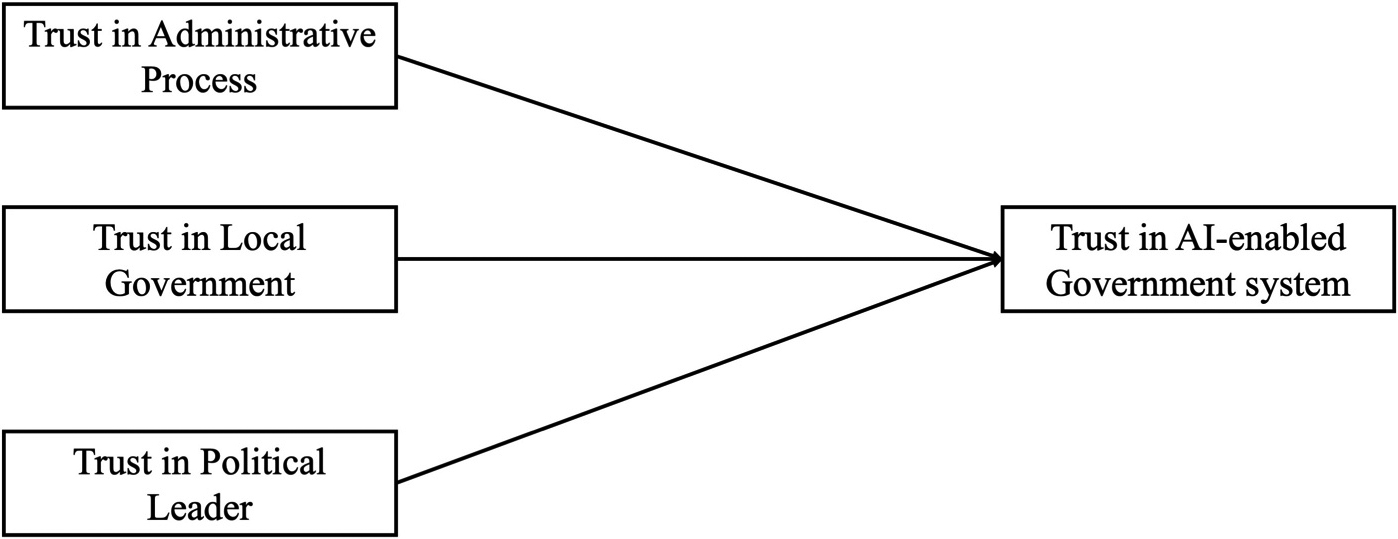
This study uses competence, benevolence, and integrity to define trust in the government AI-enabled system. First, perceived competence relates to whether people find AI systems capable, effective, efficient, and professional in providing information and recommendations. In the discussion of trust in the public sector, citizens considering public service delivery to address concerns and meet expectations are more likely to believe the government’s actions (Grimmelikhuijsen & Knies, 2017; Meijer & Grimmelikhuijsen, 2020). Similarly, citizens perceive the system as trustworthy when AI-enabled government systems can generate high-quality services. For instance, from the user perspective, when AI can provide reliable information and high-quality recommendations, individuals perceive the system as a highly competent technology (Bedué & Fritzsche, 2022). In other words, AI competence provides psychological reliability for citizens to construct trust in AI systems. This study conceptualizes perceived competence as the feasibility, efficiency, and profession of system recommendations for citizens. The three values show the AI system’s reliability.
Second, perceived benevolence concerns whether citizens believe the system prioritizes their interests and benefits. In public administration research, scholars use benevolence to examine how the government cares about citizens’ needs and interests. When citizens consider the government’s actions are for their benefit, they are more confident in the public sector (Grimmelikhuijsen & Knies, 2017; Meijer & Grimmelikhuijsen, 2020). Likely, including individuals’ well-being in AI-enabled services affects how citizens perceive the system as benevolent. As Bedué and Fritzsche (2022) state, the commitment to social needs and ethical principles is the crucial condition for AI competence. When citizens believe AI systems pursue benefits for them, the system is benevolent from their perspective. Hence, this study conceptualizes benevolence as the perceived prioritization of citizens’ interests in the AI system.
Lastly, perceived integrity is the degree to which citizens consider the system to be able to provide truthful information in a sincere manner. In the interaction between the government and civil society, the manners the public sector adopts determine the perceived trustworthiness of public organizations and administrative systems. When the government honestly articulates policy objectives, implementation status, and potential outcomes, the perceived integrity can be higher (Grimmelikhuijsen & Knies, 2017; Meijer & Grimmelikhuijsen, 2020). In the AI context, citizens have higher perceptions of integrity if the system can sincerely explain the algorithmic decision-making process, expected outcomes and impacts on users, and the commitment to regulations and guidelines (Bedué & Fritzsche, 2022; Meijer & Grimmelikhuijsen, 2020). Based on this concept, this study defines perceived integrity as the AI-enabled government system’s sincere and honest attitude to interact with citizens for its promises and objectives.
Trust in government institutions
This study defines three contextually relevant government institutions to the public AI system as the third parties in the trust transfer mechanism. Also, the three clusters of research hypotheses regarding trust transfer are discussed and proposed in this section.
Trust in administrative process
Citizens can transfer their trust in the administrative process to the AI-enabled government system. Citizens cultivate trust in the administrative process based on positive interactions with public employees (Thomas, 1998; Welch et al., 2005; Zucker, 1986). When citizens initiate contact with unknown public organizations, they can transfer their trust in the familiar administrative system, such as e-government and other public services, and process the new objects (Kettl, 2018; Tolbert & Mossberger, 2006). Similarly, citizens can move their trust from the contextually relevant third party, the administrative process, to the AI-enabled government system. Therefore, the first cluster of research hypotheses is below:
Hypothesis 1: Citizens transfer their trust in the administrative process to the perceived competence of AI-enabled government system. Hypothesis 1b: Citizens transfer their trust in the administrative process to the perceived benevolence of AI-enabled government system. Hypothesis 1c: Citizens transfer their trust in the administrative process to the perceived integrity of AI-enabled government system.
Trust in local government
Citizens can transfer their trust in local government to the AI-enabled government system. Individuals can move their trust in the local government to the contextually relevant public intuitions and service systems. Belanche et al. (2014) indicate that citizens transfer trust in the public administration system to e-government services. Likely, residents can shift their trust in the government to AI systems (Chen & Wen, 2021). Compared to the central or federal government, citizens have more interactions with local governments for civil services (Col, 2007). Based on this logic, the central or federal government may rely on local governments to promote public AI systems. When citizens receive the promotion of public AI, their trust in the local government can be transferred to the system. Hence, individuals can move trust in the local authority to the AI system.
Hypothesis 2a: Citizens transfer their trust in the local government to the perceived competence of the AI-enabled government system.
Hypothesis 2b: Citizens transfer their trust in the local government to the perceived benevolence of the AI-enabled government system.
Hypothesis 2c: Citizens transfer their trust in the local government to the perceived integrity of the AI-enabled government system.
Trust in political leader
Trust in political leaders can be transferred to the government AI system. Political leaders are the contextually relevant third party to a government or public policy. In most cases, citizens transfer their trust in politicians to public organizations, services, and policies (Hetherington, 1998; Levi & Stoker, 2000). During the COVID-19 pandemic, citizens’ political trust and attitudes affected their trust in public health actors, such as the government and experts (Robinson et al., 2021). The contextual connection between politicians and relevant governmental actors allows citizens to transfer their trust in political leaders to unfamiliar subjects and objects. Along with this statement, citizens can transfer their trust in incumbent political leaders to the AI-enabled government system due to contextual relevance.
Hypothesis 3a: Citizens transfer their trust in the political leader to the perceived competence of the AI-enabled government system.
Hypothesis 3b: Citizens transfer their trust in the political leader to the perceived benevolence of the AI-enabled government system.
Hypothesis 3c: Citizens transfer their trust in the political leader to the perceived integrity of the AI-enabled government system.
Research design
This study conducted a vignette-based survey in Taiwan and adopted quantitative methods to analyze the collected data. This study selected Taiwan as its focus because of its collectivism-oriented culture, which is similar to that of several Asian countries. Transference-based trust plays a more critical role in decision-making in collectivism-oriented countries compared to individualist countries (Kim, 2008). Also, this study adopted an AI-enabled chatbot as the contextual scenario. Governments worldwide have implemented AI-enabled chatbots as a communication instrument to interact with citizens (Androutsopoulou et al., 2019; Aoki, 2020; Henman, 2020; Vogl et al., 2020; Wang et al., 2022). Research findings on the AI government chatbot can be a reference to other countries where the public sector utilizes the system to communicate with members of society. This section discusses survey process, data source, measurements, and analytical methods.
Survey process
This study adopted a vignette-based survey to explore trust transfer for the different AI communication strategies. In a vignette-based survey, participants can experience various settings and answer survey questions so that researchers can compare the differences in responses in vignettes. Compared to a real-work intervention, a vignette-based survey design can reduce the risks of misleading participants on information about public services, control institutional and environmental settings, and advance theoretical developments (Bouwman & Grimmelikhuijsen, 2016; James et al., 2017). Much of the existing research on the topic utilizes the vignette-based survey to investigate research issues. For instance, Ingrams et al. (2022) designed different scenarios to compare citizens’ perceived trust in AI in decision-making. Similarly, Grimmelikhuijsen (2023) adopted visa and social welfare applications as the two vignettes to understand the impacts of transparency on AI trustworthiness.
The survey scenarios include three crucial elements: the introduction of an AI-enabled decision-making process, the explanation of communication strategies, and the limitation of algorithmic recommendation generation. First, this study introduces AI-enabled decision-making for travel recommendations. In the introduction section, the system clearly states that AI collects personal medical history and records and compares the information collected and the current pandemic status, such as vaccination rates, infected populations, and public health interventions. After processing and analyzing personal and pandemic data, AI generates two travel plans for users to adopt. When users must choose a plan to follow, the chatbot system recommends one. Therefore, survey participants can have an essential understanding of the AI-enabled decision-making process for travel recommendations.
Second, this study defines two communication strategies in the AI-enabled chatbot for travel recommendations in the era of COVID-19 to explore citizens’ trust transfer mechanism. Like other countries, Taiwanese citizens suffer from the pandemic and take various actions against the virus. They can ask for pandemic information from several public chatbot systems. This nature allows this study to use a vignette-based survey to understand trust transfer between the public sector and the AI-enabled government system. In the conversational AI systems like chatbots, the communication strategies may affect citizens’ trust-building process (Wang et al., 2023). Chatbot systems can use two strategies to communicate with users: feature-based and example-based approaches. The feature-based strategy emphasizes that AI can explain its decisions to users through scientific reasoning and logistics (Liao et al., 2020; Millecamp et al., 2019). For example, a travel recommendation system can communicate with users by stating that algorithms compare their medical history and vaccination rates to provide instructions. The system utilizes users’ medical information and quantitative public health data to persuade them to take necessary actions. In other words, the feature-based communication approach emphasizes employing numbers and scientific principles to explain the decision-making in recommendation provision with system users. Individuals can apply these scientific analytical results to evaluate their original plan and follow AI-enabled instructions. On the other hand, the example-based communication uses the similarities between system users and reference population (Liao et al., 2020; Millecamp et al., 2019). For instance, a recommendation system finds that other travelers with similar demographics and medical history get infected by the pandemic in a particular area, so the AI recommends that users avoid visiting that region. This approach communicates with users by connecting them to others with similar situations or conditions. Individuals can better estimate and simulate the potential outcomes of the action to reconsider their plan and accept AI-enabled recommendations.
Third, this study clarifies the limitation of algorithmic decision-making in the AI-enabled chatbot recommendation system. Based on the literature review, citizens perceive more AI risk and uncertainty, so trust transfer between the government and the system serves as a crucial trust-building process. However, although the introduction has explained the decision-making process, it does not mention system limitations. In order to strengthen participants’ perception of AI risk and uncertainty, the prototype of the chatbot system articulates the potential weakness of the algorithmic analytical process and outcome. For instance, the AI system does not include incubation periods and variant types to decrease the accuracy of travel recommendations. Similarly, when matching users’ and other travelers’ similarities, the system may not analyze travelers’ stay duration and activities, reducing the recommendation quality.
The survey participants were randomly assigned to one of the research groups: Group 1 (feature-based communication) and Group 2 (example-based communication). All survey participants read the same introduction to the AI decision-making process. Next, as Fig. 2 shows, the participants reviewed Plan A (feature-based communication) and Plan B (example-based communication). Plan A indicated that the recommendation was developed based on data analysis of personal medical information and vaccination rates. The system recommended that individuals avoid visiting a particular place because of the low vaccination rate and user health data. The system also disclosed the limitation that AI did not include incubation periods and variant types in the data process. Moreover, plan B stated that instruction was generated according to matching the similarity between the user and infected travelers. The similarity meant that the user and infected shared similar vaccination records and medical histories. This recommendation clarified the weakness of AI-enabled estimation because it lacked the deliberation of travelers’ duration of stay and travel activities. Finally, the participants received different suggestions on plan selection based on their assigned group. As Fig. 3 shows, the AI system suggested that the participants in group 1 choose plan A (feature-based). Also, as presented in Fig. 4, the system recommended that users in group 2 select plan B (example-based) to follow. After the survey scenario, the participants would answer a series of questions regarding trust transfer.
Survey vignette.
Feature-based communication (group 1).
Example-based communication (group 2).
Before launching the survey, we considered several factors to determine the sample size. First, we conducted a series of priori power analyses based on the statistical and cultural considerations to determine the required sample size. Two research groups differed in the treatment of communication strategy, so we reviewed the existing research regarding trust in AI. The difference between trust-relevant survey items in these studies ranged from 0.1 and 0.4 on seven scales (Aoki, 2020; Ingrams et al., 2022; Wang et al., 2023). Also, the policy communication in Taiwan strongly emphasizes numbers and quantitative information, which is more relevant to the feature-based strategy, so we expected the difference between the two groups to be higher. We conducted the power analysis on the difference at 0.3, 0.4, 0.5, and 0.6. Given that the power was 0.8 and the significant level was 0.05, the required sample sizes for each group were 176, 100, 64, and 45, respectively. Second, we also considered the budget when determining the sample size. In Taiwan, there were few online survey platforms like Amazon M-Turk and Qualtrics, so scholars could only contract with a survey company to initiate surveys via in-person or phone-call contacts, substantially increasing survey costs. After consulting with the survey company, we decided to maximize the sample size under the budget limit. Finally, the sample size for each group was 150 participants.
This study collected data from a vignette-based survey in Taiwan between August 29th and September 11th, 2022. Supreme Research & Consulting (SR&C), a commercial entity specializing in online and in-person surveys and case studies, administrated the survey and collected the data. The survey was conducted in Mandarin Chinese. The eligible survey participants were between 18 and 69 years old. We collected samples based on the national gender and age distributions in Taiwan. SR&C randomly engaged survey participants via in-person contacts in different locations and regions. Survey participants could complete the questionnaire via the company’s online platform or in-person survey. This survey approach could reach out to different populations instead of a particular group, such as online users, and ensured the participants were real humans rather than robots. SR&C launched an online survey to target individuals under 39 years old and an in-person survey to target those over 40. Younger adults were more familiar with the online survey, while the senior populations preferred to participate in the in-person survey. The percentage of valid samples in Groups 1 and 2 was around 25 percent. Finally, we collected 150 samples for each research group; 300 subjects participated in the survey in total.
Key constructs
Key constructs
Note: G1 refers to Group 1 and G2 means Group 2.
This study adopted factor analysis to develop constructs for the dependent and independent variables. As Table 1 shows, the constructs include perceived competence, perceived benevolence, perceived integrity, trust in the administrative process, trust in the local government, and trust in political leaders. Every construct was measured through three survey questions. The coding schemes for each survey question is the following: 1
Control variables
Control variables
Note: Numbers in parentheses refer to the coding schemes.
This study also collected demographic information as control variables. In the survey, all participants provided their demographic information for further analysis. As Table 2 indicates, the control variables are the internet and e-service usage (e.g., time spent on the internet, frequency of searching for government information, using government transaction services, and interacting with governments), COVID-19-related information (e.g., whether they tested positive for COVID-19 and whether one of their families and friends tested positive for the disease), gender, age, and education. The internet and e-service use experience may affect citizens’ perceptions of AI-enabled government systems, so this study included these items as control variables. Moreover, this study includes personal experiences with COVID-19 as the control variables. In Taiwan, the government effectively controlled the pandemic in 2020 and early 2021, so most citizens were unfamiliar with this virus and its potential symptoms. Most people were vaccinated when the disease broke out in Taiwan in late 2021 and 2022, so the impacts were minimized. Compared to other countries, the infected populations in Taiwan were relatively small. These people were more familiar with this pandemic and cared more about the related information. Also, individuals with families and friends infected by the virus might be more aware of the COVID-relevant message. Therefore, based on the pandemic development experience in Taiwan, we determined to include the pandemic-related items as control variables in this study. Furthermore, this study had the exact compositions of participants in gender (e.g., 75 males and 75 females in each group) and age groups (e.g., both groups have 29 participants aged between 30 and 39) in the two research groups to ensure validity. All these variables served as control variables.
This study utilized factor-score-based regression analysis to investigate the collected data and generate constructs to aggregate survey items (Fernandez & Moldogaziev, 2015). This study has three dependent variables for each group – perceived competence, benevolence, and integrity – and three independent variables: trust in the administrative process, the local government, and political leaders. Finally, this study established three regression models for each group, totaling six models. Using multiple models to measure the impacts of initial trust on trust in the AI system can ensure statistical validity.
Research findings
Research findings indicate that citizens transfer their trust in three government institutions to the AI-enabled system in most cases. Table 3 shows the two communication strategies’ trust transfer between the third parties and the AI system. First, trust in the administrative process, local government, and political leaders in feature-based communication is positively associated with perceived competence, benevolence, and integrity – the coefficients between dependent and independent variables at the 0.01 significance level. The models for perceived competence and benevolence explain about 40 percent of variations, and the one for perceived integrity does more than 55 percent. Second, trust in the administrative process and political leaders can be transferred to the three trust dimensions of the AI system, but trust in the local government can be moved to perceived competence and benevolence in the example-based communication approach. The coefficients of trust in the administrative process and political leader are positive and statistically significant, indicating that a trust transfer mechanism exists between the third party and the system. However, trust in the local government can only be moved to perceived competence and benevolence because the coefficient between this variable and perceived integrity is not statistically significant at the 0.05 level. Also, the three models in the example-based strategy are statistically significant, but the R-squares are less than the ones in the feature-based approach. Likely, from the perspective of adjusted R-squares, the explanatory power of the models is much smaller than the feature-based ones.
Furthermore, the research results demonstrate the impacts of control variables on trust in the AI system. First, the impacts of e-government services usage on trust in the AI system are heterogeneous. Internet usage can improve perceived competency and integrity in feature-based communication but decreases perceived benevolence and integrity in the example-based approach. Also, citizen’s government online interaction experience increases perceived integrity. Second, individuals infected by COVID-19 are more likely to trust the AI system in feature-based communication. The coefficients between personal infection and three trust dimensions are positive and significant at the 0.05 level. However, these relationships are not statistically significant in the example-based approach. Third, the impacts of experiences about family and friend’s infection on perceived integrity are different. While the experience improves perceived integrity in the feature-based strategy, this factor decreases the one in the example-based communication.
Analytical results
Analytical results
Notes: * = significant at 0.05; ** = significant at 0.01.
Hypothesis examination
The statistical findings demonstrate that citizens transfer their trust in third-party institutions to the AI-enabled government system. First, as Table 4 indicates, trust in the administrative process can be transferred to trust in the AI system. The research findings support that citizens’ trust in the administrative process can be moved to perceived competence, benevolence, and integrity, which are the focus of research hypotheses 1a, 1b, and 1c. This result demonstrates that the administrative process is one third-party entity in the contextually relevant trust transfer mechanism.
Hypothesis examination results
Hypothesis examination results
Second, citizens can transfer their trust in the local government to trust in the AI system. In feature-based AI communication, trust in the local government can be transferred to perceived competence, benevolence, and integrity. In example-based AI communication, trust in the local government can increase perceived competence and benevolence. The results echo the existing research on the connection between trust in the local government and government-supported systems (Chen & Wen, 2021; Col, 2007; Thomas, 1998; Tolbert & Mossberger, 2006; Welch et al., 2005; Zucker, 1986). However, trust in local government cannot be transferred to perceived integrity in example-based communication. It implies that citizens prefer to transfer their trust in local government to perceived integrity when receiving feature-based explanations rather than understanding the system’s decisional reasons via examples. Therefore, the local government serves as the third party in the trust transfer between the public sector and the AI system, but the transfer mechanism can be different based on communication strategies.
Third, trust in political leaders can be transferred to the AI-enabled government system. In the two research groups, trust in politicians can develop into trust in the system. The findings correspond with the research hypotheses regarding trust transfer between political leaders and the AI system. The results demonstrate that the political leader can be the other third-party institution in the contextual approach of the trust transfer mechanism.
This study expands trust transfer theory by emphasizing the contextual approach. First, this study adopts the contextual approach in the trust transfer mechanism to define the three government institutions as the third party. This study examines the context-oriented trust transfer theory identified by Belanche et al. (2014). The results support this trust transfer mechanism and identify the administrative process, local government, and political leader as the third party for trustors to move their trust to the trustee, the AI-enabled government system in this study. However, although the research findings suggest that trust can be transferred from the three government institutions to the AI system, future studies might be aware of various levels of citizens’ trust in the government. In some countries, citizens may be more confident in the AI system rather than the administrative process, local government, and politicians. This nature may transform the roles of government institutions in the trust transfer mechanism. When citizens trust AI more than the public sector, the technology can be a third party for people to transfer trust to the government, which becomes the trustee in the mechanism. In other words, the research results can be generalized to countries where citizens have higher trust in the government, but future studies need to be cautious in applying the findings to nations where individuals cannot trust the public sector.
Second, this study examines trust transfer between the government and the AI-enabled chatbot system. Chatbot systems are one popular AI application in the public sector. The government utilizes this technology to communicate with citizens for various purposes. This study demonstrates the usefulness of trust transfer theory to the chatbot system for travel recommendations during the pandemic. Future studies can examine this theory in chatbot systems for other purposes based on the findings. For instance, chatbot systems can streamline the communication between the government and citizens for emergency management (Tsai et al., 2023; Wang, 2023). Whether citizens transfer their trust in the public sector to AI for emergency management can be investigated. However, the results cannot be directly generalized to other AI applications, such as facial recognition technology, judicial sentencing systems, and automated civil services, because the context and impacts on citizens differ from the chatbot. These AI applications use different modes to interact with citizens, and the outcomes affect human rights variously so that the trust transfer mechanism can be divergent from the chatbot system for travel recommendations.
Third, the results can be likely generalized to the collectivism-oriented countries. The Taiwanese context is similar to other Eastern democratic countries, so that the results can be generalizable to these nations. As Kim (2008) indicates, trust transfer may work better in collectivism-oriented countries, such as Japan, South Korea, and Taiwan. When society and communities are more collectivist-oriented, individuals are more likely to provide sensitive information, such as medical records and contact information, to the AI-enabled government system for public purposes. The results can be more likely to be generalized to these countries. However, when future studies apply the research findings to more individualism-oriented countries, scholars might need to adjust the survey scenario to examine the trust transfer mechanism between the government and the AI system. For instance, the system can indicate that it only collects contact tracing information and will delete it anytime upon request. Therefore, the research findings can be transferable but need to be modified based on contexts.
Policy implications
The government can promote AI-enabled chatbots via an administrative system, local governments, and political leaders. Based on the research findings, citizens can transfer their trust to the three government institutions. When the government launches a new chatbot for public purposes, it can rely on these actors to implement the system. The institutions can cultivate citizens’ trust via positive interaction, high-quality public services, and commitment to citizens in daily life. The central or federal government can maintain positive relationships with these actors for system promotion.
Conclusion
This study demonstrates the trust transfer mechanism in the AI-enabled government system. Trust transfer theory emphasizes how trustors transfer trust in the third party to trustees. This study examines the contextual approach of trust transfer between the public sector and an AI-enabled government system. In this study, citizens play the role of the trustor, the AI system serves as the trustee, and the government institutions are the third party. Research results from a vignette-based survey in Taiwan demonstrate that the context-based trust transfer mechanism can explain how citizens move their trust from the public sector to the AI system. This study further identifies the administrative process, local government, and political leaders as the third party in the trust transfer mechanism. This study contributes to developing trust transfer theory and proposing feasible policy implications.
Footnotes
Authors’ biographies
Yi-Fan Wang, Ph.D., is a Postdoctoral Researcher in the Department of Political Science at National Taiwan University, Taiwan. His research interests include digital governance, artificial intelligence applications in the government, and public administration theories. Additionally, he has published several peer-reviewed research articles in U.S. and Taiwanese journals, such as Public Policy and Administration, Information Polity, and Sustainability. Dr. Wang received the 2023 Digital Governance Junior Scholar Award from the Section on Science and Technology in Government in the American Society for Public Administration.
Yu-Che Chen, Ph.D., is Isaacson Professor at the University of Nebraska at Omaha and Professor at the School of Public Administration. Dr. Chen is the Director of the Digital Governance and Analytics Lab. Dr. Chen received his Master of Public Affairs and Ph.D. in Public Policy from Indiana University-Bloomington. His current research interests are public governance of artificial intelligence, cyberinfrastructure governance, and collaborative digital governance. He has served as PI or Co-PI of research and implementation grants with a total award amount of over $2.7 million. Dr. Chen’s most recent co-edited book is the Oxford Handbook of AI Governance published. He has published a single-authored book entitled Managing Digital Governance in 2017 with Routledge and served as lead editor for two others: Routledge Handbook on Information Technology in Government (2017) and Electronic Governance and Cross-Boundary Collaboration: Innovations and Advancing Tools (2012). He has also published twenty-nine peer-reviewed journal articles, sixteen book chapters, and fifteen proceeding papers and management reports. His research works appear in scholarly journals such as Public Administration Review Public Management Review, and Government Information Quarterly. He is Associate Editor of the Government Information Quarterly and the Digital Government: Research and Practice, along with editorial board service for Public Administration Review. He serves on the Executive Committee of the Section on Science and Technology in Government for the American Society for Public Administration (ASPA).
Shih-Yi Chien, Ph.D., is an Associate Professor in the Department of Management Information Systems at National Chengchi University, Taiwan. His current research interests include human-robot interaction, human-automation collaboration, trust in automation, and XAI. His research has appeared in IEEE Transactions on Human-Machine Systems, ACM Transactions on Interactive Intelligent Systems, International Journal of Human Computer Studies, International Journal of Human-Computer Interaction, Electronic Commerce Research and Applications, Journal of Cognitive Engineering and Decision Making, Journal of Intelligent and Robotic Systems, Human Factors, and others.
Pin-Jen Wang is a Graduate Student in Information Science and a Research Assistant at University of Pittsburgh. She received her bachelor’s degree in Management Information Systems from National Chengchi University, Taiwan in 2021. Her research interests include interface design prototyping, chatbots, user studies, and social computing.