



Abstract
The ultimate strength assessment of platings affected by pitting corrosion wastage is a basic issue for the scantling and design of ship structures. In the past, several nonlinear FE analyses were performed to investigate the incidence of pitting degree and corrosion depth on the ultimate strength of plate panels, with the main aim of providing some approximate formulations, useful at least in the preliminary project phase. Based on actual state of art, the main aim of current research is to provide an analytical formulation for the ultimate strength assessment of platings with random pitting corrosion wastage, by solving the Marguerre non-linear governing differential equations for large deflection analysis of platings in the post-buckling regime. In this respect, a comparative analysis between the analytical solution and a series of FE results is preliminarily performed for uncorroded platings, combining different levels of initial geometrical imperfections and welding residual stresses. Subsequently, the comparative analysis is extended to platings affected by pitting corrosion wastage. Hence, different levels of pitting and corrosion intensity degrees are properly combined in order to investigate the goodness of the proposed analytical formulation.
Introduction
In the last century, the ultimate strength analysis of steel-plated structures was studied by a variety of researchers throughout the world [4,8,9,11,12], to correctly assess the ultimate strength of large sea-going ships [1–3], even if only recently research activities investigated the incidence of random pitting corrosion wastage on plating ultimate strength, following the growing interest of Classification Societies on the risk and reliability assessment of ageing structures [10]. In this respect, Khedmati et al. [6], Jiang and Soares [5], Zhang et al. [15] among others provided some practical design formulas to predict the plate strength degradation, based on a series of non-linear finite element analyses.
Based on actual state-of-art, there is still need to investigate the ultimate strength of platings affected by pitting corrosion wastage under uniaxial compression. In this respect, the analytical formulation based on the well-known Marguerre equations is extended to pitted platings and a comparative analysis is performed with the FE results derived by a series of elasto-plastic large-deflection simulations performed by Ansys Mechanical APDL. Current results show a very good agreement between the FE values and the analytical formulation that reveals to be reliable for the practical assessment of the ultimate strength of platings affected by pitting corrosion wastage.
Ultimate strength of uncorroded platings
Solution of Marguerre equations
The post-buckling behavior of platings under uniaxial compression can be assessed by solving the coupled nonlinear governing differential equations of large-deflection plate theory, namely the equilibrium equation and the compatibility condition that, in absence of pressure loads, can be resembled as follows [7]:
Equations (1) and (2) can be efficiently solved by the energy-principle or Galerkin method, after expanding the initial deflection field into a suitable double sine trigonometric series, satisfying the simple support boundary conditions at plate edges:

Welding residual stress field.
After determining the unknown variable
Hence, the plating ultimate strength
Geometrical imperfections
The initial deflection amplitude can be assessed on the basis of onboard deflection measurements or by some empirical formulations proposed in the past by several researchers. In this respect, it must be pointed out that the geometrical pattern of the initial deflection field is quite complex and, for platings simply supported at all edges with multi-wave shape in the longitudinal direction, it is generally modelled by the so-called thin-horse mode, based on a double sine trigonometric series, whose coefficients depend on the panel aspect ratio. Nevertheless, as stressed by Paik et al. [9], this deflection mode can be efficiently replaced by the buckling mode shape, provided by Eq. (4). Hence, in current analysis, the buckling mode shape is embodied together with average initial geometrical imperfections, namely
Ultimate strength of pitted platings
Based on the main outcomes of past research activities, the ultimate strength of pitted platings is influenced by the pitting intensity degree (
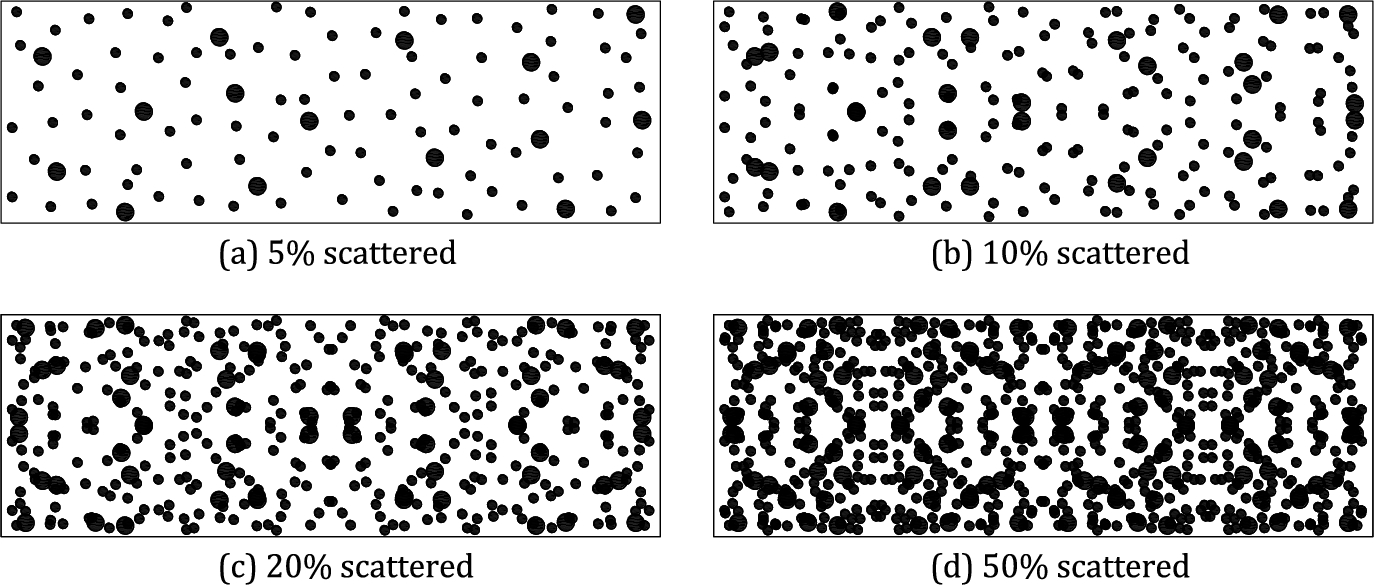
Pitting intensity diagrams.
In current analysis, the ultimate strength of pitted platings

Modelling of pitted areas by FE analysis.
Hence, the 4-node SHELL181 element was applied to mesh the plate panel, as this element is suitable for thin and moderately thick shell structures, in conjunction with the elastic-perfectly plastic material model. Furthermore, the APDL code allows to account for: (i) welding residual stresses, that are superimposed to the FE model as a pre-stress field, and (ii) initial imperfections, by properly varying the vertical coordinate of each node on the basis of a given initial displacement function. Finally, random corrosion wastage is included in the FE model by reducing the thickness of all shell elements belonging to the random pitted areas on the basis of the assumed DOC degree, as depicted in Fig. 3.
Platings without pitting corrosion wastage
The effectiveness of the analytical method is preliminarily investigated by a comparative analysis with some FE results, obtained by Ansys Mechanical APDL. In this respect, Fig. 4 reports the comparative analysis, with reference to no, slight, average and severe levels of welding residual stresses. Particularly, the plating slenderness parameter ranges from 1.0 up to 2.0, with 0.1 step, and then up to 4.0, with 0.5 step. Current results show a very good agreement between the analytical formulation and the FE results, which implies that the solution obtained by the Marguerre equations can be applied for the ultimate strength assessment of platings affected by pitting corrosion wastage.
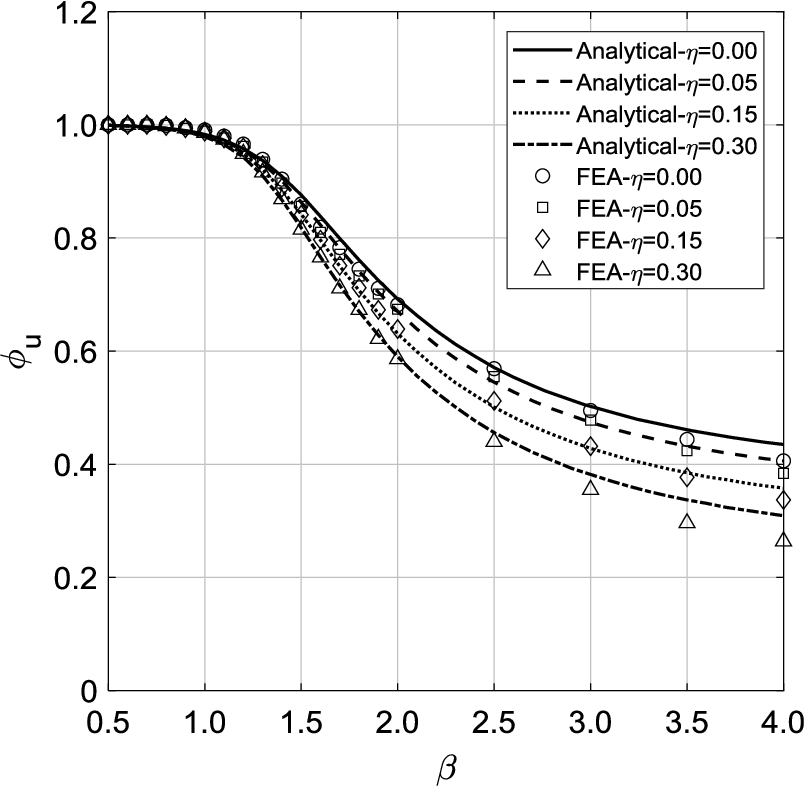
Comparative analysis for uncorroded platings.
The ultimate strength assessment of pitted platings is performed by systematically increasing the DOP degree from 5% up to 50%, while the DOC degree is set equal to 25%. Particularly, the ultimate strength analysis is performed for platings without and with severe welding residual stresses, respectively. Besides, the nonlinear FE analysis is performed with reference to a plating slenderness parameter equal to 2.0 and 3.0. Current results are reported in Figs 5–8 for pitted platings with 5%, 10%, 25% and 50% DOP degrees, respectively. In all cases, a very good agreement between the analytical values and the FE results is recognized, so proving the goodness of the approximate formulation for pitted platings reported in Section 3.
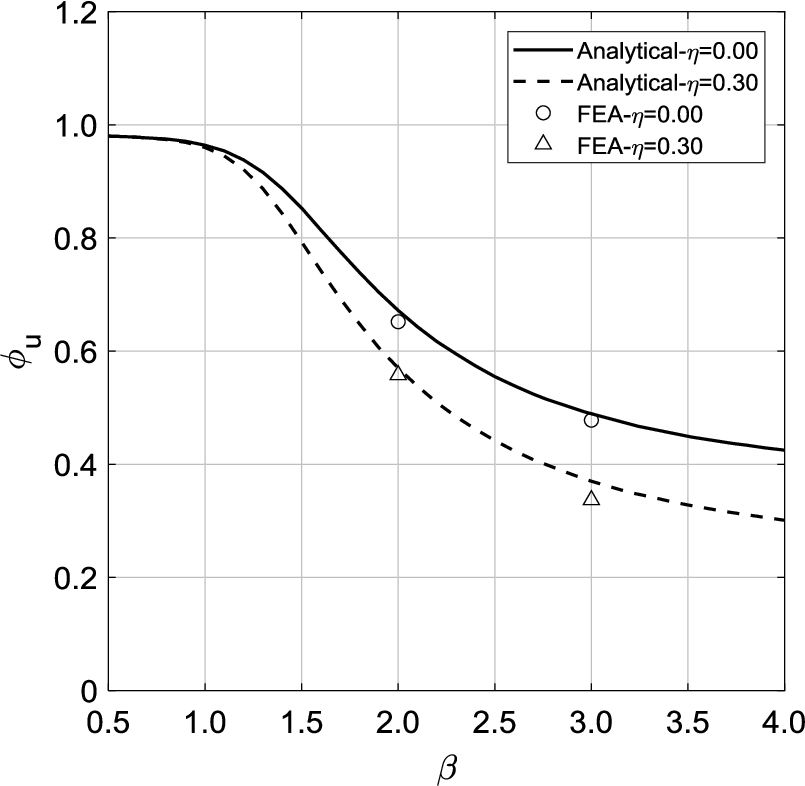
Comparative analysis for pitted platings – DOP = 5%, DOC = 25%.

Comparative analysis for pitted platings – DOP = 10%, DOC = 25%.

Comparative analysis for pitted platings – DOP = 25%, DOC = 25%.
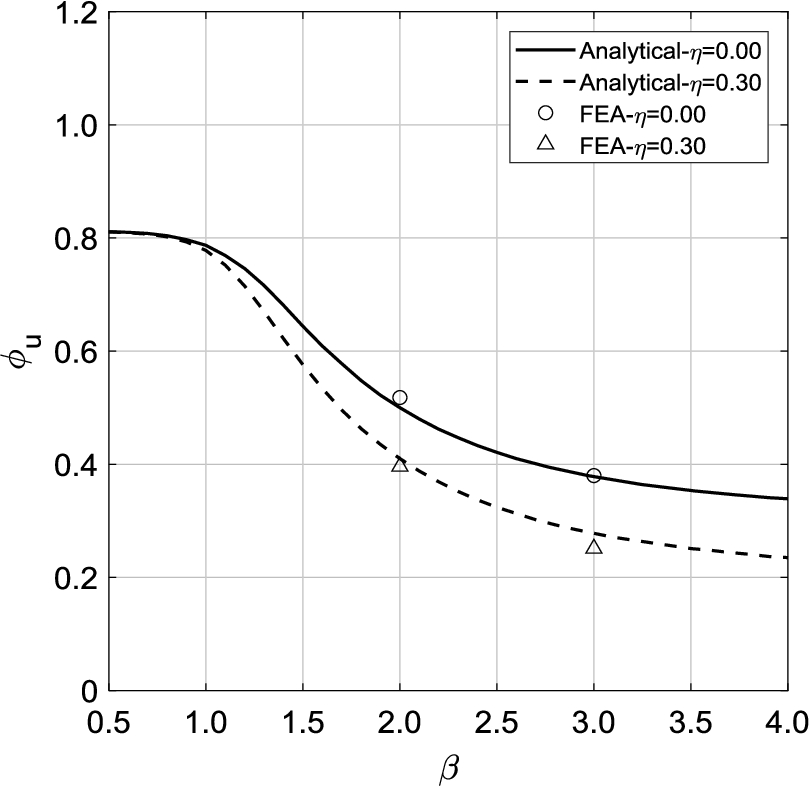
Comparative analysis for pitted platings – DOP = 50%, DOC = 25%.
The effectiveness of the analytical method for the ultimate strength assessment of platings affected by pitting corrosion wastage is further investigated by the comparative analysis with the FE results reported in Table 1. As previously said, two β-values are considered, each one coupled with no and average welding residual stresses. Hence, different combinations of
Ultimate strength of pitted platings
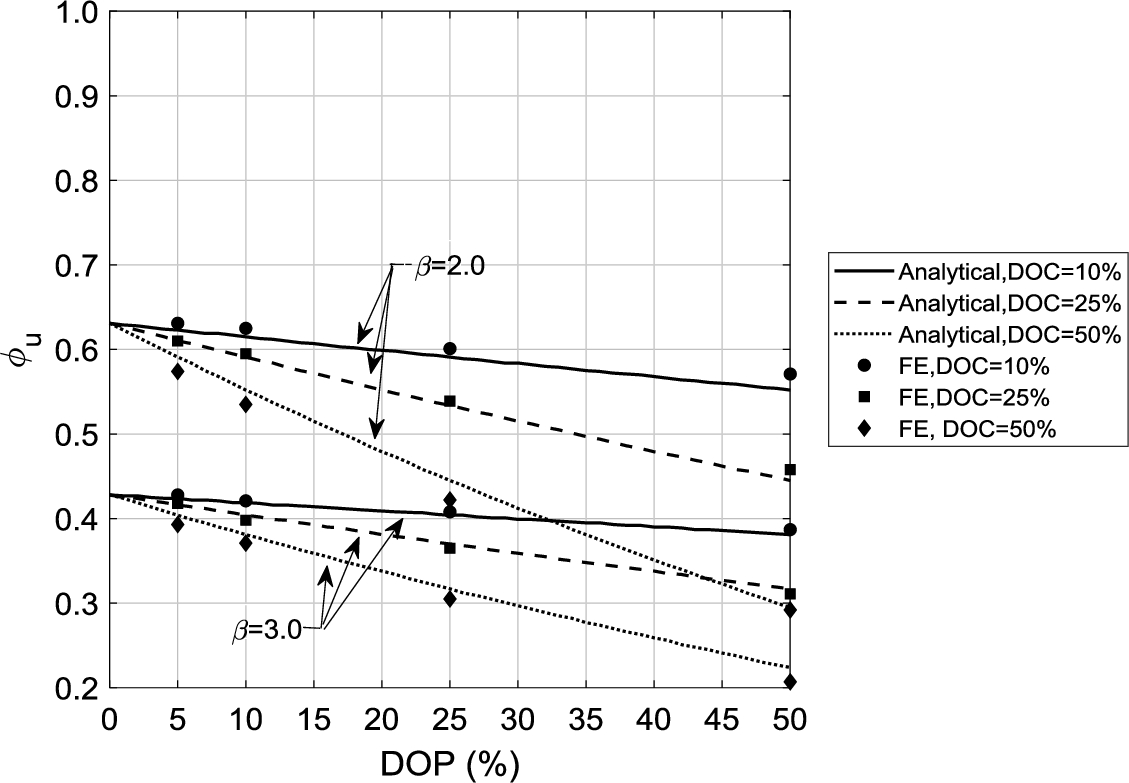
Comparative analysis between analytical formulation and FE results for pitted platings –
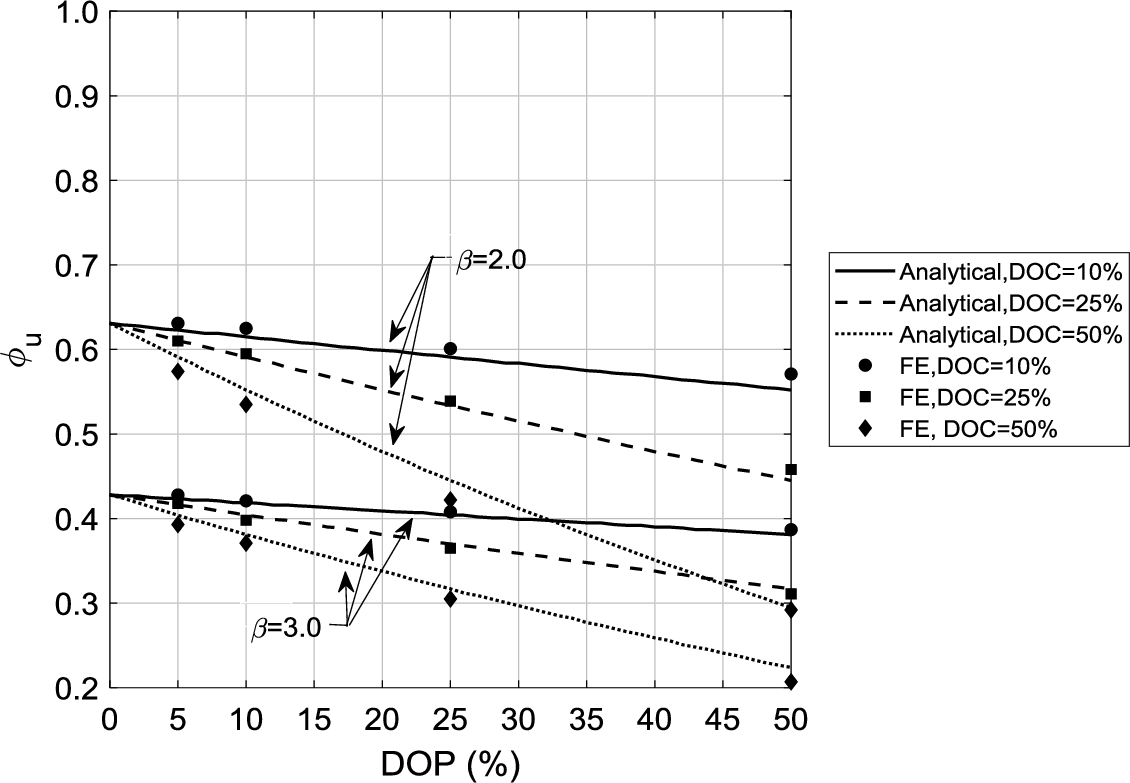
Comparative analysis between analytical formulation and FE results for pitted platings –
An analytical formulation, based on the solution of the large-deflection Marguerre equations, and devoted to the strength assessment of platings under uniaxial compression, was developed and applied to investigate the incidence of pitting corrosion wastage on the ultimate strength of platings under uniaxial compression. Particularly, the analytical solution for uncorroded platings was extended to plate panels affected by pitting corrosion wastage, by properly modifying the plate slenderness parameter and the edge function for the ultimate strength assessment. Hence, a comparative analysis with the FE results obtained by a series of elasto-plastic large-deflection simulations, was carried out by Ansys Mechanical APDL, in order to verify the effectiveness of the proposed formulation.
Based on current results, the analytical solution of Marguerre equations allows efficiently determining the ultimate strength of uncorroded platings for different combinations of initial geometrical imperfections and welding residual stresses. Furthermore, the proposed formula allows efficiently estimating the ultimate strength reduction of platings affected by pitting corrosion wastage. In this respect, several combinations of pitting and corrosion degrees were analysed, in conjunction with different levels of geometrical imperfections and welding residual stresses. Current results clearly show that the approximate formulation for pitted platings is effective for practical design purposes. Furthermore, it was verified that the ultimate strength drop-off mainly depends on the product between pitting and corrosion intensity degrees, which implies that platings with different DOP and DOC parameters behave almost identically, if relevant product is the same.
Current outcomes need to be further investigated and extended to platings with different levels of initial geometrical imperfections and different boundary conditions. In this respect, current results are quite promising for further research activities, devoted to the ultimate strength assessment of pitted platings by analytical formulations.