



Abstract
BACKGROUND:
Understanding how and why the development of conceptual ship designs sometimes become ineffective is essential for ship design firms. Our proposition is that in many projects, uncertainty influences negatively the effectiveness of the decision-making process.
OBJECTIVE:
The objective of this article is to quantify the perception of uncertainty in conceptual ship design processes.
METHODS:
In this article, we propose a research model to study such a phenomenon. The research model is tested using multivariate regression analysis, building on a survey conducted among 23 shipping companies.
RESULTS:
Our model suggests that 14% (
CONCLUSIONS:
This study contributes to research on uncertainty in ship design processes by: (a) proposing an investigative model, (b) developing and testing a survey instrument and (c) running a multivariate regression analysis to study the effect of perceived uncertainty on the effectiveness of decision-making processes in conceptual ship design.
Uncertainty in ship design processes
Proper handling of uncertainty is an important part of today’s shipping industry, from the design phase through the construction and the operation of the vessel [27,32]. This research focuses on ship design and how uncertainty, from the perspective of ship owning firms, influences the performance of the ship design process. Uncertainty arises from, and influences the development of new vessel design solutions [72] resulting, in many cases, in unnecessarily long and expensive design processes and inferior ship design solutions [68]. Uncertainty is however inevitable, and its effects can be profound. Understanding what uncertainties are affecting the ship design process, and to what extent, it is a pre-requisite for the ship designer as decision-maker to select and follow an appropriate uncertainty handling strategy [1,44]. Whether: ignore it, delay the decision, reduce it or accept it [66], will have effects on the design process and its output and outcome. After all, design is in itself an uncertainty handling process [72]. Therefore, it is recommended by this research work to study further what uncertainties are really perceived and understood by the different actors during the design process and how do they influence the outcome of the ship design decision-making process.
Our study focuses on the conceptual design phase. This phase can take from a few hours up to several hundred hours. It is the experience of the authors that for a conventional offshore vessel, this process takes typically in the range of 300 hours, as reflected in Fig. 1. The concept design profiles the vessel design, that is further developed in the basic design phase. It is common that shipping companies explore multiple designs in parallel at this stage, at high expense and considerably uncertainty lurking in the parallel design process. This expensive and time-consuming approach is taking place while ship design firms compete on a no-cure no-pay basis. For this reason, shipping companies and design firms should work more effectively with their conceptual design processes with the purpose of: (a) develop a design that fulfils the expectations of the stakeholders and is made effective in a shipbuilding contract in the shortest possible time and with an acceptable consumption of resources, and (b) reduce amount of re-work necessary during the conceptual design phase and at later stages of the ship design process.

A typical ship design process and use of resources.
Given this premise, this paper pursues two objectives. First, to develop an investigative model to measure perceived uncertainty in the ship design process. And secondly, to explore the influence that uncertainty may have on the effectiveness of decision-making processes in conceptual ship design. Thus, this research contributes to the field of ship design by identifying quantitatively how perceptual uncertainty influences ship design effectiveness. Further, it quantifies the different factors contributing to the perception of uncertainty in ship design. Such quantification shall serve as bases for ship designers to prioritize the distribution of their resources to enhance the effectiveness of conceptual ship design. Uncertainty is here, contrary to other studies such as the one of Diez, He and Campana [19], quantified indirectly. The quantification of uncertainty as a perceptual factor is a well-established practice in the management literature [46]. Effectiveness is defined in general terms as “the degree to which something is successful in producing the desired result” [50]. In our study, and following the definition proposed by Sproles [62], effectiveness in conceptual ship design relies on “how well” a vessel design solution fulfils the expectations of the stakeholders. This study is one of few we know of that explain theoretically, supported by empirical evidence, the relationship between uncertainty in conceptual ship design processes and decision-making effectiveness. This topic has previously been studied in other contexts, as for example, the study of product development carried out by Stockstrom and Herstatt [63, p. 481], who suggests that “the more the uncertainty about the market and technology is reduced during the front end, the lower the deviations from front-end specifications during the following project execution phase and higher the product development success”. Hillson [37, p. 235], affirms that “It is also widely recognized and accepted that successful management of uncertainty is intimately associated with project success”.
A literature review of the measurement of uncertainty and decision-making effectiveness is carried out in the next sections. The literature review work is carried out to identify the constructs used to set up an investigative model (Section 3). We describe the development of the survey instrument, and its use in empirical data collection. Section 4 includes the analysis of the data. The results are discussed in Section 5. The paper concludes with a discussion on the effect which our findings can have on ship design practices, and the limitations of our work, suggesting future research pathways.
The study of uncertainty in ship design and its influence on the effectiveness of the decision-making processes is explored as a multidisciplinary problem in this study, as suggested by Mistree et al. [48] among many. In our research, we explore the ship design process with a focus on the early phase, where the shipowner represents the view of uncertainty in the process of ship design. Doing so, we will also be able to track what factors affecting uncertainty in the decision-making process of conceptual vessel design. This research applies a special version of the between-method type-triangulation, where methods are substituted with disciplines and/or research fields [18]. The overlap of disciplines offers an opportunity to redefine existing issues in a field by providing an opportunity to “revise accepted assumptions” and “generate better ideas through academic entrepreneurship” [74, p. 1070]. This study is therefore initiated by exploring the four research perspectives converging in this research work: decision-making, ship design, strategic management and uncertainty. The reason for choosing more than one theoretical perspective is that designers perform more than only naval architecture and marine engineering, they are complimentary decision-makers and strategists in addition [12].
Measuring perceptual uncertainty in conceptual ship design
“The importance of understanding and quantifying the level of uncertainty in decisions has been of interest in the management research literature since the late ’60s. We have identified two postulates among the research community on uncertainty quantification. A group of researchers advocating for the measurement of uncertainty as a perceptual phenomenon (perceptual uncertainty) – the information that a specific stakeholder believes he or she is lacking, and a second group considering the measurement of objective uncertainty (actual uncertainty) – a measure that is related to the lack of complete information. These two postulates measure uncertainty from different perspectives and, as suggested by Milliken [47], a perfect balance between the two is not realistic. Perceptual uncertainty is influenced by the context, individual attributes, and limitations of cognitive reasoning that are not considered in the measurement of actual uncertainty.”
Miller’s scale of environmental uncertainty has been used as an instrument to measure uncertainty in multiple research work and studies. The instrument measures 35 items representing perceived environmental uncertainty in six areas viz. government and policies, economy, resources and services, product market and demand, competition and technology [46]. Another alternative to predict perceived uncertainty is the work of Downey and Scolum [21], who characterize uncertainty as a psychological state. The authors suggest four sources of variability in perceptual uncertainty named: perceived environment, individual cognitive processes, individual’s experience, and social expectations. The environment is characterized in the work of Downey and Scolum [21] by its complexity and dynamism, following Duncan’s proposal [22]. The perception of complexity (number of interactions), and dynamism (variability of decision-making factors) show a positive relation to the perception of uncertainty. Further, the ability of the decision-maker to cope with ambiguity (individual cognitive processes), its experience in similar decision-making situations (behavioural response repertoire) and the trustfulness in the other stakeholders (social expectations) also have a positive relationship with perceived uncertainty [21].
From a different perspective, Ramasesh and Browning [57] propose a conceptual framework to capture the likelihood of finding uncertainty factors in product development. Although the authors didn’t quantify the strength of the proposed relationships, they argue the need for such an exercise and suggest that this would benefit decision-makers in allocating efforts towards better dealing with uncertainty. All the four factors studied, complexity, complicatedness, mindlessness and project pathologies, are suggested to have a positive contribution to uncertainty. Ramasesh and Browning [57] further support their factors with items identified in a particular literature review research.
Research regarding the measurement of perceptual uncertainty reviewed in this study recognises the multidisciplinarity of uncertainty and primarily has been focused on individual sources, mostly environmental uncertainty, with only a few cases considering the internal environment [55]. However, given the complexity of today’s decision-making problems in early ship design (representing the ship design decision-making process in the present research), it is not adequate to limit the examination to just environmental uncertainty [25]. Miller’s measurement scale focuses only on environmental uncertainty, utilizing industry and firm-specific variables, which represent the external factors to the firm. Another example is the work of Lawrence and Lorsch [43], who focus on uncertainty in inter-organizational settings. However, these are only partial evaluations of the uncertainty present in decision-making, and we haven’t found any research on a complete evaluation of uncertainty that could easily be applied in this research to quantify uncertainty in ship design processes. This bias is what Taleb [65, p. 50], relates to as “tunnelling”, where researchers have focused on well-defined sources of uncertainty limiting, at the same time, the richness in studying the complex issue of uncertainty and effectiveness.
Measuring effectiveness in decision-making processes
The effectiveness of decision-making and its quantification has been studied in different contexts over the years, in most of the cases in relation to strategic management. Elbanna and Child [24] carried out an investigation on the effect of three decision-making dimensions, viz. rationality, intuition, and political behaviour, in decision-making effectiveness. They based their research on 169 managers from Egyptian companies. The analysis included seven control variables named: decision importance, decision uncertainty, decision motive, environmental uncertainty, environmental hostility, firm’s performance and company size. Their findings suggest that rationality and political behaviour have more influence on effectiveness than intuition. Further, decision-making effectiveness was proven to be both, process- and context-dependent [24]. Building on previous research by Elbanna and Child [24], AlDhean [2] evaluates the effectiveness of strategic decisions in high education institutions. Based on the responses of 485 participants, AlDhean evaluates the causality between decision effectiveness (dependent variable) and six independent variables (decision importance, rationality in decision making, intuition, decision decentralization, environmental uncertainty and organizational performance). AlDhean’s findings suggest that five of the independent variables have a significant contribution to decision effectiveness, while the effect of decision decentralization was found to be insignificant. Further, environmental uncertainty and organizational performance, play a moderator role only, influencing the relation between rationality in decision making and decision effectiveness. These findings support the arguments of Dean and Sharfman [17] and the findings of Collins and Hansen [14].
Another example is the work of Ji and Dimitratos [39], who evaluated decision-making effectiveness among Chinese firms, mostly small to medium enterprises at an early stage of internationalization. The authors studied the causality between entry mode decision effectiveness (dependent variable) and of six independent variable factors, viz. decision rationality, hierarchical centralization, environmental uncertainty, environmental munificence, local experience and local linkages. Their findings rely on 233 responses in their survey. Therefore, both decision rationality and hierarchical centralization affect decision-making effectiveness, with a weaker and negative direction in the second case. Environmental uncertainty presents a moderating role between decision rationality and decision-making effectiveness; although always positive, the relationship is stronger for lower levels of environmental uncertainty. Environmental uncertainty also moderates the effect of hierarchical centralization, confirming that higher centralization leads to lower effectiveness in uncertain environments. The factors and constructs proposed in these models are considered relevant to our research work. Further, items are supported by Cronbach’s Alpha indicating their reliability, which increases the likelihood of achieving meaningful results. Thus, we use these items and factors identified by the above-mentioned research in our model.
Conceptualization of constructs
Uncertainty in ship design and effectiveness in decision-making are the key constructs in our research model. To explain both constructs, we use a set of factors that, based on literature research, do explain the two main constructs. In our research model, uncertainty in ship design is operationalized by five factors, biz.: context, input, model, process and agent. Similarly, effectiveness in decision-making is operationalized through rationality in decision-making, experience, decentralization of decisions and intuition. The five independent factors are developed based on a literature review work where we could identify 43 items relating to these five uncertainty factors. A definition of the independent variable factors and the principal references where these have been extracted are included in Table 1. On the other hand, the four factors explaining our dependent variable decision-making effectiveness were extracted from the work of Dean and Sharfman [17] Elbanna and Child [24], Ji and Dimitratos [39] and AlDean [2]. We used only factors with Cronbach’s Alpha higher or equal to 0.700 in the references studied.
Definition of uncertainty factors
Definition of uncertainty factors
Each of these five factors is described by a set of items identified in the literature review study as related to the factors. The items are operationalized in the survey instrument by specific questions.
The purpose of this chapter is to develop and discuss a theoretical model to structure the findings of explanatory factors from the literature review. Development of theory is a central activity in both uncertainty management and decision-making under uncertainty. Unfortunately, there is no unanimity regarding what theory is more representative, explanatory or recommended to study such phenomenon [46], either if it should be measured as actual or perceived uncertainty. Miller’s environmental uncertainty scale is currently the principal reference, with recent applications by Ashill and Jobber [5], Bradley [9] and Elbanna and Gherib [25]. Furthermore, none of the existing models in the literature reviewed, seem to cover the peculiarities of a ship design process the way it is normally experienced. These peculiarities include the vocabulary used in the survey instrument, and the context or frame in which the decision-making process takes place. Thus, it was necessary to develop a revised research model for this specific research problem and apply a multi-perspective theoretical approach to try to explain the relationships and causality. Our research model builds on the findings of other researchers in this area, like Downey and Slocum [21], Miller [46], Elbanna and Gherib [25], Ramasesh and Browning [57] and connects them with the uncertainty factors extracted from ship design literature, including Gates [35], Ulstein and Brett [67], Vrijdag, Stapersma and Grunditz [69], Andrews and Erikstad [4], Gaspar, Brett, Ebrahimi, et al. [34] and Puisa [56]. The latter are used as a reference to settle the name of our uncertainty factors. The main idea was to use names familiar to people working in the shipping industry.
Following the recommendation proposed by Miller [46] as a response to criticisms regarding the aggregation of scores into a global perceived uncertainty measure [47], we propose here a disaggregated measure of uncertainty composed by five factors. Derived from strategy, decision-making, (ship) design and uncertainty literature, we suggest decomposing perceived uncertainty in five categories, viz. input, model, process, agent and context; see Fig. 2. This categorization of uncertainty in five constructs and the corresponding items have been derived from the literature search findings. It was initially proposed by Wacker [70], Ramasesh and Browning [57, p. 194], that literature review “provides the accepted definitions, applicable domains, previously identified relationships (along with empirical tests), and specific predictions”.
The model includes first a set of identified uncertainty factors (UF) (left-hand side of the model), which include: (a) context, (b) input, (c) model, (d) process, and (e) agent; and four factors reflecting the effectiveness of decision-making (EF) (right-hand side of the model), which include: (i) rationality, (ii) experience, (iii) decentralization, and (iv) intuition. Furthermore, the model includes also a set of identified control variables.
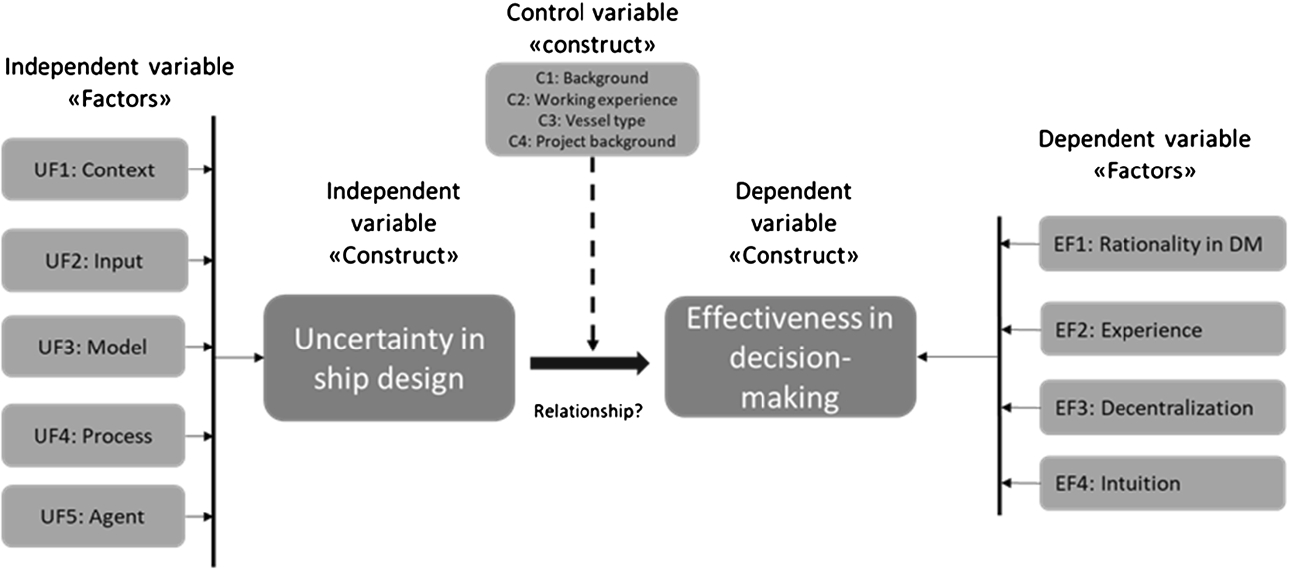
Proposed investigative model.
Based on this theoretically grounded model, we pose the following research questions (RQ): What are the important uncertainties in conceptual ship design, and how do they influence effective decision-making? The investigative model presented in Fig. 2 is further discussed in the next theorization chapter. The research model is the foundation of this research paper.
This research includes a survey and questionnaire process. The research instrument for the dependent variable was developed through an extensive literature review. This was a consequence of not finding an instrument available in the literature. However, the measurement used to capture the dependent variable was borrowed from Ji and Dimitratos [39] and AlDhean [2]. The characterization of the survey is summarized in Table 2. The shipping industry and more specifically ship owning companies were the objective of our survey. Firms and subjects participating in the survey were selected randomly from a list of more than 65 000 email addresses part of the World Register of Ships [38]. Although shipowners are only one of the many stakeholders involved in the ship design process [33], we have selected this stakeholder for being the end customer and dominant decision-maker, and the one the ship designer should support on the handling of uncertainties during the design phase. A total of 3 400 emails were selected (5% of the total sample), of which 2 454 were effectively invited to respond, 301 emails (8,9%) could not be delivered, and 645 respondents could not be reached (19%). The instrument consists of 63 questions, all of which could be scored by a 5-point Likert scale. Two different Likert scales were used, one for questions relating to uncertainty factors, and the other for questions relating to decision-making effectiveness. Additionally, an “I don’t know” response alternative was also made available as proposed by Fowler [29] and Fox et al., [31].
Characterization of the survey
Initially, a pre-test was carried out. The pre-test consisted of a group of experts with three ship design experts. The objective was to test the overall clarity, structure, relevance and wording. Based on the results from this pre-test, a few changes were made to the formulation of the questions, and the structure of the questionnaire itself. The pre-test was followed by a pilot test with three participants. After this pilot test, it was decided to include an “I don’t know” response alternative. The survey instrument was finalized and distributed to the main target population. The recommended procedures by Patten (2001) and Siniscalco and Auriat (2005) were followed. The participants were contacted via email, where the purpose of the survey was described. Thereafter, the survey was available through a website that included a guideline to complete the survey. The electronic distribution was almost the only option based on the size of the sample. During a period of two and a half months, weekly reminds were sent to the remaining participants, and new responses were received immediately after the reminder. At the end of the period, 24 participants had completed the questionnaire, and 30 more initiated it but never finish it. Out of the 24 participants, only 23 responses were eventually valid, resulting in a response rate of 0,9%. Based on this response rate, and considering our effective sample, we can achieve a confidence level of 85% with a margin error (e) of 15%.
Given this limited response rate, considering that the number of responses registered is slightly lower than the minimum ratio recommended (5 x no. predictors) [36], we should keep in mind that: (i) the generalization of results becomes questionable, and (ii) the statistical power of the regression will be negatively influenced [36]. In spite of this, and following the recommendations of Hair et al. [36], we have decided to proceed with the analysis.
The response population has a widespread background and role. A summary of the background information from the participants in the survey is enclosed in Appendix B of this article. Most of the participants (87%) have extensive experience in the industry, with more than 11 years. No major differences in perception of uncertainty or decision-making effectiveness are found among participants of different groups of years-of-experience, although participants with intermediate experience (11 to 20 years) have, on average, lower scores on questions relating to uncertainty, and higher in questions relating to decision-making effectiveness as compared to both, more and less experienced respondents. However, we found a similar behaviour as Kruger and Dunning (1999), with regards to experience in vessel newbuilding projects. Respondents with no experience in projects perceived the lowest level of uncertainty, while those with experience from one to two projects perceived the highest level. Thereafter, the level of uncertainty perceived decreases with the number of projects. Further, no major differences were found among alternative project backgrounds (vessel type, operational strategy or newbuilding strategy).
We evaluated the internal consistency of the constructs based on the coefficient alpha (Cronbach’s α). The values achieved by our measurement instrument are presented in Table 3. After adjusting the construct’s measurement scales by removing items of low consistency, we identify that six factors have alpha levels above 0.700, hence adequate according to Nunnally and Bernstein [49] and Panayides [51]. Additionally, two factors have alpha levels above 0.600, which according to Hair [36], are sufficient to prove inter-item reliability. The factor decentralization is excluded for having a low coefficient alpha
Inter-item reliability (Cronbach’s alpha)
Inter-item reliability (Cronbach’s alpha)
More detailed results are included in Table 4 and Table 5, including results from a Shapiro–Wilk normality test. Finally, and before proceeding to the analysis of the regression model, tests to identify potential heteroscedasticity and collinearity were performed. Heteroscedasticity was discarded since no major deviations are perceived on the variance of error along with the values for the dependent variable. Based on the results obtained from the reliability analysis, the investigative model has been adjusted accordingly, eliminating items and factors with low Cronbach’s alpha (lower than 0.600). The new investigative model consists therefore of five independent factors with 38 items, and three dependent factors with 15 items. An overview of the items and factors included in the initial model is presented in Table 4 and Table 5. Those items and factors excluded in the adjusted model are highlighted with a (#) in Table 4 and Table 5. Adjusted constructs and factors are indicated hereafter by a “2” at the end of the name. From here on, all the analyses use the adjusted variables.
Statistical characterization of the independent variable
(Continued)
Statistical characterization of the dependent variable
Furthermore, the range of correlations among independent variables varies from
Correlation matrix adjusted dependent and independent factors
The confirmatory analysis for our initial research model reflects a coefficient of determination
The value obtained for

Investigative model with results (β-values).
Results from the regression model by confirmatory analysis
The research results are discussed next.
The objective of this study is to explore how uncertainty factors affect the effectiveness of decision-making in conceptual ship design processes – Does uncertainty in ship design (independent variable) affect the effectiveness in decision-making in ship design (dependent variable)? A research model has been developed to measure both constructs, and it has been populated with data via a survey questionnaire instrument distributed electronically to shipping companies. The research results suggest that the presence of uncertainty in ship design processes can explain 14% (
The context factor is found to explain 20% of the relationship between uncertainty and effectiveness in decision-making. This explanatory factor relates to the exogenous factors having an influence on the future operation of the vessel and the decision-making process involving the design and construction of the new building vessel solution. This factor has the highest positive explanatory power to decision-making effectiveness. These results were not unexpected since most of the recent research on ship design under uncertainty has focused on handling environmental uncertainty (or context), as described in earlier sections of this paper. Yet, in contemporary ship design practices, we normally pay little attention to contextual factors. In most of the cases, the handling of contextual factors is left to the vessel owner, who hopefully defines the set of criteria and expectations for the new vessel design and convey them to the ship designer in one way or the other. Based on the findings from our study, ship designers should pay more attention to the markets they are operating in and guide their customers on how to design better vessels able to handle the likely changes to take place in those market segments. Variability of regulations, operational requirements or costs of factors such as fuel, among others, are also critical considerations to make. It is also paramount that the shipowner’s business proposition and life cycle expectations as to the overall performance of the vessel design are carefully scrutinized, and set expectations are met. Something as simple as running a vessel economics analysis can contribute to increasing the effectiveness of the design process. Calculating the cost of different vessel design solutions and their operating costs and contrasting those to current and historical rates will guide the designer and its customer to select a better vessel design solution. This analysis can be further enhanced with a simulation of volatile factors such as fuel price, charter rates, cargo availability and the like.
Unsurprisingly, agent is the second factor with the highest positive explanatory power to decision making-effectiveness. Both context and agent are also argued in the literature as the two largest contributors to uncertainty in decision-making problems [28,42]. In a multi-disciplinary and multi-stakeholder activity, as is ship design, the management of stakeholders is critical for the design process. In some cases, where the customer is represented by more than one stakeholder, the design process can lead to irrational, over-specified design solutions [33]. To handle this aspect of complexity, ship designers need to develop a good relationship with the parties they are working with. Hence, the importance of maintaining a good and efficient communicative relationship with existing customers and stakeholders. Stakeholder workshops in the early phase of the design process are beneficial and recommended [11]. These workshops will be useful to clear some doubts with regards to the expectations of the different stakeholders and hence, reduce the likelihood of design work being carried out under incorrect or misunderstood expectations.
Together with process, the factor input has a negative contribution to the effectiveness of the decision-making processes. This finding contradicts most of the literature on design theory and practice experience, which suggest that input is the most important aspect of a design process [15,64]. The result does, however, follow the recommendation of de Neufville and Scholtes [16], who suggest focusing on design flexibility and not on project specific needs. It is yet unclear to us the reasons behind the perception of a negative effect of input in the effectiveness of the decision process. One explanation could be the fact that input relates to the information provided by the shipowner himself to the designer. Thus, he or she will consider the time spent on adjusting the input as time lost, thus reducing the effectiveness of the process. Another alternative is that respondents have perceived input in the sense of the needs for the first contract of the vessel, and therefore, consider ineffective the specialization of the vessel to a unique operation.
The factor model is found to have a positive relationship to decision-making effectiveness, although the weakest effect among the three factors showing a positive effect. The model reflects the uncertainty on the consequences of design decisions. Today, most of the ship design practice relies on using advanced software that although accurate, require a substantial amount of resources and time to perform. Consequently, such design process leads to inadequate response time to shipowners or other stakeholders. In some cases, these practices delay the design decision-making process as a result of their comprehension and time consumption before results appear and are properly interpreted. Hence, designers and vessel owners have to proceed with decisions without fully understanding their consequences and iterate if the output and outcome of their decisions are not as expected. This rework is a substantial source of ineffectiveness in ship design processes [45]. New simulation techniques pursue the reduction of response time. Two recent examples are Erikstad [26] and Ebrahimi [23].
The factor process has the strongest contribution to effectiveness in decision making based on the findings from our model. Yet, its effect is negative, contrary to our initial proposition and what literature and theory suggest. Process relates to the uncertainty created during the design process, lack of understanding of the product and how it will fulfil the expectation originally designed for. Typically, it relies on the control the ship designer has on the process and the product and is strongly dependent on the degree of innovation and newness and novelty of the design solution. A potential reason for the negative influence of process in decision-making effectiveness could be the role of innovation. Shipping firms may perceive as negative the role of innovation in the design process, although it may have positive effects in the final vessel design solution and their lifecycle performance. This has been recognised by Petetin et al. [53], who highlight the difficulty of implementing innovation in complex product-oriented industries like shipping or aeronautics – “the uncertainty related to the value of innovation can create is often an important dissuasive factor” [53]. Thus, design development should take place close to customers, preferably as an integral process of business case development. The authors of this article have experienced this effect several times during their industrial experiences. Not all customers are open for innovation, and more of the shipping companies are more comfortable with traditional naval architecture and marine engineering solutions.
From this study, it becomes clear that it is necessary to advance research on how uncertainty is perceived by ship owners and designers during the conceptual design of a new vessel. This study contributes to new knowledge by proposing an investigative model to measure uncertainty in conceptual ship design processes. The model and its measurement instrument have been calibrated and validated with acceptable Cronbach alpha levels. No statistical significance has been found to support our findings, but the results indicate correlation, causality and directionality among the predictor variables and the dependent variable: decision-making effectiveness.
Discussion
Frequently used ship design theories cover asymmetrically the different uncertainty items identified in this research work. As presented in Table 8, these theories typically focus on only a few, and not necessarily the most important, of all the elements contributing to the perception of uncertainty in ship design processes. Commonly used ship design theories are represented by 29 publications reviewed by Ulstein and Brett [67], which include most of the recognized ship design theories with their special features. In Table 8 we have related the items from our questionnaire to the relating design activities in those ship design theories. Each of the items from our questionnaire is companied by its mean value resulting from the response of the 23 participants. The mean value represents the importance of each item as perceived by the ship owning companies on a 1 to 5 scale, where “1 = not influential at all” and “5 = extremely influential”. Further, we count the number of appearances of these design activities in the 29 publications reviewed by Ulstein and Brett [67]. Each of the design activities captured by Ulstein and Brett (2012) are associated with commercial (C), technical (T) and operational (O) aspects.
Uncertainty items in commonly used ship design theories
Uncertainty items in commonly used ship design theories
(Continued)
From the review of the information presented in Table 8, we can conclude that most ship design theories need to improve in many critical facets in relation to the handling of uncertainty and the improvement of the effectiveness of conceptual ship design processes. In spite of its recognised importance identified in our survey instrument, commonly used ship design theories underemphasize the importance of activities like business proposition and life-cycle analysis. Better handling of commercial factors such as vessel dayrates, market dynamism, and future vessel requirements, is still a pending issue in ship design theories, although major improvements have been done in the latter years. Simulation techniques [7], scenario planning and Epoch Era evaluations [41] or the use of design ilities [58], are some examples of recent theoretical developments in this direction. Similarly, there is little reference to stakeholder behaviour, and more generally to the factor agent, in ship design literature. More recently, ship design researchers and practitioners have proposed collaborative approaches to handle the uncertainty of multiple stakeholders [11,13,33]. Input items relating to the completeness, reliability and validity of the information confining the business idea are, too often, left aside in ship design practice. The expectations of the vessel owner are taken as requirements and are rarely critically questioned, in spite of its importance [3].
Based on the response to our survey, regulations represent the uncertainty item with the highest importance for shipping companies. We couldn’t find any reference in the literature suggesting this. A potential explanation for this response is the current situation of the shipping industry with multiple environmental regulations coming into force on a short period of time. The second item in terms of importance is the experience of the decision-makers with newbuilding projects, and in third place, it is the economic performance of the vessel, in other words, the economic viability of the vessel business case. Contrary, disasters, political constraints and tax policies are perceived as the items with lowest importance with respect to uncertainty in conceptual ship design processes.
Thus, knowing this information, ship design practitioners should concentrate their efforts on those factors perceived as more important, and put less emphasis on those with lower relevance. In the current shipping environment, ship design firms shall provide shipping companies with advice on how to manage and comply with future regulations relating to, for example, emissions. There exist multiple alternatives to comply with the new limits on SOx emissions coming into force in 2020. Ship design firms should inform shipping companies about these alternatives, and their consequences and implications for the operation of the vessel. We, ship designers, have to play a more active role than in the past. This aspect also relates to the economic performance of the business case. The experience of the shipping company with newbuilding projects is also important, especially if the designer and vessel owner have already collaborated in previous projects. This will facilitate a better and more effective communication and understanding between the parties, thus creating lower uncertainty and contributing to a more effective concept design process.
This study provides insights into how uncertainty influences decision-making effectiveness in conceptual ship design processes. An investigative model is proposed and tested based on the response and feedback of 23 shipping companies. The findings provide insights into where a ship design firm should put more efforts to improve the effectiveness of their ship design processes.
From our findings, ship design firms should put more effort into understanding better the contextual factors affecting the ship design process. The current and future supply and demand situation, the implication of rules and regulations or the cost level of different vessel design solutions, are important factors to consider when developing a new vessel design. Designers could gain insights from more comprehensive market analysis, business case analyses or investigate the effects of these uncertainty factors on the performance of the vessel over time by using, for example, scenario planning simulations, or Epoch-Era techniques. One example of the latter is the work of Pettersen et al. [54]. It is also important to improve communication with vessel owners and other stakeholders. The communication among stakeholders is critical in design processes, and common workshops in the early phases of the design process can help to build a common understanding of the expectations from the design project and reduce the negative effects of high uncertainty levels in the ship design process and related decision-making process. Ship designers have to improve the agility of the design process. Quicker feedback to customers/stakeholders and more interaction with them could improve the effectiveness of the design processes while reducing the uncertainty of shipowner. On the other hand, and contrary to what literature suggests, process and input seem to have a negative influence on the effectiveness of decision-making process based on the sample of our survey. A likely and potential interpretation of this somewhat surprising result is that shipowners will feel uncomfortable if ship designers challenge the information provided by them and explore innovativesolutions or alternative ways of approaching the ship design process. This is experienced in practice by us as the expressed resistance from the shipping industry to explore new avenues to ship design solutions and the time it takes to introduce new features into the industry. Overall, our findings suggest that the ship designer needs to attack the wicked problem with a more holistic and systemic perspective.
This study has three contributions to the research on uncertainty in ship design processes: (a) it proposes an investigative model to investigate perceptual uncertainty and decision-making effectiveness in ship design processes. Furthermore, (b) it provides a survey instrument, not available to date, to measure the perception of uncertainty in ship design processes and its effect on the effectiveness of decision-making in ship design. The survey instrument is tested, and Cronbach’s alpha developed. Last, (c) the research model is investigated through a multivariate regression analysis and confirmatory results found.
Limitations and further research needs
In this research, we explore the role of uncertainty in the performance of decision-making processes in conceptual ship design. We can recognise three major limitations of this study, which can be dealt with by future research initiatives into developing further the: (i) research perspectives, (ii) survey sample, (iii) survey participation. Our research has selected four research perspectives to study the effect of uncertainty in decision-making effectiveness. These perspectives are: decision-making, ship design, strategic management and uncertainty. The selection of alternative perspectives such as economics, behavioural science or mathematics, to name a few, could have resulted in identifying alternative items and factors for the two constructs under investigation, uncertainty and effectiveness in decision-making. Future research could, for example, investigate the effect of selecting one or several new perspectives in developing the explanatory model. Uncertainty among more stakeholders could be studied individually and collectively. Further, uncertainty in the downstream design process (basic design, detail engineering and production design) could cast new light on the problem at hand. Our work has intentionally focused on the perception of uncertainty by shipping companies. This has an important limitation since ship owning companies represent only one of the many stakeholders involved in the ship design process. Alternative stakeholders such as ship designers, flag states or vessel charterer may perceive uncertainty differently. Finally, the limited number of responses received in our survey limits and restricts the extrapolation and generalization of results. Thus, a new survey based on the adjusted investigative model is suggested. Ideally, the new survey should target a response level in the range of 75 to 100 observations (15 to 20 per independent variable [36]). We will welcome such extended research work to take place soon.
Footnotes
Survey instrument
1. Uncertainty in ship design
In the following questions, we would like you to describe the process followed in the latest newbuilding project you were involved in or associated with.
Scale: (1 = Not at all influential, 2 = slightly influential, 3 = somewhat influential, 4 = very influential, 5 = extremely influential)
To what extent did the following factors influence your decision of selecting a specific vessel design?
2. Decision-making effectiveness
In the following questions, we would like to explore your perceptions about the effectiveness of the decision-making process relating to the newbuilding project unit of analysis.
New scale: (1 = Never, 2 = Rarely, 3 = Occasionally, 4 = A moderate amount, 5 = A great deal)
Please, tell us about your perception by marking one of the alternatives that follow each question.
3. Demographic information
In the following questions, we would like to capture your demographic information. Please, select whichever alternative applies below.
4. Project case study
In the following questions, we would like to capture information regarding the newbuilding vessel project. Please, fill in whichever box applies below the preliminary mode of operation of the vessel used as a reference when filling in this questionnaire. For example, platform supply vessel, cruise vessel, container vessel, etc.
In the following questions, we would like to capture information regarding the newbuilding project model. Please, fill in whichever box applies below. If you feel that none of the categories here included representing the real process, please write your description in the box marked as “other”.
In the following questions, we would like to capture information regarding the operational strategy towards the newbuilding project. Please, fill in whichever box applies below. If you feel that none of the categories here included representing the real process, please write your description in the box marked as “other”.
In the following questions, we would like to capture information regarding your involvement with the newbuilding project. Please, fill in whichever box applies below. If you feel that none of the categories here included representing the real process, please write your description in the box marked as “other”.
5. Final comments
Please, write below your further comments if any.