



Abstract
Through this review of 25 clinical and experimental works on long-term musical memories in Alzheimer’s disease (AD) patients, we attempt to clarify the conceptual understanding of musical memories, identify their evolution across the stages of the pathology, and propose possible explanations concerning the neural and cognitive mechanisms that underpin the preservation and impairment of certain musical memories. After clarifying the different kind of musical memories, we investigated their alterations throughout AD’s progression from mild to severe stages. Both procedural and retrograde semantic memory seem relatively spared in AD, while episodic memory appears to be impaired early. Moreover, partial preservation of music encoding in AD can be revealed through paradigms that are especially designed for AD patients (relying on behavioral cues, using adapted settings, etc.). Although seldomly used, they would definitely help understanding the preserved capacities in every stage of AD. However, more research is needed to better understand this phenomenon and assess its specificity to music or other types of supports. These findings could lead to multiple applications in care settings and research designs, bringing more nuanced understanding of how long-term musical memory degrades throughout the course of AD, and should encourage us to prioritize patients’ preserved cognitive abilities in current AD recreational and care programs.
INTRODUCTION
The earliest recorded case study on musical memory in Alzheimer’s disease patients (hereafter AD patients) dates back to Beatty et al. [1]. The authors examined an AD patient who, despite neither being able to dress herself nor perform the pursuit rotor task of motor skill, was able to play the piece “Twinkle, Twinkle, Little Star” on the piano, and even transfer that skill to the xylophone, an instrument she had no formal training with. Shortly after, Crystal et al. [2] evaluated an AD patient, 82-year-old pianist, who was able to play the piano pieces he had learned before the onset of his illness despite suffering from a complete inability to remember the title or the name of the composer of the very piece he was able to play. Not to mention, the patient had clear difficulties with language, self-expression, factual memories, understanding of social norms, and reasoning skills, classically reported behavioral signs and symptoms of the AD pathology [3].
Since then, the scientific interest in music, memory, and AD has grown, and many studies have been examining the effect of passive listening of music [4 –9] and active musical training [10 –12] on the progression of AD signs and symptoms. Other studies have directly sought to understand the mechanisms that are responsible for the musical memories that are preserved in AD patients. In this review, we examined specifically the musical memories abilities in AD patients.
CONCEPTUAL FRAMEWORK OF MUSICAL MEMORY
Despites these early studies, formal conceptualization of musical memory has been carried out much later with the development of neuropsychological memory models and modern imagery technics. As such, it appears important to retrace briefly some of the work that allowed general and musical memory models to emerge.
Tulving [13] was one of the first researchers to dissociate conceptually and clinically both semantic and episodic long-term memories. At first, he defined semantic memory, as classically understood, to be the concepts and labels that are attached to and define an entity over the long term (e.g., the functions of an object or the meaning of a word). These memory traces are often thought as concepts that can be articulated in words, and thereby paraphrased. In 1985 [14], Tulving proposed a simplification of its definition of semantic memory which becomes the knowledge that we have about the world, unrelated to a temporal and spatial context, as opposed to episodic memories. This evolution of the Tulving’s definition of semantic memory gives a good account of the debates surrounding the delimitation of a musical semantic memory (see hereafter).
Before a long-term musical memory is encoded, it must be perceived and distinguished as a musical stimulus. This initial decoding process largely involves auditory working memory [15], a transition point towards long-term musical memory. Through the examination of several clinical case studies, Peretz et al. [16] and Peretz and Coltheart [17] build a cognitive model of music perception that conceptually breaks down the components of an auditory stimulus and explains how they are constructed into a sound with musical significance. In their model, once an acoustic input has been identified as musical, it enters the “musical lexicon” and can be encoded into long-term musical memory [16, 17]. Peretz and colleagues define the musical lexicon as a “perceptual representational system for isolated tunes, much in the same way as the mental word lexicon represents isolated words.” [16].
Therefore, should we speak of musical semantic memory only for the musical information associated with verbal labels (representing a lexicon in a classical acceptation) or can we also consider non-verbalizable musical knowledge as part of the “musical semantic memory”? Patel [18] concludes that the range of musical semantics is rather limited, because music, unlike words, does not have semantic referents that link to meaningful concepts. Indeed, paraphrasing the meaning of a musical melody seems barely possible in comparison to paraphrasing the meaning of a word. In line with the research described below, and especially the “musical lexicon” proposed by Peretz and collaborators [16, 17], and the musical memory as conceived by Patel [18], we consider musical semantic memory as the information accessed by sense of familiarity for a melodic progression, regardless of timbre or starting pitch, and stripped from any contextual information [19, 20]. It involves being able to recognize the full melody of a particular musical piece in any key, at any tempo, with any timbre, or without any ability to recall a past event where this melody was heard. Therefore, our conception of musical memory suggests that any information and/or label (i.e., its title, the name of the composer, the musical era to which it belongs) associated with a musical stimulus cannot be strictly considered as musical memory. This additional information can rather be categorized as verbal semantic memories, which is strongly associated with, but nonetheless separate from musical semantic knowledge.
Another way of representing the continuity between perception, pre-semantic processing, lexical organization, and the labeling of a semantic knowledge, both general and personal is to rely on Bruce and Young’s face identification model [21] with three distinct levels. The first one refers to the structural analysis of musical information, which corresponds acoustic analysis [22]. The second level corresponds to the structural recognition, and represents the access to stored memories for musical pieces. It refers to what Peretz calls the “music lexicon” [16, 17]. This level corresponds to the most widely used access to musical semantic memory as it triggers familiarity to music. Finally, the third level represents the knowledge of the “identity” of a specific musical piece, allowing the denomination. It includes the verbal memory of personal and general facts associated with the music (as proposed by Tulving for general memories [14] and confirmed for music by Platel [20]) (see Fig. 1).
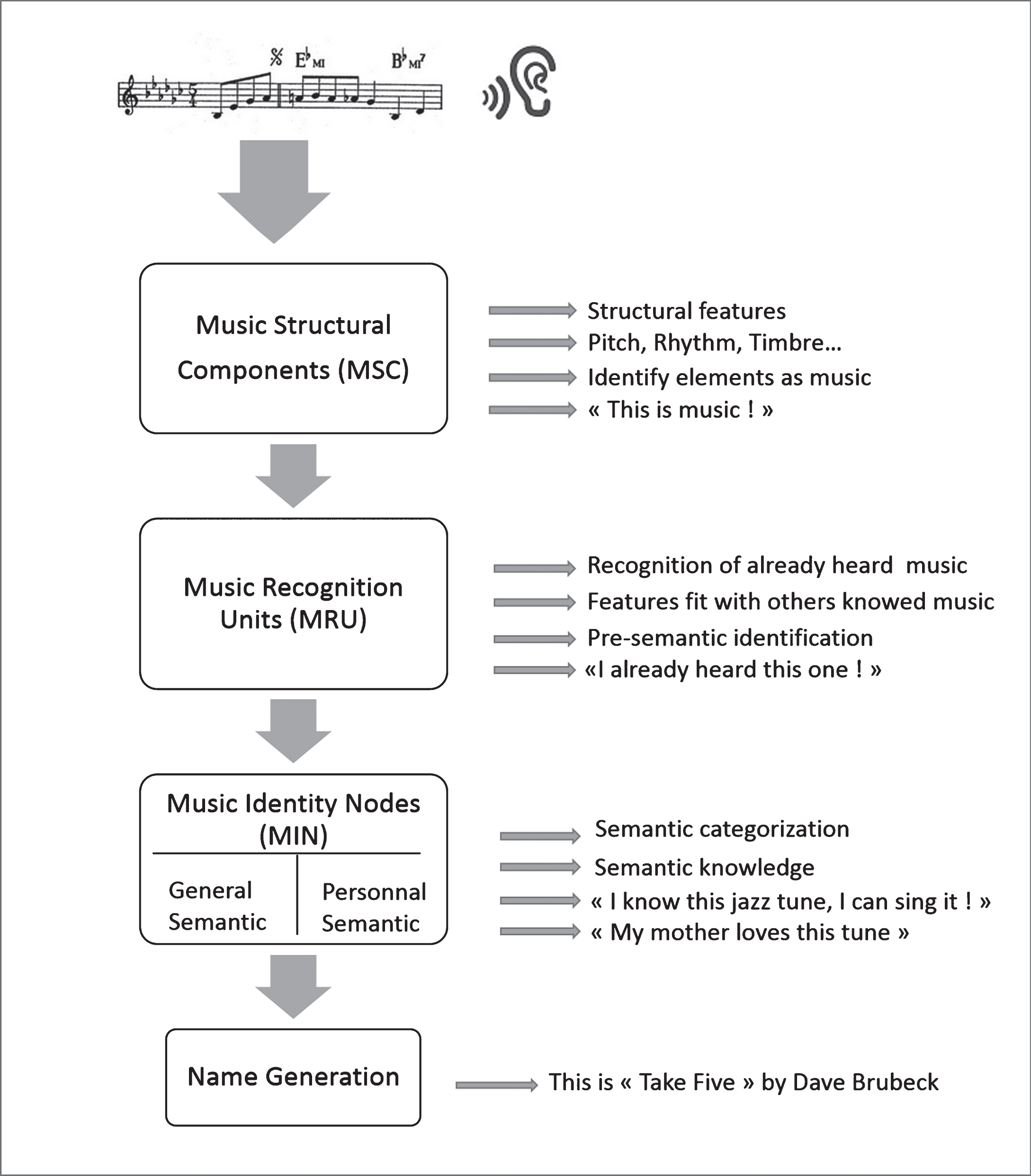
Model of music identification processes inspired by Bruce & Young (1986) face recognition model [21], declined in three main steps: 1) MSC, Music Structural Components, corresponding to structural features analyses; 2) MRU, Music Recognition Units, corresponding to pre-semantic identification; and 3) MIN, Music Identify Nodes, corresponding to semantic categorization and knowledge. This last step allows access to associated verbal labels.
However, an episodic musical memory, as contrasted with a semantic musical memory, does not only contain the precise musical details of the melody, but also the spatio-temporal context in which the specifically remembered musical extract is imbedded. We proposed [20] that episodic musical memory referred to the capacity to recognize a musical excerpt (whether familiar or not) for which the spatiotemporal context (i.e., when, where, and how) can be recalled. Actually, an episodic musical memory relates to a specific experience in time and space that has at its core a musical excerpt and may therefore change over the course of time [23] until it may lose its spatiotemporal significance and become a semantic knowledge [24, 25]. In that case, the ability to associate a musical melody to a specific way it was played—in other words, the ability to pinpoint a specific episodic musical memory in time and space—is lost. This mechanism can be considered as a “semantization” of musical episodic memories.
Some authors also distinguish between general and autobiographical musical memory. The latter refers to musical stimuli which have shaped the facts, events, and experiences that construct our life story, and therefore have rich and deep personal meaning [26, 27]. In our framework, we consider this kind of musical memory not only very specific to the individual, but also engulfing both long-term episodic and semantic musical memories. We suggest its antithesis to be a kind of “collective” musical memory for the general musical knowledge shared within a community and its influence on a society as an entity [28]. One can cite the national anthem of a nation shared among its citizens as an example. Therefore, while autobiographic and collective musical memory do provide us with new perspectives on musical memories, it still remains difficult to carry out group studies with controls on these topics due to the broad tangle of musical memory with personal experience. This is especially true for autobiographical musical memory, since a unique mosaic of musical experiences throughout our lives has influenced each of us.
Despites the focus of current literature on comparing and contrasting episodic and semantic musical memories, some case studies also address musical procedural memory, mainly referring to the automating of learned motor sequences (whether for singing or playing a musical instrument). Penfield and Milner [29] were among the first to clinically dissociate procedural memory from the other two by relating the case of a patient who was able to perform a hand-eye coordination task without any subsequent memory that he had performed it. Few years later, Berthoz [30] developed this theory and suggested that musical procedural memory also involves sensorimotor memory as well as memory for the movement and location of extremities in time and space, thereby engaging the sensorimotor system, a kind of perceptual representation system [13]. Keeping this information in mind, we suggest that musical procedural memory is the ability to perform a previously learned musical motor sequence in a fluid manner.
Beyond the different memory systems presented above, two operation modes for memories are classically distinguished: implicit (procedural) and explicit (semantic and episodic) [31]. However, this classical view has been recently challenged by recent studies suggesting that the difference between implicit and explicit memory does not necessarily imply different type of memory, but rather a difference in the musical memory encoding process [32, 33]. From this perspective, implicitly encoded musical memories are encoded in an incidental and passive manner whereas explicitly encoded musical memories require effort and deliberate encoding. This dichotomy is not to be confused with a conscious or unconscious behavior, which refers more to whether one is aware or not of an event [34].
METHODS FOR TESTING MEMORY
Overall, three different methods are routinely employed to test the retrieval of musical memory: free recall, recognition, and recollection. The first one is a conscious, deliberate, and planned behavior that requires independent retrieval of an absent musical stimulus (i.e., reproduce a melody by playing, humming, or singing). This method is often used to assess musical procedural memories in former musician who later became AD patients. Recognition task corresponds to a familiarity-based recognition task (Music Recognition Units, Fig. 1), i.e., it determines whether a familiar or unfamiliar melody is recognized as familiar or not (Y/N) by the subject, with cued recall to the access of general or personal semantic knowledge (Music Identity Nodes, Fig. 1), allowing name generation if available. However, as we pinpointed, only familiarity-based recognition strictly relies on semantic musical memory, other knowledge related to music (e.g., verbal information related to the piece) does not constitute semantic musical memory per se. Finally, recollection is similar to recognition, with the addition of the spatiotemporal context of the musical memory (i.e., determine if the melody being played is the same as the one previously played in the learning phase). Currently, most paradigms use recognition and recollection tasks to evaluate respectively semantic musical memories and episodic musical memories.
The most classical way employed to assess episodic musical memory consists in presenting novel melodies during a learning phase, before presenting the patient with a distraction task. Finally, the patient’s episodic musical memory is tested through a recollection task: the patient must identify the previously heard melodies (hereafter target), among a random assortment of target and completely novel (hereafter distractor) melodies. Evaluating semantic musical memories usually consists in asking the patients to make a judgment of familiarity for each presented musical stimulus. Procedural musical memories are generally tested based on objective judgment on the quality of an AD patient’s motor performance of a musical piece that he previously learned.
PROBLEMATICS AND OBJECTIVES
Music is largely advised as a medium to care for AD patients [35, 36]. However, important discrepancies exist in the literature as for which musical interventions actually work, or are suited depending on the severity of the disease. This may be related to the absence of consensus concerning the definition of memory systems in regards to music, and thereby the tasks to assess them. Now that we have clarified musical memory definitions and set up a distinction between memories systems used for music, our aim is to provide a more accurate proof of which memory systems are still functioning depending on the level of severity of the disease.
Taking into account this theoretical background, we decided to keep the author’s interpretation of memory systems at play for their experiments in the following tables, and to classify the results according to the musical memory definition given in this review. Therefore, tests evaluating recuperation of memories formed before the onset of the disease will be qualified as anterograde semantic for general knowledge, familiarity and recognition, and procedural memory for the ability to play a previously learned piece. Moreover, studies using a learning phase of unknown songs followed by an assessment using familiarity or recognition will be mobilizing the anterograde semantic memory. Studies using either previously known or unknown pieces on a learning session before assessing whether or not it was played during this session will be referred as testing episodic memory. Finally, mere exposure effect will be categorized as pre-semantic.
STUDIES ON MUSICAL MEMORY IN PATIENTS WITH MILD AD
Most studies on long-term musical memory in AD patients have been carried out with patients at a mild stage of the disease (21≤MMSE≤26; Table 1). This is likely due to patients’ increasing inability to cooperate and properly understand instructions as the disease exacerbates [50].
Summary of studies on musical memory in patients with mild AD (21≤MMSE≤26) a
M:F, male:female; SD, standard deviation; MMSE, Mini-Mental State Examination; Y/N, Yes/No forced answer; scale, numerical scale of forced choice; Perf = , performance equal to or not statistically significantly different from that of controls; Perf-, performance statistically significantly worse than that of controls; Perf+, performance statistically significantly better than that of controls; NI, not indicated; ≈, approximately; N/A, not applicable; y, year. a Severity of the disease in patients was based on the MMSE, which assesses the patient’s degree of cognitive impairment [49]. Based on previously established delineations [50], we propose a system that divides the progression of AD into three stages: mild stage (21≤MMSE≤26); moderate stage (16≤MMSE≤20); severe stage (0≤MMSE≤15). b Mean age (range given if SD not available). c Mean years of formal education (range given if SD not available). d MMSE is scored out of a total of 30 possible points. e Controls were matched with patients for age, education, and musical background (numerical values verified to always be within one SD of the patients’ mean) and mean MMSE values that show no cognitive impairment (MMSE≥28). f Only tasks relevant to musical memory in each study included (i.e.: verbal semantic memory tasks not included in table). g Only median available.
Semantic Musical Memory
Retrograde Semantic Musical Memory
Most researchers focused on retrograde semantic musical memories in patients with mild AD. To do so, they employed well-known familiar melodies that were carefully chosen based on pilot studies to show a near ceiling accuracy for the melody in the subject pool’s population. Hsieh et al. [39] explored this question in a simplest way by carrying out melody recognition tasks where patients were presented with short clips of famous songs and asked if they were familiar to them or not. Using a similar procedure, Golden et al. [51] compared AD patients to healthy control as well as logopenic aphasia patients and progressive non fluent aphasia patients during a tune recognition task [52]. Vanstone et al. [41] proposed a slightly different paradigm. First, patients listened to an assortment of familiar famous melodies and never-heard novel melodies. After listening to each melody, patients were asked to identify which melodies were familiar or novel to them. Both authors found that patients’ performance did not differ significantly from controls, arguing for a preserved retrograde semantic musical memory in AD patients. The reason why the authors did not observe any significant difference might be explained by the low cognitive effort required by this task. Indeed, this task implied a judgment of familiarity of the melodies, which involves the semantic musical memory, rather than the creation of a new musical information, which is highly cognitively demanding. Taken together, these studies reveal that patients with mild AD show preserved ability to judge familiarity of an already known musical melody, and thus a preservation of retrograde musical semantic memory.
Anterograde Semantic Musical Memory
Other authors employed a testing procedure for anterograde musical memory relying on incident encoding. During a learning phase, the patients were merely asked to listen to songs. The imminent melody recognition test to come was not mentioned at this stage. After a little while, patients’ semantic musical memory was assessed by testing their ability to recognize previously presented melodies during a familiarity task. For example, Halpern and O’Connor [44] asked subjects to judge the tempo of unfamiliar melodies (heard twice), so that they passively listened to unfamiliar melodies. As for Quoniam et al., they asked patients to choose their favorite melody among several (heard once, five times, or ten times depending on the condition), for the implicit learning stage [45]. These two studies tested patients’ pre-semantic musical memory ability (associated with the Music Recognition Units, Fig. 1) by using the mere exposure effect (increasing the number of times a subject is exposed to a stimulus increases his/her preference for that stimulus), suggesting the incidental encoding of that stimulus [53]. Halpern and O’Connor [44] observed a non-statistically significant level of implicit recognition ability in AD patients compared to controls. To account for this result, they suggest an impairment of aesthetic auditory appreciation ability caused by advanced neural degeneration in the auditory cortex, when compared to the primary visual cortex [54 –56]. However, Quoniam et al. [45] did observe a statistically significant priming effect, measured by increased patients’ enjoyment of the melody. It is likely that Quoniam et al. [45] observed a successful priming effect in their AD patients due to the high number of musical stimuli repetitions (up to ten times). This discrepancy brings up the need of listening to the same musical stimuli numerous times in order to generate new long-term musical memory traces in AD patients.
Episodic Musical Memory
Studies with Implicit Encoding
The three studies presented previously also tested patients’ episodic musical memory recollection ability by presenting them with a combined assortment of target and distractor melodies. During a recollection task, patients had to determine which melodies had been previously presented. Halpern and O’Connor [44] obtained a floor effect for both control and patients, suggesting that their paradigm (both learning stage and testing task) was too difficult for healthy elderly controls, let alone AD patients. Moussard et al. [46] found no difference between performance of AD patients at a mild stage of the disease and controls for both of their two implicit learning tasks. Therefore, it is difficult to draw conclusions about episodic musical memory for AD patients from these studies. Nevertheless, using a paradigm similar to the one from Halpern and O’Connor [44], Quoniam and collaborators [45] showed that AD patients had worse performance on the melody recognition task than controls. In the same way, Campanelli et al. [48] sought to understand the general musical abilities in AD patients. Within that context, they carried out an episodic musical memory task on a group of AD patients and a control group. AD patients performed significantly worse than controls on the musical memory test, revealing impaired episodic musical memory. Moreover, the authors found no significant correlation between performance with the musical perception batteries of the paradigm (evaluated by the Montreal Battery of Evaluation of Amusia), and the episodic musical memory tasks. This suggests that musical perception difficulties in discriminating pitch, detecting rhythmic changes, structuring meter, and perceiving scales, intervals, and melody contour, slightly impact long-term musical memory abilities to encode, store, and retrieve that very melody in the long-term. Therefore, the two mechanisms could partially be dissociated, and functionally independent. Clearly, results on retrieval of implicitly encoded episodic musical memories in mild AD patients are disparate.
Studies with Explicit Encoding
Recent works have focused on long-term musical memory, employing more explicit and intentional encoding and retrieval paradigms. In the learning stage of their experiment, Vanstone et al. and Ménard and Belleville explicitly asked patients to memorize novel melodies [41, 47]. Then patients performed a recognition task during which they had to retrieve the melodies that they had previously listened to, among a mix of target and distractor melodies. Both studies showed that AD patients performed worse than controls on this episodic musical memory task. Vanstone et al. also carried out an explicit learning paradigm, but instead tested patients’ episodic musical memory by explicitly telling them to remember unfamiliar melodies [41]. Patients were then exposed to an assortment of previously presented and completely novel melodies, and asked to rate the pleasantness of each melody on a scale. A statistically significant number of AD patients rated previously presented novel melodies as more pleasant than completely novel melodies. This confirms preserved semantic musical memory ability through the mere exposure effect, in concordance with Quoniam et al.’s conception [45]. However, the explicit learning task proposed by Moussard et al. [46] was slightly different: they asked patients to encode and remember completely novel melodies [46], but also melodies they were already familiar with. The recollection task they proposed was even more complex than the one from Ménard and Belleville and Vanstone et al. [41, 47]. Patients were asked to listen to pairs of melodies. The pair was either composed of 1) a familiar melody presented during the learning stage and a familiar melody that was not presented during the learning stage, or 2) a novel melody that was presented during the learning stage and a novel melody that was not presented during the learning stage. The task was to determine which melody in the pair was previously heard in the explicit learning stage. The first condition required episodic musical memory, as the patients needed not only to determine which melody was familiar, but also to retrieve the spatiotemporal context in which the melody was heard. To do so, they had to determine whether it was heard during the preceding learning task, or long time ago. Retrieval that requires spatiotemporal knowledge is a relevant method for evaluating episodic musical memory and therefore, the paradigm employed by Moussard et al. [46] tests more accurately episodic memory than the paradigms carried out by Ménard and Belleville [47] and Vanstone et al. [41]. Moussard et al. [46], however, found contradicting results, and show that mild stage AD patients show statistically equivalent performance on the episodic musical memory task to controls using a forced choice method between the song study in the learning phase and a distractor. Using this procedure, it does not seem necessary to use the episodic memory to answer and patients respond could rely on their familiarity with the song.
Omar et al. [37] performed a comparison study between one expert musician with AD at the mild stage of the disease and expert musicians control group. Their first task was to determine if paired melodies came from the same familiar piece, and whose second task was to determine if familiar pieces had vocals or not (i.e., lyrics), prompted only by the introduction of the piece (not showing any lyrics). The AD patient demonstrated worse performance on both cases. However, these tasks required additionally functional executive processes and efficient working memory, which are reported as particularly sensitive to AD progression. These results, rather unexpected, would benefit from reproduction with a group of subject to figure out if this process is typical of AD patients [37].
Episodic Musical Memory Versus Episodic Verbal Memory
Some authors also investigated the nature of episodic verbal memory in relationship to episodic musical memory in patients at the mild stage of AD. They hypothesized that if episodic musical memory is often affected at a very early stage of the pathogenesis episodic verbal memory should also be. However, if this is the case, are they truly dissociable? To differentiate episodic verbal and episodic musical memories, Ménard and Belleville [47] carried out both verbal and musical recollection tasks in parallel paradigms to determine if either degrade differently in mild AD patients [47]. In the learning stage, patients memorized novel pseudo words (two syllables each) and novel melodies (lasting 10 seconds each). During the testing stage, a randomly assorted mix verbal and musical targets and distractors, stimuli were presented to patients (tests being performed separately). No significant difference was found between AD patients’ episodic verbal and musical memory. Even though both cognitive abilities were equally impaired in mild AD patients, their underlying mechanism may be independent since no significant correlation was found between AD patients’ performance in each task.
Semantic Musical Memory Versus Semantic Verbal Memory
Cuddy et al. proposed a battery of tests aiming at dissociating semantic musical memory and semantic verbal memory [40]. The first task aimed at evaluating semantic musical memory: after presenting an assortment of familiar and novel melodies, patients had to judge whether or not each melody was familiar. The second task aimed at evaluating semantic verbal memory, and followed the same principle, but with familiar and novel lyrics from songs instead. The third task evaluated semantic musical memory: after presenting a group of familiar melodies, patients had to determine whether each melody was correct or not (some were altered by one pitch, therefore not respecting the key). The fourth task evaluated semantic verbal memory, and was structurally the same as the third task, but with familiar lyrics. The fifth task tested the association between semantic verbal and semantic musical memory: patients had to attempt to sing the lyrics of the melodies they judged familiar in the second task, whether each melody was correct or not. The sixth task also aimed at evaluating verbal semantic memory, and required patients to complete famous proverbs. Tasks four and six were the only ones to test verbal semantic memory (besides task two which was heavily dependent on musical memory) and for which AD patients at a mild stage of the disease performed statistically below the range of controls. These results from Cuddy et al. suggest that musical memory may be spared at mild stage of the disease [40].
The study by Johnson et al. also sought to dissociate semantic musical memory from semantic verbal memory, and might have done so even more accurately [38]. The first recognition task required AD patients to determine if presented familiar melodies were correct, or if they contained a single pitch alteration. Although AD patients did perform slightly worse than controls on this task, no significant difference was found. It is also crucial to note that half of the distorted pitches in the first task of Johnson et al. [38] respected the key signature of the overall piece. That means that AD patients successfully committed to long-term semantic memory a specific melody, and did not use their general knowledge and musical intuition for Western Music harmonic structures to guide their decisions. This experimental paradigm contrasts with that of Cuddy et al. [40], who intentionally used words and tunes that do not respect grammar or tonal conventions in their distorted lyrics and tunes task. In the latter study, patients may have been recruiting cognitive abilities responsible for the intuitive and abstract laws and rules of grammar and music, rather than accessing the actual verbal or musical memory for the lyrics or melodies. The second recognition task of Johnson et al. [38] tested semantic verbal memory, asking patients to recall the title of the familiar melodies that were played. Patients performed statistically much worse on this semantic verbal memory task than they did on the semantic musical memory task, confirming again a possible dissociation. Kerer et al. [42] supplemented the findings of Johnson et al. [38] with another paradigm that addressed both semantic verbal and musical memories. Patients were first presented with a familiar melody. They were then asked to provide the name of the piece and whether one note in the melody had been altered in pitch, and finally if the piece was instrumental or vocal. Patients’ ability to recall the names of the pieces was worse than controls. Interestingly, patients’ ability to detect pitch errors in familiar melodies and to identify whether the piece was instrumental or vocal significantly exceeded that of controls. The authors hypothesized that AD patients’ superior performance was due to their focus on the musical tasks, as opposed to being unconsciously distracted by other verbal memories or associations that might have been evoked by the music (reflecting lost associative or multitasking abilities in AD patients). This argues in favor of two independents cognitive processes responsible for semantic verbal and musical memories, which could interact.
Despite their ultimate goal of stimulating recollection of autobiographical memories through associated musical memories, Basaglia-Pappas et al. [43] built on the semantic musical memory studies of Johnson et al. [38] and Kerer et al. [42]. AD patients were asked to hum a familiar song whose title was given. They performed significantly worse than controls. However, when patients were asked to identify from a fixed number of melodies the ones that were presented in the previous task, AD patients performed as well as controls, suggesting that AD patients’ verbal semantic memory retrieval may be impaired, whereas semantic musical memory would be preserved.
Overall, despite some variability, current results suggest that regardless of the method used, mild stage AD patients show classic deficits of episodic musical memory, but yet a partial preservation of semantic musical memory [57]. Studies also show dissociation between semantic verbal memory and semantic musical memory, effectively providing behavioral evidence that these two cognitive functions may be dissociated.
STUDIES ON MUSICAL MEMORY IN PATIENTS WITH MODERATE AD
Procedural Musical Memory
One of the first case studies on long-term musical memory in moderate stage AD patients (16≤MMSE≤20; Table 2) was led by Beatty et al. on a professional jazz trombonist who met criteria for probable AD [58]. Two semantic verbal memory tests were conducted: 1) after explicit presentation of famous Christmas songs, the patient was asked to recall as many titles as he could; 2) the same task was performed using famous Dixieland jazz compositions. As expected, he performed well below the level of controls for both tasks. However, he obtains remarkable results on procedural musical memory task. Two audiotapes of the patient playing with his jazz band, one recorded in the late 1960 s (well before the onset of the AD pathogenesis) and one in 1993 (a year after his diagnosis), were played to a group of controls who were asked to judge the quality of his musical ability. Despite his hampered performance on the semantic verbal memory tasks (scoring 20 on the MMSE), and his disabilities to tie a necktie or put on his jacket (signs of serious procedural memory deficits for daily actions), he preserved his instrumental skills. That is, the listeners were not able to differentiate the quality of his performances. It is also worth noting that before his death, the patient required assistance with all daily living activities, yet when given a trombone, could still play a few notes and even tunes.
Summary of studies on musical memory in patients with moderate AD (16≤MMSE≤20)
Semantic Versus Episodic Musical Memory
Bartlett et al. [59] performed the first battery of experiments which successfully dissociated episodic musical memory (first two experiments presented below) and semantic musical memory (third experiment below) in moderate stage AD patients [59]. The first experiment explicitly required patients to listen to a series of well-known familiar melodies. During the testing stage, a random assortment of familiar melodies they had just heard and familiar melodies that they had not heard were presented. Their task was to determine which familiar melodies had just been presented. The second experiment mirrored the first, but with completely novel melodies instead. Patients showed significantly lower performance for both experiments compared to controls, indicating an impaired episodic musical memory. The first experiment, on familiar melodies also garnered a statistically significant number of type I errors (false positive, or false alarms), suggesting that AD patients were wrongly guessing and assuming that the familiar tunes they were hearing had been presented in the experiment (despite being previously familiar well-known melodies). This might suggest that patients’ responses in the first experiment were elicited from a sense of familiarity for the musical excerpts, rather than a consciously controlled episodically driven memory retrieval process. The third experiment combined all previously played melodies (familiar and novel) into a random assortment. Patients were asked to determine which melodies were familiar (heard before the experiment) and which were novel (heard for the first time during the experiment). They were then asked to name the songs they deemed familiar to test their semantic verbal memories. A slight deficit in AD patients’ ability to successfully detect familiar melodies was observed. Patients also performed significantly worse in the semantic verbal memory test than for the semantic musical memory, further suggesting a behavioral dissociation between verbal and musical semantic memories. This is to our knowledge the first study to suggest dissociation between partial preservation of musical semantic memory and verbal semantic memory in late stage AD.
Samson et al. further extended the work done by Bartlett et al. to include a 24-hour retention period [62]. A preliminary task tested patients’ ability to judge familiarity for melodies: patients were presented with an assortment of familiar and unfamiliar melodies, and asked to determine which were familiar to them. No difference between patients and controls was observed, showing again preserved retrograde semantic musical memory. The first task presented the same mixture of familiar and novel melodies as in the preliminary task, but intertwined them with new familiar and new novel melodies (that they had not previously encountered in this battery of tests, hereafter foils). Patients were asked to determine which melodies (familiar or novel) had been presented in the preliminary task. The second task was the same as the first one, but the melodies were shuffled and new foils were included. The third task (identical in structure to the first and second tasks) was performed 24 hours after the second task, melodies were reshuffled and new foils were again included. For the three tasks, patients showed significantly lower recognition ability (lower hit rates and higher false alarm rates) than controls, albeit significantly above the level of chance confirming that the task was not too hard for the patients but rather that they suffer from impaired episodic musical memory. AD patients were not able to improve their performance over the course of the tasks, showing impaired episodic musical memory ability. The authors suggest that learning and remembering difficulties may underline patients’ inability to internalize prior knowledge relevant to the task. They claim that this is evidenced by the large amount of false alarms (type I errors) despite the patients receiving a continuous feedback on the accuracy of each response. This study clearly shows a dissociation between successful access to the Music Recognition Units (retrograde semantic musical memory) and impaired ability to retain spatio-temporal details of musical information (episodic musical memory) in moderate stage AD patients. Using the same paradigm as they did for mild stage AD patients, Moussard et al. [46] have highlighted with moderate AD patients an impairment on episodic musical memory only when explicit learning phase was proposed during episodic musical memory recollection tasks. Actually, they have shown a significant lower performance compared to controls on explicitly learned episodic musical memories [46]. However, patients showed no significant difference when compared to controls on incidentally learned musical episodic memories.
Retrograde Semantic Musical Memory
Vanstone et al. [60] further corroborated the preserved semantic musical memory abilities with a case study involving a moderate stage AD patient to perform two tasks. The first task was a classic familiarity test paradigm, in which an assortment of familiar or novel melodies was presented to the patient, who then had to determine those with which he was familiar. The second task presented the patient with spoken lyrics and prompted him to sing the melody of the song whose lyrics had previously been spoken; this is a unique kind of aided free recall of musical semantic memory. For both tasks, no statistically significant difference was found between patient and control performance, indicating preserved retrograde semantic musical memory ability.
Although it might seem as though semantic musical memory is mostly preserved throughout moderate stage AD patients, Vanstone and Cuddy suggested that the AD pathogenesis is variable [61]. They carried out three tests to evaluate semantic musical memory. During the first task, patients were presented with an assortment of familiar and novel melodies, and are asked to determine whether each was familiar or not. During the second task, patients were presented with lyrics to famous melodies and were prompted to try to sing the associated melody. During the third task, patients were presented with familiar melodies, some of which are altered by a pitch (not respecting the key), and were asked to determine if the melody is correct or not. Surprisingly, Vanstone and Cuddy [61] observed a significant lower performance for AD patients (including both moderate and severe patients) when compared to controls. A close examination of individual patients, however, reveals an important variability in cognitive ability and profiles across the moderate stage, with some patients performing equal to controls, but others well below. Moreover, despite a diversity in musical education in both controls and patients, statistical parameters did not detect a predictive effect of number of years of musical training on semantic musical memory ability. These heterogeneous results are also supported by the work of Cuddy et al. [40]. Indeed, they found a large diversity in moderate stage AD patients performance using the paradigm explained previously and not regarding patients’ musical training [40].
In summary, research conducted with moderate stage AD patients show preserved procedural and partially preserved semantic musical memory, with unequivocal episodic musical memory impairment. Nonetheless, the heterogeneity of results at this stage of the disease, especially in regards to semantic musical memory, reveals the singularity of each patient all along the course of the disease progression, making categorical diagnosis and evaluation more difficult. We can also acknowledge that many studies on patients at this stage begin not only to consider verbal and written responses, but also patients’ behavior (i.e., facial expressions, quality and duration of attention, responsiveness) in order to assess their performances.
STUDIES ON MUSICAL MEMORY IN PATIENTS WITH SEVERE AD
Current knowledge on musical memory and severe stage AD patients (0≤MMSE≤15; Table 3) mostly come from case studies. Due to cognitive and speech impairment, musical memory cannot solely be assessed on verbal answers (yes/no questions) but requires taking into account behavioral cues (i.e., comments’ spontaneity, social attitude, answers’ conviction, demeanor, facial expressions, and voice tone). Although these methodologies have weaknesses compared to standard cognitive evaluation, these behavioral methodologies are well suited for patients’ inter- and intra-groups comparisons.
Summary of studies on musical memory in patients with severe AD (0≤MMSE≤15)
Procedural Musical Memory
Following up this methodology, Beatty et al. developed an innovative paradigm consisting of repeating a set of musical memory assessments over the course of three years, and documenting individual performance evolution of a female pianist with AD [64]. The assessment comprised various cognitive functions tests including language, attention, sequencing, and semantic verbal memory. A significant decline for the patient compared to controls over time was observed. To test her musical procedural memory, she was first recorded while playing a collection of familiar tunes. These recording were then played to impartial controls who empirically and numerically judged her performance. Interestingly, her piano playing skill showed only a slight (non-significant) decline in overall rated quality. This result demonstrates again a preserved ability to store and retrieve previously encoded musical procedural memories. Note, however, that the patient was unable to learn new songs, showing impairment in explicit encoding of new procedural musical memories.
In contrast, Cowles et al. carried out a case on a severe female AD former violinist patient who was still able to learn new pieces [69]. Prior to the musical procedural memory test, the patient carried out an extensive battery testing general memory, language, visuospatial construction, and attention abilities. As expected, he performed on average worse than controls. However, after a training period, the patient was not only able to play a newly learned melody from the sheet music, but also to retain significant portions of the melody for at least 10 minutes. With prompting from her teacher, the patient was nearly able to finish the piece from memory. With such a severe AD form and considering her impairments with other cognitive tasks (not to mention the difficulty of this musical task for non-musicians), her ability was remarkable. This case study clearly shows patient’s preserved ability to encode novel musical procedural memories. Fornazzari et al. published a similar case study on a severe stage AD patient with preserved ability to explicitly encode novel procedural musical memories: despite several key and pitch inaccuracies, the patient successfully learned a new melody on the piano [68].
Semantic Musical Memory
Retrograde Semantic Musical Memory
Regarding retrograde semantic memory, in 1993, Polk and Kertesz observed one of the first few cases of preserved musical semantic memory ability in two former musician AD patients through several musical memory tests [63]. In the first task, the two patients (CW and MA) were presented with familiar and novel melodies, and were then asked to determine which ones were familiar. During the second task, patients were required to complete a familiar melody by singing the last pitch. One of the patients was additionally asked to identify the eventual presence of distortions in familiar melodies. The rest of the battery tested musical working memory and other abilities associated with music, but not necessarily long-term musical memory, as we have defined it. Unfortunately, no control tests were performed; nonetheless, near flawless performance was observed on all three tests, showing severe stage AD patients’ preserved retrograde musical semantic memory. Both patients were also tested on their ability to play their respective instruments: CW showed retained procedural musical memory to strum chords on his guitar, but MA could not perform at a similar level on the piano. Although this seems to indicate a relative variability in procedural musical memory in severe stage AD patients, impairment of other cognitive and physical abilities might influence willingness and ability to carry out procedural musical memories.
Cuddy and Duffin presented a case study showing partial preservation of semantic musical memory abilities in another female patient with severe AD [65]. The first task presented the patient with an assortment of familiar and unfamiliar melodies. The patient was then asked to identify familiar ones. Because of the advanced stage of her pathogenesis, her language skills were severely impaired, therefore observation of the patient’s behavioral reactions and facial expressions were used to judge her responses. The patient was almost perfectly able to recognize and respond to all familiar songs, spontaneously singing lyrics or humming the melody. A second task presented again the patient with familiar melodies, but this time with pitch distortion in half of the items. The patients’ task was to identify any pitch distortions in the familiar melodies. The patient responded adequately to almost all pitch errors, with averse facial reaction and exclamations. These results clearly show a functional retrograde musical semantic memory in this AD patient. Vanstone et al. follow up this study with another case that mirrors the one they carried out for a moderate stage of AD patient [60]. For both tasks, no significant difference was found between the patient and control performance, indicating preserved ability to recognize familiar melodies, and preserved semantic musical memory.
Anterograde Semantic Musical Memory
Notably, in collaboration with Platel, Samson et al. [67] have investigated the anterograde semantic musical memory. They supplemented the above case studies with two group studies on familiarity and recognition in severe AD patients. In the first study, patients were exposed to songs with lyrics, instrumental music, and short stories a repeated number of times across a two-week period during the learning stage. At the end of this period, they were asked to make a judgment on the familiarity of stimuli from each category. A significantly higher familiarity scores for both musical stimuli, but not for the stories was reported, suggesting preserved anterograde semantic musical memory, but impaired anterograde semantic verbal memory in advanced AD patients. The second study was designed in the same way, but with instrumental music and poems as stimuli. Patients were tested for familiarity to these two conditions after each exposure session, at the end of the learning stage, and two months after the learning stage. Despite significant increase in familiarity for both music and poems after each exposure session, only music stimuli achieved a significant level of familiarity after the two months gap. This finding suggests that severe AD patients preserve their ability to encode incidentally new semantic musical memories over the long-term, unlike verbal stimuli such as poems. Therefore, even with the poem’ structure, rhyme and rhythm, there appears to be features that differentiates music from structured prose regarding learning.
Vanstone and Cuddy [61] followed up this work with a battery of tests that parallel those they employed with moderate stage AD patients, and gather results that opposed those from Cuddy and Duffin [65], Vanstone et al. [60], and Samson et al. (2009). In Vanstone and Cuddy [61], patients showed significantly worse performance on anterograde semantic musical memory tasks. Nonetheless, a close examination of the data revealed great variability in performance across AD patients, indicating that, cognitive abilities become more heterogeneous and difficult to generalize at the later stages of the disease. This important variability may also be a marker of other cognitive functions loss that may greatly impair the participation to such protocols (familiarity with the examinators’ faces resulting in iterative questioning, attention fluctuations, etc.).
Finally Baird, Umbach, and Thompson [66] reported surprising learning ability in AD patients. The authors reported the case of a severe AD non-musician with ability to learn a new song without lyrics. After regular exposure to the song for a period of two weeks, the patient was able to hum along the song with the help of an experimenter. As surprising as results may be, the authors acknowledge the possibility of their patient exceptional ability to synchronize with the experimenter during the learning phase, rather than providing a complete proof of new learning. However, after the two weeks of exposure, he was spontaneously able to hum the song, demonstrating free recall. This case provides supplementary evidence to the preservation of the Music Recognition Units (Fig. 1), as the lyrics were not recalled.
Semantic Musical Memory Versus Semantic Verbal Memory
Cuddy et al. [40] reported the latest group study on severe AD patients’ musical memory, showing varying results depending on the nature of the memory tasks. Patients performed the same tasks as those from the mild and moderate stage groups. Their performance on unfamiliar words or melodies judgment task, or on production of unfamiliar words, were significantly inferior to the controls, whereas performance for familiar words or melodies were significantly better, despite not being as high as mild and moderate stage AD patients.
These observations suggest that some long-term musical memory abilities, including semantic and procedural musical memories, are resistant to the AD pathology, as opposed to episodic musical memory or verbal semantic memory. Nevertheless, being able to use procedural memory to play an instrument at the later AD stages is not that surprising considering the areas of the brain that are at stake in playing a piece learned by heart (inferior-posterior areas such as basal ganglia or cerebellum). Indeed, these areas are well preserved even at these stages. However, results on anterograde semantic memory allow thinking that when a patient feels familiar with a recently learned musical excerpt or can reproduce a newly learned melody on an instrument, a new representation has been successfully encoded, stored, and retrieved from long-term musical memory. What, therefore, are the neural substrates underpinning these new representations? Furthermore, why can some long-term musical memories, as opposed to other kinds of musical memories and long-term verbal memories, be successfully formed and retrieved? The following brain imaging paradigms might provide pieces of an answer and clarify the neural components responsible for the preserved and lost musical memory processes in AD patients across all stages of the pathology.
DISCUSSION AND PERSPECTIVES
Contribution of Neuroimaging Results
Both structural and functional neuroimaging data could complement the conceptual and behavioral mechanisms underpinning musical memory. To our knowledge, any research had directly studied the functional activations of musical memories on AD patients until an advanced stage. By comparing the AD anatomic pathogenesis (for review, see Veitch et al. [52]) with the functional activations of various long-term musical memories, we should be able to explain the peculiar pathological progression of long-term musical memories in AD patients across all stages. An important literature exists concerning the exploration of musical cognition [18 , 70–74] with neuroimaging methods. However, experimental works specifically focusing on musical memory are much scarcer [75 –77] and mainly done in healthy subjects. We emphasize the complementary results of four neuroimaging studies allowing assumptions on the underlying cerebral substrates organization of episodic and semantic memories and verbal and musical memories and their dissociations.
First, the brain imaging study led by Platel et al. provides a possible neural explanation uncovering the dissociation between semantic and episodic musical memories [20]. They proposed at healthy non-musician subjects two tasks (one episodic and one semantic musical memory task) in the PET scan. The authors highlighted activation of bilateral middle and superior frontal gyri and the precuneus for the episodic musical memory task, while the semantic musical memory task recruited bilateral medial and orbital frontal cortex, the left angular gyrus, and the left anterior middle temporal gyrus. These activations are consistent with the idea of one specific brain network existing for musical memory, rather than specialized networks engaged for each kind of long-term musical memory. Schwindt and Black follow up this experiment with a meta-analysis, and find similar activated neural networks [78].
The conceptual and behavioral dissociation between semantic musical verbal memories discussed in aforementioned studies is another important distinction, between language and music, which has gathered significant interest in the field [79 –83]. This led Isabelle Peretz [16, 17] to develop a cognitive model showing that semantic musical memory, by recruiting bilateral temporal and prefrontal lobe activations, engages a much larger neural network than verbal semantic memory does. As Isabelle Peretz suggests, we argue that this distributed nature of the substrates that are responsible for musical semantic memory across brain structures could be one factors explaining AD preserved semantic musical memory, in contrast to the vulnerability of their semantic verbal memories. Johnson et al. [38] confirmed this claim. They performed voxel-based morphometry (hereafter VBM) on all subject groups. The authors found a positive correlation between musical semantic memory performance (familiar melody pitch error detection task) and volume of the bilateral inferior and superior temporal gyri, and bilateral temporal poles. However, higher performance on the verbal semantic memory test (title recall task) correlated with greater volume in the bilateral inferior and middle temporal gyri, bilateral temporal poles, right frontal cortex, right inferior frontal gyrus (pars triangularis), and the hippocampus. Although some regions do overlap, a certain anatomical dissociation exists, further supporting the conceptual and behavioral dissociation between semantic musical memory and semantic verbal memory.
Groussard et al. propose a paradigm that dissociates the neural substrates of musical semantic memory and verbal semantic memory with functional magnetic resonance imaging (fMRI) [84]. Based on four tasks, neural imaging revealed for healthy non-musicians participants that both semantic verbal and semantic musical processes recruited the left inferior frontal and posterior middle temporal cortices. Semantic musical material however recruited the superior temporal gyrus bilaterally, while semantic verbal material the left middle and inferior gyri (Fig. 2). Thus, the implication of a larger and bilateral network for musical semantic memory is a possible explanation for their relative preservation in patients. These particular structures recruited during the semantic musical memory tasks are most of the time those that are later reached by the AD pathology [85].

Results obtained by Groussard et al. [85]. Activation in the musical semantic contrast (in red), verbal semantic contrast (in blue) and conjunction analysis (in yellow) of musical semantic versus musical reference and verbal semantic versus verbal reference.
Jacobsen et al. [86] have proposed to compare the functional activation of healthy controls participants with patients suffering from cerebral atrophy in a long-term semantic musical memory task, to investigate brain areas responsible for long-term semantic musical memory and thus to understand why this function is preserved even in advanced AD patients. One hour before the 7T fMRI brain scanning, controls were presented with a series of unfamiliar melodies. During the scan, they were presented with an assortment of three kinds of melodies: familiar, recently heard, and completely novel. MRI scan subtraction of the recently learned music with the familiar music allowed to conclude that “semantic” musical memory task recruits significant activation in the caudal anterior cingulate and the ventral pre-supplementary motor areas. Neuroimaging of AD patients revealed a grey matter atrophy in the temporal, inferior parietal cortex, and the precuneus. No overlap was found between atrophied brain regions in AD patients and those associated with the musical recognition task in controls. In other words, this study provides a possible physiological explanation for the partial preservation of semantic musical memory in AD: the neural substrates that underpin their function would be targeted later in the AD pathogenesis.
Current neuroimaging data on long-term musical memories provides clues into the neural substrates responsible for long-term musical memories preservation in AD patients. It is nonetheless important to acknowledge the limitations of neuroimaging data. The differences in structure among each study’s behavioral paradigm could lend to recruitment of different neural substrates, and thereby activations of different brain regions. For example, although we have attempted to make conceptual and behavioral distinctions between the different kinds of musical memories, the memory retrieval tasks sometimes recruit both episodic and semantic mechanisms. In addition, while many semantic musical memories are effortlessly recognized, the data gathered from PET and fMRI indicate regions of higher metabolic activity that in turn are needed for deliberate and effortful cognitive processes. Therefore, these limitations and imprecisions emphasize the necessity for further investigations and clarifications of the mechanisms that underpin musical memories in AD patients with researches including AD patients with functional and structural neuroimaging investigation after learning phase of new song to identify cerebral areas permitted to encoded ones.
Limitations and Issues of the Literature
Overall, a couple of limitations can be brought up while studying musical memory in AD, which may account for the discrepancies among studies.
First, studies may rely on different theoretical basis. In the introduction, we gathered information from the literature in order to set up a coherent and inclusive theoretical framework of musical memory. To bypass this limitation, we defined and circumscribed memory systems involved in music processing regarding tasks used to evaluate them, and interpreted results according to this theoretical view. To our knowledge, no prior establishment of a rigorous theoretical background had been proposed regarding musical memory, and even if ours might be challenged, it is coherent with the recent memory literature and classical models, as well as results from the literature we presented. As such, it allows us to set the path for a more cohesive and inclusive way of studying musical memory for both AD patients and the general population.
From this perspective, episodic musical memory can be tested using humming, singing, or playing on an instrument a song that has been presented previously. Another evaluation way would be to propose a forced choice between two very similar pieces among which one has been previously played for the first time, referring to the retrieving sounds ability with their structural organization from a one-time event memory.
On the other hand, semantic musical memory, stripped away from its specific playing context (i.e., played with different instruments, or in a different key), can be revealed through the sense of familiarity or recognition of a musical piece. The contextual verbal information surrounding the piece are not musical memory per se, but verbal attributes attached to the music. Moreover, the two dimensions of semantic memory are to be contrasted: while retrograde musical semantic memory is well known to be resistant to AD, anterograde musical semantic memory should also be functional, but may rely on still unclear mechanisms. As promising clues, an important number of repetition (4 or more), incident encoding (without learning instruction) and pleasant settings seem to be the conditions in which new learning could be possible even at severe AD stage.
Finally, procedural memory can be evaluated by asking to play a song on a known instrument, either from memory or by reading/playing from ear. Whether memorized by heart or read, playing the music also involves a decoding process. However, playing a song from memory is a “pure” form of procedural memory retrieval.
Another limitation is the way most neuropsychological assessments are carried out. Using classical encoding/retrieval paradigms for testing musical memory in AD, especially in the latter stages, seems to have many limitations. Primarily, due to massive verbal memory impairments, testing musical memory with typical yes/no answers (or any other verbal only retrieval assessment) is challenging. Most of the time, patients are not comfortable with verbal production, so that assessing linguistic answer only does not provide enough information. Most AD patients at a late stage of the disease have speech impairments, which brings the necessity to revisit the way retrieval is assessed. Few studies have tried to investigate possibilities of adding behavioral cues, such as facial mimics or humming, with results showing a wider range of answers [87] along with further possibilities of investigating the answers. Moreover, carefully designed scales and double quotation may reduce the possibility of subjective assessment, and provide further evidence of preserved cognitive capacities in AD patients at a late stage, especially regarding music but also other forms non-verbal information learning.
Theoretical and Clinical Perspectives
In this review, important differences have been pointed out between studies regarding the AD patients included (number of patients, disease severity, socio-cultural level, and musical expertise), the processes studied and methods used (tasks, nature of the musical material used). The most consistent element is the noticeable strength of musical semantic memory mechanisms in AD patients, even at a severe stage. However, what was even more remarkable is the partial yet documented preservation of semantic memory encoding. This would suggest that the activation and mobilization of semantic musical memories, both retrograde and anterograde, is still possible regardless of the stage and should be prioritized for therapies. More work ought to be done to understand the disease pathogenesis and why some brain networks are preferentially spared, or targeted. Moreover, could engagement in tasks that activate the preserved brain areas of AD patients help to maintain not only the functions of those regions, but also other regions? Many papers suggest that musical training results in increased grey matter volume in some cortical regions and increased plasticity [88, 89], but does this truly delay the onset of the disease and promote better cognitive aging? Further research should seek to uncover this mechanism, and if any neural relationships exist with the partial preservation of semantic musical memory observed in AD.
It is also important to note that most of the current studies draw conclusions about musical memory abilities based on behavioral tasks (as mentioned above) that only test the retrieval stage. Although it is logical to verify the proper functioning of a system based on the quality of its final product, the same cannot be said when the final product is impaired: The deficits in episodic musical memory of AD patients does not mean that the whole processing system is impaired; there may well be solely encoding, storage, or retrieval deficits. Further work should seek to dissociate each step of the construction of musical memory to determine the neural mechanism that underpin each of them, and which one is first to be responsible for the impairment of episodic musical memories in AD patients. Furthermore, current semantic musical memory studies often assess retrograde musical memory, that is, correspond to the ability to have a sense of familiarity for well-known songs before the onset of the AD pathology. Further investigations should be done on severe stage AD patients’ ability to encode new semantic musical memories thanks to the sense of familiarity. It might then become interesting to compare the neural substrates recruited when retrieving music well-known before the disease, and music tunes learnt after the onset of the disease, to determine whether similar or different networks are engaged in semantic musical memory encoding, storage, and retrieval.
Many studies have also explored the strong associations between verbal and musical memory abilities in order to reveal the potential of music to be used as a mnemonic proxy to both decrease the difficulties of verbal learning, and increase the ability to retrieve otherwise inaccessible verbal semantic or even episodic memories [90 –95]. Some authors suggest that it merely provides an arousal effect, heightening our attention and priming our perceptual systems to encode and store the memories with more precision. However, this would suggest that any arousal means would have the same end, but it seems to be inaccurate: musically accompanied text is better retained than associated with non-musical sound or video [96].
The same can be said about the effect of emotions (especially pleasant emotions) on the musical information retention, which could explain why new musical information encoding would be facilitated [67 , 93]. The emotional factor is yet frequently put forward to explain the benefits of musical interventions in AD literature, as well as other dementias [4 –7]. Therefore, more work is definitely needed to understand the relationship between emotions and musical memory, and would provide the key to understand discrepancies between research works and fieldwork regarding musical memory. However, using music in experimental conditions may dispossess it of the emotions it conveys, which is one of its most important dimension [72, 97], and can largely influence memories attached to it [67]. To fix that important issue, alternative ways of testing music memory in more ecological settings should be developed to encompass every parameter of music listening, including emotions.
Through this review, we focused on AD, as the literature regarding other dementias or other neurological pathologies is scarcer, and could be the topic of another review by itself. However, work on semantic dementia [98 –101] and frontotemporal dementia [99 , 103] continue to emerge, and may provide additional proofs to get a better understanding of music processing for both the general population and patients suffering from neurological diseases.
Further investigations are also required to understand the preservation of technical knowledge related to music from experts (such as music theory, perfect pitch, rhythm reading, or finding the key to a piece). Although some studies show no effect of expertise in musical semantic memory [40], investigating music abilities that need both low and high expertise may be an interesting way of investigating musical knowledge’s effect on musical memory.
The studies’ results gathered in this literature review not only provide information on the neuropsychological underpinnings of musical memory in AD patients, but also a better understanding of how to develop greater cognitive stimulation techniques for patients based on their preserved semantic musical memories. To deepen this understanding, we need to continue seeking more information on the neural underpinnings of musical memories in both healthy subjects and AD patients, notably on a physiological level. Peck et al. begin to scrap the surface by observing a triangular interaction between music’s ability to enhance the default network connectivity, dopaminergic projections, and regulation of the autonomic nervous system [104]. One could wonder if this ability to globally activate brain regions and the vascular system is unique to music, or if we could develop other methods that can stimulate similar mechanisms. Either way, we can wonder if these interventions, musical or not, before or after AD diagnosis, have a long-term effect on slowing the progression of the pathology, or strengthening the brain against the onset of the disease [105 –107].
The numerous clinical case and group studies show us that for the majority of AD patients, both anterograde and retrograde semantic musical memory is still working partially. Thus, even though the literature is not always consensual, there are a few directions that can be useful for the health care professionals. First, on the mild and moderate stage of AD, semantic musical memory seems to be relatively well preserved, and can therefore provide an anchor for care. Indeed, valorization of patients is often a pillar of care for people with AD, and can be eased with participatory arts activities [108]. Therefore, using preserved semantic memory as a way to put patients in a situation of success can be easily achieved. By gathering information about patients’ tastes, it is possible to easily set up an activity where they can comment and evoke autobiographical memories about music or songs for example. During the AD severe stage, it becomes harder to find activities that are both suitable to patients and trigger positive emotions and behaviors. Music, however, can reaches both these goals when correctly used. In this review, we have highlighted the possibility of some music memory systems’ preservation in AD. As a result, relying upon semantic memory and creating a sense of familiarity seem to be the two most beneficial options whenever trying to use music with patients at severe stage of AD. Although traditional explicit testing is not suitable, behavioral cues provide enough evidence (as different or reliable may they be depending on the study) to promote the use of music in AD to create learning of new information [67 , 94]. It can also provide a concrete example to discuss the perception that is sometimes carried by people caring for AD patients that their interventions are useless, because immediately forgotten. Thus, this partial musical memory preservation may contribute to change care professionals’ and even family caregivers’ attitude toward AD, by focusing on preserved learning capabilities rather than deficits.
DISCLOSURE STATEMENT
Authors’ disclosures available online (https://www.j-alz.com/manuscript-disclosures/18-0474r2).
Footnotes
ACKNOWLEDGMENTS
We thank Camille Chapot for reviewing the English phrasing and Caroline Mauger for her contribution in a first French draft. We are grateful to the reviewers for helpful comments regarding this manuscript. Tyler Chan and Renaud Coppalle were respectively supported by summer research grant of Chicago University and Normandy Region PhD grant.