



Abstract
The Chinese Academy of Medical Sciences and Peking Union Medical College (CAMS/PUMC) Human Brain Bank was established in December 2012 and had accomplished 197 brain donations by November 2017. The brain bank was based on a large-scale willed body donation program in CAMS/PUMC starting from 1999. Demographic and medical characteristic analysis of brain donors was conducted to facilitate the construction of the brain bank. The average postmortem delay of brain donors was 17.7 h and 77.7% of these donors died less than 15 km away from the brain bank. Donors were predominantly with higher-level education (p < 0.001) and at an older age when registration (p < 0.001) and donation (p < 0.001) occurred. Our results elucidated the characteristics of donors in the CAMS/PUMC Human Brain Bank, which may provide useful information to target potential donors and improve the quality and quantity of brain specimens. The current study may pave the way for the construction of a nationwide network of standardized human brain banks in China.
INTRODUCTION
With the development of our society and the prolongation of human lives, neurological and psychiatric disorders, especially neurodegenerative diseases, have a severe impact on the quality of our lives. Neurodegenerative diseases are chronic diseases characterized by the progressive loss of structure or function of neurons in the nervous system, mainly including Parkinson’s, Alzheimer’s, and Huntington’s diseases [1]. Epidemiological studies demonstrated that the prevalence of Alzheimer’s disease experienced a significant increase in the aged population in China. In 2010, estimates of the age-specific prevalence of Alzheimer’s disease indicated morbidities of 30.86% in the 90–95 age group and 48.19% in the 95–99 age group [2]. A cross-sectional study in China by Zhen-Xin Zhang demonstrated that the prevalence of Parkinson’s disease in those aged over 65 years was 1.7% in China [3]. Neurodegenerative diseases now do not only influence the society and people’s daily lives to different degrees but attract scientists’ interests in China and all over the world.
Although cell and organ culture and transgenic animal models play important roles in studies into central nervous system diseases [4], there is no doubt that the human samples are absolutely necessary considering species variation [5]. Human brain banks are banks of human brain samples that gather, store, and provide human brain tissues for basic and clinical research, and thus, with the help of complementary and newer techniques, contribute to research on the mechanisms of neurological diseases and new diagnostic approaches [6, 7]. The construction of human brain banks and the collection of brain samples are vital approaches to the assistance of researchers in acquiring an in-depth understanding of brain diseases [8], including neurodegenerative diseases, schizophrenia, and alcohol addiction.
The construction of human brain bank was popular in the last century and the beginning of this century. According to incomplete statistics [5], up until 2014, the USA has established 46 brain banks and stored human brain specimens for research. This number is still increasing, and many centers in USA, Europe, Australia, and New Zealand have been constructed. Although samples could be obtained by Chinese researchers through international academic communications, complicated permitting processes, racial differences, and language barriers make it inconvenient to collect brain samples from foreign countries for research. Consequently, the construction of human brain banks is imperative and urgent in China, a country with the world’s largest population [9].
In 2002, China’s first human brain bank was established at Anhui Medical University by Professor Jiangning Zhou, the doctoral student of Professor Dick Swaab who founded Netherlands Brain Bank in 1985, but the bank in Anhui still needed scaling up. The traditional superstitious views, deep-rooted cultural barriers, the absence of legislation, and the lack of channels for donation are main obstacles for the construction of brain banks [10]. The Chinese Academy of Medical Sciences (CAMS)/Peking Union Medical College (PUMC) Human Brain Bank was established in December 2012 based on the PUMC body donation station founded in 1999. Until the establishment of the human brain bank, more than 700 donors had donated their whole bodies to our station but few brain samples had been collected. The main purpose of those cadavers was for anatomical dissection for medical education or clinical training, which, along with the limitation of human resources and the postmortem delay, accounted for the shortage of available samples. With the help of researchers from the Netherlands and Australia, systematic managements and standardized protocols have been gradually built up during the last five years, which provided our bank with human brain specimens of relatively high quality that can be used by researchers interested in neurosciences, especially neurodegenerative diseases [11–13]. In April 2014, the first “International Workshop of Human Brain Banking in China” was held in Changsha and Beijing to exchange the knowledge on brain banking and to discuss the role of human brain studies in neurological and psychiatric disorders. The China Brain Bank Consortium was proposed and initiated during this conference [9]. In May 2016, the China Human Brain Bank Consortium was formally established by ten major medical institutes in China during the 2nd “International Workshop of Human Brain Banking in China” held in Beijing. However, the scale of our brain bank is relatively small compared to that in the USA, Europe, Australia, and New Zealand. The construction of our human brain bank requires continuous increase in the number of brain specimens, which is one of the primary objectives in the development of CAMS/PUMC Human Brain Bank during the next few years.
Most scientists studying human brain tissues mainly focus on the pathogenesis or molecular mechanism of certain diseases, while little work has been done regarding to the donors’ demographic and medical characteristics. Demographic characteristics of human brain bank donors are collected during the interval between body donation application and the end of brain procurement, which are vital information of human brain banks [14]. Demographic analysis is an effective approach to understand who is willing to donate their whole bodies or brains [14, 15]. Afterwards, subsequent publicity could be conducted and a reasonable amount of funding could be given to specific population to promote the donation program. Previous research revealed that a typical applicant for body donation program in Brazil was a white female, elder, unmarried or single, religious, bourgeois, and with high level of education [15]. Driver’s licenses and electronic health record revealed that verified organ donor designation was positively associated with age 35–54 years, female, being employed, with private insurance, an yearly income above $45,000 and fewer comorbid conditions [16]. T. Garrick’s research demonstrated that most people involved in Australian brain donation program were young females with good education, and the overall donation rate might increase with combined efforts from research institutions and transplant organizations [14]. China is a unique country with remarkable oriental culture specificities [17, 18], where the donors’ demographic and medical characteristics may be unique, which means the extrapolation of observations from western perspectives might not be applicable.
Thus, the aim of the research is to introduce the current situation of the CAMS/PUMC Human Brain Bank and to elucidate the demographic and medical characteristics of 197 donors to the bank, which could be applied to developing educational and professional ideas for brain donation and to constructing the human brain banks in China.
METHODS
Data were collected from the time of the bank’s establishment in December 2012 to November 2017 using both the willed body donation registration form designed by Beijing Red Cross and filled out by donors, and information collection form of CAMS/PUMC Human Brain Bank filled out by their next-of-kin with the help of station staff. Some donors or their next-of-kin failed to complete all the sections of the forms, and as a result, the number of participants varies in the specific items. The record form of our brain bank filled out by laboratory staff was composed of registration, donation, and procuring details; the survey filled out by donors and their next-of-kin was composed of several open-ended questions including name, national identity number, gender, age, schooling, medical history, and home address. Copies of death certificate were also gathered to collect information such as the place and cause of death. Moreover, to verify whether the donors’ demographic profile differed from that of general Beijing population, the statistical results were compared with the most recent (2010) national census data from National Bureau of Statistics of the People’s Republic of China (http://www.stats.gov.cn/tjsj/tjgb/rkpcgb/dfrkpcgb/201202/t20120228_30381.html) and the death causes among residents in Beijing in 2015 [19].
PUMC body donation program is voluntary and non-remunerated, in which all donors and their next-of-kin were given written informed consent for using the donated body tissue for medical education and research. The present study was approved by the Ethics Committee of the Institute of Basic Medical Sciences, Chinese Academy of Medical Sciences (Approval Number: 009-2014; 031-2017).
Statistical analysis was conducted using Microsoft Excel 2013 and SPSS 20.0. Continuous variables are presented as mean±standard deviation or [median (first quartile, third quartile)]. Normality of distributions was tested using Shapiro-Wilk test. The differences between non-normal continuous variables were determined by Mann-Whitney U test. The correlation between non-normal continuous variables was assessed by Spearman correlation analysis. Categorical data were analyzed using Chi-square test. p-value < 0.05 was considered to be statistically significant.
RESULTS
Donation database
From December 2012 to November 2017, CAMS/PUMC Human Brain Bank received brain samples from 197 donors. During this period, 695 whole-body donations were completed and 1,775 donors registered in the willed body donation program. The number of brain and whole-body donation samples received and registrants per half-year are shown in Fig. 1. The number of registrants were quite variable while the number of brain and whole-body donations received remained relatively stable. Usually, the postmortem delay of brain donors was required to be less than 24 h, while that of whole-body donation was not limited.

Distribution of the number of brain and whole-body donations received and registrants from December 2012 to November 2017 in the CAMS/PUMC Human Brain Bank.
Postmortem delay
The average postmortem delay of the 194 brain donors with record in the recent five years was 17.7 h, and median postmortem delay was 12.0 (5.1, 21.0) h, 81.4% of which were within 24 h. 46 (23.7%) had known history of neurological and psychiatric disorders, whose average postmortem delay was 28.9 h and median postmortem delay was 16.0 (6.8, 37.9) h, which differed significantly from donors without neurological and psychiatric disorders (p = 0.010), whose average postmortem delay was 14.3 h and median postmortem delay was 9.8 (5.0, 19.6) h. The proportion of donors with known history of neurological and psychiatric disorders was significantly higher (p = 0.004) among the donors over 24 h (43.2%) than less than 24 h (19.0%) (see Fig. 2).
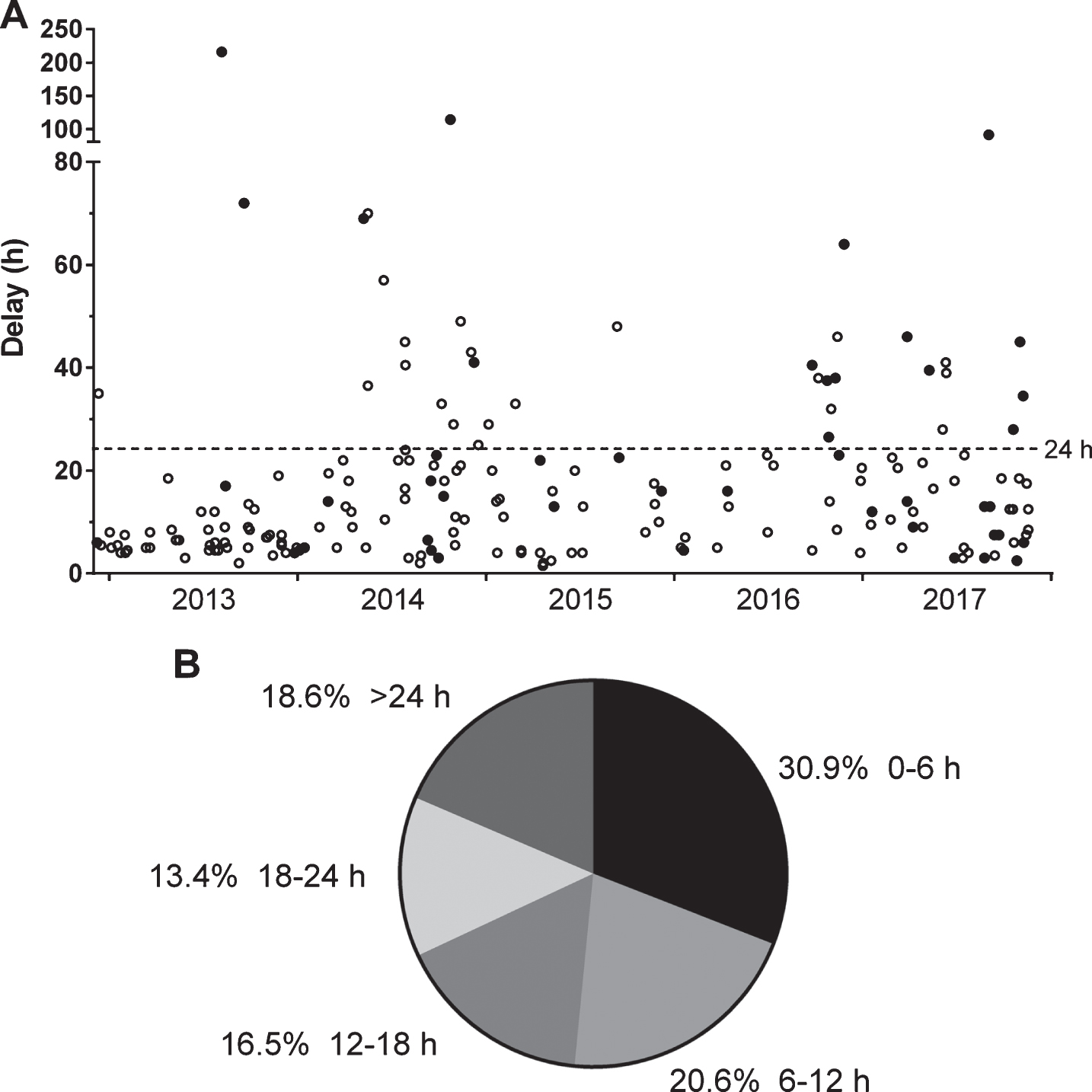
Postmortem delay of brain donors in the CAMS/PUMC Human Brain Bank. A) Postmortem delay of brain donors from December 2012 to November 2017. Solid and hollow points represent donors with and without known history of neurological and psychiatric disorders. B) Distribution of postmortem delay of 194 brain donors.
Place of death
The place of death of 193 donors are shown in Fig. 3A. Among the 193 donors whose places of death were known, 163 died in hospitals, 19 at home, and 11 in nursing homes. The average distance was 11.1 km, and the median distance was 7.9 (4.5, 14.0) km. As shown in Fig. 3B, the highest proportion of donors (36.3%) were located in the area between 5 and 10 km, and most of the donors (77.7%) were less than 15 km away from CAMS/PUMC Human Brain Bank. The distance between the place of death and donation station was negatively correlated with the postmortem delay (Fig. 3C, r= –0.196, p = 0.007). Moreover, the median postmortem delay of the donors who died in hospitals with mortuary (n = 131) was 13.5 (6.5, 23.0) h, while that of the donors who died in hospitals without mortuary (n = 29) was 7.5 (4.3, 17.3) h, the difference of which was significant (Fig. 3D, p = 0.015). The postmortem delay data of three donors who died in hospital were missing.
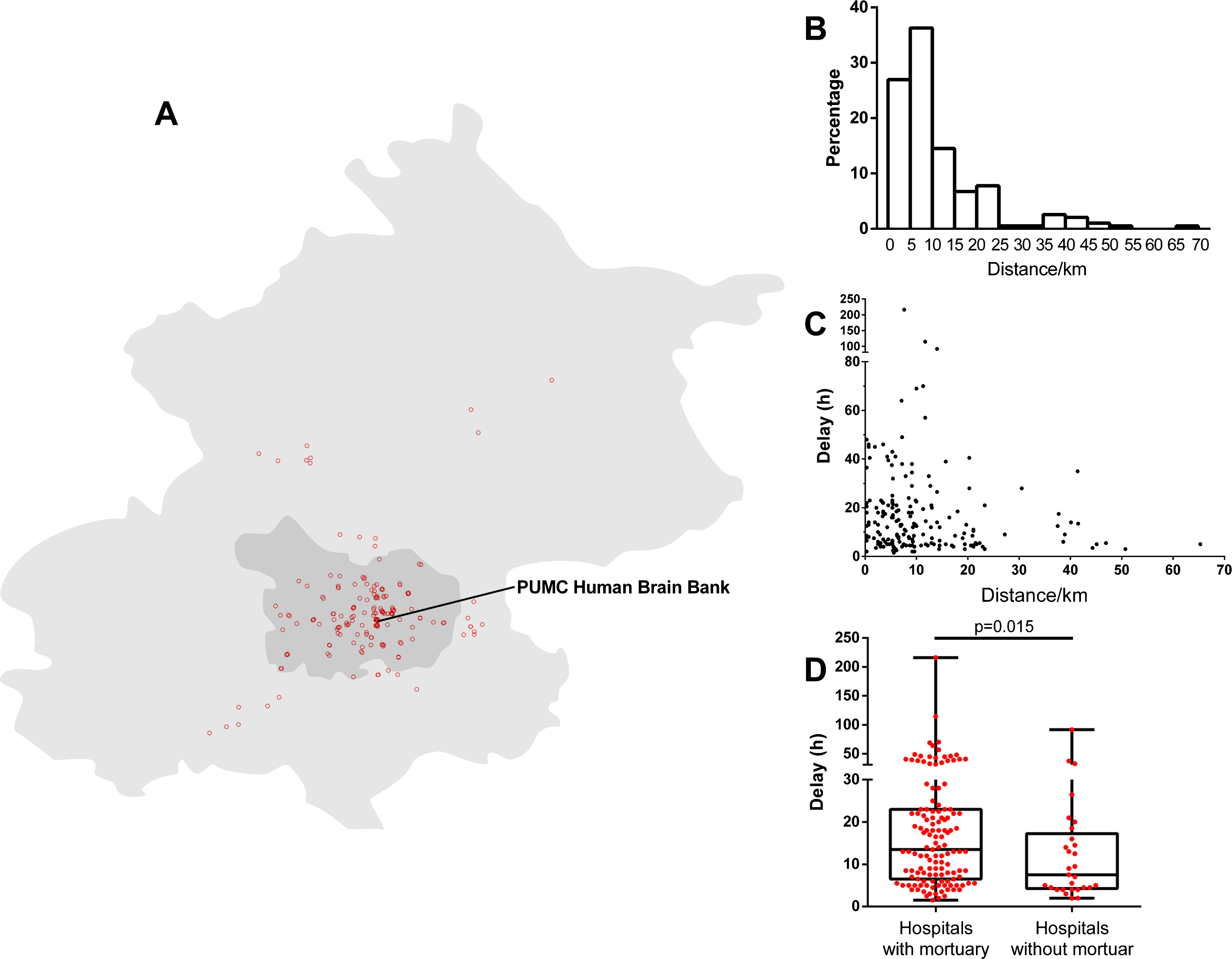
Place of death of donors in the CAMS/PUMC Human Brain Bank. A) Location of donors’ place of death and the CAMS/PUMC Human Brain Bank. The downtown of Beijing is in dark grey and suburban is in light grey. B) Distribution of the distance between where donors died and the brain bank. C) Relationship between the postmortem delay and the distance. D) Comparison of the postmortem delay between donors who died in hospitals with and without mortuary.
Demographic characteristics
Demographic characteristics of brain donors are shown in Table 1, and comparison was conducted between the profile of donors and general Beijing population. All the analyzed variables except gender were significantly different between these two samples. Education levels of brain donors are higher (p < 0.001), and 44.6% of the donors with known education data had received higher education. The proportion of the people who were 65 or older were significantly higher (p < 0.001) among donors (79.2%) than general Beijing death population (63.7%). The average age when they registered was 74.0 and median age of registration was 76.0 (69.0, 81.0), and 82.2% of the donors registered after 65 years old, which was significantly higher (p < 0.001) than that in general Beijing population (8.7%).
Comparison of demographic characteristics between donors of CAMS/PUMC Human Brain Bank and general Beijing population
aThe two age groups 0–14 and 15–64 were calculated together in statistical analysis since the expected value of the 0–14 group was too small. *p < 0.05.
Causes of death
The primary cause of death among the brain donors was cancer (33.0%), followed by heart diseases (18.8%), respiratory diseases (13.7%), cerebrovascular diseases (10.7%), and nervous system diseases (7.6%). The top five causes of death accounted for 83.8% in total. The most prevalent cancer was lung cancer, accounting for 17 of 65 donors died of cancer (see Fig. 4).
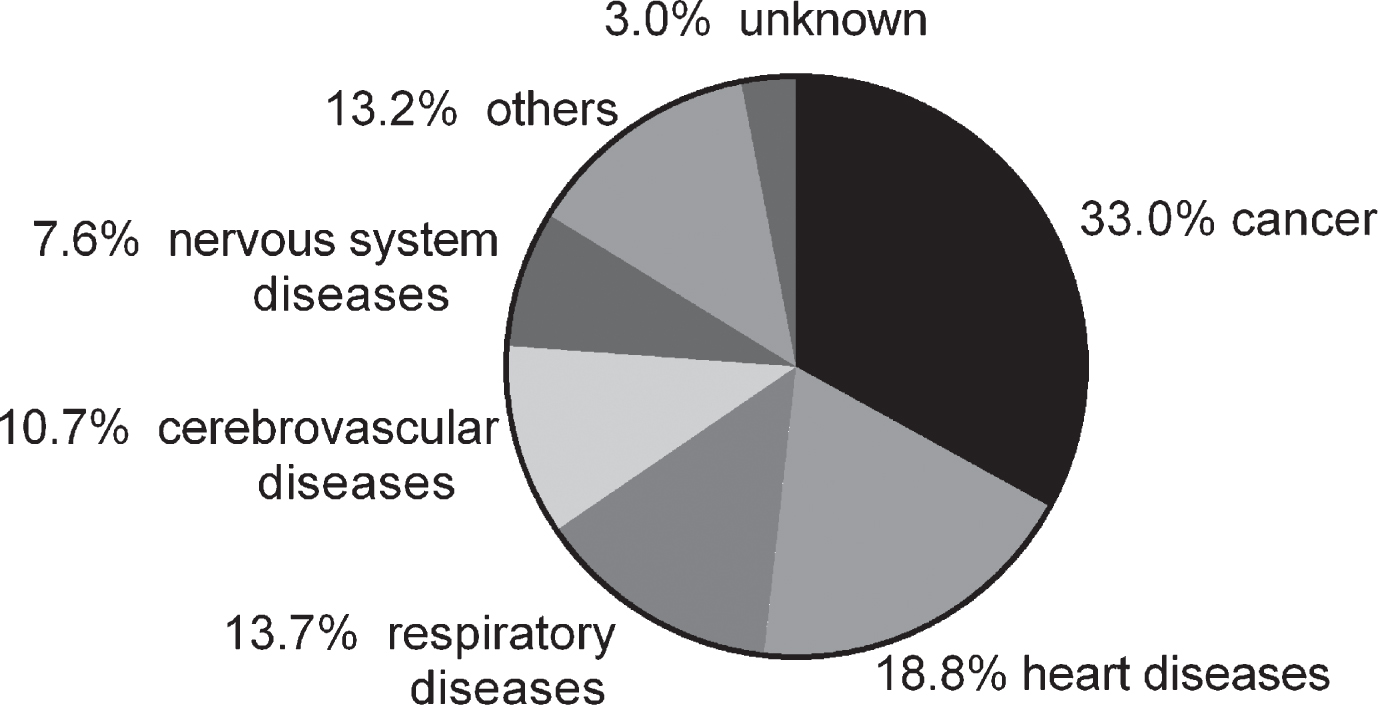
The causes of death of brain donors in CAMS/PUMC Human Brain Bank.
DISCUSSION
Donation database, postmortem delay, and place of death
During the past five years, the number of samples of human brain bank was much less than that of whole-body donors and people who registered to donate their bodies, and the number ratio was 197:695:1175. The percentage of cadavers whose brains were collected to human brain bank was 28.3%, which was relatively low mainly because of the postmortem delay. Death certificate is necessary for the acceptance of the cadavers. Due to many procedure and interest considerations, the acquisition of the certificate from local police stations or certain hospitals was usually delayed, especially if the patients died at their own homes, on weekends, or at a relatively younger age. Another reason is about the farewell ceremony. In recent years, many young people in Beijing chose to leave Beijing for other domestic and foreign metropolises. The traditional concept of so-called “being laid to rest” requires the relatives must have a grand final meeting with the deceased. Under this circumstance, the postmortem delay can be more than 24 h or even up to a few days. The deficiency of vehicles and personnel also hinders the construction of the bank. The personnel allocation of our donation station is seriously inadequate, in which system only one full-time employee is in charge of donation registration and data preservation. Other staff are all anatomy, histology, and embryology faculties, clinicians from PUMC hospital, as well as undergraduate and graduate students of PUMC. Not being able to possess our own hearse and to conduct the brain procurement overnight also hampers the continuous growth of the number of brains collected in CAMS/PUMC Human Brain Bank.
Our average postmortem delay over the past five years was 17.7 h. Tissues are best suitable for research when the postmortem delay is less than 6 h [5]. The prolonged postmortem delay may lead to the low tissue quality measured by related indicators, such as agonal state, pH, and the integrity of RNA and protein [4, 20]. Studies of protein in postmortem human brains can be hampered by the prolonged postmortem delay [21]. There is a huge gap in timeliness and efficiency between CAMS/PUMC Human Brain Bank and the Sun Health Research Institute Brain Donation Program that has a 2.75-h median postmortem delay for the entire collection [22]. Due to the social customs nowadays in China and considerations of humanism, staff in the brain bank usually choose not to interfere with the process of the farewell ceremony. Measures taken are aimed at the perfection of our infrastructure, as well as the recruitment of professional staff, to reduce the postmortem delay and enlarge the scale of the bank.
Although normal donors’ brains are equally vital for neuropathological and biochemical comparison [23, 24], mostly we choose not to enroll them into the human bank if the cadavers were received over 24 h after death. There is a trade-off in timing between tissue quality and tissue quantity, which means the longer the permitted postmortem delay, the more likely the donators can be included in the brain bank, but maybe the worse the tissue quality [25]. To maintain the continuous growth of the number of brain samples, some donors with neurological and psychiatric disorders and with a postmortem delay over 24 h were also enrolled into the brain bank. In regard to 24–48 h, we might decide whether to enroll them into the brain bank for certain research according to the short-term plans.
Figure 3 demonstrated where the donors died according to the death certificate. 77.7% donors died within 15 km away from the brain bank, indicating that this area may be the essential area for further brain donation promotion. 90.2% donors died in hospitals or nursing homes. Donation intention may be affected by donors’ or their relatives’ consideration on distances to the donation station, and future publicity can be focused on hospitals and nursing homes in this area to encourage the brain donation. Among donors who died in hospitals, 82.2% died in hospitals with mortuary while others without mortuary. In Beijing, if people die in the first-class hospital equipped with mortuary, cadavers are advised to be carried and preserved in the mortuary due to security concerns and conflicts of interests, while community hospitals, mostly without mortuary, usually have much simpler procedures. According to the staff in charge of the cadaver reception, relatives of donors from hospitals without mortuary are more likely to finish the postmortem procedures in 24 hs and these donors are more likely to be enrolled into the brain bank, which can explain the interesting finding that the distance was negatively correlated with the postmortem delay. The CAMS/PUMC Human Brain Bank is located in the center areas of Beijing city, and the hospitals nearby are mostly the first-class hospitals in China. Manual intervention is an important factor which may cause negative impacts on the brain donation. Thus, future efforts must be made on the communication with hospitals from which donors come, as well as the policy support from authorities in order to shorten the postmortem delay.
Age, schooling, gender, and cause of death
Table 1 demonstrated that older and better-educated people were more likely to donate their bodies and brains. This result is in accordance with Linda Boise’s result that the positive predictors concerning whether volunteers were willing to donate their brains for research included older age [26], as well as Andrea Oxley da Rocha’s result that in Brazil a typical applicant for body donation is over 60 years old and has completed high school and/or holds a university degree [15]. The average age of donors registered in our donation station is 74.0, which could be explained by the theory that when coming to that age, people are more likely to think about death, and changes of social environment, diseases, and mental state might motivate them to think over these questions [27]. The age around 74.0 may be the range of potential donors in Beijing, on whom in the future the mass media can mainly focus. The People’s Republic of China was founded less than 70 years ago, and in terms of promoting people’s level of education, we still have a long way to go, especially for the elderly. The donors to CAMS/PUMC Human Brain Bank were predominantly equipped with high-level education, and good education may boost the concept of contributing to human health and social progress. The ratio of female to male registered in our donation station is 85:112 and no sex difference was observed between data from the brain bank and from Beijing Statistics Bureau, which is consistent with Bolt [28] and Cornwall’s studies [29]. However, Andrea Oxley da Rocha’s research demonstrated that among registrants to the body donation program, the ratio of female to male was 2:1, which could be explained by the common notion that women are more altruistic than men [15].
The distribution of causes of death in CAMS/PUMC Human Brain Bank was shown in Fig. 4 The construction of the human brain bank requires samples with a variety of sources, especially donors with neurological and psychiatric disorders. Only five Parkinson’s disease samples were collected over the past five years. Because of the small number of samples, Huntington disease, schizophrenia, and alcohol addiction samples have not been collected so far, which might become of great value in future research [4, 30–32]. As a consequence, an important task nowadays is to collect brain samples with certain diseases to conduct further research. Previous research revealed that samples from healthy donors are also indispensable materials as either control group in research about neurological or psychiatric disorders [25], or experimental group of aging-related research [12, 33]. The collection of the brain samples with or without neurodegenerative diseases will still be conducted in the future.
A service to research community and its relevance to the research of Alzheimer’s disease
During the past five years, brain samples were provided to more than 30 research teams in Tsinghua University, Peking University, Beijing Hospital, Beijing Tiantan hospital, Shanghai Ruijin Hospital, etc. CAMS/PUMC Human Brain Bank has become a core organization with the largest number of postmortem human brains in China. The website of CAMS/PUMC Human Brain Bank was set up in 2014 to popularize the basic knowledge about neurosciences and to provide the platform to acquire brain specimens for scientific research (http://anatomy.sbm.pumc.edu.cn/brainbank/), where researchers all over the country can register and submit requirements of brain tissues. The management team of the brain bank will reply to the applications, and distribute the samples upon approval by the review committee based on the research projects, tissue availability and ethical considerations.
Neuropathological diagnosis of Alzheimer’s disease is regularly conducted according to the NIA-AA guideline [34]. A total of 33 brains were diagnosed as Alzheimer’s disease (12 scored High and 21 scored Intermediate), based on histopathologic assessments of amyloid-β deposits, staging of neurofibrillary tangles, and scoring of neuritic plaques. Due to the high availability of aged brains, Alzheimer’s disease and Lewy body diseases have been the main research focuses of CAMS/PUMC Human Brain Bank. The basic strategy of the bank is to conduct medical history collection, cognitive status evaluation, brain tissue procurement and conservation, pathological diagnosis, and tissue distribution. Researchers in our collaborating laboratories mainly focus on the pathogenesis and molecular mechanisms of the diseases, quantitative proteomic and epigenetic profiling, and other analyses of the brain tissues.
Significance, limitations, and further direction of the research
This study is the first one to analyze the demographic and medical characteristics of donors in Chinese human brain bank. On the one hand, this is the reflection of current status of Chinese human brain bank construction, and on the other hand, donor profile surveys can be used to target potential population who are more likely to donate [15], which can enlarge the scale of the brain bank. Our research provided the demographic and medical profile on brain donation in China and an innovative approach to construct human brain bank based on willed whole-body station.
With the increase of donors, the database management system in Chinese human brain bank is required as donors’ medical data, contact information, and the options listed on the consent form [25] must be kept up to date. Demographic and medical analysis of donors provided an essential perspective to design the system so as to achieve better operation of the Chinese Human Brain Bank.
The limitation of this research is that the insufficient sample number and some missing demographic and medical information may result in the inaccurate conclusion. Further research will concentrate more on detailed demographic profile and medical history collection and analysis, including ethnicity, religion, marital status, socioeconomic status, donation status of their family members, chronic diseases, and other detailed medical records in Beijing hospitals. In this study, the cause of death was only obtained from the death certificate filled out by physicians, and did not necessarily reflect the diagnosis of the neurodegenerative diseases in some circumstances. The medical histories of donors were regularly collected from their next-of-kin by our brain bank staff. Efforts were made to collect the medical history in details from the hospitals or nursing homes where the donors lived. Collection and preservation of the medical history and brain imaging records of the brain donors will be one of the major focuses of the brain bank in the future.
Willed body donation has been thriving in Beijing for nearly 20 years [17, 36] while brain donation is relatively novel to the public. To investigate the familiarity and popularize the donation program is also a mission of neuroscientists. Why or why not to donate are to be discussed in China to fully understand the key factors involved in the brain donation process. With the demographic and medical data, further research may concentrate on the motives in donation with semi-structured interview [37] or in-depth interview [27] and the comparison between donors and non-donors. Also, we can investigate the familiarity of whole-body donation and brain donation in community or medical schools. Some Chinese people are reluctant to choose organ and body donation owing to a traditional view emphasizing body intactness after death [9], which makes the popularization of whole-body and brain donation remain unsatisfactory in China. The relationship between this traditional thought, philosophical as well as religious issues, and the construction of our human brain bank remains to be studied.
Footnotes
ACKNOWLEDGMENTS
We sincerely thank all donors to CAMS/PUMC body donation station and human brain bank, as well as registrants to donate their bodies or brains. This research was supported by grants from the National Natural Science Foundation of China (NSFC #81271239, #81771205, #91632113), the Natural Science Foundation and Major Basic Research Program of Shanghai (16JC1420500, 16JC1420502), and the CAMS Innovation Fund for Medical Sciences (CIFMS #2017-I2M-3-008).
