



Abstract
While the importance of working conditions on cognitive function has been tentatively suggested previously, few studies have considered cumulative effects of exposure throughout the working life. We examined the association between job demand-control status and late-life cognitive decline, taking into account exposure durations. In the population-based cohort study, Swedish National Study on Aging and Care-Kungsholmen, 2,873 dementia-free participants aged 60+ were followed up to nine years. Cognitive function was measured using the Mini-Mental State Examination. The entire working life was outlined through interview and occupations were graded with a psychosocial job-exposure matrix. Multivariate linear mixed-effects models were used. Slower cognitive decline was observed among people with high job control (β: 0.10, 95% CI: 0.03, 0.19) and demands (β: 0.15, 95% CI: 0.07, 0.22) in the longest-held job. Compared to active job, faster decline was shown in low strain (β: – 0.17, 95% CI: – 0.26, – 0.08), high strain (β: – 0.13, 95% CI: – 0.24, – 0.03), and passive job (β: – 0.22, 95% CI: – 0.34, – 0.11). Longer duration of active jobs was associated with slower cognitive decline (β: 0.24, 95% CI: 0.16, 0.32), whereas faster decline was associated with longer durations of low strain (β: – 0.12, 95% CI: – 0.19, – 0.05), high strain (β: – 0.13, 95% CI: – 0.21, – 0.04), and passive jobs (β: – 0.12, 95% CI: – 0.20, – 0.04). In conclusion, not only psychologically stressful jobs, but also low-stimulating and passive jobs are associated with faster cognitive decline in later life. Duration of exposure may play a role in the psychosocial working condition-cognitive decline association.
INTRODUCTION
For most people, a large proportion of their adult life is devoted to work. So far, negative psychosocial workplace conditions have been related to various physical and mental health outcomes [1, 2]. One of the widely tested models is the demand control model, which measures working conditions based on two prominent components, job demands and job control, and creates four categories: high job strain (low control and high demands), low job strain (high control and low demands), passive job (low control and low demands), and active job (high control and high demands) [3, 4]. With the inclusion of social support at work [5], iso-strain, the combination of high job strain and low job support, was further generated [6].
Age-related cognitive decline precedes late-life cognitive impairment and dementia [7]. Since there is currently no cure for dementia [8], identifying modifiable risk factors associated with cognitive decline is crucial. Active jobs represent mentally challenging occupations that have been related to positive behavioral outcomes, such as learning skills and engagement in activities [4], potentially suggesting their role in improving cognitive capacity or even decelerating cognitive decline. By contrast, high job strain has been associated with vascular risk factors, which are involved in the pathogenesis of dementia [9], and thus may also trigger cognitive decline in later life. It has been recently reported in a systematic review that studies concerning demand-control status in relation to cognitive function are relatively scarce and their results are inconclusive [10]. So far, low job control, alone and in combination with high or low job demands (i.e., high job strain or passive job), has been shown to be associated with worse cognitive function [11–14]. However, two of those studies used only one-time measures of cognition [13, 14], and the other studies that did examine cognitive decline over time focused on specific cognitive domains [11, 12].
It has been discussed in the field of occupational health research that cumulative or repeated exposure to negative working conditions in relation to health is overlooked [15]. Indeed, assessment of job demands and control in the majority of previous studies focusing on cognition was restricted to a single time-point. To the best of our knowledge, there is only one study that examined cumulative exposure to high job strain and active jobs in relation to several cognitive domains among the working population [16]. Therefore, further research focusing on cumulative exposure to job demands and control status across the life course and the change in cognitive function in late life is needed.
In this study, we examined the association between four demand-control categories in midlife and cognitive decline in later life using active jobs as reference, and further investigated whether duration of exposure throughout working life plays a role in the association between each demand-control category and cognitive decline.
MATERIALS AND METHODS
Study population
Participants in this study were derived from the ongoing, population-based observational study, Swedish National Study on Aging and Care in Kungsholmen (SNAC-K) [17]. SNAC-K population is randomly sampled and consisted of individuals aged 60+ years who live either at home or in institutions in the Kungsholmen district, a central area in Stockholm. Considering the more rapid changes in health and higher attrition rates among older adults, follow-up examinations were conducted with different intervals between age cohorts, being six years for the younger cohorts (aged 60, 66, and 72 years), and three years for the older cohorts (aged 78, 81, 84, 87, 90, 93, 96, and 99+ years). Among the 5,111 individuals initially invited, 4,590 were alive and eligible to participate. With 1,227 refusals, 3,363 (73.3%) persons attended the baseline survey (March 2001 through June 2004). After excluding individuals with dementia (n = 321), Mini-Mental State Examination (MMSE) score <24 (n = 53), missing MMSE score (n = 5), and missing occupational information (n = 111), 2,873 participants were retained for the present study and followed up to 9 years (mean follow-up time was 6.4±1.7 years; ranging from 2.1 to 10.3 years). People included in the older age groups were assessed three times during the follow-up with 3 years of intervals, whereas younger participants were examined twice during the same period (Supplementary Figure 1).
All phases of the SNAC-K study were approved by the Ethics Committee at Karolinska Institutet and the Regional Ethics Review Board in Stockholm. Informed consent in writing was obtained from all participants or their next of kin.
Assessment of global cognitive function
Global cognitive function was measured using a 30-point version of the MMSE at baseline and each follow-up. MMSE consists of questions on orientation in time and space, attention, numeracy, memory, language, and visual construction [18].
Assessment of psychosocial working condition
Occupational data were collected at baseline using interviews and structural questionnaires conducted by trained nurses. The questionnaire included questions regarding employer, job title, contents, and time span of the latest job and four longest-held jobs during individual’s lifelong work activities [17]. Each occupation was coded according to the 3-digit Nordic occupation classification from Statistics Sweden [19]. Levels of each job’s psychosocial working condition, including job control, job demands and job support, were estimated through a validated psychosocial job-exposure matrix [20], which was based on data from the Swedish Work Environment Survey. So far, this matrix has been used in studies examining the impact of working conditions on a variety of outcomes, including cardiovascular diseases and dementia [21–23].
Assessment of covariates
Examinations at baseline and all follow-up waves of the SNAC-K study followed a structured protocol (available at http://www.snac.org). Information on demographic factors (age, sex, and education), lifestyle factors (cigarette smoking, alcohol consumption, leisure activity, and household burden) and early-life conditions (parental socioeconomic status (SES) and financial hardship) were collected through interviews by physicians and nurses. Educational level was assessed according to the highest degree achieved and categorized as elementary, high school, and university. Cigarette smoking was categorized as never, former, or current smoking. Alcohol consumption was categorized into no drinking or occasional, light-to-moderate, and heavy drinking [24]. According to a previous report [25], global leisure activity engagement includes three activities— mental, social, and physical— and was derived from a global leisure activity index. Engagement in global, and the three types of activities was categorized into three levels as low, moderate, and high, based on the variety and intensity of activities, or frequency of engagement. Household burden defined as household chores load was measured by hours per week and dichotomized by the median [26]. Occupation of the participant’s father was used to assess early-life SES in accordance with three groups: manual, intermediate, and professional [27]. Early-life financial hardship was evaluated with a retrospective question about financial strain in participant’s family.
Height and weight were measured in light clothes with no shoes. Body mass index was calculated and categorized into four groups: underweight (<20), normal weight (≥20– 25), over-weight (≥25– 30), and obese (≥30). C-reactive protein (CRP) value was derived from blood samples to evaluate inflammatory status. Chronic diseases, including hypertension, heart diseases, depression, and diabetes were ascertained by means of clinical examinations, self-reported medical histories, laboratory data, current drug use, and linkage with the Swedish National Patient Register, as reported previously [28].
Statistical analysis
The differences in characteristics between participants with different demand-control categories were tested using Chi-square (χ2) for categorical variables and one-way ANOVA for continuous variables. We also examined differences between participants who attended at least one follow-up examination and dropouts. Linear mixed-effects models with random effects for intercept and slope were used to examine the association between working conditions and MMSE score changes over time.
Original ratings of demands and control were converted into an ascending scale (higher scores represent greater demands/control) to aid interpretation. Job control and demands scores were first analyzed as continuous variables, then as dichotomous variables using the median of their respective scores from the psychosocial job-exposure matrix. Further, we generated four demand-control categories (i.e., high job strain, low job strain, passive job, or active job) based on the cross-tabulation of the dichotomized job control and job demands levels. We compared the effects of each category on MMSE score changes over time, using active job as reference [21]. Job support was dichotomized by the median of the scores and used in the stratified analyses. Based on the occupational information of the latest job and four longest-held jobs provided by study participants, work condition was first measured using the longest-held work because of its largest contribution to lifelong job exposure [21]. We also assessed demands and control status by the latest job to reduce recall bias.
The cumulative exposure to work conditions was assessed as follows. We identified demand-control categories of the five jobs first, followed by summing up the total years of exposure to each demand-control category. To explore the critical duration of exposure for which the effect of each demand-control category on cognitive decline starts to appear, we identified people with 0 years of exposure first, followed by categorizing people into ten groups based on the distribution of the years of exposure to each category. Next, we compared the effect of each decile on cognitive decline, using 0 years of exposure as reference. Using the results from the model of duration deciles, we selected cut-off points to dichotomize the years of exposure to each demand-control category. These thresholds were chosen when the change in the direction of the association between a given decile and the rate of cognitive decline was observed.
In the basic adjusted models, age, sex, and education were controlled for. In the fully adjusted models, variables regarding health conditions (diabetes, depression, hypertension, heart diseases, and inflammatory status), lifestyle factors (obesity, smoking status, alcohol consumption, and leisure activity engagement) and early-life conditions (SES and financial hardship) were considered as potential confounders. These analyses were repeated in the stratified analyses by sex, household chore load, levels of educational attainment, job support, and engagement in leisure activities. Sensitivity analyses were further conducted using different study subpopulations: 1) a subpopulation with MMSE score ≥27 at baseline (n = 2,655) [29]; 2) a stroke-free subpopulation at baseline (n = 2,666); and 3) a subpopulation aged 65+ (after retirement age) at baseline (n = 2,151). Furthermore, we conducted multiple imputation for missing data. All analyses were computed using Stata SE 15.0 (StataCorp LP., College Station, TX).
RESULTS
Characteristics of the study population
Of the 2,873 participants, 1090 (38%) were men and 1,783 (62%) were women. The mean age at baseline was 72.7 (SD = 10.2) years. Baseline characteristics of the study population, stratified across the four demand-control categories, are presented in Table 1.
Baseline characteristics of the study population by demand-control category related to the longest-held job (n = 2,873)
Data are presented as mean±standard deviations or number (proportion %). BMI, body mass index; MMSE, Mini-Mental State Examination. Missing data: Depression = 5, BMI = 89, Smoking = 15, Leisure activity engagement = 365, Father’s occupation = 124, Early-life financial hardship = 43. aIncluding atrial fibrillation, bradycardias and conduction diseases, ischemic heart disease, cardiac valve disease, and heart failure. bIncluding mental, physical and social activity.
Compared to people who attended the first follow-up examination (n = 2,198), those who dropped out (refused/moved: n = 337, 11.7%; deceased: n = 338, 11.8%) were older, less educated, had lower MMSE score at baseline, less likely to engage in leisure activities or to work with active jobs (Supplementary Table 1).
Association of psychosocial working condition with cognitive decline
In both analyses when job control and job demands were treated as continuous or dichotomous variables, both higher job control and job demands scores were associated with slower cognitive decline (Table 2).
β coefficients and 95% confidence intervals (CI) for the relation of job control and demands to changes in global cognitive function over 9 years of follow-up
aAdjusted for age, sex, and education. bAdjusted for age, sex, education, health status, lifestyle, and early-life conditions.
Figure 1 shows the association of each demand-control category with MMSE changes over time. Using active job as reference, low job strain, high job strain and passive job were all associated with faster cognitive decline (β: – 0.17, 95% CI: – 0.26 to – 0.08; β: – 0.13, 95% CI: – 0.24 to – 0.03; β: – 0.22, 95% CI: – 0.34 to – 0.11). Further, we collapsed these three categories into non-active jobs. Compared to people with active jobs, those with non-active jobs demonstrated an accelerated rate of cognitive decline (β: – 0.16, 95% CI: – 0.22 to – 0.09).
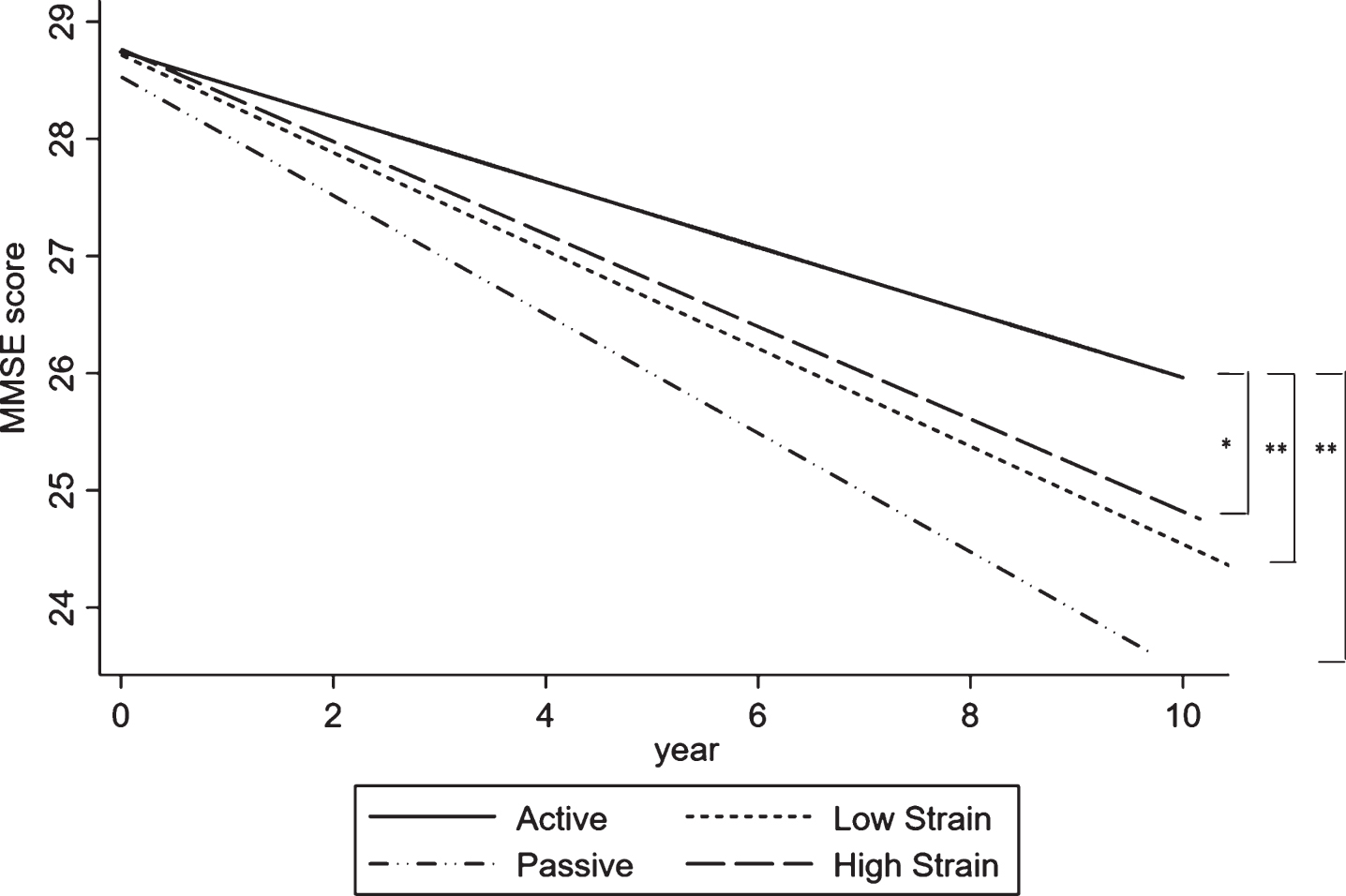
Estimated mean score of Mini-Mental State Examination (MMSE) at each year of follow-up in participants with active job (reference group; high control and high demands; solid line) versus high job strain (low control and high demands; long-dash), low job strain (high control and low demands; short-dash), and passive job (low control and low demands; dash-dot-dot). Mixed-effects models were fully adjusted. *p < 0.05 **p < 0.01.
All sensitivity analyses confirmed these results. Similar results were found for job demands and control status related to the latest job.
In the stratified analyses by sex, the effects of low job strain, high job strain, and passive job on cognitive decline remained in men, while the effect of high job strain disappeared in women. When stratified by job support level, the effect of high job strain was only shown in people with low job support, not those with high support, whereas compared to active job, low job strain was not associated with cognitive decline in people with low job support. Furthermore, the associations between accelerated cognitive decline and low job strain or passive job were only present in people with lower levels of education or engagement in global leisure activities, not in those with higher levels (Table 3). Similar results were shown in stratified analyses by engagement in mental, physical or social activities separately (Supplementary Table 2). No difference was identified when stratified by household chores load.
β coefficients and 95% confidence intervals (CI) for the relation of demand-control categories to changes in global cognitive function over 9 years of follow-up, stratified by sex, job support, education and global leisure activity level
aAdjusted for age, sex, and education. bAdjusted for age, sex, education, health status, lifestyle, and early-life conditions.
Duration of exposure to working condition and cognitive decline
By comparing the effects of duration (divided into deciles) of demand-control categories on cognitive decline, we observed the effect of 1– 4 years of exposure to high job strain on cognitive decline was similar to 0 years of exposure. Thus, we dichotomized the duration of exposure to high job strain into 0– 4 years (short duration) versus 5+ years (longer duration). Following a similar procedure, the duration of exposure to low job strain was dichotomized as 0– 5 years (short) versus 6+ years (long); the duration of passive job: 0– 2 years (short) versus 3+ years (long); active job: 0 years (short) versus 1+ years (long) (Supplementary Table 3).
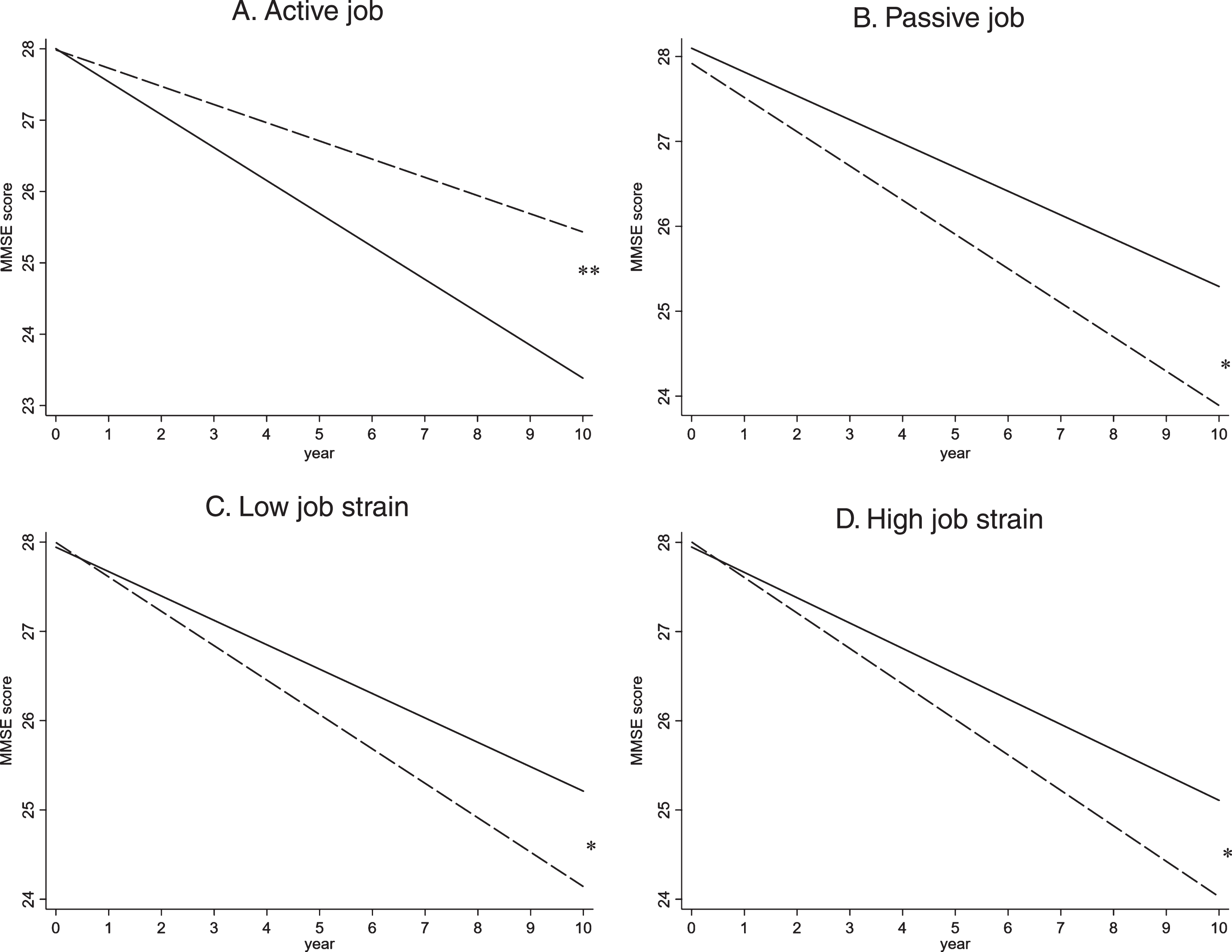
Estimated mean score of Mini-Mental State Examination (MMSE) at each year of follow-up by duration of exposure in years to (A) Active job, (B) Passive job, (C) Low job strain, (D) High job strain. Solid line refers to shorter duration of exposure to active job (0 years), passive job (0– 2 years), low job strain (0– 5 years), and high job strain (0– 4 years). Long-dash refers to longer duration of exposure to active job (1+ years), passive job (3+ years), low job strain (6+ years), and high job strain (5+ years). *p < 0.01 **p < 0.001.
Compared to people with shorter duration of exposure, those with longer duration of exposure to active job had slower cognitive decline (β: 0.24, 95% CI: 0.16 to 0.32). In contrary, faster cognitive decline was associated with longer durations of low job strain (β: – 0.12, 95% CI: – 0.19 to – 0.05), high job strain (β: – 0.13, 95% CI: – 0.21 to – 0.04) and passive job (β: – 0.12, 95% CI: – 0.20 to – 0.04), in comparison with shorter durations (Fig. 2).
DISCUSSION
In this population-based longitudinal study, we found that high levels of job control and job demands were associated with a slower rate of decline in MMSE scores. Combining job demands and controls into categories of occupational condition revealed that, in comparison with active jobs, non-active jobs (including low job strain, high job strain and passive jobs) were associated with accelerated cognitive decline during the follow-up period. These associations remained robust after controlling for several potential confounding factors. Importantly, we observed evidence of cumulative effects of exposure to working conditions on changes in global cognitive function. Compared to people with no exposure or shorter durations of exposure, those with longer durations of low strain, high strain, and passive job exhibited an accelerated rate of cognitive decline. In contrast, slower global cognitive decline was observed in people with longer duration of exposure to active job. In summary, our findings show that not only psychologically stressful jobs but also low-stimulating and passive jobs are associated with faster global cognitive decline in older ages, and that these deleterious effects are amplified with longer exposure durations.
The physiological mechanisms underlying the association between working conditions and cognition likely differ between demand-control categories. High job strain has been related to stress response that activates hypothalamus-pituitary-adrenal (HPA) axis and induces hypersecretion of glucocorticoid hormone, especially when the stress is repeated or prolonged [30–32]. Glucocorticoid has been shown to be neurotoxic and could reduce dendritic density in hippocampus [33], which is of crucial importance for cognition [34] and one of the first brain regions to be affected in Alzheimer’s disease [35]. By contrast, low job strain and passive job— the two indicators of deficient mental stimulation at work [13, 36] which were also found to accelerate the rate of cognitive decline in our study— may impair the development of cognitive reserve due to the reduction in neural connections or the depletion of neurons [37].
Our finding that high job control is related to slower cognitive decline is in line with previous studies investigating the effect of working conditions on cognitive function [11–14] and dementia risk [21, 38]. A high level of job control refers to self-direction at work, a component of job complexity that requires active use of multiple cognitive functions and may facilitate the development of behavioral strategies to compensate for age-related cognitive decline [37, 40]. By contrast, a low level of job control reduces flexibility and independence in an individual’s working condition, which may simultaneously induce work overload and stress [41].
The cognitive reserve theory associates lack of mental engagement with cognitive deterioration [36], suggesting that mental demands at work may increase cognitive reserve and postpone the occurrence of cognitive deficits [42]. In line with these findings, we found the effects of low job demands, including low job strain and passive job, on cognitive decline only in people with lower levels of education or with weaker engagement in leisure activities. Given that previous literature has indicated beneficial effects of higher education [27] and active participation in leisure activities [43] on dementia risk, our results suggest a possibility that by inducing cognitive reserve, education and leisure activities may attenuate the adverse effect of low cognitive stimulation at work on decreased global cognitive function in later life.
Furthermore, the association between high job strain and accelerated rate of cognitive decline was present only in people with low job support (iso-strain), not in those with high job support. These findings suggest that social support could buffer the negative effect of high job strain on cognition [35] and support the hypothesis that iso-strain is the most detrimental scenario in the expanded job strain model [5]. Interestingly, among those with low levels of job support, low job strain was no longer associated with faster cognitive decline in comparison to active job. Active jobs likely reflect eustress— so-called beneficial stress— which appears to exert protection against cognitive decline. However, in the absence of adequate support, eustress may become counterproductive and overwhelming even for those with active jobs. In contrast, the mitigating effects of job support might not be required by those with low job strain, as they are subjected to markedly lower levels of job demands.
It is noteworthy that cognitive decline in the current study was detected using MMSE, which was developed as a screening instrument for cognitive impairment and may lack sensitivity to slight cognitive deterioration [44]. And our results pertain exclusively to cognitive decline and should not be interpreted in relation to the risk of dementia or Alzheimer’s disease. However, using a novel methodological approach, our study made an important contribution by exploring the thresholds of exposure duration at which the cumulative impacts of demand-control categories on global cognitive function emerge. We identified different cut-off points in terms of years of exposure to demand-control categories, which may be due to different mechanisms linking job status and cognition outlined above. Furthermore, we detected the effects of cumulative exposure to both beneficial (i.e., active job) and detrimental job categories (i.e., low job strain, high job strain, or passive job) on cognitive reservation/deterioration by comparing longer and shorter durations of exposure. These findings confirmed the hypothesis that long-lasting or recurrent exposure to unfavorable working conditions is associated with elevated risk of health problems [45]. Future studies should build on our findings of the importance of cumulative exposure windows and adopt more comprehensive neuropsychological measures or a specific set of diagnostic criteria for dementia and Alzheimer’s disease, while also exploring the differences in the duration thresholds in more detail.
In addition, we found an association between high job strain and cognitive decline only in men, while there were no sex differences in the effects of low job strain and passive jobs on the rate of change in cognitive function. To our knowledge, no study so far has addressed sex differences in the relation of job strain and cognition. One possible explanation for these findings may be the substantial sex differences in both the magnitude and the duration of stress response, shaped by male (e.g., testosterone) and female (e.g., estradiol) sex hormones [46]. More studies are needed to better understand the mechanisms underlying gender differences in the association between stress and cognition.
This study has several strengths. First, it is a longitudinal population-based study with a relatively long-term follow-up. Second, our access to lifelong occupational information enables the assessment of working conditions from several chronological perspectives, including the longest-held job, the latest job, or the duration of exposure to each measure of demand-control status throughout individual’s working life. Multiple measures of working conditions can help avoid potential misclassification from single time-point measure, resulting in a more reliable assessment [15, 16]. Third, individual predispositions, such as cognitive capacity, educational level, personality and early-life conditions, might preselect participants into occupations. Information about education and early-life conditions enabled us to reduce some of this potential bias. Forth, the underlying mechanisms linking stress to cognitive decline involve both HPA axis [30–32] and inflammatory reaction [47]. Although there are many other inflammation-related markers, controlling for inflammatory status using CRP might help us clarify physiological mechanisms.
Some limitations should also be considered. We relied on self-reported recollections of lifelong career attainment, as well as some covariates (including education, lifestyle, and early-life conditions), which could introduce information bias. In sensitivity analyses, we introduced even more strict criteria (MMSE score ≥27, with no history of stroke) to include participants and considered latest, rather than longest occupations, in order to assess the possibilities of misclassification by impaired recollection, and the results remained unchanged. Second, occupation-based measures of job control and demands do not take into account either study participant’s perception on working conditions or variability in job characteristics within a given occupation. But this approach has the advantage of reducing possible self-reporting bias that could be introduced by subjective measures of job conditions. Third, insufficient sensitivity of MMSE to minor progress in cognitive impairment may result in underestimation of the effect of working conditions on global cognitive decline here. MMSE does not assess all cognitive domains, such as executive functioning, which is particularly vulnerable due to vascular diseases [48]. Since vascular pathology may be involved in the link between high job strain and cognition, the observed association between job strain and cognitive decline might have further been underestimated. Fourth, although a wide range of potential confounding factors was considered, residual confounding may not be fully ruled out. In addition, non-work-related stress (i.e., from family or society) may pose additional effect on cognitive health. While we do not have information on all sources of stress outside of work, we did not detect differences between individuals with high and low household chores load. Fifth, we were not able to capture the change in cognition in 23.5% of participants who did not attend the first follow-up examination. Considering that the higher proportion of these people was in unfavorable job categories, the detrimental effects of high/low strain or passive jobs could be underestimated here. Finally, our study population consisted of participants living in the central area of Stockholm. In spite of the comparable age and sex compositions to the whole city of Stockholm, the study population has a higher proportion of women, is better-educated, and contains more white-collar workers with active jobs compared to other urban areas of Sweden.
In conclusion, our study provides the first evidence that not only high job strain but also low job strain and passive jobs are associated with faster cognitive decline in later life, whereas active jobs may decelerate cognitive decline. Importantly, we demonstrate that these effects are accentuated with longer durations of exposure. These findings have both occupational- and public health implications, indicating potential targets for the prevention of cognitive impairment in late life.
Footnotes
ACKNOWLEDGMENTS
The authors would like to express their gratitude to all participants and staff involved in the data collection and management in SNAC-K study. SNAC-K is financially supported by the Swedish Ministry of Health and Social Affairs, the participating County Councils and Municipalities, and the Swedish Research Council. In addition, specific grants were obtained from the Swedish Research Council (No 2017-00981), the National Natural Science Foundation of China (No 81771519), Demensfonden, the Konung Gustaf V:s och Drottning Victorias Frimurarestiftelse (No. 2016-2017), the Ministry of Education of Taiwan, the Swedish National Graduate School on Ageing and Health (SWEAH), and Gamla Tjänarinnor Foundation. This project is also part of CoSTREAM ( ) and received funding from the European Union’s Horizon 2020 research and innovation programme under the grant agreement (No 667375). The funders had no role in study design, data collection and analysis, decision to publish, or preparation of the manuscript.