



Abstract
Background:
Care navigation is an approach to personalized care management and care coordination that can help overcome barriers to care. Care navigation has not been extensively studied in dementia, where health care workforce innovations are needed as a result of increasing disease prevalence and resulting costs to the health care system.
Objective:
To identify facilitators and barriers to care navigation in dementia and to assess dementia caregiver satisfaction with care navigation.
Methods:
Methods include qualitative research (interviews, focus groups, observations) with “Care Team Navigators” (CTNs) who were part of a dementia care navigation program, the Care Ecosystem, and a quantitative survey with caregivers about their experiences with CTNs. Transcripts were analyzed to identify themes within the data.
Results:
CTNs identified the following facilitators to care navigation in dementia: working closely with caregivers; providing emotional support; tailoring education and resources; and coordinating with a clinical team around issues ranging from clinical questions to financial and legal decision-making. The barriers CTNS identified included burn-out, the progressive nature of the disease; coordinating with primary care providers; and identifying resources for dyads who are low-income, do not speak English, or live in rural areas. Caregivers across both sites highly rated CTNs, though satisfaction was higher among those in Nebraska and Iowa.
Conclusions:
Innovative approaches to care delivery in dementia are crucial. Care navigation offers a feasible model to train unlicensed people to deliver care as a way to deliver larger-scale support for the growing population of adults living with dementia and their caregivers.
INTRODUCTION
Care navigation is an approach to personalized care management and care coordination that can help patients overcome barriers to care. These barriers include navigating the complex logistics of the health care system (e.g., transportation, clinic schedules, or appointment follow-up); cultural and language barriers (e.g., understanding information given by a provider, interacting with providers or health care organizations); and barriers related to insurance status (e.g., facilitating payment through Medicaid) [1]. Originating in efforts to reduce health disparities and improve health outcomes in cancer, care navigation exists in many clinical settings, including mental health, kidney disease, and diabetes [1, 3–10]. Care navigation typically involves a partnership between a patient and navigator. Navigators identify a patient’s needs and goals, provide disease education, and help with treatment protocols in order to improve health outcomes [1, 7]. Care navigation has not been extensively studied in dementia, where health care workforce innovations are needed as a result of increasing disease prevalence and resulting costs to the health care system [12, 13].
By 2050 there will be more than 14 million people in the United States with dementia, the majority of whom will be cared for at home by family members [13]. Family caregivers manage behavior changes and medications, plan and implement care transitions, and help make difficult financial and legal decisions [13–19]. Innovative strategies are needed to expand the workforce supporting people with dementia and their caregivers [20, 21]. Care navigation may be particularly suitable to dementia due to the limited capacity of primary care providers and specialists to manage the complex needs in all cases. The experience of dementia is unique for each family and changes over the course of the disease’s progression. Care navigators have the potential to improve care and support in a meaningful way for people with dementia and their caregivers. However, little is known about this role in the context of dementia.
In this study, we identified facilitators and barriers to care navigation in dementia in order to elaborate on implications for future implementation of care navigator programs in dementia. We conducted this research within a program, the Care Ecosystem, which provides care navigation to people with dementia and their caregivers through Care Team Navigators (CTNs). We also examined caregivers’ perspectives on the extent to which CTNs were able to meet their needs. Other dimensions of the Care Ecosystem program, including participant demographics and CTN training, are discussed in a prior publication [22].
METHODS
Study setting: Description of the Care Ecosystem program and CTN training
The Care Ecosystem program provides telephone and web-based personalized care for people with dementia (PWD) and their caregivers, enrolled as dyads, and tested in a clinical trial through two urban academic health centers: the University of California, San Francisco (UCSF) and the University of Nebraska Medical Center (UNMC). Dyads, who live throughout urban and rural California, Nebraska, and Iowa, are assigned a Care Team Navigator (CTN), a trained, unlicensed dementia care guide. CTNs are supported and supervised by a clinical team comprised of an advanced practice clinical nurse, a social worker, and a pharmacist. Clinical team members provide continuing education, answer case questions, discuss care protocols, and work with cases that require triage (Fig. 1).
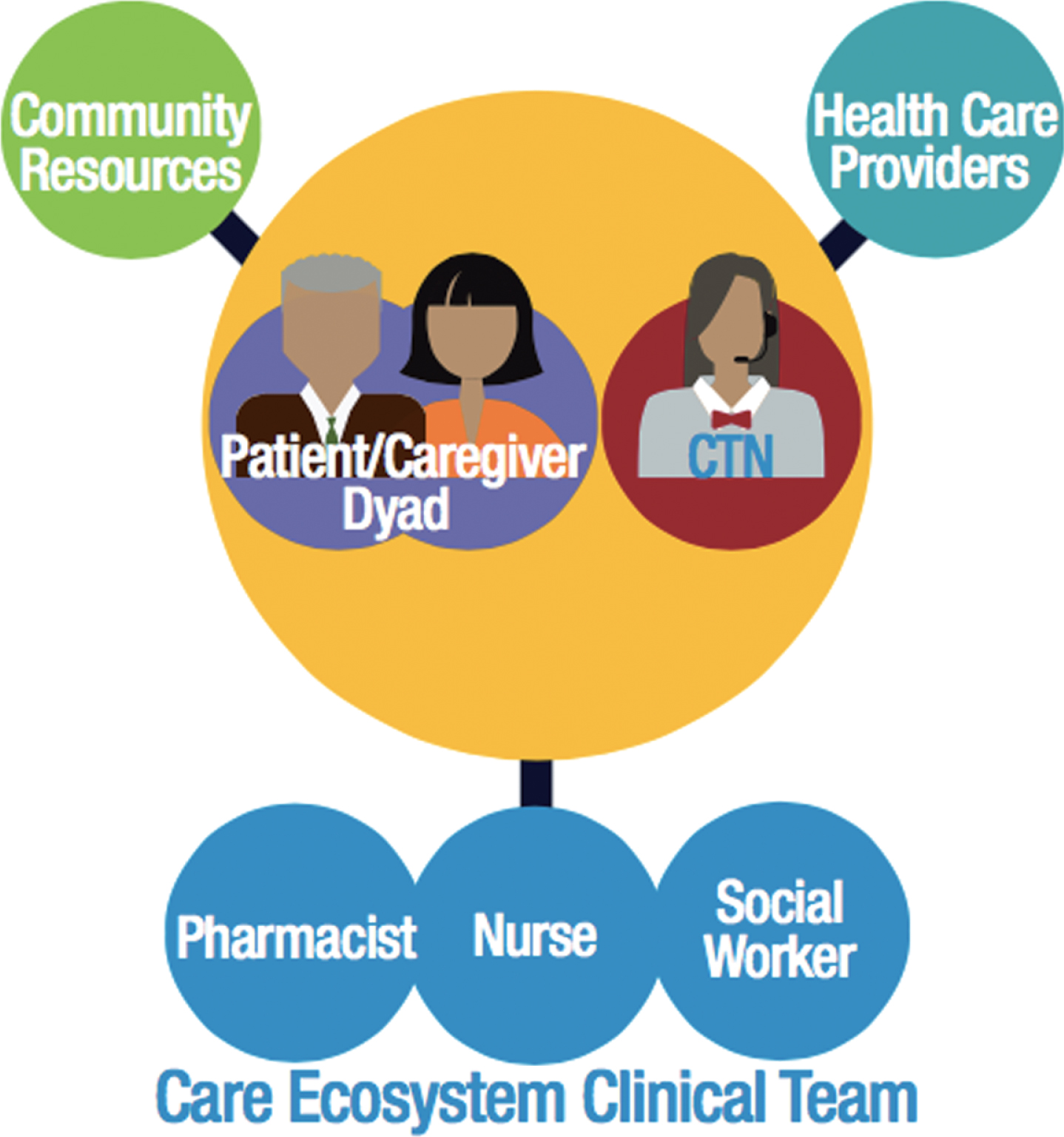
Care Ecosystem Clinical Team.
CTNs receive 80 hours of initial training that includes site visits, clinical observations, debriefing, and shadowing, followed by ongoing supervision. Didactic and supervision topics include common issues in neurodegenerative diseases and aging, how to review medication lists, skills in supportive listening and communication, how to complete assessments of patient function, behavior, and safety risks, how to identify and triage acute problems to the clinical team, and how to identify relevant community resources [23]. CTNs offer caregiver education and support, provide curated information about community-based resources, share care planning and legal and decision-making tools, and provide tailored behavioral interventions. Behavioral interventions include providing, as-needed, educational information about behaviors, instrumental help identifying resources such as day programs or caregiver support programs, and emotional support for caregivers. For complex behaviors, CTNs triage to the supervisory clinical team (e.g., consultation with pharmacist about medications lists) [23, 24].
Interactions between CTNs and dyads occur during telephone calls scheduled monthly, or more frequently as needed. During the initial intake, the CTN and the dyad negotiate the frequency of contact. CTNs provide more contact during higher-need times and less contact during lower-need times. Some dyads did not need as much support from their CTNs. To respond to differential intervention dosage needs, the study team created a category called “navigated care light” where dyads could opt to be contacted on a quarterly basis with handouts and a reminder that support is available as-needed. A full CTN caseload ranges from 50–80 dyads.
Workflow and communication were supported by the Care Ecosystem Dashboard, a relationship management software built on a Salesforce platform that was uniquely adapted to the program. In the Dashboard, CTNs documented issues, care plans, and interventions. The software also provided a mechanism to rapidly triage difficult cases to the clinical team, who monitor the Dashboard. Trial design, details about the dashboard, and outcomes of interest were previously described [22].
Study design
We conducted qualitative interviews, focus groups, and observations to assess the CTN role within the Care Ecosystem, and we used survey questions to assess the experience of caregivers enrolled in the program. The first author (AB) conducted open-ended interviews with CTNs (n = 10), informal interviews with five clinical supervisory staff members, and approximately 20 observations of CTN meetings, debriefings, and workflow. The first author (AB) and co-author JM conducted two focus groups with CTNs. Data was collected from 2016-2017. Our Institutional Review Boards approved this research. Participants consented to all research activities.
Participants
All CTNs employed at the time of this qualitative study agreed to participate (n = 10). Seven CTNs were from California and 3 were from Nebraska. Caregivers (n = 269), 150 from California and 119 from Nebraska or Iowa, provided satisfaction data about their experiences with their CTN in a survey twelve months after enrollment if they had three or more CTN contacts at the time.
Interview, focus group, and observation protocol
The first author (AB) and co-author (JM) created a semi-structured interview guide and a focus group guide. Interview and focus group questions were part of a larger qualitative investigation of the Care Ecosystem designed to study the following domains: 1) care navigator background and skills; 2) care navigator role (activities in practice, unexpected responsibilities, rewarding and difficult experiences, strategies for job success); 3) triage (reasons for coordinating care, scope and boundaries of role); 4) addressing caregiver burden and caregiver self-efficacy. The interview and focus group protocols were more comprehensive than the scope of this paper. For this paper, we identified and analyzed areas of the interview and focus groups where CTNs discussed their role. From these responses, we identified themes related to facilitators, barriers, and scope of role. These results are represented in the tables and our results section.
Observations focused on interactions between CTNs and the clinical supervisory team, which was comprised of a clinical nurse specialist, a social worker, and a pharmacist. The first author observed aspects of the CTN role and routines in practice and reasons for triage.
Survey
Caregivers were asked to complete a 12-month outcome survey as part of their enrollment in the study. The survey covered many domains outside of the scope of this paper, which will be described in a future manuscript. For the purpose of this study, we evaluated the acceptability and perception of CTNs from the viewpoint of caregivers through five survey questions. The caregiver satisfaction questions analyzed for this study were completed between August 2016 and February 2018. They were added to the 12-month outcome survey 6 months after data collection began on that survey. This survey also assessed caregiver demographic factors, caregiver burden, using the Zarit-12, and caregiver depression, using the PHQ-9 [25, 26].
Analysis
Qualitative
All semi-structured interviews and focus groups were transcribed. We entered interview and focus group transcripts into Dedoose, a qualitative data analysis software [27]. The first author conducted a preliminary review of the interview and focus group transcripts, identified responses where the CTN role was discussed, and coded these responses. Coded data was organized according to facilitators to care navigation in dementia, barriers to care navigation in dementia, and responses that articulated the scope of the CTN role. The first author then reviewed observation and informal interview notes to assess these data in relationship to interview and focus group findings. This approach, called data triangulation, is a process of using multiple different data sources to help confirm and ensure the rigor of qualitative research findings [28, 29]. The first author then reviewed coded content with two other members of the multidisciplinary research team (JM, a clinical nurse specialist and KLP, a neuropsychologist). The resulting list of codes were those that appeared frequently in the data, were thematically relevant to the questions of the paper, and were validated through data triangulation. Any disagreements about codes were discussed and resolved among the team. When coding was complete, all codes were organized into thematic areas. We summarized each theme and identified representative quotes to illustrate each theme’s meaning. These thematic areas became the input for the qualitative results of this paper, represented in our tables.
Quantitative
To explore how satisfaction with the CTN varied by caregiver-related factors, we created a summary “CTN Satisfaction” score by assigning the scale values from 0 (Never) to 4 (Nearly Always) and averaging the 5 scores. CTN Satisfaction was compared using independent samples t-tests and ANOVA by caregiver gender, caregiver relationship (spouse, child, other), location (California versus Nebraska or Iowa). Spearman correlations were used to correlate CTN Satisfaction with caregiver depression (PhQ-9) and caregiver burden (Zarit-12).
RESULTS
CTN characteristics
CTNs were hired for interpersonal skills that included communication, empathy, interest in working with people, and ability to work well on a team. The Care Ecosystem team also assessed CTNs’ prior experience for demonstration of these skills and their ability to work with people. Some examples of prior relevant experience included: working in caregiver support organizations, working in clinical research, being a camp counselor, working in volunteer organizations, jobs in the community service sector, and activities while in high school or college that reflected an interest in working with people with special needs [22]. CTNs who participated in this qualitative study were all college graduates, with one who had a Master of Public Health. They primarily majored in the health sciences, social sciences, or social work.
Perceived facilitators of successful care navigation in the context of dementia
Through our multiple data sources, we identified the following themes as facilitators to CTN work in dementia (Table 2).
Participant Characteristics
*Caregiver burden was measured using the Zarit-12 tool. [25] Severe burden was defined as a score greater than 17. **Caregiver depression was measured using the PHQ-9 tool. [26] Moderate to severe depression was defined as a score of 10 or greater.
Care Team Navigators’ perceived facilitators and barriers to care navigation in dementia
Theme 1: Emphasis on caregiver
While CTNs worked with dyads, they all reported that they primarily supported caregivers, particularly those who were socially isolated or burdened. CTNs helped caregivers problem-solve stressful situations, navigate resources, learn about the disease process, and provided anticipatory guidance to help them prepare for the future.
Theme 2: Providing emotional support
A recurring theme among all CTNs was the importance of being able to provide emotional support, particularly to the caregiver. The aspects of this emotional support they identified included using communication skills, empathy, validation, and reinforcement. CTNs reported that these relationship-oriented skills helped build trust, thereby facilitating the dissemination of information and care strategies. Training in motivational interviewing and role-playing alongside education about dementia-specific needs helped CTNs develop these skills.
Theme 3: Building a continuous relationship
Many CTNs reported that consistency of contact and building long-term relationships with caregivers provided a foundation for successful implementation of other aspects of the intervention, particularly given the sensitive nature of many issues caregivers face. Due to the structure of the Care Ecosystem program, CTNs were able to provide ongoing and regular contact, at least once per month, over an extended period of time. This level of contact exceeded the contact most caregivers had with other providers in the health care system.
Theme 4: Tailoring education and resources
Most CTNs saw themselves as educators and resource providers. CTNs discussed the importance of developing an in-depth understanding of the range of dyad needs during intake and regularly scheduled calls in order to tailor educational materials and resources. CTNs tailored resources by region, socioeconomic situation, language, cultural background, education, caregiver’s understanding of the disease, type of dementia, and stage of disease. Resources focused on disease education, behavior management, decision-making around power of attorney and advanced health directives, and respite, such as adult day programs.
Theme 5: Triaging to clinical support team
CTNs were trained and supervised by a small clinical support team of advanced practice nurses, social workers, and pharmacists to help address the complex medical, social, legal and financial needs in dementia. All CTNs and clinical supervisory team members identified areas outside of the CTN scope of practice that were escalated to clinical team members. Typical reasons for coordination and triage are summarized in Table 3. All CTNs identified medications and suicide assessments as areas for immediate escalation. CTNs received support from clinical team members during debriefing sessions, one-on-one meetings, and ongoing education to engage in problem-solving. In debriefings, CTNs reviewed cases and discussed strategies and communication.
Reasons for coordination or triage with clinical team
Perceived barriers of successful care navigation in the context of dementia
Through our multiple data sources, we identified the following themes as barriers to CTN work in dementia (Table 2).
Theme 1: Stress and burnout
Some CTNs reported stress and burnout related to the job, particularly in taking on an in-depth emotionally supportive role with dyads. The clinical support team helping to address CTN burnout through lectures by a university Chaplain, stress-reduction workshops, and workshops with a psychotherapist to build skills in maintaining boundaries and lowering the potential for burnout.
Theme 2: Difficulties associated with neurodegenerative disease
Neurodegenerative diseases involve inevitable decline and are often accompanied by complex comorbidities. Some CTNs struggled with supporting caregivers in the grief process associated with the illness, as well as following continually changing care plans as the disease progresses. Many CTNs reported difficulties when complex clinical problems emerged; they triaged these cases to the clinical team or the PWD’s other medical providers.
Theme 3: Coordinating with primary care providers
All CTNs had to coordinate with the PWD’s primary care provider (PCP) to communicate pharmacist-recommended changes to medications and review advanced care planning documents. While all PCPs were made aware of their patients’ participation in Care Ecosystem, their busy schedules often prohibited direct engagement with the program. Many CTNs reported difficulties reaching and coordinating with these providers.
Theme 4: Identifying resources for low-income, rural, and non-English speaking dyads
All CTNs reported difficulties identifying and accessing resources for dyads that had financial limitations or did not qualify for insurance benefits; for those who lived in rural areas; and for those who did not speak English and who struggled to find language-matched educational materials or support groups. CTNs reported that working with these dyads took extra time, and bilingual CTNs translated materials or offered extra support, such as helping translate during a medical appointment.
Caregiver satisfaction with CTNs
In satisfaction surveys twelve months into the intervention, 269 caregivers, whose demographics are presented in Table 1, responded about their experience with their CTNs (Table 4). The majority of caregivers reported that they could nearly always trust CTNs (92%) and that CTNs were nearly always responsive (90%) and knowledgeable (79%). Seventy-eight percent reported that they nearly always felt support by CTNs and 86% felt that they were nearly always listened to by their CTN.
Caregiver Satisfaction with their CTN (n = 269)
There was no significant correlation between Satisfaction with the CTN and either caregiver depression measured by the PHQ-9 (rs = –0.01, p = 0.91), or caregiver burden measured by the Zarit-12 (rs = 0.03, p = 0.64). Satisfaction with the CTN was very similar for male (N = 84, M = 3.7, SD = 0.4) and female (N = 185, M = 3.8, SD = 0.4) caregivers, and was very similar for spouses (N = 156, M = 3.8, SD = 0.4), children (N = 78, M = 3.8, SD = 0.3), and other relationships (N = 35, M = 3.8, SD = 0.3); all ps > 0.10. Satisfaction scores were slightly higher among participants living in Nebraska or Iowa (N = 119, M = 3.9, SD = 0.3) than among those living in California (N = 150, M = 3.7, SD = 0.4).
DISCUSSION
The findings from this study demonstrate facilitators and barriers to care navigation in dementia, as well as the scope of the care navigator role. Care team navigators identified the following facilitators to their work: working closely with caregivers; providing emotional support through a relationship-oriented approach; tailoring education and resources; and coordinating with an expert clinical team around issues ranging from clinical questions to financial and legal decision-making. The barriers they identified included burn-out, difficulties due to the progressive and complex nature of the disease; coordinating with primary care providers; and identifying resources for dyads who are low-income, do not speak English, or live in rural areas. We also found that caregivers across both sites accepted and highly rated CTNs, though satisfaction was higher among those in Nebraska and Iowa.
There is an increasing role for non-clinically trained health workers, such as navigators, in the health care system [2, 30–32]. Prior studies of care navigation in other diseases suggest ways that navigation programs have improved clinical health outcomes through decreased hospital readmissions among high-risk older adults in safety net settings, improved survival, and have addressed health disparities [1, 33]. Many of these studies highlight the experience of navigation from the patient’s perspective and focus primarily on the relationship between navigator and patient [34–36].
In contrast, we identified unique aspects of dementia care navigation from the perspective of care team navigators that may be less common in other chronic diseases. In dementia, where patients are progressively declining and experience cognitive impairment, our findings show that navigators work primarily with caregivers to address both PWD and caregiver needs. In other disease areas, navigation may involve family members more peripherally. Furthermore, while in other disease areas such as breast cancer navigation, outcomes may be based on improving survival, in dementia, outcomes cannot be captured by assessing disease progression because decline is inevitable. CTNs focus on improving PWD and caregiver quality of life through providing emotional support, resources and education, connecting caregivers to social services, and assisting with medications reconciliation and advanced care planning.
Additionally, in the Care Ecosystem, CTNs were able to carry a large caseload following intensive training because they had ongoing supervision from a small clinical team. Unlike many other programs in dementia that rely on skilled health providers, in the Care Ecosystem, the dyad is primarily managed by the CTN, but also has efficient and continuous access to dementia-specific expertise (nurse, social worker, pharmacist). These clinical experts help manage difficult issues outside the scope of the CTN’s role [37]. This approach has the potential to lower costs to the health care system. Furthermore, CTNs were able to provide assistance, guided by experts, in medications reconciliation and advanced care planning, activities that are often beyond the scope of typical care navigation in other diseases.
Maximizing facilitators, overcoming barriers
Our findings have many implications for the future implementation of care navigator programs in dementia. Facilitators we identified can help health care systems identify the right people for this type of role. Early-career college-trained individuals with strong communication skills who are interested in the health and social sciences may have an important role to play as part of the non-clinician workforce in dementia. These individuals can learn about key components of the disease and its management, as well as how to identify relevant resources, through targeted didactic training and through the support of a small clinical team. Furthermore, the Care Ecosystem has developed an online toolkit to provide an overview of the Care Ecosystem model and guidance for how to implement the program within other institutions [38].
However, role burnout in dementia care is a serious issue— as it is with all clinical care— and emotional and practical demands are immense. CTN burnout can be addressed by providing additional training in maintaining boundaries and managing work stress. In the Care Ecosystem, after recognizing the stress the CTNs were experiencing, a Chaplain and a local psychotherapist were brought in to offer workshops on stress-reduction techniques. To address the challenges of coordinating with primary care, it is important to build partnerships and demonstrate the added value of care navigation. As the Care Ecosystem moves out of research and into clinical implementation, we anticipate that PCPs will learn to rely on the CTN role to reduce their workload in areas where CTNs have the capability to offer more time focused specifically on the patient’s dementia. We are currently working to demonstrate the advantages health systems may experience by partnering with the Care Ecosystem through recent implementation at sites around the United States (see https://memory.ucsf.edu/research-trials/professional/care-ecosystem for more information). These sites include the Curry Senior Center in San Francisco, Health Partners Center for Memory and Aging in Bloomington, Minnesota, The UC HealthSeniors Clinic in Denver, Colorado, and the Oechsner brain Health and Cognitive Disorders program in New Orleans, Louisiana. These sites are receiving ongoing implementation guidance from the UCSF and UNMC Care Ecosystem teams, and are also using the Care Ecosystem Toolkit as a guide (https://memory.ucsf.edu/sites/memory.ucsf.edu/files/wysiwyg/CareEcosystemToolkit.pdf). Finally, CTNs worked with the social worker on the program to create a resource database organized by income-level, language, and region as a way to address the barrier of identifying resources for certain underserved populations.
Limitations
Our sample was small, though represented all employed CTNs at the time. Caregiver participants were primarily white and well-educated. Different barriers and facilitators may be identified in more diverse populations. Finally, it is unclear whether findings will generalize to less educated care navigators who are not seeking future careers in health-related fields. There may thus be new barriers and facilitators that emerge among different populations of care navigators.
Conclusions
Innovative approaches to care delivery in dementia are crucial. Care team navigation offers a feasible model to train unlicensed people from a variety of backgrounds to deliver care over the phone or web, provide emotional support, and rapidly connect people to services and dementia experts. Care navigation has potential as an approach to delivering larger-scale support for the growing population of adults living with dementia and their caregivers. In the current health care climate, reimbursement for dementia care is low and there are a limited number of clinicians who are entering into specialty careers, for example geriatrics and neurology. While during the trial the Care Ecosystem was covered through grant support, we have identified new approaches to cover this navigation program. This kind of care could be provided in a value-based system or by making use of new Medicare billing codes, for example complex chronic illness care codes and cognitive impairment care codes. Furthermore, the implementation sites around the country are currently implementing aiming to use a number of different funding mechanisms, including a new Medicare billing code for Cognitive Evaluation and Care Planning (CECP) visits and using the Medicare Wellness Visit to initiate the Complex Chronic Care Management in order to allow an advanced practice nurse to bill for the navigator service. These programs are also being tailored to their particular sites, thus providing ongoing insight into how best to tailor the program to suit the specific needs of a given population. This work will address the need for more research to understand how non-clinical workers can integrate into patients’ existing clinical teams and payment models given the current health policy environment.
Footnotes
ACKNOWLEDGMENTS
We thank our staff research coordinators and CTNs for their contributions. We are grateful to our study participants for their effort and time. We are thankful to the Atlantic Fellows program for Equity in Brain Health for their support for this project.
This publication was made possible by Grant Number 1C1CMS331346 from the U.S. Department of Health and Human Services, Centers for Medicare & Medicaid Services. The funders had no role in study design, data collection and analysis, decision to publish, or preparation of the manuscript.
The contents of this publication are solely the responsibility of the authors and do not necessarily represent the official views of the National Institute of Health, or the United States Department of Health and Human Services or any of its agencies.
