



Abstract
Background:
Subjective memory complaints (SMCs) may be the first sign of cognitive decline in aging.
Objective:
To examine whether SMCs reported by oneself and informant predict cognitive change over 2 years among at-risk elderly people, and to determine the relationship of different types of SMCs (prospective and retrospective memory complaints) and change in cognitive function.
Methods:
This investigation is part of the FINGER project, which is a multicenter randomized controlled trial aiming at preventing cognitive decline in cognitively healthy older adults with increased risk of dementia. A subsample of 303 control-group participants (aged 60–80 years) and their informants (n = 261) rated the frequency of SMCs, using the Prospective and Retrospective Memory Questionnaire (PRMQ). Cognitive performance was measured at baseline and at 1- and 2-year follow-up visits using a neuropsychological test battery.
Results:
Participants who reported more SMCs improved less in global cognition, executive function, and memory during the subsequent 2 years in the fully-adjusted analyses. Self-reported retrospective memory problems predicted less improvement in all cognitive domains, whereas prospective memory problems did not. Informant-reported memory problems were not linked to subsequent change in cognition.
Conclusion:
Our results indicate that self-reported SMCs, measured with PRMQ, predict future cognitive change in several cognitive domains. By contrast, reports by informants were not linked to changes in cognition. Among cognitively healthy at-risk elderly individuals, the persons themselves observe more easily problems relevant for their future cognitive trajectories than their informants.
INTRODUCTION
Memory impairments are often the first manifested symptoms of Alzheimer’s disease (AD) [1]. Especially deficits in episodic memory, but also in other cognitive domains, including executive function and processing speed, have been observed years before the clinical dementia diagnosis [1]. Assessing subjective memory complaints (SMCs), everyday memory concerns expressed by people, is one approach in attempting to detect early signs of degenerative dementing processes and enable early diagnosis. SMCs have been related to the development of cognitive decline and dementia [2–4] and to underlying neurophysiological changes even among persons with normal cognitive function [5, 6]. However, associations have not been found in all studies [2–4, 7] and SMCs have also been suggested to have limited utility for the very early identification of AD [8, 9]. Further, SMCs may be inconsistently related to current cognitive functioning, but more strongly linked with future cognitive decline [10].
SMCs are very common among elderly individuals [7] and have been linked to a range of non-cognitive factors, including depression [11], and to various demographic, clinical [7], and personality [12] characteristics. In addition, while memory self-awareness decreases during the progression of AD, it may show marked variability among persons with mild cognitive impairment (MCI) [13].
Self- and informant-reported SMCs have been shown to diverge in prodromal stages of AD [14]. In clinical settings self-reports are often associated with actual cognitive test performance among healthy controls, but among patients with MCI, informant reports are more often associated with cognition [15, 16]. In a population-based study [2], both self-reported SMCs and informant reports predicted future dementia or AD, independent of objective memory performance across 10–12 years follow-up time. In a non-demented clinical sample, informant complaints improved accuracy of the Mini-Mental State Examination (MMSE) in predicting probable AD over 2 years, but patient complaints did not [17]. A recent review suggested a higher risk of progression of cognitive impairment among individuals who had subjective complaints that were corroborated by an informant [7].
Studies on SMCs have usually not assessed prospective (PM) and retrospective (RM) memory complaints separately. In short, PM is the ability to remember to perform a planned action or intention in the future, and RM refers to remembering the past events. Self-reported PM and RM complaints may offer important additional information with added discriminative power in identifying individuals at risk of future cognitive decline [18, 19]. In our previous work, both self-reported PM and RM complaints were linked to slower processing speed in cross-sectional analysis among cognitively healthy older persons at increased risk of dementia [20]. It has been suggested that PM failures may have greater impact on the lives of carers and, therefore, more likely to be reported [21]. In one study, informant PM reports made an independent contribution to the prediction of AD over and above RM reports [22].
The objective of this study is to examine whether SMCs, including both PM and RM complaints, assessed both by participants and informants predict future cognitive change (over 2 years) among healthy at-risk elderly people.
METHODS
Study design
The current study is part of the Finnish Geriatric Intervention Study to Prevent Cognitive Impairment and Disability (FINGER) (ClinicalTrials.gov identifier NCT01041989). The protocol and the main results of FINGER have been described earlier [23, 24]. In brief, FINGER is a multi-center randomized controlled trial aiming to lower the risk of cognitive impairment in elderly persons at increased risk of cognitive decline. Participants received either an intensive multidomain intervention or regular health advice. The primary outcome was cognitive performance measured with the modified Neuropsychological Test Battery (NTB) [23]. FINGER has been approved by the Coordinating Ethics Committee of the Helsinki and Uusimaa Hospital District and written informed consent to perform this study was received.
Participants
Control group participants were included in this study, so that the role of SMCs in predicting cognitive change in a “non-intervention setting” can be assessed. Participants were 60–77 years of age at the beginning of the study. They were recruited from previous population-based, non-intervention surveys [25, 26] that are well representative of the Finnish population [27]. Participants were prescreened using the Cardiovascular Risk Factors, Aging and Dementia (CAIDE) Dementia Risk Score, and those scoring at least 6 points (range 0–15 points, based on age, sex, education, systolic blood pressure, body mass index, total cholesterol, and physical activity, indicating presence of some dementia risk factors) were invited to the screening visit. This group of persons that had CAIDE score of at least 6 points represents 84% of the population in this age group [27]. They were further screened with the Consortium to Establish a Registry for Alzheimer’s Disease (CERAD) neuropsychological test battery. The Prospective and Retrospective Memory Questionnaire (PRMQ) was added to the study protocol after study onset, and thus, PRMQ data are available for the control-group participants who were included in the study after August 2010 (n = 303).
For inclusion, at least one of the following criteria had to be met: 1) Word List Memory Task learning score (10 words×3) ≤19 words; 2) Word List Recall ≤75%; or 3) Mini-Mental State Examination (MMSE) [28] ≤26/30 points. These criteria selected persons with cognitive performance at the mean level or slightly lower than expected for age according to Finnish population norms [29], but without substantial cognitive impairment. Nearly half of the screened participants fulfilled the inclusion criteria and were included in the study. The majority of the screened participants that were not included had CERAD test performance above the cut-off levels [27]. Exclusion criteria were conditions affecting safe engagement in the intervention (especially the exercise component): malignant diseases; major depression; dementia/substantial cognitive decline; MMSE <20; symptomatic cardiovascular disease; revascularization within 1 year; severe loss of vision, hearing, or communicative ability; conditions preventing cooperation as judged by study physicians; as well as coincident participation in any other intervention trial [27]. With these recruitment, inclusion/exclusion criteria, the participants have an increased risk for dementia and room for improvement, and their mean cognitive performance was less than 0.5 SD below the average level of the cognitively normal population [27, 30]. In terms of neuropathology, the proportion of participants with brain amyloid accumulation was intermediate between healthy older adults and AD patients (11C-Pittsburgh compound B -PET imaging was conducted in a sub-sample of participants) [31].
During the study, 24 participants (7.9%) in the current analytic sample discontinued. Main reasons were health related issues (12 participants), lack of time or motivation (4 participants), and unknown reasons (4 participants). Participant characteristics are reported in Table 1.
Baseline characteristics of the participants (mean, standard deviation (SD) or %) and cognitive performance in different domains during study
PRMQ, Prospective and Retrospective Memory Questionnaire; NTB, Neuropsychological test battery. *Range for possible scores: Zung scale (20–80); PRMQ total (16–80); PRMQ prospective score (8–40), PRMQ retrospective score (8–40); MMSE (0–30). Higher scores on PRMQ indicate presence of more complaints. **Higher scores on NTB total and domain scores indicate better cognitive performance.
Assessment of cognitive performance
Cognitive performance was measured at baseline and 1- and 2-year follow-ups, using a modified NTB, known to be a reliable and sensitive measure of the mild cognitive changes typical for AD [32], expanded with additional tasks to detect executive dysfunction. Assessment was administered by trained study psychologists.
The NTB consisted of 14 tests from three different cognitive domains: The memory domain included Visual Paired Associates immediate and delayed; Logical Memory immediate and delayed from the Wechsler Memory Scale-Revised (WMS-III, WMS-R) [33]; and Word List Learning and Delayed Recall from the CERAD battery [29, 34]. The executive-function domain included tests of Category Fluency [34], Digit Span [33], Concept Shifting (CST) [35] (condition C), Trail Making (TMT) [36] (shifting score B-A), and a shortened 40-stimulus version of the original Stroop test [37] (interference score 3–2). The processing-speed domain included Letter Digit Substitution (LDST) [38], Concept Shifting (condition A), and Stroop (condition 2).
Zero-skewness log-transformation was applied to skewed NTB components, and standardized z scores were calculated. NTB total score and domain scores for memory, executive functioning, and processing speed were obtained by averaging individual NTB component z scores. Z scores for tests at each timepoint were standardized to the baseline mean and SD of the total FINGER population (n = 1,260). Because of missing values, the minimum number of necessary NTB components was set to 8/14 for calculating the NTB total score, 3/5 for executive functioning, 2/3 for processing speed, and 3/6 for memory. A higher NTB score indicates better performance.
Assessment of subjective memory performance
Participants completed the PRMQ, and the informant version of PRMQ was given at the 6-month visit. PRMQ is a 16-item self-report measure of memory failures in everyday life [19]. Eight items inquire about PM and eight about RM. Each item has 5 response alternatives: Very often, quite often, sometimes, rarely or never. The PM questions enquire, e.g., how often the participant decides to do something in a few minutes and then forgets it, or if he/she forgets appointments if not prompted by someone or by a reminder such as a calendar. The RM questions enquire, e.g., if the participant forgets something he/she was told a few minutes earlier, or if he/she repeats the same story to the same person on different occasions. The score ranges from 16 to 80. Higher scores indicate more SMCs. Both PRMQ and the informant version have acceptable reliability and validity [18, 19]. Participants with missing values for any of the PRMQ items were excluded from analyses (n = 15 for participant PRMQ and n = 42 for informant PRMQ). In addition to continuous PRMQ values, also dichotomous variables (using median-value cutoffs) were used (PRMQ total ≥36 and sub domains ≥18).
Other questionnaires and measures
Participants completed at baseline visit several questionnaires inquiring about lifestyles, health status, mood, and quality of life. Depressive symptoms were assessed by the Zung Self-Rating Depression Scale [39], and quality of life was evaluated by the RAND-36 [40]. Data on subjective health status were collected, using a 5-point Likert-scale (1 = very good, 5 = very poor). Self-reported frequency of leisure time physical activities causing sweating and breathlessness lasting at least 20 min at least twice a week was regarded as being physically active. Education was measured as number of years of schooling. Genomic DNA was extracted from venous blood samples with Chemagic MSM1 from PerkinElmer using magnetic beads.APOE genotyping was determined by polymerase chain reaction using TaqMan genotyping assays (Applied Biosystems (ABI), Foster City, CA, USA) for two single-nucleotide polymorphisms (rs429358 and rs7412) and an allelic discrimination method on the ABI 7500 platform [41].
Statistical analyses
All statistical analyses were performed using IBM SPSS Statistics version 22. Level of significance was set at p = 0.05 in all analyses.
Descriptive statistics were used to characterize the study population. Linear mixed effects regression modeling was applied with Maximum likelihood estimation method. Change in cognitive test scores was modeled as a function of PRMQ or its subdomains, time and the PRMQ×time interaction. Variables considered as possible confounding factors were entered into models. These were included as fixed effects in linear mixed model. Specifically, we adjusted for age, sex, study site, education, and depression (model 1), and additionally for marital status, subjective health, physical activity, and APOE ɛ4 status (model 2). Covariates in the model 2 were not related to the outcome. Next, we investigated the covariate x time interactions by adding them one by one to model 1. In the final model (model 3), we took into account the same covariates as in the model 1 and, additionally, covariate×time interactions for those that were significant in previous analytical steps (age×time and depression x time). Self-reported and informant-reported PRMQ scores were first analyzed separately, and in the last model simultaneously and with other covariates as in the model 1.
RESULTS
Participant characteristics
There were 303 participants (women = 155; men = 148). Participant characteristics and baseline cognitive performance are reported in Tables 1 and 2. Self-reported PRMQ data were available for 288 participants and informant-based PRMQ data for 261 participants. Mean score on total PRMQ reported by the participants was 36.0, and by the informants 30.4 (p < 0.001 for the difference between participant and informant ratings). No significant difference was found between PM and RM problems reported by participants (p > 0.07). Informants reported more PM than RM problems (p = 0.001).
Cognitive performance at baseline (mean, standard deviation (SD)
* Timed task where lower scores indicate faster performance/better test results. In other tasks, higher numbers indicate better results. WMS-R, Wechsler Memory Scale-Revised; CERAD, Consortium to Establish a Registry for Alzheimer’s Disease; CST, Concept Shifting Test; TMT, Trail Making Test; LDST, Letter Digit Substitution Test.
Self-reported SMCs and change in neuropsychological performance
Overall, cognitive performance improved during two-year follow-up (p < 0.001). Mean change in NTB total score was 0.12 (SD 0.35). Reporting more memory complaints (higher PRMQ total) was related to less improvement in NTB total score and in memory even after full adjustments (Table 3). Higher PRMQ total score was also linked to reduced improvement in executive function, but the association was attenuated after adjustments. PRMQ total score was unrelated to change in processing speed.
The association between self-reported and informant-reported prospective and retrospective memory complaints (measured with Prospective and Retrospective Memory Questionnaire, PRMQ) and change in cognitive function during 2 years. Results are from mixed linear models (estimates of PRMQ effect per year and p values)
PRMQ = Prospective and Retrospective memory questionnaire. Model 1. Adjusted for age, sex, study site, education, and depression. Model 2. Adjusted for age, sex, study site, education, depression, marital status, subjective health, physical activity, and APOE4 allele. Model 3. Adjusted for age, sex, study site, education and depression and interactions with time and age and depression. Higher scores on PRMQ indicate presence of more complaints. Higher scores on cognitive outcomes indicate better cognitive performance. Significant effects are in bold typeface.
PM complaints predicted less improvement in NTB total score and memory, although these associations were somewhat diluted with full adjustments. PM scores were not associated with change in either processing speed or executive function. RM complaints predicted less improvement in all cognitive domains, except processing speed.
Regarding dichotomous PRMQ variables, those with more reported PRMQ total or RM problems (PRMQ total ≥36; RM ≥18) improved less in NTB total score compared with those who reported fewer memory problems (Fig. 1). The mean difference between groups reporting more PRMQ problems compared with less PRMQ problems (group x time interaction) in change in NTB total score per year was –0.062 (95 % CI –0.108 to –0.017) for PRMQ total and –0.075 (–0.120 to –0.030) for RM. Reporting more PM problems (≥18) was not significantly associated with change in NTB total score; estimate –0.033 (–0.078 to 0.012).
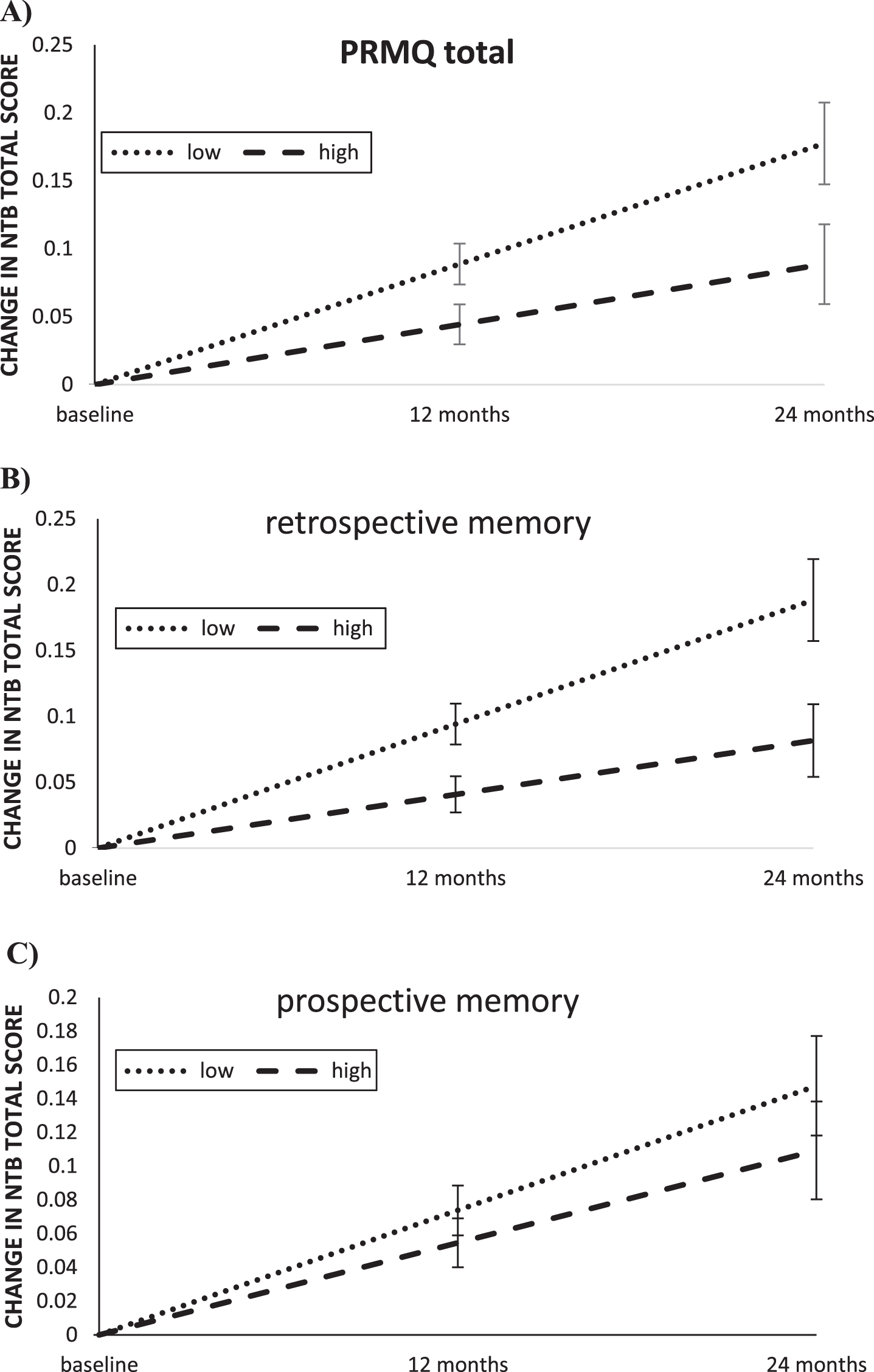
Cognitive changes during 2-year follow-up time as a function of subjective memory assessment; part A for total PRMQ; part B for retrospective memory; and part C for prospective memory. The figure shows estimated mean change in cognitive performance from baseline through 12 and 24 months (higher scores indicate better performance). Error bars are standard errors around the means. Mixed-model repeated-measures analyses were used to assess between-group differences (higher/lower subjective memory complaints) in changes from baseline to 24 months based on data from participants with at least one post-baseline measurement. Low and high refer to the amount of reported subjective memory complaints below or above the median level (using cutoffs: PRMQ total ≥36 and sub domains ≥18).
Informant-reported SMCs and change in neuropsychological performance
Informant reported data were received from participants’ spouses (48.3%), children (13.3%), and significant others (13.0%). Information on the relationship with the participant was missing for 25.3%. More informant-reported SMCs (higher PRMQ total score) was linked to less improvement in executive function, but this effect fell short of significance after full adjustments (Table 3). Informant PRMQ total score was not associated with change in NTB total, processing speed or memory domains. Informant PM or RM complaints were unrelated to change in any cognitive domain after full adjustments. These patterns remained unchanged in sensitivity analyses within the group of spouses only.
Participant and informant PRMQ ratings analyzed simultaneously and change in neuropsychological performance
When both self and informant reports were adjusted for each other, self-reported PRMQ total score was associated with all other cognitive domains, except processing speed. Self-reported RM complaints predicted less improvement in all cognitive domains, and PM complaints were related to NTB total score and processing speed. Informant reports for PM complaints were associated with improvement in processing speed (Table 4).
The association between self-reported and informant-reported prospective and retrospective memory complaints (measured with Prospective and Retrospective Memory Questionnaire, PRMQ) and change in cognitive function during 2 years. Participant and informant reports are adjusted for each other. Results are from mixed linear models (estimates of PRMQ effect per year and p values)
PRMQ, Prospective and Retrospective memory questionnaire. Model adjusted for age, sex, study site, education and depression, and self and informant reports are entered simultaneously. Higher scores on PRMQ indicate presence of more complaints. Higher scores on cognitive outcomes indicate better cognitive performance. Significant effects are in bold typeface.
DISCUSSION
The aim of this study was to examine whether self-reported or informant reported SMCs predict 2-year cognitive change among healthy, but at-risk elderly people. The results show that having more self-reported SMCs, measured with the PRMQ predicts poorer development in NTB total and memory scores. Subjective RM problems, but not PM problems, predicted less improvement in NTB total, memory, and executive functions. Informant ratings in PRMQ total and PM and RM subscales were not associated with any cognitive domain after adjustments.
The question of whether self or informant reports are more predictive of future cognitive decline is complex, and depends on the time of the assessment. In contrast to some previous studies suggesting informant reports to be more predictive [2, 42] when assessing self and informant reports simultaneously, our study found self-reports to be more accurate in predicting future cognitive change. Our older sample was cognitively healthy but at risk, whereas most previous studies were based on memory-clinic patients or persons with MCI. To our knowledge, this is the first study assessing both subjective PM and RM complaints simultaneously among both participants and their informants in relation to cognitive performance across several domains. Overall, we were seeing an improvement in cognitive performance in our sample [23]. Such a pattern is quite common in longitudinal studies of cognitive aging with relatively short retest intervals and likely reflects placebo effects or practice effects of repeated cognitive testing. Some studies suggest that lack of improvement in repeated cognitive testing may be linked to pathological processes and later progression of cognitive impairment [43, 44]. However, it is possible, that participants’ lack of improvement over time may also reflect baseline inter-individual differences in memory encoding irrespective of cognitive decline. Also one other study has shown that cognitively normal individuals converting to MCI self-recognized decline earlier than informants [45]. In the current study, the changes noted by the informants (even if attenuated with full adjustments), were in fact linked to future changes in executive functions rather than to memory. When participant and informant reports were adjusted for each other, we observed that while participant-reported PM complaints were associated with less improvement in processing speed, informant-reported PM complaints were associated with more improvement.
One previous study that investigated informant reports of PM and RM problems among participants with memory problems or early AD found that especially PM problems were linked to objective cognitive outcomes [22]. The present findings suggest that informant PM and RM reports are only weakly related to cognitive changes. Surprisingly, subjective PM problems were less associated with future cognitive change than RM problems; PM has been suggested to be more vulnerable than RM to changes in the early phase of AD [22, 46]. It has also been suggested that PM functions are especially important from an independent living point of view [47], and, therefore, more easily observed than RM problems. It could be that commonly used memory tests, as those included in our study, evaluate RM function more accurately than PM function. Self-reported PM and RM complaints have rarely been compared. One previous study suggested that self-reported RM but not PM complaints were helpful in differentiating elderly persons with subjective cognitive impairment and amnestic MCI, which is in line with the current results [48].
Decline in cognitive function, including both episodic memory and executive function may begin decades before diagnosis of dementia [49]. Even though the participants in our study did not face cognitive difficulties causing functional decline, their reports of memory problems were relevant for future changes in memory and executive function. Informant reports were somewhat linked to changes in executive function. Perhaps changes in executive functions can be earlier and more easily observed because of their relevance for everyday performance [50].
Affective factors in the individual or the informant or the quality of the relationship between the two might influence the subjective evaluations [51]. In addition to the depressive symptoms alone being an independent risk factor for dementia [52], these symptoms may affect the subjective experience of cognitive deficits, including memory problems [53]. In one study [54], cognitive and memory complaints were more closely associated with mood and general mental health than actual cognitive status. Toward this end, the associations observed between participant-reported SMCs and cognitive performance (NTB total, executive functions, and memory), and between informant- reported SMCs and cognition (executive functions), remained significant after adjusting for depressive symptoms.
This study has a number of strengths. The study population is drawn from earlier population-based studies, and with the inclusion criteria used, the population can be seen representative of the normal Finnish population with some risk factors for dementia, and cognitive functioning at the average level or slightly below the average of this age group [27]. Note that the study included only high-risk individuals, not participants already diagnosed with dementia. The richness of the data collected allowed adjusting for many possible confounding factors. In assessing neuropsychological performance, we used a comprehensive and standardized NTB comprising measurements of several key cognitive domains and a psychometrically validated [19] method for assessing SMCs. Finally, the drop-out rate was only 8% after 2 years.
The limitations include: the timing of the subjective memory assessment, as participants completed the PRMQ six months after the first neuropsychological testing. However, no major changes in memory functions or their subjective assessments are likely to have occurred during this time period. Because of the long preclinical stage before clinical dementia, it is possible that some participants might already have had some dementia-related brain changes. MCI diagnostics was not done and some of the participants might have fulfilled MCI criteria at baseline (depending on the criteria used). However, the mean cognitive performance was less than 0·5 SD below the average level for the cognitively normal Finnish population [30]. The duration of the 2-year follow-up time was fairly short to track the progression of cognitive decline. However, studies with longer follow-up periods have reported similar results and shown SMCs to predict future diagnostic outcomes and later progression to AD [2, 55]. Due to a relatively small sample size our study may have had limited power to detect some moderate degree associations that may have existed. Although there are no validation studies or norms for the PRMQ in the Finnish population, the questionnaire is widely used and can be viewed as culturally neutral. No alternate versions of the cognitive tests were used, which may have contributed to the magnitude of the observed improvement in cognitive performance over time.
In sum, our findings indicate that self-reported SMCs, measured with the PRMQ among cognitively healthy older adults at increased risk of cognitive decline, predict 2-year cognitive changes. The results are in line with previous findings that underscore the usefulness of subjective memory assessment in identifying individuals at risk of future cognitive impairment or eventually dementia [2]. Compared with informant reports, self-reported memory failures seem to be more sensitive indicators for predicting cognitive change in this relatively healthy population.
Footnotes
ACKNOWLEDGMENTS
This research was supported by grants fromthe Academy of Finland’s Responding to Public Health Challenges Research Programme (SALVE), Academy of Finland grants 259615, 278457, 287490, 294061, 305810; La Carita Foundation, Juho Vainio Foundation, Novo Nordisk Foundation, Finnish Social Insurance Institution, Ministry of Education and Culture Research Grant, and EVO/VTR grants of University Hospitals of Kuopio, Oulu and Turku, Seinäjoki Central hospital and Oulu City Hospital for FINGER project, Swedish Research Council; Alzheimer’s Research & Prevention Foundation USA; AXA Research Fund; the Sheika Salama Bint Hamdan Alahyan Foundation, Finnish Medical Foundation, Academy of Finland for Joint Program of Neurodegenerative Disorders – prevention (MIND-AD), an Alexander von Humboldt Research Award, Knut and Alice Wallenberg Foundation Sweden, Center for Innovative Medicine (CIMED) at Karolinska Institutet Sweden, Stiftelsen Stockholms sjukhem Sweden, Konung Gustaf V:s och Drottning Victorias Frimurarstiftelse Sweden, af Jochnick Foundation Sweden as well as personal grants from Finnish Brain foundation sr (LV).
The funding sources had no involvement in the study design, in the collection, analysis and interpretation of data, in the writing of the article, or in the decision to submit the article for publication.
