



Abstract
Socially assistive robots have the potential to improve aged care by providing assistance through social interaction. While some evidence suggests a positive impact of social robots on measures of well-being, the adoption of robotic technology remains slow. One approach to improve technology adoption is involving all stakeholders in the process of technology development using co-creation methods. To capture relevant stake holders’ priorities and perceptions on the ethics of robotic companions, we conducted an interactive co-creation workshop at the 2019 Geriatric Services Conference in Vancouver, BC. The participants were presented with different portrayals of robotic companions in popular culture and answered questions about perceptions, expectations, and ethical concerns about the implementation of robotic technology. Our results reveal that the most pressing ethical concerns with robotic technology, such as issues related to privacy, are critical potential barriers to technology adoption. We also found that most participants agree on the types of tasks that robots should help with, such as domestic chores, communication, and medication reminders. Activities that robots should not help with, according to the stakeholders, included bathing, toileting, and managing finances. The perspectives that were captured contribute to a preliminary outline of the areas of importance for geriatric care stake holders in the process of ethical technology design and development.
Keywords
INTRODUCTION
Improving independence and quality of life for the 50 million people currently living with dementia worldwide [1] can be realized by complementing human care with robotic assistive technologies. Social robots, defined as robots with a goal of providing assistance to human users through social interaction, include humanoid robots (e.g., Pepper [2]), pet-like robots (e.g., Paro [3]; Miro [4]), and avatar-based robots [5]. Robotic solutions are promising in their potential to support aging in place and act as engaging solutions to promote the cognitive health of older adults with and without dementia as well as their caregivers [6]. The promise of the positive impact of social robotics on the older adult population is supported by early lines of evidence. A recent systematic review of controlled trials analyzing the impact of social robots on the well-being of older adults suggests that social robots can improve nine quality of life outcomes, including reducing loneliness, stress, anxiety, and decreasing medication use [7].
Despite these benefits, real-world implementation of social robots has been slow. Barriers to adoption include lack of older adult input in the design and development of these solutions, overly optimistic expectations about the capabilities of robots, lack of emotional alignment between social robots and their end-users, and ethical concerns such as infantilization, deception, and privacy [8–10]. Where solutions were developed and implemented, evaluations of their impact have yielded mixed results, for example reductions in depressive symptoms [11] and loneliness [12] with some robots but not others [13]. These mixed results likely arise from methodological differences such as variety of outcome measures, and, perhaps most importantly, lack of alignment between outcome measures and the priorities and values of end-users.
One solution to address adoption barriers, potential harms and ethical concerns is through the meaningful involvement of end-users in the process of development of robots [10]. Different models to achieve this goal have emerged, such as participatory design, user-centered design, and community-based action research. While all of these models have their own advantages and challenges, their key guiding principle is that incorporating the voice of end-users in technology development leads to solutions that are readily acceptable, adopted and beneficial for target users. Taking into consideration the priorities of end-users is especially critical when designing assistive technology such as social robots as their effectiveness and the magnitude of their impact depends on willingness to use them. A recent scoping review of co-design studies involving people living with dementia suggests that co-design efforts have positive impacts for both the participants and the researchers [14]. Specific benefits for people with dementia included positive impact on imagination, increased social interaction, feelings of pride, and feelings of being understood and valued. For the design process, benefits included ongoing feedback, challenges to the designers’ preconceptions and emergence of creative solutions [14]. Robotic solutions that are co-designed with older adults and their formal or informal caregivers will prioritize the needs and values of the target population and therefore likely benefit from higher adoption rates.
The goals of this project were to: 1) confirm the feasibility of a co-creation process for social robots, and 2) capture preliminary priority areas for socially assistive robots from the perspective of multidisciplinary geriatric care stakeholders.
METHODS
The Geriatric Services Conference is an annual interdisciplinary event held in Vancouver, BC, Canada with the goal of improving geriatric care by connecting various stakeholders including researchers, clinicians, patients, and volunteers.
The data presented in this report were collected during a 60-minute workshop at the 2019 Geriatric Services Conference. The workshop was attended by 31 participants and consisted of a multimedia presentation during which participants were asked a series of questions about their perceptions of robots via a real-time Internet-based polling system, followed by a discussion. The presentation included excerpts from popular media such as movies and television series portraying human-robot interaction. The participants watched three short clips to help stimulate the discussion. The first excerpt, from 2016 television series “Westworld”, portrayed a highly realistic humanoid robot. The second clip, from the 2012 movie “Robot & Frank” showed an intelligent robotic healthcare aid giving nutritional and activity planning advice to an older adult. The third excerpt came from the 2009 movie “Surrogates” and showed a scenario in which people could live their lives through the bodies of robotic surrogates. Each person responded to questions individually and anonymously using their mobile device in between the clips shown. Participants could revisit the questions and change their answers at any point during the workshop using their mobile devices. The question themes included: 1) definition of a robot; 2) social consequences of using assistive robots; and 3) ethical concerns. The question about ethical concerns asked participants to rank 10 established ethical concerns [15, 16] and write down any additional concerns. This task could be completed on paper as well as in through the online polling system. In addition to questions answered individually, the workshop included a group activity during which participants partnered with at least one other person to identify activities that robots should and should not assist with.
RESULTS
Defining a robot
For the first question, participants were asked to identify which items they considered to be robots: 1) the assistive robot Pepper, 2) Roomba, an automated vacuum cleaner, 3) a plush mechanical dog toy, and 4) Amazon Echo, a smart home device. Participants were able to select multiple answers. Out of the 31 participants, 20 answered this question. The option chosen by the largest number of participants was the picture of the assistive robot Pepper (17 votes, 85%), followed by the picture of a Roomba (14 votes, 70%), the mechanical dog toy (12 votes, 60%), and the smart home device (11 votes, 55%). The pictures used for this question together with participants’ answers are represented in Fig. 1.
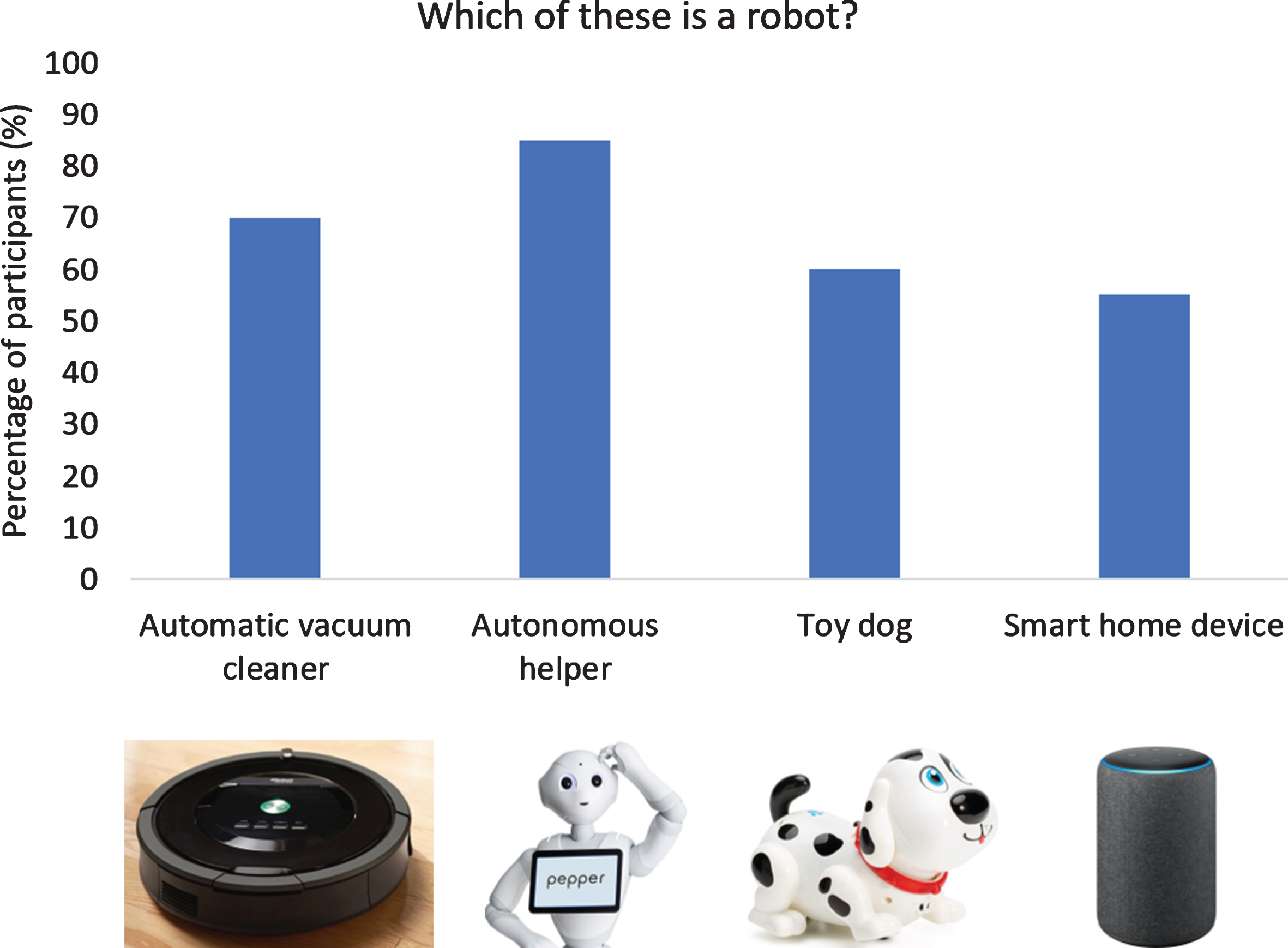
The first question in the workshop with results. Each participant could select multiple answers.
The social consequences of robots
Participants were asked whether they felt the increase in availability and adoption of social robots would lead to more social connectedness or more isolation. This question was answered by 17 participants. The majority of participants responded that the use of socially assistive robots will make us more connected (14 votes, 82%). Three participants (18%) answered that the robots will make us feel more isolated. None of the participants chose the third available option which stated that the level of social connectedness will be no different than today.
Ethical issues in social robotics
Workshop participants were asked to form small groups and discuss 10 well-established ethical considerations related to social robotics from the literature, and then rank them in order of most concerning (1) to least concerning (10). A total of 11 completed responses were collected from groups of participants. The importance of different consideration according to our sample was ordered as depicted in Table 1. Starting from the most important: 1) privacy of personal information (average ranking 2.6); 2) potential third party use of information (3.5); 3) lack of user control over who sees the data collected by the robot (4.0); 4) lack of clarity about who should be held responsible if something goes wrong (4.8); 5) issues of autonomy (4.9); 6) managing the expectations of older adults about what robots are able to do (5.8); 7) equal access to social robotics (6.1); 8) deceiving, lifelike looks of robots (7.2); 9) stigma associated with robot use (7.6); and 10) older adults becoming too attached to the robots (8.6). Complete rankings and phrasing of the categories can be found in Supplementary Table 1.
Ethical considerations in social robotics
Desired applications for social robotics
In groups, participants were asked to imagine activities of daily living they felt robots could assist with. Participants were provided with a list of activities of daily living and instrumental activities of daily living drawn from the literature as examples [17]. After identifying which activities robots would be able to perform, participants were asked to classify whether, in their opinion, robots should perform any of these activities. This step was aimed at distinguishing between perceived capabilities and functionalities of social robots and ethically acceptable application areas. A total of 12 groups completed this activity, and 27 activities were identified in total. All of the groups agreed that house cleaning is an activity robots could and should help with. The second most desired application for robots was shopping and meal preparation (n = 10), followed by communication (n = 9) and assistance with medications (n = 9). Activities such as dressing and grooming, feeding, bathing, and toileting were considered unfit to be performed by a robot, with 6 to 8 groups indicating that robots should not help in these situations. Detailed answers for this question can be found in Fig. 2.
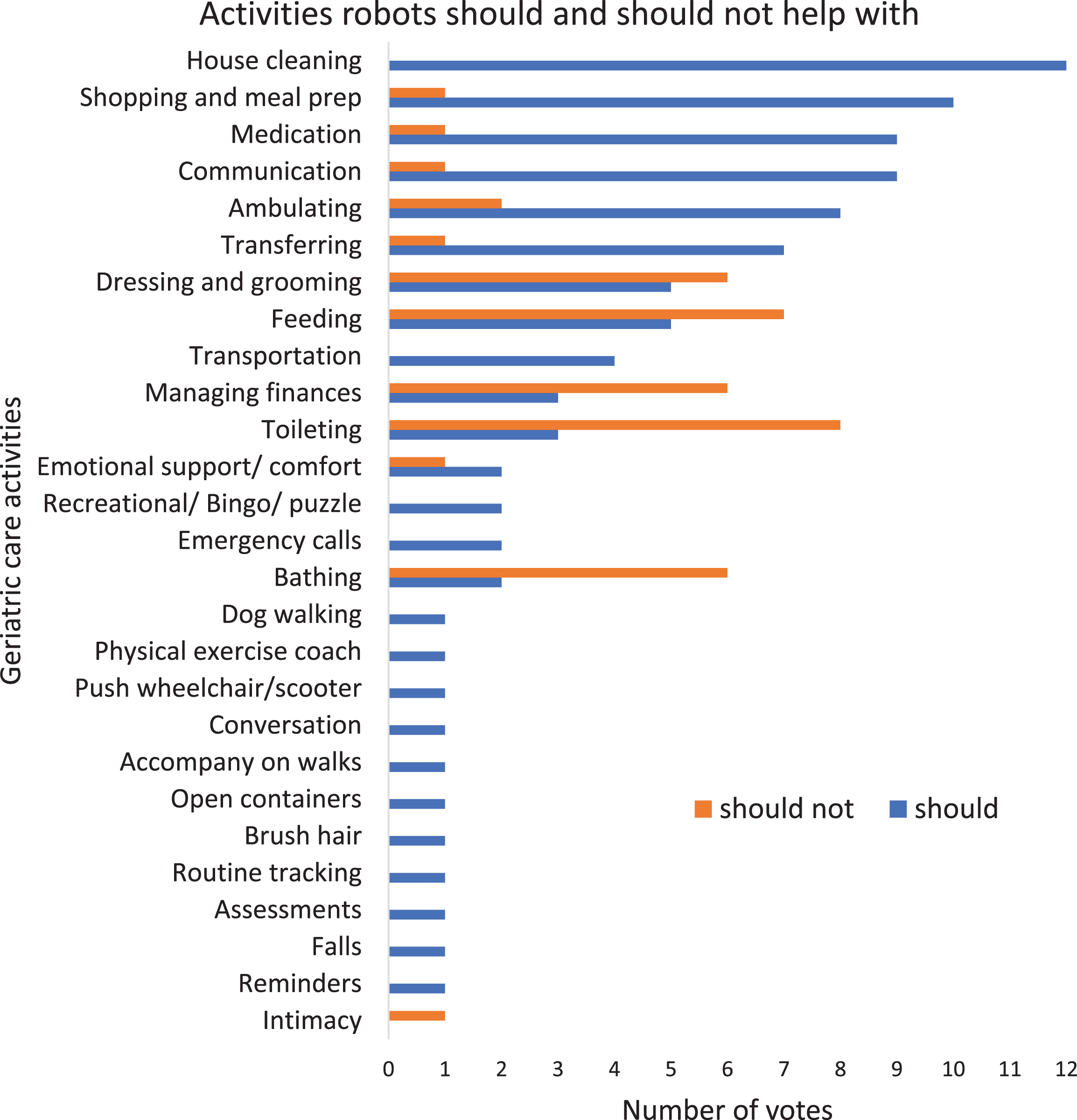
Complete summary of votes for acceptability of aged care activities that could be taken on by robots.
DISCUSSION
This study demonstrates the feasibility of incorporating the voices of diverse stakeholders in robotics research using interactive activities. The perspectives and priorities of stakeholders were captured in order to identify preliminary areas for further development of socially assistive robots through co-creation.
The insights from the workshop participants at the 2019 Geriatric Services Conference highlight critical challenges in implementation of socially assistive robotics in the context of geriatric care. Our results suggest that there are varied interpretations of what a robot is which may contribute to different understandings of robot research by participants. The results also point to differing expectations for how robots will change aged care. Understandings, acceptability and expectations all contribute to the adoption of novel technologies and co-creation approaches are key in establishing these parameters early in the development process.
While there are certainly differences in the stake holders’ perspectives, the results also showcase areas of agreement. The participants showed a unified view on ethical concerns stemming from robotic assistance, with privacy, protection of personal information, and control of end-users over who has access to the robot-interaction data being the three highest-rated ethical considerations in order of importance. Notably, all of these areas of concern are related to software design of robots and are independent of the physical form. The main issue regarding the physical embodiment of the robot is the possible deception of users (e.g., the robot being too life-like). This concern was ranked as third to last, suggesting that ethical software development is of higher priority for stakeholders. Participants also agree on the activities with which robotic assistance is expected and desired. The fact that the greatest level of acceptance of robotic help was expressed in areas such as domestic chores, meal preparation and communication, but not in areas such as feeding and bathing is consistent with other robot acceptance studies [18]. As the field of social robotics advances, available application areas are increasingly better defined. For example, some robotic solutions are being designed specifically for companionship for older adults [19, 20] or for physical therapy for children [21]. As we gather new knowledge about possible functionalities, co-creation approaches can further refine how these interventions are delivered to ensure maximum benefits.
The results of this preliminary work highlight areas of ethical concern for stakeholders and can serve as a starting point to collect more information from larger, more diverse groups. Such information could then be incorporated into the process of developing social robot solutions, to make sure that all most pressing ethical concerns are addressed at the stage of technology development, rather than implementation. While the outcome of our workshop was not a co-created social robot, the session demonstrated feasibility of ethics-oriented co-creation activities with stakeholders that result in actionable priorities.
The approach presented has limitations. Due to the nature of the conference setting, our workshop participants were conference attendees who were interested in the topic of social robots. Demographic information was not collected, which also limits the generalizability of our findings. While necessary, engaging people with different backgrounds poses unique challenges. Recruitment of a diverse group of participants is difficult not only because of differing schedules and interests of stakeholders, but also the tendency to recruit easily available populations, as exemplified by the sampling bias of the initiative described above. Potential participants who are harder to reach (e.g., living in remote areas) could nonetheless be the main benefactors of some of the assistive technology (e.g., telehealth robots), which highlights the importance of including diverse populations in co-creation efforts. To offset these challenges, research-based methods (e.g., end-user centered design [22] or participatory design [20]) and guidelines (e.g., ethical adoption [10]) have been developed and are increasingly used in technology research and development.
The insights from this pilot work serve to determine priority areas for further ethical co-creation initiatives. The success of robotic technology development and implementation in aged care depends on whether the technology genuinely helps older adults, but also is readily accepted and adopted. Fully embracing co-creation methods in technology development will result in better outcomes both for older adults and the industry.
