




Abstract
Background:
Estrogens have been found to reduce amyloid-β (Aβ) levels, a risk factor associated with dementia. We hypothesized that phytoestrogenic soybean products such as tempe and tofu might show similar effects.
Objective:
The aim of this study were to analyze the effect of tempe and tofu flour on Aβ1-40 serum levels in ovariectomized rats.
Methods:
This research was conducted on female Sprague Dawley rats, aged 12 months. Before the intervention rats underwent ovariectomy (OVx) and were grouped into 5 intervention groups which were given tempe flour, tofu flour, estradiol, or casein as an active control. There was also a non-OVx control group which was fed a normal diet.
Results:
The intake of tempe and tofu flour decreased Aβ serum levels in all estrogen and phytoestrogenic treatment groups, offsetting effects of OVx (but not in the casein group, where Aβ levels rise).
Conclusion:
The tempe flour group showed the strongest decrease in serum Aβ levels compared to the other groups. Future studies should investigate whether tempe can reduce Aβ levels in patients with dementia.
INTRODUCTION
Alzheimer’s disease (AD) is a progressive neurodegenerative disease, which is the main cause of dementia in elderly subjects [1]. One of the main characteristics of AD is loss of memory. Amyloid-β (Aβ) peptide levels are also elevated in AD brain and blood and precede cognitive impairment [2, 3]. The prevalence of AD is around 1.5% at age 65 years, doubling every 4 year to reach ∼30% at age 80 years. The risk of AD is also higher in older women than in men, which may be related to their lower levels of sex steroids, such as estrogens after menopause [4, 5]. Estrogen depletion and surgical menopause at an earlier age further increase dementia risk [6 –8]. Other risk factors which are associated with cognitive impairment and dementia are genetic factors, but also treatable factors associated with cardiovascular disease, such as diabetes mellitus, depression, hypertension, engaging in less physical and social activities, smoking, high total cholesterol, and obesity [9 –11]. Lastly, low folate and cobalamin (vitamin B12) levels intake increase risk for dementia [12 –16].
Estrogen can have effects on many organ systems, including the brain [17 –19] through the presence of the estrogen receptor. Estrogen replacement therapy (ERT) may have beneficial effects on aging process, but its use in older women could confer risk. ERT was shown to protect against the development of AD (perhaps by acting on Aβ) according to meta-analyses of observational trials, but treatment study results indicate that an older age and longer duration of treatment (>1 year) may actually confer risk for dementia and restrict its use to recently menopausal women for short periods of time [20]. Prolonged use of estrogens in older women may confer risk for dementia possibly through its effect on promoting apoptosis in neuronal cells undergoing pathological change, which is more likely in older women [21, 22].
Phytoestrogens are a group of biologically active plant substances with a chemical structure that is similar to that of estradiol, the most potent endogenous estrogen [23]. The three major classes of phytoestrogens are isoflavones, lignans, and comestans and the major bioactive isoflavones are genistein and daidzein, as well as equol (which is produced in the intestines). Isoflavones may have positive effects on cognitive function and may also reduce Aβ [24 –26]. Isoflavone sources are soybean and soybean products. Indonesia is a country where people commonly consume large amounts of tempe and tofu, soy products rich in phytoestrogens. Tempe consumption was shown to also increase serum estrogen [27].
In a previous human observational study, high tofu consumption was associated with worse memory, although high tempe consumption (a fermented whole soybean product) was independently related to better memory, particularly in Indonesian participants over 68 years of age [28]. Similarly, data from the Honolulu-Asia Aging Study (HAAS) in Japanese Americans also showed that higher midlife tofu consumption was independently associated with indicators of cognitive impairment and brain atrophy in late life [29]. Age may thus modify the effect of phytoestrogens on cognition, similar to the effect of estrogens [30 –33]. The positive effect of tempe regardless of age may be explained by its soybean fermentation which produces folate and cobalamin. Folate can reduce the negative association of high estrogen with adverse brain function in older women [34]. We hypothesized that because phytoestrogens have half the bioactive effect of estrogens (due to their lower binding capacity to the estrogen receptor or ER) that effects on Aβ would be strongest in ovariectomized (OVx) rats given estradiol, followed by tempe and tofu flour.
METHODS
Design
The study was conducted using an experimental design with pre-post-treatment controls at the animal hospital and Histology Laboratory of the Faculty of Veterinary Medicine, Bogor Agricultural University. Sprague Dawley strain female rats aged 1 year (n = 72) were obtained from the Faculty of Veterinary Medicine, Bogor Agricultural University. Rats were placed in a plastic cage with a lid made of wire covered with chaff ram, and given drinking water ad libitum. The environment was not humid with adequate ventilation and adequate lighting with cycles of 14 h light and 10 h of darkness.
Rats were fed modified flour given three months after OVx surgery. Feed before the intervention was derived from PT. Comfeed Indonesia. Composition of nutrients in flour was: 18–20% crude protein, 40% crude fat, 7% crude fiber, 2% calcium and phosphorus, 13% ash and 10% water. Rats were then grouped into 5 groups: tempe flour, tofu flour, estradiol, casein after OVx, and non-OVx controls given normal feed without additions. Three months after OVx, diets were started. Dietary interventions were carried out for 2 months using the different feed compositions according to the AIN-93m which consisted of 14% protein, 5% minerals, 4% fat, 1% vitamins, 5% fiber, and 66% starch. The active control group was given casein as a protein; the passive control group was also given casein but had not undergone OVx. Tempe and tofu were substituted for casein as active treatments. Another group was given casein and estradiol 3 months after OVx. In the estradiol group, treatment consisted of ethinylestradiol (synthetic estrogen) of 9×10⁻³ mg/day/200g B by using a sonde. Nutrient content of the tempe and tofu flour was assessed using HPLC in the laboratory in Bogor.
Point observations were made at a time before OVx called baseline 1 (BS1), three months post-OVx called baseline 2 (BS2), two weeks after the intervention (I2), five weeks after the intervention (I5), and eight weeks after the intervention (I8). Aβ in serum assays were carried out at the Reproduction and Rehabilitation Unit (URR) Laboratory in the Faculty of Veterinary Medicine, Bogor Agricutural University. Analysis of Aβ in serum was done using the ELISA method with Amyloid Beta Peptide 1–40 (Aβ1–40) (E90864Ra) reagent.
Processing and data analysis
Data obtained were processed and analyzed statistically to investigate differences between the treatment groups using analysis of variance (ANOVA) repeated measures with post hoc Tukey tests and polynomial contrasts in SPSS 17.0.
RESULTS
Intake of tempe flour (4.4 gram/day) was equivalent to intake of folic acid of 1.104×10⁻³ ppm, vitamin B12 of 4.27×10⁻² mcg and 22.25 mg isoflavones, while tofu flour only contained 10.16 mcg isoflavones and no B vitamins. Results of this study (Table 1) showed that rats had a significant increase in serum Aβ three months after OVx. The tempe (fermented soybean) flour intervention group from the second week after until the fifth week of treatment showed a significant decline in Aβ levels in serum which dropped below that of controls. After eight weeks, Aβ levels began rising slightly again, although these remained significantly lower compared to casein treatment using repeated measures ANOVA post hoc Tukey tests (p < 0.05). Tofu flour also induced a decline in Aβ40 levels after two weeks of treatment until after eight weeks of intervention. However, the Aβ40 level in serum remained higher than that of the rats consuming tempe flour and seemed to only offset the effect of OVx. The estradiol group intervention had similarly decreased Aβ40 in serum offsetting effects of OVx on Aβ. In the casein group Aβ40 levels increased at two, five, and eight weeks after intervention over that of all phytooestrogenic compounds. This was in contrast to the non-OVx group, where the level of Aβ40 tended to remain the same (Fig. 1 and Table 2).
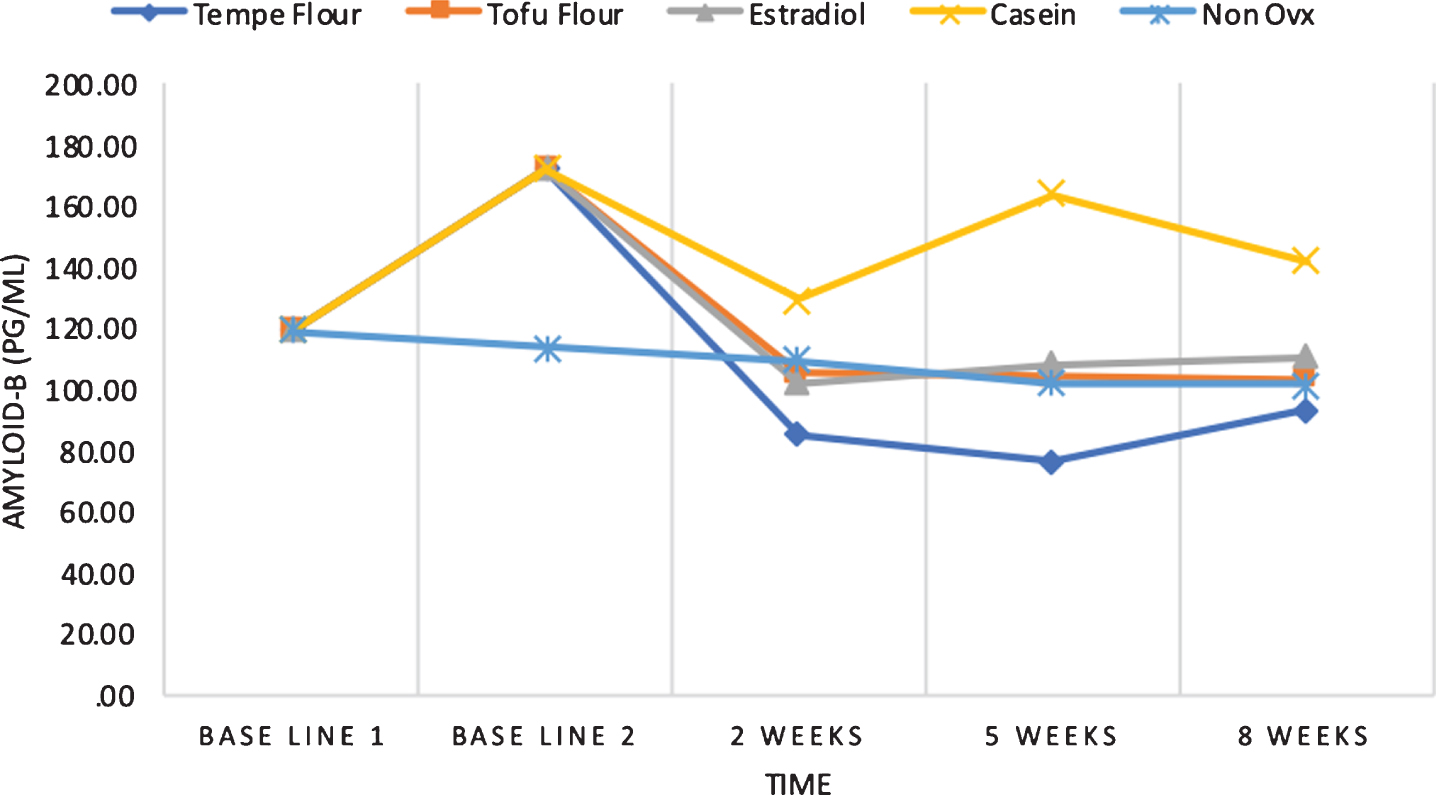
Aβ40 levels in serum across different treated groups over time.
Mean±SD (CI) and p values of Aβ40 in Serum at Baseline
Mean±SD (CI) and p values of Aβ40 in Serum During Intervention
I2, two weeks; I5, five weeks; I8, eight weeks.
The tempe flour group had the largest change in Aβ levels after eighth weeks of intervention (p < 0.05). The lowest Aβ40 content was found in the tempe flour group, which was below baseline. The difference in Aβ levels in the tofu, estradiol, and casein flour groups from baseline 2 was not significant (Table 3).
Mean±SD (95% CI) difference in Aβ40 (pg/ml) for time of intervention with baseline 2
a p = 0.048.
DISCUSSION
Estrogen reduces the risk of AD in postmenopausal women, Aβ levels in animal AD models, and Aβ secretion from neuronal tissue, indicating ERT can improve cognition and delay development of AD. The exact biological mechanism of estrogen as a neuroprotective agent is unknown. ERT can slow the occurrence of AD by reducing the release of Aβ, the main component of the amyloid plaque, to the brain parenchyma [35]. This phenomenon was first described in non-neuronal and neuronal tissue cells. In animal models, guinea pigs and transgenic mice show that postoperative estrogen administration can decrease Aβ levels. There was an inverse relation between 17β-E2 and Aβ42 in cerebrospinal fluid in female patients with AD [36].
Estrogen mechanisms that regulate Aβ have not been fully explained, although this sex hormone is involved in both regulating the production and clearance of Aβ [37]. In this study in serum, estrogen levels dropped significantly after OVx which was followed by an increase in serum levels of Aβ40. The increase in the lag time cannot be explained by considering Aβ40 clearance from the brain which occurs in a short time (a few minutes) [38]. Aβ is the result of the production of proteolytic cleavage of its parent protein, the amyloid-β protein precursor (AβPP). The majority of AβPP is metabolized by two pathways. In the amyloidogenic pathway, AβPP is cleaved by β-secretase and γ-secretase, liberating the Aβ peptide largely from the chain of amino acids 40 and 42. In the non-amyloidogenic pathway, AβPP is cleaved in the Aβ domain by α-secretase, preventing the formation of the full-length Aβ peptide, but releasing a solution in the form of a protective AβPP called αAβPP. Cell culture studies showed that estradiol and testosterone can improve the processing of AβPP by promoting the non-amyloidogenic pathway, thereby reducing the production of Aβ [39].
Serum Aβ levels in the OVx group showed a significant increase from baseline 1. Increased Aβ, due to OVx, could be caused a loss of negative estrogen feedback to gonadotropin lutein hormone, thereby causing an increase in lutein hormone levels which in vitro was also proven to increase Aβ production through the amyloidogenic pathway [40]. Giving tempe flour to rats showed a decrease in serum Aβ. At eighth weeks of intervention, the tofu flour group had a serum Aβ content 1.11 times lower than the tofu flour group. Compared with the estradiol and casein groups, the tempe flour group Aβ results were 1.2 and 1.5 times lower, respectively. Aβ in the tofu flour group was almost the same as non-OVx group showing offsetting of OVx similar to the estrogen treatment.
In this study, we showed that tempe flour has the potential to reduce Aβ40 in OVx rats below baseline levels. Further research needs to be done to investigate the effect of tempe flour consumption in older female rats (3 years old), and male middle-age and older rats. Considering its safety profile, tempe treatment studies should commence in female patients who are planned to undergo OVx and in those who are afflicted with AD.
Conclusion
A regular high intake of phytoestrogens derived from tempe flour may have positive effects on brain function by reducing Aβ40 levels in elderly female rats.
Future studies should include younger and older male rats and further identify Aβ40 mechanisms related to tempe consumption.
Footnotes
ACKNOWLEDGMENTS
We would like to acknowledge the technical and scientific influence of Professor Rizal Damanik, Dr. Adi Winarto, Professor Ekowati, Professor Barry Sharp, Dr. Helen Griffiths, Dr. Brenden Theaker, Dr. Rimbawan, Professor Made Astawan, Professor Widodo Suparno, Dr. Saptawati Bardosono, Tiwi Nurhastuti, Tinon Ambarini, Toni Sugiarso, and Univeritas Respati Indonesia for their generous funding. Also a Sandwich Program to Loughborough University from the Directorate General of Higher Education, Ministry of Education, Indonesia.
