



Abstract
Background:
In recent years, the efficacy of type 2 diabetes mellitus (T2DM) drugs in the treatment of Alzheimer’s disease (AD) has attracted extensive interest owing to the close associations between the two diseases.
Objective:
Here, we screened traditional Chinese medicine (TCM) and multi-target ingredients that may have potential therapeutic effects on both T2DM and AD from T2DM prescriptions.
Methods:
Network pharmacology and molecular docking were used.
Results:
Firstly, the top 10 frequently used herbs and corresponding 275 active ingredients were identified from 263 T2DM-related TCM prescriptions. Secondly, through the comparative analysis of 208 potential targets of ingredients, 1,740 T2DM-related targets, and 2,060 AD-related targets, 61 common targets were identified to be shared. Thirdly, by constructing pharmacological network, 26 key targets and 154 representative ingredients were identified. Further enrichment analysis showed that common targets were involved in regulating multiple pathways related to T2DM and AD, while network analysis also found that the combination of Danshen (Radix Salviae)-Gancao (Licorice)-Shanyao (Rhizoma Dioscoreae) contained the vast majority of the representative ingredients and might be potential for the cotreatment of the two diseases. Fourthly, MAPK1, PPARG, GSK3B, BACE1, and NR3C1 were selected as potential targets for virtual screening of multi-target ingredients. Further docking studies showed that multiple natural compounds, including salvianolic acid J, gancaonin H, gadelaidic acid, icos-5-enoic acid, and sigmoidin-B, exhibited high binding affinities with the five targets.
Conclusion:
To summarize, the present study provides a potential TCM combination that might possess the potential advantage of cotreatment of AD and T2DM.
Keywords
INTRODUCTION
Alzheimer’s disease (AD) is a serious neurodegenerative disease that poses an important challenge to public health. More than 50 million people wor-ldwide are currently affected by this disease and this fig will grow steadily due to the aging of the population [1]. AD patients are generally companied with the symptom of memory loss, impairment of cognitive functions, and behavior and personality changes, which bring a serious burden on individuals, family, and society [2]. Despite much effort been devoted to developing drugs to combat AD, there is still an urgent need for new effective agent.
Type 2 diabetes mellitus (T2DM) is a prevalent metabolic disease, which is characterized by dysregulation of carbohydrates, impaired insulin secretion, and insulin resistance [3]. In recent years, an increasing number of studies found that T2DM was closely related to the development of AD. Clinical and epidemiological studies supported that T2DM was an important risk factor promoting the development of AD. For example, a large population-based study comprising a total of 1,396 individuals in Sweden demonstrated that patients with diabetes had an in-creased risk of developing AD by approximately 69%[4]. Moreover, further studies found that there were multiple common pathogenic mechanisms between T2DM and AD, including impaired insulin signaling, insulin resistance, inflammation, amyloid-β (Aβ) de-posits, and hyperphosphorylated tau [5–7]. Many studies have provided evidence that impaired insulin signaling due to insulin resistance and relative insulin deficiency also occurs in the brain of AD patients [8, 9].
Owing to the similar pathogenesis between AD and T2DM, the beneficial effects of T2DM drugs in the treatment of AD have lately received great attention, and these effective drugs might be involved in multiple mechanisms [10]. Firstly, T2DM drugs might play a beneficial role in AD by decreasing the production of Aβ. For instance, glimepiride could reduce extracellular Aβ concentrations by inhibiting the activity of β-secretase 1 (BACE1) and downregulating the expression of BACE1 mRNA [11]. Secondly, T2DM drugs have been shown to ameliorate cognitive ability and other AD-related pathology by regulating insulin signaling pathways. A case of this is dulaglutide, which could reduce the hyperphosphorylation of tau and neurofilaments by regulating phosphoinositide-3-kinase/AKT/glycogen synthase kinase 3 beta (PI3K/AKT/GSK3B) signaling pathway [12]. In addition, liraglutide treatment not only significantly reduced the levels of hyperphosphorylated tau and neurofilaments by improving c-Jun N-terminal kinase (JNK) and extracellular signal-regulated kinase (ERK/MAPK) signals [13], but also decreased the load of Aβ plaques in hippocampus and caspase-3 (CASP3) level [14]. Thirdly, the improvement in inflammation-related neuropathy might also play a crucial role. It has been reported that peroxisome proliferator-activated receptor gamma (PPARG) agonists, such as pioglitazone, significantly ameliorated inflammatory responses in the brain by inhibiting proinflammatory gene expression and modulating the activation of microglia [15, 16].
In recent years, traditional Chinese medicine (TCM) prescriptions have been proven to be effective in the treatment of T2DM. Although antidiabetic drugs mentioned above have achieved encouraging outcomes in the treatment of AD, the beneficial effects of T2DM-related TCM in AD remain to be explored. More recently, the emergence of network pharmacology has transformed the research pattern from “one target, one drug” mode to “network target, multi-component” mode, which promotes the modernization of TCM research [17]. Also, molecular docking has been used as an effective tool in modern drug discovery, which can predict the binding affinity between receptor and ligand [18]. Therefore, using network pharmacology approach, the present study aims to screen TCM and multi-target ingredients that have potential effects on cotreatment of T2DM and AD from T2DM prescriptions.
MATERIAL AND METHODS
Selection of TCM prescriptions for T2DM
A systematic search was performed up to January 2020 in the China National Knowledge Infrastructure (CNKI) and PubMed for relevant studies. The main keywords were “traditional Chinese medicine” or “traditional Chinese medicine prescription” or “Chinese patent medicine” and “Type 2 diabetes mellitus”. The literature was excluded when its content related to duplicate publication, review, complication, animal experiment, and cell experiment. If the study referred to TCM prescription for clinical treatment of T2DM, the full text was analyzed to extract information of prescription. Besides, a supplementary search for available TCM prescriptions of T2DM was carried out based on the Yao Zhi Database (https://db.yaozh.com/). TCM prescriptions included in this study were sorted out and established a database of summary information, including name, composition, and type of research. Then, the frequencies of single herbs among them were calculated and common herbs were screened.
Screening active ingredients of herbs
First of all, the active ingredients of herbs were obtained through the Traditional Chinese Medicine Systems Pharmacology Database and Analysis Platform (TCMSP, http://tcmspw.com/tcmsp.php) database and Traditional Chinese Medicines Integrated Database (TCMID, http://www.megabionet.org/tcmid/) [19]. TCMSP database described the absorption, distribution, metabolism, and excretion (ADME) parameters of the herbal ingredients, such as oral bioavailability (OB) and drug-likeness (DL) [20]. OB≥30%and DL≥0.18 were set as filter conditions to select bioactive ingredients. Besides, the herbal ingredients from TCMID database were filtered by Lipinski’s and Veber’s rules using Discovery Studio (DS) software. The compounds that meet the above screening criteria were considered as effective ingredients with therapeutic effects.
Predicting potential targets of active ingredients
To predict the potential targets of active ingredients, based on the above mol2 format files, a reverse docking was performed using the PharmaMapper server (http://www.lilab-ecust.cn/pharmmapper/), which provides a service for the identification of potential targets with a pharmacophore matching ap-proach [21]. The species of the predicted targets was set as “Homo sapiens”, and other parameters were set to default. According to the value of “fit score”, the top 10 targets of each compound were selected for further study. Subsequently, we utilized UniProt (https://www.uniprot.org/) database to convert tar-gets to corresponding gene names.
Identification of T2DM-related targets and AD-related targets
Using “Alzheimer’s disease” and “Type 2 diabetes mellitus” as the searching terms, the DrugBank da-tabase (https://www.drugbank.ca/), Therapeutic Target Database (TTD, http://db.idrblab.net/ttd/), TCMSP database, and DisGeNET (https://www.disgenet.org/) database were employed to identify T2DM-related targets and AD-related targets in February 2020.
Searching for common targets
The intersection targets of active ingredients, T2DM, and AD were identified by the Venn diagram (http://bioinfogp.cnb.csic.es/tools/venny/). The common targets were the predicted treatment targets of active ingredients against both T2DM and AD.
Construction of networks and analysis
To understand the relationship between herbs, ac-tive ingredients, disease-related targets and pathways, the herb-active ingredient-common target network and target-pathway network were respectively constr-ucted, visualized, and analyzed by Cytoscape 3.6.1 software. And the common targets were also impor-ted into the Search Tool for the Retrieval of Interacting Genes (STRING) database (https://string-db.org) to construct protein-protein interaction (PPI) network [22]. We set medium confidence scores (> 0.4) and limited the species to “Homo sapiens”. Degree centrality was a vital parameter to measure the local centrality of a node in the network. Generally, a node with a high degree centrality could be the important node of the network. In this study, the targets with a degree centrality above median value in the PPI network were selected as key targets for further analysis.
Further, Gene Ontology (GO) and Kyoto Encyclopedia of Genes and Genomes (KEGG) enrichment analysis were employed based on common targets mentioned above and Metascape database (http://metascape.org/gp/index.html) [23]. The species of the targets was set as “Homo sapiens” and terms with p-value < 0.05 were saved and grouped into clusters. The most statistically significant biological functions and pathways were chosen.
Molecular docking
To discover natural compounds with potential effects on T2DM and AD, MAPK1, PPARG, BACE1, GSK3B, and NR3C1 were selected for molecular docking with the main ingredients of herbs. The CD-OCKER in DS was adopted to perform molecular docking studies. First, the conformations of proteins were obtained from the Protein Data Bank database and Autotools was used to optimize the protein str-ucture, remove water molecules, add hydrogen atoms and force field. Besides, all small molecules were processed with energy minimization. The location of the ligand in the co-crystallographic structure was defined as the binding site. CDOCKER depended on CHARMm-based force field and generated confo-rmations using the high temperature, then conformations were moved to the binding site for binding pose analysis [24]. Generally, the higher the -CDOCKER interaction energy, the greater the binding affinity between protein and ligand. The conformation with the highest -CDOCKER interaction energy was picked out for further analysis.
RESULTS
T2DM-related TCM prescriptions and common herbs
According to statistics, 263 TCM prescriptions for T2DM were obtained and the frequencies of single herbs among them were calculated. As shown in Table 1, the top 10 herbs were frequently used in TCM prescriptions for clinical treatment of T2DM, including Huangqi (Hedysarum Multijugum Ma-xim.), Huanglian (Coptidis Rhizoma), Shanyao (Rhizoma Dioscoreae), Danshen (Radix Salviae), Gegen (Radix Puerariae), Fuling (Poria Cocos (Schw.) Wolf.), Tianhuafen (Trichosanthis Radix), Gancao (Licorice), Maidong (Ophiopogonis Radix), and Shengdihuang (Rehmanniae Radix).
Frequencies of single herbs in TCM prescriptions for treating T2DM
Active ingredients of herbs
According to the established screening criteria, we retrieved 275 active ingredients of herbs from two databases after removing the repetitive compounds. On the one hand, a total of 228 active compounds were acquired by consulting the TCMSP database, and these active compounds were primarily originated from Huangqi (20 compounds), Huanglian (14 compounds), Shanyao (16 compounds), Danshen (65 compounds), Gegen (4 compounds), Fuling (15 compounds), Tianhuafen (2 compounds), and Gancao (92 compounds). On the other hand, the rest of compounds were obtained from the TCMID database, and they were from Maidong (37 compounds) and Shengdihuang (24 compounds).
Potential targets of active ingredients
The targets of active ingredients of the top 10 frequently used herbs were predicted by PharmaMapper server. After eliminating the repetitive targets, we finally gained 208 potential targets of 275 active ingredients.
Related targets of T2DM and AD
After deleting duplicate targets, 1,740 T2DM-related targets and 2,060 AD-related targets were identified from four databases. Using a comparative analysis of two diseases related targets, a total of 614 overlapped targets were identified to be shared between T2DM and AD. These targets were closely related to the occurrence and development of T2DM and AD.
Common targets of active ingredients, T2DM, and AD
The disease-related targets regulated by active ingredients were screened via a Venn diagram. A total of 61 common targets, including BACE1, PCK1, MAOB, PTPN1, NR3C1, PPARG, CASP3, ALB, MAPK1, GSK3B, ESR1, MAPK14, INSR, and so on, were identified by the intersection of active components, T2DM, and AD. The common targets were regarded as the related targets of herbal ingredients in treating T2DM and AD, and the results were shown by the Venn diagram (Fig. 1).
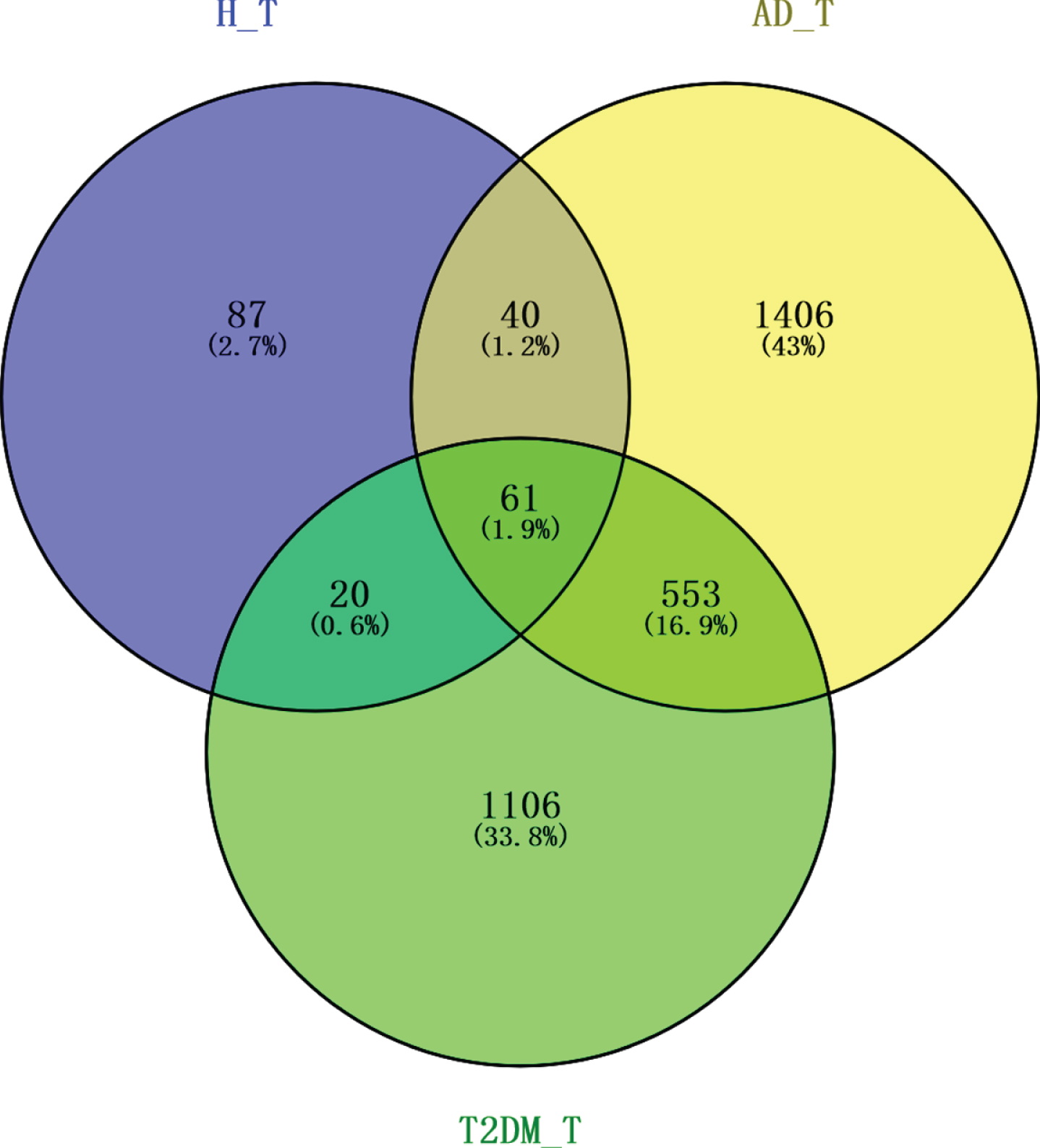
Targets’ intersection of 10 herbs, T2DM, and AD (The blue circle represents targets of 10 herbs, the green circle represents T2DM-related targets, the yellow circle represents AD-related targets).
Network of herb-active ingredient-common target
To further comprehensively understand the as-sociations among herbs, active ingredients, and dise-ase-related targets, we established an herb-active ingredient-common target network as shown in Fig. 2. The network contained 10 herbs, 275 active in-gredients, and 61 common targets. It was obvious that one target was regulated by multiple compo-unds and one compound also interacted with multiple targets. This network revealed that components such as poricoic acid C (degree = 9), α-amyrin (degree = 8), dehydrotanshinone II A (degree = 8), miltionone II (degree = 8), glycyrol (degree = 8), and worenine (degree = 8) were the high-degree ingredients and that targets such as TTR (degree = 130), VDR (degree = 87), RBP4 (degree = 75), SHBG (deg-ree = 57), and BACE1 (degree = 56) were the high-degree targets. We speculated that the high-degree ingredients involved in the treatment of T2DM and AD. For this reason, the compounds with degree ≥5 were selected as the representative ingredients for further molecular docking research. Notably, net-work analysis showed that 154 representative ingredients were mainly from Danshen, Gancao, and Shanyao.
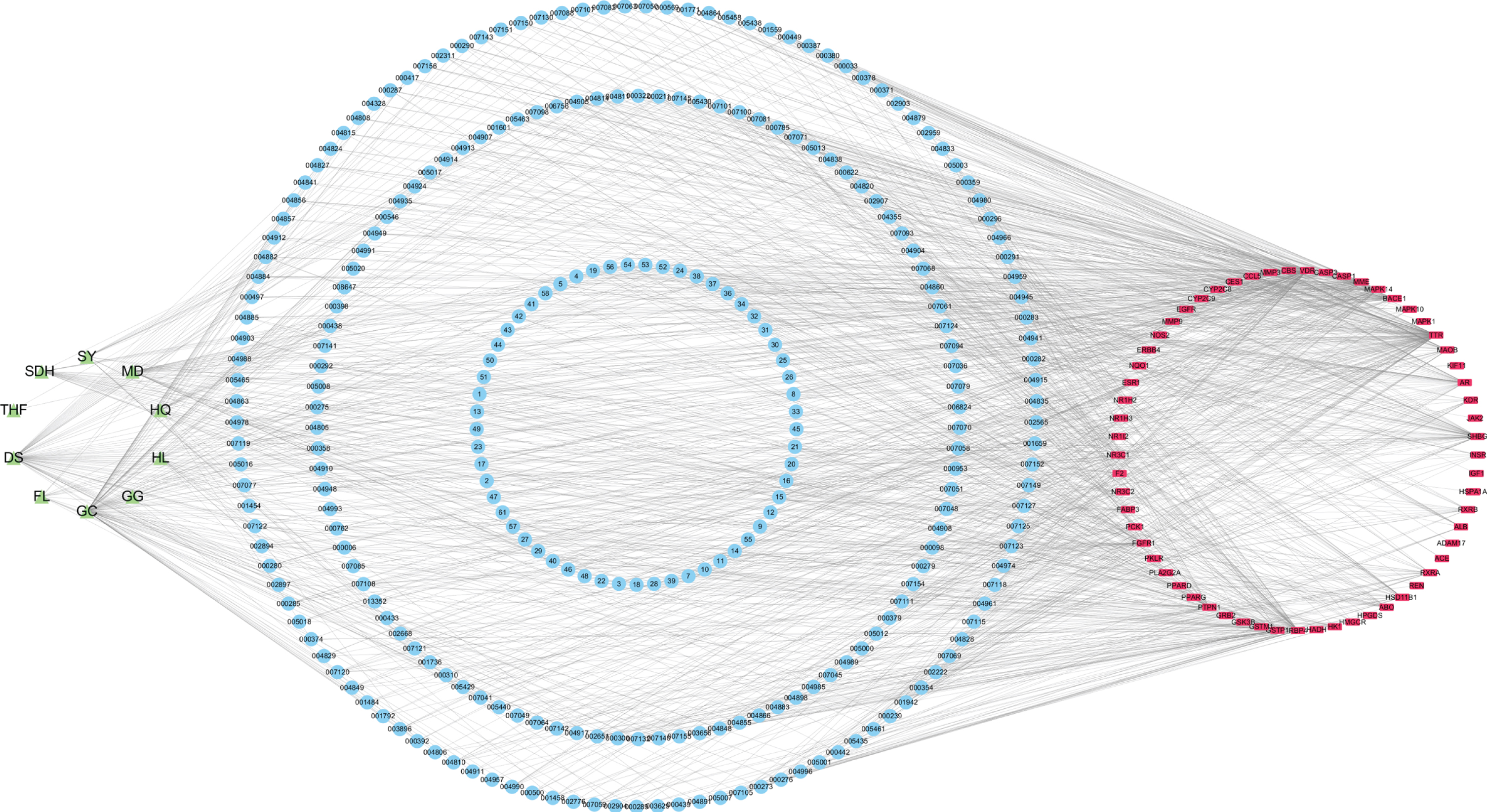
Herb-active ingredient-common target network (Green triangles represent 10 herbs, blue circles represent active ingredients from 10 herbs, and red rectangles represent common targets of active ingredients, T2DM, and AD).
PPI network
To further comprehend protein-protein interactions, based on the STRING database, a PPI network comprising of 61 common targets was constrsucted and finally visualized by Cytoscape. As shown in Fig. 3, the higher the degree value, the darker the color, the larger the node. The threshold value was degree >12.9, and 26 key targets were further scr-eened, including ALB, MAPK1, IGF1, CASP3, EGFR, ESR1, PPARG, MMP9, KDR, ACE, MAPK14, AR, NR3C1, HPGDS, JAK2, GRB2, REN, GSK3B, PTPN1, RXRA, PCK1, F2, CYP2C9, ADAM17, MMP3, and CCL5 (Table 2). These 26 targets were located in the cores of the PPI network and could be regarded as valuable targets for active ingredients against T2DM and AD.

The PPI network for the identification of key targets (the larger the node, the deeper the color, representing the greater the degree of the node).
Summary information of 26 key targets, their corresponding uniprot ID, gene symbols, and degrees of correlation with proteins
GO and KEGG pathway enrichment analysis
GO and KEGG enrichment analyses were performed to verify the effectiveness of common targets in the treatment of T2DM and AD. The most notable biological functions of the targets were nuclear receptor activity, regulation of hormone levels, muscle cell proliferation, monocarboxylic acid metabolic process, regulation of phosphatidylinositol 3-kinase signaling, response to lipopolysaccharide, response to peptide, reproductive structure develop-ment, regulation of cytokine-mediated signaling pat-hway, striated muscle cell proliferation, response to acid chemical, lipid transport, reactive oxygen spe-cies metabolic process, alcohol metabolic process, epithelial cell proliferation, monocarboxylic acid binding, cofactor binding, glucose metabolic process, response to toxic substance, amyloid-beta metabolic process, and so on (Fig. 4A). To further analyze the relationships between the terms, a subset of enriched terms was selected and presented as a network map. Enriched terms with similarities > 0.3 were regarded as a cluster and connected by edges. The nodes represented enriched terms that were colored by cluster ID as shown in Fig. 4B. And enriched terms were also colored by p-value (Fig. 4C), the deeper the color, the smaller the p-value.
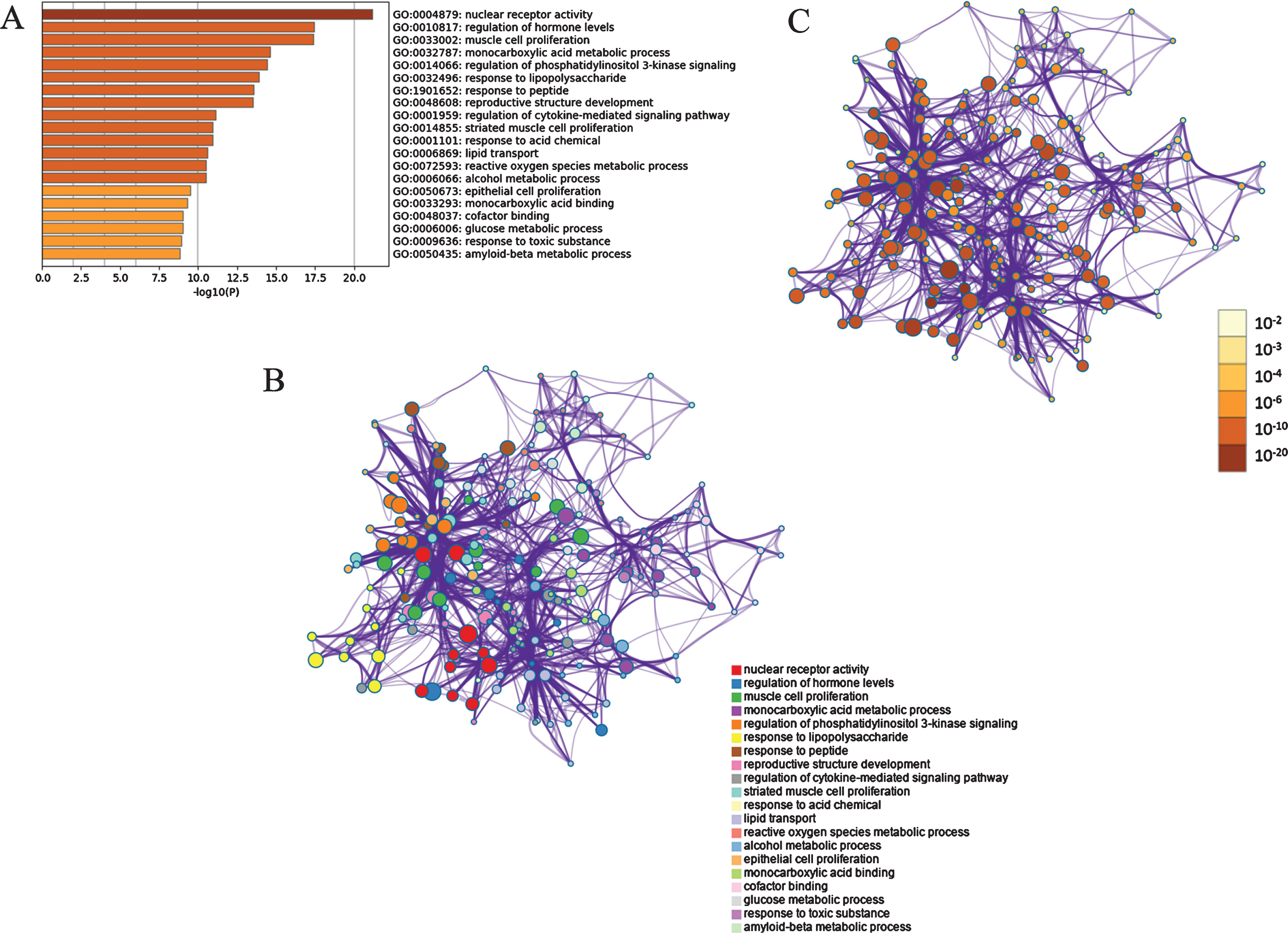
GO terms enrichment analysis of common targets. A) The most 20 notable biological functions of common targets, B) Enriched terms with similarity > 0.3 are regarded as a cluster and colored by cluster-ID, C) Nodes represent enriched terms that are colored by p-value. The deeper the color, the smaller the p-value).
The active ingredients of the 10 herbs might exert therapeutic effects on T2DM and AD through multiple signaling pathways according to the KEGG en-richment analysis. The most significant biological pathways were pathways in cancer, proteoglycans in cancer, insulin signaling pathway, endocrine res-istance, PPAR signaling pathway, influenza A, drug metabolism-cytochrome P450, fluid shear stress and atherosclerosis, HIF-1 signaling pathway, Alzhei-mer’s disease, serotonergic synapse, renin-angiot-ensin system, amyotrophic lateral sclerosis (ALS), endocytosis, and so on (Fig. 5). The targets involved in the regulation of these signaling pathways were shown in Fig. 6.
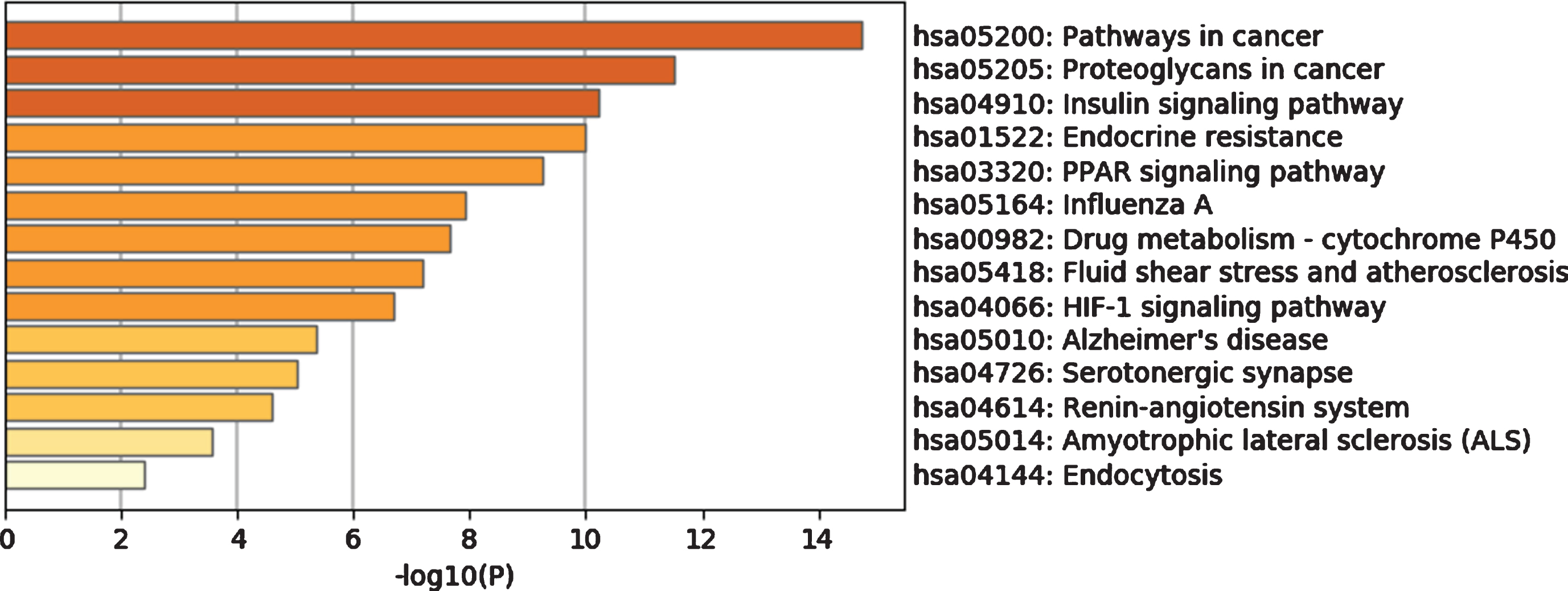
The most 14 notable pathways of KEGG terms enrichment analysis (the y-axis shows significantly enriched pathways of common targets and the x-axis shows the -log10(p) values of these pathways).
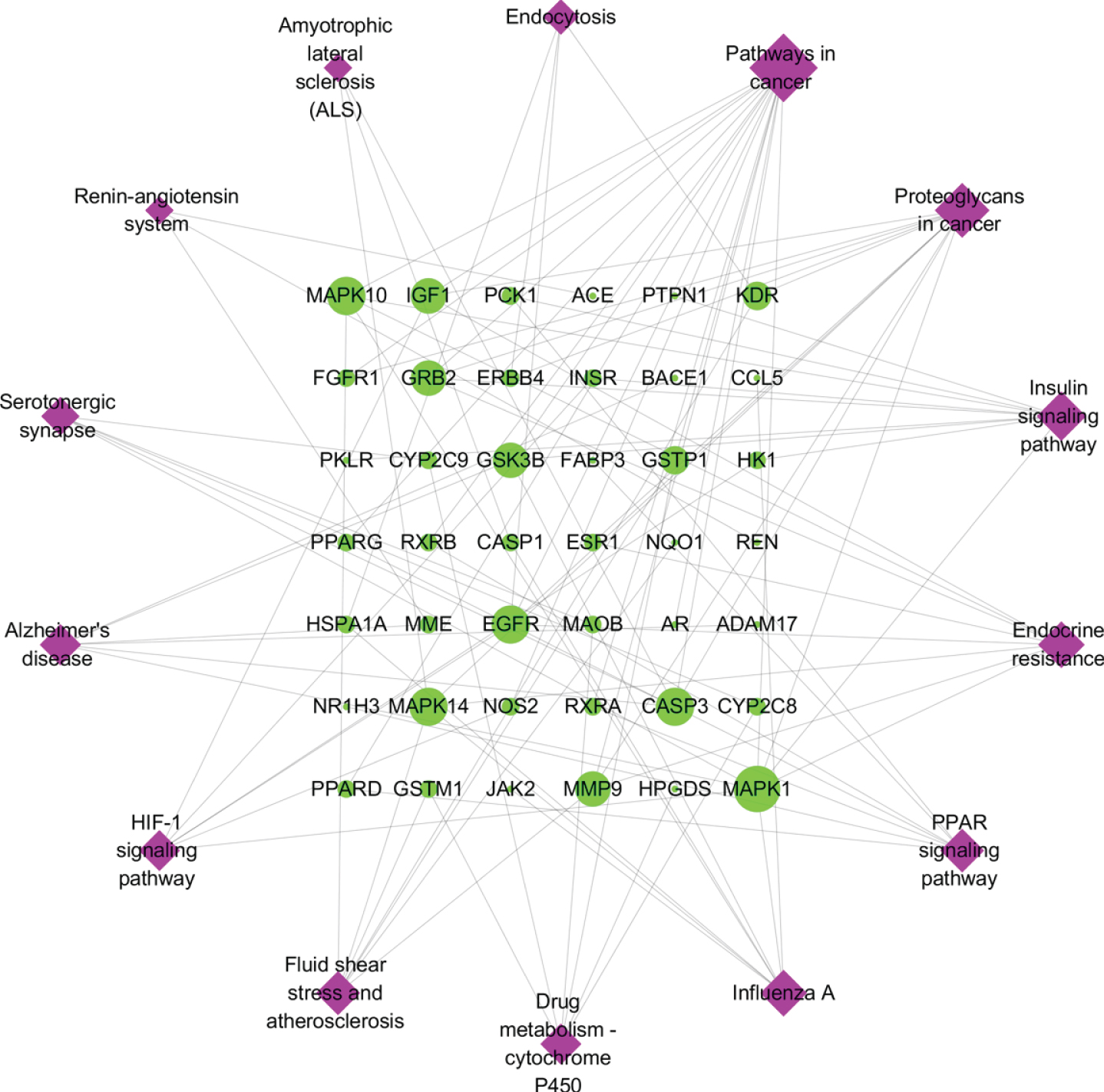
Target-pathway network (green circles represent the targets, purple diamonds represent significantly enriched pathways, nodes sizes are proportional to their degrees).
Virtual screening of ingredients
MAPK1, PPARG, BACE1, GSK3B, and NR3C1 were selected for molecular docking with 154 representative ingredients based on the key targets, pat-hways analysis, and research of T2DM drugs against AD. Corresponding protein receptors were constr-ucted to screen multi-target therapeutic constituents. Several natural compounds with high binding affinity to multiple targets have been discovered, including salvianolic acid J, gancaonin H, gadelaidic acid, icos-5-enoic acid, sigmoidin-B, and so on, as shown in Table 3. As an example, salvianolic acid J was successfully docked with the five targets and possessed high docking scores (Fig. 7).
Docking scores of top 5 natural compounds binding with BACE1, GSK3B, PPARG, MAPK1 and NR3C1
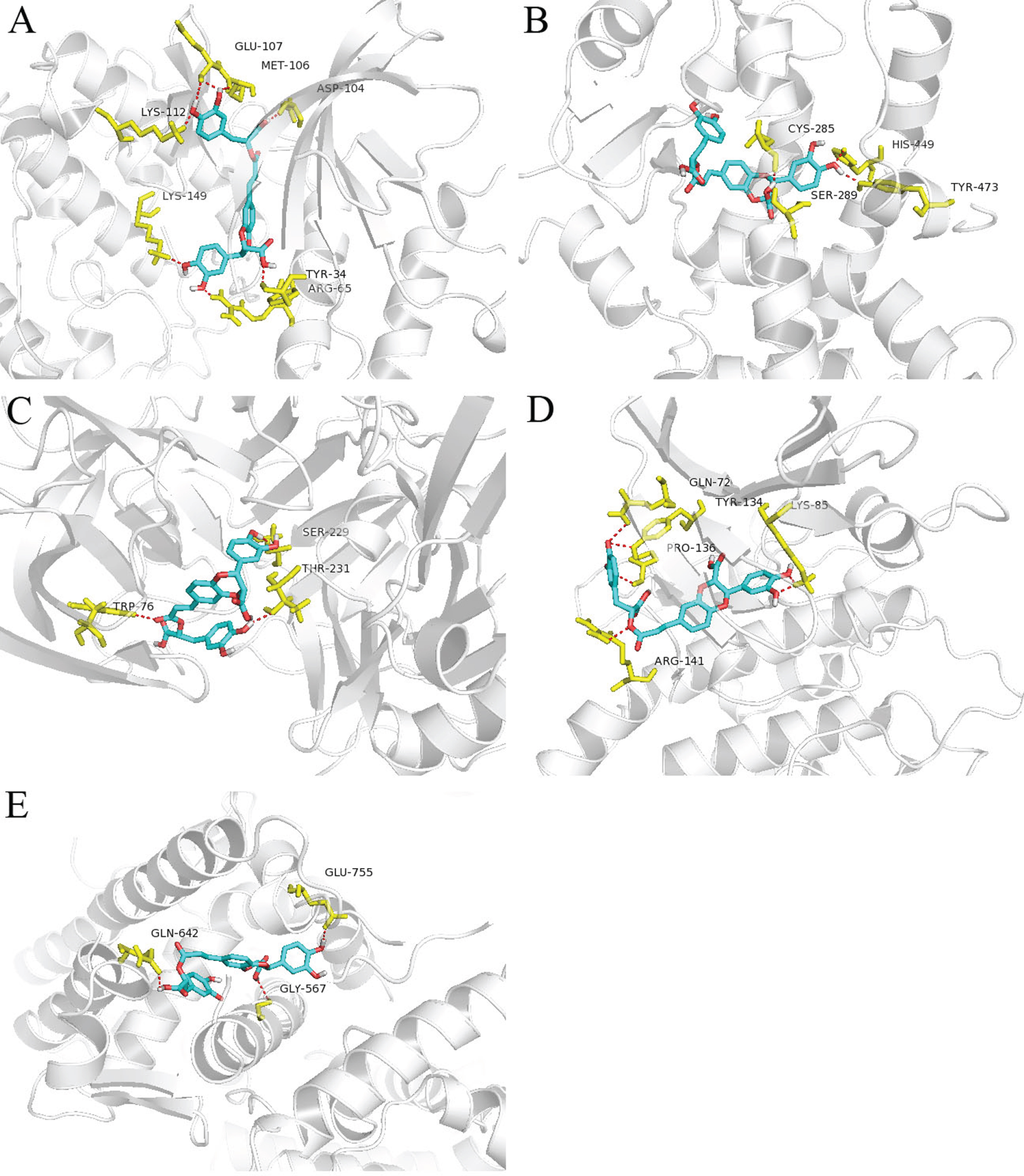
Molecular docking modes of salvianolic acid J with five potential targets. Salvianolic acid J binds to MAPK1 (A), PPARG (B), BACE1 (C), GSK3B (D), and NR3C1 (E).
DISCUSSION
As two prevalent diseases threatening public health worldwide, the screening of drugs for the cotreatment of AD and T2DM has gained much attention. In this work, we collected 263 T2DM-related TCM prescriptions and analyzed the 10 most frequently used single herbs. Also, 61 common targets were identified to be shared between targets of active ingredients, T2DM, and AD, and 154 compounds with high relevance to these targets were defined as representative ingredients with therapeutic effects. The common targets might be targets for herbs to exert therapeutic effects, which were involved in regulating multiple pathways related to T2DM and AD. The results of pathway enrichment analysis showed that these common targets were enriched in multiple biological pathways related to T2DM and AD, including insulin signaling pathway, PPAR signaling pathway, AD, and so on. Previous studies have reported that impaired insulin signaling and insulin resistance were common pathological features of T2DM and AD [25]. It is well known that one of the major downstream pathways of insulin receptor substrate proteins is the PI3K/AKT cascade, which regulates multiple downstream pathways, including mTORC1, GSK3B, and the FoxO family of transcription factors [26]. Impaired PI3K/AKT signaling pathway led to the activation of GSK3B activity, while excessive activation of GSK3B would increase the production of Aβ and the phosphorylation of tau [27]. In addition, the activation of the PPARG signaling pathway improved the spatial learning and recognition impairments in AD and T2DM mice [28].
According to the topological analysis of PPI, we further found the 26 key targets from the 61 common targets for subsequent study. Based on the key targets, pathways analysis, and related researches of T2DM drugs against AD, five potential therapeutic targets were selected for virtual screening, including MAPK1, PPARG, GSK3B, BACE1, and NR3C1. MAPK1 is a significant element of the ERK signaling pathway. Inhibition of ERK activity reduced the production of microglial neuroinflammatory molecules, such as interleukin (IL)-1beta [29]. Meanwhile, reduced activation of the ERK signaling pathway was also a novel therapeutic strategy against insulin resistance and T2DM [30]. PPARG agonists such as thiazolidinediones were widely used to treat T2DM and could effectively control blood glucose, enhance insulin sensitivity, and restore pancreatic β-cell function [31]. Moreover, clinical studies have indicated that PPARG agonists decreased AD-related pathological changes, such as lipid metabolism disorders, inflammation, and oxidative stress [32]. GSK3B is a key enzyme involved in many cellular functions, and the overexpression of GSK3B contributed to the increase of blood glucose, insulin deficiency and insulin resistance [33]. Besides, excessive activation of GSK3B in mice promoted hyperphosphorylation of tau protein, neuronal death, reactive astrocytosis, and cognitive disorder [34]. BACE1 inhibitors have also been shown to possess the potential against AD by reducing Aβ burden in the brain [35]. NR3C1 encodes glucocorticoid receptor, the excessive activation of which would induce AD-like changes in the brain. Moreover, increased glucocorticoid levels have been observed in both AD and T2DM patients [36, 37]. Further studies in AD mice demonstrated that targeting glucocorticoid receptors could prevent amyloid lesions, ameliorate inflammatory responses and cognitive function, indicating that glucocorticoid receptor was a promising target for AD treatment [38, 39].
Certainly, the limitations of the present study need to be noted. Only five targets were selected as the screening models, which meant that we might miss some candidate targets. Besides, the inhibitory effects of multi-target ingredients were estimated by virtual screening and were worthy of further experimental studies.
CONCLUSIONS
In summary, by using network pharmacology and virtual screening technology, the present study ado-pted a novel approach for discovering Chinese herbal medicines and multi-target therapeutic ingredients against T2DM and AD from T2DM prescriptions. Ultimately, several natural compounds were identi-fied as potential drug candidates against T2DM and AD, including salvianolic acid J, gancaonin H, gadelaidic acid, icos-5-enoic acid, and sigmoidin-B. Notably, representative ingredients with high relevance to the overlapped targets between T2DM and AD, and natural compounds with high binding affinities to five therapeutic targets were both chiefly originated from Danshen, Gancao, and Sha-nyao. Hence, the present study suggested that Dan-shen-Gancao-Shanyao might be a promising TCM combination for the cotreatment of T2DM and AD, and encourage further studies in the future.
