



Abstract
Background:
Cognitive decline is classically attributed to organic causes such as dementia; however, depression can play a role in cognitive decline.
Objective:
To evaluate cognitive screening tools and the 4-item Geriatric Depression Scale (GDS-4) for use in primary care to distinguish cognitive decline secondary to depression.
Method:
Clinical data collected over 2.5 years for assessed patients in a secondary clinical service for younger adults. Cognitive screening tools (General Practitioner Assessment of Cognition, Addenbrooke’s Cognitive Examination-III, Rowland Universal Dementia Assessment Scale, Salzburg Dementia Test Prediction) and GDS-4 were analyzed for their accuracy to differentiate patients with cognitive decline due to depression from those with subjective cognitive complaints.
Results:
180 young adults seen in a memory clinic setting (< 65 years) were included. These individuals either had a diagnosis of depression (n = 46) or no cognitive impairment on assessment (n = 134) despite having subjective cognitive complaints. All used cognitive tools had poor accuracy in differentiating cognitive decline secondary to depression from subjective cognitive complaints. The GDS-4 alone, however, was able to differentiate with high accuracy (AUC = 0.818) individuals who had cognitive problems secondary to depression.
Conclusion:
Cognitive screening tools used alone are ineffective in discriminating cognitive decline secondary to depression. Incorporating the GDS-4 into the screening process by primary practitioners could facilitate early identification and treatment of depression in younger people, avoiding unnecessary referrals memory services.
INTRODUCTION
Many of younger people presenting with memory complaints in primary care would have functional cognitive impairment (FCI). This is defined as complaints about memory function or another cognitive process in the absence of relevant neuropathology and with evidence of inconsistency between symptoms reported and signs identified at assessment [1]. FCI is most frequently associated with depression and anxiety, with suggestions of a linear association of severity of depression and FCI [2]. Further to this, research focusing on neuroscience models and physiological changes on cognitive decline in depression shows changes in orbitofrontal cortex and hippocampus [3, 4] in people with depression.
While young onset dementia incidence continues to increase [5, 6] and depression remains more prevalent in the 16–64 age group [7], it is increasingly important for clinicians to differentiate FCI secondary to depression from young onset dementia. With misdiagnosis rates of 30–50% for young onset dementia [8] and increasing number of referrals to memory assessment clinics [9], it is becoming important to understand how effective the currently used screening cognitive tools are in identifying cognitive disorders in young people presenting with depressive symptomatology, and whether depression screening tools need to accompany them to improve the depression diagnosis in younger people.
Depression affects approximately 1 in 5 individuals within the UK population [10]. However, the severity of the condition manifests differently with some experiencing cognitive symptoms. In terms of cognitive disorder in depression, evidence suggests significant correlations between depression severity and cognitive performance [11], specifically a decline in episodic memory, executive function, and processing speed [12]. This strong connection between depression and cognitive decline makes it important for clinicians to understand how cognitive tools reflect the cognitive disorders in depression and how to distinguish between them.
Primary care is traditionally the first point of contact when service users have a mental health problem, including memory complaints. The increased rate of referrals from primary care to memory assessment clinics [8] indicates there is an increasing need for clinicians to refer adequately to offer timely treatment to ensure resources are being optimally utilized [11]. Various tools have been recommended by the National Institute for Health and Care Excellence (NICE) (2018) including the General Practitioner Assessment of Cognition (GPCOG), 6-item Cognitive Impairment Test (6CIT), Memory Impairment Screen, Test Your Memory, and Mini-Cog to identify a cognitive decline prior to referral [13]. These tools tend to focus more on identifying cognitive decline for a dementia diagnosis. Still, they have not been evaluated to identify cognitive decline secondary to depression, especially not in younger, working-age adults. NICE guidance (2018) [13] further suggests that all reversible causes of cognitive decline such as depression need to be assessed before referral to specialized secondary care memory services. If the effectiveness of cognitive screening tools in the context of FCI can be identified, it may help clinicians to interpret these findings more effectively and help determine the best referral pathway, i.e., memory clinic, mental health services or treatment be initiated in primary care setting.
In this study, we analyze the referrals to a memory service setting for young people who did not reach the diagnosis of dementia and the accompanying cognitive assessments they had versus their final clinical diagnosis of FCI, i.e., depression. Based on this, we suggest to primary care to improve the timely diagnosis and treatment of functional disorders, especially depression.
METHODS
Patients
Data was collected from patients referred to sec-ondary care memory services for younger people (< 65 years) over 2.5-year period (01/09/19 to 28/02/21). Out of the total 348 referrals, following a full cognitive assessment undertaken by two senior consultant psychiatrists (EBM-L and MC), 243 (69.8%) patients did not receive the dementia diagnosis. Thus, 180 (51.7%) patients of the non-dementia group formed the data analyzed for this study. This group consisted of individuals with FCI due to depression and a control group of those assessed to have normal cognitive function despite having subjective cognitive complaints. The remaining 63 (18.1%) of patients were not included due to their cause of FCI being due to less common causes such as anxiety, bipolar disorder, post-traumatic stress disorder, learning disability, and malingering. Of the 180 patients analyzed, the majority of the referrals were from primary care (n = 158, 87.8%), and the remaining were referred directly from secondary services (n = 22, 12.2%), including services such as adult mental health services and other specialties (e.g., respiratory medicine).
The 180 patients consisted of 91 (50.6%) males and 89 (49.4%) females and had a mean age of 58.2 years (table 1). 114 (63.3%) were white British and the remaining had ethnic minority backgrounds, including 59 South Asians (32.8%), 1 Black-African (0.6%), 1 Caribbean (0.6%), and 5 with any other white background (2.8%).
Patients’ Characteristics. ANOVA analysis
ACE-III, Addenbrooke’s Cognitive Examination-III; GPCOG, General Practitioner Assessment of Cognition; RUDAS, Rowland Universal Dementia Assessment Scale; SDTP, Salzburg Dementia Test Prediction; SDTP_MMSE, Salzburg Dementia Test Prediction converted to Mini-Mental State Exam; GDS-4, 4 item Geriatric Depression Scale.
The study had institutional LPT NHS Trust Quality Improvement Committee approval.
Depression diagnosis
Statistical Manual of Mental Disorders 5 (DSM-5) criteria was used as a framework to support the diagnosis of depression [14]. Of the 180 patients where there was a clinical suspicion of depression, the consultation focused on eliciting ‘core’ symptoms (i.e., depression mood or loss of interest and pleasure) and associating symptoms (i.e., appetite changes, fatigue, worthlessness, guilt, lack of concentration, and suicidal ideations) to diagnose depression [14].
The GDS-4 tool [15] was used on patients with clinical suspicion of low mood (n = 62). This tool was used as a supplementary tool to help support diagnosis.
FCI clinical criteria
We considered a functional cognitive disorder only if memory symptoms were in the context of depression since this was the largest group of FCI in our analyzed group of patients (n = 46) with FCI due to other causes excluded. The rest of the patients (n = 134) did not fulfill the criteria below and served as a cognitively intact control group. FCI was defined based on core clinical features of the functional cognitive disorder [16]: One or more persistent cognitive symptoms that are distressing and/or cause significant impairment in day-to-day functioning; Inconsistencies between self-reported symp-toms and everyday functioning/neuropsycho-logical test results; Symptoms are not better explained by another neurodegenerative, neurological, general medical or mental health condition.
Data collection
Data was collected from an NHS Trust electronic patient record system RIO (until 31/11/20) and SystmOne (01/12/20 and onwards). Data collected provided by the referrer consisted of cognitive screening tool used and the obtained score. The memory clinic data were scores on cognitive tools (i.e., Addenbrooke’s Cognitive Examination-III (ACE-III), Rowland Universal Dementia Assessment Scale (RUDAS), etc.) used to assess patients further. Additionally, data on demographics, including age, gender, ethnicity, and educational background, was also available. Neuroradiological assessments (MRI or FDG-PET brain scans) were utilized to aid the formulation of the clinical diagnosis as established by the Memory clinic physicians (i.e., dementia, FCI, etc.).
Cognitive screening tools
Data from toolkits such as the GPCOG (n = 103, 57.2%), Mini-Mental State Exam (MMSE; n = 13; 7.2%), 6CIT (n = 6, 3.33%), RUDAS (n = 4, 2.2%), and Montreal Cognitive Assessment (MoCA n = 2, 1.1%) was collected. Primary care physicians administered the majority of these screening tools; only 3 of the referrals (2 MMSE and 1 MoCA) were conducted by secondary care team members. Out of the 180 referrals, 52 patients (20.6%) either had no information accessible or had no screening tool conducted by the referrers. For the purpose of this study, the 6CIT, MMSE, and MoCA were not analyzed due to a very small minority of patients having these screening tools conducted by the referrer.
Within the memory clinic, further cognitive tools were used: ACE-III, with all sections including attention, memory, fluency, language, and visuospatial assessed and recorded (n = 153), Mini Addenbrooke’s Cognitive Examination (Mini-ACE; n = 4), Salzburg Dementia Test Prediction (SDTP; n = 114), MoCA (n = 1), and RUDAS (n = 38). Some patients had one or more tools used during the consultation. Additionally, the MoCA and Mini-ACE did not form part of the analysis due to a small minority of patients having these tools performed on them. ACE-III was prioritized, but if this was not successful or other tools were deemed more effective (e.g., RUDAS for lower educational patients), alternative screening tools were attempted in place. The SDTP scores (day of the week, year and spelling W-O-R-L-D backwards enabling patients to gain a total score out of 7) were converted into an MMSE score [9]. 5 patients did not have any form of screening: for two patients, cognitive assessment was abandoned due to anxiety, one patient had the assessment completed prior to referral, one patient refused, and another one was too tired to complete the testing.
Depression screening tool
The GDS-4 [15] was used in 62 (34.4%) of the analyzed patients. This tool was scored on four questions, with a cumulative score of 0 implied no depression, 1 implied being unsure, and a score of 2 or greater implied likely depression [17].
Analysis
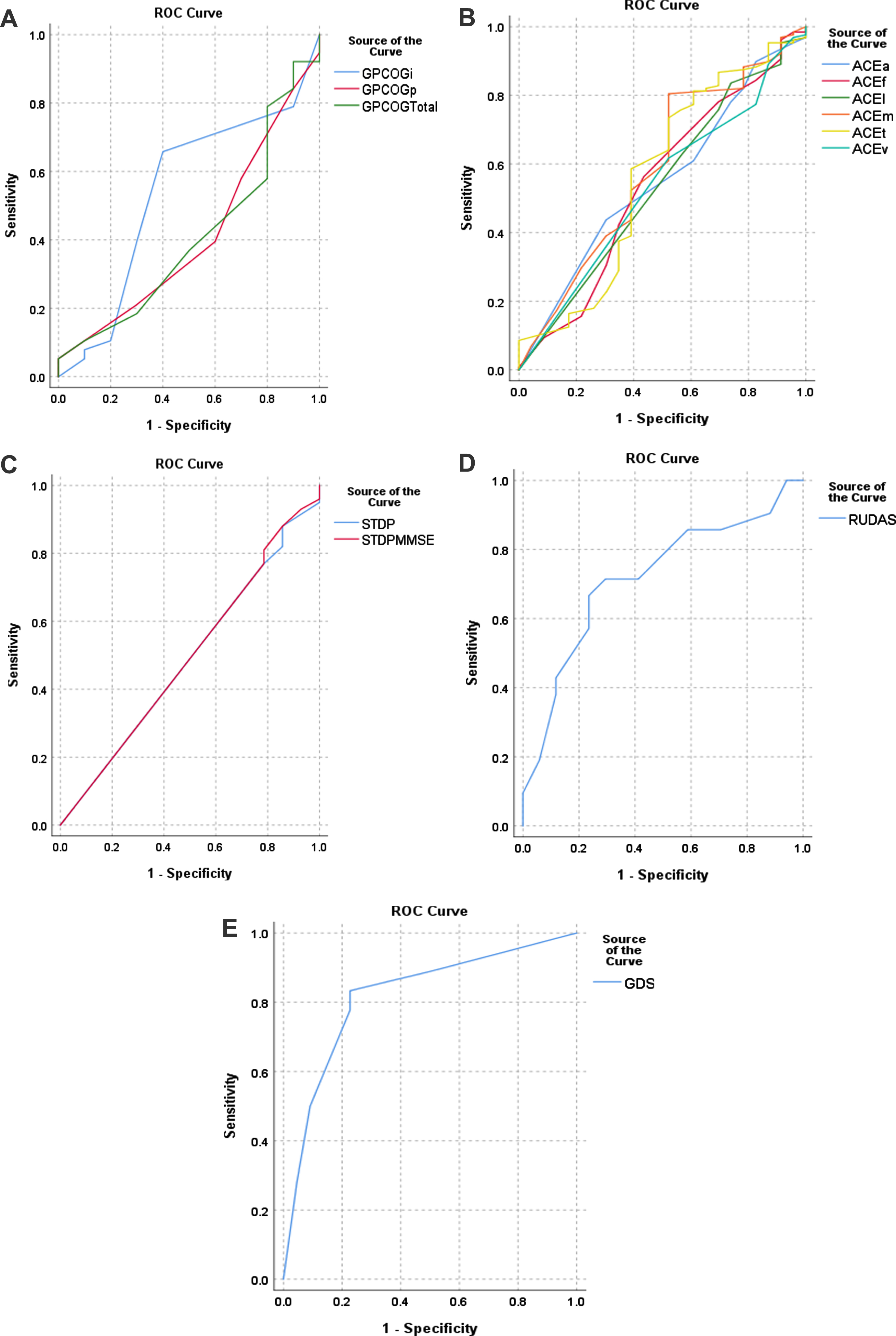
SPSS v26 was used to conduct statistical analysis providing standard descriptive statistics (e.g., mean, median, standard deviation (SD), and frequency) and receiver operating characteristic (ROC) analysis, to determine the accuracy of the referral tool(s) in relation to FCI in depression. The accuracy was classified according to the traditional point system: 0.90–1.00 –excellent; 0.80–090 = good; 0.70–0.80 = fair/acceptable; 0.60 = 0.70 = poor; 0.50–0.60 = fail; < 0.50 = no discrimination [18], with ROC curves with an area under the curve (AUC) < 0.75 being considered not clinically useful [19]. The interpretation of statistical inference from the data analyses were set at the 5% significance level.
RESULTS
From the 180 patients, 134 (74.4%) had subjective memory complaints, not related to functional cognitive impairment due to depression and formed the control group. 46 (25.6%) patients had a new diagnosis of depression and formed the FCI secondary to depression group. Neuroradiological assessments (MRI or FDG-PET brain scans) were used to support diagnosis of subjective cognitive complaints due to other causes rather than FCI due to depression. Patients who had no morphological and/or functional changes and did not meet DSM-V criteria for depression formed the control group. The FCI secondary to depression group was formed as they fulfilled the DSM-V criteria and additionally, had no neuroradiological changes. Individuals with morphological and/or functional changes on neuroradiological assessment were excluded from the study due to their subjective cognitive complaints being due to an organic cause or FCI due to causes other than depression.
Within the data set of 180 patients, there was no variations in respect to patients’ age (F = 3.182 p = 0.076), duration of their subjective memory symptoms (F = 0.038, p = 0.845) and their education level (F = 2.167 p = 0.143) between the individuals with depression in comparison to the control group (Table 1).
Cognitive screening tools
All the screening tools had poor accuracy in discriminating between FCI due to depression and the control group (Tables 1 and 2). Thus, the GPCOG tool performed poorly, with the GPCOG informant section performing the best but had poor accu-racy of discrimination (AUC = 0.541). Additionally, the total section (AUC = 0.408) and patient section (AUC = 0.411) showed no discrimination (Table 2). The ACE-III, both total and individual subscales, was, similarly, unable to differentiate between the two analyzed groups with good accuracy. The ACE-III memory sub-section (AUC = 0.587) performed slightly better than the other subsections of attention (AUC = 0.551), fluency (AUC = 0.542), language (AUC = 0.535), and visuospatial ability (AUC = 0.532). Additionally, the total ACE-III scores had a poor level of accuracy (AUC = 0.564) (Table 2). The SDTP (AUC = 0.490) and the MMSE SDTP (AUC = 0.495) provided the lowest ROC curve scores of all the cognitive tools we used, and were, again, unable to provide any discrimination between the groups (Table 2). The RUDAS (AUC = 0.718), however, was able to discriminate between the groups with a fair accuracy level, although the accuracy level was not AUC > 0.800.
Sensitivity and specificity, accuracy and cut off points of: GPCOG tool (including the total, patient, and informant section), ACE-III (including subsections of attention, memory, fluency, language and visuospatial), SDTP, SDTP converted to MMSE, RUDAS, and 4-GDS
AUC, Area Under the Curve; P, true positive; FP, false positive; FN, false negative; TN, true negative. Other abbreviations as in Table 1.
GDS-4 analysis
The GDS-4 scores were substantially higher in the depression compared to the control group (2.47 ± 1.31 and 0.86 ± 1.11; F = 24.06, p = 0.001). The ROC analysis showed that the 4-GDS was able to distinguish FCI due to depression very well from the control group with an AUC of 0.818 (Table 2).
DISCUSSION
Within this study, we focused on the effectiveness of cognitive tools being able to discriminate FCI due to depression against a control, cognitively intact group. The analysis showed evidence that cognitive assessment and screening tools used were ineffective in distinguishing a FCI due to depression in younger people with suspected dementia. The AUC analysis for all cognitive tools either provided a score with no discrimination or poor accuracy. However, the RUDAS scale performed better than all others, but the AUC score did not provide a high level of accuracy.
A previous study used cognitive screening tools to distinguish between dementia and depression [20]. This study found sensitivity of 58% and specificity of 85% between dementia and depression, but dementia and the control had sensitivity and specificity of 83% and 85%, indicating the ineffectiveness of the screening tools to distinguish between dementia and depression. It is worth noting that in this study only cued recall was assessed for cognition and the study focused on older people, with an average age of 73 years. Although focusing on younger patients, our study further expands on this and shows that cognitive screening and assessment tools alone were unable to differentiate successfully between a control group and those with FCI due to depression.
Another study, using the ACE-R, found that the total ACE-R score and the memory and fluency subscales were able to distinguish between people with and without late onset depression [21]. A further study showed that people with late onset depression, specifically those with no history of previous depression, performed worse on the ACE-III [22]. However, our study suggests the contrary to this in a younger age group, as the ACE-III total and all subscales’ scores had poor discrimination between control and the depression group. However, it is worth noting that the memory (AUC = 0.587) subsection performed the best against all the other subsections, and the fluency (AUC = 0.542) subsection performed the third best with the attention subsection performing seconding best (AUC = 0.551).
Some studies suggested that due to depression there is an expectation for a decline in executive function, processing speed, and episodic memory [23–25]. However, the sub-sections in the ACE-III in our study do not support this, as the sub-sections were unable to discriminate the depressed group from the control group. The reason why the ACE-III may have not been able to discriminate between FCI and controls in our study and previous studies suggested may be due to the age of the patients. Our patients performed better in the ACE-III than expected and this is in agreement with a previous study that age was a predictor of performance and that all sub-sections of the ACE-III were influenced by age [4].
The GDS-4 had a high accuracy (AUC = 0.818) in identifying depression with average scores in depression (2.47±1.311) much greater than the control group (0.86±1.11). Although designed as a screening test for depressive symptoms in older adults [26], this brief scale showed to be able to successfully differentiate depressive symptoms in our younger patients. A further study screening for depression in acutely unwell older patients showed sensitivities and specificities of 72% and 90% respectively for the GDS-4 indicating its ability to identify depression accurately [27]. Another study, also conducted in older people, reported that individuals with Alzheimer’s disease dementia and no depression had a GDS score within normal range, whereas those who have FCI due to depression and no dementia tended to have a score implying a mood disorder [28].
A further study found that the GDS-4 had high sensitivity and specificity in identifying depression in physically unwell older patients [29]. Additionally, this study found that two GDS questions (‘Do you feel your life is empty?’ and ‘Do you feel happy most of the time?’) and asking, ‘Are you depressed?’ were sufficient to diagnose depression in older medically ill people, irrespectively whether they had dementia or not [29].’ In our study, we routinely asked our patients’ Are you depressed?’. However, this was not included in the analysis as it was not found suitable since the ethnic, cultural, and educational backgrounds may have played a role in the interpretation of the question. Literature suggests that emotions are seen as a weakness among people from ethnic minority background [30]. Interestingly, the GDS-4 question ‘Are you happy most of the time?’ was answered adequately by all patients. This would argue GDS-4 alone maybe better suited for a diverse clinical population, to avoid possible biases.
The high GDS-4 accuracy argues that this tool could be used for screening to help distinguish cognitive decline due to depression in young people. This will help primary physicians follow the NICE 2018 guidance [13], i.e., rule out depression before making a memory clinic referral and commence treatment in the community rather than requiring a secondary referral.
Limitations
Our study has some limitation. The GDS-4 was not used routinely within the memory clinic; it was used by one of the two psychiatrists and only used if suspicion of low mood. Euthymic patients during the consultations did not have the GDS-4 routinely performed, and this contributed to the specificity of the GDS-4 being only 0.277 as patients who were not clinically suspected to be depressed did not have the GDS-4 attempted. Additionally, this data set only focused on patients referred to the young onset dementia memory clinic and thus assessed in a secondary care environment. Therefore, this data set only consists of patients with suspected cognitive decline who were under 65 years.
Conclusion
We demonstrate that the current screening and assessment cognitive tools in primary and secondary care are not sufficient on their own to help differentiate between FCI due to depression and subjective memory complaints. This emphasizes the need of improving the routine cognitive screening, especially in primary care setting. Therefore, the addition of the GDS-4 in routine screening would provide an additional affective component to supplement the cognitive screening tools. The combination of the screening tools and the GDS-4 in primary care setting will help improve the diagnostic route to timely management of this condition and facilitate access to adequate mental health services, avoiding the (unnecessary) memory clinical route referrals.
