



Abstract
Background:
Considering the world’s rapidly increasing life expectancy, with people working and maintaining active lifestyles longer than ever before, addressing the effects of aging on cognition is of utmost importance. A greater understanding of cognitive aging may also be critical in distinguishing natural cognitive aging from pre-clinical stages of Alzheimer’s disease and related cognitive disorders.
Objective:
To systematically examine the association between aging and cognitive performance in a cognitively and otherwise healthy probability population-based sample using a computer-based method.
Methods:
This cross-sectional study enrolled 673 cognitively and otherwise healthy participants aged 25–89 years (mean age 52.3±14.2 years, 52.5% of whom were female) from the Kardiovize study cohort. Mild cognitive impairment and dementia cases were excluded, followed by measurement of cognitive performance with the computer-administered Cogstate Brief Battery. We used ANCOVA and Modified Signed-Likelihood Ratio tests to examine patterns of cognition across age groups.
Results:
We found a gradual decrease in cognitive performance across the lifespan, which required two decades to demonstrate significant changes. In contrast to attention and learning, psychomotor speed and working memory showed the most significant age-related decrease and variability in performance. The established pattern of cognitive aging was not altered by sex or education.
Conclusion:
These findings corroborate, validate, and extend the current understanding of natural cognitive aging and pinpoint specific cognitive domains with the most extensive age-related interindividual differences. This will contribute to the development of strategies to preserve cognition with aging and may also serve to improve early diagnostics of cognitive disorders using computer-based methods.
INTRODUCTION
Cognitive aging has continued to intrigue scientists for over a century [1]. As a result, there is a wealth of studies documenting the involvement of aging in cognition. These studies show that aging results in reduced psychomotor speed [2], decreased working memory [3] and other executive abilities [4], and reduced learning and memory [5, 6]. Although these studies demonstrate the age-dependent changes in a spectrum of cognitive domains [7], not all components constituting individual cognitive domains are equally affected by aging [8]. For example, while attention efficacy decreases with aging [9], the ability to modulate and divide attention remains preserved [10–12]. However, the interpretation of the results of these studies remains confounded by the methodological differences and lack of pre-screening for cognitive and general health [7, 14]. Therefore, the results of many of these studies encompass measurements of cognitive performance in participants with and without cognitive decline and other health issues. Considering many cognitive aging studies report data from historical cohorts [15, 16], there is a need to investigate the age-related cognitive changes in contemporary populations with an extending lifespan.
Existing studies about cognitive aging often only examine individual cognitive domains [12, 17], undertake very different sampling approaches [13], consist of small sample sizes [9] and narrow age ranges failing to reflect old age by contemporary standards [18], do not pre-screen for cognitive and general health [14], and are overwhelmingly based on pencil-and-paper experimental instruments [5]. There clearly remains a significant gap in understanding cognitive aging in the modern time. Several reasons make filling this gap in understanding cognitive aging of utmost importance. As the world’s population ages [19], people are working and maintaining active lifestyles significantly longer than ever before. Accordingly, it is imperative to understand whether aging impacts the natural evolution of cognitive performance throughout the lifespan to the extent that it hampers working and maintaining active lifestyles later in life. Appropriate interventions could equip people with the means to preserve cognition during aging [20]. Second, aging is the major risk factor for Alzheimer’s disease (AD) and other related disorders [21], with a wealth of data reporting pathological changes in cognitive disorders several years prior to their clinical onset [22]. These data are best encapsulated by the recent biological definitions of AD in its pre-clinical stages [23, 24]. Consequently, understanding cognitive aging is now more crucial than ever to distinguish natural cognitive aging from pre-clinical stages of AD [25]. A better understanding of cognitive aging will improve diagnostics and open new avenues in the therapeutics of cognitive disorders. This will be helpful in clinically phenotyping patients prior to starting therapies with emerging medicines against AD in the optimal timeframe of disease progression when cognition is either fully or nearly preserved [26]. To narrow this gap in our understanding of cognitive aging in contemporary populations, we here examine the effects of aging on cognitive performance systematically in a cognitively and otherwise healthy adult population-based sample using a computer-based instrument.
METHODS
Participants and study design
The Kardiovize study investigates health longitudinally in an epidemiological cohort based on a randomly selected 1% of the population of the residents of the city of Brno, Czech Republic [27]. A total of 848 out of 2,434 participants enrolled in the Kardiovize study completed cognitive testing. Data from 149 participants were excluded due to missing more than 10% of the demographic characteristics or incomplete cognitive testing results. The remaining 699 participants first completed an extensive general health questionnaire. None of the participants were excluded due to poor general health, defined as presence of severe chronic disorders, terminal illness or other conditions known to adversely affect cognitive performance. The participants were then screened for cognitive impairment, which identified 26 participants with cognitive impairment who were excluded from the study. Therefore, the final sample of this study consisted of 673 cognitively and otherwise healthy participants. To investigate the effect of aging on cognition, including calculating the time needed to record significant changes in cognition as a result of aging, we stratified participants into 25–39, 40–49, 50–59, 60–69, and 70–89 year-old age groups. Given that sex and education is known to be linked to cognition and differed among age-groups, they were included in the study as covariates to control for their effects on the results of cognitive testing. All the cognitive and other data obtained from the final sample of 673 participants in this study were entered into a validated web-based research electronic data capture (REDCap) database [28].
The research protocols of the study were approved by the Institutional Review Board and by the ethics committee of the St. Anne’s University Hospital, Brno, Czech Republic. All the participants of the Kardiovize study provided written and informed consent.
Measurements
To exclude participants with possible cognitive decline, including mild cognitive impairment (MCI) and dementia, we screened the sample using the Montreal Cognitive Assessment (MoCA) [29]. The MoCA total score ranges from 0 to 30, with a higher score indicating better cognitive performance. Validation of the Czech version of the MoCA showed that scores of <23 are consistent with MCI [30]. Therefore, all participants with scores <23 were excluded from the study.
To test the cognitively and otherwise healthy population-based sample for the effects of aging on cognitive performance, we used the well-established Cogstate® Brief Battery (CBB). CBB is a short version of the computer-administered cognitive test battery requiring roughly 10 min for administration [31–33]. It uses playing cards to examine four basic cognitive domains: visual attention, psychomotor speed, visual learning, and working memory. Attention and psychomotor speed were assessed by measuring the response time needed to correctly identify the red (attention) or detect a new playing card (psychomotor speed). The primary outcome of the attention and psychomotor speed measurements was the log10 transformed reaction time of correct responses in milliseconds (log RT (in ms)). Learning and working memory were assessed by measuring accuracy in recognizing a card previously seen in the deck (learning) or determining whether the new card is the same as the last one (working memory). The primary outcome of the learning and working memory measurements was the arcsine of the square root of the correct responses (arc). Both transformations (log and arcsine) help distinguish better smaller differences in scores and are directly built into the CBB software and applied automatically before the output file is provided. Mean log RT (in ms) of all four cognitive domains was used to calculate the global cognitive score. Sex was measured as a binary variable, while education was measured as an ordinal variable recording maximum formal level of education attained.
Statistical analysis
Descriptive statistics were performed on demographic variables. No missing values were detected. Demographic data were compared between sexes, age groups, and education using one sample χ2 test for categorical variables. The interactions between age, sex and education was examined also using χ2 test of independence. ANOVA and ANCOVA tests and Games-Howell post-hoc tests were performed to assess age-related differences in cognitive performance. Overall and pair differences in coefficients of variation were examined using the Modified Signed-Likelihood Ratio Test. Pairwise analyses were adjusted using Benjamini-Hochberg FDR correction for multiple comparisons. Any 2-sided p < 0.05 was considered statistically significant. Statistical analyses and data visualizations were performed using SPSS (version 21) and RStudio (v.1.4.1717, RStudio Inc.; R version 4.1.1, The R Foundation for Statistical Computing) using the cvequality (v.0.2.0), stats (v.3.6.2) and ggplot2 (v.1.0.12) packages.
RESULTS
This cross-sectional study examined a total of 673 participants: 353 (52%) were females, mean age (±SD) 52.3±14.2 years (Table 1). The study sample mean attention, psychomotor speed, learning and working memory scores (±SD), expressed either as logarithms of the reaction times measured in ms (log RT in ms) or as arcsines of the square roots of the correct responses (arc), equaled to 2.70±0.06 (log RT in ms), 2.54±0.11 (log RT in ms), 1.00±0.11 (arc) and 1.41±0.14 (arc), respectively. The mean global cognitive score (±SD) totaled 2.80±0.07 (log RT in ms) (Table 1).
Basic characteristics of the population-based sample
GCSE, General Certificate of Secondary Education. a The values are shown in the order “Without GCSE”, “With GCSE”, “University”. University education includes higher vocational school, bachelor, master, and doctoral degrees.
Measurements of age-dependent changes in cognitive performance found that mean scores of attention and psychomotor speed were significantly lower in the youngest compared with the oldest age group. More specifically, the mean attention scores (±SD) amounted to 2.67±0.05 and 2.72±0.05 (log RT in ms), while the mean psychomotor speed scores (±SD) equalled to 2.49±0.07 and 2.61±0.10 (log RT in ms) in the youngest versus the oldest age group, respectively. The mean scores for learning and working memory were significantly higher in the youngest compared to the oldest age group. The mean learning scores (±SD) amounted to 1.04±0.10 and 0.97±0.10 (arc) and for working memory to 1.45±0.12 and 1.35±0.18 (arc) in the youngest versus the oldest age group, respectively. In addition, the mean global cognitive score (±SD) averaged 2.76±0.05 and 2.84±0.07 (log RT in ms) in the youngest versus the oldest age group, respectively (Table 2, Fig. 1). These measurements showed significant differences between age groups in cognitive performance across all cognitive domains examined by the CogState test with psychomotor speed (p < 0.001, part. η2 = 0.112, medium effect) and global cognition (p < 0.001, part. η2 = 0.144, large effect) demonstrating the largest age-dependent difference requiring two decades to become significant (Supplementary Table 1). Sex and education, both interacted significantly with age (sex p = 0.007, education p < 0.001), however, adding them to the cognitive models collectively (Table 3) or separately (Supplementary Table 2) did not change the significance of the findings.
Average CBB-derived domain specific and global cognition scores in different age groups
Data are reported as mean±SD.

Distribution of Cogstate® Brief Battery-derived domain specific and global cognition scores in individual age groups. Frequency (y) was calculated using probability density function based on Kernel density estimation.
The association of age with the Cogstate® Brief Battery-derived domain specific and global cognitive performance
part. η2, partial Eta-squared. aANOVA tests were performed for comparison of means. bGeneral Linear Models (ANCOVA type) were performed for comparison of means while adjusting for the effect of sex and education.
Investigating age-related changes in variability of the domain specific and global cognitive performances (Fig. 2), we found that attention and learning maintained stable coefficients of variation throughout the age groups. In contrast, coefficients of variation of psychomotor speed initially increased and then plateaued in the older age groups (p < 0.001, Supplementary Tables 3 and 4), while coefficients of variation of working memory continued increasing also in the older age groups with a distinct rise in the oldest age group (p < 0.001, Supplementary Tables 3and 4). The coefficient of variation of global cognition also steadily increased in the older age groups (p = 0.011, Supplementary Tables 2 and 3).
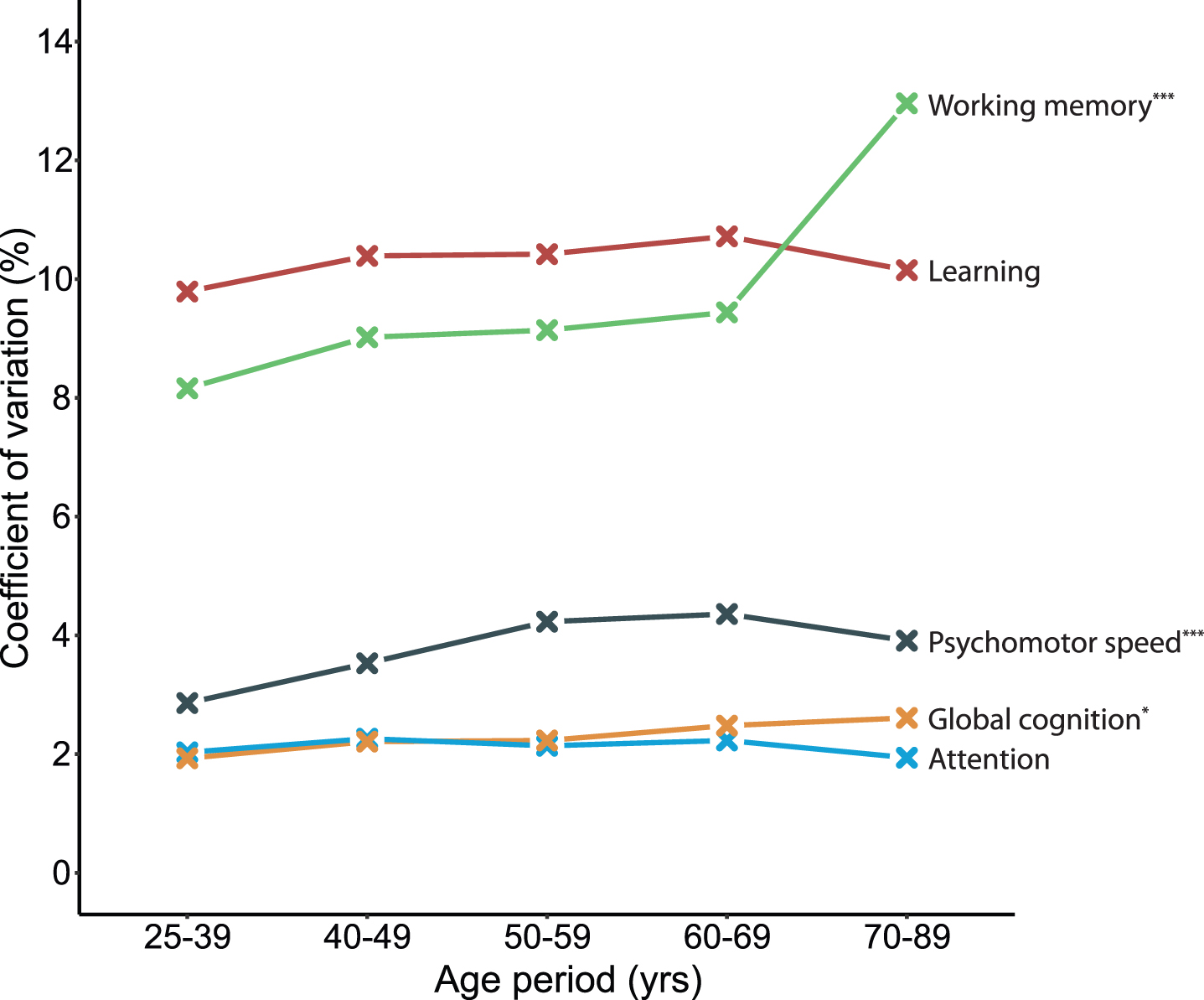
Coefficients of variation of Cogstate® Brief Battery-derived domain specific and global cognition scores in individual age groups. The p values were obtained from Modified Signed-Likelihood Ratio Test. Asterisks indicate significance of differences between age groups (*p < 0.05, ***p < 0.001).
DISCUSSION
In this study we investigated age-related differences in cognitive performance in a cognitively and otherwise healthy contemporary population-based sample using a computerized cognitive test. We found significant differences between age groups in all domain specific and global cognition measures. Our measurements showed significantly decreased values in cognitive performance every two decades throughout the age groups. These findings indicate that age-related cognitive changes are a relatively slow process in a cognitively and otherwise healthy population, but begin as early as in midlife. The present study corroborates previous reports of age-dependent differences in attention [9], psychomotor speed [17], learning [5, 6], and working memory [3], validates the findings of these reports in a cognitively and otherwise healthy contemporary population-based sample and extends them by approximating natural cognitive aging using a modern computer-based instrument.
In addition, our study suggests that the variability in cognitive performance also increases with age. Such variability in the cognitive performance could suggest greater interindividual differences in cognition in older age. Intriguingly, the increase in variability of psychomotor speed eventually plateaued, which sharply contrasts with the significant increase in the variability of working memory in the oldest age group. Although attention and learning also demonstrated an age-dependent decrease in their performance, these cognitive domains showed no significant differences in their variability. This could be indicative of their relative preservation with aging compared to psychomotor speed and working memory. However, considering our study is cross-sectional, it does not provide a longitudinal follow-up to validate our hypotheses. Further studies with longitudinal follow-up are needed to examine age-related changes in cognitive performance and variability to underpin genetic and environmental elements contributing to the interindividual differences in cognition in older age.
In contrast to most previously reported studies, which investigate cognitive performance in different age groups using pencil-and-paper-based tools, either by brief screening tools such as the MoCA and MMSE [29, 34] or by more comprehensive tools such as the Wechsler Adult Intelligence Scale [35], we here used a modern computer-based instrument, the CBB. The emergence of new computer-based methods in the current rapidly evolving technological era offers new experimental and diagnostic possibilities, which may be better suited to test current and, in particular, future computer savvy generations compared to the currently established mainstream methods. Computer-based methods provide detailed and accurate measurement of the reaction time in the order of milliseconds [36, 37], which is not achievable with conventional pencil-and-paper methods. Such precise measurements significantly improve the testing of performance in different cognitive domains and their interactions. These novel methods also use the computational power of the testing device to obtain fast, error-free results and their summaries and allow for remote diagnostics, monitoring and the creation of networks of information about cognitive performance (normative databases, cross-cultural comparisons, etc.). In contrast to manually measured assessment of cognitive performances, computer-based methods provide more data, which are particularly amenable to novel mining approaches. Computer-base methods will undoubtedly contribute to the development of strategies designed to allow people to work and maintain proactive lifestyles longer than ever before. These methods will also improve diagnostics and assist in the therapeutics of AD and related disorders. For example, current clinical diagnostics of AD and related disorders are based on demonstrating cognitive deficits by using predefined cut-off points. Despite several practical advantages, this approach also has its shortcomings in that the cut-off points may not be accurate, can be confounded by language and cultural factors and subject to changes over time [38–41]. Furthermore, the cut-off points often reflect the overall score of the instrument, thus failing to capture changes in individual cognitive domains. Comparing individual to standardized cognitive aging profiles, in addition to screening for cognitive deficits using cut-off points, can improve diagnostics of cognitive impairment and the early detection of cognitive disorders. The development of novel therapies for AD [42] requires defining cognitive disorders early and with better certainty, and this can benefit from the thorough understanding of cognitive aging.
Limitations
Although cognitively and generally healthy, participants of our study sample are relatively highly educated compared to the general education level in the population, which may have affected measurements of cognitive performance [43, 44]. This higher average education is likely linked to the city-based nature of the study sample, and inclusion of a more diverse population might have led to slightly different results. However, the models adjusted for education showed stable and unchanged differences in cognition between the age-groups. On a separate note, given the generally low prevalence of diseases in the study population, it is also possible that good health positively affected the cognitive performance of older age groups compared to similarly aged non-participants with a higher prevalence of diseases. It is worth noting that the examined cognitive domains all demonstrated vulnerability to the adverse effects of aging and that different selection of examined cognitive domains, for example language, could well shed light also on relative strengths of cognitve aging. Finally, the cross-sectional nature of the data does not allow for causal inferences and longitudinal conclusions to be made.
Conclusions
We used a computer-based instrument to show that all cognitive domains undergo significant age-related changes in a cognitively and otherwise healthy population-based sample. We further show differential effect of aging on individual cognitive domains with psychomotor speed and working memory demonstrating the most extensive changes and interindividual differences. These findings corroborate, validate and extend previous studies on cognitive aging and contribute to the development of strategies that safeguard and preserve cognition during aging and allow more precise diagnostics of cognitive disorders.
Footnotes
ACKNOWLEDGMENTS
The study was funded by the European Commission: European Regional Development Fund and European Social Fund –Projects ENOCH (CZ.02.1.01/0.0/0.0/16_019/0000868) and MAGNET (CZ.02.1.01/0.0/0.0/15_003/0000492). The funding organizations had no role in the design and conduct of the study; collection, management, analysis, and interpretation of the data; preparation, review, or approval of the manuscript; and decision to submit the manuscript for publication.
